

In This Article
Learn how to effectively rebrand your startup by aligning your identity with growth goals and using AI tools for consistency and insight.
Updated:
Trusted by 1,000+ teams
Startups use Averi to build
content engines that rank.
Rebranding a startup isn't just about updating a logo or tagline - it’s about reshaping how your business is perceived to match its growth and future goals. Here’s what you need to know:
Why Rebrand? Your brand must evolve as your business scales. Outdated branding can confuse customers and hinder growth.
When to Rebrand: Rebranding makes sense if your current identity no longer reflects your mission, values, or market position.
Steps to Rebrand:
Evaluate Your Brand: Check for gaps between your mission and customer perception.
Define Your Identity: Clarify your mission, vision, and values to align with your goals.
Craft Messaging: Use customer data to create messages that resonate with your audience.
Launch the Rebrand: Roll out updates across all channels with a clear plan.
Track Results: Measure metrics like brand awareness, engagement, and revenue to gauge success.
Use AI Tools: Platforms like Averi AI streamline rebranding by analyzing your brand, refining messaging, and ensuring consistency.
Rebranding is a chance to align your startup’s identity with its growth. With the right approach and tools, you can create a brand that resonates with your audience and drives success.
Transforming a Business: How I Rebranded Using AI and Fiverr
Step 1: Deciding If You Need a Rebrand
Not every startup benefits from a full rebrand. Jumping into major changes too soon can drain resources and confuse your audience. The real question is whether your brand has become an obstacle to growth rather than just feeling a little dated. Sometimes, what seems like brand fatigue can be solved with a small refresh or a sharper messaging strategy.
A rebrand should address specific business challenges. If your current brand still communicates your value effectively, even if it feels a bit tired, it might make more sense to channel your resources into areas like product innovation or customer acquisition. Start by examining your brand's identity to uncover any disconnects between how your business operates now and how it’s perceived.
Finding Brand Identity Problems
Your brand identity isn’t just about logos or colors - it’s about your mission, values, personality, and how customers experience your company. Issues arise when there’s a gap between who your company truly is and how it’s presented to the world. Take a hard look at whether your brand still reflects your company’s current state.
When there’s a drift from your mission, it creates confusion - both internally and externally. If your daily operations, product offerings, and customer interactions no longer align with your stated mission and values, it’s a sign that your brand may need realignment to better represent your business.
Checking Market Perception
Internal evaluations are just one side of the story. It’s equally important to understand how your brand is perceived by others. Use customer surveys, interviews, and feedback sessions to uncover how people view your company and what they believe your core strengths are. Pay attention to whether the words they use match your intended messaging.
Social media and review platforms can also provide valuable, unfiltered insights. Comments on posts, discussions in industry forums, and reviews on sites like G2 or Trustpilot can reveal whether your positioning feels too generic or too similar to competitors.
Your sales team is another great resource. They interact with prospects daily and can shed light on recurring misconceptions about your brand. Additionally, conducting brand perception audits with both customers and non-customers can help you compare their views with your intended positioning. Addressing these gaps early ensures that any rebrand strengthens your business instead of creating confusion. Laying this groundwork sets the stage for a brand identity that aligns with your company’s goals and resonates with your audience.
Step 2: Creating Your New Brand Identity
Rebranding is more than just a cosmetic update; it’s about redefining who you are as a business - from your mission to the way customers interact with you. Your brand identity is the essence of your company, encompassing everything from your purpose to the experience you deliver at every touchpoint. This step is about clarifying what your business stands for and how you want to be seen in the marketplace.
Your new identity should reflect not just where your company has been, but where it’s headed. Think strategically about your long-term goals and ensure that every element of your identity aligns with that vision. This groundwork is essential for crafting a mission that resonates, aligning your team’s values, and positioning your business for future success.
Setting Clear Mission, Vision, and Values
At the heart of your rebrand are your mission, vision, and values. These guide every decision you make, shape your company culture, and influence how customers perceive you. Take a close look at your current mission and ask yourself if it still aligns with your operations and where you’re headed.
Your mission should clearly articulate the problem you solve and the impact you create. Avoid vague statements like “we help businesses succeed.” Instead, focus on the specific value you bring. A well-crafted mission should be so clear that a new employee or potential customer can immediately grasp what you do and why it matters.
Your vision, on the other hand, should paint a picture of the future you’re working toward - not just for your company, but for your industry as a whole. Think about the long-term changes you aim to drive and how your work might shape the market in the years to come.
Values are the principles that guide how your business operates. They should be more than just words - they need to be evident in your daily actions. For example, if transparency is one of your core values, it should show up in your pricing, communication, and customer interactions. Misaligned or hollow values can quickly erode trust with both employees and customers.
Once you’ve defined your mission, vision, and values, test them with key stakeholders. This can help you identify any gaps between how you want to be perceived and how others currently see you.
Using Averi AI for Brand Analysis
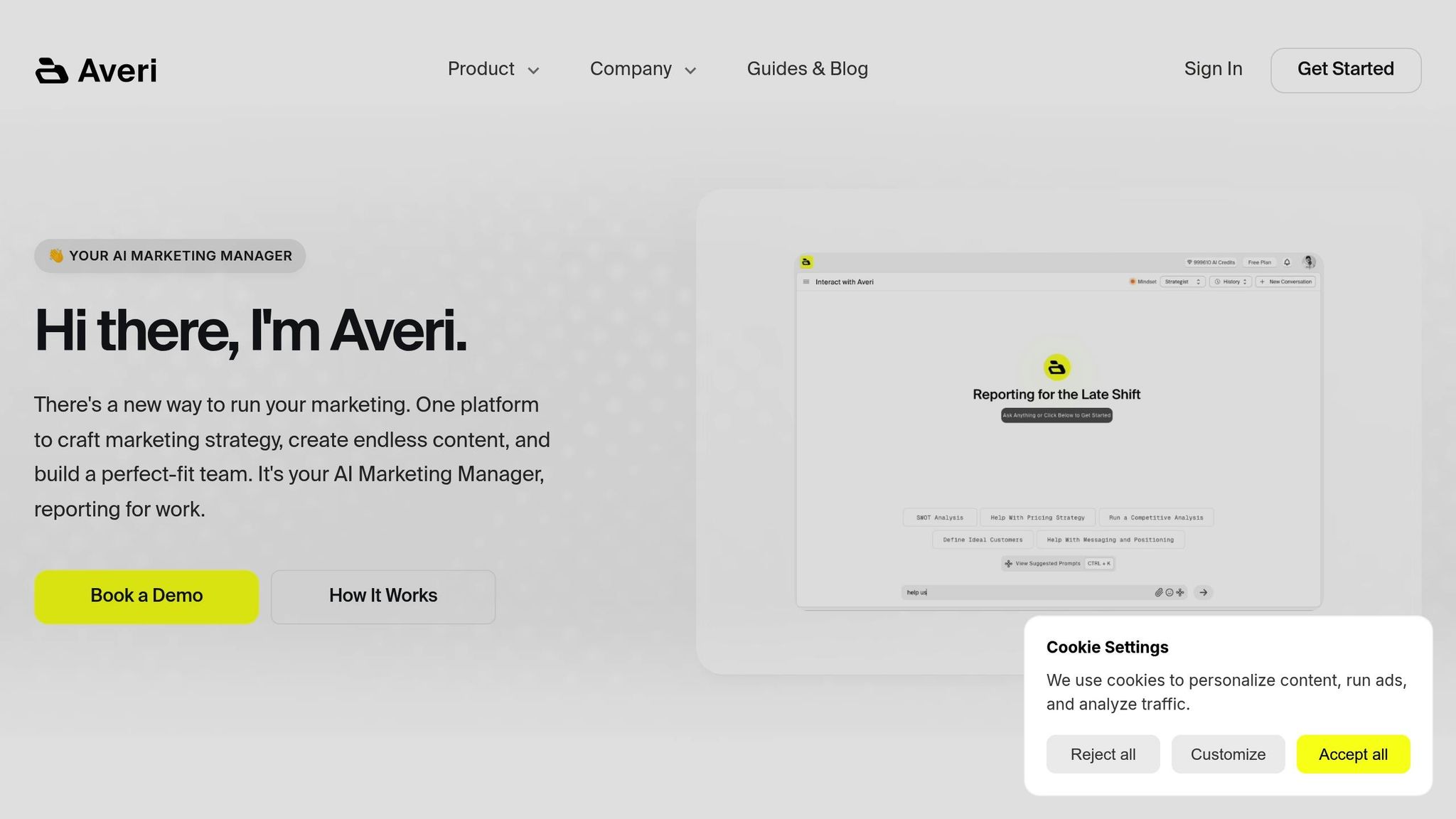
After solidifying your foundational statements, tools like Averi AI can help you refine and maintain your brand identity. Averi AI’s Brand Core centralizes your voice, guidelines, and values, ensuring your brand is expressed consistently across all channels. Its Brand Voice feature helps you articulate your personality, making your content feel both distinctive and authentic.
Averi AI doesn’t just analyze your brand - it evolves with it. The platform builds a dynamic brand record, learning from every decision and creative output to sharpen your guidelines and keep your messaging consistent over time.
For tasks like concept development, Averi’s Synapse system combines the speed of AI with the expertise of human strategists. It uses AI for quick iterations and connects you with branding professionals for insights that require a more nuanced touch. This hybrid approach ensures the best of both worlds - efficiency and depth.
Additionally, Averi’s Adaptive Reasoning tailors its analysis to your brand’s specific needs. Straightforward decisions are handled efficiently, while more strategic choices get the detailed attention they require. This ensures that your brand identity remains both consistent and adaptable as your business grows.
Step 3: Matching Your Message to Your Audience
Once your brand identity is established, the next step is crafting messages that truly connect with your audience. This isn’t just about delivering what you want to say - it’s about understanding what your audience needs to hear and presenting it in a way that resonates with them. Striking this balance can determine whether your rebrand thrives or falters.
One common pitfall for startups is assuming they fully understand their audience without digging into the data. A rebrand offers the perfect chance to revisit customer insights and refine how you engage with your audience. By embracing a data-driven approach, you can ensure every message you craft serves a purpose and strengthens your brand’s connection with its audience.
Using Customer Data to Shape Messaging
With your brand identity as a foundation, use customer data to build messaging that feels personal and relevant. This involves diving deep into customer motivations, addressing their pain points, and tailoring messages to their preferences.
Start by consolidating all your customer interactions - whether through support tickets, sales calls, social media, or website activity - into a unified system. When these insights are scattered across different tools, it’s easy to miss the bigger picture of what your audience truly values.
AI tools can be a game-changer here, especially for B2B startups. For example, AI-driven Account Based Marketing (ABM) can uncover patterns and insights about target accounts, industries, and personas. This allows you to create messaging that addresses the specific challenges your prospects face.
"Thanks to Copy.ai, we're generating 5x more meetings with our personalized, AI-powered GTM strategy."
Jean English, Former Chief Marketing Officer @ Juniper Networks[1]
Maintaining Consistency Across Channels
Consistency in messaging doesn’t mean repeating the same words everywhere. Instead, it’s about staying true to your brand’s voice, values, and promises while adapting your approach to suit each platform. Whether your audience encounters your brand on LinkedIn, via email, or on your website, they should feel the same sense of authenticity and clarity.
Fragmented tools often lead to inconsistent messaging. A unified go-to-market platform can help ensure that all teams work from the same set of brand guidelines and messaging frameworks. AI-powered workflows can further simplify this process, naturally aligning cross-functional teams around a cohesive message. For instance, Averi AI integrates brand guidelines into every step of content creation, ensuring a unified approach across all channels.
Scaling Messaging with Averi AI
Averi AI simplifies the challenge of maintaining brand consistency while scaling your messaging. Its Brand Core feature centralizes your voice, values, and guidelines, ensuring that every piece of content reflects your brand identity, no matter who creates it or where it’s shared.
Using a structured workflow - Think → Create → Execute → Scale - Averi AI keeps your messaging aligned from strategy to execution. Its Synapse system intelligently decides when to rely on AI for routine tasks and when to tap into human expertise for more nuanced content needs. Meanwhile, the Library feature builds a repository of your brand guidelines, past successes, and audience insights, so every new piece of content benefits from your accumulated knowledge and experience.
Step 4: Rolling Out Your Rebrand
With your new brand identity and messaging polished, it’s time to bring your rebrand to life. This phase is all about execution - rolling out your updated identity across every channel and touchpoint. A smooth, well-coordinated launch ensures your rebrand builds excitement rather than confusion.
Think of your rollout as a unified campaign rather than a series of disconnected updates. Every element - your website, social media, sales materials, and customer communications - should work in harmony to tell your brand’s refreshed story. A detailed launch plan is key to achieving this consistency.
Making a Rebrand Launch Plan
A well-thought-out launch plan acts as your blueprint, keeping teams on the same page and ensuring every update happens on schedule. Create a timeline with clear milestones and assign responsibilities for updating assets like your logo, website, business cards, and email signatures.
Plan the sequence of your rollout carefully. Start with your website and main digital channels, so your online presence reflects the new brand immediately. Follow this with updates to social media profiles, physical materials, and communications with partners. This step-by-step approach ensures customers encounter a cohesive brand experience, no matter where they interact with you.
Build in extra time for unexpected delays. Rebranding often involves dependencies, such as approvals or coordination with vendors, that can slow things down. To keep everyone aligned, establish a central hub where stakeholders can track progress and access the latest assets. This avoids confusion and ensures no one is working with outdated materials.
Using AI-Driven Workflow Automation
AI platforms can simplify the rollout process by automating repetitive tasks and maintaining consistency across all your content. Instead of manually updating every piece, AI tools can handle much of the work while adhering to your new brand standards.
Take Lenovo as an example. In 2024, Roman Olney, Lenovo's Head of Global Digital Experience, shared how AI transformed their marketing process:
"Copy.ai has been phenomenal in transforming the way we develop marketing content. By automating workflows that would typically take weeks and cost thousands of dollars through agencies, they've saved us $16 million dollars this year alone." [1]
AI can generate drafts for blog posts, social media updates, email campaigns, and landing pages in seconds, allowing your team to focus on refining the content to fit your brand’s voice. Tools like Averi AI's Synapse are particularly useful during a rebrand, automating routine updates while leaving room for human input on high-priority assets. Its Brand Core feature ensures every piece aligns with your updated guidelines.
For smaller businesses, AI-driven workflows are a game-changer, enabling them to produce consistent, high-quality content at a scale that typically requires a larger team. This makes it easier to refresh existing materials and create new ones that reflect your updated positioning.
Training Teams and Partners
With automation managing content updates, the next step is aligning your people with the new brand vision. Beyond just sharing guidelines, help your teams understand the reasoning behind the rebrand and how it impacts their roles.
Start with your internal teams, especially those who interact directly with customers. Sales teams need to understand how the new positioning shapes their conversations, while customer service representatives should be ready to explain the rebrand to existing customers. Marketing teams benefit from hands-on training in applying the updated voice and visuals.
Use real-world examples in your training. Don’t just share your new color palette - show how it should appear in presentations, social media posts, and email templates. Walk through customer scenarios to illustrate how the new messaging differs from the old.
AI tools can also support this transition. As Ashley Levesque, VP of Marketing at Banzai, noted:
"I didn't even know AI workflows were something that I was lacking until someone said, 'Did you know you could do all of this with Copy.ai?'" [1]
By embedding your brand guidelines into an AI platform, you create a system that helps team members apply them correctly. The platform can flag inconsistencies and suggest improvements, acting as a safety net during the learning process.
Don’t forget about external partners like distributors, resellers, and agencies. These stakeholders also need clarity on your rebrand. Share updated assets, messaging frameworks, and clear explanations of what’s changed. Partner-specific training sessions can address their unique needs and ensure they represent your brand accurately.
Finally, schedule regular check-ins during the first few months post-launch. These feedback sessions allow you to address concerns, correct any inconsistencies, and fine-tune your approach for ongoing success. By staying proactive, you set the stage for a rebrand that resonates with both your team and your audience.
Step 5: Tracking and Improving Rebrand Results
Your rebrand is live, your team is on the same page, and your customers are starting to see your updated identity. Now comes the critical task: measuring whether your rebrand is delivering the results you hoped for. Without proper tracking, you could miss out on key insights about your rebrand’s performance and where adjustments might be needed.
To truly understand the impact of your rebrand, focus on metrics that go beyond surface-level numbers. Look at customer perception, engagement, and conversion rates. The data you gather will inform future marketing decisions and refine your overall brand strategy as your business evolves. Start by identifying the key performance indicators (KPIs) that align with your rebrand’s goals.
Key Metrics to Track After Rebranding
The metrics you monitor should reflect the primary objectives of your rebrand. For example, if your goal was to position your brand as more premium, you might track increases in average order value. If you aimed to expand your audience, focus on metrics like new customer acquisition and changes in audience demographics.
Brand awareness metrics: These help you gauge whether more people are recognizing and remembering your brand. Keep an eye on direct website traffic, branded search volume, and unprompted mentions on social media. Measuring aided and unaided brand recall can also establish a baseline for tracking improvements over time.
Customer engagement indicators: These show how your audience is interacting with your refreshed identity. Metrics like email open rates, social media engagement (likes, shares, comments), and website time-on-page can reveal whether your messaging is resonating.
Revenue and conversion metrics: These provide a clear picture of business impact. Monitor conversion rates throughout your sales funnel, along with metrics like average deal size and customer acquisition costs, to determine if your rebrand is attracting higher-value customers.
Customer sentiment analysis: This offers insight into how people feel about your rebrand. Track reviews, social media comments, and customer support interactions to identify shifts in tone and sentiment.
To simplify this process, consider creating a rebrand dashboard. A consolidated view of these metrics can make it easier to monitor performance. Update your dashboard monthly for the first six months after launch, then shift to quarterly updates to spot trends and make informed adjustments.
Using AI to Monitor Performance
AI tools can take performance tracking to the next level, making it easier to consolidate data and uncover insights that might otherwise be missed. Instead of manually pulling reports from multiple platforms, AI can provide a unified view of your rebrand’s impact across all marketing channels.
With AI, you can centralize data from web analytics, social media, email campaigns, and sales activities into one dashboard. This allows for a comprehensive view of your rebrand’s performance and helps identify patterns or correlations across different channels [1].
AI also offers deeper insights into specific audience segments. By analyzing data on target accounts, industries, and personas, it can reveal how your rebrand resonates with different customer types [1]. This detailed understanding allows you to fine-tune your targeting and messaging.
Another powerful feature of AI is its ability to analyze customer interactions and feedback at scale. It can process data from sources like sales transcripts to provide actionable insights on market perception and customer responses to your rebrand [1]. Every interaction becomes a valuable data point that enhances your understanding of your brand’s reception.
For example, tools like Averi AI’s Synapse system automate much of this work, focusing on performance tracking rather than content creation. The platform’s AI workflows ensure consistent monitoring of key metrics, helping your team stay aligned on what matters most [1].
AI doesn’t replace human judgment - it enhances it. By handling data collection and initial analysis, AI frees up your team to focus on strategic decisions and creative problem-solving. It also ensures that your rebrand maintains momentum by keeping your brand voice consistent across all outputs, a critical factor in measuring the success of your new identity [1].
The combination of human insight and AI-powered efficiency can help you identify opportunities, address challenges, and make the most of your rebrand’s potential.
Conclusion: Building a Brand That Grows with Your Startup
Rebranding your startup goes far beyond designing a fresh logo or crafting a catchy tagline - it's about creating a strategic framework that grows alongside your business. The five-step process we've discussed provides a structured path: evaluating the need for a rebrand, crafting a new brand identity, aligning your message with your audience, implementing the changes, and measuring the results.
These steps are not just a checklist but a foundation for long-term growth. By analyzing how your brand is perceived, clearly defining your mission and values, and maintaining consistent messaging, you set your startup up for success that goes deeper than surface-level updates.
AI-powered platforms like Averi AI can make this process more efficient and effective. Averi AI simplifies rebranding by offering an integrated workspace that bridges strategy and execution. Its Synapse system smartly balances AI-generated outputs with human expertise, ensuring a blend of speed and nuance. The Brand Core feature acts as a central hub, consolidating your brand’s voice and guidelines to maintain consistency across all channels, while also training the AI for better contextual understanding.
Making decisions driven by data is what separates a successful rebrand from a costly misstep. By tapping into customer insights to refine your messaging, tracking key metrics like engagement and brand recognition, and using AI to analyze performance on a larger scale, you can ensure your rebrand delivers tangible results rather than just a new look.
Rebranding is more than a temporary project - it’s an investment in your startup’s future. The knowledge you gain, the systems you establish, and the foundation you create will be assets as your business evolves. With a well-thought-out strategy and the right tools, your rebrand can become a powerful driver of growth, not just a one-time refresh. Leveraging AI insights alongside a solid plan ensures your efforts are focused and impactful.
FAQs
How can I tell if my startup needs a rebrand, and what are the key signs to look for?
If your startup seems stuck in place, it might be time to rethink your branding. Stagnant growth could signal that your current brand isn’t clicking with your audience. Similarly, a disconnect between how people see your brand and what your business aims to achieve is a clear red flag. Changes in your target audience or an outdated visual identity and messaging are also strong signs that a rebrand might be in order.
Refreshing your brand can help you forge stronger connections with your audience, carve out a distinct place in the market, and align your image with the growth and direction of your business.
How important is customer feedback in a rebrand, and how can startups collect and use it effectively?
Customer feedback plays a crucial role in shaping a rebrand that truly resonates with your audience. It provides valuable insights into how your brand is perceived, uncovers unmet needs, and pinpoints areas that need improvement. By integrating this feedback, you can ensure your rebrand aligns with customer expectations and delivers impactful business outcomes.
Startups can gather feedback through various channels, including surveys, social media interactions, one-on-one conversations, and analytics tools. Once this information is collected, it’s important to analyze the data thoroughly to refine your messaging, visuals, and overall strategy. By actively listening to your audience, you can craft a rebrand that not only connects with them but also supports your growth objectives.
How can startups use AI tools like Averi AI to simplify and improve their rebranding efforts?
AI tools such as Averi AI are reshaping how startups approach rebranding by taking over time-consuming tasks, maintaining consistent brand messaging, and speeding up the entire process. With capabilities like AI-generated drafts, seamless workflows, and human oversight to ensure quality, Averi AI allows startups to save both time and money - all while upholding professional standards.
By combining multiple functionalities into a single, unified platform, Averi AI eliminates the hassle of juggling different tools. This streamlined solution helps startups focus on building a distinct brand identity, making the rebranding journey more efficient and aligned with their growth objectives.
Related Blog Posts

Zach Chmael
CMO, Averi
"We built Averi around the exact workflow we've used to scale our web traffic over 6000% in the last 6 months."
Your content should be working harder.
Averi's content engine builds Google entity authority, drives AI citations, and scales your visibility so you can get more customers.