

In This Article
Use SEO, AI, and multiformat content to drive organic installs, boost retention, and scale measurable growth for consumer apps.
Updated:
Trusted by 1,000+ teams
Startups use Averi to build
content engines that rank.
Content marketing can transform how your app attracts and retains users. By creating engaging materials like blogs, videos, and guides, you can educate users, solve their problems, and build trust - all while reducing costs compared to paid ads. In 2022, mobile app downloads exceeded 255 billion, yet 70% of people prefer learning about brands through articles rather than ads. By 2026, AI-driven content will further reshape user discovery, emphasizing the need for multimedia and storytelling.
Key Takeaways:
Set measurable goals: Use frameworks like AARRR (Acquisition, Activation, Retention, Revenue, Referral) to align content with app growth metrics.
Understand your audience: Research user habits, create personas, and tailor content to different awareness stages.
Optimize for AI and search: Combine SEO with AI-focused strategies to ensure your app appears in both traditional and AI-powered search results.
Diversify content formats: Use blogs, videos, newsletters, and tutorials to engage users across platforms.
Leverage AI tools: Automate research, drafting, and analytics to save time and improve efficiency.
Track performance: Monitor metrics like retention, conversion rates, and AI-driven traffic to refine your strategy.
With the right approach, content marketing can drive organic installs, improve user retention, and position your app for long-term success.
The Content Framework Top Apps Use to Go Viral in 2025
Set Clear Goals for Your Content Marketing
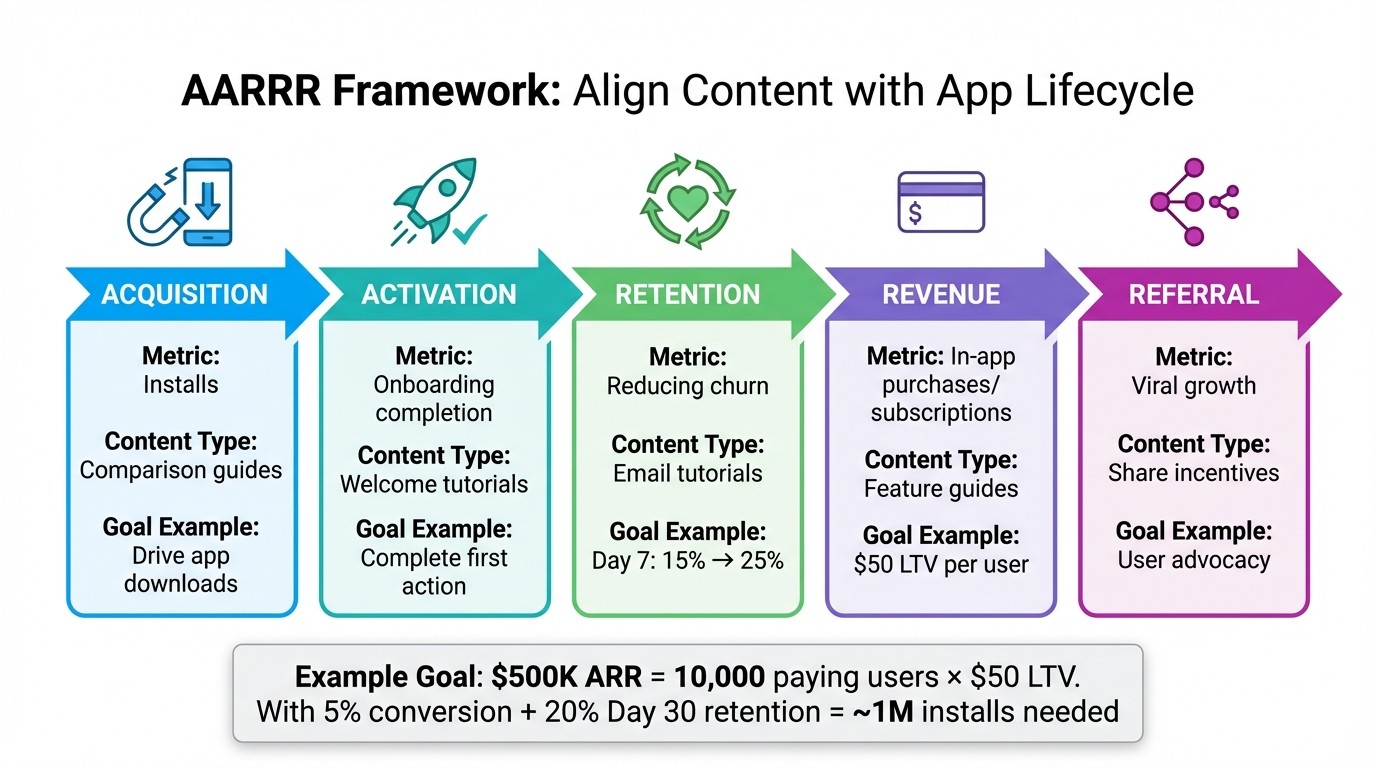
AARRR Framework for App Content Marketing Goals
Vague objectives like "increase engagement" won't lead to real growth. Instead, focus on specific, measurable targets that align directly with your app's performance metrics. For instance, setting a goal to "increase Day 7 retention from 15% to 25% within 90 days" gives your team a clear benchmark and timeline to work toward.
The AARRR framework is a helpful structure for aligning content goals with your app's lifecycle: Acquisition (installs), Activation (onboarding completion), Retention (reducing churn), Revenue (in-app purchases or subscriptions), and Referral (viral growth). Tailor your content to each stage. For example, use comparison guides to drive installs during the acquisition phase and email tutorials to improve retention.
Reverse-engineering your goals can also provide clarity. Let’s say you aim to generate $500,000 in annual recurring revenue with a $50 lifetime value (LTV) per user. To achieve this, you’d need 10,000 paying users. With a 5% conversion rate and 20% Day 30 retention, this means targeting approximately 1 million installs. This approach ensures you understand the content traffic needed at the top of your funnel.
Connect Goals to App Metrics
Your app store listing functions as your primary landing page, so optimizing it is just as critical as optimizing your website. One key metric to track is the conversion rate from store page visits to installs. For example, if 10,000 users visit your store page but only 2% convert, it may indicate that your content is attracting the wrong audience for your app.
Metrics like Customer Acquisition Cost (CAC) and Lifetime Value (LTV) are essential for evaluating the efficiency of your content marketing. If acquiring a user costs $15 (factoring in production and distribution expenses) but each user generates $60 over their lifetime, your strategy is working. Regularly monitoring these numbers - ideally monthly - can help you spot and address potential problems early.
"To ensure you pursue relevant measurement, it's paramount to pinpoint which metrics are worth mapping for your business, and which don't have any real impact on your bottom line." - Einav Mor-Samuels, AppsFlyer [4]
Retention is far more critical to long-term profitability than download numbers alone. Statistics show that roughly 50% of apps are uninstalled within the first month, and 40% of users delete apps simply because they’re not being used [4]. This makes engagement after installation a top priority. By tracking retention rates at Day 1, Day 7, and Day 30, you can identify where users are dropping off and adjust your strategy accordingly.
Track and Measure Results
To effectively measure your progress, break your tracking into three phases, each with distinct KPIs:
Foundation (months 1–2): Focus on visibility metrics like impressions (10,000–50,000) and the number of pages indexed.
Traction (months 3–5): Shift to organic traffic growth (5,000–15,000 visits) and top-10 keyword rankings.
Acceleration (months 6–9): Measure qualified leads, pipeline influence, and the number of authoritative backlinks.
Another valuable metric is your "organic multiplier", which compares paid and organic installs. For instance, if paid ads generate 1,000 installs per month and organic efforts bring in 3,000 installs, this indicates your content is creating a ripple effect that amplifies results.
Bottom-of-funnel content should be a priority, particularly for users ready to download. Allocate about 40% of your content budget to high-intent resources like comparison pages, pricing guides, and detailed "how-to" articles. Interestingly, traffic referred by AI converts at a rate 4.4 times higher than traditional organic search [3]. This underscores the growing need to optimize your content for AI-powered platforms like ChatGPT and Perplexity, alongside traditional SEO.
Use analytics tools to identify "striking distance" keywords - those ranking between positions 10 and 30. By making targeted improvements, you can nudge these keywords onto page one, significantly boosting traffic. Active blogs, for instance, generate 67% more leads [3], highlighting the importance of consistent tracking and optimization.
With specific goals and a solid measurement framework in place, the next step is to focus on understanding and targeting your app's users effectively.
Understand and Target Your App's Users
Creating content that resonates starts with knowing exactly who you’re speaking to. When you define your ideal users clearly, it becomes much easier to tailor your messaging, choose the right marketing channels, and develop campaigns that turn potential users into loyal advocates [1].
Research Your Audience
To truly understand your audience, leverage tools like SparkToro, Statista, and Pew Research to gain insights into their online habits [1]. For direct feedback, in-app tools like Typeform or Hotjar are great for asking users about their preferences and challenges [1].
Start by focusing on a specific user group to build traction before broadening your scope [1]. Document the top three ideal customer profiles (ICPs) and outline their main challenges in their own words [3].
It’s also critical to align your content with the different stages of user awareness:
Unaware: They don’t yet recognize they have a problem.
Problem-aware: They know there’s an issue but aren’t sure what to do.
Solution-aware: They’re exploring potential options.
Product-aware: They’re evaluating your app specifically.
By understanding these stages, you can craft content that meets users at the right moment in their journey [3].
Create User Personas
Building on your research, user personas help ensure your content directly addresses user needs. These personas should include details about demographics (age, location, job title), psychographics (values, motivations), behavior (device preferences, online habits), goals (desired outcomes), and pain points (specific frustrations) [5][6][7].
For consumer apps, it’s important to distinguish between two types of personas:
User persona: The individual who interacts with your app daily.
Buyer persona: The decision-maker who authorizes the purchase.
Their needs often differ and should be addressed separately [5][7].
Persona Element | Details to Include |
|---|---|
Demographics | Age, location, job title, industry, company size |
Challenges | What frustrates them? What problems do they face? |
Behaviors | Online habits, preferred devices, platforms they frequent |
Motivations | What are they trying to achieve? Why would they use your app? |
Objections | What concerns might stop them from downloading or purchasing? |
Segment users into four key types to refine your messaging:
Competitive: Seek the best option available.
Spontaneous: Value speed and convenience.
Humanistic: Connect with brand stories and emotional appeal.
Methodical: Depend on detailed data and evidence.
For instance, spontaneous users might respond well to short, engaging videos, while methodical users prefer detailed guides with statistics. Research shows that companies using personas see a 55% boost in organic search traffic and a 97% increase in leads generated from their website [7].
"Your user persona should be the hero of the tale, and your product their secret weapon." - Arielle Yen, Design Thinking Expert, Mural [7]
Finally, align these personas with your app’s metrics to ensure your content not only engages but also drives measurable results. This foundation sets the stage for creating content that truly connects with your audience.
Plan and Create Content That Drives Results
Once you've identified your target audience, the next step is creating a system that consistently reaches them. This involves planning your content, making it easy to find, and using the right mix of formats to engage users where they already spend their time.
Build a Content Calendar
A content calendar helps you publish consistently and strategically. Start by defining measurable goals tied to your app's performance, such as "Attract 10,000 monthly organic visitors within a year" [2]. Then, choose 3–5 content pillars - key topics that connect your audience's challenges to the solutions your app provides. These pillars establish focus and authority in your niche [2].
Align your content with the buyer's journey to enhance its impact. Publishing weekly can increase conversions by 3.5 times compared to monthly posts [2].
Week | Content Piece | Type | Funnel Stage | Status |
|---|---|---|---|---|
1 | "Complete Guide to [Problem]" | Pillar Post | Awareness | Draft |
2 | "[App] vs [Competitor]" | Comparison | Consideration | Idea |
3 | "How [User] Solved [Problem]" | Case Study | Decision | Idea |
4 | Monthly Feature Update | Newsletter | Retention | Recurring |
Use this table to track progress, content type, and where each piece fits in the funnel. Once your calendar is set, focus on making your content easily discoverable through search and AI optimization.
Optimize Content for Search and Discovery
Your content needs to perform well in two key areas: traditional search engines like Google and AI-powered tools like ChatGPT or Perplexity. This dual approach - balancing traditional SEO with Generative Engine Optimization (GEO) - ensures your app appears whether users search on Google or ask an AI chatbot for advice [3].
Organize your content into topic clusters: write 2–3 pillar posts (2,500–4,000 words) on core topics and support them with 10–15 related long-tail articles (1,500–2,500 words). This structure signals expertise to search engines [3]. Focus on bottom-of-funnel content, such as comparison pages and use-case guides, as they can convert users at 2–5 times the rate of general blog posts [3].
To improve visibility in AI-driven tools, include 40–60 word "answer blocks" at the start of key sections. These concise summaries make it easier for AI systems to cite your content when providing answers [3]. Additionally, prioritize technical SEO basics like fast loading times, mobile-friendly designs, and clear internal links between related articles.
This combination of SEO and GEO strategies ensures your app's content reaches the right users and supports measurable growth.
Use Multiple Content Formats
People consume content in different ways, so it's important to diversify your formats. Short-form videos on platforms like TikTok and Instagram Reels are great for quick, mobile-friendly content that builds awareness [11]. For deeper engagement, YouTube videos can build trust by offering tutorials and educational content that showcase the value of your app [8].
To keep users engaged, email newsletters can share product updates, tips, and reinforce habits [9]. How-to guides and tutorials help users discover features they might otherwise miss, reducing churn [10][11]. You could also consider adding live activities or widgets, like real-time sports scores or delivery updates, directly to users' lock screens [11].
One well-crafted blog post can be repurposed into multiple assets, such as social media clips, email content, infographics, and more. This repurposing strategy lets you maximize your reach without starting from scratch every time [2]. Tailor each format to user needs - if someone is reading a troubleshooting guide, link them directly to the solution in your app rather than the homepage [8].
Content Type | Primary Goal | Best Channel |
|---|---|---|
Comparison Pages | Conversion (Downloads) | Website SEO / Blog |
Short-form Video | Awareness / Engagement | TikTok / Instagram |
Newsletters | Retention | |
Live Activities | Engagement / Utility | Mobile Lock Screen |
Tutorials | Retention / Education | YouTube / In-app |
"We do attribution in a very simple way: we ask people in onboarding where they came from. And we found that to be actually the most reliable way of doing it." - Opal [8]
Finally, track which formats drive the most downloads and engagement. Use this data to refine your strategy, doubling down on what works and cutting what doesn’t. A clear content plan paired with varied formats creates a repeatable system for driving results over time.
Use AI Tools to Automate Content Marketing
Creating high-quality content for consumer apps typically takes 4–6 hours per post - a commitment many founders can't afford. AI-powered tools can cut that time to under an hour, all while maintaining quality and optimizing for both traditional search engines and AI-driven platforms like ChatGPT [3]. This allows you to focus on the strategic aspects - messaging and positioning - while AI handles the bulk of the execution, saving time and effort [3].
Automate Research and Content Creation
AI tools excel at tackling the most time-intensive parts of content marketing: analyzing competitors, finding keyword opportunities, and drafting structured content. Platforms like Averi act as content engines that adapt to your brand's voice over time. By inputting your website and product details, the system evaluates your positioning, identifies content gaps, and suggests topics tailored to your audience. It also tracks market trends, organizing ideas into useful categories like comparisons, how-to guides, and listicles, so you're never starting from scratch.
After you approve a topic, the AI digs into research using credible sources, applies SEO and GEO optimization to help your content rank on Google and AI search tools, and generates a structured draft. From there, you can fine-tune the draft in a collaborative editor, adding your personal touch and unique insights. This dual-optimized approach ensures your content is ready for both traditional search engines and AI-powered platforms [3]. The efficiency of this process highlights the stark contrast with traditional methods.
Manual vs. AI Workflows
The difference between manual and AI-assisted workflows extends beyond speed - it’s about scalability. Traditional methods usually produce 2–3 pieces per week, requiring 15–25 hours of work [12]. AI-assisted systems, on the other hand, can generate over 20 variations weekly while reducing your time commitment to just 3–5 hours [12].
Step | Manual Process | AI with Averi |
|---|---|---|
Strategy | Competitor analysis and brainstorming | Automated competitor analysis and keyword suggestions |
Drafting | Writing and revising manually | AI-generated drafts optimized for SEO |
Publishing | Formatting and uploading to CMS | Direct publishing to CMS platforms |
Analytics | Manual data aggregation and insights | Performance tracking with actionable recommendations |
With SEO strategies offering a 748% ROI and AI-referred traffic converting 4.4 times higher than traditional organic search [2][3], automation doesn’t replace human creativity - it enhances it. By letting AI handle execution, you can focus on strategy and refinement. Over time, the system learns from each piece you publish, making your content marketing efforts more scalable and efficient. These streamlined workflows allow you to achieve more while spending less time on repetitive tasks.
Distribute Content Across the Right Channels
Creating great content is only half the battle - it’s meaningless if your audience never sees it. The real challenge lies in targeting the 2–3 channels where your audience already spends their time. Spreading yourself too thin across too many platforms dilutes your efforts and makes it harder to connect with users effectively [1]. The best channels often depend on your app's niche: gaming apps thrive on platforms like YouTube or Twitch, dating apps perform well on TikTok and Instagram Reels, while productivity tools shine through SEO and LinkedIn [1].
Choose High-Impact Channels
Your app store listing is the cornerstone of your content distribution strategy. It’s your primary conversion funnel, so optimizing titles, keywords, and visuals is crucial [1]. Beyond the app store, your distribution strategy should align with your app category. For instance:
Gaming apps: Video walkthroughs on YouTube and conversations on Reddit can build strong engagement.
Fitness and wellness apps: Instagram's visual appeal and Facebook Groups foster community interaction.
Productivity apps: LinkedIn’s professional audience and well-executed SEO strategies drive visibility.
To refine your approach, tools like SparkToro can help you uncover what your audience reads and follows, or you can analyze where competitors consistently appear [1]. Additionally, platforms like Typeform or Hotjar can collect user feedback through in-app surveys, helping you identify where your audience spends their time online [1]. This research ensures your efforts focus on channels that reliably drive downloads.
Combine Paid and Organic Strategies
Once you’ve identified the right channels, blending paid and organic strategies creates a powerful feedback loop. Paid placements can significantly boost your app store ranking, making your app more visible to organic users [13]. This interplay creates a cycle where paid efforts amplify organic growth and vice versa [13].
"In the app marketplace, ad-driven users and organic users have a sort of symbiotic relationship. The more downloads you get through your media placements, the higher your rank becomes in the app stores and thereby how visible it is to potential organic users."
To track which efforts drive the most downloads, use Custom Product Pages (CPPs) tailored to specific social and paid channels [8]. Onboarding surveys can also help pinpoint where users discovered your app [8]. Pair high-intent paid channels like Apple Search Ads or Google Ads with educational blog content to nurture users after their first interaction [1][9]. This combination captures immediate demand while building sustained visibility. Considering that organic search generates 44.6% of all B2B revenue [3], this dual approach not only drives growth but also makes paid campaigns more cost-effective over time.
Monitor Performance and Improve Over Time
Once your content is out in the world, the real work begins. Tracking performance is what turns a one-time success into ongoing growth. Publishing is just the starting point - what comes next is a cycle of measurement and refinement. Without data-driven adjustments, your strategy risks losing its way. The focus should be on tracking metrics that directly impact your app’s growth, avoiding superficial numbers that might look good but don’t deliver meaningful results.
Track the Right Metrics
Each stage of your funnel requires specific metrics to gauge performance and refine tactics. For acquisition, key indicators include app downloads, cost per install (CPI), customer acquisition cost (CAC), organic sessions, and keyword rankings. During activation, monitor onboarding completions, Day 1 retention rates, and app store conversion rates. Retention metrics should focus on Day 7/30 retention, daily active users (DAU) to monthly active users (MAU) ratios, churn rate, and session duration. For revenue, keep an eye on lifetime value (LTV), average revenue per user (ARPU), monthly recurring revenue (MRR), and in-app purchase conversions. And for referrals, track viral coefficient, new signups, social shares, and mentions of your brand [1].
Beyond these funnel-specific metrics, pay attention to in-app actions that reveal your app's true value. For example, a fitness app might track completed workouts, while a messaging app might measure messages sent. These behaviors show whether your content is pulling in the right audience. Additionally, look for opportunities in keywords ranked between positions 10 and 30 - these represent potential quick wins [3]. Another emerging metric is AI-driven traffic. If tools like ChatGPT or Perplexity mention your brand, you’re in a strong position, as AI-referred traffic converts at 4.4x the rate of traditional organic search [3]. These data points not only reflect your current standing but also highlight areas for improvement.
Update Content Based on Data
Your performance metrics will reveal what’s working and what isn’t. For instance, high bounce rates or low time spent on a page suggest your content either misses the mark on quality or doesn’t align with user intent [9]. When you notice these trends, conduct an audit to identify your top-performing content - the 20% that drives 80% of your results [3]. Expand on these high achievers by increasing word count, incorporating fresh statistics, and adding visual assets like infographics.
For content that underperforms, dig into the reasons before deciding to cut it. Common issues include high keyword difficulty, shallow coverage, or a mismatch with search intent. Use tools like Google Search Console to uncover search terms that need more targeted updates [3][8]. Set a schedule - such as quarterly reviews - to refresh data and expand on your best-performing pieces systematically [3].
"The blog post you publish today can drive traffic for years - if you update it." - Zach Chmael, CMO of Averi [3].
While attribution isn’t always precise, combining analytics with user feedback can fill in the gaps. For example, during onboarding, ask users how they discovered your app. These insights often reveal high-performing content that analytics alone might overlook [8]. Additionally, Custom Product Pages tailored to specific channels can help you directly link downloads to campaigns [8]. Don’t wait for perfect data - run small experiments, tweak your messaging, and use quick feedback loops to make adjustments on the fly [1].
Build a Content Marketing System That Scales
A well-structured content marketing system does more than just keep your strategy consistent - it creates a framework for sustainable growth. The key lies in building a system that grows on its own momentum, relying on repeatable processes, interconnected content, and automation to handle the heavy lifting. This allows you to focus your energy on refining your product.
Start by implementing a topic cluster model. Choose 3–5 pillar topics that align with your goals and support them with 10–15 related articles each. This approach establishes your authority on key subjects and helps you surpass competitors [3]. Once you've built this foundation, scale your reach using programmatic SEO to target long-tail keyword variations like "App for [Industry]" or "[Competitor] Alternative" [3]. The numbers speak for themselves: companies publishing 9 or more blog posts per month see traffic grow by 35.8%, compared to just 16.5% for those posting 1–4 times [3].
AI tools like Averi can turn what used to be a full-time job into a manageable 5-hour weekly routine. For example:
Spend 1 hour on strategy and approvals.
Dedicate 2 hours to refining AI-generated drafts.
Use 1 hour for content distribution.
Reserve 1 hour for planning [3].
This streamlined workflow can transform a single pillar post into 10 or more additional assets, including social media posts, newsletters, and video scripts [2][3]. Averi simplifies the entire process - handling research, drafting, publishing, and analytics - all in one platform, effectively replacing 6–10 separate tools [3].
Once your system is running smoothly, track your progress in phases to ensure you're hitting key milestones:
Months 1–2: 10,000–50,000 impressions and indexed pages.
Months 3–5: 5,000–15,000 monthly visitors and 10–20 top-10 keywords.
Months 6–9: 30,000–60,000 visitors and 50+ top-10 keywords.
Months 10–12: 100,000+ visitors and 100+ top-10 keywords [3].
As your metrics confirm success, refine your strategy further by optimizing for both traditional SEO and AI-driven search. For Google, focus on elements like keywords and headers. For AI tools like ChatGPT and Perplexity, include FAQ sections, concise 40–60 word answers, and citable statistics [3]. This dual approach is game-changing: AI-referred traffic converts at 4.4 times the rate of traditional organic search [3], and organic search already accounts for 44.6% of all B2B revenue [3].
FAQs
How do I pick the best AARRR goal to start with?
To select the most effective AARRR (Acquisition, Activation, Retention, Referral, Revenue) goal, focus on the areas where your app needs the most attention or has the greatest potential for growth. Pinpoint the stage with the biggest gaps, whether it’s struggling to attract new users or facing low engagement after onboarding. Pick a goal that aligns with your immediate business priorities, can be measured effectively, and is realistic to achieve. This approach helps you build momentum while fine-tuning your overall strategy.
What content should I create to improve retention after install?
To keep users engaged after installation, prioritize delivering content that feels tailored and relevant to their interests. This could involve sending targeted in-app messages, providing helpful tutorials, or sharing timely updates that improve their overall experience. Leveraging AI-driven workflows and content automation tools can simplify and scale these efforts, allowing you to communicate quickly and effectively while ensuring users stay consistently engaged over the long term.
How can I tell if AI-driven traffic is working for my app?
To gauge the success of AI-driven traffic, focus on tracking essential engagement metrics. Key indicators include time spent in-app, daily active users (DAU), monthly active users (MAU), session length, and churn rate (measured by daily uninstalls). Additionally, personalization efforts like dynamic content and customized user journeys can serve as valuable markers of effectiveness. Observing these metrics over time allows you to spot patterns and evaluate how well users are engaging and staying connected.
Related Blog Posts

Zach Chmael
CMO, Averi
"We built Averi around the exact workflow we've used to scale our web traffic over 6000% in the last 6 months."
Your content should be working harder.
Averi's content engine builds Google entity authority, drives AI citations, and scales your visibility so you can get more customers.