

In This Article
Define your agency’s emotional core, align visuals and voice, use AI to scale content, and measure emotional impact to build a memorable brand.
Updated:
Trusted by 1,000+ teams
Startups use Averi to build
content engines that rank.
A vibe-driven brand focuses on the emotional energy your agency projects - how clients feel when they interact with your content, product, or team. It’s about emotional connection, not just services or deliverables. By 2025, 47% of Fortune 500 companies had integrated emotional branding into their strategies, proving its impact in competitive markets.
Key Steps:
Define Your Emotional Core: Choose 1-2 emotions (e.g., confidence, playfulness) that align with your audience’s needs and your agency’s values.
Visual and Voice Identity: Use colors, fonts, and tone that consistently reflect your emotional core. Examples: Duolingo’s playful humor, Notion’s calm productivity.
Leverage AI Tools: Platforms like Averi AI help scale content creation while maintaining your brand’s emotional tone.
Measure Emotional Impact: Use sentiment analysis, engagement metrics, and audience feedback to refine your messaging.
Why It Matters:
When services are similar, your vibe becomes your competitive edge. A clear emotional focus builds trust, fosters loyalty, and ensures your brand resonates deeply with your audience.
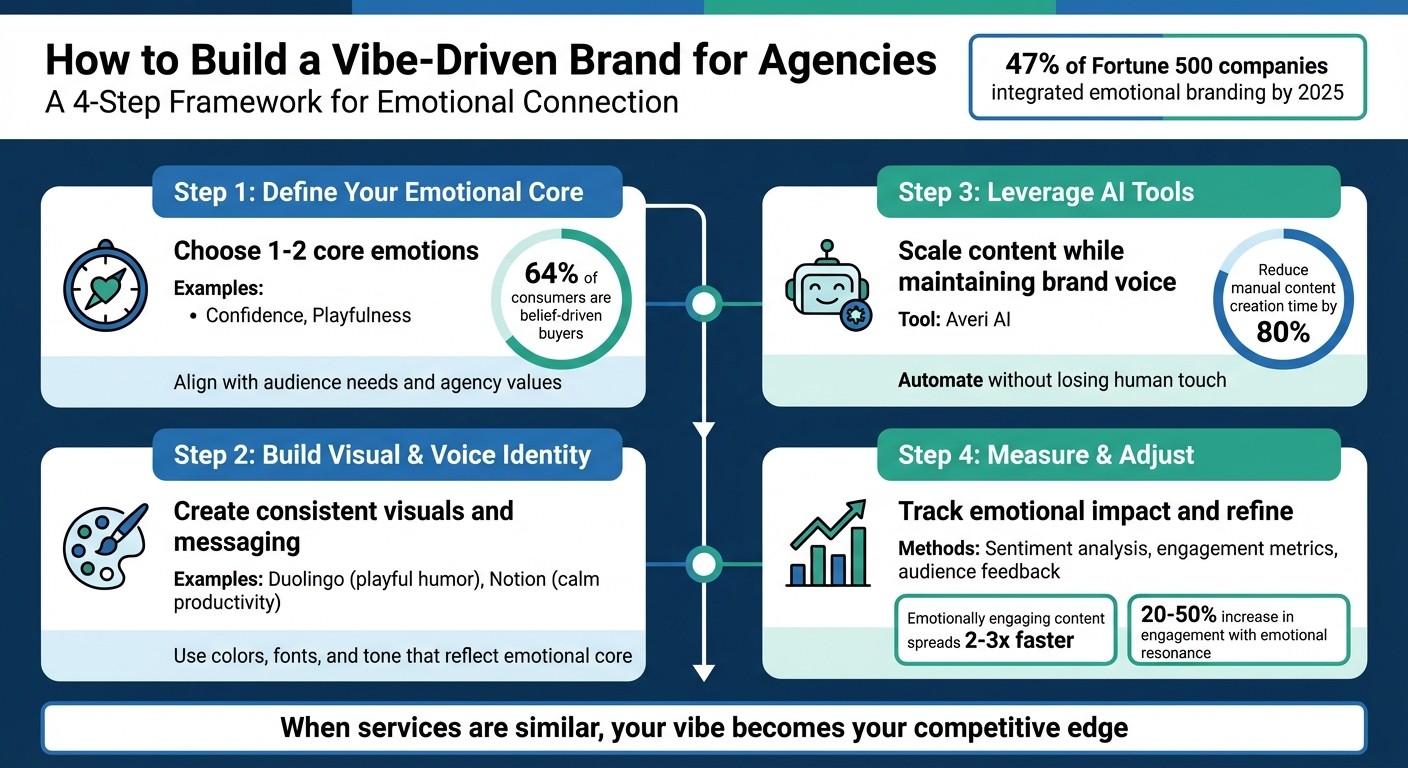
4-Step Framework for Building a Vibe-Driven Brand for Agencies
How To Use Emotional Branding (In 7 Steps)
Building a vibe-driven brand requires AI content creation tools that preserve your agency's unique voice while scaling output.
Define Your Brand's Emotional Core
Your emotional core is the single feeling you want clients to experience whenever they interact with your agency. It’s the emotional thread that ties together every touchpoint, from your website to how your team answers calls. Selecting one or two core emotions ensures consistency in how your brand communicates and connects.
This focus is crucial because 64% of consumers are belief-driven buyers, expecting brands to address societal issues alongside delivering products [5]. A clear emotional core acts as a guide for all your messaging. For example, if your core emotion is "confidence", your pitch decks should exude certainty, avoiding any language that feels hesitant. On the other hand, if "playfulness" defines your brand, you might use an onboarding process that feels lighthearted and engaging.
Identify What Your Audience Feels and Needs
To define your agency's emotional core, start by understanding your audience's deeper feelings and concerns. Go beyond surface-level benefits like ROI and dig into the emotions driving their decisions. Are they nervous about making a costly mistake? Feeling overwhelmed by too many choices? Or maybe they’re eager to find a partner who truly understands their challenges?
Tap into social listening tools to capture real-time conversations on platforms like LinkedIn, Reddit, or niche industry forums. Pair this data with direct interviews and surveys, asking not just what clients want, but how they hope to feel during the process. This combination of insights will help you uncover the emotional landscape of your audience, providing a foundation for selecting your brand’s defining emotion.
Choose Your Brand's Primary Emotion
Once you’ve mapped out your audience’s emotional needs, choose one or two core emotions that align with both their expectations and what your agency genuinely offers. This isn’t about creating artificial feelings - it’s about identifying where your values naturally intersect with your clients’ emotional priorities.
"Emotional brand positioning is not just about making a product or service appealing - it's about forging deep, lasting connections with consumers by aligning a brand's values and messaging with the emotional needs and desires of consumers."
Take Duolingo as an example. They embraced "playful and cheeky" as their emotional core, which shines through in everything from their app notifications to their social media humor. This approach reinforces their promise that learning a language can be enjoyable and stress-free [1]. Similarly, your agency’s emotional core should be specific and consistently reflected across all interactions. If you choose "confidence", you might highlight it with bold messaging, compelling case studies, and a polished visual identity. Document this emotional foundation clearly—remember that modern brand guidelines are living systems that shape every brand decision moving forward.
This defined emotional core will serve as the starting point for crafting your visual and voice identity in the next section.
Build a Consistent Visual and Voice Identity
Once you've nailed down your brand's emotional essence, the next step is ensuring that energy shines through in both your visuals and your messaging across every platform. The way your brand looks and sounds should consistently reflect that emotional core. For example, color choices can evoke specific feelings - blues and greens are calming and trustworthy, while reds and oranges bring energy and vibrancy. Even typography plays a role: sans-serif fonts like Helvetica feel modern and approachable, while serif fonts lean toward tradition and dependability.
Take Notion as an example. The brand perfectly captures its "calm productivity" ethos with muted colors, clean layouts, and concise visuals that emphasize clarity. Similarly, Kin Euphorics has built its "slow luxury" identity by using soft color palettes and textured designs, aligning its visuals with its mindful and ritualistic messaging. These brands demonstrate how consistent visuals can reinforce the emotional resonance of a brand.
Create Visual Guidelines That Express Emotion
Start by translating your emotional core into visual elements. A great way to do this is by creating a mood board. Gather images, colors, and textures that evoke the feelings you want your audience to associate with your brand. For example, if your core emotion is "confidence", you might choose bold imagery, sharp contrasts, and clean, structured lines. If your brand leans toward playfulness, opt for bright colors, rounded shapes, and lively patterns. Tools like Canva or Figma can help you pull these elements together into a cohesive digital mood board.
From there, transform your mood board into a formal style guide. This guide should include precise details like hex codes for colors, specific font pairings, and any filters or effects for images. Think of it as a blueprint to keep your visuals consistent across all platforms. A mismatch - like Instagram posts that feel disconnected from your website or pitch decks - can undermine the trust you've worked to build. Consistency in visuals strengthens emotional connections, creating an experience that feels seamless and intentional.
Define Your Brand Voice and Messaging Style
Your visual identity is only half the story. To fully capture your brand's emotional essence, your voice needs to align with your visuals. How you communicate - your word choices, tone, and sentence structure - should reflect the same emotional energy. For instance, a "bold" brand voice might use short, decisive sentences and confident statements, while a "calm" voice would lean into longer, more reflective phrasing.
To ensure clarity, develop a messaging playbook. Outline your tone - whether it's warm, cheeky, or authoritative - and specify the kinds of vocabulary and sentence patterns that fit your brand. Include examples of what works and what doesn’t, so your team and any AI tools you use can consistently produce aligned content. Testing AI-generated prompts against your guidelines can help fine-tune your brand's voice.
Regularly review your communications - social media posts, email campaigns, and client messages - to make sure they stay true to your emotional core. When your tone wavers, it can weaken the emotional connection you've built. But when your visuals and voice work in harmony, they create a cohesive brand experience that feels genuine at every interaction.
Use AI Tools to Scale Brand Execution
Once you’ve nailed down your brand’s visual and voice identity, the next hurdle is producing enough content without overwhelming your team. That’s where AI-powered platforms like Averi AI step in. These tools can take on the heavy lifting of research, drafting, and optimization while ensuring your brand’s emotional tone stays intact. The trick is to set up systems that automate the process without losing the human touch that makes your brand relatable. Let’s explore how AI tools can help create diverse content while maintaining your brand’s unique voice.
Automate Content Creation While Preserving Brand Voice
Start by creating a vibe profile - a document that captures your brand’s emotional essence, tone, and style. For instance, if your brand exudes a "warm and welcoming" vibe like Starbucks, your profile should detail language patterns, sentence structures, and word choices that convey that warmth. On the other hand, a "high-energy" brand like Red Bull might lean on short, punchy sentences and action-oriented language.
Averi AI uses this vibe profile as a foundation to draft emails, social posts, and blogs that align with your brand’s tone. The platform handles the heavy lifting of drafting and optimizing, while your team refines the outputs to ensure they hit the mark. This partnership between AI and human oversight can slash manual content creation time by as much as 80%, allowing your team to focus on strategy and creative direction.
Here’s a real-world example: Heinz leveraged AI for meme creation, resulting in 15 million impressions and a 15% sales increase. The AI generated content variations quickly, but human oversight ensured the humor stayed relevant and aligned with the brand’s voice.
Set Up Workflows That Maintain Brand Consistency
Once AI is generating your content drafts, the next step is to establish workflows that protect and uphold your brand identity. Implement a checkpoint system where AI outputs are reviewed against your vibe profile and undergo human approval. Platforms like Averi AI streamline this process, integrating everything into a single workspace so your team can focus without constantly switching between tools.
Build shared prompt libraries that your team can access anytime. These libraries should include pre-written prompts tailored to specific content types - social posts, email campaigns, blog intros - already infused with your brand’s tone and emotional cues. This ensures that anyone creating content can pull from a consistent set of guidelines, even as your team grows or changes.
Monitor metrics like Context Switching Ratio (how often your team switches between tools) and Momentum Score (time spent continuously on one task) to identify workflow bottlenecks. If your team is losing time navigating between various platforms, consider consolidating into a unified workspace.
"Before Averi, I spent 70% of my time managing processes and only 30% on actual creative work. Now that ratio is completely reversed." - Sarah K., CMO, Tech Startup
The goal is to let AI handle repetitive tasks like drafting, formatting, and optimization, while your team focuses on the strategic and creative elements that make your brand stand out. When workflows are efficient, your brand’s identity remains consistent across platforms, and your team can dedicate their energy to work that truly drives results. This balance of automation and human refinement ensures your brand’s personality shines, even as you scale.
Measure and Adjust Your Brand's Emotional Impact
Creating a brand that resonates emotionally isn’t a one-time effort. It’s an ongoing process of checking if your messaging truly connects with your audience and making adjustments when it doesn’t. The focus should shift from surface-level metrics like likes and impressions to something deeper - measuring how your brand makes people feel.
Gauge Emotional Responses from Your Audience
Start by using sentiment analysis tools to understand the emotional tone in your audience’s feedback. AI-powered platforms like Google Cloud Natural Language API can help identify emotions such as joy, nostalgia, or frustration by scoring responses on a positive-to-negative spectrum.
In addition to sentiment analysis, track social engagement metrics that highlight emotional connections. Look at the share-to-impression ratio (how often people share your content compared to just viewing it), the depth of comments (are they meaningful or just emojis?), and how long users engage with posts that match your brand’s vibe. Research shows that emotionally engaging content spreads 2–3 times faster than other types of content [2].
You can also gather direct feedback through surveys. Use open-ended questions like, “What emotions does this content evoke?” and pair them with Likert scales (e.g., rating feelings of inspiration or energy from 1 to 5). Add prompts specific to your brand’s personality, such as, “Does this feel cozy, ambitious, or rebellious?” Platforms like Typeform or SurveyMonkey can integrate with AI tools for sentiment tagging, helping you identify patterns and confirm whether your brand inspires feelings of connection or aspiration.
Leverage these insights to adjust your messaging in real time.
Test and Fine-Tune Your Messaging
Once you’ve collected audience feedback, use it to refine your messaging through structured testing. Experiment with 6–8 variations of tone, such as nostalgic, bold, energetic, or cheeky, and track how they affect click-through rates and conversions. Tools like Google Optimize or Optimizely simplify this process, and brands that focus on emotional resonance often see engagement increase by 20–50% compared to content that prioritizes features [3].
Track audience reactions further using tools like Hotjar for heatmaps, session recordings, and surveys asking questions like, “Which version felt more true to our brand?” Use automation to stay agile - set triggers to refresh content if engagement drops below 50% of the baseline after four hours or amplify promotion when it exceeds 200%. AI agents tuned to your brand’s voice can help monitor performance and analyze sentiment across campaigns, ensuring your messaging stays aligned with your brand’s emotional tone.
Conclusion: Building a Brand That Connects
Creating a vibe-driven brand starts with uncovering and defining your agency's emotional essence. Once identified, this core should be reflected consistently - whether through visuals, messaging, or internal workflows. Achieving this level of alignment requires clear documentation and structured processes to keep everyone on the same page.
AI tools offer a way to scale this consistency without losing the heart of your brand. By leveraging dynamic workflows, your team can automate repetitive tasks while maintaining your brand's unique voice and memory across campaigns. This frees up time for deeper creative work and strategic decision-making, ensuring your brand remains authentic and impactful.
To ensure your brand stays aligned with its emotional core, ongoing measurement is essential. Use tools like sentiment analysis, audience engagement metrics, and direct feedback to understand how your messaging resonates. Experiment with variations in tone and delivery, letting real data guide your adjustments. The most successful agencies treat their brand as an evolving entity - one that grows and improves with every interaction.
The key to success lies in designing systems that prioritize emotional connection, consistency, and smart use of automation. Start by auditing your current emotional signals and test a single campaign variation to see how it performs. It’s through this iterative process that your brand can truly thrive.
FAQs
How do I pick my agency’s core vibe?
To shape your agency's core vibe, concentrate on five essential elements: tone, visuals, values, rituals, and community cues. These components work together to build an emotional connection that strikes a chord with your audience. Incorporate relatable storytelling and meaningful insights into structured, repeatable frameworks to maintain consistency. By doing so, you ensure your vibe aligns seamlessly with your brand identity, making it easy for your target market to recognize and connect with emotionally.
How can I keep my brand voice consistent across channels?
To keep your brand voice consistent across various platforms, it's crucial to establish key elements such as tone, visual style, core values, and community-focused cues. These components act as a guide to ensure all content aligns seamlessly. Tools like Averi AI can streamline this process by automating storytelling and maintaining adherence to brand guidelines. By sticking to a structured and repeatable strategy, your messaging will remain genuine and easily identifiable across channels like social media, email campaigns, and your website.
How do I measure if my vibe is working?
To determine whether your brand's vibe is hitting the mark, pay attention to the strength of your emotional connection with your audience and the influence you're having on the broader cultural landscape. Look for signs such as genuine storytelling, consistent and memorable brand elements (like tone, visuals, and community presence), and authentic engagement or recognition from your audience.
Key metrics to monitor include engagement rates, customer loyalty, and the growth of your community. Indicators like positive feedback, expanding reach, and a thriving, connected audience are strong signals that your brand's vibe is resonating in a meaningful way.
Related Blog Posts

Zach Chmael
CMO, Averi
"We built Averi around the exact workflow we've used to scale our web traffic over 6000% in the last 6 months."
Your content should be working harder.
Averi's content engine builds Google entity authority, drives AI citations, and scales your visibility so you can get more customers.