

In This Article
How financial brands use tone, visuals, values and AI personalization to create emotional connections, boost retention, and scale content.
Updated:
Trusted by 1,000+ teams
Startups use Averi to build
content engines that rank.
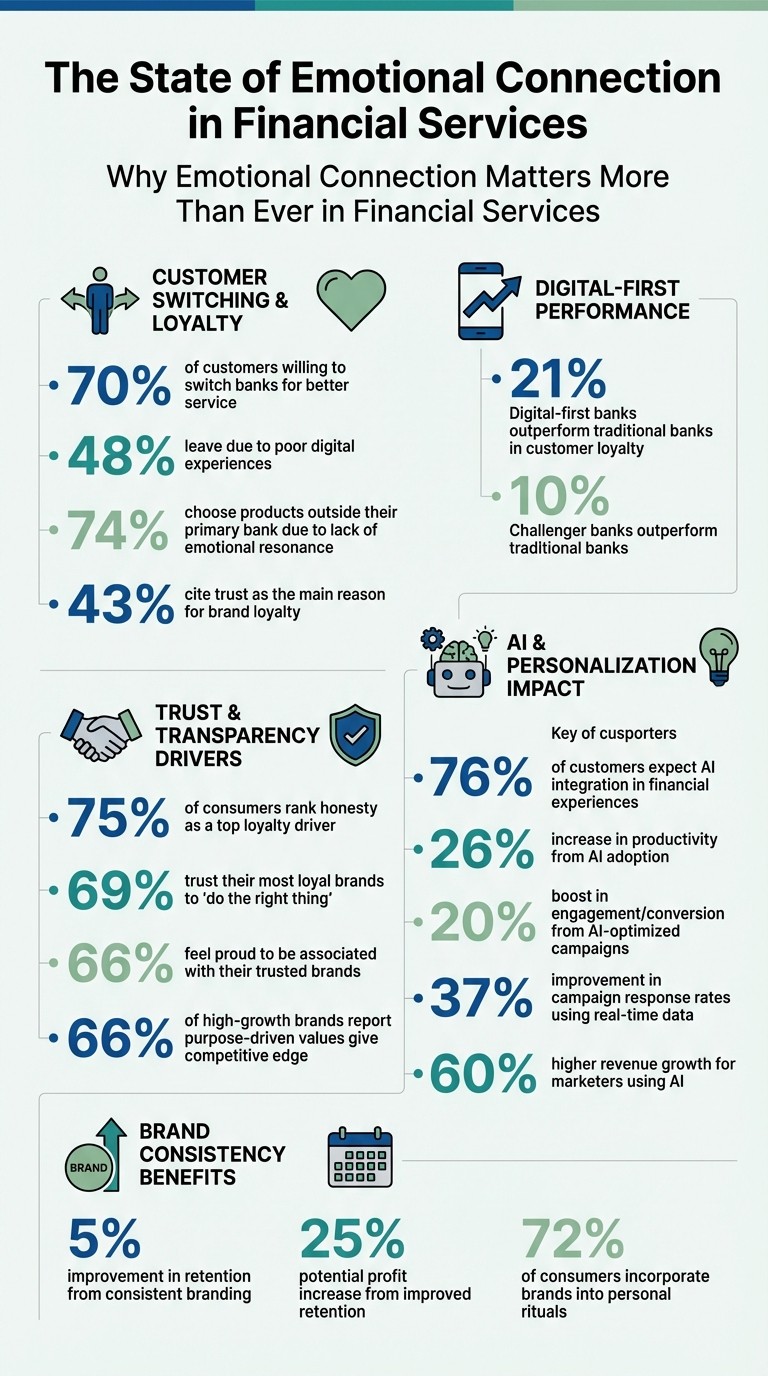
Building a vibe-driven brand in financial services means creating emotional connections that go beyond trust and functionality. With 70% of customers willing to switch banks for better service and 48% leaving due to poor digital experiences, the stakes are high. Success lies in aligning your brand's tone, visuals, values, and customer interactions with their emotional drivers like trust, control, and simplicity.
Key takeaways:
Emotional connection matters: 74% of customers choose products outside their primary bank due to a lack of emotional resonance.
Digital experience is critical: Smartphones are the primary banking touchpoint, and uninspired digital interactions drive customers away.
AI can help: Use tools like Averi AI to analyze customer behavior, create consistent content, and personalize messaging for better engagement.
Key Statistics for Building Vibe-Driven Financial Brands
Digital Banking Trends 2021: Creating Emotional Connections Between Financial Brands And Customers
Define Your Brand's Vibe
Your brand's vibe is more than a collection of adjectives - it's the emotional energy your financial brand projects every time someone interacts with it. This matters because in the financial sector, where 74% of customers choose products outside their primary bank due to a lack of emotional connection, getting this right is critical [4].
Your vibe is shaped by five key elements: tone of voice (the personality in your communication), visual language (the colors and designs that set the mood), values (your guiding principles), rituals (patterns in how you interact), and community cues (signals that foster a sense of belonging) [1]. These components influence how customers perceive your brand before they even engage with your services. Defining your vibe clearly lays the groundwork for meaningful audience connections and impactful content strategies.
Understand Emotional Drivers in Financial Services
To make your vibe resonate, it's essential to connect it to the emotional factors that drive financial decisions. Despite being framed by numbers, financial choices are deeply emotional. For instance, 43% of consumers cite trust as the main reason they remain loyal to a brand, and that trust is built on feelings of security, control, and support [7]. James Robert Lay, CEO of Digital Growth Institute, highlights this shift:
People do business with people. People bank with people. And I think there's this humanity we're seeing coming out of the Covid experience as we continue to move forward into this decade [3].
These emotional drivers fall into distinct categories. Trust relies on consistency and transparency, creating a sense of reliability. Predictability fosters stability and honesty, which 75% of consumers rank as a top loyalty driver because it helps them feel more in control of their finances [3]. Connection builds belonging through shared values, while support simplifies the customer experience, reducing decision fatigue - a factor that pushes 48% of consumers to switch brands if simplicity isn't delivered [6][7]. Finally, delight introduces a spark of excitement through unexpected rewards or fresh ideas.
Your brand's vibe serves as the bridge between loyalty driven by convenience and loyalty rooted in emotional connection [5]. Digital-first and challenger banks have already mastered this, outperforming traditional banks in customer loyalty by 21% and 10%, respectively [3].
Align Vibe with Brand Values and Audience Expectations
Emotional engagement is the foundation of customer loyalty, and your brand’s values are the compass guiding every decision, from product design to handling crises. A striking 66% of high-growth brands report that purpose-driven values not only guide employee decisions but also give them a competitive edge [1]. The challenge is ensuring your values align with what your audience genuinely cares about - whether that’s reliability, transparency, innovation, or community.
To start, audit your brand voice using specialized marketing tools to ensure it’s consistent across every touchpoint, from social media posts to customer service emails [1]. Then, compare your stated values with customer expectations. If you claim transparency but bury key details in jargon, your authenticity takes a hit. Similarly, if you promise innovation but deliver a clunky digital experience, customers will look elsewhere. Trust is earned through alignment between what you say and what you do - 69% of customers trust their most loyal brands to "do the right thing", and 66% feel proud to be associated with them [6]. Your vibe must live up to these expectations, consistently reinforcing trust and pride through every interaction.
Research Your Audience: Map Values and Pain Points
Creating a message that truly connects starts with understanding who your audience is and what keeps them up at night financially. In financial services, this means digging deeper than surface-level demographics to uncover the emotional drivers behind their decisions - whether it’s the fear of outliving their retirement savings or the frustration of dealing with overly complicated investment tools.
To get there, gather both quantitative and qualitative insights. Look at transaction histories, app usage patterns, and CRM data to track how customers behave. Then, complement this with surveys and interviews that explore the emotional side of their financial journeys. Ask questions like: What financial goals make them feel the most vulnerable? Where do they feel let down by their current providers? This dual approach uncovers not just what your audience does, but why they do it - and highlights the areas where your brand can step in to make a meaningful impact.
Use AI Tools for Customer Segmentation
Instead of manually sifting through spreadsheets, let AI tools like Averi AI do the heavy lifting. These platforms analyze customer behaviors, preferences, and financial habits on a large scale to create detailed, actionable personas. Averi AI, for example, segments audiences based on engagement levels, transaction patterns, and content interaction, while also mapping these groups to emotional drivers like trust, control, or aspiration.
Take Plum, a UK-based savings app, as an example. By using persona mapping, they discovered that many users felt intimidated by traditional financial jargon. Their solution? Crafting playful, jargon-free messaging aimed at empowerment-focused segments. This approach not only unified their branding but also spurred significant customer growth [8][9]. Similarly, Dubai Digital Bank identified a disconnect with their audience's family-first values through segmentation. By shifting their messaging to emphasize family security, they managed to cut their customer acquisition costs by 180% [8][9].
AI-driven segmentation also uncovers micro-segments that traditional methods might miss. For instance, younger professionals grappling with student debt might be active on Instagram, while retirees concerned about healthcare costs are more engaged on Facebook. These nuanced insights allow you to adapt your messaging to fit each group’s emotional landscape, ensuring your brand feels genuinely relevant rather than just broadly "friendly."
Identify Gaps in Relevance and Emotional Connection
Once you’ve segmented your audience, the next step is to identify where your messaging doesn’t align with their emotional needs. Gap analysis helps you pinpoint where your tone or content might be falling short - whether it’s coming across as too formal when your audience wants a more approachable vibe, or focusing on product features when they’re seeking emotional reassurance.
Tools like sentiment analysis and engagement metrics can reveal these disconnects. For example, if your Net Promoter Scores are low or certain content types see poor engagement, dig into the feedback. Are customers describing your brand as "cold" when you were aiming for "professional"? Are they asking for simplicity, but finding your messaging overly complex? PensionBee, for instance, saw a boost in user confidence by presenting pension metrics in straightforward, everyday language [9].
Also, compare your brand’s promises with customer expectations. If you claim transparency but hide fees in fine print, or tout innovation while offering a clunky mobile experience, customers will notice - and nearly half (48%) will switch brands when simplicity isn’t delivered [6][7]. Closing these gaps means aligning your messaging with what your research reveals: the emotional triggers, pain points, and values that matter most to your audience.
Use AI for Dynamic Content Creation
After nailing your audience research and defining your brand's personality, the next big hurdle is producing content that consistently reflects your vibe - without exhausting your team. This is where AI-driven tools like Averi AI can make a real difference. These platforms take on the heavy lifting of content strategy, ideation, and execution, all while keeping your brand voice intact.
The time savings alone are striking. On average, AI and automation free up 12.5 hours per week for marketers, which adds up to 25 extra workdays per year [2]. For financial services teams juggling compliance, campaign planning, and content calendars, this extra time can be redirected toward more strategic initiatives. Even better, marketing campaigns optimized with AI see a 20% boost in key metrics like engagement and conversion [2]. This proves you don’t have to choose between speed and quality - AI helps you achieve both while maintaining consistency.
Automate Content Strategy and Ideation
AI platforms simplify the brainstorming process by analyzing competitors, industry trends, and keyword data to surface content ideas that align with your brand. Tools like Averi AI eliminate hours of manual research, identifying opportunities you might miss.
For instance, if your competitors focus heavily on security but overlook community-building, AI might suggest creating customer success stories or peer support narratives to highlight your brand's relatable, human side. By combining competitive analysis with keyword insights and emotional triggers like trust or empowerment, the platform organizes content ideas into actionable categories - like tutorials, comparisons, or editorials - ready for your approval.
This streamlined process removes the stress of last-minute content planning. Brands that rely on real-time data for marketing see a 37% improvement in campaign response rates compared to those using outdated, static data [2]. This ensures your content stays relevant and aligned with what’s resonating in the market right now.
Maintain Brand Voice Consistency Across Channels
Once you’ve got your content ideas, the next challenge is ensuring they all reflect your brand’s voice. Scaling up production often risks watering down your personality, but AI tools prevent this by creating detailed voice profiles. These profiles define your tone, vocabulary, and emotional appeal, guiding every piece of content - whether it’s a blog post, email, or social media caption.
Averi AI learns your tone and style directly from your website, applying it consistently across all drafts. Whether it’s a punchy Instagram caption or a detailed blog article, the AI adjusts the format and length to suit the channel while keeping the emotional message intact. This consistency is crucial in industries like financial services, where trust is built through dependable, reliable communication.
Every piece of content you save strengthens the AI’s understanding of your brand, creating a compounding effect that improves future drafts. As Sarah K., CMO of a tech startup, explained:
Before Averi, I spent 70% of my time managing processes and only 30% on actual creative work. Now that ratio is completely reversed. [2]
The result? A steady stream of content that resonates emotionally with your audience, reinforces your brand identity, and scales effortlessly across multiple platforms and customer segments.
Build Personalized Marketing Workflows
Creating content that connects with your audience is just the beginning. The real challenge lies in delivering the perfect message at the ideal moment without overwhelming your team. This is where AI-powered workflows come into play, offering financial services brands a way to move beyond basic automation and embrace what experts are calling "strategic transformation" [11].
The demand for AI in financial services is growing rapidly. 76% of customers now expect AI to be integrated into their financial experiences to enhance speed and convenience [11]. Organizations leveraging AI are reporting a 26% increase in productivity, but the real game-changer isn't just operational efficiency - it's the ability to deliver deeply personalized experiences at scale. Instead of relying on broad customer segments, AI enables millions of individualized decisions, tailoring content, timing, and channels for each customer [12].
Take the example of Fundrise, a real estate investment platform. Between June and August 2025, the company adopted AI Decisioning to manage its lifecycle marketing program. Within just a few months, Fundrise saw a 4x increase in investments compared to its traditional campaigns [12]. Jon Carden, Chief Marketing Officer at Fundrise, highlighted the broader impact:
The beauty of AI Decisioning is that it doesn't just change how marketing teams operate, it changes how the entire business operates. We're learning faster and scaling faster than ever before. [12]
This shift is already shaping how financial institutions approach marketing, offering practical strategies for implementation.
Set Up AI-Powered Campaigns with Averi AI
Start by defining clear financial goals, whether it's increasing product usage, growing account balances, or reducing churn. AI agents can then autonomously tailor messages and adjust frequency, moving far beyond the limitations of static, rule-based automation [12].
Averi's Strategy Module provides a framework for financial brands to define their unique voice, analyze its impact on different audience segments, and develop consistent content pillars across all channels. Once your brand identity is solidified, Averi's Command Bar acts as an execution tool, speeding up content creation while ensuring your voice stays consistent and coordinating multi-channel workflows.
Instead of manually segmenting audiences or relying on static content calendars, AI systems enable real-time, one-to-one personalization [11]. For example, you can upload a library of resources - credit card perks, financial planning guides, or investment education materials - and the AI will dynamically select the best content for each individual based on their behavior, preferences, and stage in the customer journey [11].
This approach is already delivering impressive results. In early 2025, JPMorgan Chase & Co. rolled out a proprietary generative AI platform to over 200,000 employees, showcasing how AI can reduce costs while boosting engagement through personalized experiences [11]. Erin Pryor, Chief Marketing Officer at First Horizon Bank, emphasized the strategic advantage:
AI's ability to analyze internal data produces predictive insights, which marketing can use to understand our clients' needs better. This information allows us to personalize messages based on the client's preferences. [14]
AI also enhances lead scoring by analyzing demographic and browsing data, enabling teams to focus on high-value prospects more likely to convert [13]. With real-time monitoring, marketers can track campaign performance and make immediate adjustments - whether it's tweaking a subject line or refining messaging based on engagement metrics [13].
Keep Vibe Consistent Across Touchpoints
As you roll out personalized campaigns, consistency becomes critical. Mixed messaging - for instance, a friendly email followed by a formal ad - can confuse customers and erode trust.
To maintain a cohesive brand experience, align five key elements across all touchpoints: tone of voice, visual style, core values, rituals, and community cues [1]. AI tools can help by creating detailed voice profiles that guide every piece of content, from emails and social media posts to landing pages and in-app messages. Every interaction should reflect the same brand personality.
By implementing workflows that evolve through reinforcement learning, you can move beyond periodic A/B testing, leading to continuous improvements in marketing effectiveness [11]. This approach creates a compounding effect, making your campaigns progressively more impactful.
Currently, 44% of organizations are scaling AI to tailor customer experiences and anticipate client needs, while 26% report "very strong and consistent" positive outcomes from AI adoption [14]. Financial services brands excelling in personalized workflows aren't just automating processes - they're building adaptable systems that learn, evolve, and maintain a consistent brand identity across every customer interaction.
Measure and Optimize Your Brand Vibe
Creating a brand that connects emotionally with its audience isn’t a one-time effort - it’s an ongoing process. Financial services brands need to ensure their emotional appeal genuinely resonates by relying on hard data rather than gut feeling. This approach ties back to the dynamic workflow automation powered by Averi AI discussed earlier.
Track Engagement and Emotional Metrics
To understand how well your brand vibe connects, track a mix of emotional and transactional metrics. Key indicators like Brand Affinity Scores, Customer Lifetime Value (CLV), Customer Acquisition Cost (CAC), and Net Promoter Score (NPS) can reveal the depth of your customers’ emotional investment. For example, a fintech company in Dubai saw a 250% boost in brand affinity by using storytelling that aligned with local values. Authentic vibes don’t just build connections - they also drive organic referrals, cutting acquisition costs significantly [8].
Use sentiment analysis to measure how your audience feels about your brand across social media, reviews, and direct feedback. Keep an eye on community engagement metrics, such as participation in financial challenges, user-generated content, and attendance at brand-hosted events. These go beyond transactions, reflecting a deeper connection. Consistent branding across all customer touchpoints can improve retention by up to 5%, which can, in turn, increase profits by as much as 25% [10]. Other valuable metrics include share rates, comment sentiment, and time spent engaging with content, all of which indicate whether your messaging resonates emotionally better than traditional financial communications.
These insights lay the groundwork for refining your strategy with AI.
Refine Strategies with AI Recommendations
Once you’ve gathered emotional and engagement data, AI tools can help refine your approach. These tools transform raw numbers into actionable insights. For instance, Averi’s Strategy Module evaluates how different elements of your brand voice perform across audience segments. It can pinpoint whether millennial parents respond more to family-focused messaging or if campaigns celebrating cultural milestones generate higher engagement in certain regions [8].
AI-optimized campaigns consistently outperform traditional methods, delivering a 20% increase in key metrics like conversion, engagement, and ROI [2]. Real-time analytics further enhance results, boosting campaign response rates by 37% compared to static data approaches [2]. Averi’s system doesn’t just analyze - it continuously monitors performance, advising on which content to amplify, refresh, or replace based on audience behavior.
This kind of adaptive learning pays off. Starbucks, for example, implemented an AI-driven personalization system that used real-time data to refine customer interactions, tripling response rates compared to their older segmentation methods [2]. Financial services brands can adopt a similar approach, documenting successful strategies in a centralized "vibe brief" and leveraging AI to apply these insights to future campaigns automatically [2].
Conclusion: Building a Vibe-Driven Brand for Long-Term Success
This guide has walked through the essentials of defining your vibe, using AI to create content, and personalizing workflows. A vibe-driven brand thrives on genuine, lasting emotional connections. The most successful brands understand that trust and relevance matter more than flashy campaigns. By late 2025, nearly half of Fortune 500 companies - 47% - had integrated vibe marketing elements [1], proving that consistent execution of this strategy drives real results.
The key lies in combining human insight with AI-powered efficiency. Tools like Averi AI handle tasks like research, content creation, segmentation, and tracking, allowing your team to focus on making strategic decisions. Marketers who embrace AI report about 60% higher revenue growth compared to their peers [2].
"The brands that thrive in the next decade won't be the ones with the biggest marketing budgets... They'll be the ones that figured out how to use technology to build more authentic human connections, not fewer." - Zach Chmael, Head of Marketing, Averi AI [2]
This dual approach - merging authenticity with technological precision - delivers a powerful advantage.
The impact extends far beyond individual campaigns. With 72% of consumers incorporating brands into their personal rituals [1], every interaction becomes an opportunity to reinforce your vibe. By automating repetitive tasks, AI creates space for your team to focus on refining the elements that define your brand’s identity.
Define your core values, scale personalized experiences through AI, and track what fosters connection. Your vibe becomes more than a strategy - it evolves into a framework that grows stronger with every customer interaction.
FAQs
What is a “vibe-driven” brand in financial services?
A “vibe-driven” brand in financial services focuses on creating an emotional bond with its audience by projecting an energy that reflects their values and identity. Rather than centering solely on products, these brands prioritize storytelling, impactful visuals, authenticity, and active community involvement. This strategy allows them to build trust and loyalty while standing out in a competitive market by connecting on a deeper, more personal level with their audience.
How do I find my customers’ emotional drivers (not just demographics)?
To better understand emotional drivers beyond basic demographics, dive into the feelings that shape customer choices - things like trust, security, or even a sense of excitement. Tools such as surveys, in-depth interviews, and behavioral data analysis can help uncover these motivations. Building emotional connections is particularly impactful in industries like financial services, where fostering trust and security can greatly enhance customer loyalty and lifetime value. Aligning your brand with these emotional needs isn’t just helpful - it’s essential for deeper, long-term relationships.
How can I use AI for personalization without losing trust or consistency?
To integrate AI into personalization efforts while maintaining trust and consistency, it's essential to craft content that feels genuine and emotionally engaging, staying true to your brand's voice and values. Use AI to generate dynamic content and create personalized workflows, but ensure rigorous quality checks through review processes and well-defined guidelines. Being transparent about AI's role and blending its efficiency with human oversight helps build trust and fosters authentic connections, delivering meaningful and consistent experiences on a larger scale.
Related Blog Posts

Zach Chmael
CMO, Averi
"We built Averi around the exact workflow we've used to scale our web traffic over 6000% in the last 6 months."
Your content should be working harder.
Averi's content engine builds Google entity authority, drives AI citations, and scales your visibility so you can get more customers.