

In This Article
Define your core vibe, align messaging and visuals, personalize donor engagement, and measure emotional impact.
Updated:
Trusted by 1,000+ teams
Startups use Averi to build
content engines that rank.
Nonprofits need more than a mission - they need a vibe that emotionally connects with their community. A vibe-driven brand focuses on creating real connections through emotional clarity and alignment, helping nonprofits stand out in a crowded space. By building a brand that resonates with donors, volunteers, and beneficiaries, nonprofits can achieve higher engagement, loyalty, and trust.
Key Steps to Build a Vibe-Driven Brand:
Define Your Core Vibe: Identify the emotional energy your organization wants to project.
Audit Your Brand: Assess how your visuals, messaging, and audience perception align with your mission.
Create a Messaging Framework: Develop consistent, emotionally resonant communication. This allows your team to operate in a strategic flow state while creating content.
Design Consistent Visuals: Ensure your brand is instantly recognizable across all platforms.
Engage Donors Personally: Use tailored messaging and AI tools for meaningful interactions.
Measure and Improve: Track emotional engagement and refine strategies with data insights.
By aligning your brand’s messaging, visuals, and engagement strategies, you can build deeper connections and inspire lasting support. It’s about becoming a trusted part of your audience’s daily life, not just an organization they occasionally support.
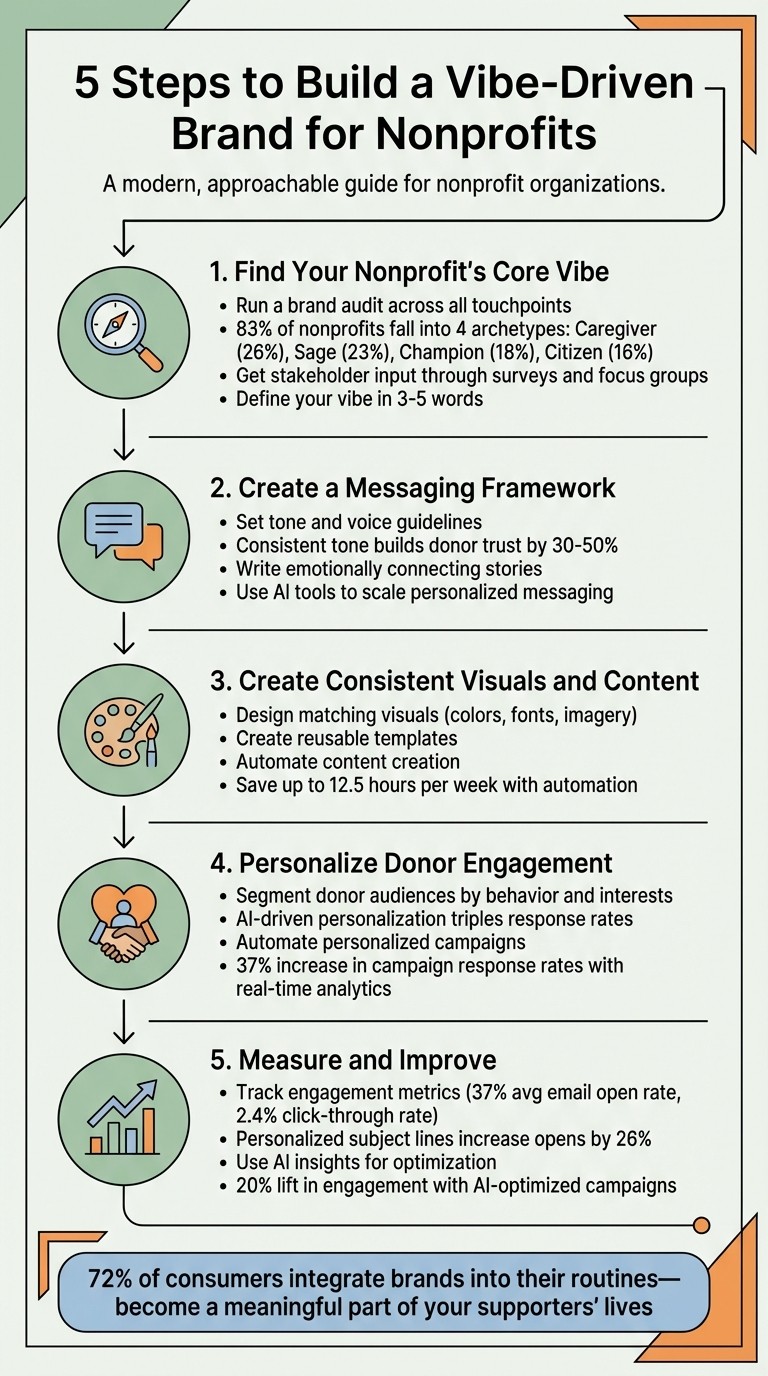
5 Steps to Build a Vibe-Driven Brand for Nonprofits
Episode 131: Branding Isn’t Your Logo: Why Nonprofits Must Evolve to Stay Relevant
Step 1: Find Your Nonprofit's Core Vibe
Your nonprofit's core vibe is the emotional energy people associate with your organization. It’s what they feel when they read a social post, open a donation appeal, or volunteer at an event. Start by asking yourself if the vibe you’re projecting really matches your mission. This means looking both inward - at your content - and outward - at how your community perceives you.
"Your brand is not just a logo and tagline. Instead, it's the emotional and strategic bridge between your organization and the people you serve." – Brand Auditors
Take a hard look at your current content and how your audience reacts to it. Then, bring your stakeholders into the loop to validate your observations and uncover any blind spots.
Run a Brand Audit
A brand audit helps identify gaps between the vibe you think you’re projecting and the one your audience actually experiences. Start by evaluating key touchpoints: your website, social media, emails, printed materials, and even phone interactions. Assemble a diverse team for the audit, including front-line staff, board members, and external stakeholders, to ensure a well-rounded perspective.
Begin with your mission, vision, and values, and then dig into your visual and verbal identity. Does your color palette evoke the emotions you’re aiming for? Is your tone of voice consistent across platforms? You can use tools like the Nielsen Norman Framework to map your brand tone across dimensions such as Funny vs. Serious, Formal vs. Casual, Respectful vs. Irreverent, and Enthusiastic vs. Matter-of-fact.
For a quick vibe check, remove your logo from content samples and see if people still recognize it as yours. If they can’t, your visual identity might need some work. To go deeper, use sentiment analysis tools to examine patterns in email responses and social media comments. Research shows that 83% of nonprofits fall into four main archetypes: Caregiver (26%), Sage (23%), Champion (18%), and Citizen (16%) [3]. Determine which archetype aligns with your core mission - whether it’s offering connection, creating stability, empowering individuals, or driving advocacy.
Use the insights from this audit to guide a broader review with your stakeholders.
Get Input from Stakeholders
Building on your audit, engage your community to uncover perspectives you might have missed. Your team, donors, volunteers, and beneficiaries often see your brand from angles you don’t. Gather feedback through surveys, interviews, and focus groups to better understand the emotional connection people have with your organization. Ask open-ended questions like, “What three words come to mind when you think of us?” or “How do you feel when you interact with our content?”
Survey staff and volunteers to check if their daily actions align with your mission and values. Internal misalignment can often show up externally - if your team doesn’t feel the vibe, your audience probably won’t either. Use social listening tools to track real-time conversations on platforms like Twitter/X, TikTok, LinkedIn, and Reddit. Dive into communities on Discord or relevant subreddits where your audience naturally gathers. Interactive tools like polls, surveys, or quizzes can also help engage your audience directly in brand decisions. Test multiple creative approaches to see which emotional tone generates the most engagement and positive reactions. Compare your visual identity and engagement metrics with similar organizations to identify areas where you can stand out. Make it a habit to revisit this process annually or during major transitions, such as leadership changes or mergers.
"Find out who you are and do it on purpose." – Dolly Parton
Distill your core vibe into 3–5 words (e.g., “Hopeful, grounded, and community-driven”) to serve as a guiding principle for all future branding decisions. This clarity will help you create a messaging framework that truly connects with your audience.
Step 2: Create a Messaging Framework That Matches Your Vibe
Building on the insights from your brand audit, this step helps translate your organization’s essence into a consistent messaging framework. This blueprint ensures that every interaction - whether it’s a newsletter, social media post, or event - delivers the same emotional experience. The goal is to align your communication style with your core vibe, creating a unified voice that resonates with your audience.
Nonprofits today are shifting away from formal, institutional messaging. Instead, they’re embracing authentic, donor-centered narratives that focus on connection rather than self-promotion [5]. It’s about moving the conversation from "what we do" to "what we can achieve together", inviting people into your mission rather than speaking at them.
Set Your Tone and Voice Guidelines
Start by documenting tone and voice guidelines that reflect the emotional goals identified in your brand audit. Think about how you want your organization to sound: should it balance warmth with authority to build trust, or lean into an energetic, inclusive tone to inspire action?
Define specific attributes that align with your vibe. For example, if your organization is "hopeful, grounded, and community-driven", your tone might be optimistic yet practical, avoiding jargon in favor of everyday language. Take Alternative Futures Group (AFG) as an example: they redefined their messaging around "purpose, people, progress", which allowed them to balance a human touch with professionalism. This approach united their teams under a shared narrative, ensuring consistent communication across all levels, from front-line staff to board members [4].
Your guidelines should also include practical advice tailored to different audiences. For instance:
For major donors, use language that’s authoritative yet warm, such as, "Together, we’re transforming lives", rather than, "We need your help."
For volunteers, adopt an energetic tone, like, "Join our movement of change-makers" [5].
Workshops can help train your team to embody this voice, creating alignment across the organization. Research shows that maintaining a consistent tone builds donor trust by 30–50% in today’s competitive nonprofit landscape [4].
Write Stories That Connect Emotionally
Once your tone is set, focus on storytelling to bring your mission to life. Real, relatable narratives are far more impactful than polished marketing language. Start with a vivid moment - a specific challenge or triumph - and connect it to the tangible outcomes of your work. For example, highlight how a farmer’s family transitioned from struggling with land loss to sustaining their livelihood, thanks to restored acreage. Then, tie the donor directly to that success: "Your support made this possible - join us" [5].
Organizations like Coffee Foundation, a mental health nonprofit launched in 2024, excel at this. Their impact page uses clear, data-driven stories paired with their Theory of Change to engage new donors [6]. Similarly, Intersectional Environmentalist fosters a sense of belonging and action through community-focused narratives [6].
Avoid overly polished imagery or tokenism. Instead, opt for authentic visuals and stories that reflect both struggles and triumphs. For example, AFG uses real photos and genuine accounts of people with disabilities, which helps build trust and evoke positivity [4]. Research shows that authentic storytelling, emphasizing results over promotion, increases empathy and donations [5].
Use AI Tools to Support Your Messaging
AI tools can be a game-changer for scaling personalized messaging while maintaining your organization’s authentic voice. Platforms like Jasper.ai allow you to generate tone-matched content by inputting keywords that reflect your vibe, such as "warm" or "optimistic." Similarly, Averi AI helps create personalized templates tailored to different audience segments, ensuring consistent yet customized messaging.
To use these tools effectively, start by inputting your core vibe and tone guidelines. For example, you could prompt: "Write an energetic story for young volunteers about our reforestation project." While AI can save time, remember to edit drafts to preserve a human touch - over-reliance on automation risks diluting emotional impact [4][5].
Here’s a practical workflow to consider:
Segment your audiences (e.g., high-value donors, first-time supporters, volunteers).
Use AI to draft tailored messages for each group.
Review and refine drafts to ensure they align with your tone guidelines.
A/B test messages to identify what resonates most with your audience.
Step 3: Create Consistent Visuals and Content
Turn your messaging framework into a cohesive visual identity and a streamlined content strategy. The goal isn't perfection but creating a recognizable and trustworthy presence. Your audience should be able to identify your nonprofit's content at a glance, even without a logo.
Design Matching Visuals
Craft a visual identity that reflects your nonprofit's essence. This includes defining your color palette, typography, and imagery. For instance, if your nonprofit conveys a "hopeful, grounded, and community-driven" vibe, you might use fresh green tones to symbolize growth and stability, pair them with rounded, approachable fonts, and feature authentic photos of real people rather than staged stock images [4][6].
Take inspiration from Alternative Futures Group (AFG), a charity care organization that built a vibrant visual identity. They used a dynamic color palette, refined typography, and genuine photography, aligning with their brand values of "purpose, people, progress" [4].
To maintain consistency, tools like Canva or Adobe Express can simplify the process. Use these platforms to create reusable templates for social media posts, email headers, and event materials. Develop 3–5 design variations and lock in your brand colors and fonts to avoid deviations. A brief training session with your team can ensure everyone knows how to use these templates effectively [6].
Once your visual identity is set, focus on streamlining content creation to match this cohesive style.
Automate Content Creation and Publishing
Manual content creation can be time-consuming and inconsistent. To keep your messaging aligned, consider using AI-powered tools to generate content at scale while maintaining your nonprofit's tone. Platforms like Averi AI can create tailored posts, emails, and more, based on your brand's defined parameters [5][7].
For example, you can integrate your visual style guide - complete with colors, fonts, and tone - into an AI tool. Set it to generate content regularly, like weekly posts or monthly newsletters. These tools can pull from stakeholder stories and mission-driven narratives to ensure every piece resonates with your audience. Add scheduling tools and A/B testing to optimize engagement, potentially saving marketers up to 12.5 hours per week [2].
The success of WaterAid’s #TeamWater campaign highlights the impact of consistent and automated messaging. By collaborating with influencers like MrBeast and using a simple "Impact Equation" ($1 = 1 Year of Water), the campaign raised over $40 million in just a few months [8].
Every visual and piece of content should reinforce your nonprofit's core vibe, strengthening the emotional connection with your community.
Step 4: Personalize Donor Engagement
Once you’ve nailed down consistent visuals and messaging, the next step is to make every donor interaction feel personal. Generic mass emails just don’t cut it anymore. Donors want to feel recognized, valued, and connected to your mission in ways that align with their own passions and reasons for giving. Personalization is about crafting interactions that resonate with each donor's unique interests.
And the effort is worth it. Studies show that AI-driven personalization can triple customer response rates compared to traditional segmentation methods [2]. Organizations using real-time marketing analytics see campaign response rates jump by 37% [2]. For nonprofits, this means you can build stronger donor relationships without needing to expand your team - a win for resource-strapped organizations. By personalizing engagement, you turn your organization’s overarching mission into meaningful, one-on-one connections.
Segment Your Donor Audiences
Effective personalization starts with thoughtful donor segmentation. Go beyond basic demographics like age and location, and focus on behaviors, interests, and giving patterns. Understanding why people give is key - some are inspired by stories of impact, others by a sense of community, and some by shared values with your organization.
Leverage tools like DonorSearch or your CRM’s analytics to identify trends in donation frequency, gift sizes, event participation, or volunteer hours. Group donors into categories such as “monthly sustainers,” “event-only supporters,” “lapsed donors,” or “major gift prospects.” Then, craft messaging that speaks directly to each group’s unique connection to your mission.
Don’t stop at donation data - track other engagement signals like email opens, website visits, social media interactions, and survey feedback. These insights can help you fine-tune your approach. Organizations that use AI for continuous refinement report about 60% faster revenue growth compared to their peers [2].
Automate Personalized Campaigns
Once you’ve segmented your donors, automation can help you scale personalization without losing the personal touch. AI platforms allow you to create tailored email sequences and social media posts for each segment, all while keeping your nonprofit’s voice authentic and consistent.
Set up automated touchpoints like welcome emails, thank-you notes (sent within 24 hours), birthday greetings, and updates on specific programs donors have supported. These messages should reference their giving history and reflect their interests [9][10].
Experiment with 6–8 variations of your messaging across different segments to see what resonates best. By integrating AI and automation into your process, you can save an average of 12.5 hours per week - time that can be reinvested in building deeper donor relationships [2].
The trick is to balance consistency with a genuine, human feel. Define your organization’s personality in 3–5 words (e.g., “hopeful, transparent, community-driven”) and ensure your AI tools reflect that tone in every interaction. Your donors should feel like they’re hearing from a trusted friend who understands their values, not just receiving another marketing email.
Step 5: Measure and Improve Your Brand's Vibe
Creating a brand that resonates emotionally isn't a "set it and forget it" task. To ensure your messaging connects with your audience, it's crucial to monitor how well it lands and adjust based on the data. With the right tools and metrics, you can track emotional engagement and fine-tune your approach.
Track Engagement and Emotional Response
Focus on metrics that reveal emotional engagement, not just surface-level interactions. Since your messaging and visuals are designed to evoke a specific vibe, these metrics help confirm if you're hitting the right emotional notes.
For instance, nonprofits typically see email open rates around 37%, with click-through rates averaging 2.4% [11]. If your numbers aren't meeting these benchmarks, it might indicate your messaging isn't resonating emotionally. Personalized subject lines can increase open rates by 26%, while tailored calls to action are 202% more effective than generic ones [14].
Dive deeper into engagement by analyzing a variety of interactions - email clicks, volunteer hours, event participation, social media shares, and even the depth of comments [15]. The share-to-impression ratio can reveal how viral your content is, while sentiment analysis of comments and messages can provide insights into how your brand is perceived. Targeted surveys can further measure trust, satisfaction, and overall perception [11][13][15].
"Effective fundraising balances analytical insights with emotional connections - use your data to reach donors and your mission to move them." – Chaz Runfola, Senior Fundraising Consultant at DonorPerfect [11].
Improve Strategies Using AI Insights
Once you've gathered engagement data, use AI tools to refine your strategies. AI can analyze A/B tests and sentiment data, providing real-time insights that help you optimize your campaigns. This approach can lead to significant improvements - AI-optimized campaigns often see a 20% lift in key metrics like engagement, conversion rates, and ROI [2].
Experiment with A/B testing on subject lines, visuals, and calls to action to identify the emotional triggers that resonate most with different donor groups [11][13]. AI-driven sentiment analysis can further refine your storytelling by revealing how audiences respond to your messaging [12]. Document these findings in a "Learning Loop System" to continuously enhance your brand strategy [2]. Teams using AI analytics can adapt to market changes five times faster than those relying on traditional methods [2], allowing you to adjust your messaging in real time as donor preferences shift.
Think of your brand's vibe as a dynamic, evolving system. Review your metrics monthly, test new ideas quarterly, and let the data shape your creative decisions. By staying in tune with donor emotions and preferences, you'll strengthen your brand, deepen connections with your audience, and ensure your mission resonates with those who care most.
Conclusion: Building a Brand That Connects
Creating a vibe-driven brand goes far beyond a logo or tagline - it's about crafting a consistent emotional experience that resonates with donors, volunteers, and supporters. The five steps outlined here - defining your core vibe, building a messaging framework, ensuring consistent visuals, personalizing donor engagement, and tracking your impact - work together to form a system that becomes more effective over time. By aligning your vibe, messaging, visuals, and engagement strategies, you create a brand that reflects the values explored throughout this guide.
Successful nonprofits recognize that consistency isn't accidental; it's built through tone, visuals, values, rituals, and community signals [1]. With 72% of consumers already integrating brands into their routines, the opportunity is clear: become a meaningful, recurring part of your supporters' lives. Pay attention to donor behavior, encourage active participation, and focus on genuine connections [1].
AI tools like Averi AI can support this process by helping you scale while maintaining consistency. Research shows AI-driven campaigns can improve conversion rates, engagement, and ROI by 20% [2], and 86% of marketers report saving at least an hour daily by using AI [2]. While AI brings efficiency, your human judgment ensures the brand’s authenticity and emotional depth. As AI enables broader access to intelligence, your ability to interpret context and uphold values becomes your competitive edge [17]. This balance between AI-powered efficiency and human insight is where strategy meets meaningful connection.
"The brands winning in 2025 are those using platforms like Averi AI to maintain their distinctive vibe while scaling their output." - Averi Academy [1]
Think of your brand as a dynamic system that grows alongside your community. Regular audits can help you maintain a consistent tone, recognizable visuals, and actions that stay true to your principles [1]. By applying the 60-30-10 rule - dedicating 60% of your AI usage to proven strategies, 30% to refining current resources, and 10% to exploring new tools [16] - you can deepen relationships and keep your brand evolving.
FAQs
How do we define our nonprofit’s core vibe?
Defining your nonprofit's core vibe involves pinpointing the emotional energy and personality your organization radiates, as well as how it resonates with your audience. To craft this connection, focus on five essential elements: tone, visuals, values, rituals, and community cues. Together, these components shape a brand that taps into emotion, storytelling, and shared experiences to build loyalty and connection. By aligning these elements with your mission, you can cultivate genuine relationships and a deep sense of belonging within your community.
How can we keep our brand consistent across channels?
To ensure your brand stays consistent across all channels, aim for a unified "vibe" that genuinely connects with your audience. Harmonize essential elements like tone, visuals, values, rituals, and community signals across every platform. Leverage AI tools to streamline and standardize content creation, helping maintain consistent messaging and imagery. Develop clear brand guidelines, implement structured workflows, and routinely review content to foster trust and maintain a cohesive, recognizable brand presence.
What should we track to measure emotional engagement?
To understand emotional engagement, pay attention to metrics that highlight how your audience feels about and relates to your brand. Look for emotional cues such as connection, loyalty, or a sense of belonging. These can be identified through sentiment analysis, in-depth feedback, and the level of interaction with your content. Dive into audience comments, track shares, and note personal stories they share about your brand. Tools like surveys and sentiment analysis platforms can help you measure changes in how your brand is perceived. Combine both numbers and personal insights to get a full picture of your emotional impact.
Related Blog Posts

Zach Chmael
CMO, Averi
"We built Averi around the exact workflow we've used to scale our web traffic over 6000% in the last 6 months."
Your content should be working harder.
Averi's content engine builds Google entity authority, drives AI citations, and scales your visibility so you can get more customers.