

In This Article
Vibe-driven real estate brands turn listings into emotional experiences with targeted personas, storytelling, consistent visuals, and AI personalization.
Updated:
Trusted by 1,000+ teams
Startups use Averi to build
content engines that rank.
In real estate, success often hinges on more than just facts about properties - it's about creating an emotional connection. A vibe-driven brand transforms listings into lifestyle experiences, helping buyers envision their future. Here's how to make it work:
Understand Your Audience: Define target personas based on their needs (e.g., first-time buyers, families) and focus on the emotions they seek, like confidence or belonging.
Craft a Unique Selling Proposition (USP): Clearly communicate what sets you apart, such as a specific expertise or approach.
Tell Stories: Use testimonials, vivid narratives, and property visions to build trust and help buyers imagine their lives in the space.
Maintain Consistency: Ensure your brand's visuals, voice, and messaging are aligned across all platforms.
Leverage AI: Automate tasks with an AI content engine for personalization to save time while staying on-brand.
Real Estate Branding Statistics: Online Search, Agent Competition, and Content Performance
Building a Real Estate Brand that Becomes the Market
Define Your Brand's Core Identity
To forge lasting relationships with clients, focus on defining your brand's core identity. This identity shapes how clients perceive you, builds trust, and communicates who you serve, what you stand for, and the emotions you evoke throughout the buying or selling journey.
Identify Your Target Personas
Begin by studying your current clients. Pay attention to the questions they ask most often. For instance, if many inquire, "How much do I need for a down payment?" you're likely working with first-time buyers who need guidance and reassurance. On the other hand, questions about school districts or local amenities suggest you're helping families who prioritize community and stability.
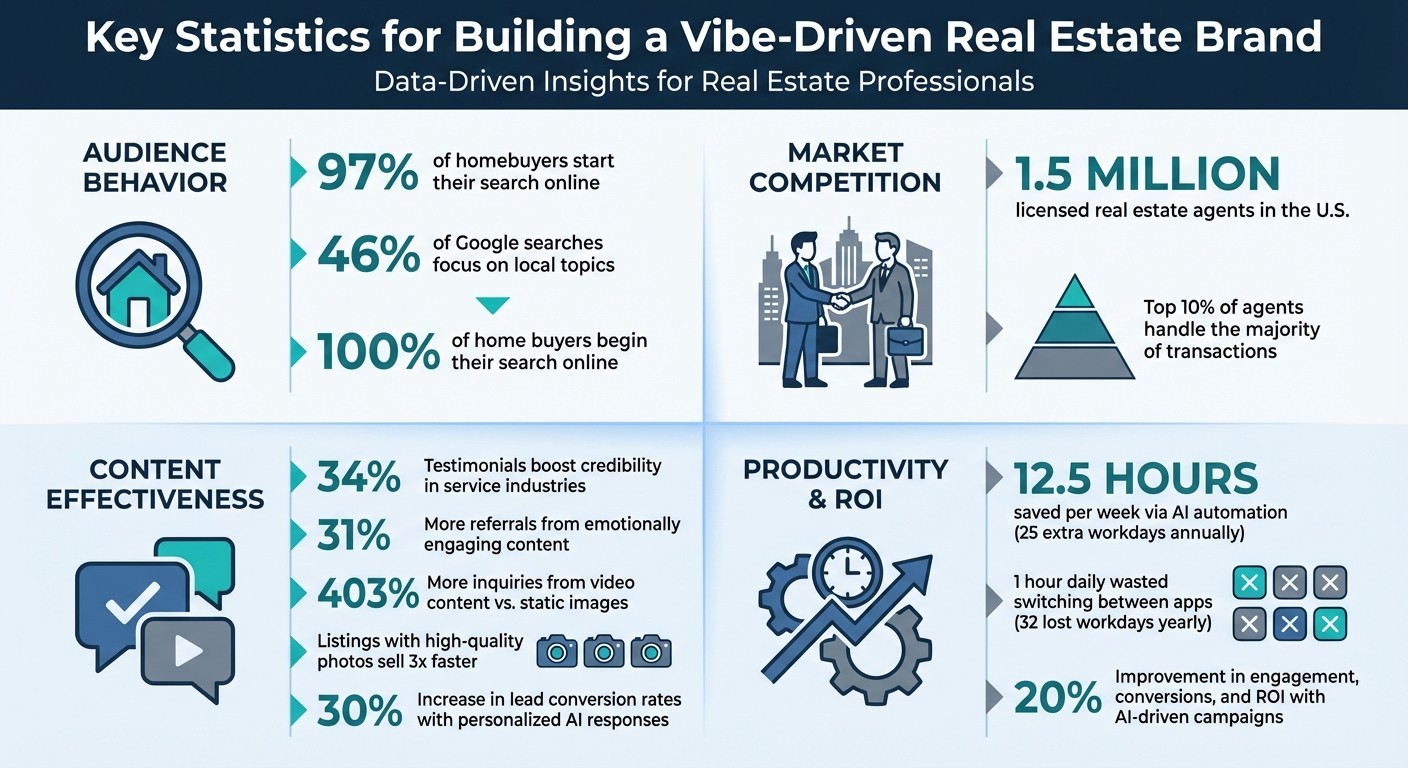
Expand your understanding beyond direct interactions. Attend local events like school board meetings or neighborhood gatherings, and use tools such as Answer The Public to discover what people in your area are searching for online. Considering that 97% of homebuyers start their search online and 46% of Google searches focus on local topics, these insights provide a clear window into your audience's priorities.
Define your personas based on transaction types (e.g., first-time buyers, downsizers, investors), life stages (young professionals, retirees), and geographic areas (specific neighborhoods or school districts). Equally important, identify your "anti-audience" - the clients you don't serve, such as investors seeking off-market deals. This clarity ensures your efforts are focused where they matter most, sharpening your appeal and avoiding wasted energy on mismatched leads.
Establish Emotional Triggers
Once you've identified your audience, decide on the core emotion your brand should evoke. Are you instilling confidence in first-time buyers who feel overwhelmed? Helping families feel a sense of belonging in a new community? Or creating excitement for luxury buyers seeking something extraordinary?
Every aspect of your branding should align with this emotion. Choose colors and fonts that reflect the desired feeling - soft pastels and serif fonts for warmth and elegance, or bold colors and clean sans-serifs for a modern, luxurious vibe. Define a primary brand personality (like "Patient Teacher" or "Calm Guide") and a complementary secondary trait to ensure your messaging feels human and consistent across all platforms.
Craft Your Unique Selling Proposition
With over 1.5 million licensed real estate agents in the U.S. - and the top 10% handling the majority of transactions [3] - your unique selling proposition (USP) must stand out. Use this framework to clarify your positioning:
"For [target audience] who [situation/need], [Your Brand] is the [category] that [key benefit] because [reason to believe]."
For example:
"For first-time buyers in Portland who feel overwhelmed by the process, Sarah Chen Real Estate is the patient guide that turns confusion into confidence because we prioritize education before transaction."
Your USP should spotlight a specific, observable approach - like guaranteeing video walkthroughs within 24 hours of a showing or focusing exclusively on historic homes built before 1950. Test its effectiveness by removing your logo and seeing if someone could still identify your brand. A strong USP not only communicates what you do but also why you do it and who you do it for, ensuring your ideal clients feel you're speaking directly to them.
Use Storytelling to Build Emotional Connections
Data may provide the details, but stories create the emotional pull that sells. Buyers don’t just want to know about square footage or school districts - they imagine their mornings in a sun-soaked kitchen or evenings in a neighborhood park. By weaving these vivid narratives into your listings, you can show that you understand their hopes and dreams, building trust and standing out in a competitive market. These emotional connections not only attract clients but also foster loyalty and word-of-mouth referrals.
Share Real Client Testimonials
Few things build trust like hearing real stories from people who’ve walked the same path. Testimonials bring a human element to high-stakes decisions, offering reassurance and credibility. When potential buyers hear others describe their journey - whether it’s overcoming the stress of financing or finding the perfect home - they feel a sense of relief and connection. Research shows that testimonials can boost credibility by up to 34% in service industries, and emotionally engaging content generates 31% more referrals [4].
For example, a luxury real estate agent shared a video testimonial from a first-time buyer who went from feeling overwhelmed to ecstatic after closing. The relatable story, paired with engaging visuals, increased inquiries by 25% on Instagram [5]. Another agent highlighted a family’s transition to their dream home, a story that not only humanized their brand but also led to consistent referrals and enhanced visibility on social platforms.
Short, impactful videos - 30 to 60 seconds long - are particularly effective. Capture moments like a client receiving their keys or celebrating a successful bid. Share these clips on Instagram Reels, LinkedIn, or email newsletters, and integrate them into landing pages or blog posts. Encourage clients to tag your brand in their "closing day" photos to generate authentic content that resonates with potential buyers while boosting your social presence.
Next, bring your listings to life by crafting property visions that inspire.
Showcase Property Visions
Turning a house into a home for potential buyers means going beyond the features list. Instead of just mentioning amenities, paint a picture of the lifestyle the property offers. Think phrases like, “Wake up to breathtaking bay views,” or “Enjoy evenings with friendly neighbors in a vibrant community.” These narratives help buyers see themselves living in the space, making the property feel more personal and desirable.
Take inspiration from Oglebay Park Resort, which reimagined its branding to highlight its appeal as a "national destination." By using stories and visuals that evoked adventure and nostalgia, the resort shifted its image from a local getaway to a sought-after experience. Similarly, a condo project marketed as an "urban oasis" attracted young professionals by promoting a “work-hard-play-hard” lifestyle through 3D renders and engaging social media content.
To create compelling property visions, start by learning about your audience. Conduct surveys or interviews to understand what matters most to different groups - whether it’s millennials, families, or retirees. Use this insight to craft vibrant narratives, paired with immersive visuals like virtual tours or neighborhood walkthroughs. Share these visions across your website, email campaigns, and even in-person events to ensure every interaction reinforces the story you’re telling, whether it’s about “relaxed luxury” or “dynamic city living.”
Finally, use storytelling to address the challenges your clients face head-on.
Address Client Pain Points Through Stories
The home-buying process can be overwhelming, with stress about finances, relocation, or navigating a competitive market. These challenges are opportunities to connect with your audience by sharing stories that show how you’ve helped others overcome similar hurdles. Framing these experiences as hero’s journeys - where clients move from frustration to joy with your guidance - positions you as a trusted partner rather than just another salesperson.
For instance, a story titled "From Overwhelmed to Overjoyed: A First-Time Buyer's Journey" could outline how your expertise turned a daunting 45-day search into a smooth 20-day process. In one example, this approach led to a 15% increase in leads [5], as it showcased both problem-solving skills and empathy.
To uncover these pain points, conduct interviews or post-closing surveys to understand what kept your clients up at night. Then, create content that addresses these concerns - whether it’s educational pieces on financing, behind-the-scenes looks at your process, or insights into market trends. Share these stories through blogs, social media, and email campaigns to align with your brand’s voice and connect emotionally with your audience. By addressing their fears and frustrations, you’ll position yourself as the guide they can trust.
Design a Unified Brand Identity
To make a lasting impression, your brand needs a consistent look and feel across every platform. Whether it’s a social media post, an email, or a billboard, people should instantly recognize your brand. This kind of consistency builds familiarity and trust - two critical factors in real estate, where decisions often carry significant emotional and financial weight.
Develop Visual Elements
A strong visual identity speaks volumes without saying a word. Elements like colors, fonts, and imagery set the tone for your brand. For instance, pastels can create a calming effect, while bold colors exude energy and confidence. Typography also plays a key role: rounded, chunky fonts feel approachable, thin serif fonts convey sophistication, and cursive styles add a touch of elegance or luxury [1].
Take inspiration from AOR's branding work with Greystar Development and Metlife on "The Calo", a residential project in Utah. By incorporating visuals inspired by the state flower and a nature-based color palette, the branding evoked trust and aligned with the lifestyle they wanted to promote [7]. The takeaway? Your visual choices should resonate with your audience’s aspirations and reflect the story you’re telling.
Start by performing a visual coherence check. Remove your logo from a few pieces of content and ask someone unfamiliar with your brand if they can still identify it as yours [1]. If they can’t, it’s time to refine your visual elements. Create a brand guide that outlines your primary and secondary colors, preferred fonts, and imagery styles. For example, you might opt for bright, airy photos for family homes or darker, dramatic visuals for luxury estates. This guide will act as your go-to resource, ensuring every piece of content aligns with your brand identity.
Establish a Consistent Voice
While visuals grab attention, your brand’s voice keeps people engaged. This is the tone and language you use across all touchpoints, creating a sense of familiarity no matter where someone interacts with your brand [8]. A consistent voice builds trust and strengthens connections.
"Consistency in tone and voice is absolutely essential for trust-building. Whether through email, social media, or face-to-face interactions, your audience should always feel like they're interacting with the same entity." - Sara Levy-Lambert, Awning [8]
Start by defining your brand personality. Choose a few traits that reflect your target audience and your style. Are you professional and authoritative? Friendly and approachable? Maybe innovative and forward-looking? Cheryl Towey, a real estate agent, nailed this balance by using the tagline "Real Estate Rooted in Trust, Expertise & Results" across her platforms. She paired it with a personal story about returning to her New Jersey roots, blending professionalism with warmth [9].
Next, create a voice guide to keep your communication consistent. Include dos and don’ts, examples of preferred phrases, and words to avoid [6]. For instance, if you cater to first-time buyers, use conversational phrases like “Let’s find your perfect fit” instead of formal language like “We facilitate optimal real estate transactions.” On the other hand, if you’re in the luxury market, adopt a polished tone that reflects exclusivity. The goal is to ensure that every interaction - whether it’s a blog post, a DM, or a conversation at an open house - sounds unmistakably like your brand.
Finally, assess your existing materials. Review your website, social media profiles, and marketing collateral to ensure your voice is consistent across the board [9]. If you notice discrepancies, update your content to align with your brand guide. This kind of consistency can transform casual visitors into loyal clients who trust your expertise.
Use AI Tools to Automate and Personalize Content
Creating a brand that resonates deeply means delivering consistent, vibe-aligned content across all channels - whether it's social media, email campaigns, blog posts, or property descriptions. AI tools can take over repetitive tasks, ensuring your brand’s voice and emotional tone remain intact.
The trick lies in selecting tools that complement your efforts. Platforms like Averi AI blend automation with human oversight, ensuring the content feels genuine, not mechanical. With clear guidance, AI can handle research, drafting, and even publishing, laying a solid foundation for refining workflows and delivering more personalized content.
Automate Content Marketing Workflows
Traditional content creation often involves juggling multiple tools. AI workspaces simplify this by combining everything into one streamlined platform. For example, Averi AI automates tasks like market research, topic selection, and scheduling, saving up to 12.5 hours per week - equivalent to gaining 25 extra workdays annually [2]. For real estate agents, this time can be redirected toward client interactions, property tours, or strengthening relationships.
Unlike standalone tools like Jasper or Copy.ai, which require manual oversight and separate publishing steps, AI workspaces offer built-in quality checks and direct CMS integration. Averi’s AGM-2 model generates hyper-localized content, while its Human Cortex feature connects with over 2,500 experts to ensure regional accuracy and brand consistency - especially crucial when marketing properties across varying price ranges.
Automating workflows doesn’t just save time; it also boosts results. Real estate brands using AI-driven campaigns have reported a 20% improvement in areas like engagement, conversions, and ROI [2].
Personalize Client Engagement
Generic messaging often fails to connect emotionally. AI thrives at crafting tailored content for specific client profiles, whether it's first-time buyers focused on affordability or high-end clients seeking exclusivity. For instance, AI receptionists can adjust scripts based on client preferences and market trends, making interactions feel immediately relevant [10].
Businesses leveraging personalized AI responses have seen a 30% jump in lead conversion rates [10]. Imagine a potential client asking about family-friendly neighborhoods. AI can instantly follow up with information on school ratings, nearby parks, and parent testimonials - without requiring manual input.
"The goal here is to make the whole process of buying or selling a home less of a headache for everyone involved. AI handles the repetitive stuff so agents can focus on the important parts, like building relationships and closing deals." - My AI Front Desk [10]
AI can also qualify leads by collecting details like budget, timeline, and location preferences, categorizing them into hot, warm, or cold leads before they reach you [10][11]. This ensures your time is spent with clients ready to act, while automated follow-ups nurture others until they’re prepared to move forward.
Scale Storytelling with AI
Storytelling is the heart of a strong brand, but crafting unique narratives for every listing, blog, or social post can be exhausting. AI tools simplify this by scaling storytelling efforts while maintaining your brand’s tone. Averi’s Brand Memory feature learns your style, ensuring every piece stays on-brand.
This consistency is especially vital for teams spread across multiple agents or offices, preventing mismatched messaging. The Synapse system automates research, writing, and publishing, reducing turnaround times from days to hours. This allows you to react to market shifts five times faster than traditional workflows [2].
Additionally, Averi's Command Bar makes repurposing content effortless. Write a single neighborhood spotlight, and the AI reformats it for platforms like Instagram, LinkedIn, email newsletters, and blogs - each version optimized for its audience while keeping the core message intact. Over time, as your content library grows, the AI learns and improves, strengthening future outputs and amplifying your brand’s storytelling power.
Maintain Consistent Branding Across All Channels
Once you've established a unified brand identity and narrative, consistency across platforms becomes the glue that holds it all together. In real estate, clients often pick their agent before they even start looking at properties [3]. A seamless brand presence - whether it’s on Instagram Reels, email newsletters, or open house signage - instills the kind of trust needed for clients to make major financial decisions. This isn’t just about keeping things visually aligned; it’s about building and maintaining credibility. Consistency reinforces the identity you’ve worked so hard to create.
Brand recognition doesn’t happen overnight - it’s the result of years of steady messaging, visuals, and service [3]. Imagine a luxury agent who shares polished property tours on LinkedIn but then sends out casual, unpolished emails. That kind of mismatch stands out, creating a disconnect that can erode trust faster than a bad review.
On top of that, professionals waste about an hour each day switching between apps, which adds up to a staggering 32 lost workdays every year [2]. For real estate teams juggling tools like Canva, Mailchimp, and multiple social media schedulers, this constant tool-switching not only eats into productivity but also increases the risk of inconsistent branding. Over time, these small inconsistencies in tone, visuals, or messaging can undermine your brand.
Create Multi-Channel Brand Assets
To avoid these pitfalls, start by developing a cohesive visual language that works across every platform. For example, if your brand is all about being the "friendly neighborhood expert", stick to a pastel color palette and rounded fonts - not just on your website, but everywhere [1]. Consistency in design helps reinforce the emotional tone you want to convey.
Centralizing your assets in one workspace can make a huge difference. Instead of exporting designs from one tool and reformatting them for each platform, solutions like Averi AI allow you to create content once and adapt it seamlessly for different channels without losing your core message. Regularly reviewing your workflow - identifying where you’re losing time or encountering bottlenecks - can also help you stay consistent [2].
Once your visuals are unified, the next step is ensuring that your messaging aligns across every platform.
Implement Cross-Platform Strategies
Each platform has its own unique style and format requirements, but your core message should remain the same. For instance, a property listing could be shared as a 30-second Instagram Reel during peak evening hours, a professional LinkedIn carousel during business hours, or a detailed newsletter on a Tuesday morning [1]. The format may shift, but the tone and vibe should always feel familiar.
Consistency helps turn your brand into a reliable presence in your clients’ lives. Real estate agents who provide regular, value-driven updates - like market insights through newsletters - build loyalty that lasts long after a single transaction. This is why personal branding matters so much; clients often choose the person behind the brokerage [3].
Tools like Averi make it easier to maintain this level of consistency by learning from your previous content. As you build a library of assets, the system refines its outputs to better align with your tone and style. By late 2025, nearly half of Fortune 500 companies were embracing vibe marketing, focusing on emotional clarity over traditional advertising [1]. Real estate professionals who prioritize cross-platform consistency today are setting themselves up to lead their local markets well into the future.
Conclusion
Looking back at the strategies we've explored, creating a vibe-driven brand goes beyond simple transactions - it builds lasting relationships. When you establish an emotional identity that resonates with clients at every touchpoint, you’re not just selling properties; you’re cultivating trust that turns first-time buyers into loyal advocates. This means defining your core values, telling genuine stories, and ensuring a cohesive visual presence - whether it’s on Instagram or a yard sign.
Consider this: listings with high-quality photos sell three times faster, and video content generates 403% more inquiries than static images [13]. While visuals are critical, they’re only part of the picture. As Carrie Little from CarMarc Realty Group wisely noted:
"AI is a tool that enhances your business while preserving the essential human touch." [12]
Striking that balance between technology and authenticity is what separates brands that leave an impression from those that fade away.
AI tools like Averi can amplify your storytelling while keeping your voice intact. They take care of tasks like research, drafting, and distributing content across platforms, leaving you free to focus on what truly matters - strategic decisions and nurturing client relationships. With 100% of home buyers beginning their search online [14], your brand needs to show up consistently and meaningfully in the moments that count.
The top real estate professionals today aren’t just selling homes - they’re creating seamless brand experiences. Whether clients encounter your content on LinkedIn in the morning or see a Reel late at night, the message feels connected and intentional. Achieving this requires a strategic blend of emotional storytelling and smart technology that reduces friction.
Start by defining your brand identity, weave in stories that connect, and use AI to maintain consistency. The agents who succeed aren’t just the ones who show up often - they’re the ones who show up with clarity and purpose. That’s the power of a vibe-driven brand.
FAQs
How do I figure out my brand’s “vibe”?
To pinpoint your brand’s "vibe", consider the emotional and social energy it radiates. This involves looking at key aspects like tone, visuals, values, rituals, and the signals your community sends out. Together, these elements shape a compelling presence that connects deeply with your audience.
Knowing your audience's preferences and lifestyle is essential. By weaving storytelling and meaningful insights into your brand's identity, you can create a unified image that sparks emotional bonds, encourages loyalty, and makes your brand stand out effortlessly.
What’s the fastest way to make my listings feel like a lifestyle?
AI-powered tools offer a powerful way to create content and visuals that strike an emotional chord with potential buyers. With AI, you can craft polished imagery, compelling neighborhood stories, and lifestyle-driven narratives that make your listings stand out. Combine these efforts with vibe marketing strategies - such as consistent storytelling tailored to the local area and dynamic content campaigns - to foster a genuine connection with your audience. These techniques help buyers picture themselves living in the home, driving up engagement and sparking interest more effectively.
How can I use AI without sounding fake?
To make the most of AI while staying true to your brand's identity, focus on building emotional connections and sharing real, relatable stories. AI is great for speeding up processes, but it can't replicate the depth of real human experiences. By showcasing your unique values, using a tone that reflects your personality, and crafting narratives that resonate, you can avoid creating content that feels impersonal or overly polished. When you pair AI's efficiency with genuine human insight, your brand will come across as more relatable and emotionally engaging, helping you connect with your audience on a deeper level.
Related Blog Posts

Zach Chmael
CMO, Averi
"We built Averi around the exact workflow we've used to scale our web traffic over 6000% in the last 6 months."
Your content should be working harder.
Averi's content engine builds Google entity authority, drives AI citations, and scales your visibility so you can get more customers.