How to Create Editorial-Led Growth for Healthcare & Wellness

Averi Academy
Averi Team
8 minutes

In This Article
Build patient-centered, medically reviewed content that drives organic growth: define personas, map journeys, ensure medical accuracy, and optimize for SEO and AI.
Updated:
Trusted by 1,000+ teams
Startups use Averi to build
content engines that rank.
Healthcare and wellness brands face a growing challenge: people increasingly distrust ads and seek reliable, well-researched information online. With 7% of Google searches being health-related and 75% of Americans turning to the internet for health advice, there's a clear demand for content that educates and informs. However, 52% of the population doubts the credibility of online health information, creating an opportunity for organizations to step in with trustworthy content.
This article explains how to create patient-centered, medically accurate content that builds trust and drives growth. Key strategies include:
Define Patient Personas: Understand who your audience is, their concerns, and how they search for information.
Develop Content Pillars: Focus on themes like preventive care and symptom-based education to address patient needs.
Align Content with Patient Journeys: Tailor content formats - such as blog posts, videos, or testimonials - to different stages of the decision-making process.
Ensure Medical Accuracy: Collaborate with licensed professionals and cite respected sources like the CDC or Mayo Clinic.
Optimize for SEO and AI Platforms: Use clear summaries, bullet points, and schema markup to rank well in search engines and AI-driven tools.
Streamline Content Production: Leverage AI tools or freelancers to create high-quality content efficiently while maintaining quality control.
Measure and Improve: Track metrics like organic traffic, engagement, and conversions, and refresh underperforming content regularly.
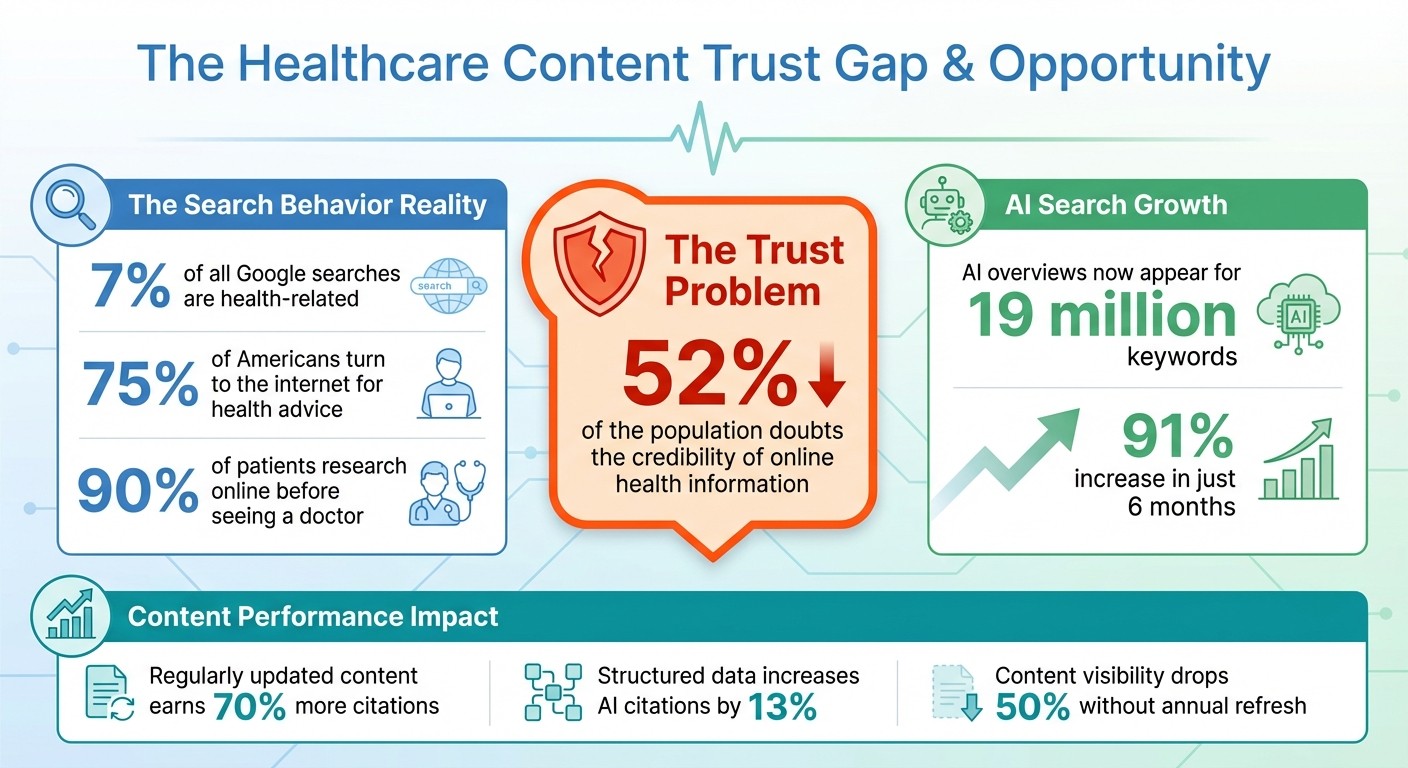
Healthcare Content Marketing Statistics and Trust Gap
How To Amplify Healthcare Marketing With AI Content Strategy
Building Your Editorial Strategy Foundation
Before diving into content creation, it’s essential to lay down a solid editorial framework. This groundwork ensures your efforts align with both the needs of your patients and your business objectives.
Define Patient Personas and Content Goals
Start by crafting detailed patient personas. These should capture key aspects like health concerns, typical search behaviors, and triggers that influence decision-making. For instance, a persona for a midlife woman might include symptoms such as night sweats or brain fog, outline her search queries like "is this normal for my age?", and note her preference for short videos or concise articles.
Each persona should be tied to specific content goals. For example, if your aim is to raise awareness among patients who haven’t yet been diagnosed, focus on "secondary searches." These are queries where users describe symptoms without knowing the underlying condition. Someone searching for "Why am I constantly seeking reassurance?" may not realize they’re experiencing OCD symptoms yet [1]. By addressing these searches, you position your organization as a trusted source early in the patient’s journey.
With personas established, the next step is to define your content themes.
Identify Content Pillars and Themes
Choose three to five main content pillars that reflect your expertise, address patient challenges, and fill gaps in the market. Popular pillars include preventive care, managing chronic conditions, and sharing patient success stories [2]. Take Midi Health as an example: their focus on midlife health led to content like "how to get rid of meno belly." With fewer than 30 well-researched, medically reviewed articles, they attracted nearly 500,000 visits and ranked in the top 10 for about 2,000 keywords [1].
In addition to these pillars, consider secondary themes that tackle questions patients ask before they have a diagnosis. Covering these "secondary intent" topics helps establish authority and connects with patients where they are in their journey. To boost visibility in AI-driven search results, use clear summaries, bullet points for key takeaways, and schema markup - an approach shown to increase citations by 70% [4].
Map Content to the Patient Journey
Once your personas and themes are in place, align your content with the patient journey. Tailor formats to the specific stages of their experience. At the awareness stage, focus on symptom-based blog posts that answer early, straightforward questions. For the consideration stage, provide comparison guides, expert videos, or detailed "how-to" articles to help patients weigh their options. At the decision stage, include patient testimonials, booking links, and clear calls to action to encourage conversions.
Sung Jo, Acquisition Marketing Lead at Descript, demonstrated the power of this approach by working with AirOps to refresh over 1,000 existing content pieces. The result? A 35% boost in organic traffic and a 33% rise in LLM (AI search) visibility within just 60 days [3][4].
Creating and Optimizing Content
Producing content that earns trust and enhances discovery requires a careful balance between clinical accuracy and approachable language. The content must cater to both traditional search engines and the newer AI-driven platforms.
Conduct Keyword and Topic Research
Start by identifying the top 20 questions patients ask about each condition - this list serves as your content blueprint [5]. The key is to translate medical jargon into terms patients can easily relate to. For instance, someone searching for "how to get rid of meno belly" is likely seeking guidance on what a clinician might describe as "managing abdominal weight gain during menopause" [1].
AI tools can simplify and speed up this research process. For example, in 2025, the telehealth platform Wyndly boosted its organic traffic from 10,000 to 200,000 monthly clicks - a 20x jump - by automating content research based on expert-led videos. These technologies can also help identify content gaps by comparing your website with competitors, ensuring your content remains both relevant and competitive [6]. This research is the foundation for creating material that is both authoritative and engaging.
Ensure Medical Accuracy and Trust
With 90% of patients conducting online research before seeing a doctor, every piece of content either builds or diminishes trust [7]. To ensure credibility, align all information with respected sources such as the CDC, WHO, NHS, Mayo Clinic, or peer-reviewed journals [7][8]. As Derek Flanzraich, founder of Greatist, emphasizes:
"The days of poorly written long-tail content stuffed full of keywords is over. Actually helpful, well-researched, medically reviewed content that deserves to rank #1 are typically the ones that do" [1].
Use automated tools to verify that AI-generated content cites original sources accurately and avoids misinformation [11]. Additionally, all clinical or treatment-related articles should be reviewed by licensed professionals before publication [8]. Highlight "last updated" dates prominently, include detailed author bios with credentials, and replace generic stock images with authentic visuals or patient testimonials [7][8]. This approach not only builds trust but also improves visibility on both search engines and AI platforms.
Optimize for SEO and AI Visibility
AI overviews now dominate over 19 million keywords, reflecting a 91% rise in just six months [10]. To take advantage of this, structure content with concise summaries, bullet-point takeaways, and lists [1]. Use a conversational tone, incorporating "if/then" statements to make complex ideas easier to grasp [1].
Additionally, create content that addresses pre-diagnosis questions. By delivering medically reviewed, accessible answers at this early stage, your organization becomes a trusted resource during a critical point in the patient journey. This strategy not only supports patients but also positions your content to rank well across both traditional and AI-driven platforms.
Building an Efficient Content Production Workflow
Organizations face a tough decision when it comes to content production: hire an in-house team, pay agencies $10,000–$20,000 a month, or lean on AI tools and freelancers [3]. The biggest hurdle? Workflow inefficiencies. Research shows that 52% of content created by Fortune 500 companies remains unused, while marketing teams lose up to 16 hours weekly in meetings and manual processes [3]. Addressing these inefficiencies is critical when deciding on the right content creation strategy.
Choose Your Content Creation Approach
Different AI tools for content marketing and approaches cater to varying needs:
AI Workspaces: Platforms like Averi combine AI's speed with human review checkpoints. This approach works well for industries like healthcare, where consistent output is essential but expanding staff isn’t feasible.
Point Tools: Solutions like Jasper or Copy.ai are great for quick drafting and brainstorming. However, they often require additional manual review and lack integration with systems like CMS or CRM platforms.
Freelancer Marketplaces: Options like Fiverr are suitable for one-off projects, though quality and turnaround times can vary [3].
For instance, companies leveraging AI workflows have achieved over 5x growth in signups without increasing team size [4]. The secret? Streamlined workflows, not just adding more people.
Establish Quality Control Processes
When it comes to healthcare content, quality control starts with ensuring medical accuracy while maintaining a clear brand voice and readability. Start by creating detailed standard operating procedures (SOPs) that outline responsibilities for reviewing clinical claims, verifying tone, and approving final drafts [5]. Utilize tools like Brand Kits within your AI platform to ensure empathy, approved terminology, and compliance are baked into your content [3]. Setting clear service-level agreements (SLAs) for medical reviews can also keep things moving efficiently.
Use AI-Powered Tools for Workflow Automation
Once processes are in place, AI-powered platforms can streamline the entire production pipeline. For example, Averi AI handles everything from topic research and drafting to SEO optimization, while keeping human oversight at key quality checkpoints. This is especially useful for small teams, as 65% of marketers identify research and ideation as the most time-consuming parts of their workflow [3].
Other tools can further enhance efficiency:
AirOps: Focused on Answer Engine Optimization (AEO), helping your content gain visibility in AI-driven search results like ChatGPT and AI overviews [4].
Workflow Orchestrators: Tools like Zapier, Make, and n8n integrate AI drafting solutions with CMS, CRM, and analytics systems [11].
For example, Aha, a product roadmap company, increased its content output by 5x while maintaining 99.9% accuracy by implementing structured quality gates [3]. As Bret Taylor, Chairman of the Board at OpenAI, puts it:
"You don't want to start developing experience once it's perfect - because your competitor will have already proven it works." [3]
The goal isn’t perfection from the start - it’s about building a system that improves with each iteration.
Measuring and Improving Performance
Once you've fine-tuned your production workflow, the next step is to track outcomes and refine your strategy. The ability to measure results and make data-driven adjustments is what sets thriving healthcare organizations apart from those that stagnate. As Stewart Gandolf, CEO of Healthcare Success, aptly puts it:
"You can't manage what you can't measure. With a healthcare content strategy, you can plan and schedule deliverables, monitor results, and measure against expectations" [2].
Define Key Performance Metrics
To start, group your metrics into three main categories: cost, utilization, and performance [2]. For performance metrics, align them with the patient's journey. At the awareness stage, focus on metrics like organic traffic, social media engagement, and impressions from blog posts or infographics. During the consideration stage, track downloads, email signups, and click-through rates on case studies or comparison guides. Finally, at the conversion stage, measure SQLs (sales-qualified leads), appointment bookings, and conversion rates from tools like ROI calculators or product demos [2].
Set up automated alerts for content that sees a drop of over 20% month-over-month in performance - this can signal the need for a refresh [9].
Use Analytics to Adjust Your Strategy
Performance data can reveal areas ripe for improvement. For example, a content refresh at Descript led to a 35% boost in organic traffic and a 33% increase in visibility within 60 days [4][3]. Similarly, Webflow improved its workflows and saw click-through rates rise by 15-30% within days of updating older content [4]. Studies show that content visibility can drop by 50% if it isn’t refreshed at least once a year [4].
Focus your updates on high-impact, bottom-of-the-funnel content, such as treatment comparison guides, rather than top-of-the-funnel educational pieces. These updates can yield more tangible results [11].
Scale Content Efforts Over Time
Scaling content requires building systems that deliver compounding results. Use performance data to identify winning strategies, then automate repetitive tasks to free up resources. For instance, implementing structured data and rich schema can increase earned citations in AI-driven searches by 13% [4], while regularly updated content earns 70% more citations [4].
Leverage a reusable knowledge base - such as case studies, subject matter expert transcripts, or proprietary data - to enable AI tools to streamline production [11]. The ultimate goal is to create a self-improving system: each published piece generates insights that refine future content, making every cycle smarter and more effective. This approach strengthens your editorial strategy and drives consistent growth in patient engagement.
Conclusion
Editorial-driven content lays the groundwork for consistent patient acquisition and long-term trust. As advertising costs on platforms like Google and Facebook continue to rise, creating high-quality organic content offers a dependable way to sustain revenue over time [1]. By addressing specific patient needs at the exact moment they’re searching for answers, you tap into intent that no advertising budget can replicate.
Organizations that succeed in this space document their strategies, engage clinicians early to meet E-E-A-T standards, and establish systems that build momentum over time. These essential steps naturally pave the way for more advanced techniques, such as Answer Engine Optimization.
Answer Engine Optimization ensures your content performs well not only in traditional search engines but also in AI-driven tools like ChatGPT and Google AI Overviews [4]. Well-crafted, optimized content boosts organic traffic and strengthens visibility in AI-powered search.
Key steps to remember include defining patient personas, mapping their journey, ensuring medical accuracy, and optimizing with AI tools. Platforms like Averi AI can streamline research, drafting, and content distribution, allowing your team to concentrate on strategy and expert reviews instead of repetitive tasks.
By applying these strategies, you can turn content marketing into a reliable, self-sustaining growth engine. As Christina Farr and Derek Flanzraich from Second Opinion emphasize:
"Building trust through content isn't just a nice-to-have - it's a must-have. The companies that invest now will have a defensible moat, a loyal audience, and a sustainable path to growth" [1].
The time to start building that moat is now.
FAQs
How do I pick the right patient personas?
To identify the most effective patient personas, start by diving deep into your audience's needs, habits, and preferences. Gather insights on demographics, common health conditions, motivations, and obstacles they face in accessing care. Craft content that resonates with each group by offering resources they value, such as educational articles or personal testimonials. Well-developed personas not only foster trust and engagement but also ensure your content stays aligned with patients' changing needs through continuous research and feedback.
What makes health content medically trustworthy?
Medically reliable health content stands on a foundation of evidence drawn from peer-reviewed studies, established clinical guidelines, and expert agreements. It is either developed or carefully reviewed by qualified healthcare professionals to maintain its accuracy. Trustworthiness is further reinforced by being transparent about sources, adhering to standards such as HIPAA, and using a clear, empathetic tone. Instead of resorting to sensationalism, dependable health information prioritizes accuracy and offers practical, actionable advice to help individuals make well-informed decisions.
How can I measure content-driven patient growth?
To gauge the impact of content on patient growth, focus on key metrics such as website traffic, conversion rates (like appointment bookings), and the volume of patient inquiries generated by your content campaigns. For patient retention, consider gathering insights through surveys or feedback forms to evaluate ongoing engagement and satisfaction.
Leverage analytics tools to track performance indicators, including engagement time, bounce rates, and referral sources. When you combine these quantitative metrics with qualitative feedback, you gain a well-rounded understanding of how your content contributes to both attracting new patients and fostering long-term loyalty.
Related Blog Posts

Zach Chmael
CMO, Averi
"We built Averi around the exact workflow we've used to scale our web traffic over 6000% in the last 6 months."
Your content should be working harder.
Averi's content engine builds Google entity authority, drives AI citations, and scales your visibility so you can get more customers.