

In This Article
Use ICPs, role segmentation, interviews, and tools to build actionable buyer personas for B2B SaaS and align marketing, sales, and product.
Updated:
Trusted by 1,000+ teams
Startups use Averi to build
content engines that rank.
B2B SaaS companies face long, complex sales cycles involving multiple decision-makers. Without clear buyer personas, your marketing and sales efforts risk being scattered and ineffective.
Buyer personas are detailed profiles of your ideal customers, built from data and research. They help you understand the goals, challenges, and decision-making factors of key roles like VPs, Product Managers, and IT Directors. This guide explains how to create personas that align your go-to-market strategy with customer needs.
Key Takeaways:
Start with your Ideal Customer Profile (ICP): Define the companies that benefit most from your product based on size, industry, and challenges.
Segment by roles: Identify decision-makers, end users, and influencers within the buying committee.
Gather data: Use customer interviews, sales insights, and tools like LinkedIn or G2 to understand pain points and buying behaviors.
Document personas: Include role, goals, challenges, and preferences in a concise, actionable format.
Leverage AI tools: Platforms like Averi AI can streamline persona creation and keep profiles updated.
By applying personas across marketing and sales, you can create targeted campaigns, improve engagement, and drive better results. Regularly refine personas based on feedback and data to keep them accurate and impactful.
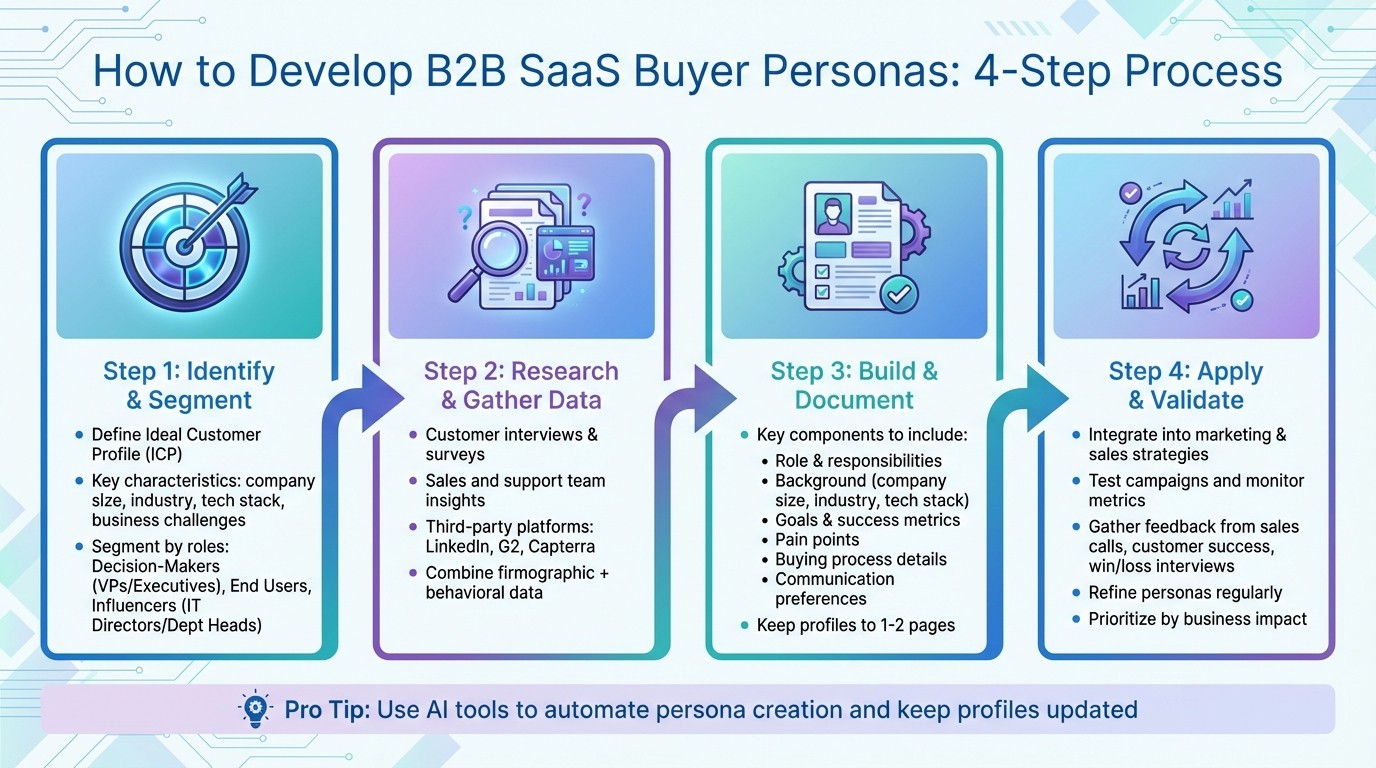
4-Step B2B SaaS Buyer Persona Development Process
How to Develop the Right Personas for Better B2B Content
Identifying and Segmenting Your Target Audience
To craft meaningful personas, start by pinpointing your target audience. This involves defining your Ideal Customer Profile (ICP) and dividing your audience into segments that represent the various ways they engage with your product. Without this clear focus, personas risk becoming too generic to guide decision-making effectively. Proper segmentation lays the groundwork for detailed persona development in later stages.
Defining Your Ideal Customer Profile (ICP)
Your ICP is essentially a blueprint of the types of companies that benefit most from your product. Focus on identifying 3–5 key characteristics of your best customers, such as company size, industry, technology stack, and primary business challenges. For example, if you offer a marketing automation platform, your ICP might include B2B SaaS companies with 50–200 employees that use tools like HubSpot or Salesforce and face challenges with lead qualification and nurturing.
Leverage AI-powered go-to-market (GTM) platforms to gather insights and refine your ICP automatically for more accuracy and efficiency [1].
Segmenting by Roles and Responsibilities
After defining the companies you want to target, the next step is to break down their buying committees into specific roles. In the B2B SaaS world, purchasing decisions often involve multiple stakeholders. Identify key players such as:
Decision-Makers: Typically VPs or executives who control budgets.
End Users: The individuals who will use the product daily.
Influencers: Department heads or IT directors who shape the decision-making process.
Each role comes with its own priorities. For instance, a CFO might focus on ROI and contract details, while a Product Manager is more concerned with usability and integration. Meanwhile, an IT Director will likely prioritize security and data compliance. Address these distinct concerns by creating personas tailored to each role, outlining their goals, challenges, and the language they use when evaluating solutions.
Using Company and Behavioral Data
To build a complete picture of your audience, combine firmographic data (such as company size and industry) with behavioral insights. This might include technographics, engagement trends, and intent signals that reveal how prospects interact with your brand.
Modern GTM platforms integrate these data points into a single, actionable resource. This enables AI-driven automation to deliver highly targeted messaging that aligns with each prospect’s stage in the buying journey [1].
Researching and Gathering Data for Buyer Personas
Once you've segmented your audience, the next step is to gather solid data to create detailed buyer personas. This approach ensures you're working with real insights rather than assumptions, setting a strong base for the profiles you'll develop later.
Customer Interviews and Surveys
Start by conducting interviews and surveys to uncover the challenges, decision-making factors, and evaluation criteria that matter most to your audience. Open-ended questions can provide a deeper understanding of their day-to-day struggles and thought processes when considering your product. For broader insights, short surveys that mix closed and open-ended questions can gather data at scale. These surveys can target both current customers and prospects who chose not to convert, helping you identify gaps in your messaging or product positioning. To enhance these findings, tap into the knowledge of your internal teams.
Sales and Support Team Insights
Your sales and support teams are on the front lines, engaging with prospects and customers every day. Sales teams can reveal common objections and highlight the features that often seal the deal. Meanwhile, support teams have a deep understanding of the recurring pain points that lead customers to seek help, as well as the language they use to describe their challenges. Regularly collecting these insights through team discussions can uncover patterns and fill gaps that raw analytics might miss. Once you've gathered internal perspectives, round out the picture with external data sources.
Using Third-Party Platforms and Tools
External platforms provide a wealth of information to enrich your buyer personas. LinkedIn groups and professional communities offer a glimpse into role-specific challenges and conversations. Review sites like G2 and Capterra highlight what buyers prioritize and the language they use when evaluating solutions. Additionally, AI-driven go-to-market tools like Copy.ai can consolidate firmographic and behavioral data from multiple sources, giving you a unified and comprehensive foundation for building personas [1].
Building and Documenting Buyer Personas
Once your research is complete, the next step is turning all that data into actionable persona profiles. These documents aren’t just for show - they’re tools meant to guide your team’s decisions and strategies.
Key Components of a Persona Profile
An effective B2B SaaS persona should be clear and to the point, ideally fitting on one or two pages. It should include:
Role and Responsibilities: Who they are and what they do.
Background: Details like company size, industry, and tech stack.
Goals and Success Metrics: What they aim to achieve and how they measure success.
Key Pain Points: The challenges they face that your product can solve.
Buying Process Details: How they make purchasing decisions.
Communication Preferences: The best ways to engage with them.
This streamlined approach ensures your team focuses on the most important aspects, making it easier to address real challenges effectively.
Prioritizing Pain Points and Solutions
Not all pain points are created equal. Your focus should be on the issues that directly influence your persona’s success metrics and align closely with what your product offers. For example, a VP of Marketing at a mid-market SaaS company might be more concerned with "proving ROI on content spend" than with smaller tasks like "finding stock photos."
To make your personas truly useful, tie each major pain point directly to a feature of your product, using the same language your audience uses. If your sales team frequently hears phrases like "we're drowning in tools" during discovery calls, make sure that exact wording appears in the persona profile. This ensures your messaging and positioning resonate deeply with your audience. Once you’ve mapped out these core challenges, leveraging smart tools can make persona creation much more efficient.
Using Averi AI to Automate Persona Creation
Technology now offers powerful ways to simplify and improve persona development. Averi’s Brand Core acts as a central hub for your customer research, ideal customer profiles (ICPs), and market insights. When you initiate a project in Averi, the AI already understands your target audience and can assist in structuring persona profiles based on the data you’ve gathered.
In /create mode, you can transform raw data - like interview transcripts or survey results - into polished, standardized persona documents. The Library feature ensures these personas are easily accessible to your entire team. Plus, because Averi continuously learns from the information you save, it can streamline updates and refinements over time. With Averi’s Human Cortex, you can even activate a marketing strategist who has immediate access to all relevant context from your Brand Core and Library, making the process even faster and more effective.
Applying and Validating Personas in Your Strategy
Integrating Personas into Marketing and Sales
Once you've built detailed persona profiles, the real value lies in how you apply them. Creating personas is just the beginning; using them strategically across your go-to-market (GTM) efforts is what drives results. Personas should be woven into every interaction - whether it’s a blog post, a cold email, or a sales pitch. When sales, content, and demand generation teams align their efforts around these profiles, they can deliver more precise, data-informed engagement. This approach has been shown to improve both meeting generation and conversion rates.
Make persona insights a cornerstone of decision-making across teams. Sales reps can use these profiles during discovery calls to ask sharper, more relevant questions. Content creators can craft thought leadership pieces or case studies that resonate with specific buyer needs. Demand generation teams can build highly targeted account-based marketing (ABM) campaigns. AI tools can amplify this process by analyzing accounts, industries, and personas to produce tailored assets at scale[1]. Of course, integration is just the start - ongoing testing will help refine your approach over time.
Testing and Refining Personas Over Time
Buyer personas aren’t static; they need to evolve as markets shift and customer behaviors change. Regularly validate your personas by running campaigns targeted at specific segments and monitoring key metrics like engagement, conversion rates, and pipeline velocity. If you notice that content aimed at one persona consistently underperforms compared to others, it might indicate a need to revisit your assumptions about their priorities or challenges.
Use multiple feedback sources to refine your personas. Sales call recordings, customer success conversations, win/loss interviews, and campaign analytics can all reveal gaps between your assumptions and reality. For example, if your sales team finds that prospects care more about integration capabilities than initially documented, update the persona to reflect this insight. Similarly, if survey data shows a shift in communication preferences, adjust your strategy accordingly. This ongoing feedback loop ensures your personas remain accurate and actionable. Once refined, focus your energy on the personas that deliver the most business value.
Prioritizing Personas by Business Impact
Not all personas are created equal. It’s essential to concentrate your efforts on the ones that significantly impact revenue and align with your growth goals. Look at which personas drive higher conversion rates, larger deal sizes, faster sales cycles, and better retention. Even if these personas represent a smaller share of your pipeline, their outsized contribution to revenue makes them worth prioritizing.
Your product roadmap and market positioning should also influence prioritization. For instance, if you’re targeting enterprise accounts, it makes sense to focus on personas in that segment, even if they’re not currently your biggest revenue source. Automation tools can help you manage this balance by streamlining efforts for secondary personas, allowing you to direct more resources toward high-impact profiles.
In Averi’s Brand Core, you can document persona prioritization alongside your ideal customer profile and market insights. This ensures that AI tools understand which audiences are most critical when generating content or guiding strategy. By embedding this context into every project, your marketing efforts naturally align with your business goals without requiring constant adjustments.
Conclusion
Key Takeaways
Creating effective buyer personas for B2B SaaS companies is not a one-and-done task - it’s an evolving process that directly influences your go-to-market strategy. Start by clearly defining your ideal customer profile, and then segment your audience based on roles and responsibilities to identify key decision-makers. Use real-world data from customer interviews, sales interactions, and behavioral insights instead of relying on assumptions. Each persona should be thoroughly documented, focusing on specific pain points, goals, and buying triggers that your teams can act on.
The true value of these personas lies in how you apply them across marketing, sales, and product development. When data-rich personas are used consistently, they can lead to better meeting generation and lower costs through tailored, AI-driven approaches. In short, well-crafted personas have a direct impact on revenue growth.
To keep personas relevant, regularly validate them through campaigns and customer feedback. Focus on those profiles that deliver the most impact and use these insights to refine your marketing strategies moving forward.
Next Steps for Persona Development
If you’re just beginning, start this week by gathering insights from customer interviews and your sales team. For those with existing personas, take time to audit them against recent win/loss data and adjust any outdated assumptions.
AI tools like Averi AI can streamline this process. Averi enables you to centralize persona profiles within its Brand Core feature, ensuring that every campaign, content piece, and strategy discussion is rooted in accurate customer context. By housing your personas alongside brand guidelines and past work in an AI workspace, you’re not just improving your marketing efforts - you’re building a foundation of institutional knowledge that grows with your business.
FAQs
How can Averi AI help improve persona development for B2B SaaS companies?
AI tools such as Averi AI bring a new level of efficiency to persona development for B2B SaaS companies by automating tedious tasks and providing precise, data-backed insights. By analyzing customer behaviors, preferences, and challenges, these tools help craft detailed buyer personas that truly reflect your target audience.
Using Averi AI, you can simplify workflows, keep personas aligned with shifting market trends, and fine-tune your marketing strategies to better meet customer expectations. This enables B2B SaaS businesses to dedicate more time to designing personalized, impactful campaigns that deliver measurable results.
What’s the difference between decision-makers, end users, and influencers in B2B persona development?
In B2B persona development, it's essential to recognize the distinct roles within the decision-making process:
Decision-makers are those who define strategic objectives and have the authority to approve budgets or investments. They focus on aligning purchases with broader business goals.
End users interact with the product or service daily, prioritizing functionality and ease of use in their evaluation.
Influencers provide expertise or recommendations that significantly impact purchasing decisions, often shaping the direction others take.
By understanding these roles, you can craft messaging and strategies that resonate with each group’s specific priorities and concerns.
How can buyer personas enhance marketing and sales strategies in B2B SaaS?
Buyer personas play a crucial role in shaping marketing and sales strategies that genuinely connect with your audience. By diving into the specific needs, challenges, and decision-making patterns of your ideal customers, you can craft messages and campaigns that truly resonate. This approach not only boosts engagement but also drives better conversion rates and fosters long-term customer loyalty.
In the B2B SaaS space, where buyer journeys are often intricate, personas offer much-needed clarity for marketing and sales teams alike. They enable personalized outreach, foster alignment between departments, and directly address the unique obstacles your audience faces. Tools like Averi AI can take persona development to the next level, making the process more data-driven and efficient while keeping your strategies sharp and relevant.
Related Blog Posts

Zach Chmael
CMO, Averi
"We built Averi around the exact workflow we've used to scale our web traffic over 6000% in the last 6 months."
Your content should be working harder.
Averi's content engine builds Google entity authority, drives AI citations, and scales your visibility so you can get more customers.