How to Launch Product Launch Campaigns for Consumer Apps

Averi Academy
Averi Team
8 minutes

In This Article
Step-by-step guide to launching consumer apps: set goals, use ASO and paid ads, leverage AI for assets, run phased rollouts, and iterate with analytics.
Updated:
Trusted by 1,000+ teams
Startups use Averi to build
content engines that rank.
Launching a consumer app requires a fast-paced, user-focused approach. Unlike enterprise software, consumer apps must grab attention instantly and drive installs through concise messaging and multi-channel strategies. Here’s a quick breakdown of what works:
Set clear goals: Track installs, activation rates, and retention metrics to measure success. Monitor costs like Customer Acquisition Cost (CAC) and Return on Ad Spend (ROAS).
Use multiple channels: Combine App Store Optimization (ASO), paid ads, influencer partnerships, and in-app messaging for maximum reach.
Leverage AI tools: Automate content creation for ads, emails, and social posts while maintaining a consistent brand voice. Save time and resources by streamlining workflows.
Launch in phases: Start with a soft launch to test strategies, then roll out globally with synchronized campaigns.
Iterate and improve: Use analytics to refine your approach post-launch. AI can help analyze data and suggest improvements.
With these steps, you can efficiently launch, track, and scale your app campaigns for better engagement and retention.
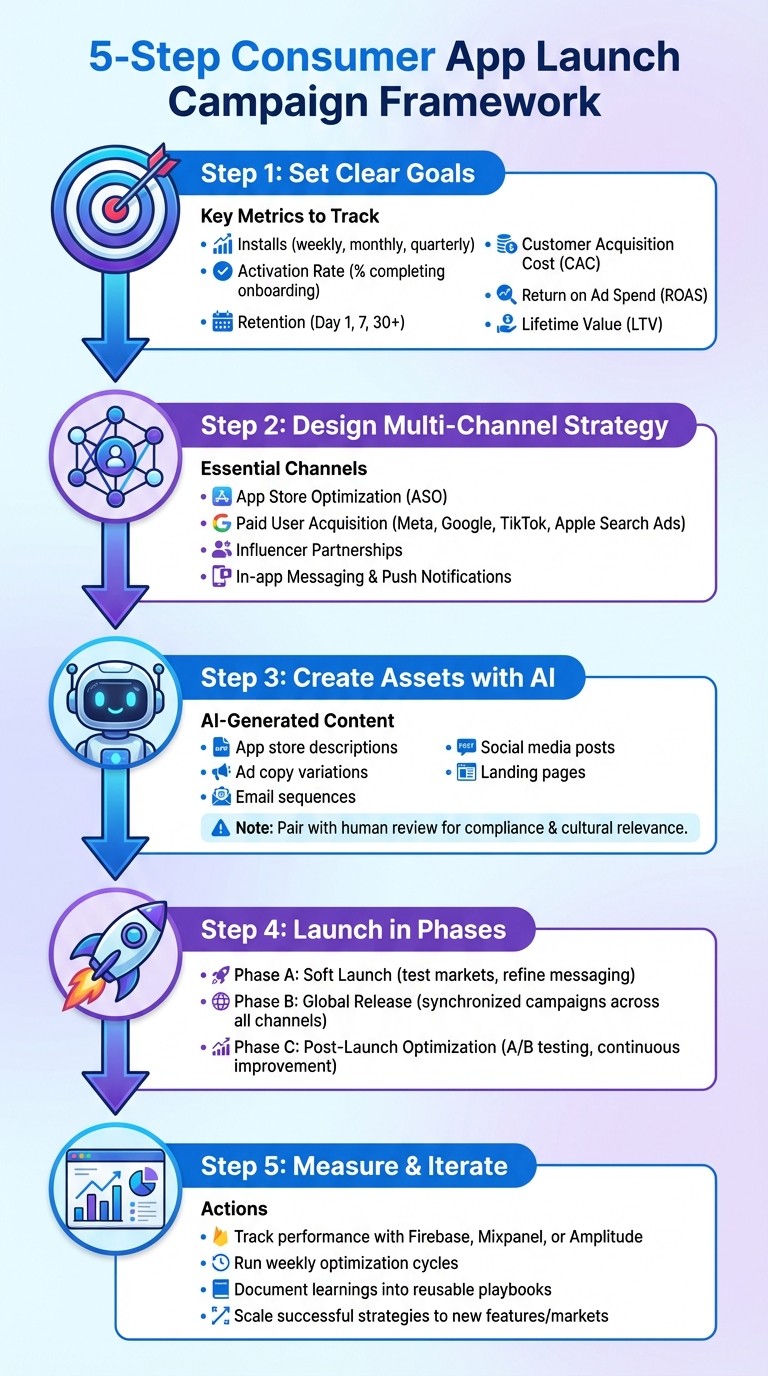
5-Step Consumer App Launch Campaign Framework
10 Proven App Marketing Strategies to Skyrocket Downloads in 2025
Set Goals for Your Consumer App Launch
Before rolling out your campaign content, it's essential to establish clear, measurable goals. Without these, it becomes nearly impossible to evaluate performance or fine-tune your strategy. These metrics act as the backbone of a flexible and effective launch plan.
Define Key Metrics for Success
To gauge the success of your consumer app launch, focus on these critical metrics:
Installs: Track the number of downloads within specific time periods, such as a week, a month, or a quarter.
Activation Rate: Measure the percentage of users who complete key onboarding steps, like creating an account or finishing a tutorial.
Retention: Monitor how many users return after key milestones - day one, day seven, day thirty, and beyond.
Beyond user engagement, it's vital to evaluate the financial side of your launch. Keep an eye on metrics like Customer Acquisition Cost (CAC) to understand how much you're spending to gain each user. Pair this with Return on Ad Spend (ROAS) to see how much revenue you're generating for every dollar spent on advertising. For subscription-based apps, Lifetime Value (LTV) is particularly important to ensure that the revenue generated from each user outweighs the cost of acquiring them.
Design a Multi-Channel Launch Strategy
With your goals firmly established, the next step is to map out the channels and timing that will effectively connect with your audience. Launching a consumer app requires a well-orchestrated plan across multiple platforms, each tailored to play a specific role during different stages of the launch. The trick is aligning the right channel with the right phase while ensuring your messaging remains consistent across the board.
Selecting the Best Channels for Consumer Apps
Certain channels are indispensable for a successful consumer app launch. Start with App Store Optimization (ASO). This involves fine-tuning your app’s title, description, keywords, and screenshots to make it more discoverable organically. ASO is a foundational step for any app entering the market.
Paid User Acquisition (UA) is another powerful tool. Platforms like Meta, Google, TikTok, and Apple Search Ads allow you to reach your audience quickly. These channels are particularly effective when you have clear activation metrics and the ability to test and refine your approach based on early results. For apps in categories like lifestyle, wellness, or entertainment, influencer partnerships provide valuable social proof and help amplify your reach. Once users install the app, in-app messaging and push notifications are key to guiding them through onboarding and boosting retention.
AI can further streamline this process by tailoring messaging for each platform while maintaining a cohesive brand voice. This ensures your content resonates with the unique audiences of each channel without losing consistency.
Structuring Campaigns for Each Launch Phase
After selecting your channels, it’s time to organize your launch into clear, actionable phases. Each phase should build on the last to create momentum.
A soft launch is the first step. By targeting select markets, you can test your messaging, identify technical issues, and gather feedback from early users. During this phase, refine your ASO and run small-scale paid UA campaigns to validate your strategies.
The global release marks the full-scale activation of all channels. This is where you synchronize paid ads, influencer collaborations, PR efforts, and organic social media campaigns. A concentrated push during this phase is crucial for driving your app up the download charts.
Finally, post-launch optimization focuses on retention and continuous improvement. Use tools like in-app messaging, A/B testing, and ASO updates to keep your app relevant and engaging. AI-powered workflows can automate these processes, ensuring your team stays on track without being bogged down by manual tasks. By integrating data and fostering collaboration across teams, you can eliminate inefficiencies and maintain a steady rhythm of optimization.
Each phase is a stepping stone, and when executed cohesively, they set the stage for a successful app launch and sustained growth.
Create and Automate Launch Assets with AI
Once you’ve mapped out your multi-channel launch strategy, the next step is creating the assets needed for each platform. From app store descriptions and ad copy to email sequences, social media posts, and landing pages, the list of required materials can feel endless. This is where AI-powered workflows can turn what used to take weeks into a matter of hours - without compromising on quality or your brand’s unique voice. These tools not only streamline the process but also ensure consistency across all your messaging.
Use AI to Generate Messaging and Creative Assets
AI marketing platforms have revolutionized how launch assets are created. They allow you to produce high-quality content tailored to each channel in a fraction of the time it would take manually. Whether it’s drafting app store descriptions, creating multiple Facebook ad variations, writing email sequences, or crafting Instagram captions, AI tools can do the heavy lifting. The best part? You can define your brand’s voice upfront, ensuring that every piece of content aligns seamlessly with your identity.
For consumer app launches, this means you can quickly test different creative approaches, fine-tune messages for specific audience segments, and stay ahead of competitors still relying on traditional, time-consuming workflows.
Pair AI with Human Review for Polished Results
While AI excels at speed and efficiency, human oversight is essential for ensuring the final output meets all your standards. Incorporating expert review into your workflow ensures that the content not only aligns with your brand voice but also adheres to compliance requirements and resonates with your audience.
For instance, AI might generate a great first draft of your app’s privacy policy messaging, but a compliance expert should step in to confirm it aligns with U.S. regulations like the CCPA. Similarly, while AI can localize ad copy, native speakers should verify that idioms and cultural references make sense for American audiences. This hybrid approach lets AI handle the groundwork while humans fine-tune the details, ensuring your messaging is accurate, culturally relevant, and strategically aligned.
Streamline Approvals and Automate Iterations
To maximize efficiency, connect your AI-generated content directly to the platforms where it will be published. Choose tools with integrations that link to your CMS, ad platforms like Meta and Google, email services, and CRMs. This eliminates the need for manual transfers and keeps everything moving smoothly.
Set up automated workflows to route drafts to the right stakeholders for review, track revisions, and publish finalized content. By automating these steps, your team can maintain the momentum established during the planning phase. For app launches, this means you’ll be able to adapt quickly to performance data, make real-time adjustments, and carry that energy from a soft launch all the way to a global rollout.
Launch, Measure, and Iterate for Success
Coordinate a Smooth Launch Day
Launch day is where all your planning comes to life. Make sure your app is ready and accessible, and align your pre-scheduled social media posts, paid ads, and email campaigns to go live seamlessly. AI-powered tools can simplify these tasks, automating coordination across teams and ensuring everything runs like clockwork.
For in-app communication, consider using AI to create multiple versions of onboarding messages, feature highlights, and push notifications that stay true to your launch strategy. Additionally, AI-driven translation tools can help you roll out your app in multiple markets simultaneously, delivering messages that feel authentic and natural to local audiences.
Once the launch is underway, your attention should shift to tracking performance metrics immediately.
Track Key Metrics with Analytics Tools
Post-launch, it’s all about monitoring your app’s performance. Tools like Firebase, Mixpanel, or Amplitude can provide insights into critical metrics you identified during the planning phase. Keep an eye on events like profile completions, purchases, and user invites to ensure your messaging connects with users and the app meets their expectations.
Integrating your analytics tools with a centralized data system can take this further. By combining data from ad platforms, email campaigns, and in-app behavior, AI can deliver actionable insights. This approach allows you to spot trends quickly and adjust your strategy in real time, optimizing your efforts across different channels.
Run Optimization Cycles for Continuous Improvement
Once you’ve gathered initial performance data, start refining your strategy through structured weekly cycles. Analyze the data to pinpoint underperforming areas - whether it’s a specific channel, messaging, or feature - and test new ideas to address these gaps. AI tools can assist by analyzing your data and suggesting targeted improvements, such as adjusting your onboarding process or fine-tuning audience targeting.
Documenting what works and what doesn’t is key. By organizing these insights into reusable playbooks, you can lay the groundwork for stronger launches in the future. With AI-powered workflows, these lessons can be applied systematically, ensuring each new product launch or market expansion builds on a well-informed, solid foundation.
Scale Launch Playbooks for Features and Markets
Once you've fine-tuned your launch process, the next step is scaling it to amplify your results across new features, campaigns, and markets.
Clone and Customize Launch Systems
Your first successful launch sets the stage for replicating that success. Instead of reinventing the wheel, reuse established workflows for future launches - whether it's a major app update, a seasonal campaign, or a new market entry. AI platforms make this process seamless by transforming proven workflows into flexible systems.
Roman Olney, Head of Global Digital Experience at Lenovo, shared, "By automating workflows that would typically take weeks and cost thousands of dollars through agencies, they've saved us $16 million dollars this year alone." [1]
This is the power of systematization: repetitive manual tasks are replaced with efficient, high-quality processes that maintain consistency. For instance, when launching in new geographic markets, AI tools can adapt your messaging to align with local preferences and cultural nuances. These tools also enable real-time generation of localized content, eliminating the need for costly agencies and lengthy turnaround times. Simply adjust your existing workflows - tweaking messaging, timing, or channel strategies - to fit your new objectives, and you’re ready to go.
Build Reusable AI Templates
Creating a library of reusable AI templates is like building a launch toolkit that gets better with every campaign. Document your best-performing briefs, campaign structures, and reporting frameworks in a centralized repository powered by AI. This ensures your future launches are faster, more consistent, and always aligned with your brand voice and audience insights.
Platforms like Averi AI simplify this process by storing your templates alongside brand guidelines, customer personas, and past campaign data. When it’s time for a new launch, the AI taps into this library, generating tailored assets that align with your standards. This eliminates the need for lengthy briefings and ensures every campaign starts with a strong foundation.
Jean English, Former Chief Marketing Officer at Juniper Networks, highlighted the efficiency gains achieved through AI-powered go-to-market strategies. [1]
Conclusion
Building on the use of AI and streamlined workflows from earlier discussions, these strategies lay the groundwork for sustained campaign success.
Leverage AI for Streamlined and Scalable Launches
Launching a consumer app demands a combination of speed, accuracy, and the ability to scale across multiple channels and markets. AI-driven workflows eliminate common bottlenecks like endless revisions, disconnected tools, and manual content creation. Platforms such as Averi AI centralize everything - strategic discussions, content production, and expert input - into one seamless workspace. By integrating all creative tasks into a single system, you can significantly accelerate the launch process.
The impact is clear. Industry examples highlight how these tools save time and resources while maintaining quality and consistency [1]. This efficiency allows teams to shift focus toward more strategic activities, ensuring every launch is both effective and scalable.
Embrace Iteration and Continuous Learning
Every app launch provides valuable lessons. Perfection isn’t the goal from the outset; instead, the most successful campaigns treat launches as opportunities to learn and improve. Real-time data and performance metrics guide refinements in messaging, channel selection, and overall strategy. With AI tools, this process becomes faster and more precise, enabling teams to test new approaches, respond to market feedback, and scale successful tactics without restarting from scratch.
FAQs
How do AI tools make app launch campaigns more efficient?
AI tools play a key role in making app launch campaigns more efficient by automating time-consuming tasks such as content creation and localization. This not only saves valuable time but also minimizes the need for manual effort. By simplifying workflows, these tools enable teams to collaborate more seamlessly and execute campaigns more quickly.
What sets AI apart is its ability to deliver data-driven insights. These insights help fine-tune targeting, messaging, and performance tracking, ensuring campaigns are more precise and well-tailored to their audience. The result? Faster time-to-market paired with improved campaign outcomes.
What are the advantages of using multiple channels to launch a consumer app?
Launching your app using multiple channels allows you to connect with a broad audience by tapping into platforms like social media, email, app stores, and paid advertising. This approach increases your app's visibility and helps you engage with various user groups, boosting the likelihood of interaction and conversions.
By spreading your campaign across different platforms, you can customize your messaging to suit each one, delivering a more tailored and meaningful experience for users. This method not only encourages higher engagement but also strengthens the overall impact of your launch, leading to tangible results.
Why should you launch a consumer app in phases?
Launching a consumer app in stages is a practical way to reduce risks and boost the chances of success. By introducing the app gradually, you can test its features, collect valuable user feedback, and fine-tune it before going all-in with a full launch. This step-by-step approach not only improves the app's alignment with market needs but also creates a smoother experience for users. Additionally, it helps manage resources wisely and uncovers potential issues early on, saving both time and money down the road.
Related Blog Posts

Zach Chmael
CMO, Averi
"We built Averi around the exact workflow we've used to scale our web traffic over 6000% in the last 6 months."
Your content should be working harder.
Averi's content engine builds Google entity authority, drives AI citations, and scales your visibility so you can get more customers.