How to Run Founder-Led Marketing for Education Platforms

Averi Academy
Averi Team
8 minutes

In This Article
Founders who lead marketing with AI can build trust, publish consistently, and drive enrollments for education platforms—without agencies.
Updated:
Trusted by 1,000+ teams
Startups use Averi to build
content engines that rank.
You don’t need to hire an agency to market your education platform effectively. Founder-led marketing allows you to take control of your strategy, leveraging your unique insights to build trust with learners. By combining your expertise with AI tools, you can streamline content creation, maintain a consistent publishing schedule, and measure results - all without becoming overwhelmed.
Here’s a quick overview of the process:
Set clear goals: Define what makes your platform different and establish measurable targets, like increasing enrollments or improving course completion rates.
Use AI for content creation: Tools like Averi AI help with research, drafting, and optimization, saving time while keeping your voice consistent.
Focus on quality: Blend AI efficiency with human review to ensure content aligns with your mission and resonates with your audience.
Automate publishing: Connect AI tools to your CMS for seamless uploads and consistent scheduling.
Track and refine: Monitor performance metrics like cost per lead and enrollment conversions to improve over time.
This approach enables you to grow your platform’s visibility and credibility while staying focused on your core business. With AI handling the heavy lifting, you can deliver consistent, impactful content that builds trust and drives results.
Founder Led Marketing 101 - Content Creation for Business Owners
Step 1: Set Your Marketing Vision and Goals
Before diving into campaigns, take a step back and ask yourself: What sets your platform apart, and what measurable outcomes are you aiming for? These answers are the backbone of your content, social posts, and campaigns. They’ll also shape the AI-driven strategies you'll explore later in this guide.
Define What Makes Your Platform Stand Out
Your platform’s value lies in the problems it solves that others overlook. Don’t just list features - focus on the transformation you bring. Are you helping professionals change careers without leaving their current jobs? Are you making college-level courses accessible to high school students? Or are you connecting graduates with jobs within 90 days of completing your program?
Take inspiration from established brands in the space. Duolingo, for instance, built its identity around gamification, turning language learning into a fun, game-like experience. Quantic, on the other hand, emphasizes career outcomes for business professionals, focusing on measurable advancement rather than entertainment. Your differentiation should be just as clear and specific [5].
To uncover your unique value, talk to your frontline teams. They know why students choose your platform and the pain points they’ve had with competitors [5]. Keep in mind that education is a major decision for students and parents alike. They invest time in researching options, often looking for testimonials and success stories that resonate with their own situations [1].
"Your prospects DON'T care about the inputs (features) of your product... They care about one thing: the output (benefits) to them." - Journey Engine [5]
Once you’ve nailed down what makes you different, it’s time to establish measurable marketing goals.
Create Clear, Trackable Marketing Goals
Vague goals like "increase awareness" won’t cut it. Tie your marketing efforts directly to business outcomes you can measure. For example, aim to enroll 200 new students by June 30, 2026; generate 1,500 qualified leads per month at a cost of under $45 per lead; or boost course completion rates from 68% to 80% by December 2026.
Break these goals into smaller targets by executing a full-funnel marketing campaign across your primary channels. For awareness, track website traffic, social media reach, and search rankings. At the consideration stage, focus on metrics like video views, content downloads, or time spent on course pages. For decision-making, measure free trial sign-ups, consultation bookings, and enrollment conversions [1].
Assign metrics to each goal and review them weekly or monthly. For enrollment growth, monitor cost per lead (CPL) and lead-to-enrollment conversion rates. Identify which channels bring in the highest-quality leads. For retention, track course completion rates, satisfaction scores, and referrals.
Your goals should match your platform’s current priorities. A newer platform may need to focus on building awareness and credibility. An established platform with steady traffic but low enrollments might prioritize trust-building through success stories and reviews [1]. Whether your challenge is visibility, trust, or conversion, your objectives will directly shape your content strategy and publishing plans in the next steps.
Step 2: Create a Content Strategy Using AI
After setting your goals, the next step is crafting a content plan that directly addresses your audience's needs - without spending weeks on manual research. AI tools like Averi AI simplify this process by handling competitor analysis, keyword research, and content scheduling while ensuring your unique voice shines through. Building on the goals you established in Step 1, this method keeps your content focused and efficient.
Use AI for Brand Voice and Competitor Insights
By inputting your website into Averi AI, you can extract and define your brand's tone and style - whether it's formal and data-driven or casual and approachable. This generates a brand voice profile that ensures all future content stays consistent without requiring constant manual oversight. For instance, an edtech platform targeting K–12 educators might identify a tone that’s supportive, educator-friendly, and focused on accessibility and engagement. This tone would then guide blog posts, landing pages, and email campaigns [3][4].
AI also helps uncover gaps in your competitors’ strategies. For example, it might reveal that competitors aren’t covering topics like AI-driven personalization in hybrid learning environments - offering you an opportunity to create high-impact content. While manual competitor research can be tedious, AI tools quickly analyze rival websites, highlight their best-performing content, and pinpoint underserved topics. This targeted approach has been shown to boost engagement by 46% by focusing on areas others overlook [2][3].
Build a Content Plan for Education Audiences
Once you’ve established your brand voice and identified content opportunities, it’s time to create a content calendar tailored to your audience - whether they’re students, parents, or educators. AI tools can identify high-volume, low-competition keywords, such as "best online math tutors for kids" (for parents), "teacher professional development courses" (for educators), or "free study apps for college students", ensuring your content aligns with user intent [2][4].
With these insights, you can map out a 30-day content plan featuring a variety of formats. For awareness, you might create how-to guides like "How to Gamify Homework for Better Retention." For consideration, case studies such as "85% Course Completion with Personalized Learning" could demonstrate proven success, inspired by platforms like 5Mins that use AI-driven techniques like chunking and spaced repetition [2]. For decision-stage content, comparison articles or free trial walkthroughs can help users make informed choices. AI tools can organize these topics by funnel stage and format them into an easy-to-manage content queue for your review.
Step 3: Create Content with AI and Human Review
Now that you have a solid content plan, it's time to start producing articles, guides, and landing pages that not only rank well but also resonate with your audience. AI tools can take care of the heavy lifting - handling research, drafting, and AI content creation - while your team ensures each piece stays true to your platform's mission and tone. This blend of efficiency and authenticity is what sets founder-led marketing apart from fully automated approaches.
Draft Content Faster with AI Tools
AI tools like Averi AI can create initial drafts by pulling in relevant research, structuring articles for search engines, and even adding helpful elements like FAQs or TL;DR summaries. For education platforms, this means generating content tailored to specific audience needs, whether it’s a guide on blended learning strategies or a comparison of tutoring apps. These tools build on the brand context you established earlier, ensuring every draft reflects your unique voice and positioning. Unlike Jasper, AI workspaces like Averi retain this brand context continuously, which helps reinforce a founder-led approach.
Here’s how it works: pick a topic from your content queue, and the AI conducts thorough research, complete with verifiable hyperlinks. It optimizes the draft for search engine rankings by structuring the content, suggesting internal links, and creating meta descriptions - all while helping you sidestep writer’s block. The result? Drafts are completed faster, leaving more time for human refinement.
Review and Edit Content as a Team
Once the AI delivers a draft, it’s time for your team to step in and polish it. Human review ensures the content aligns with your platform’s mission and tone, keeping the focus on your unique vision. Founders play a key role here, refining the narrative to reflect deep expertise and positioning the platform as a trusted advisor, not just another service provider. Use storytelling techniques to address real-world challenges like teacher retention, digital equity, or student engagement.
Collaborative editing tools make this process seamless. Your team can leave comments, tag collaborators, and edit in real time. If a section needs tweaking, simply highlight it and ask the AI to rewrite, expand, or adjust. This keeps the process efficient without compromising quality. Sarah Chen, Founder of TechScale, shared that in June 2025, her team achieved more in two weeks using Averi’s combination of AI efficiency and expert input than they had in three months with a traditional agency [1].
This approach underscores the advantage of AI workspaces over freelance marketplaces, which require detailed briefs for every task, or single-function tools that demand extensive manual oversight. By building on prior context, these systems continuously improve quality with every piece of content you publish.
Step 4: Publish Content and Track Results
Once your content is polished and ready, the next step is efficient publication paired with performance tracking. Automating the publishing process can save time and reduce errors, allowing you to focus on broader strategies and growth. The goal is to establish workflows that ensure quality while keeping your content pipeline moving smoothly.
Automate Publishing to Stay Consistent
By connecting AI tools directly to your CMS, you can skip the hassle of manual uploads. Platforms like Averi AI integrate seamlessly with systems like WordPress, Webflow, or Framer, handling formatting, metadata, and internal links automatically. For education platforms that publish weekly guides on topics such as digital equity or blended learning strategies, maintaining this consistency not only strengthens audience trust but also signals reliability to search engines.
If you're using other automation tools, it's a good idea to configure them to create posts as drafts rather than publishing immediately. This setup gives you a chance for a final review before the content goes live. For WordPress users, application passwords offer a secure way to enable REST API access without using admin credentials. Similarly, if you're using Webflow, ensure your automation tools correctly map custom fields - this is especially critical for education-focused content that relies on detailed metadata like course levels, subject tags, or learner personas.
"Organizations using AI automation tools save an average of 2.5 hours per employee per day while improving output quality by 35%." - Margarita Petrakova, Team-GPT [7]
Once your content is live, the next step is to monitor its performance closely and adapt your strategy accordingly.
Monitor Performance and Adjust Your Approach
After ensuring a steady publishing cadence through automation, turn your attention to tracking performance metrics. This data will help you identify what’s working and where there’s room for improvement. For education platforms, metrics like enrollment-related conversions, cost per lead (CPL), and channel-specific conversion rates are particularly important [1]. If you’re running founder-led outreach alongside your content efforts, keep an eye on meeting booking rates and close rates - if close rates dip below 10%, it’s time to revisit and fine-tune your messaging [6].
AI-driven analytics tools offer more than just raw data; they provide actionable insights. Platforms like Averi can track impressions, clicks, and keyword rankings while suggesting updates to improve performance. For instance, if an article about teacher retention is sitting at the #8 spot in search rankings, the system might recommend adding a targeted FAQ section or refreshing outdated statistics to help it climb to page one. This creates a feedback loop where performance data guides your next steps, ensuring each piece of content becomes more effective over time.
Step 5: Compare AI Tools for Founder-Led Marketing
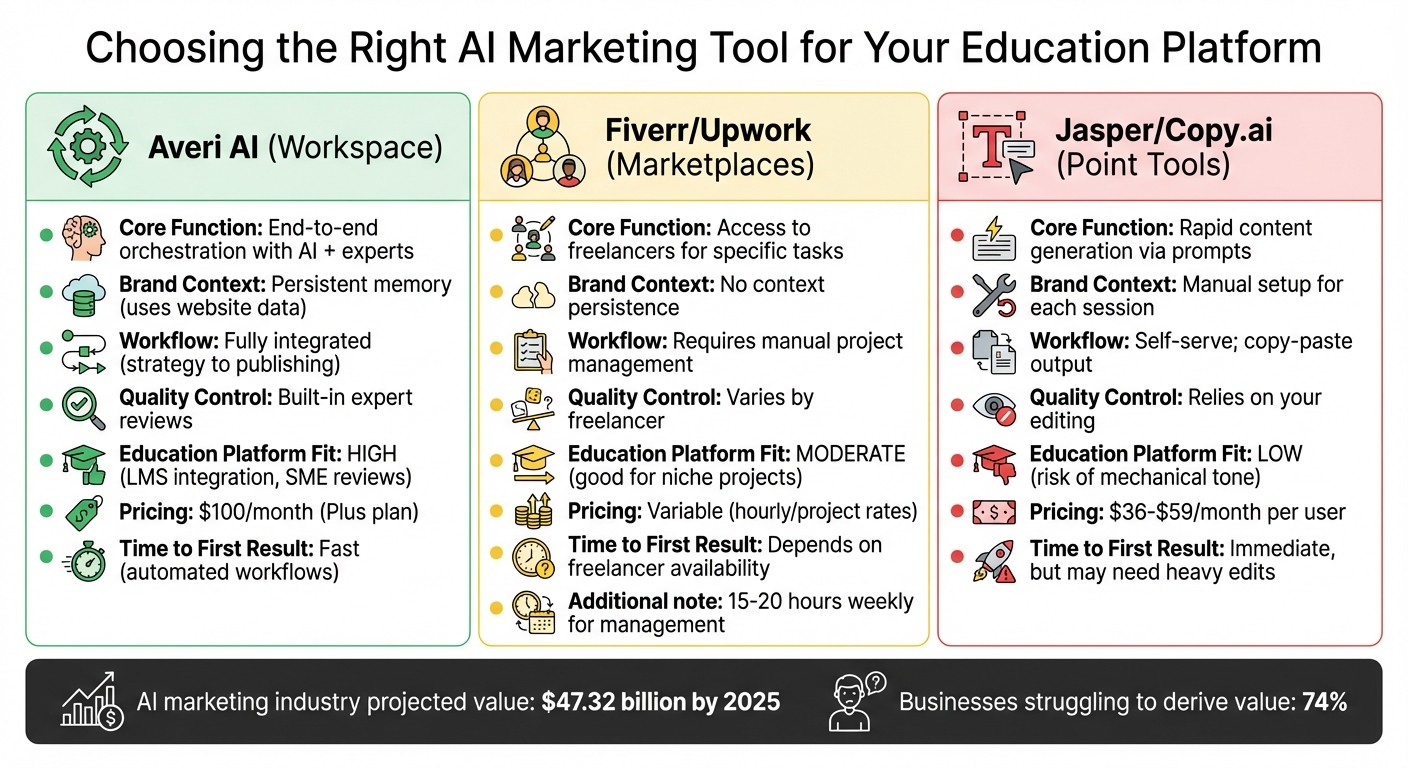
AI Marketing Tools Comparison for Education Platforms: Workspaces vs Marketplaces vs Point Tools
As you refine your founder-led marketing strategy, it's crucial to assess how various AI tools can complement your efforts. Founders typically face three main options: AI workspaces like Averi, which manage your entire content pipeline; talent marketplaces such as Fiverr and Upwork, connecting you with freelancers; and AI point tools like Jasper or Copy.ai, designed for on-demand text generation. Each option has its strengths and trade-offs.
AI workspaces provide an all-in-one solution, handling everything from strategy to publishing, complete with quality checks. Marketplaces give access to specialized freelance skills but demand significant time for vetting and managing projects. Meanwhile, point tools are great for quickly drafting content but leave tasks like coordination, brand consistency, and distribution entirely up to you.
If you're looking for a comprehensive, hands-off system, a workspace model might be your best bet. For specific, one-time needs - like creating visuals for a product launch - marketplaces can be a practical choice. And if your content operation is already running smoothly but needs a boost in drafting speed, point tools can fill that gap. For education platforms, tools that maintain a consistent brand voice are particularly important.
Cost considerations also vary widely. Jasper's Pro plan is priced at $59 per user each month, while Copy.ai's Pro tier starts at $36 per month for up to five users [8]. Marketplaces often charge by the hour or per project, with founders frequently dedicating 15–20 hours weekly to manage freelancers [8]. On the other hand, Averi's Plus plan costs $100 monthly and covers everything from strategy to publishing.
To help you decide which option aligns with your needs, here's a quick breakdown of the differences:
Comparison Table: Averi AI vs. Marketplaces vs. Point Tools
Feature | Averi AI (Workspace) | Fiverr/Upwork (Marketplaces) | Jasper/Copy.ai (Point Tools) |
|---|---|---|---|
Core Function | End-to-end orchestration with AI + experts | Access to freelancers for specific tasks | Rapid content generation via prompts |
Brand Context | Persistent memory (uses website data) | No context persistence | Manual setup for each session |
Workflow | Fully integrated (strategy to publishing) | Requires manual project management | Self-serve; copy-paste output |
Quality Control | Built-in expert reviews | Varies by freelancer | Relies on your editing |
Education Platform Fit | High (LMS integration, SME reviews) | Moderate (good for niche projects) | Low (risk of mechanical tone) |
Pricing | $100/month (Plus plan) | Variable (hourly/project rates) | $36–$59/month per user |
Time to First Result | Fast (automated workflows) | Depends on freelancer availability | Immediate, but may need heavy edits |
The AI marketing industry is projected to hit $47.32 billion by 2025, yet 74% of businesses still find it challenging to derive measurable value from these tools [8][9]. The key lies in selecting solutions that integrate seamlessly into your existing processes, rather than forcing you to restructure around the tool.
Conclusion
Leading marketing efforts as a founder for your education platform boils down to four key actions: clearly define your vision and target audience, utilize AI tools to streamline content creation, collaborate with your team for quality assurance, and use data to refine and improve continuously. By blending your authentic founder perspective with AI-driven workflows, you gain a strong competitive edge. For instance, 5Mins achieved a 20-fold increase in annual recurring revenue by integrating personalized micro-learning strategies and intelligent tools[2].
Think of marketing as relationship-building rather than just generating leads[3]. With 82% of customers trusting companies whose leaders actively engage on social media[3], your genuine voice becomes your most valuable asset. Stick to the 90-10 principle: dedicate 90% of your content to educating your audience on topics like learning trends, employee development, and industry challenges, and reserve just 10% for promoting your platform[3].
Start small and focus on one platform where your audience is most active - whether that’s LinkedIn for HR professionals or niche forums specific to your industry. Commit to delivering consistent, value-packed content. AI tools like Averi can handle tasks like research, drafting, and publishing, allowing you to focus on maintaining the authentic voice that builds trust and credibility. This steady, intentional approach creates a foundation for sustainable growth and ongoing improvement.
Success in EdTech comes from a combination of vision, execution, and adaptability[2]. Founders who pair proven strategies with data-driven decisions can build systems that scale effectively, attract investors, and foster lasting customer loyalty[2]. Over time, your marketing efforts will compound, with each piece of content strengthening your brand voice and enhancing the impact of the next.
The education platform market is highly competitive, but founder-led marketing gives you a distinct advantage that no agency or generic content approach can replicate. By aligning your unique vision with the efficiency of AI, you can solidify your position in the market. If you're ready to take the next step, consider Averi's Plus plan for $100/month, offering a complete content marketing strategy that merges AI-powered workflows with expert guidance. This allows you to expand your visibility while staying focused on building your product.
FAQs
How do I choose the right marketing goals for my platform?
To kick things off, align your marketing goals with the mission of your platform and the needs of your audience. Whether you're aiming to grow enrollment, enhance engagement, or strengthen brand awareness, focus on what matters most. Set clear, measurable objectives - like increasing conversion rates or boosting social media interactions - that resonate with your audience's goals. Rely on data insights and trackable metrics to stay on course and achieve meaningful growth for your platform.
What should I review before publishing AI-written content?
Before sharing AI-generated content, it's crucial to review a few important elements to ensure it meets your brand's standards and maintains quality:
Factual accuracy: Double-check all information, as AI can sometimes produce incorrect or misleading details.
Tone and voice: Tailor the content to align with your brand's personality and resonate with your target audience.
Compliance: Confirm that the content follows legal guidelines, respects privacy policies, and steers clear of sensitive or inappropriate topics.
Human involvement plays a critical role in polishing AI-created material to ensure it meets the necessary standards and aligns with your goals.
What are the key metrics for enrollments and retention?
To gauge success in enrollments, key metrics to monitor include the enrollment rate and pipeline indicators. For retention, focus on first-to-second-year persistence and overall graduation or completion rates. These figures reveal how effectively new students are being attracted and supported to complete their programs.
Related Blog Posts

Zach Chmael
CMO, Averi
"We built Averi around the exact workflow we've used to scale our web traffic over 6000% in the last 6 months."
Your content should be working harder.
Averi's content engine builds Google entity authority, drives AI citations, and scales your visibility so you can get more customers.