How to Run Founder-Led Marketing for Media & Entertainment

Averi Academy
Averi Team
8 minutes

In This Article
Founder-led marketing in media uses AI to automate trend-driven content, save hours, cut costs, and keep your voice at the center of storytelling.
Updated:
Trusted by 1,000+ teams
Startups use Averi to build
content engines that rank.
Your voice is your strongest marketing asset. As a founder in media and entertainment, your storytelling sets you apart. Yet, time is tight - 56% of founders have less than an hour daily for marketing, while agencies charge $5,000–$15,000+ monthly. AI tools like Averi can save you time and cut costs by up to $480 per blog post, helping you maintain control over your brand's message without the heavy workload.
Key Takeaways:
Time-Saving: AI handles research, drafting, and SEO, leaving you 15 minutes for approvals.
Cost-Effective: Traditional blog posts cost $611; AI reduces this to $131.
Scalable Strategy: Publish 8–12 posts monthly with just 2 hours of effort per week.
Trend-Based Content: Use tools like SEMrush and Ahrefs to stay ahead of industry buzz.
Performance Tracking: Focus on metrics like conversions, engagement, and traffic to refine your approach.
This guide offers a 4-step system to streamline founder-led marketing: define a strategy, automate production, refine with your input, and measure success. With AI support, you can focus on your creative vision while ensuring consistent and impactful results.
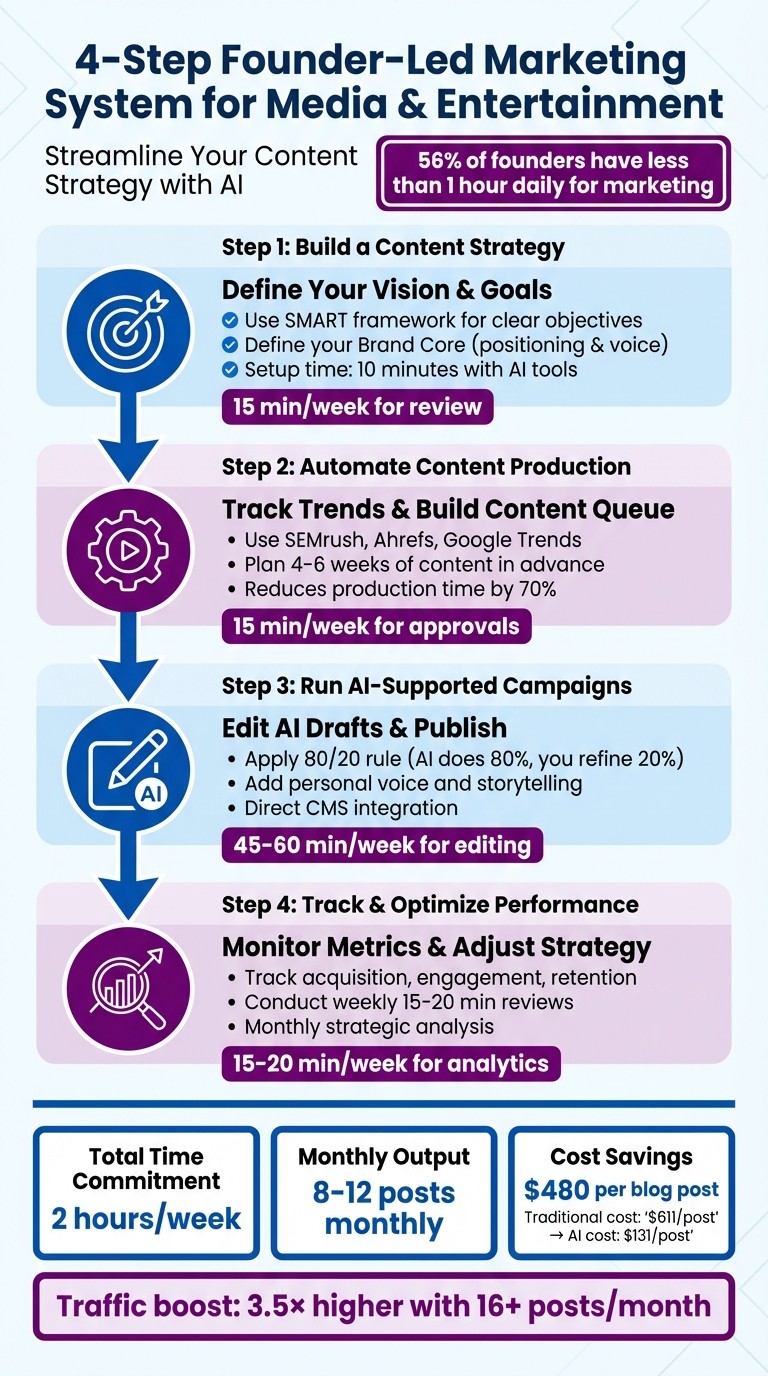
4-Step Founder-Led Marketing System for Media & Entertainment
Step 1: Build a Content Strategy That Reflects Your Vision
Align Your Vision with Tangible Goals
Turn your creative ideas into results that can be measured and tracked. Instead of relying on excitement alone, define clear objectives like securing 5,000 early-access sign-ups before a premiere. Use the SMART framework - Specific, Measurable, Achievable, Relevant, and Time-bound - to shape these goals. For example, aim for milestones such as "gain 10,000 followers by March 15, 2026" or "achieve 2,500 early access registrations prior to launch" [1].
Define your Brand Core - this is your distinct positioning and voice, which will anchor your content strategy [2]. Organize your content into categories, such as behind-the-scenes clips, fan reactions, or cast interviews, to keep your messaging diverse yet cohesive [1]. Once your vision and strategy are clear, you can bring in AI tools to streamline execution.
Leverage AI for a Consistent Content Plan
With your Brand Core in place, use tools like Averi to simplify the execution process. Averi scans your website to understand your business, products, and voice [2]. It then identifies Ideal Customer Profiles (ICPs) and highlights competitor gaps, ensuring your content stands out [2].
Setting up Averi takes just 10 minutes. From there, it creates a weekly content plan tailored to your goals and industry trends, requiring only 15 minutes of review. While the AI takes care of research, drafting, and SEO optimization, you retain control over the overall strategy, brand voice, and final quality checks. Businesses that publish at least 16 posts per month see traffic levels 3.5× higher than those posting fewer than four [2].
As you approve content, the AI learns from your feedback, improving its ability to draft content that aligns with your vision over time.
Step 2: Automate Content Production Around Media Trends
Use SEO and Trend Data to Pinpoint Topics That Matter
In the fast-moving world of media, staying ahead means knowing what’s buzzing right now. AI tools can help you track search trends, social media chatter, and the latest keywords tied to film releases, music events, or streaming launches. Platforms like Google Trends, Ahrefs, and SEMrush are excellent for spotting topics with high interest but low competition. For instance, SEMrush’s Topic Research feature clusters related keywords around trending media topics, making it easier to decide which ideas are worth pursuing [3][4].
To refine your strategy, check keyword difficulty and search volume in Ahrefs, then cross-check with platforms like Exploding Topics or Google Alerts. This helps you catch emerging subjects, such as "AI in Hollywood scripting" during awards season. Setting alerts for keyword volume increases of 20–50% can help you act fast. Feed these insights into tools like Notion or Airtable for a weekly review. This way, your content will reflect what audiences are actively searching for, rather than relying on guesswork.
Once you’ve identified the trends, the next step is to streamline how you deliver content.
Build a Content Queue for Consistent Publishing
After locking in high-value topics, organize them into a structured content queue. Align this queue with your release calendar and audience preferences. To keep things fresh, include recurring themes like behind-the-scenes footage, fan reactions, cast interviews, or teaser clips. Plan 4–6 weeks of content in advance using tools like Buffer or Contentful, syncing with key dates from IMDb Pro or other industry calendars [3][4].
Averi can simplify this process by using trend data to create content templates, draft outlines, and schedule posts for your review. This system reduces production time by up to 70%, leaving you with just 15 minutes of weekly approval work [3]. Over time, it adapts to your preferences, improving its ability to align with your brand’s tone and goals. By automating these steps, you ensure your content stays timely and impactful.
To gauge success, track engagement metrics, website traffic through Google Analytics, and conversions using UTM tags. If trend-based content outperforms evergreen pieces by double or more, adjust your content queue to focus on timely topics [3].
Step 3: Run Campaigns with AI Support and Founder Input
Edit AI Drafts to Match Your Voice
AI can handle the heavy lifting - research, structure, and initial drafts - but your voice is what makes the content resonate. A smart strategy follows the 80/20 rule: let AI handle 80% of the work, and then dedicate 20–30 minutes to refine it with your unique insights, personal stories, and tone adjustments [2].
Start by training the AI during onboarding. Have it analyze your website and media assets to understand your "Brand Core" - your positioning, products, and specific voice [2]. This preparation ensures drafts arrive closer to your style, reducing the time you spend editing. For media and entertainment, think of each piece as a storytelling opportunity rather than just promotion [1]. For example, if you're writing about a film release, add your perspective on why the cinematography stands out or how the soundtrack complements the story - these are the personal touches AI can't create.
Set aside a 45–60 minute block each week to refine 2–3 AI-generated drafts. Spend a few minutes reviewing the structure, 10–15 minutes adding personality or bold takes on industry trends, and a final few minutes polishing the piece. This workflow saves an average of $480 per blog post compared to traditional manual creation [2]. Use an editing tool that allows you to highlight sections and ask the AI to rewrite, expand, or adjust the tone while you weave in personal anecdotes [2].
Once the content reflects your unique voice, the next step is to publish it seamlessly without worrying about formatting issues.
Publish Directly to Your Platform
After refining your draft, connect your AI workspace directly to your CMS - whether it’s WordPress, Webflow, or Framer. This integration eliminates manual formatting errors and ensures consistency [2]. Your content will go live with proper formatting, internal links, and meta descriptions already in place.
For media and entertainment, timing is everything. Covering a trending topic, like an awards show or surprise album release, requires quick publishing. Direct publishing speeds up production and ensures founder-edited content reaches your audience promptly while maintaining quality [2]. Each published piece should also save to a digital library, helping the AI learn and better align with your style over time [2]. This iterative process means future drafts will require even less editing.
Monitor engagement metrics and website traffic through tools like Google Analytics, and track conversions using UTM tags to measure effectiveness. If trend-based content consistently outperforms evergreen topics, adjust your publishing schedule to prioritize timely material.
Founder-Led Marketing Without Becoming an Influencer
Step 4: Track Performance and Adjust Your Approach
Using data to refine your marketing approach ensures your efforts connect meaningfully with your audience.
Identify What Content Performs Best
Skip vanity metrics and focus on what truly matters - acquisition, engagement, and retention. For industries like media and entertainment, dig deeper by tracking emotional engagement through saved or shared posts, as these often signal a strong connection with your audience.
Set up a full-funnel marketing strategy to monitor performance at every stage:
Top of the funnel: Measure reach, click-through rates (CTR), and cost per view to assess brand visibility.
Middle of the funnel: Track engagement metrics like time spent on your site or interactions with your content to gauge trust-building.
Bottom of the funnel: Focus on conversion rates, trial sign-ups, and customer acquisition costs (CAC) to evaluate how effectively your content drives action.
Post-conversion, keep an eye on churn rate and customer lifetime value (CLV) to measure long-term loyalty. Tools like Google Analytics 4 (GA4) and Heap can help track user behavior, while YouTube Studio provides platform-specific insights. For a deeper understanding of audience sentiment, tools like Brandwatch or Meltwater can reveal how people feel about your content beyond clicks and views.
Make it a habit to conduct a quick weekly review - 15 to 20 minutes is enough - to spot patterns in high-performing content. Use these insights to fine-tune your upcoming content without the need for constant monitoring.
Once you’ve identified what’s working, channel your efforts into making meaningful adjustments based on the data.
Make Changes Based on Data
Modern analytics tools powered by AI can offer practical suggestions for improvement. For example, if a blog post is ranking #8 on Google, the system might recommend adding an FAQ section, improving internal links, or targeting related keywords to boost it to the first page. If a trending topic emerges in your industry, these tools can suggest angles to help you ride the wave of interest.
Plan monthly strategic reviews to focus on real trends rather than reacting to daily fluctuations. Use SMART goals, such as increasing organic traffic by 20% within six months, to keep your strategy focused and measurable.
Look for content gaps by analyzing high-value keywords with low competition. For instance, if you notice strong search volume for "indie film distribution strategies" but limited quality content, this presents an opportunity to create standout material. Repurposing high-performing content is another smart move - turn a blog post on cinematography techniques into a video tutorial or podcast to expand its reach without starting from scratch.
Don’t just rely on your internal metrics; pay attention to external signals as well. Monitor competitor content and social media sentiment to stay ahead of market trends. If a competitor publishes a detailed guide on streaming platform algorithms, consider crafting a unique piece that offers your perspective or fills in gaps they overlooked. This kind of competitive intelligence ensures your content strategy stays forward-thinking and dynamic.
Conclusion
Founder-led marketing in media and entertainment allows you to amplify your impact without needing a full-time team. By blending your creative vision with AI-driven tools like Averi AI, you can keep the personal touch your audience values while automating tasks that typically eat up 15–20 hours or more each week.
Consider this: 47% of small business owners handle all their marketing themselves, but 56% can only spare an hour or less per day for it [2]. A single traditional post takes about 3 hours and 48 minutes to create and costs $611. With AI, that cost drops to $131, saving $480 per post [2]. This gives you the freedom to focus on what truly matters - deciding which stories to tell, identifying trends to leverage, and shaping your brand's position in a competitive market.
These numbers underscore the importance of automating production for founder-led marketing.
"You don't need more time for content. You need a system that creates content without requiring your time." - Zach Chmael, Head of Marketing at Averi [2]
This streamlined four-step framework ensures your brand stays impactful and efficient. By aligning your creative vision with AI-powered systems, you can overcome the time constraints that often hinder consistency. The process - developing a strategy tied to your vision, automating production based on current media trends, running campaigns supported by AI, and monitoring performance - transforms your efforts into a content engine. With just 2 hours per week (15 minutes for queue approvals, 45–60 minutes for content reviews, and 15–20 minutes for analytics), you can generate 8–12 posts monthly, far outpacing the typical 2–4 posts created manually [2].
In the fast-paced world of media and entertainment, where timing and attention are everything, this method keeps you ahead of key moments like award shows, premieres, and trending conversations. You remain the creative force behind your brand, while the execution runs seamlessly in the background.
FAQs
What should I track to prove content is driving sign-ups or revenue?
To gauge how well your content is performing, keep an eye on key metrics such as website traffic, engagement rates, conversion rates, email subscriber growth, and lead generation. These numbers reveal how your content drives sign-ups or impacts revenue. By focusing on measurable results, you can clearly link content performance to broader business objectives.
How do I keep my voice when AI writes the first draft?
To ensure AI-generated drafts reflect your brand's identity, start by clearly defining your brand’s personality, tone, and style. Provide the AI with detailed voice guidelines and review past content to establish consistency. Always pair AI outputs with human oversight to fine-tune the nuances and maintain a genuine feel. Using techniques like iterative prompting - where you give specific feedback to refine the AI's results - can further align the content with your brand’s voice. By blending well-trained AI with thoughtful human review, you can preserve consistency and stay true to your brand’s identity.
How do I pick trends worth covering before they fade?
To stay ahead, keep an eye on patterns that maintain interest and relevance over time. Founder-led brands often share genuine stories and activities that connect deeply with their audiences, which can help in recognizing trends early. Leverage AI tools to sift through data from social media, news outlets, and industry reports to identify trends that are gaining traction. By blending these approaches, you can focus on trends that have staying power rather than chasing short-lived fads, ensuring your content remains both timely and impactful.
Related Blog Posts

Zach Chmael
CMO, Averi
"We built Averi around the exact workflow we've used to scale our web traffic over 6000% in the last 6 months."
Your content should be working harder.
Averi's content engine builds Google entity authority, drives AI citations, and scales your visibility so you can get more customers.