From Keyword → Brief → Draft → Publish: A Modern SEO Content Workflow

Averi Academy
Averi Team
8 minutes

In This Article
Automate keyword research, briefs, drafting, and publishing with AI to cut content time, lower per-post costs, and scale SEO output.
Updated:
Trusted by 1,000+ teams
Startups use Averi to build
content engines that rank.
Creating SEO content is no longer a slow, manual process. With AI tools, small teams can now produce 8–12+ posts monthly in just 2 hours per week, compared to the traditional 15–20 hours for only 2–4 posts. This workflow automates keyword research, brief creation, drafting, and publishing, cutting costs per post from $611 to $131 while improving efficiency by 400%.
Key Takeaways:
Automation: AI simplifies every step, from keyword research to publishing, reducing a week-long process to 2–3 days.
Cost-Effective: AI-assisted content costs $131/post vs. $611 using traditional methods.
Performance Boost: Companies publishing 16+ posts monthly see 3.5x more traffic.
AI Tools: Platforms like Averi, Surfer, and Scalenut optimize content creation with features like automated briefs, SEO checks, and CMS integration.
By combining AI efficiency with human oversight, this workflow ensures high-quality, SEO-friendly content at scale.
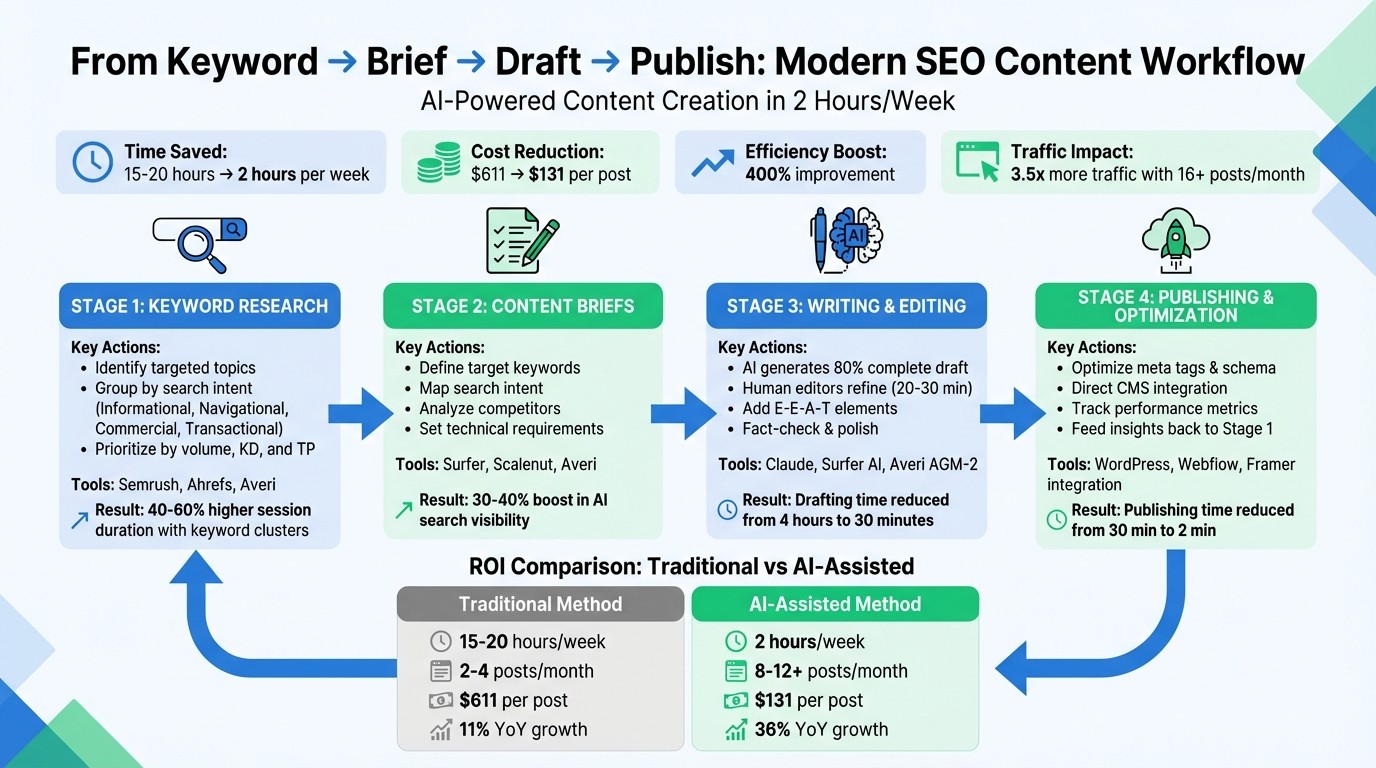
Modern SEO Content Workflow: 4-Stage Process from Keyword Research to Publishing
How to Do AI-Generated SEO Blog Content (the Right Way)
Stage 1: Keyword Research
Keyword research is the cornerstone of any successful content strategy. It’s about pinpointing targeted topics that resonate with what your audience is actively searching for. This step ensures that every subsequent action in your SEO workflow is guided by data and has a clear purpose. Thanks to modern AI tools, this process has become quicker and more precise, helping identify opportunities, group related terms, and prioritize them based on their potential impact.
Keyword Research Tools
The tool you choose will depend on your budget and the complexity of your workflow. Here are some popular options:
Semrush ($139.95/month): Features tools like Keyword Magic for research and Copilot AI to monitor ranking drops and suggest opportunities [10][5].
Ahrefs ($129/month): Known for its extensive backlink data and reliable keyword difficulty metrics [5].
Moz Keyword Explorer: Uses "Moz AI" to help identify primary search intent, making it easier to align content with different stages of the buyer’s journey [11].
For smaller budgets, consider:
KeySearch ($24/month): Offers solid volume and difficulty metrics [5].
AlsoAsked ($15/month): Specializes in question-based keywords, ideal for structuring H2 and H3 subheadings around user queries [5].
Averi: Takes a proactive approach by continuously researching your market, tracking competitors’ content, and queuing high-opportunity topics aligned with your target audience - no need for manual keyword exports.
Grouping and Ranking Keywords
Once you’ve gathered your keywords, the next step is to organize them by search intent, transforming a scattered list into a cohesive strategy. AI tools typically use two methods for clustering keywords:
Semantic clustering: Groups keywords based on shared words.
SERP-based clustering: Groups keywords based on overlapping URLs in the top 10 search results. This method is more accurate because it reflects how Google interprets searcher intent [7][9].
Keywords generally fall into four intent categories:
Informational: Users seeking to learn something.
Navigational: Users looking for a specific website.
Commercial: Users comparing options.
Tools like Quattr use semantic similarity and user behavior to organize related terms into logical clusters [12]. Meanwhile, Surfer offers a "Topical Map" feature to help build authority in a specific niche by identifying keyword clusters [5]. Sites that implement strong keyword cluster structures tend to see 40-60% higher session durations compared to those with isolated content [8].
After grouping, prioritize keywords based on search volume, Keyword Difficulty (KD), and Traffic Potential (TP). Look for opportunities where competitors have lower Domain Authority or where forums like Reddit are ranking - these often signal gaps where your high-quality content can shine [7][9].
"The difference between a page that ranks and one that gets buried isn't luck or brute force - it's the ability to read between the lines of a SERP, spot the motivation behind the query, and respond directly to it."
Eric Carlson, SEO Manager at Siteimprove[6]
Example: Creating a Keyword List
Let’s say you’re marketing a SaaS product for small businesses in the US. Start by exporting keywords using seed terms like "workflow automation", "business process automation", and "task management software." This will yield hundreds of variations.
From there:
Identify broad Parent Topics such as "workflow automation tools", "project management software", and "team collaboration platforms."
Map each keyword to its intent: for instance, "how to automate workflows" is Informational, "best workflow automation software" is Commercial, and "buy workflow automation tool" is Transactional [8].
Choose 3-5 Pillar Topics to focus on, like "workflow automation for small business." Then, plan 5-10 supporting "spoke" pages for each pillar, such as "workflow automation vs. project management" or "free workflow automation tools" [8].
To refine your list, use Google Autocomplete in incognito mode to discover trending, real-time keywords that paid tools might miss [5]. Finally, perform a "SERP Sanity Check" by manually searching your top 2-3 keywords to verify that the ranking results align with the type of content you intend to create [7][9].
With this structured keyword list, you’ll be ready to craft content briefs that drive targeted campaigns effectively.
Stage 2: Building Content Briefs
A content brief transforms your keyword research into a clear roadmap for creating content. It ensures writers stay aligned with SEO objectives while reflecting your brand’s tone and style. Without a well-constructed brief, even the most promising keywords can lead to content that misses the mark on search intent or fails to perform.
Once your keywords are sorted, the next step is to craft a brief that guides every stage of the writing process.
What to Include in a Content Brief
A strong content brief should cover five essential components:
Target keywords with search volume to guide natural integration.
Heading hierarchy (H1, H2, H3) that aligns with user questions and search intent.
Search intent mapping, specifying whether the content is informational (e.g., "What is workflow automation?"), instructional (e.g., "How to automate tasks"), or commercial (e.g., "Best workflow tools for startups") [13].
Competitive analysis to pinpoint gaps in existing high-ranking content and provide a unique angle for differentiation [1][2].
Technical requirements, such as meta titles, meta descriptions, internal linking suggestions, and schema markup (FAQ or How-To), to improve search engine understanding [2][3].
Additional elements like brand voice guidelines, audience pain points, estimated word count, and content format (e.g., listicle, how-to guide) can further streamline the process.
Considering that 77.6% of marketers struggle with getting content to rank and 70.6% find it challenging to meet user intent, incorporating these elements addresses common hurdles [1].
Leveraging AI for Content Briefs
AI tools can cut brief creation time from hours to mere minutes by automating keyword research, competitive analysis, and structural recommendations [2]. These tools ensure your briefs are not only efficient but also tightly aligned with your keyword strategy.
Platforms like Surfer Content Editor ($99/month) analyze top-ranking pages to suggest heading structures, keyword density, and content length [14]. Similarly, Scalenut ($49/month) uses semantic analysis to generate topic clusters and outlines [14].
Tools like Averi go a step further by integrating your brand voice, highlighting competitor weaknesses, and building a robust SEO framework. Averi’s "Strategic Cortex" organizes content into a "Hero, Hub, and Hygiene" model, ensuring briefs cater to both traditional Google search and AI-driven tools (GEO) [1][3]. The system also incorporates FAQ sections, entity definitions, and structured data - features that can boost a piece’s likelihood of appearing in LLM-generated responses by 30–40% [3].
By automating these processes, AI ensures briefs follow SEO best practices while enhancing readability.
Example: Brief for a How-To Guide
Here’s an example of a brief designed for a how-to guide aimed at startup marketing teams on "how to automate content workflows."
Primary Keyword: "automate content workflows" (1,200 monthly searches, KD 35)
Secondary Keywords: "content automation tools", "marketing workflow software", "AI content planning"
Search Intent: Instructional - users are looking for step-by-step guidance.
Target Audience: Marketing managers at Series A/B startups with lean teams of 5–15 people.
Heading Structure:
H1: How to Automate Content Workflows in 2026
H2: Why Content Automation Matters for Lean Teams
H2: Step 1: Map Your Current Workflow
H2: Step 2: Choose the Right Automation Tools
H3: Keyword Research Automation
H3: Brief Creation Tools
H3: Publishing and Analytics
H2: Step 3: Set Up Your Content Calendar
H2: Common Mistakes to Avoid
Competitive Gaps: Many top-ranking articles focus on enterprise-level solutions. This guide can stand out by spotlighting budget-friendly options for startups (under $200/month). For example, it could highlight how automating brief creation reduces the process from 90 minutes to just 10 [2].
Technical Requirements: Include an FAQ schema with questions like "What is content workflow automation?" and "How much does content automation cost?" Use tables to compare 3–4 tools, detailing pricing and features. Link internally to your "content marketing strategy" pillar page.
Brand Voice: Maintain a conversational tone, avoiding jargon. Use real-world examples from startups rather than generic enterprise scenarios.
This approach equips writers with everything they need to produce content that ranks well, engages readers, and stays true to your brand - all while minimizing the need for revisions.
Stage 3: Writing and Editing Drafts
Once your brief is finalized, the next step is to create a draft and refine it for publication. AI tools take care of the groundwork - research, structure, and initial drafting - while human editors step in to add the polish that ensures the content truly reflects your brand's voice and expertise.
AI Writing Tools
AI tools like Surfer AI, Claude, and Averi streamline the drafting process by automating research and applying SEO principles, significantly reducing manual effort [2]. For example, Averi's AGM-2 model is specifically designed for marketing content. It adapts to your brand voice during onboarding and generates drafts that are about 80% complete right out of the gate [17]. The platform organizes content for both traditional Google search and Generative Engine Optimization (GEO), including features like FAQ sections, TL;DR summaries, and optimized heading structures [2][3]. This dual approach can boost visibility in AI-driven search results by 30–40% [3].
Switching to AI-assisted content creation can save businesses substantial time and money. Drafting costs drop by approximately $480 per post compared to traditional human-only workflows, with costs averaging $131 versus $611. Moreover, the time required for drafting shrinks from nearly four hours to just 20–30 minutes for review and refinement [2]. Companies leveraging AI-assisted workflows report a 36% year-over-year growth rate, compared to 11% for those relying solely on human content production [17].
Human Editing for Quality Control
After the AI generates a draft, human editors take over to refine and tailor the content. Instead of rewriting from scratch, editors focus on aligning the draft with the brand's voice and adding expert insights [1]. By incorporating brand-specific terminology, insider knowledge, and emotional elements, they ensure the final product meets both quality and engagement standards [2]. Tools like monday work management and Google Docs facilitate seamless collaboration, offering features like real-time notifications, shared comments, and status updates to streamline the editing process [4].
Editors also integrate E-E-A-T principles (Experience, Expertise, Authoritativeness, Trustworthiness) into the content. This includes adding author bios, verifying insights with subject matter experts, and conducting rigorous fact-checking to meet Google's quality benchmarks [4][15]. The editing process typically takes 20–30 minutes per piece, broken down into steps like structural review (5 minutes), refining tone and insights (10–15 minutes), and final polishing (5–10 minutes), which includes adding meta tags and internal links [2]. Additionally, editors can use AI tools to adjust tone, compress sections, or expand ideas, further saving time [2].
Example: From Draft to Final
Here’s a real-world example of how a marketing team used Averi to craft a "how-to" guide on automating content workflows in February 2026, showcasing the seamless collaboration between AI and human expertise:
Step 1: AI Draft Generation
The team chose an approved topic, and Averi loaded the brand’s context from its Library. In just 10 minutes, it produced a 1,800-word draft that included hyperlinked sources, an FAQ section, a TL;DR summary, and suggestions for internal links.
Step 2: Collaborative Editing
Using Averi's editing tools, the marketing manager and a freelance editor customized a generic section by adding budget-friendly solutions for startups and a firsthand example of time saved through automation.
Step 3: Quality Control
The editor verified all statistics, ensured the content matched the brand’s established voice, and added a custom meta description. Internal links to the company’s content strategy page were automatically suggested and incorporated.
Step 4: Final Approval
After 25 minutes of collaborative editing, the draft was marked as "Human Reviewed" and published immediately.
This workflow highlights how AI’s efficiency, combined with human expertise, can produce engaging, high-quality content that ranks well and maintains brand consistency - all without the logistical challenges of traditional freelance or agency setups.
Stage 4: Publishing and Optimization
Once your draft is polished, the next step is to optimize and publish it through your CMS. This phase blends technical SEO with automation, ensuring your content not only gets published efficiently but also ranks well on both traditional search engines and AI-driven platforms like ChatGPT and Perplexity.
SEO Optimization Steps
Start by refining your title tags, meta descriptions, and headings to align with search intent [19]. These elements play a crucial role in signaling your content's focus and influencing click-through rates.
Incorporate schema markup - structured data such as Article, FAQ, and HowTo schema - to help Google and AI platforms better understand your content [19][3]. This structured approach is essential for improving visibility in today's evolving search environment.
Strengthen your site's internal linking structure and enforce schema markup. Automated tools can recommend descriptive internal links to fortify your topic clusters [19][3]. Additionally, ensure your technical setup supports server-side rendering and allows proper crawl access. Your robots.txt file should permit access to AI crawlers like GPTBot, ClaudeBot, and PerplexityBot [3]. This step is critical as AI platforms are predicted to account for 15% of the search market by 2028 [3].
Here are a couple of quick tips for optimization:
Add subheadings approximately every 300 words to help AI models segment and retrieve information more effectively [3].
Use concise, single-idea paragraphs to make your content easier for AI systems to process [3].
Once these adjustments are complete, move seamlessly into the publishing phase.
Publishing to Your CMS
With your content optimized, publishing becomes the next priority - and automation can dramatically simplify this step. Tools like Averi can publish directly to platforms like WordPress, Webflow, or Framer, reducing publishing time from 30 minutes of manual work to just 2 minutes [2].
Direct CMS integration eliminates the risk of copy-paste errors and formatting issues [19][2]. Your content goes live exactly as approved, complete with metadata, internal links, and schema markup intact. This ensures a flawless transition from draft to publication. Additionally, each published piece is automatically saved to your content library, building a repository that improves the accuracy and alignment of future AI-generated drafts [2].
Systematized publishing can increase your quarterly content output by 30–50% [19]. Over time, this pace leads to more ranking opportunities, improved internal linking, and valuable data to guide future content strategies. Once your content is live, shift your focus to tracking its performance.
Tracking Performance After Publishing
Publishing is just the beginning of the feedback loop. After your content goes live, monitor key metrics to understand its performance and identify areas for improvement. Track organic sessions, click-through rates (CTR), dwell time, and keyword rankings to evaluate traditional SEO success [19][2]. Also, pay attention to brand mentions in AI-generated responses from platforms like ChatGPT and Perplexity, as well as traffic driven by AI-powered search [3].
Modern content tools like Averi go beyond simple reporting by offering actionable insights based on performance data [2]. For instance, the system might highlight a blog post ranking #8 for a target keyword and suggest specific tweaks to move it to page one. It could also flag trending topics in your industry with ready-to-use content ideas [2]. This transforms analytics from passive observation into an active optimization process, feeding data directly into future keyword strategies and content planning.
High-performing teams make real-time adjustments [1]. A quick 15–20 minute analytics review each week is enough to identify what’s working and what needs refinement [2]. Monthly entity audits can also uncover gaps in your content strategy - ask AI tools like ChatGPT, "Why didn’t you recommend us?" to pinpoint areas where competitors are outperforming you [3].
Companies that publish 16 or more blog posts per month see 3.5 times more inbound traffic than those with inconsistent publishing schedules [1][2]. Additionally, AI-assisted content creation can boost organic traffic by 120% in just six months [1]. The secret lies in consistency - regular publishing, performance tracking, and data-driven decision-making. Over time, this approach creates a compounding effect, where each new piece of content becomes smarter, sharper, and more likely to succeed.
How Averi Automates the Entire Workflow
Averi brings together keyword research, brief creation, drafting, and publishing into a single, streamlined system. Instead of juggling multiple tools or coordinating with freelancers, everything happens within one platform that adapts to your business needs over time. This approach eliminates the inefficiencies of the fragmented, manual methods many teams rely on.
Averi vs. Manual Workflows
Traditional workflows for content creation demand a lot of time - around 15–20 hours weekly for just a few posts. This includes 2–3 hours for keyword research, 4–6 hours for writing, 30 minutes for publishing, and up to 3 hours for analytics [2].
Averi reduces this workload to just 2 hours per week [2]. It automates keyword research by identifying trending topics and competitor gaps, then queues up content ideas for your review. Once you approve a topic, Averi generates a fully optimized draft in minutes, including SEO enhancements, internal links, and metadata. You spend 20–30 minutes refining the draft before publishing directly to platforms like WordPress, Webflow, or Framer in just 2 minutes [2]. The system also tracks performance and uses that data to suggest new content ideas, ensuring your strategy evolves based on results.
The financial benefits are just as compelling. Producing content with Averi costs $131 per post, compared to $611 with traditional methods [2]. For startups working with limited resources, this can mean the difference between maintaining a consistent content strategy and abandoning it altogether.
Why Startups Choose Averi
Startups often face unique challenges: 47% of founders handle their own marketing, but 56% have less than an hour per day to dedicate to it [2]. Averi simplifies this by storing your brand voice and positioning in its Brand Core [2], which ensures all drafts naturally reflect your brand identity.
Publishing directly to your CMS eliminates time-consuming manual steps. Tasks that once took 30 minutes now take just 2 minutes [2]. Each published piece is stored in your Library, a growing collection that helps the AI create sharper, more brand-aligned drafts over time [18]. Built-in analytics go beyond reporting numbers - they offer actionable insights, like identifying posts ranking at #8 and suggesting tweaks to push them to page one [2].
The payoff is clear: companies publishing 16+ blog posts per month generate 3.5 times more inbound traffic than those with irregular schedules [1][2]. Averi makes this level of output possible without requiring a full marketing team.
Example: Using Averi End-to-End
In 2025, a mid-stage B2B SaaS company used Averi to launch a new product feature. Within 48 hours, the team published 94 pieces of content across six platforms, including blog posts, social media updates, email campaigns, and comparison pages. Averi handled research, drafting, and publishing, while the team focused on approvals. The result? A 340% increase in feature adoption and a 67% reduction in release timelines [1].
For solo founders, the process is even simpler. Spend 15 minutes on Monday reviewing the automated content queue, 45–60 minutes mid-week refining AI drafts, and 15–20 minutes on Friday analyzing performance and approving the next batch of topics [2]. Meanwhile, Averi works in the background - tracking competitors, identifying keyword opportunities, and queuing up fresh content ideas - so you can focus on growing your business.
The creators of Averi used this very workflow to grow their own web traffic by over 6,000% in just six months [16]. This isn’t just automation - it’s a self-improving system where every piece of content strengthens the next, making your strategy smarter and more efficient over time.
Conclusion
Let’s bring everything together into a streamlined, effective system.
Summary of the 4 Workflow Stages
The process - keyword research, brief creation, drafting, and publishing - forms a cohesive cycle that transforms disorganized content efforts into a dependable engine for SEO success. Each stage plays a critical role: keyword research uncovers valuable opportunities, briefs establish clear structure and tone, drafting combines AI efficiency with human oversight, and publishing ties it all together by tracking performance and feeding insights back into the system for ongoing refinement [16][18].
This isn’t about churning out more content; it’s about creating a system that builds momentum with every piece. Companies publishing 16 or more blog posts per month see 3.5 times more inbound traffic - a level of output this workflow makes achievable without overburdening teams or compromising quality [1][2].
Why AI Tools Matter for Content Marketing
AI-assisted workflows are reshaping the game, driving 36% annual growth compared to 11% for human-only approaches [17]. Tools like Averi don’t just speed up the process - they ensure every draft aligns with your brand’s voice and leverages insights from past performance. With features like a Brand Core and Library, Averi helps maintain consistency while scaling output.
"You don't need more time for content. You need a system that creates content without requiring your time."
– Zach Chmael, Head of Marketing, Averi [2]
The rise of AI-powered search makes this shift non-negotiable. Language models are expected to capture 15% of the search market by 2028, and content with precise, data-backed insights is 30–40% more likely to surface in AI-generated answers [3]. To stay visible, optimizing for both traditional search engines and generative AI tools is no longer optional - it’s essential.
Averi’s creators built the platform based on a workflow that scaled their web traffic by over 6,000% in just six months [16]. This isn’t just theory - it’s proof that structured, AI-driven systems outperform manual methods in building lasting organic visibility. The real question isn’t whether to adopt AI tools but whether you can afford to ignore them.
FAQs
How do I pick keywords that are actually worth writing about?
When selecting keywords, prioritize those that closely match user intent, are directly relevant to your content, and offer a realistic opportunity to rank well. Leverage AI-driven tools to simplify the process of brainstorming and analyzing potential keywords. Concentrate on themes that establish your expertise in a specific area, as this can significantly boost your visibility and influence on search engine results pages (SERPs).
What should I include in an SEO content brief to reduce rewrites?
To cut down on rewrites, make sure your SEO content brief is clear and detailed from the start. Include essential elements like target keywords, the intended audience, content objectives, and specific style or tone preferences. Lay out structural needs, such as headings or FAQ sections, and carefully review the brief for clarity before sending it out. By offering precise instructions upfront, you can align expectations, reduce back-and-forth edits, and save time without compromising on quality.
How do I optimize posts for both Google and AI-powered search?
To make your posts stand out on Google and AI-driven search platforms, prioritize crafting well-researched, SEO-focused content. Take advantage of AI tools to assist with research, structure, and initial drafts. Ensure your content matches user search intent, incorporates relevant keywords naturally, and follows technical SEO guidelines. Tools like Frase and Rankability can help simplify the process and boost your results.
Related Blog Posts

Zach Chmael
CMO, Averi
"We built Averi around the exact workflow we've used to scale our web traffic over 6000% in the last 6 months."
Your content should be working harder.
Averi's content engine builds Google entity authority, drives AI citations, and scales your visibility so you can get more customers.