

In This Article
Small teams use AI, integrated workflows, and focused strategy to produce enterprise-quality content faster, cut costs, and scale output.
Updated:
Trusted by 1,000+ teams
Startups use Averi to build
content engines that rank.
Lean teams can now create enterprise-level content by combining AI tools with focused human expertise. This approach allows small teams to produce high-quality, scalable content without large budgets or headcounts. Here's how:
AI Efficiency: Tools like Averi AI automate research, drafting, and publishing, reducing production time by up to 67% and costs by 50%.
Content Systems: Shifting from "campaign thinking" to "strategic content engine thinking" enables continuous, multi-platform content creation.
Key Metrics: Successful content ranks in Google's top three, drives 30–50% of organic traffic, and achieves conversion rates of 2–20%.
Optimized Workflows: Integrated systems streamline processes, saving 3–5 hours weekly and cutting content costs from $611 to $131 per post.
Performance Tracking: Regular analytics reviews improve content strategy, boosting traffic by 15–25% quarterly.
Core Challenges Lean Teams Face
What Enterprise-Level Content Actually Means
Enterprise-level content hits benchmarks that set it apart: ranking in Google's top three for target keywords, driving 30–50% of organic traffic, and maintaining bounce rates below 40% with dwell times exceeding three minutes [4][5]. A consistent tone across 95% or more of assets, achieved through style guides, reinforces brand identity. On top of that, conversion rates often range from 2–5% for gated content and 10–20% for optimized landing pages [4][5].
For small businesses, these metrics aren’t just aspirational - they’re essential for competing without relying on big advertising budgets. Brand consistency, for example, can boost revenue by as much as 23% [3]. Similarly, publishing 16 or more blog posts a month results in 3.5 times more inbound traffic compared to sporadic posting [1]. Without hitting these standards, lean teams risk creating content that doesn’t deliver results, wasting valuable time and missing key growth opportunities. Yet, achieving these outcomes is no small feat, especially when operational and strategic limitations come into play.
Common Problems for Small Teams
While enterprise-level metrics are the goal, lean teams often face significant barriers in trying to meet them. Many of these teams operate with just 1–3 people handling everything - from research and writing to editing, design, and analytics [7][6]. This setup naturally creates bottlenecks. Without a documented strategy, which only 69% of top B2B organizations have [6], role confusion becomes an issue, leaving tasks like ideation and final edits up in the air.
Decision fatigue adds another layer of difficulty. When one person is responsible for countless small decisions - choosing topics, adjusting formats, prioritizing platforms - it can lower the quality of output by 25% and grind workflows to a halt [4][5]. Fragmented tools exacerbate the problem, with teams losing over 30% of their time switching between documents, emails, and spreadsheets [4][5]. For instance, 62% of email marketing teams need two weeks or more to create a single email [2], while 77.6% of content marketers rank getting content to perform well in search results as their biggest frustration [1].
To make matters worse, traditional workflows designed for larger teams often extend timelines by 50%, making it even harder for lean teams to develop efficient, repeatable content processes [1][4][5].
I Built a Marketing Team with 1 AI Agent and No Code (free n8n template)
Building a Content Strategy That Scales
Creating a strategy that grows with your needs starts with nailing down the essentials: a clear brand voice, a well-defined target audience, and specific goals. When small teams establish these elements upfront, they eliminate the trial-and-error process that often slows production. In fact, using detailed briefs can cut production time by 30–50%, as writers and editors no longer need to guess the tone or audience expectations [4]. This shared understanding ensures that content remains consistent and aligned with objectives, reducing unnecessary revisions.
The problem? Laying this groundwork typically involves weeks of manual effort - digging into competitor analysis, identifying content gaps, and mapping topics to business goals. For a team of just a few people already juggling multiple tasks, this timeline can feel impossible. That’s where AI tools come in, offering a way to streamline and speed up the process.
Using AI to Build Your Content Strategy
AI tools like Averi AI simplify the heavy lifting of strategy creation. By scanning your website, these tools can pinpoint content gaps, analyze competitors’ best-performing topics, and identify emerging industry trends. They then use this data to generate tailored content calendars and detailed briefs [4]. What once took weeks can now be done in hours. For example, the system can surface high-traffic keywords, recommend pillar-cluster strategies, and suggest content ideas categorized by format - whether it’s a listicle, a how-to guide, or a comparison piece. Each suggestion comes complete with titles, target keywords, and overviews, ready for immediate review.
This approach allows even a two-person team to operate like a well-equipped content powerhouse, without the need to hire a dedicated analyst. Instead of spending days figuring out what to write about, teams can focus on reviewing AI-generated suggestions and selecting the ones that align with their goals. The time saved on planning can then be redirected toward execution, helping small teams maintain a steady publishing cadence that’s critical for driving inbound growth [1].
Once the strategy is in place, the next step is deciding on the right mix of content types.
Choosing the Right Content Mix
After establishing a strategic foundation, determining the ideal content mix becomes the focus. For lean teams, spreading resources across every format isn’t practical, so prioritizing is essential. A 70/20/10 approach works well: 70% educational content, 20% promotional material, and 10% experimental pieces. This mix, tailored to audience needs, can boost efficiency by 40% [4].
The exact balance depends on your audience’s preferences and your team’s capabilities. For instance, if your analytics show strong demand for tutorials, it makes sense to prioritize how-to guides over video content - especially if you lack video production expertise. Similarly, if your audience consists of B2B tech buyers, allocating 50% of your resources to detailed guides rather than short-form social posts will likely yield better results [4]. Defining audience personas early - covering demographics, challenges, and preferred platforms - ensures your efforts are focused on formats that resonate, avoiding wasted time on low-impact content [4].
Creating Content With AI and Automated Workflows
Once your strategy and content mix are set, the next hurdle is execution. For smaller teams, the traditional process - manual research, drafting, formatting, and publishing - can eat up hours for every piece of content. AI-powered workflows change the game by compressing timelines while maintaining quality.
Automating Topic Research and Ideation
With a clear strategy in place, AI can streamline the process of generating ideas. Platforms like Jasper.ai can suggest topics based on keyword trends, while tools like Ahrefs analyze search volume and competition. These tools can deliver over 50 topic clusters tailored to goals such as "SaaS lead generation" [5]. This reduces brainstorming time to just minutes, allowing teams to focus on selecting the most relevant ideas instead of starting from scratch.
AI tools also help align content ideas with business objectives. Content briefs can map topics to specific goals - whether it’s targeting a stage in the buyer's journey or achieving a KPI like "boosting conversions by 20%." AI platforms can even score topics for relevance, ensuring outputs match predefined priorities. Teams using this method report that 80-90% of AI-generated ideas align with revenue-driven content [4][5], solving the common problem of misaligned manual ideation.
AI Drafting and Human Editing
AI tools can produce 1,000-word drafts in seconds, cutting first-draft creation time from four hours to just 30 minutes [5]. Afterward, human editors refine the drafts for tone, accuracy, and brand voice. Collaborative tools - like those in Averi AI - include features like real-time feedback, version tracking, and shared style guides, which help editors flag inconsistencies and reduce revision cycles by 40% [4][5].
For example, a small SaaS marketing team used Jasper.ai to draft blog posts and then edited them for authenticity. This allowed them to create 12 high-quality pieces per month, compared to just four before, while maintaining 95% brand consistency through templates and multi-stage reviews. The result? A 25% increase in engagement [5]. With polished drafts ready, teams can transition smoothly to automated publishing.
Publishing Directly to Your CMS
Once content is refined, automated CMS integrations handle the final steps. Manual publishing can take one to two hours per piece, but direct CMS integrations eliminate this bottleneck entirely. Tools like Averi AI, Jasper.ai, or WordPress plugins connect via APIs or platforms like Zapier, allowing AI-generated and polished content to be exported directly as formatted posts, ready for scheduling or publishing. For instance, connecting to Webflow for visually rich sites can reduce publishing time from 30 minutes to just two minutes per article [5].
These integrations also handle SEO optimization, image formatting, and mobile responsiveness, cutting errors by 90% [4][5]. For lean teams managing multiple channels, this means fewer mistakes and more time to focus on refining strategy instead of technical tasks. The result is a seamless workflow where content moves from draft to live without manual handoffs, enabling teams to scale their output without increasing staff.
Tracking Performance and Improving Over Time
Keeping tabs on performance isn’t just about knowing what works - it’s about shaping every future effort to be better. Teams that commit to weekly analytics reviews can uncover patterns that lead to success, allowing them to scale their efforts significantly without needing to grow their team size.
Metrics That Drive Content Success
To elevate content from average to exceptional, focus on three core metrics: SEO rankings, engagement rates, and conversions. For SEO, prioritize tracking keyword positions and organic traffic growth. The best-performing content often secures spots in the top three search results for high-demand keywords, which can account for 30–50% of organic traffic. When it comes to engagement, key indicators include time on page (over 2 minutes), bounce rate (below 40%), and social shares. For conversions, keep an eye on lead generation, sign-ups, and sales tied to specific content. Industry standards suggest high-quality content typically achieves engagement rates of 5–10% and boosts conversions by 2–5% [4][5]. These metrics not only measure success but also provide a roadmap for making smarter, data-driven decisions.
Turning Performance Data Into Action
Once metrics are in place, use them to fine-tune your content strategy. For example, focus on content that achieves conversion rates above 5% - these are your star performers. Replicating or repurposing their success can lead to major gains. A great example? One team turned their top-performing blog posts into LinkedIn threads, resulting in a 40% increase in leads [5]. Meanwhile, underperforming content doesn’t have to be a lost cause. Refreshing it with updated data, punchier headlines, and stronger calls-to-action can boost rankings by 20–30% [4].
AI tools can make this process even smoother. By reviewing performance data through platforms like Averi AI, teams can save hours of work while spotting opportunities. For instance, dashboards can flag content that’s ranking at #8 and suggest actions to push it into the top spots. Dedicating just 15–20 minutes weekly to these reviews can uncover trends and opportunities that drive real results, like 15–25% growth in quarterly traffic [4][5]. This kind of consistent feedback loop ensures your strategy stays sharp and adaptable.
Producing More Content Without Hiring More People
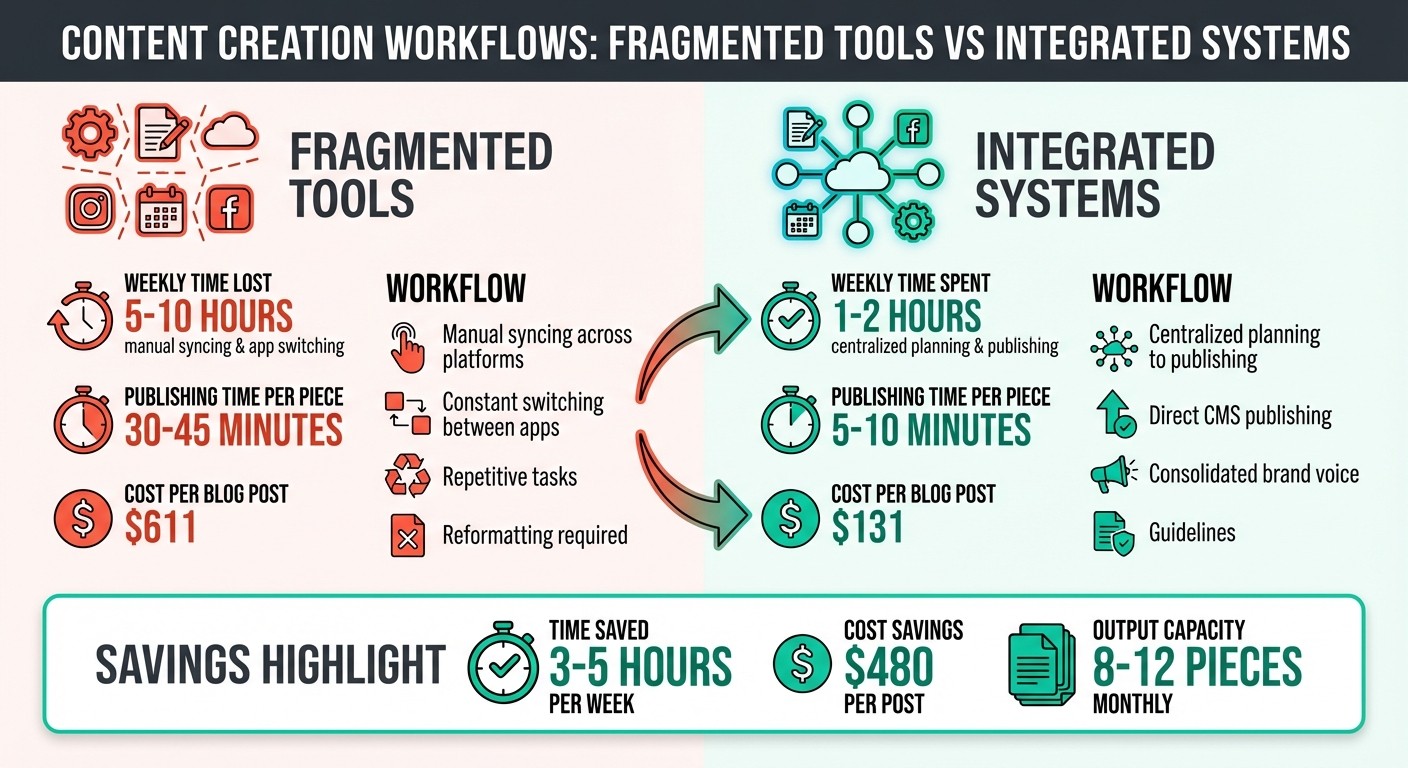
Fragmented Tools vs Integrated Content Systems: Time and Cost Comparison
With a streamlined strategy and automated workflows in place, lean teams can improve AI productivity by unifying their tools. The real challenge for small teams isn’t a lack of talent - it’s the time wasted switching between disconnected apps. Jumping from calendars to drafting tools to CMS platforms eats up hours. Teams juggling fragmented workflows often lose 5–10 hours each week to manual handoffs and repetitive tasks. By contrast, an integrated system like Averi centralizes everything - from planning to publishing - cutting that time down to just 1–2 hours.
Fragmented Tools vs. Integrated Systems
The difference between using scattered tools and an integrated system is striking when you look at three key areas: setup, weekly execution, and publishing. Fragmented tools require constant syncing across platforms, which adds unnecessary steps. Integrated systems streamline the process by consolidating your brand voice, content guidelines, and performance data in one place. For instance, publishing a single piece of content with disconnected tools can take 30–45 minutes, but an integrated system reduces that to just 5–10 minutes by allowing direct CMS publishing without reformatting. For a team producing 8–12 pieces monthly, this could save 3–5 hours every week - time that can be spent on strategic initiatives instead.
The financial upside is equally compelling. Traditional content creation, factoring in research, writing, editing, and publishing, costs approximately $611 per blog post. With AI-assisted workflows and an integrated platform, that cost drops to about $131 per post - a savings of $480 per piece.
By adopting an integrated system, daily operations become a well-oiled routine.
A Sample Week for a Lean Content Team
With AI-driven insights and a unified workflow, a lean team can maintain high productivity while cutting down on operational overhead. A three-person team using an integrated system can produce enterprise-level content by focusing their efforts on key approvals rather than lengthy creation cycles. Here’s how their week might look:
Monday: The inbound marketer spends 15 minutes reviewing AI-generated content ideas. These suggestions are based on keyword research, competitor analysis, and trending topics.
Tuesday–Thursday: The writer spends under an hour refining AI-generated drafts, focusing on injecting the brand’s unique voice and perspective instead of starting from scratch. Simultaneously, the designer works on visual assets using pre-made templates to ensure consistency.
Friday: The team dedicates 15–20 minutes to reviewing performance data from published content, approving optimization suggestions, and queuing topics for the next week.
"A content engine is a system that produces, publishes, and optimizes content with minimal ongoing founder involvement." - Zach Chmael, Head of Marketing, Averi
This approach keeps the team’s total weekly time commitment to around 1.5–2 hours while enabling them to produce 8–12 pieces of content monthly. The system automates tasks like research, keyword analysis, drafting, SEO formatting, and CMS publishing. Additionally, every published piece is stored in the system’s library, building a smarter foundation for future drafts without the need for extra coordination.
Conclusion
This article explored how small teams can achieve enterprise-level content output by leveraging AI tools and efficient systems. With AI-driven workflows, integrated platforms, and a focus on data, even a lean team can consistently produce high-quality content. By automating tasks like research, drafting, and publishing, while reserving human effort for strategy and refinement, a three-person team can generate 8–12 pieces of enterprise-grade content each month.
The secret lies in starting small and scaling wisely. Begin with a single AI tool for tasks like topic research or drafting. Test its effectiveness for a week and expand based on the time it saves. Incorporate templates, detailed content briefs, and performance metrics to create a repeatable system that gets better with each iteration. Research shows that companies publishing 16 or more posts monthly see 3.5 times more traffic than those posting fewer than four [8].
Using an integrated platform can further enhance efficiency by reducing manual handoffs and consolidating brand voice, guidelines, and performance data in one place. This streamlined approach eliminates the inefficiencies of switching between tools, allowing your team to focus on creativity and strategy. These processes can transform how you approach content creation.
Ready to take the next step? Explore Averi AI to automate your workflows from strategy to publishing. Sign up today and try it for free!
FAQs
What’s the fastest way to build a scalable content strategy with a small team?
To develop a scalable content strategy with a small team, leverage AI-driven tools to simplify processes like research, drafting, and publishing. Pair these tools with well-defined workflows and focused strategic guidance, as suggested in Averi's frameworks for building efficient and repeatable content systems. This method helps maintain quality while making the best use of your team’s time and resources.
How do we maintain brand voice and accuracy when using AI to draft content?
To keep your brand voice consistent and ensure accuracy when working with AI, structured workflows with human oversight are essential. Start by creating a detailed style guide outlining your brand's voice, tone, and formatting rules - this will serve as a roadmap for AI-generated drafts. Always have humans review AI outputs to verify factual accuracy and ensure they align with your messaging.
While AI can efficiently handle tasks like research or drafting, the final approval should always rest with a human team member. Establishing clear review processes and vetting layers helps maintain consistency and prevents mistakes. Think of AI as a powerful assistant, not the sole creator, ensuring your brand stays authentic and error-free.
What metrics should we track weekly to show content is driving revenue?
Track engagement rate, conversion rate, and ROI on a weekly basis. These metrics provide insight into how your audience interacts with your content, how effectively leads are being generated, and the overall financial return. Together, they help illustrate how your content drives revenue growth.
Related Blog Posts

Zach Chmael
CMO, Averi
"We built Averi around the exact workflow we've used to scale our web traffic over 6000% in the last 6 months."
Your content should be working harder.
Averi's content engine builds Google entity authority, drives AI citations, and scales your visibility so you can get more customers.