

In This Article
Adaptive AI automates personalized campaigns, diagnoses issues in real time, and helps marketing teams launch tailored campaigns faster with higher ROI.
Updated:
Trusted by 1,000+ teams
Startups use Averi to build
content engines that rank.
Marketing is evolving, and AI is leading the charge. Traditional tools often fall short when it comes to personalization, speed, and efficiency. Enter adaptive AI reasoning - a system designed to tailor strategies, automate tasks, and deliver results faster than ever. Companies like Lenovo are already seeing massive savings, such as $16 million in one year, by leveraging this technology.
Key Insights:
Smarter Campaigns: AI analyzes data in real time, diagnoses issues, and recommends fixes without human delays.
Personalization at Scale: Deeply tailored messages that maintain brand consistency across channels.
Efficiency Gains: Teams report 40% faster execution and 25% performance improvements.
Seamless Collaboration: AI handles repetitive tasks while humans focus on creative, high-impact work.
By integrating AI with human expertise, marketing teams can create campaigns in days, not weeks, while boosting ROI. The future of marketing is here - are you ready to adapt?
AI for Marketing: Automate Campaigns and Personalization at Scale
What Is Adaptive AI Reasoning?
Addressing earlier challenges in scaling and personalization, adaptive AI reasoning offers a more efficient way to tackle decision-making and execution in marketing.
This technology autonomously handles analysis, diagnosis, and execution of marketing tasks. Unlike systems that rely on rigid rules, it examines data, identifies issues, and creates actionable plans - all without needing constant human oversight. For instance, if a campaign is underperforming, adaptive AI doesn’t just highlight the problem. It digs into the data, pinpoints the issue (like high click-through rates paired with low engagement), and recommends specific fixes tailored to each channel [1].
This approach surpasses basic automation. David from Thorn captured the shift perfectly:
"Averi doesn't just give us insights, it helps us act on them. That's the gap every other platform misses. We're finally turning data into real campaigns." [1]
The standout feature is contextual understanding. Adaptive AI remembers your brand voice, past successes, and strategic goals, applying that knowledge to every task. Payton from Broadside shared:
"I've been testing it against ChatGPT…I love how it's customized to the information that I have in there in terms of my brand and tone." [1]
This capability lays the groundwork for a deeper comparison with traditional methods in the next section.
How It Differs from Standard Marketing Automation
Traditional marketing automation relies on if-then logic - for example, if someone downloads a whitepaper, then send a follow-up email. It’s a rigid system. Adaptive AI reasoning, however, takes a smarter approach. It evaluates real-time context, makes strategic decisions, diagnoses campaign issues, and proposes fixes - all without waiting for human intervention [1].
Another limitation of standard tools is fragmentation. Marketing teams often juggle disconnected AI tools and platforms that don’t integrate, creating inefficiencies known as "GTM bloat" [2]. Indy from Lucid AI experienced this firsthand:
"We replaced five disconnected tools with Averi and got 40% faster execution with 25% performance improvement." [1]
Adaptive AI eliminates these silos by unifying systems into a single platform. It codifies best practices, connects teams, and converts insights into action without manual delays [2].
Personalization is another area where traditional tools fall short. Basic automation can handle simple tasks like adding a first name or segmenting by industry, but adaptive AI takes it much further. It deeply researches accounts and contacts, drafts highly tailored outreach, and creates assets designed for specific personas - all while maintaining your brand’s tone [2]. Achieving this level of customization with traditional tools often requires complex integrations and manual effort.
These distinctions lead to clear advantages for marketing teams.
Main Benefits for Marketing Teams
Adaptive AI updates customer profiles in real time and forecasts channel performance using both historical and live data. Instead of relying on static lists or manually refreshing data, it enriches inbound leads automatically. It researches accounts and contacts, reducing the time it takes to respond to leads and boosting conversion rates [2]. When planning campaigns, adaptive AI predicts channel performance based on past trends, helping you allocate your budget more effectively.
Perhaps the most transformative change is the seamless collaboration between AI and humans. Adaptive AI doesn’t replace your team - it complements them, taking care of repetitive tasks while flagging areas that require human creativity or judgment. Kevin from Fieldgrade described this balance:
"The AI handles what it should, and my team handles what we do best. No confusion about roles, no redundant work. Just better marketing, faster." [1]
This partnership allows marketers to focus on strategic, high-value work while the AI scales execution. The result is a smoother workflow, turning insights into campaigns without unnecessary guesswork or wasted effort.
How Adaptive AI Reasoning Solves Marketing Scaling Problems
Scaling marketing efforts often involves overcoming hurdles like tool fatigue, inconsistent messaging, and sluggish execution. Adaptive AI reasoning takes a different approach by offering a unified, intelligent system that learns, evolves, and takes action. This streamlined method enables the platform to provide accurate, real-time marketing insights.
Real-Time Data Analysis for Personalization
With adaptive AI, lead profiles are enriched instantly through real-time account research. The system processes both historical data and live updates to predict which channels will yield the best results. This enables your team to act quickly, delivering messaging tailored to each prospect’s industry, role, and unique challenges. The result? A shift from broad audience segmentation to highly detailed, account-specific personalization.
AI-Human Collaboration Without Slowdowns
Routine tasks like drafting content, analyzing data, and generating assets are handled by adaptive AI, freeing up your team for more strategic work. When human judgment or specialized expertise is required, platforms like Averi AI seamlessly integrate marketing professionals into the workflow. This eliminates the need to juggle multiple tools or manage separate freelancer platforms. By working alongside your team, the AI enhances productivity, prevents approval bottlenecks, and avoids repetitive tasks.
Predictive Scenario Modeling
Before campaigns even launch, adaptive AI predicts performance by analyzing past trends, current market dynamics, and your specific objectives. It runs simulations to test different scenarios - such as adjusting budgets, tweaking messaging, or exploring alternative channel strategies. This data-driven approach minimizes wasted resources on underperforming campaigns, allowing you to start with confidence and make informed decisions from the outset.
How Averi AI Uses Adaptive Reasoning
Averi AI showcases its Synapse architecture to bring adaptive reasoning to life. This system doesn’t treat every task the same - it routes them through specialized layers for strategy, content, analytics, and even human expertise when needed. By doing so, it adjusts its cognitive depth automatically, ensuring the right level of focus for each request.
Synapse Architecture and Adaptive Modes
The Synapse architecture employs what Averi calls Adaptive Reasoning, which dynamically switches between three modes: Express, Standard, and Deep. Simple tasks, like drafting quick social media posts, are handled in Express mode, prioritizing speed. On the other hand, complex challenges, such as campaign strategy or positioning, activate Deep mode for a more thorough analysis. This approach ensures quick results for routine tasks and detailed insights for critical decisions - all without requiring manual adjustments.
When the task demands a human touch, Synapse knows when to bring in experts. For instance, technical SEO audits or conversion-focused design work trigger the Human Cortex, connecting you with one of Averi’s 2,500+ vetted specialists.
Think → Create → Execute → Scale Workflow
Averi’s marketing workflow is designed as a seamless process rather than fragmented steps. The Think phase focuses on strategy and planning, while the Create phase uses a structured three-part canvas - Discuss → Draft → Edit - to transform briefs into ready-to-use content like blog posts, email sequences, ads, or landing pages. During the Execute phase, human specialists step in when needed, with full context already shared. Finally, the Scale phase consolidates everything into your Library, ensuring that each project builds on the last.
"Averi turned our marketing chaos into a system. We're launching campaigns in days instead of weeks, and our team finally has the clarity they've been craving" [1].
Sarah from Ghost Note highlighted how this workflow eliminates the inefficiencies of juggling tools like ChatGPT for brainstorming, Google Docs for drafting, and email threads for freelancer coordination. With Averi, it’s all integrated.
Persistent Brand Memory
Averi’s integrated system also ensures long-term brand consistency. Unlike tools that forget your preferences after each session, Averi uses its Brand Core and Library system to maintain a persistent memory. Once you train the AI on your brand’s voice, mission, values, and target audience, it applies that context across every draft, conversation, and campaign. Custom folders help organize marketing strategies, previous work, and product details, further refining the AI’s understanding over time.
Payton from Broadside shared:
"I've been testing it against ChatGPT…I love how it's customized to the information that I have in there in terms of my brand and tone" [1].
This persistent memory eliminates the need to repeatedly explain your brand’s positioning or upload guidelines. When human experts are brought in, they instantly access the same context, cutting out lengthy briefing calls. This continuity drives greater efficiency and personalization, making your marketing efforts more cohesive and impactful.
Measured Results from Adaptive AI in Marketing
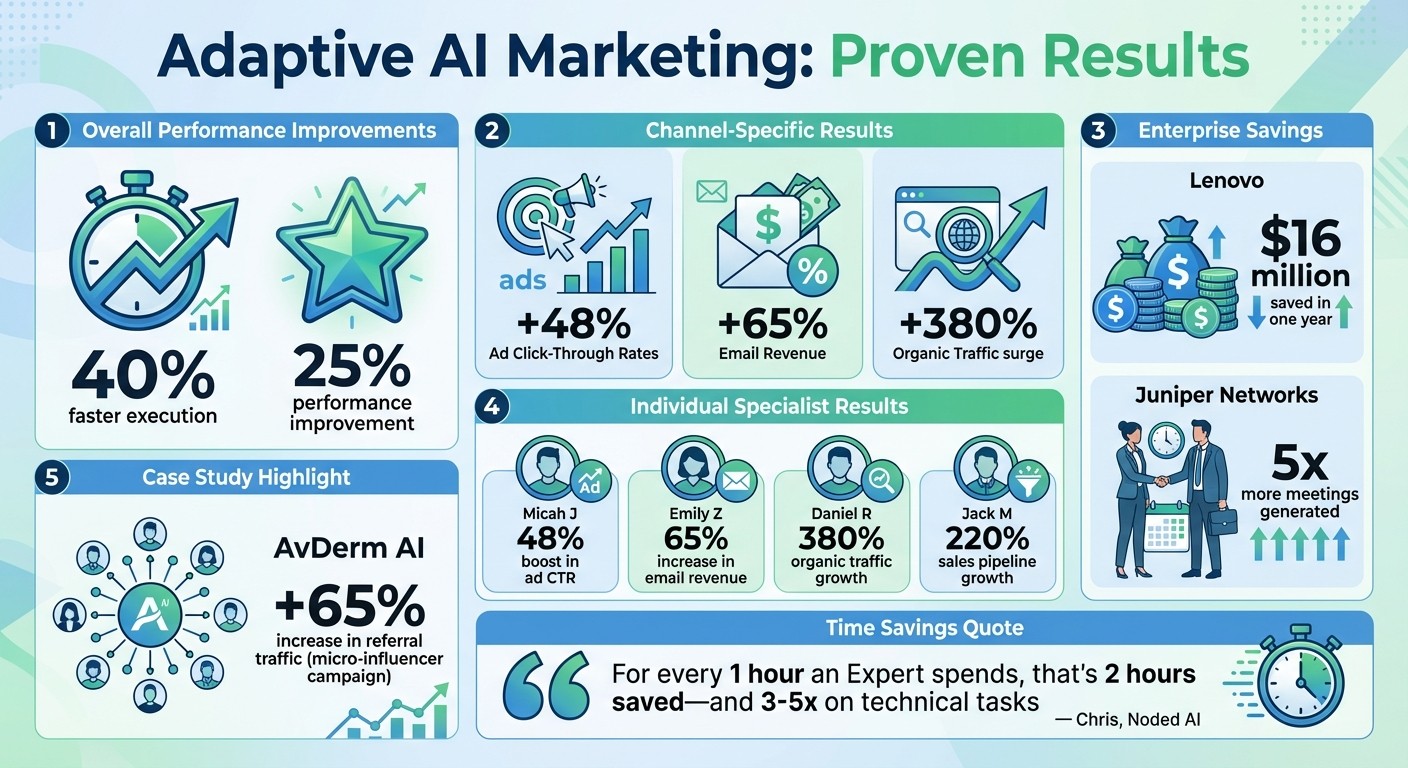
Adaptive AI Marketing Results: Performance Metrics and ROI Statistics
The data highlights how adaptive AI reasoning turns theoretical benefits into measurable marketing outcomes.
Improved Efficiency and ROI
Adaptive AI has proven to significantly enhance speed, reduce costs, and boost campaign effectiveness. Marketing teams have reported a 25% improvement in performance and a 40% faster execution rate compared to traditional workflows [1]. Across various channels, the results have been striking: ad click-through rates increased by 48%, email revenue grew by 65%, and organic traffic surged by 380% [1].
The savings for enterprises are equally impressive. For instance, Roman Olney, Head of Global Digital Experience at Lenovo, saved $16 million in a single year by automating marketing workflows [2]. Similarly, Jean English, former Chief Marketing Officer at Juniper Networks, shared that her team achieved five times more meetings by leveraging personalized, AI-driven go-to-market strategies [2].
On an individual level, Averi AI specialists have delivered standout results:
Micah J: Boosted ad click-through rates by 48%.
Emily Z: Increased email revenue by 65% with targeted campaigns.
Daniel R: Achieved 380% organic traffic growth through SEO optimization.
Jack M: Grew the sales pipeline by 220% with refined growth strategies [1].
These results demonstrate how adaptive AI enables scalable, personalized content that meets the needs of diverse audiences.
Personalization at Scale
Beyond efficiency, adaptive AI excels at crafting messages tailored to specific audiences. By leveraging adaptive reasoning, brands can maintain consistency while personalizing content across various channels and campaigns. AI tools trained on a company’s unique voice and values - referred to as its centralized Brand Core - ensure that all messaging aligns with the brand's identity.
For example, Alex from AvDerm AI launched a campaign using micro-influencers identified by an Averi expert, resulting in a 65% increase in referral traffic to their website within a month [1]. This approach ensures consistent messaging across partnerships while tailoring content to resonate with different audience segments.
Streamlined Workflows for Faster Execution
In addition to efficiency and personalization, adaptive AI simplifies workflows, enabling faster execution. By providing a unified workspace, teams can avoid the inefficiencies of switching between multiple apps. This integrated environment streamlines brainstorming, drafting, and collaboration, reducing the need for redundant briefings and handoffs.
Chris from Noded AI captured this benefit perfectly:
"For every hour my Expert is spending on core marketing, that's probably 2 hours I would have spent on it. And it's probably 3 to 5x on the things that are very technical." [1]
With routine tasks handled by AI, human experts can focus on strategic initiatives, all within a shared context that enhances productivity and minimizes friction.
Conclusion
Marketing no longer has to choose between speed, quality, and creative depth. With adaptive AI reasoning, it's possible to deliver personalized content at scale, launch campaigns faster, and maintain strategic focus - all while fostering smooth collaboration between AI systems and human expertise.
The numbers speak for themselves: adaptive AI platforms have demonstrated a 40% faster execution rate and a 25% improvement in performance [1]. Companies like Lenovo saved $16 million in just one year, and Juniper Networks achieved five times more meetings by leveraging personalized strategies [2]. These results highlight a major shift in how marketing operations are approached.
What sets adaptive AI apart is its ability to integrate seamlessly and retain context. Instead of juggling multiple tools and losing track of ideas between strategy, content creation, and team collaboration, everything happens in one cohesive workspace. The AI learns your brand, remembers the context of your work, and knows exactly when to involve human expertise. This streamlined approach has already proven to cut down campaign launch times significantly [1].
For those looking to embrace this new era, Averi AI offers a solution that combines marketing-focused AI with skilled human experts. Its Synapse architecture and proprietary AGM-2 model ensure your campaigns stay true to your brand while scaling efficiently. By adopting this integrated approach, you can keep your marketing agile and ahead of the competition.
The question is no longer whether adaptive AI is transforming marketing - it’s whether your team will embrace it before your competitors do.
FAQs
What makes adaptive AI reasoning different from traditional marketing automation?
Adaptive AI reasoning transforms the way marketing campaigns operate by moving past rigid, rule-based systems. Instead of sticking to static guidelines, it continuously refines its responses by analyzing context, leveraging real-time data, and drawing insights from previous interactions.
This dynamic approach allows for highly personalized and scalable marketing efforts. It adjusts outputs to meet specific needs while seamlessly integrating human expertise when required. The outcome? Campaigns that are not only quicker and more efficient but also grow and adapt alongside your business.
What are the main advantages of using adaptive AI in marketing?
Adaptive AI is reshaping the marketing landscape by delivering customized outputs that align with the preferences and behaviors of specific audiences. It also supports smart decision-making and allows for smooth collaboration with human expertise whenever necessary. This technology simplifies content creation, enhances targeting accuracy, and makes managing campaigns more efficient.
With its blend of speed, relevance, and flexibility, adaptive AI equips marketing teams to launch campaigns more quickly and achieve stronger results, positioning itself as a crucial resource for today's marketers.
How does adaptive AI reasoning enhance personalization in marketing campaigns?
AI systems that can learn and adjust in real time are transforming how businesses personalize their customer interactions. By analyzing a customer’s preferences, behaviors, and interactions as they happen, these systems fine-tune content, messaging, and offers to align with individual needs and interests.
The result? Every interaction feels more relevant and tailored, creating deeper engagement, boosting customer satisfaction, and driving better conversion rates. As these systems continuously learn and evolve, they empower marketers to craft campaigns that resonate on a more personal and effective level.
Related Blog Posts

Zach Chmael
CMO, Averi
"We built Averi around the exact workflow we've used to scale our web traffic over 6000% in the last 6 months."
Your content should be working harder.
Averi's content engine builds Google entity authority, drives AI citations, and scales your visibility so you can get more customers.