The Simplest Content Marketing Stack for Early-Stage Startups

Averi Academy
Averi Team
8 minutes

In This Article
Streamline your startup's content marketing with a Hub + Spokes 5‑tool stack: affordable AI-driven planning, creation, publishing, social scheduling, and analytics.
Updated:
Trusted by 1,000+ teams
Startups use Averi to build
content engines that rank.
For early-stage startups, managing a marketing stack can quickly become expensive and inefficient. Many small teams waste between $100,000 and $200,000 annually on underused tools and lose 20 hours of productivity each week due to app-switching. The solution? A streamlined "Hub + Spokes" model that focuses on a few essential tools to plan, create, publish, and measure content effectively.
Key Takeaways:
Budget-Friendly Tools: Stick to affordable options like HubSpot Starter ($20/month), AI writing tools (Jasper or Copy.ai at $39–$49/month), and free or low-cost social media schedulers (Buffer or Later).
AI-Powered Efficiency: Use AI to handle 80% of content creation, leaving your team to refine the final 20%. This approach can save time and drive growth even with a small team.
Reduce Complexity: Avoid tool bloat by using one central hub (e.g., Averi) for planning and content creation, paired with a few specialized tools for publishing and analytics.
Focus on Results: Track key metrics like organic traffic, engagement, and conversions with tools like Google Analytics or PostHog.
By keeping your stack simple and efficient, you can focus on creating impactful content and scaling your efforts as your startup grows.
Core Principles for Building Your Marketing Stack
Affordable Tools for Limited Budgets
For early-stage startups working with tight budgets - typically between $500 and $1,500 per month for their entire marketing stack - every dollar needs to deliver value. The goal at this stage isn't perfection but practicality: a system that gets the job done without straining resources.
The smartest approach? Stick to tools that fit your current needs rather than investing in expensive, enterprise-level solutions you might not fully utilize for years. Look for options with free plans or pricing under $100 per month that still provide tangible results. For instance, HubSpot Starter is just $20 per month, while AI writing tools like Jasper or Copy.ai range from $39 to $49 monthly. Social media scheduling platforms such as Buffer and Later often offer free tiers or affordable plans under $100 per month [1].
However, beware of "tool bloat" - spending money on features you don't use or losing time switching between multiple platforms. Studies show that marketers typically use only about 33% of their stack's capabilities [1]. By choosing tools that align with your current scale and offer room to grow, you'll avoid wasted resources and set the stage for efficient, cost-effective automation.
AI-Powered Automation
AI has transformed content marketing, especially for small teams. In the past, startups often needed to hire writers, editors, and strategists to produce content - a costly but necessary investment for finding product-market fit. Now, AI can handle the heavy lifting, creating an 80% first draft while humans focus on refining the final 20% for strategic and creative polish [4].
As Kyle Coleman, CMO at Copy.ai, puts it:
"AI takes me from zero to an 80% first draft. But the final 20%, the careful, thoughtful editing, that's still entirely human." [4]
This collaboration between AI and human effort allows smaller teams to achieve results that once required much larger groups.
Take Averi’s case study from early 2025 as an example. Over just 60 days, a two-person team used AI to generate first drafts and human oversight for strategy and editing. The results were impressive: they published over 100 pieces of content, boosted organic traffic by 340%, grew their newsletter to 3,400 subscribers with a 47% open rate, and increased demo requests by 190% [3]. This combination of AI efficiency and human expertise creates a scalable, streamlined system for growth.
Growth Without Added Complexity
When scaling your marketing stack, simplicity is key. A common mistake startups make is choosing the "best-of-breed" tool for every task, which often leads to a fragmented system. Managing 10 tools can create up to 45 integration points, while managing 40 tools can result in a staggering 780 connections [1]. Each integration introduces potential failures, data silos, and distractions that pull focus from core marketing efforts.
The Hub + Spokes model offers a smarter alternative. Use one central platform (the Hub) to handle key workflows like content creation, data management, and campaign execution. Then, connect only a few specialized tools (the Spokes) for tasks like analytics or social media scheduling. This approach can reduce integration points from 45 to just 10 [1], cutting down on inefficiencies. It also helps prevent the productivity loss caused by constant app-switching, which can cost a five-person team around 20 hours per week [1].
As the Averi team wisely notes:
"A slightly inferior tool that integrates seamlessly produces better outcomes than a superior tool that creates data silos." [1]
To keep things streamlined, follow the "One-In, One-Out" rule: whenever you add a new tool, eliminate an old one. Also, prioritize native integrations over middleware solutions like Zapier, as native connections are generally more reliable and offer real-time syncing without delays [1]. As your annual recurring revenue (ARR) grows from $1M to $3M, your marketing stack budget might expand to $2,000–$5,000 per month. Even so, aim to increase capabilities without adding unnecessary complexity.
Building the Ultimate Marketing Tech Stack for 2025
The 5-Tool Marketing Stack: Plan, Create, Publish, Measure, Improve
A streamlined marketing stack doesn’t need an endless array of tools or overly complicated setups. Instead, it thrives on a few key platforms that work in harmony. These five tools cover the essentials: planning, creating, publishing, tracking, and refining your marketing efforts.
1. Averi: Your All-in-One Workspace for Planning and Content Creation
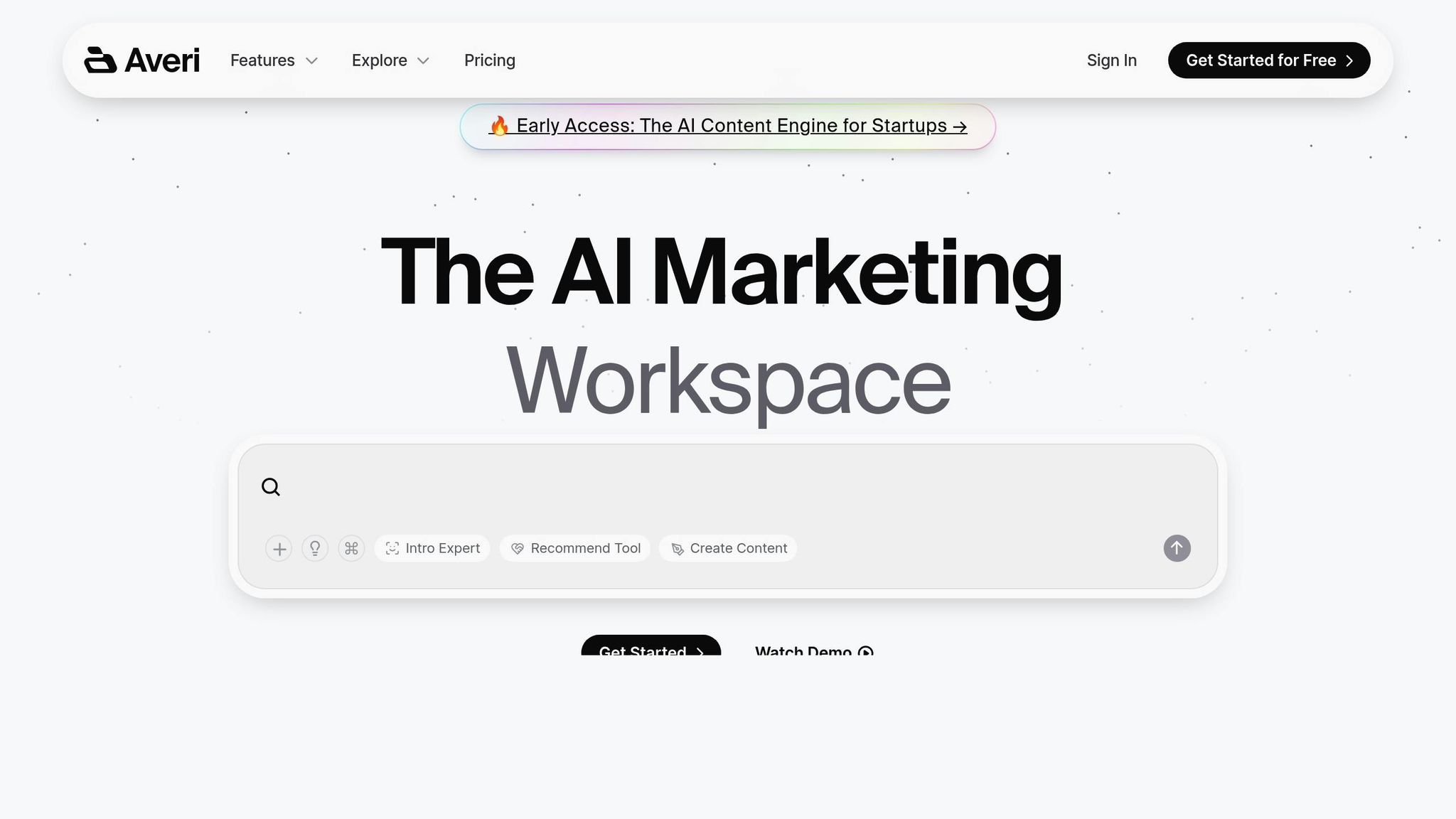
Averi acts as the central hub for your marketing operations - a place where ideas are born, developed, and executed. Forget juggling multiple apps for strategy, drafting, or managing freelancers. Averi consolidates everything into one cohesive platform, ensuring your team stays aligned from start to finish.
Kick off your strategy with Averi’s marketing-focused AI. It helps define your goals, pinpoint your ideal audience, and map out campaigns. When it’s time to create, the /create mode offers a structured, three-phase canvas (Discuss → Draft → Edit) that turns ideas into polished content. The AI handles about 80% of the heavy lifting, leaving you with the final 20% to add that human touch.
Everything you produce is stored in Averi’s Library - a treasure trove of brand guidelines, past campaigns, and customer insights. This ensures both your team and the AI have access to a shared institutional memory. For more complex tasks, Averi’s Human Cortex brings in vetted specialists who seamlessly integrate into your workflow, eliminating the need for tedious re-briefing.
Behind the scenes, Averi’s Synapse orchestration intelligently manages tasks. Straightforward jobs are handled quickly, while more strategic work gets the attention it deserves.
2. CMS (Webflow or WordPress) for Effortless Publishing
Your CMS is where your content comes to life. Webflow and WordPress are two standout options that pair perfectly with Averi’s Content Engine. Once your content is approved in Averi, it can be published directly to your site without the hassle of manual copying or formatting.
Webflow is ideal for teams that want design flexibility without needing coding skills, while WordPress offers unmatched versatility with its vast library of plugins for SEO, forms, and analytics. By integrating your CMS with Averi, you can avoid the productivity drain of constant context-switching.
3. Google Analytics or PostHog for Performance Tracking

Understanding how your content performs is critical, and analytics tools like Google Analytics or PostHog provide the insights you need. Google Analytics is a go-to for startups, offering seamless integration with other Google tools at no cost. If you’re looking for deeper insights into user behavior, PostHog is a great alternative.
Focus on revenue-driving metrics like organic traffic to gauge your SEO efforts, engagement rates to measure content impact, and conversions such as sign-ups or demo requests. Custom events and data segmentation by factors like acquisition channel or device type can help pinpoint your most valuable audiences. As Kayla Carmicheal from HubSpot explains:
"Content marketing analytics are like having a behind-the-scenes guide - they reveal what's working, what's not, and where there's room to grow" [5].
4. Buffer or Later for Social Media Scheduling
Social media scheduling tools like Buffer and Later make distributing your content a breeze. Both offer free or affordable plans, making them perfect for teams on a budget. By connecting them to your Hub, you can schedule posts in bulk and let automation handle the routine tasks, freeing you up to focus on crafting impactful strategies and content.
5. Averi Content Engine for Continuous Improvement
The Averi Content Engine ensures your content strategy evolves and improves over time. This self-sustaining system identifies high-intent keywords, tracks competitor activity, and spots content gaps. Weekly, it generates fresh content ideas based on performance data and market trends.
When a topic gets the green light, the Engine takes care of everything - from research and drafting to internal linking and metadata - before publishing directly to your CMS. Post-publication, it monitors metrics like impressions, clicks, and rankings, suggesting updates to keep your content relevant and effective. Over time, this process compounds your results, making each new piece of content even more impactful than the last.
How to Set Up and Use Your Marketing Stack
Week 1: Connect Your Tools
Start by linking your core platforms to ensure a smooth workflow. Begin with your CMS, such as WordPress or Webflow. Register for an account, select a template that fits your needs, and configure a blog subdomain for your content publishing needs [7]. After that, verify ownership in Google Search Console. This step is essential for enabling proper indexing and tracking your site's performance [6]. Without verification, Google won't be able to monitor your search visibility or address any indexing issues.
Next, set up your social media scheduler. Tools like Buffer or Later make this straightforward - register an account and connect your social media profiles (LinkedIn, Instagram, Facebook) through their dashboard [6]. To simplify your publishing process, integrate Averi with your CMS. This allows approved content to be published directly, saving you from manual copying or formatting.
Once everything is connected, you're ready to optimize your daily workflow.
Daily Workflow: Approve, Create, Publish, Monitor
Your daily routine should follow a streamlined loop: approve content ideas from Averi's queue, create drafts using its /create mode, publish directly to your CMS, and monitor performance metrics like organic traffic, engagement, and conversions through Google Analytics. Keeping all these tasks in one workspace minimizes friction and helps you stay productive.
Leverage these analytics to fine-tune your content calendar and focus on what resonates most with your audience.
When to Use AI vs. Human Review
AI tools are great for handling top-of-funnel tasks like generating how-to guides or conducting keyword research. However, when it comes to content that requires genuine storytelling or a personal touch, human review is indispensable [10].
Always fact-check AI output - human experts should validate data and citations to ensure accuracy [9][11]. As Kim Macomber, Senior Director of Content at Neil Patel Accel, puts it:
"AI can get you to 70 percent, but that last 30 percent (the part that connects, converts, or earns backlinks) still requires human input" [8].
Cost Breakdown by Team Size
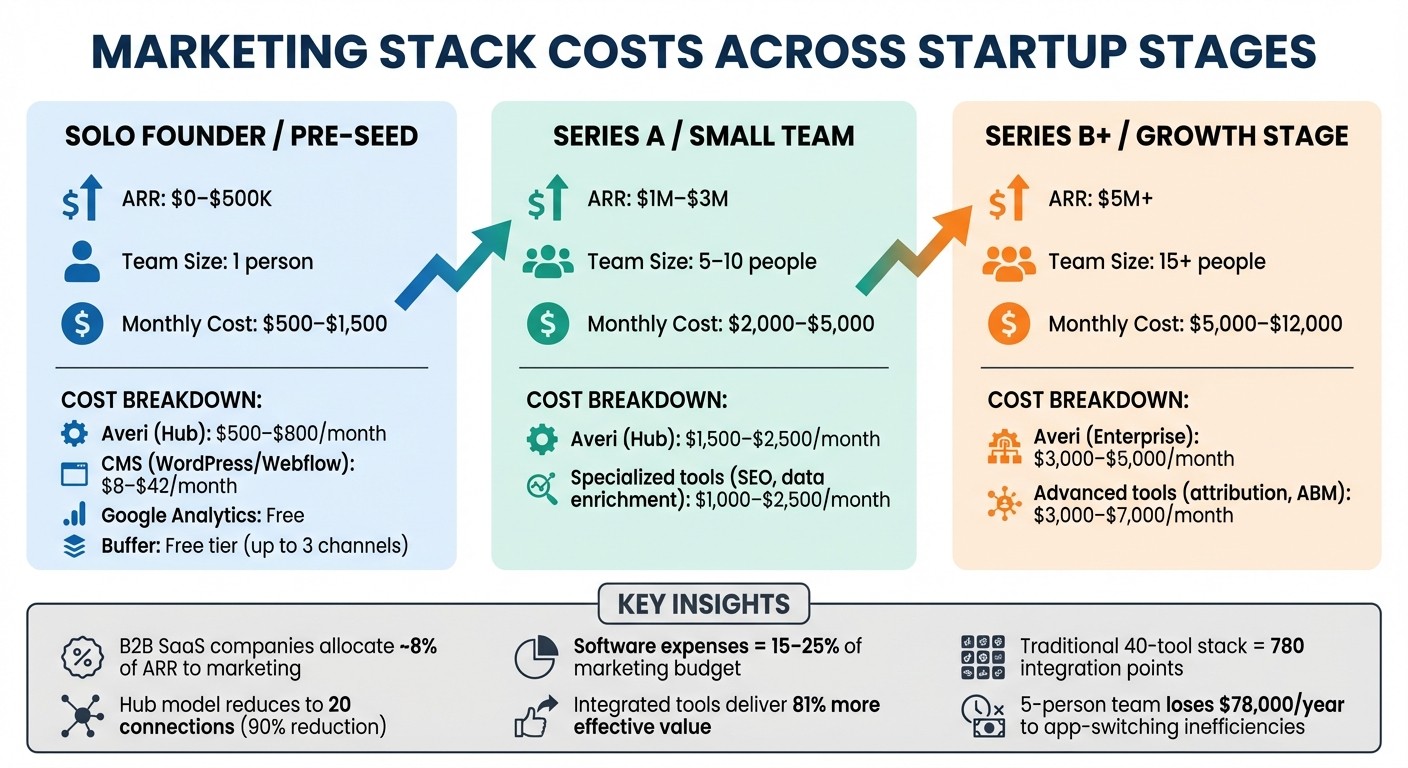
Marketing Stack Costs by Startup Stage: Solo to Growth
Pricing Comparison: Solo, Small Team, Growth Stage
As your team grows, so does the cost of maintaining your marketing stack, but the scaling remains manageable. For a solo founder or pre-seed startup (with $0–$500K ARR), a complete marketing stack can run between $500 and $1,500 per month. This budget includes Averi as the central hub, costing around $500–$800/month, a basic CMS like WordPress or Webflow for hosting ($8–$42/month), Google Analytics (free), and Buffer's free tier for managing up to three social channels [1].
When you advance to Series A with a small team of 5–10 people (with $1M–$3M ARR), monthly costs rise to $2,000–$5,000. Averi's hub at this stage costs $1,500–$2,500/month, and you'll likely add other specialized tools like data enrichment platforms or professional SEO suites, which together can cost an additional $1,000–$2,500 [1].
For growth-stage startups at Series B and beyond (with $5M+ ARR and a team of 15 or more), the marketing stack budget typically ranges from $5,000 to $12,000 per month. Averi’s enterprise tier accounts for $3,000–$5,000/month, while the rest goes toward advanced tools such as attribution software, ABM platforms, and other specialized solutions, totaling $3,000–$7,000 [1].
On average, B2B SaaS companies allocate about 8% of their Annual Recurring Revenue (ARR) to marketing, with software expenses making up 15% to 25% of that budget [1]. This ensures spending remains focused on tools that deliver real value without paying for underutilized features.
Next, let's explore how AI tools can further cut costs and improve productivity.
Time and Money Saved with AI Tools
An integrated AI workspace doesn’t just simplify workflows - it can significantly cut costs and save time. Beyond subscription fees, inefficiencies in how tools are used can quickly drive up expenses. For instance, the hidden costs of juggling disconnected platforms and constant context-switching can add up. A five-person team, for example, can lose approximately $78,000 annually due to inefficiencies, with each person wasting around four hours per week navigating between tools instead of focusing on essential marketing tasks [1].
Switching to an integrated AI workspace like Averi eliminates much of this waste. Instead of relying on a scattered toolset - such as ChatGPT, Google Docs, Photoshop, and Upwork - Averi consolidates workflows. A traditional marketing stack with 40 tools may require up to 780 integration points, but using a central hub reduces this to just 20 connections, cutting complexity by 90% [1].
Moreover, integrated tools have been shown to deliver 81% more effective value compared to isolated best-of-breed solutions. This streamlined approach maximizes efficiency, especially for early-stage startups looking to make the most of their resources. [1]
Conclusion
Crafting a content marketing stack doesn’t need to be overwhelming or costly. The secret lies in selecting one central hub - a tool that serves as the backbone for planning, creating, publishing, and analyzing your content. For early-stage startups, this means sticking to budgets and steering clear of unnecessary features.
With this simple setup, the focus shifts to creating actionable content. Start with a Minimum Viable Content Engine: aim to produce one pillar piece of content each week, then repurpose it into various formats. Forget perfection - consistency is what drives progress and builds momentum, even without a large marketing team.
Follow the 70/20/10 rule to guide your content mix: dedicate 70% to evergreen topics that maintain long-term value, 20% to timely content that addresses current trends, and 10% to experimental ideas [2]. This structure not only keeps your strategy balanced but also allows it to grow alongside your team. As you scale from a solo founder to a larger operation, your stack can evolve too - just remember, integration beats complexity every time.
The most successful startups thrive by shipping content consistently, learning from their results, and doubling down on what works. Your marketing stack should simplify this process, not complicate it. Stick to these principles to ensure your marketing efforts remain efficient and scalable as your business grows.
FAQs
How can early-stage startups avoid overwhelming their marketing stack with unnecessary tools?
Early-stage startups can avoid the chaos of tool overload by focusing on a lean, purpose-driven marketing stack. Start by taking stock of your current tools and aligning each one with a specific function, such as content creation, distribution, analytics, or workflow management. If you find overlap - two tools handling the same job - keep the one that offers stronger integrations and a lower overall cost, and let go of the other. The goal is to build a streamlined setup with just 3–5 tools that meet your essential needs. This might include an AI-powered workspace for content creation and review, a lightweight CMS, a simple analytics platform, and a tool to manage your distribution channels.
To reduce reliance on extra tools, focus on creating efficient workflows. Techniques like batch content production or repurposing material from a single source can go a long way. For instance, an AI workspace can take care of drafting, editing, and even scheduling, eliminating the need for multiple apps. When evaluating new tools, prioritize those that bring new capabilities rather than duplicating existing ones.
Regularly assessing your tools' performance is also key. Set clear metrics - like leads generated or traffic growth - and measure each tool’s impact. If a tool fails to deliver noticeable results within a trial period, it’s time to cut it loose. By concentrating on outcomes and consolidating functions, startups can maintain a cost-effective and efficient marketing stack without unnecessary clutter.
How does AI help small teams create high-quality content more efficiently?
AI has become an invaluable ally for small teams, making it possible to create high-quality content at a scale that once demanded a much larger workforce. By automating time-consuming tasks such as topic research, drafting, crafting SEO-friendly outlines, and even handling basic editing, AI frees up marketers to concentrate on the more strategic aspects - like refining the brand's voice and perfecting the final touches.
This streamlined approach allows smaller teams to work more efficiently, transforming a single idea into multiple polished pieces of content in less time. With AI in their toolkit, teams can consistently produce a steady flow of high-quality content, staying nimble and competitive even in fast-paced, demanding markets.
Why is the 'Hub + Spokes' model ideal for early-stage startups?
The Hub + Spokes model is a smart choice for early-stage startups. It enables a small, AI-supported core team to handle all content processes efficiently while tapping into external tools or experts only when needed. This setup keeps critical tasks like planning, editing, and publishing centralized, allowing startups to move quickly while maintaining quality and brand consistency.
By relying on the hub as the main platform, startups can sidestep the common pitfalls of juggling too many tools, which often lead to higher costs and unnecessary complications. The spokes - like freelance platforms or specialized services - are brought in on an as-needed basis, offering flexibility without the burden of a full-stack solution. This streamlined approach creates workflows that are both scalable and efficient, helping startups stay nimble even with tight budgets and limited resources.
In essence, the Hub + Spokes model keeps startups focused, cost-efficient, and well-prepared to grow when the time comes.
Related Blog Posts

Zach Chmael
CMO, Averi
"We built Averi around the exact workflow we've used to scale our web traffic over 6000% in the last 6 months."
Your content should be working harder.
Averi's content engine builds Google entity authority, drives AI citations, and scales your visibility so you can get more customers.