How Startups Can Build Topical Authority Without a Content Team

Averi Academy
Averi Team
8 minutes

In This Article
AI lets startups automate research, drafting, SEO, and publishing to build topical authority with minimal time and cost.
Updated:
Trusted by 1,000+ teams
Startups use Averi to build
content engines that rank.
Startups don’t need a big content team to dominate their niche. By leveraging AI content creation strategies, you can create expert-level content faster, cheaper, and more effectively than ever before. Here’s how to build topical authority without hiring expensive agencies or full-time staff:
Why it matters: Organic search drives 44.6% of B2B revenue, but 47% of small businesses manage marketing themselves, often missing SEO opportunities.
The challenge: Producing high-quality, interconnected content is time-consuming and costly, with agencies charging $5,000–$15,000/month and content managers costing $120,000+ annually.
The solution: AI tools like Surfer SEO and Averi automate content strategy, topic research, drafting, and publishing. This cuts costs per post from $611 to $131 and reduces weekly effort to 2 hours while scaling output to 8–12 posts/month.
The results: Consistent, high-quality content boosts rankings, increases visibility, and positions your brand as a trusted source for both search engines and AI-driven tools like ChatGPT.
AI-powered content creation is the fastest way to scale your marketing while saving time and money. Startups can now compete with larger players by building a system that works smarter, not harder.
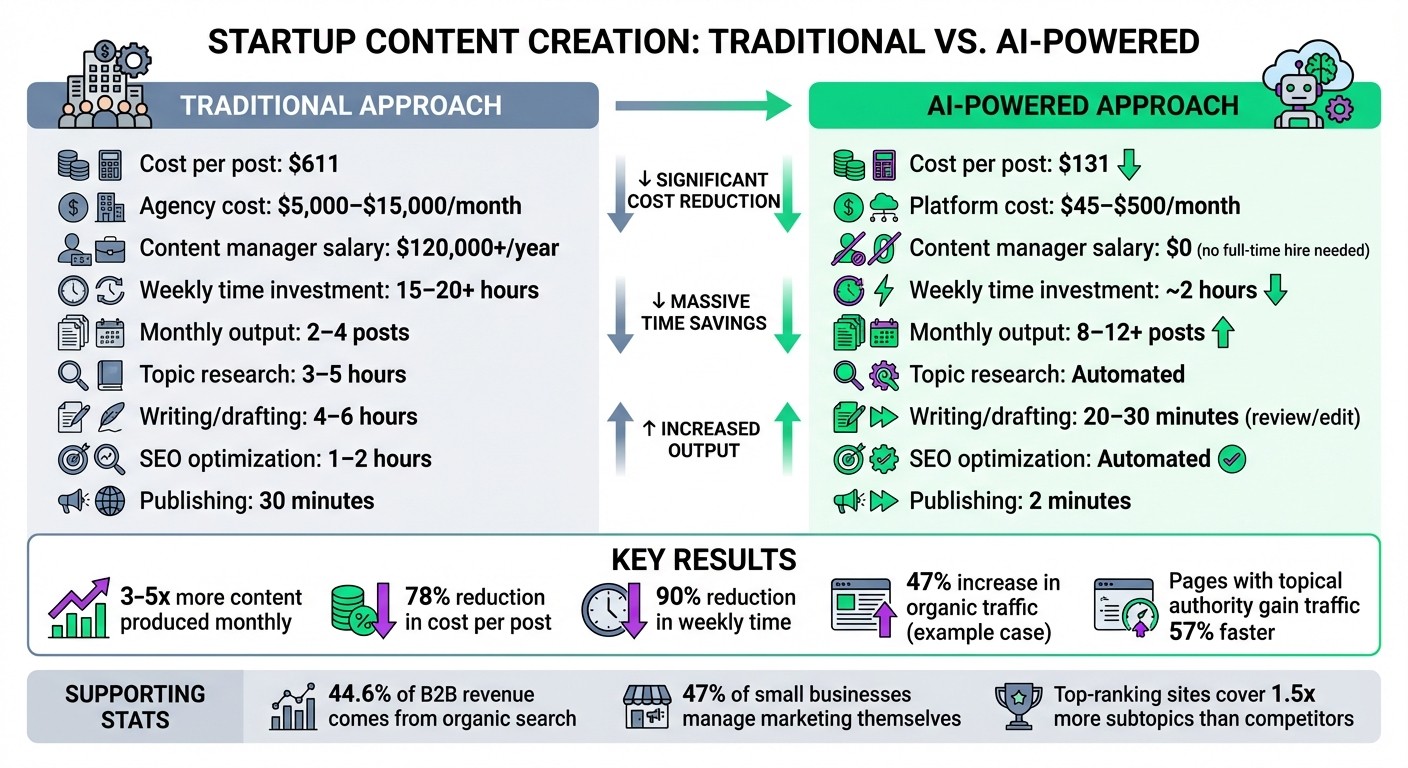
Traditional vs AI-Powered Content Creation: Time and Cost Comparison for Startups
AI marketing Masterclass: From beginner to expert in 60 minutes
Using AI to Build Your Content Strategy
Developing a content strategy used to require hiring a strategist, but AI has reshaped this process entirely. Today's AI platforms can analyze your website to understand your products, brand voice, and positioning, creating a "Brand Core" that guides your content creation. The setup is quick - typically around 10 minutes - and from there, AI keeps a constant pulse on your market, tracks competitors, and spots content gaps.
Automating Strategy and Planning
Traditional content planning often demands 3–5 hours of work each week. AI simplifies this by automating the analysis, flagging high-performing topics, and suggesting fresh angles. With an AI-generated "Content Queue", you can review topics, titles, keywords, and even content outlines in as little as 15 minutes a week.
Platforms like Surfer SEO (starting at $99/month for the Essential plan) analyze top-ranking search results to provide tailored keyword and structure recommendations. Meanwhile, tools like HubSpot AI (starting at $50/month for 1,000 contacts) combine predictive lead scoring with content planning. Averi takes it a step further by generating a complete content marketing plan during setup and continuously queuing new ideas, categorized into formats like listicles, how-to guides, editorials, and comparisons. This approach allows startups to scale their output from 2–4 posts per month to 8–12 or more, while slashing the cost per post from $611 to $131.
Once your content plan is in place, AI continues to refine your strategy by uncovering niche topics and SEO opportunities.
Finding High-Value Topics and SEO Opportunities
AI excels at pinpointing high-value topics by evaluating search volume, keyword difficulty, and traffic potential all at once - a process that could take hours manually. The trick is to focus on specific niches where you can create thorough, standout content. For instance, instead of targeting a broad term like "AI for SMEs", AI tools might suggest a more focused opportunity, such as "AI tools for invoicing software", where competition is lower and the topic aligns closely with your expertise.
Modern AI platforms also use SERP-based clustering to group keywords by search intent - Informational, Navigational, Commercial, and Transactional - ensuring your content matches the buyer's journey. Tools like BuzzSumo (Pro plan at $79/month) analyze competitor performance to highlight trending topics in your field. AI can even identify commercial intent keywords where platforms like Reddit are ranking, offering unique opportunities to stand out. Additionally, it organizes topics into strategic structures like the Pillar and Spoke model, helping you build cohesive content clusters that establish authority rather than publishing scattered, unrelated articles.
Creating Content Efficiently Without a Team
Once your strategy is ready and topics are lined up, the next hurdle is execution. Traditional content creation can take 6–8 hours per article, but AI tools drastically cut this time by handling research, structuring, and drafting. This allows you to focus on injecting your brand's unique voice and insights, reducing your effort to just 20% of the usual time.
Drafting and Editing with AI and Human Input
Modern AI platforms can draft articles using reliable data, SEO-focused keywords, and a pillar-cluster structure. For example, a SaaS startup in the fitness industry leveraged AI to create 10 articles on running gear topics - covering details like shoe types and training tips. After human edits to refine tone and align with the brand, these articles boosted their organic traffic by 47%.
Human input remains essential for polishing AI drafts. Tools like Averi’s collaborative canvas make this process seamless. You can highlight sections for AI to rewrite, expand, or adjust tone, while features like real-time comments and teammate tagging simplify reviews. Automated suggestions for internal links and meta descriptions ensure SEO essentials are covered without additional effort.
Activity | Traditional Workflow | AI + Human Workflow |
|---|---|---|
Topic Research | 3–5 hours | Automated |
Writing/Drafting | 4–6 hours | 20–30 minutes (Review/Edit) |
SEO Optimization | 1–2 hours | Automated |
Publishing | 30 minutes | 2 minutes |
Weekly Total Time | 15–20+ hours | ~2 hours |
This streamlined approach not only slashes production time but also enhances your website’s authority with consistent, high-quality updates. Published articles are archived and used by AI to improve future drafts, ensuring each new piece better reflects your brand’s style and goals.
Publishing Directly to Your CMS
Once drafting and editing are optimized, the next step is smooth publishing. Direct CMS integrations remove the need for manual copy-pasting, which often introduces formatting errors. Tools like AirOps and Averi can push fully formatted, SEO-ready content straight to platforms like WordPress, Webflow, or Framer via API connections. One startup agency cut publishing time from 2 hours to just 10 minutes per article while avoiding around 90% of common errors, such as broken links. The system also automates meta tags, schema markup, and internal links - no manual input required.
This level of automation not only saves time but also builds a scalable content library that strengthens your site’s authority. Every new post becomes part of an easily searchable archive, simplifying the process of updating older articles or linking to related content as your library expands. Startups using these workflows often produce 3–5 times more content each month. Top-ranking sites, in particular, tend to cover 1.5 times more subtopics than competitors, all managed by a single person dedicating less than 2 hours per week. This efficient system lays the groundwork for monitoring results and refining your content strategy over time.
Tracking Performance and Improving Your Content
Publishing content is just the start; the real impact comes from analyzing performance metrics to uncover growth opportunities and address weaknesses. Startups that keep a close eye on the right data can pinpoint areas to improve, such as boosting a keyword from position #8 to the first page, and identify where competitors might be gaining an edge.
Monitoring Metrics and Rankings
Focus on metrics that showcase your authority rather than superficial numbers. For example, the Keyword Ranking Count tracks how many terms in your cluster rank in the top 10 search results - growth here demonstrates that search engines see your expertise [4]. Keep an eye on your Average SERP Position across all cluster keywords; an average position of 3–5 reflects established authority [4]. Another key metric, Topic Share, measures the percentage of total traffic you capture within your niche compared to competitors [5].
Google Search Console can help you find "low-hanging fruit" - keywords ranking in positions 11–20 that could quickly move to the first page with minor updates or better internal linking [4]. Set up alerts for any priority keyword that drops more than three positions, so you can refresh that content before it loses visibility [6]. Data shows that pages with strong topical authority gain traffic 57% faster [5], and well-structured topic clusters maintain their rankings 2.5 times longer than standalone posts [4].
Beyond traditional SEO, start tracking AI Citations - how often your content or brand is mentioned in responses from AI tools like ChatGPT and Perplexity. This metric highlights whether your content is recognized as a trusted source in AI-driven searches [7]. If your brand isn’t cited in major prompts within your niche, it signals a gap in your content strategy that needs attention.
These metrics provide a clear roadmap for refining your content strategy.
Using Data to Guide Future Content
Performance metrics don’t just measure success - they guide your next steps. For instance, if a satellite page ranks well but generates little traffic to your pillar page (under a 2% click-through rate), adjust the anchor text and link placement [4]. If your awareness-stage content outperforms decision-stage pages, it’s time to prioritize content that drives conversions [4].
AI-powered tools like Averi simplify this process by identifying opportunities automatically. Instead of manually combing through spreadsheets, you get actionable suggestions - like trending topics to cover, pages that need updates, and high-relevance keywords with low competition. A quick 15–20 minute review of an AI-generated dashboard each week is enough to highlight top-performing content to expand on and underperforming pieces to improve or retire [1]. This continuous feedback loop ensures that every piece of content you create strengthens your overall strategy, building momentum without adding unnecessary workload.
Conclusion: Building a Self-Running Content System
Developing a self-running content system, guided by AI-driven strategies, is the cornerstone of maintaining topical authority. Startups can streamline their content marketing by leveraging AI to handle tasks like topic research, drafting, SEO adjustments, and performance tracking, leaving you free to concentrate on strategic decisions and product innovation. This shifts content marketing from a labor-intensive process to a scalable system that grows in value over time.
The secret lies in achieving consistency with minimal effort. AI-powered tools like Averi redefine the process - just 2 hours of weekly oversight can produce 8–12+ posts each month, compared to the 2–4 posts typically achieved with manual workflows [1]. By automating repetitive tasks, you gain more time to focus on high-level strategy.
The advantages multiply over time. Strategically built content clusters demonstrate authority to search engines, increasing your organic visibility and cementing your brand as a trusted expert in your field [2][3]. AI further refines this process by analyzing performance data, helping you identify which topics deserve more attention, which keywords need a push to climb from position #8 to page one, and how to counter competitor strategies [1].
"You don't need more time for content. You need a system that creates content without requiring your time." - Zach Chmael, Head of Marketing, Averi [1]
Instead of hiring a costly full-time content manager or agency, platforms like Averi offer automated content solutions for as little as $45–$500 per month [1]. These tools create a self-sustaining content engine that handles research, drafting, publishing, and optimization - allowing you to focus on the initiatives that truly drive your business forward. By embracing automation, startups can scale their growth while dedicating their energy to innovation and strategic priorities. This approach transforms content creation from a burden into a powerful, growth-driving asset.
FAQs
What’s the best first topic cluster to build for my startup?
When choosing your first topic cluster, aim for a broad, relevant theme that resonates with your industry and audience. Begin with a detailed pillar page addressing a central topic, then support it with subtopics that dive into specific areas. For instance, a digital marketing startup might create a pillar page on "Content Marketing Strategies" and develop related clusters covering SEO techniques, automation tools, and methods for boosting audience engagement. This structured approach not only establishes authority but also enhances visibility in search engine results.
How do I keep AI-written content accurate and on-brand?
To keep AI-generated content both precise and aligned with your brand, it's crucial to establish clear rules for tone, voice, and messaging. These guidelines act as a roadmap for AI tools, ensuring they produce content that resonates with your audience. However, AI alone isn't enough - human oversight plays a vital role in reviewing and fine-tuning the output. This step is essential for correcting errors and ensuring the content reflects your brand's values. By blending AI's efficiency with human attention to detail, you can achieve consistent, reliable, and brand-aligned content.
How long does it take for topical authority to improve rankings?
Topical authority can begin to enhance search rankings in as little as 3 to 6 weeks by increasing organic visibility relatively quickly. However, achieving more substantial and lasting improvements often requires several months to a year. The timeline largely depends on the quality of the content and the intensity of competition in the given niche.
Related Blog Posts

Zach Chmael
CMO, Averi
"We built Averi around the exact workflow we've used to scale our web traffic over 6000% in the last 6 months."
Your content should be working harder.
Averi's content engine builds Google entity authority, drives AI citations, and scales your visibility so you can get more customers.