

In This Article
Compare top behavioral analytics tools for turning clicks, app events, and email engagement into real-time segments, predictions, and personalized campaigns.
Updated:
Trusted by 1,000+ teams
Startups use Averi to build
content engines that rank.
Behavioral pattern recognition tools are transforming marketing by focusing on customer actions instead of demographics. These tools analyze data like website clicks, app activity, and email engagement to create tailored campaigns, predict customer behavior, and improve decision-making accuracy. With AI-driven insights, businesses can boost performance by up to 25% compared to traditional methods.
Key Takeaways:
By 2025, the AI marketing tools market reached $47.32 billion, projected to hit $107.5 billion by 2028.
AI tools improve decision-making speed by 78% and forecasting accuracy by 47%.
Platforms like Hotjar, Amplitude, and Braze help companies identify user behaviors such as rage clicks, cart abandonment, and churn risks.
Notable Tools:
Averi AI: Integrates behavioral insights with campaign execution, offering real-time segmentation and predictive modeling.
Segment: Consolidates data from multiple sources for instant activation.
Amplitude: Focuses on event-based tracking for product-led growth and retention.
Mixpanel: Tracks user actions and provides detailed funnel analysis.
Optimove: Leverages predictive analytics for lifecycle marketing.
Dynamic Yield: Personalizes digital experiences in real-time.
Adobe Real-Time CDP: Combines customer journey analytics with AI-powered segmentation.
Salesforce Marketing Cloud: Unifies data and uses AI for predictive insights.
Braze: Automates multi-channel campaigns with real-time data.
Klaviyo: Specializes in email and SMS campaigns for e-commerce.
These platforms cater to businesses of all sizes, from startups to enterprises, and focus on improving engagement, retention, and conversion rates. Choose a tool based on your data needs, company size, and marketing goals to turn customer behavior into actionable strategies.
How Behavioral Pattern Recognition Works in Marketing
Behavioral pattern recognition relies on three key data sources: your CRM (tracking customer purchase history and support tickets), customer data platforms (CDPs) that unify profiles across multiple channels, and analytics tools that monitor user interactions like website clicks, app activity, and email engagement. While traditional analytics tools such as GA4 provide insights into where users drop off - like page views, bounce rates, or session lengths - behavioral analytics platforms like Hotjar and VWO go deeper. They reveal why users disengage by capturing heatmaps, session replays, and behaviors such as "rage clicks" [3]. These tools work together to uncover the underlying reasons for user actions.
Several analytical techniques are employed to make sense of this data. Methods like clustering customers by behavior, RFM scoring (Recency, Frequency, Monetary value), and friction scoring (tracking user frustration through metrics like rage clicks, u-turns, and dead clicks) help create actionable user segments [2][3]. Additionally, journey and funnel analysis maps the specific paths users take through your site, identifying exactly where they abandon carts or exit forms.
The results are transformative. These insights enable businesses to predict churn, create personalized website experiences, recommend products tailored to individual preferences, and retarget users based on their actions. For instance, Amazon attributes approximately 35% of its revenue to its recommendation engine [4]. Similarly, lead qualification becomes more precise by scoring prospects based on their interactions - such as clicking on "Learn more" or attending webinars [4][5]. Such data-driven strategies empower marketers to craft a highly personalized e-commerce marketing strategy and effective campaigns.
When choosing tools for behavioral pattern recognition, prioritize those with real-time CRM synchronization [1]. Opt for platforms that allow you to act directly from the insights dashboard - whether it’s launching an A/B test or sending a tailored email - without requiring you to switch between tools [3]. Pricing models also matter: some platforms charge based on "unique tracked users", while others bill per "session." Select a model that aligns with your traffic volume [3]. Additionally, ensure the tool can handle peak traffic periods without exhausting data quotas, thanks to flexible sampling options [3].
"The surveys, session recordings & heatmaps features appeal to us the most. Knowledge and customer data are king and these two features shape our roadmap as to what we prioritize for development and initiatives we work on." [3]
Alice Michael, Group Head Of Ecommerce Operations, APG & Co
1. Averi AI
Averi AI is more than just a marketing platform - it's a full-service workspace designed to bridge the gap between data insights and campaign execution. While many platforms focus solely on gathering and segmenting data, Averi takes it a step further by integrating behavioral insights directly into actionable strategies. Its AGM-2 model, built specifically for marketing cognition, analyzes customer behavior with a marketer's perspective and turns those insights into immediate actions.
AI-Driven Predictive Modeling and Personalization
Averi’s Synapse system processes data in real time, intelligently dividing tasks between AI and human experts based on their complexity. For instance, when the platform identifies a high-value customer segment, it immediately generates tailored campaign assets. This capability has produced impressive results: a mid-market SaaS company reduced campaign planning time by 65% and improved performance by 40%, while an e-commerce retailer saw a 200% increase in personalized content production - all while maintaining brand consistency [1]. These successes highlight how Averi seamlessly transforms behavioral data into impactful campaigns, with its real-time segmentation features playing a key role in this efficiency.
Real-Time Segmentation and Activation
Averi's Adaptive Reasoning system scales its analysis to match the complexity of the task, from basic segmentation to intricate strategic decisions. The platform’s Human Cortex feature brings in expert marketers for tasks requiring deeper interpretation or creative input, combining the speed of AI with the nuance of human judgment. To ensure brand integrity, the Brand Core feature retains context across all campaigns, safeguarding your brand voice, product positioning, and previous campaign learnings. As the system evolves with every project, it sharpens its ability to target behaviors more precisely. With AI-driven analytics improving decision-making speed by 78% and predictive analytics enhancing forecasting accuracy by 47% [1], Averi AI offers a powerful blend of insight and execution that drives measurable results.
2. Segment
Segment takes the power of behavioral insights and combines it with data standardization to help marketers make smarter, faster decisions. As a customer data platform (CDP), Segment pulls together behavioral data from websites, mobile apps, emails, and third-party tools. The platform organizes this data and seamlessly routes it to analytics, email, advertising, and CRM systems. By simplifying data collection, Segment enables marketers to act on insights almost instantly, paving the way for precise, behavior-driven campaigns.
Behavioral Data Integration and Analysis
Segment consolidates customer data into a single, trustworthy source. Whether a customer is browsing your product pages, abandoning their cart, or opening an email, Segment captures these actions and converts them into consistent data formats. This standardization is critical because marketing teams often run into issues with tools that define metrics differently - what one system calls a "conversion", another might not recognize the same way. Segment solves this problem by creating a shared data framework across your entire tech stack. This not only makes behavioral analysis more dependable but also reduces the technical hurdles that often slow campaign execution. With a unified and standardized data foundation, your team can quickly turn insights into action.
Real-Time Capabilities for Segmentation and Activation
Segment processes events as they happen, ensuring customer profiles are updated in real time. For example, when a user completes a high-value action, that information is immediately sent to your email platform, ad networks, or analytics tools. Thanks to its robust API and webhook integrations, Segment works seamlessly with tools like Salesforce and HubSpot. This real-time capability allows you to trigger personalized messages based on what a customer is doing right now, rather than relying on delayed batch updates that may no longer be relevant.
Scalability for Businesses of All Sizes
Segment is designed to grow with your business, making it a vital tool for companies of any size. From startups tracking simple user journeys to large enterprises managing millions of interactions across dozens of platforms, Segment’s architecture can handle it all. The platform manages increasing data volumes effortlessly, without requiring major infrastructure changes. This makes Segment an ideal choice for businesses looking for a solution that can keep up as their marketing needs become more complex and sophisticated.
3. Amplitude
Amplitude takes a different approach to analytics by prioritizing event-based tracking over traditional demographic data. It captures user interactions - like clicks, page views, and feature usage - and transforms them into detailed behavioral profiles. This dual focus on who your customers are and what they do across digital touchpoints is a game-changer for teams focused on product-led growth vs. sales-led growth and retention. With this level of insight, you can craft campaigns that directly respond to user behavior.
Unlike other tools that rely on broader metrics, Amplitude's emphasis on individual user events allows for highly precise segmentation and immediate action. This event-driven approach ensures your campaigns are laser-focused and effective.
Behavioral Data Integration and Analysis
One of Amplitude's standout features is its ability to turn behavioral data into actionable insights. Using funnel-based segmentation, it highlights exactly where users drop off in the conversion process. For example, if 500 users begin a checkout process but only 200 complete it, Amplitude pinpoints the exact step where friction occurs. Armed with this insight, you can create targeted campaigns to re-engage users who abandoned the process.
The platform also keeps lifecycle segments dynamic, updating categories like "new", "active", "at-risk", and "dormant" as user behavior changes. These segments evolve in real time, ensuring your campaigns are always based on the most current data rather than outdated snapshots.
Real-Time Capabilities for Segmentation and Activation
Amplitude doesn’t just organize data - it acts on it immediately. The platform processes events in real time, ensuring user profiles are constantly updated. If a user completes a high-value action or starts showing signs of disengagement, that data triggers automated responses instantly.
Amplitude integrates seamlessly with tools like Braze, Salesforce, HubSpot, Google Ads, and Meta, allowing you to activate insights across your entire marketing stack. It also syncs with CDPs like Segment and mParticle, giving you a unified view of user behavior across multiple channels.
AI-Driven Predictive Modeling and Personalization
Amplitude’s predictive analytics take things a step further by identifying patterns before they turn into problems. For instance, the platform can flag users who are likely to churn based on their behavior, enabling you to launch campaigns that address these risks head-on. This proactive approach is especially valuable for subscription-based businesses and SaaS companies, where retention is critical to revenue. By combining predictive churn insights with lifecycle data, you can develop highly targeted campaigns that tackle specific risk factors, rather than relying on one-size-fits-all retention strategies.
4. Mixpanel
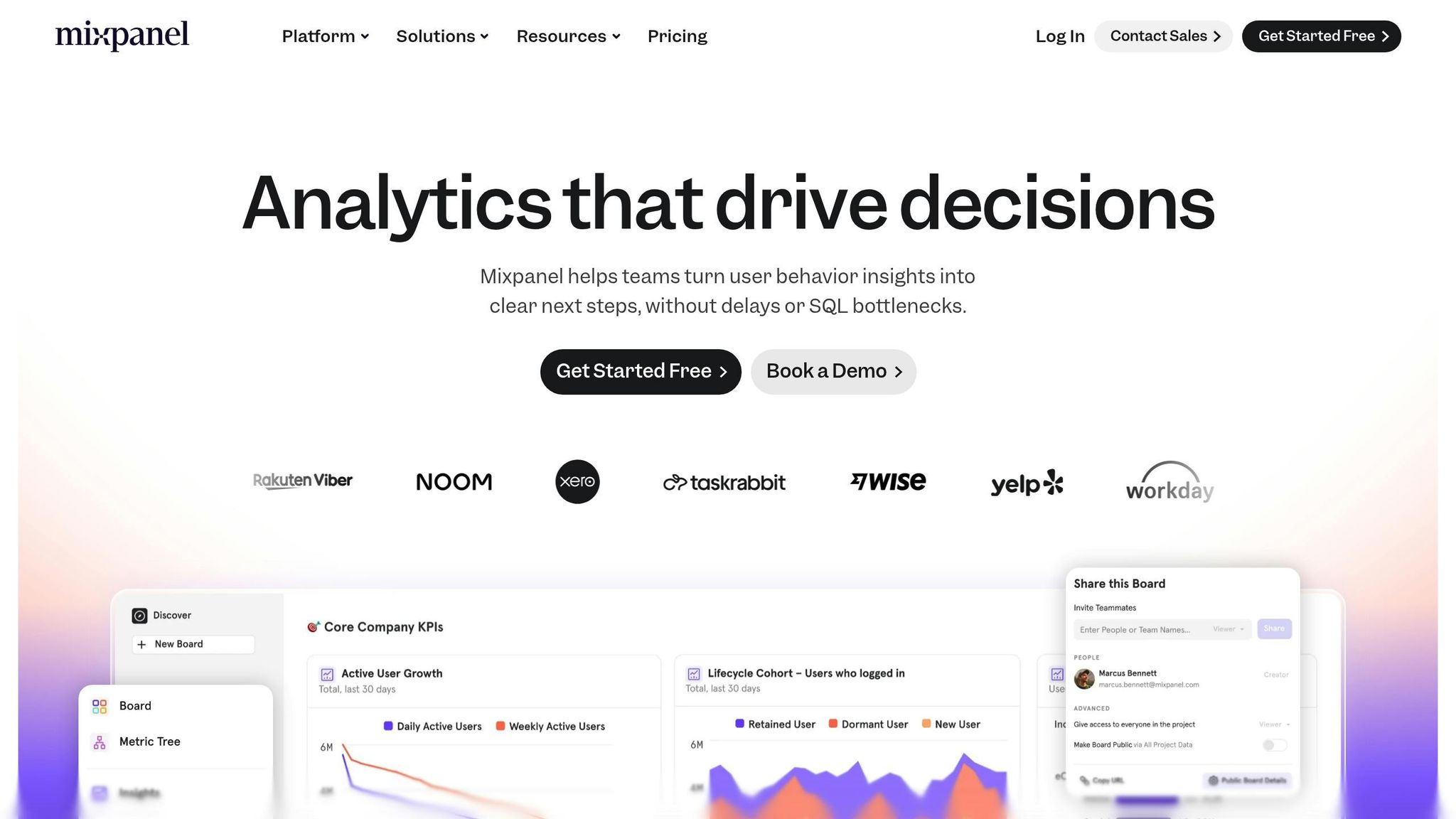
Mixpanel stands out among behavioral analytics platforms by offering a sharp focus on user actions rather than traditional metrics like page views. This event-based approach captures specific activities such as "Added to Cart" or "Video Played", providing deeper insights into both visits and subsequent engagement, like clicking a demo button or scrolling through content.
Behavioral Data Integration and Analysis
Mixpanel seamlessly connects with cloud data warehouses like Snowflake, BigQuery, and Redshift, allowing you to analyze behavioral data directly from its primary storage. This eliminates the need for data transfers and ensures consistency across your tech stack. By tracking detailed user interactions - clicks, scrolls, and mouse movements - Mixpanel empowers marketers to refine user experiences and uncover opportunities for A/B testing.
Real-Time Segmentation and Activation
Mixpanel’s real-time processing capabilities enable dynamic audience segmentation based on current user behavior. This allows for immediate actions, such as sending personalized offers when users take high-value steps or disengage. By focusing on real-time behavior rather than relying solely on historical data, it supports a more proactive approach to decision-making.
Flexible for Teams of All Sizes
Whether you're part of a small team or a large enterprise, Mixpanel adapts to your needs. Its integration with cloud data warehouses is ideal for larger organizations, while its event-driven model remains approachable for teams aiming to achieve specific conversion goals. This scalability makes it a versatile tool for businesses across the spectrum.
5. Optimove
Optimove stands out among marketing platforms by using AI to transform customer behavior data into targeted marketing strategies, with a particular emphasis on predictive modeling for enterprise-level needs. The platform focuses on forecasting critical metrics like customer lifetime value, churn likelihood, and lifecycle transitions, offering businesses actionable insights.
AI-Powered Predictive Modeling and Personalization
At the heart of Optimove is its OptiGen AI Engine, which identifies the most effective next steps for each customer. By creating thousands of micro-segments, the platform tailors hyper-personalized campaigns at a scale that meets enterprise demands. Unlike traditional predictive analytics, this system provides highly customized messaging, ensuring relevance for every individual customer.
Comprehensive Behavioral Data Integration
Optimove excels at integrating marketing data from various touchpoints to map out detailed customer journeys [1]. By connecting transactional data with lifecycle stages, the platform uncovers behavioral trends that inform actionable marketing strategies. From initial conversion to churn, these insights help businesses craft campaigns that resonate with their audience. This seamless data integration makes Optimove a powerful tool for handling large-scale operations.
Built for Enterprise-Level Personalization
Designed for mid-to-large organizations, Optimove delivers a robust solution for businesses aiming to implement predictive modeling on a grand scale. It supports real-time personalization across web, mobile, and email channels [1]. The platform’s ability to manage complex customer databases while maintaining detailed segmentation and individualized messaging ensures that enterprises can achieve personalization without sacrificing efficiency.
6. Dynamic Yield
Dynamic Yield leverages AI to transform behavioral data into tailored digital experiences, turning customer insights into actionable marketing strategies.
Understanding and Using Behavioral Data
Dynamic Yield analyzes customer behavior to uncover patterns and predict which content or products will resonate most. By examining browsing habits, purchase history, and similarities between customers, the platform creates a detailed profile of each visitor’s preferences. This data-driven approach helps marketers understand customer intent and deliver timely, relevant messages.
Adapting in Real Time Across Channels
The platform excels at real-time adjustments, tailoring website experiences based on traffic sources and user behavior as it happens. It can modify layouts, calls-to-action, and content blocks dynamically as visitors move through a site. This adaptability extends to web, mobile, and email channels, ensuring a seamless experience. Additionally, Dynamic Yield supports AI-powered pricing strategies, adjusting prices based on demand, competition, and customer segments for maximum impact.
Predictive Modeling and Smarter Personalization
With machine learning at its core, Dynamic Yield enhances both product recommendations and A/B testing. This speeds up decision-making processes by 78% [1]. Studies also indicate that personalized recommendations can boost sales by as much as 20% [1], underscoring the value of predictive personalization.
Built for Enterprise-Level Needs
Dynamic Yield is tailored for businesses with large audiences and complex product offerings. Its pricing ranges from $500 to over $10,000 per month, depending on factors like traffic volume and integration requirements [1]. Competing with platforms like Adobe Target and Optimizely, it’s an ideal choice for mid-to-large companies with advanced marketing needs and extensive customer data. These features make Dynamic Yield a standout option for enterprises, setting the stage for comparison with other leading tools.
7. Adobe Real-Time CDP and Customer Journey Analytics
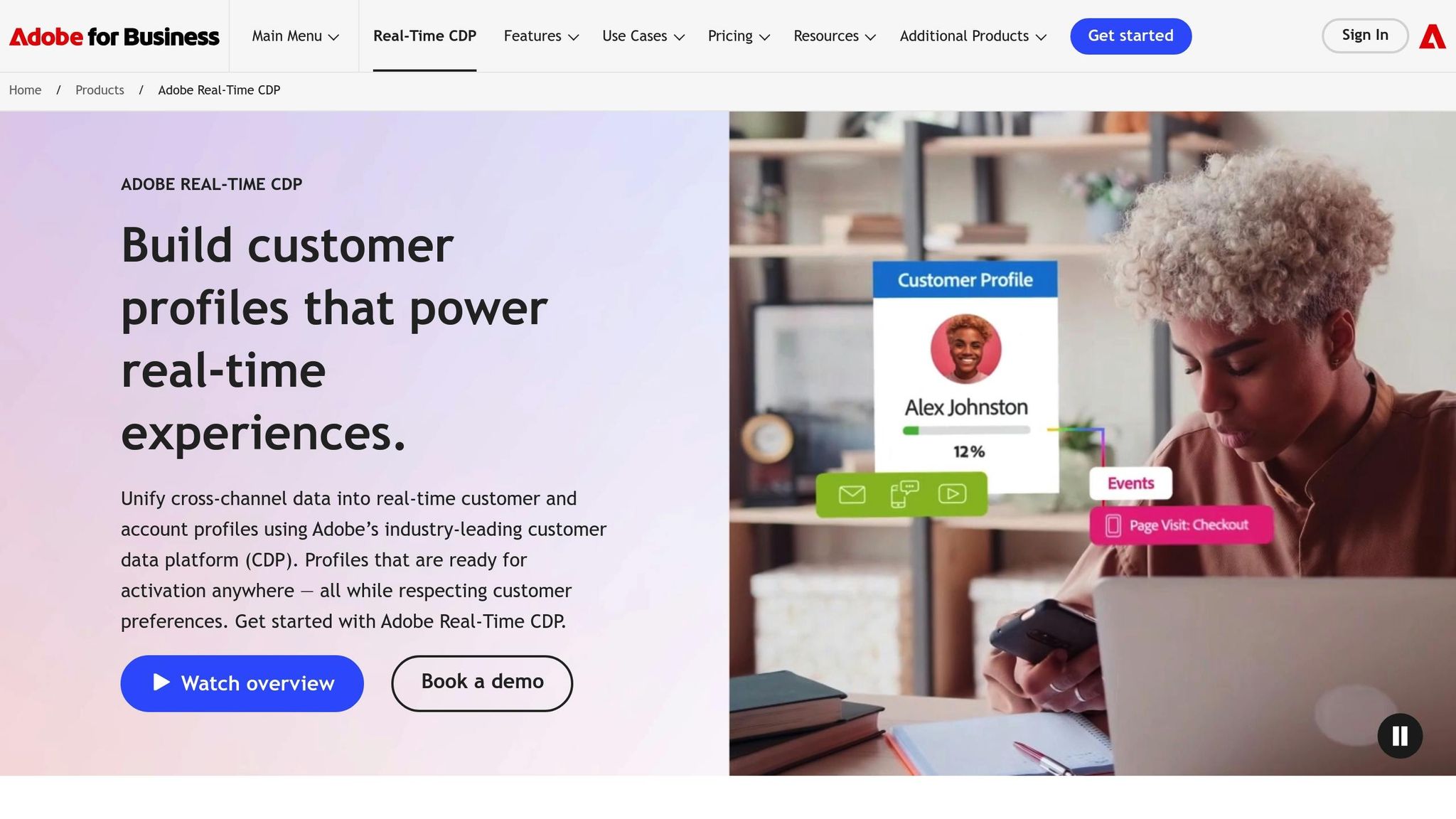
Adobe Real-Time CDP and Customer Journey Analytics work together to bring a complete picture of customer behavior across multiple touchpoints. While Real-Time CDP creates a constantly updated profile for each customer, Customer Journey Analytics dives into the details, analyzing patterns across platforms like websites, mobile apps, email, in-store purchases, and call centers. Together, they provide a seamless way to unify data and extract actionable insights.
Behavioral Data Integration and Analysis
Real-Time CDP gathers behavioral data from various sources such as websites, mobile apps, email systems, point-of-sale terminals, call centers, and even third-party tools. By applying identity resolution, it connects all these scattered events into a single, unified profile for each customer. Using Adobe's Experience Data Model (XDM), the platform standardizes data - whether it's page views, purchases in USD, or email clicks - into a consistent format. This streamlined data structure is essential for enabling real-time segmentation and personalized marketing efforts. For U.S. marketers, this can mean consolidating data from clickstreams, CRM systems, loyalty programs, and ad impressions into one place for precise targeting and measurement. Customer Journey Analytics takes it a step further by offering cross-channel journey analysis, allowing teams to visualize customer paths, create cohort analyses, and track funnels that show how users transition from mobile apps to websites or from online browsing to in-store purchases.
Real-Time Capabilities for Segmentation and Activation
Adobe Real-Time CDP processes live behavioral data - such as product views, search queries, and cart updates - and refreshes segment membership in near real time. Marketers can define segments like "Viewed a product twice within 30 minutes but didn’t purchase" and instantly sync these segments with email platforms, mobile push services, or ad networks. This allows for timely actions, like sending a cart abandonment email within minutes or pausing paid ads for customers who just completed a purchase. A Forrester Consulting study commissioned by Adobe found that companies using Adobe Experience Platform with Real-Time CDP achieved a 242% ROI over three years and noted a 20% boost in conversion rates for personalized campaigns after integrating behavioral data and leveraging real-time segmentation[6].
AI-Driven Predictive Modeling and Personalization
Adobe Sensei, Adobe's AI engine, powers advanced features across Real-Time CDP and Customer Journey Analytics. It enables propensity modeling, churn prediction, and automated personalization by analyzing behavioral signals like page views, product categories, time spent on-site, and email engagement. These insights help predict conversion likelihood and assign scores to customer profiles. For instance, a segment like "High propensity to buy > 0.8" can be used to deliver targeted offers, recommend products, or show next-best content at scale. Marketers can also conduct A/B testing on these AI-driven experiences and measure improvements in conversion rates or revenue per visitor using Customer Journey Analytics.
Scalability for Enterprise Use Cases
Adobe’s platform is built on a cloud infrastructure capable of managing large volumes of streaming data and complex queries, making it ideal for enterprise brands with millions of customer profiles and intricate omnichannel journeys. Mid-market U.S. companies can start small by focusing on key data sources and use cases, gradually expanding to include more channels and advanced modeling as they grow. Pricing is tailored to factors like data volume, the number of profiles, and the applications enabled, with annual contracts typically starting in the six-figure USD range. The platform also offers role-based access, workspaces, and templates to help smaller teams act quickly on insights, while larger enterprises can integrate deeply with Adobe Experience Cloud and custom data pipelines.
8. Salesforce Marketing Cloud Intelligence and Einstein
Salesforce Marketing Cloud Intelligence, previously known as Datorama, teams up with Einstein to deliver a powerful analytics and AI engine at the core of your CRM and marketing ecosystem. This platform consolidates behavioral data from emails, websites, mobile apps, ads, and sales into a unified source of truth. Einstein Analytics processes this data to detect patterns, anticipate trends, and enable real-time personalization for every customer interaction.
Behavioral Data Integration and Analysis
Marketing Cloud Intelligence pulls data from various touchpoints - like website activity, email engagement, ad impressions, CRM updates, and purchase histories - and standardizes it into a consistent format. This structured data then feeds Einstein Analytics, which uses AI to reveal patterns, such as identifying high-converting customer segments or pinpointing campaign elements that yield the best ROI. Through its integration with Salesforce CRM, every behavioral signal is seamlessly tied to customer profiles and workflows. For U.S.-based marketers managing intricate multi-channel funnels, this integration eliminates the hassle of piecing together data from disconnected tools. With this solid data foundation, insights are activated instantly, driving timely actions.
Real-Time Capabilities for Segmentation and Activation
Interaction Studio leverages real-time browsing data - such as pages viewed, time spent, and cart activity - to deliver personalized content across web, mobile, and email channels. Meanwhile, Einstein Bots handle thousands of interactions, qualifying leads and automatically routing high-value prospects to the appropriate teams. The platform also supports automated attribution modeling, tracking customer journeys across multiple touchpoints in real time to identify which channels and messages are driving conversions.
AI-Driven Predictive Modeling and Personalization
Einstein enhances its functionality with predictive models that analyze historical behavioral data to forecast customer actions. For example, it can predict who might churn or which leads are ready to make a purchase. These predictive insights empower marketers to build targeted segments and launch tailored campaigns across various media channels. Companies leveraging AI marketing tools have reported performance improvements of 15–25% compared to traditional manual methods[1].
Scalability for Enterprise Use Cases
Designed for large enterprises with complex marketing needs, Salesforce supports extensive customer databases and intricate operations. Monthly costs range from $2,000 to $20,000, depending on data volume and selected features, with additional expenses for integrations and training[1]. While the initial investment is substantial, the platform offers a consolidated data source that eliminates silos and simplifies coordination across teams. Its scalability makes it ideal for enterprises running multi-channel campaigns, managing global customer bases, and navigating sophisticated sales workflows. By turning behavioral insights into actionable revenue opportunities, Salesforce delivers measurable results for organizations aiming to streamline and scale their marketing efforts.
9. Braze
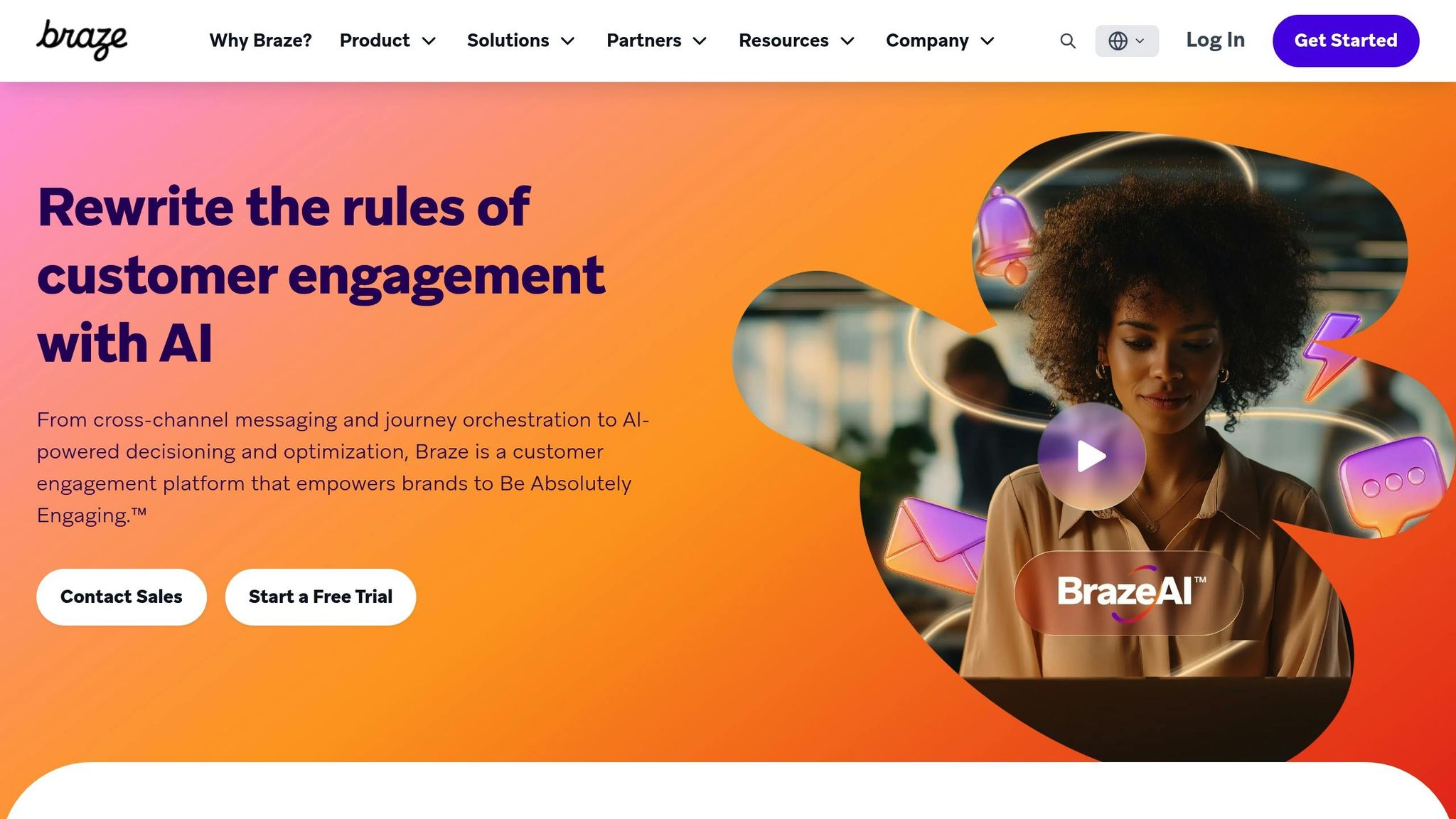
Braze is a platform designed to help enterprise brands create personalized, multi-channel campaigns across email, push notifications, SMS, in-app messaging, and WhatsApp. At the heart of its technology is BrazeAI™, an advanced system that processes massive datasets of customer activity. It identifies patterns, predicts behaviors, and automates message delivery on a large scale. Unlike platforms that rely on manual segmentation and scheduling, Braze uses AI to make split-second decisions about what message to send, when to send it, and which channel will yield the best engagement. This combination of automated segmentation and real-time messaging places Braze among the leading AI tools in the marketing space.
Behavioral Data Integration and Analysis
Braze collects behavioral data from various sources, including websites, mobile apps, purchase histories, and social media interactions. Its BrazeAI™ processes this information to uncover the behaviors that differentiate customers who convert from those who don’t. With its AI Query Builder, marketers can generate detailed SQL reports using natural language, eliminating the need for a dedicated data science team. This feature supports journey orchestration and predictive modeling, transforming raw engagement data into campaigns that adapt dynamically to customer behavior. This seamless data integration is the foundation for Braze's powerful real-time segmentation capabilities.
Real-Time Segmentation and Activation
Braze’s real-time engine activates behavioral data as soon as it’s captured. Features like Intelligent Timing optimize when messages are sent, while Intelligent Channel ensures delivery through the platform each user prefers, based on past interactions. Personalized Paths takes automation further by testing different message content, creative assets, and offers in real time to find the most engaging combinations. For instance, in 2025, OneRoof, a property platform in New Zealand, used the Braze Intelligence Suite to deliver AI-driven, localized recommendations. This led to a 218% increase in total clicks on property listings, a 57% rise in unique clicks, and a 23% improvement in email click-to-open rates[7].
Predictive Modeling and Personalization
Braze offers tools like Predictive Churn, which identifies users at risk of leaving, and Predictive Events, which forecasts actions such as first purchases or subscription renewals. These models enable marketers to focus retention efforts on high-value users. Additionally, AI Item Recommendations suggests the next best product or content for each customer, while Intelligent Selection uses reinforcement learning to deliver the best-performing campaign variant for specific segments. A great example of this is Pazza Pasta, a German food brand, which used Personalized Paths and AI Item Recommendations to launch automated WhatsApp campaigns in 2025. This approach resulted in purchase rates six times higher than traditional email campaigns[7]. These predictive tools enhance Braze’s ability to handle large-scale, multi-channel marketing.
Built for Enterprise-Scale Campaigns
Braze is specifically designed to manage high-volume, cross-channel campaigns for global audiences. It integrates with data warehouses like Snowflake and supports privacy-conscious marketing by enabling brands to train AI models using first-party data. The platform also maintains consistency in brand voice through customizable guidelines. While pricing details aren’t publicly available, Braze primarily caters to mid-market and enterprise-level clients with extensive customer databases and multi-channel needs. By combining behavioral insights, predictive analytics, and real-time activation in one platform, Braze eliminates the need for separate tools, making it an efficient solution for large-scale marketing operations. This focus on enterprise scalability highlights its role as a key player in AI-driven marketing solutions.
10. Klaviyo
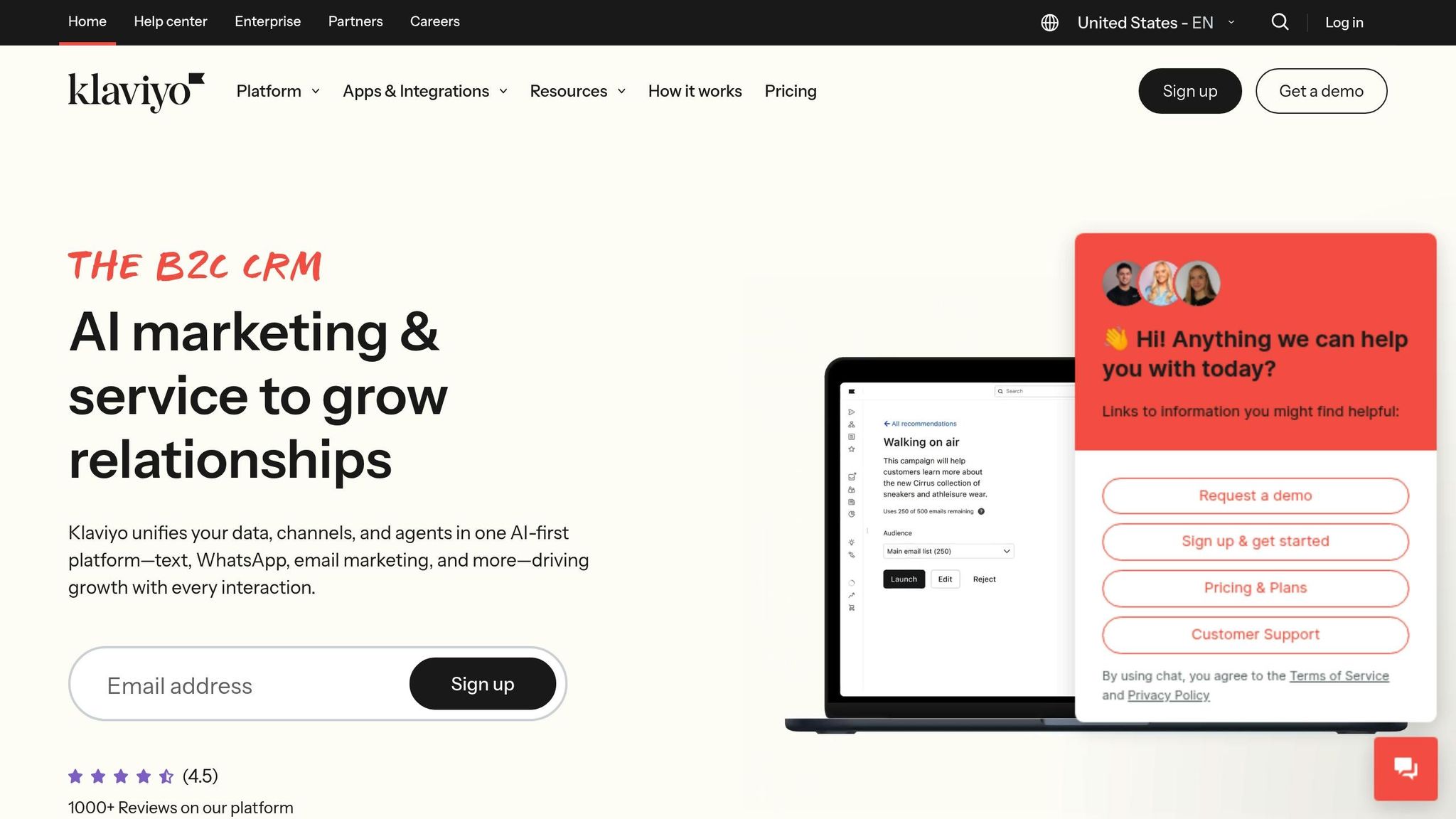
Klaviyo is a marketing platform designed for e-commerce brands, specializing in email and SMS campaigns that turn customer behavior into revenue opportunities. Tailored for small to medium-sized businesses, it integrates seamlessly with e-commerce platforms to gather behavioral data - such as clicks, browsing history, cart activity, and purchases. This data builds detailed customer profiles, enabling advanced segmentation and real-time campaign activation.
Behavioral Data Integration and Insights
Klaviyo connects with platforms like Shopify, WooCommerce, and custom APIs to collect and analyze behavioral data. This data allows the platform to segment customers into specific cohorts based on patterns like engagement levels, purchase frequency, and lifetime value. By leveraging AI tools like Usermaven, Klaviyo identifies groups based on factors such as "likelihood of conversion" and interaction trends, triggering automated workflows that deliver highly relevant messages.
Real-Time Updates for Targeted Campaigns
The platform's real-time processing engine ensures customer segments are constantly updated as new data flows in. When paired with tools like Audiense, Klaviyo enriches these segments by incorporating psychographic and social behavior data. This dynamic updating ensures that marketing campaigns are always aligned with the most current audience insights.
Predictive Modeling and Personalized Campaigns
Klaviyo takes personalization to the next level by using predictive analytics to craft tailored email and SMS campaigns. Drawing on social intelligence from platforms like Audiense, it segments audiences based on deeper insights, such as psychographic traits and social behaviors, rather than relying solely on basic demographic data. By transforming behavioral insights into actionable campaigns, Klaviyo stands out as a go-to solution for e-commerce brands looking to connect with their customers in meaningful ways.
Tool Comparison
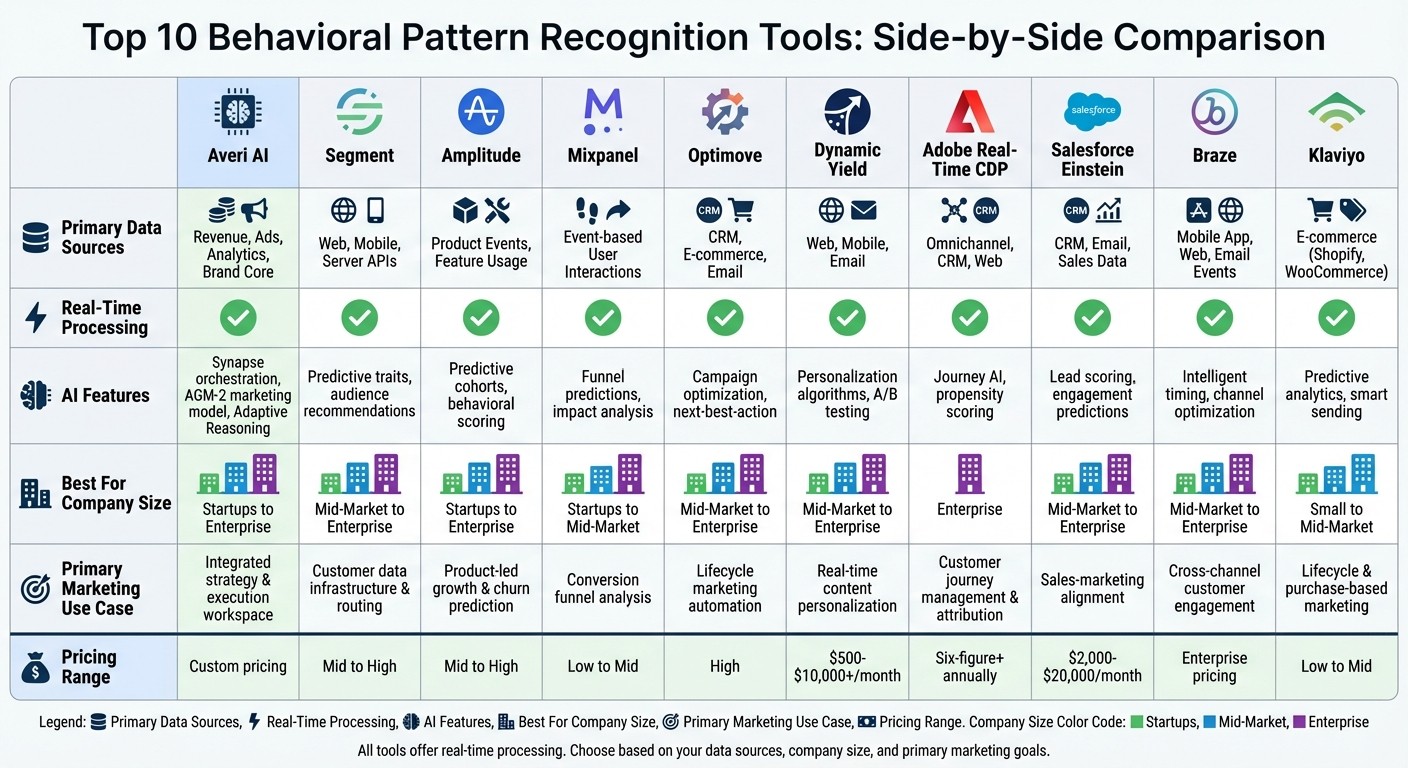
Behavioral Pattern Recognition Tools Comparison: Features, Pricing, and Best Use Cases
Selecting the best behavioral pattern recognition tool depends on several factors: where your data resides, how quickly you need actionable insights, and your specific goals. The table below provides a detailed comparison of key platforms, highlighting their data sources, processing speed, AI capabilities, ideal company size, and primary marketing applications.
Tool | Primary Data Sources | Real-Time Processing | AI Features | Best For Company Size | Primary Marketing Use Case |
|---|---|---|---|---|---|
Averi AI | Revenue, Ads, Analytics, Brand Core | Yes | Synapse orchestration, AGM-2 marketing model, Adaptive Reasoning | Startups to Enterprise | Integrated strategy & execution workspace |
Segment | Web, Mobile, Server APIs | Yes | Predictive traits, audience recommendations | Mid-Market to Enterprise | Customer data infrastructure & routing |
Amplitude | Product Events, Feature Usage | Yes | Predictive cohorts, behavioral scoring | Startups to Enterprise | Product-led growth & churn prediction |
Mixpanel | Event-based User Interactions | Yes | Funnel predictions, impact analysis | Startups to Mid-Market | Conversion funnel analysis |
Optimove | CRM, E-commerce, Email | Yes | Campaign optimization, next-best-action | Mid-Market to Enterprise | Lifecycle marketing automation |
Dynamic Yield | Web, Mobile, Email | Yes | Personalization algorithms, A/B testing | Mid-Market to Enterprise | Real-time content personalization |
Adobe Real-Time CDP | Omnichannel, CRM, Web | Yes | Journey AI, propensity scoring | Enterprise | Customer journey management & attribution |
Salesforce Einstein | CRM, Email, Sales Data | Yes | Lead scoring, engagement predictions | Mid-Market to Enterprise | Sales-marketing alignment |
Braze | Mobile App, Web, Email Events | Yes | Intelligent timing, channel optimization | Mid-Market to Enterprise | Cross-channel customer engagement |
Klaviyo | E-commerce (Shopify, WooCommerce) | Yes | Predictive analytics, smart sending | Small to Mid-Market | Lifecycle & purchase-based marketing |
To make the most of behavior-driven marketing, marketers should weigh how each tool performs in critical areas like processing speed, scalability, and data privacy. For example, tools like Adobe Real-Time CDP and Braze excel at instant data processing, which is crucial for triggering timely campaigns such as abandoned cart reminders.
Company size also plays a significant role. Startups often gravitate toward user-friendly, plug-and-play options like Mixpanel and Klaviyo, while enterprises benefit from the flexibility and customization offered by platforms like Adobe and Salesforce.
Data privacy remains a top concern, with 40% of marketers emphasizing its importance [1]. When evaluating tools, check for compliance with GDPR, CCPA, and other regulations, especially if your business operates internationally. Consider factors like data retention policies, user consent mechanisms, and security features to ensure your tool aligns with privacy standards.
Conclusion
Behavioral pattern recognition tools have become a cornerstone for modern marketing teams, transforming raw data into strategies that uncover the why behind customer actions - not just the where. Ali Good, SVP of Marketing at Harver, puts it succinctly: focusing on real customer behavior uncovers what truly matters [3].
These AI-powered tools bring impressive results, enabling decisions to be made 78% faster and forecasts to be 47% more accurate, with performance gains of up to 25% over traditional methods [1]. They also make large-scale personalized campaigns achievable without the need for overwhelming manual work.
Selecting the right platform depends on your marketing goals and the complexity of your customer journey. For example, product teams often rely on event-based platforms like Amplitude or Mixpanel, while e-commerce brands may see stronger returns with lifecycle-focused tools such as Klaviyo or Optimove. Enterprise organizations managing intricate omnichannel experiences might turn to Adobe or Salesforce for their depth. For those looking for a seamless, all-in-one solution, platforms like Averi AI integrate behavioral insights with campaign execution, eliminating the need to juggle multiple tools. For teams needing additional support, you can also hire vetted experts to help implement these complex systems.
To demonstrate value quickly, focus on high-impact areas like checkout or pricing pages [1]. And with 40% of marketers identifying data privacy as a top concern [1], it’s critical to choose tools that prioritize compliance with regulations like GDPR and CCPA from the outset. The most effective platforms bridge the gap between insight and action, making it easy to transition from identifying patterns to implementing campaigns.
Marketing has evolved from broad demographic targeting to precise, behavior-driven strategies. Teams adopting these tools now stand to gain a lasting edge: every customer interaction feeds into smarter campaigns and more meaningful experiences. By aligning strategies with these advanced tools, marketers can turn insights into action and drive results with unmatched efficiency.
FAQs
How can behavioral pattern recognition tools enhance marketing campaigns?
Behavioral pattern recognition tools dive deep into data - everything from clicks and purchase histories to social media activity and sentiment cues - to reveal the underlying patterns that shape customer decisions. By leveraging advanced AI methods like natural language processing and sequence analysis, these tools can forecast customer actions, spot emerging trends, and segment audiences on the fly. This capability empowers marketers to design campaigns that feel tailor-made, boosting engagement, retention, and conversion rates.
When these insights are woven into marketing workflows, teams can react instantly to shifts in customer behavior. Automated adjustments to bids, creative assets, and channel strategies ensure campaigns stay relevant and impactful. Real-time feedback and testing further streamline the process, enabling swift refinements that avoid delays. Solutions like Averi AI push this even further by blending AI-driven insights with human expertise, creating campaigns that are not only precise but also deliver measurable results at every stage of the marketing funnel.
What should I look for in a behavioral pattern recognition tool for marketing?
When selecting a behavioral pattern recognition tool for marketing, prioritize how it manages data handling. Tools capable of processing real-time interaction signals - such as clicks, purchases, or social mentions - offer a current and dynamic view of customer behavior. In contrast, static models can fall behind, especially in rapidly shifting markets. It's also essential to choose a tool that integrates smoothly with your existing systems, like your CRM, CMS, ad platforms, and data warehouse, ensuring all customer touchpoints are unified.
Take a close look at the tool’s model accuracy and capabilities. Advanced AI models, particularly those using technologies like transformers, excel at analyzing text, sentiment, and behavioral patterns compared to basic rule-based systems. Make sure the tool offers transparency regarding its training data, provides options for fine-tuning, and includes quality control measures to ensure its outputs align with your brand’s needs.
Don’t overlook practical considerations such as compliance with data privacy regulations like GDPR or CCPA, the pricing structure, scalability, and the availability of human support. For instance, Averi AI stands out by combining real-time segmentation, privacy-compliant data handling, and expert-driven insights in a single workspace, with flexible pricing options. Opting for a tool that strikes the right balance across these factors will empower you to gain actionable insights with ease and efficiency.
How can AI insights improve customer engagement and loyalty?
AI-driven tools are reshaping how businesses connect with their audiences by turning customer data - like clicks, purchases, and social media activity - into tailored recommendations. These systems predict customer behavior in real time, enabling marketers to deliver the right content, offers, or messages exactly when they’ll have the most impact. The result? Higher click-through rates and stronger customer relationships.
When it comes to customer retention, AI plays a crucial role by spotting early signs of churn, such as a drop in engagement or negative feedback. It can then trigger timely actions, like offering loyalty rewards or sending personalized follow-ups, to re-engage those customers. By continuously updating audience segments based on behavior, preferences, and demographics, campaigns stay relevant and effective. Today’s platforms blend predictive analytics with actionable strategies, helping businesses address churn and build lasting customer loyalty.
AI also excels at analyzing social media activity, revealing trends in sentiment and audience behavior. These insights allow marketers to fine-tune their strategies, ensuring content stays engaging and relationships with customers remain strong.
Related Blog Posts

Zach Chmael
CMO, Averi
"We built Averi around the exact workflow we've used to scale our web traffic over 6000% in the last 6 months."
Your content should be working harder.
Averi's content engine builds Google entity authority, drives AI citations, and scales your visibility so you can get more customers.