7 Free SEO Tools Every Startup Should Use Before Paying for Semrush

Zach Chmael
Head of Marketing
5 minutes

In This Article
This guide covers seven free SEO tools that, together, give you 80% of what a paid suite offers at your stage. Each one solves a specific problem. None of them require a credit card. And at the end, I'll tell you exactly when it does make sense to upgrade.
Updated
Trusted by 1,000+ teams
Startups use Averi to build
content engines that rank.
TL;DR
💸 Semrush starts at $139.95/month—over $1,600/year that most pre-Series A startups can't justify until they've built a content foundation
🔍 Google Search Console is the single most valuable free SEO tool in existence—it shows you real data from Google's own index, not estimates
📊 These 7 free tools cover the full SEO workflow: keyword research, technical audits, on-page optimization, rank tracking, content planning, and competitor analysis
🚀 91% of B2B organizations use content marketing, but most startups waste their first 6 months optimizing the wrong things with the wrong tools
⏰ The right time to upgrade to paid tools is after you've published 30+ pages of content and need competitive intelligence at scale—not before
🧰 Averi's free resources hub includes 431+ templates, calculators, and interactive tools that complement every tool on this list

Zach Chmael
CMO, Averi
"We built Averi around the exact workflow we've used to scale our web traffic over 6000% in the last 6 months."
Your content should be working harder.
Averi's content engine builds Google entity authority, drives AI citations, and scales your visibility so you can get more customers.
7 Free SEO Tools Every Startup Should Use Before Paying for Semrush
Semrush starts at $139.95 per month. That's $1,679 a year.
For a seed-stage startup burning through runway and figuring out product-market fit, that's not a line item… it's a statement of faith.
And here's the thing: most startups don't need Semrush yet. Not because Semrush isn't excellent (it is), but because the foundational SEO work that actually moves the needle at your stage can be done with free tools.
Keyword research. Technical audits. Content optimization. Rank tracking. Competitor analysis.
There's a free tool for each of these that will carry you through your first 50 pieces of content and well past your first 10,000 organic sessions.
The mistake isn't eventually paying for Semrush. The mistake is paying $140/month before you've done the free work that tells you what to pay for. You need to understand your keyword landscape, your technical baseline, and your content gaps before an enterprise SEO suite can actually help you.
Otherwise, you're paying for a Formula 1 dashboard while learning to parallel park.
This guide covers seven free SEO tools that, together, give you 80% of what a paid suite offers at your stage. Each one solves a specific problem. None of them require a credit card. And at the end, I'll tell you exactly when it does make sense to upgrade.

Why Should Startups Wait Before Paying for SEO Tools?
The question isn't whether professional SEO tools are valuable. They are. The question is whether they're valuable at your stage.
And for most startups pre-Series A, the answer is no… not yet.
Here's why.
Paid SEO suites like Semrush, Ahrefs, and Moz are built for marketers who already know what they're optimizing for. They're exceptional at competitive analysis at scale, tracking thousands of keywords, historical trend data, and advanced link analysis. These are optimization problems, fine-tuning an existing engine.
But most early-stage startups don't have an engine yet.
They have a website with 5-15 pages, zero domain authority, and a vague sense that "SEO matters."
At that stage, what you need isn't a $140/month dashboard. You need to understand the basics: What are people searching for? Can Google find your pages? Is your content structured correctly? Who's ranking for the terms you care about?
Free tools answer all of these questions. And they answer them with data that's often more accurate than paid alternatives, because the most important free tool—Google Search Console—comes straight from Google itself.
Save the Semrush budget for when you actually have enough content and traffic to need it. Until then, here are the seven tools that will get you there.
Tool 1: Google Search Console — Your Single Source of Truth
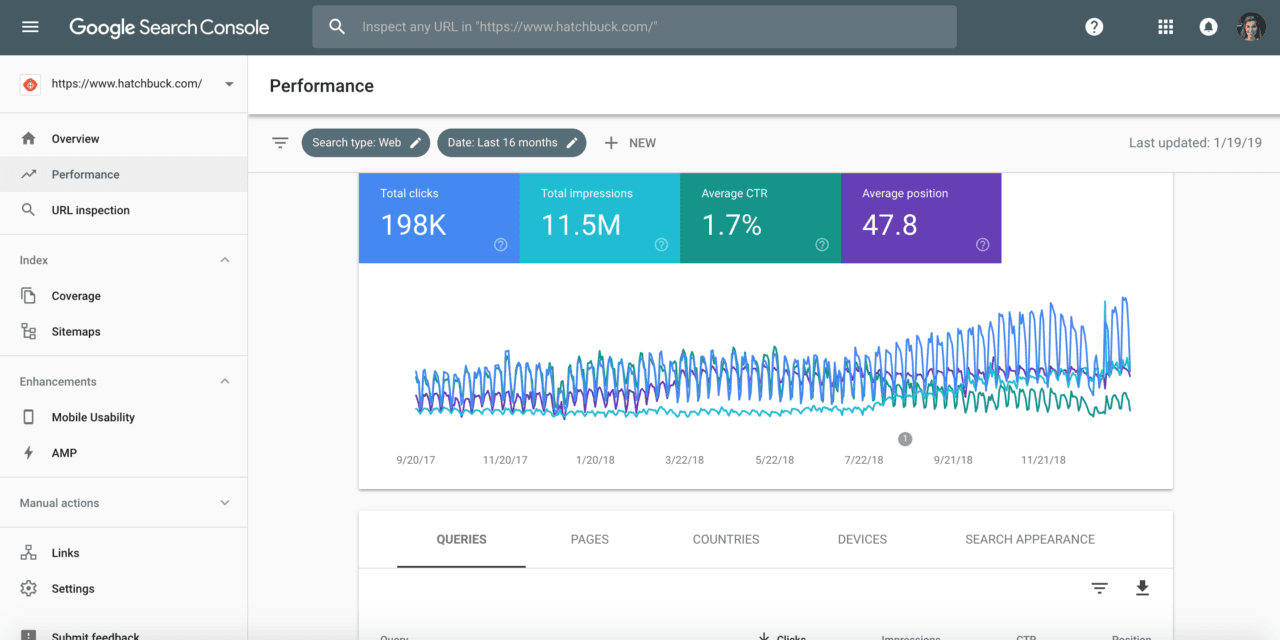
Google Search Console (GSC) is the most valuable SEO tool in existence, and it's completely free.
It shows you exactly how Google sees your website—not estimates, not projections, but actual data from Google's index. Every other SEO tool is approximating what GSC tells you directly.
What it does for startups: GSC shows you which queries bring impressions and clicks to your site, your average ranking position for each query, which pages are indexed (and which aren't), mobile usability issues, Core Web Vitals scores, and manual actions or security issues. It's your diagnostic dashboard for everything Google-related.
How to use it at your stage: Start by verifying your domain and submitting your sitemap. Then check the "Coverage" report weekly to make sure your pages are being indexed. Review the "Performance" report to see which queries you're appearing for—this is goldmine data for content planning. Look at your CTR (click-through rate) by query to identify pages with high impressions but low clicks, which means your title tags and meta descriptions need work.
What it replaces in Semrush: Position tracking (for your own site), technical issue detection, index coverage analysis, and CTR optimization data. GSC doesn't show competitor data—that's the legitimate gap—but for understanding your own site's performance, it's superior to any paid tool.
Pro tip: Export your GSC data monthly into a spreadsheet. Track trends over time. Use our free SEO Reporting Template to build a dashboard that connects your GSC data to actual business metrics.
Tool 2: Google Analytics 4 — Understanding What Happens After the Click
If GSC tells you how people find your site, GA4 tells you what happens after they arrive. Together, they form the complete picture of your organic search performance… and both are free.
What it does for startups: GA4 tracks user behavior on your site: which pages they visit, how long they stay, what actions they take, and where they drop off. For SEO specifically, it connects organic traffic to business outcomes. You can see which blog posts drive demo requests, which landing pages convert, and which content generates email signups.
How to use it at your stage: Set up conversion events for your key actions (signups, demo requests, email captures). Create a custom "Organic Search" segment and analyze which pages and queries drive the most valuable traffic—not just the most traffic. This distinction matters enormously at the startup stage where every lead counts.
With AI search growing at roughly 1% month-over-month, also configure custom referral tracking for AI platforms (ChatGPT, Perplexity, Claude). AI search visitors convert at 4.4x the rate of traditional organic—you want to see this traffic separately.
What it replaces in Semrush: Traffic analytics, user behavior analysis, and conversion attribution. Semrush's traffic analytics is useful for analyzing competitor sites, but for your own site, GA4 is the authoritative source.
Pro tip: Use our Organic Pipeline Calculator to project how your current organic traffic translates into revenue based on your conversion rates.
Tool 3: Google Keyword Planner — Keyword Research Without the Price Tag
Keyword research is the foundation of any SEO strategy, and Google gives you a free tool to do it. Google Keyword Planner was built for advertisers, but it's equally valuable for organic keyword research, especially at the startup stage where you're identifying your initial target terms.
What it does for startups: Keyword Planner shows you monthly search volumes, competition levels, and related keyword suggestions for any topic. You can input a seed keyword (like "content marketing for startups") and get hundreds of related terms with volume estimates. It also shows seasonal trends, which helps with content calendar planning.
How to use it at your stage: Start with 5-10 seed keywords that describe your product category and your buyers' problems. Export the suggestions, filter for terms with 100-1,000 monthly searches (the sweet spot for startups—enough volume to matter, not so competitive you'll never rank), and group them into topic clusters. This becomes your initial content roadmap.
Complement Keyword Planner with AlsoAsked.com (free for limited searches) and AnswerThePublic (free tier available) to find the specific questions people ask around your target topics. These question-based queries are perfect for building FAQ content that AI systems love to cite.
What it replaces in Semrush: Basic keyword research, search volume estimates, and keyword suggestions. Semrush's keyword database is significantly larger (26+ billion keywords) and includes keyword difficulty scoring, SERP feature analysis, and intent classification. But for identifying your first 50-100 target keywords, Keyword Planner is more than sufficient.
Pro tip: Use our free Keyword Research Template to organize your findings into a prioritized content plan, and our SEO Content Brief Template to turn each target keyword into a structured brief before you write.
Tool 4: Screaming Frog (Free Version) — Your Technical SEO Audit in a Box
Screaming Frog's free version crawls up to 500 URLs—more than enough for most startup websites—and gives you a comprehensive technical SEO audit that would cost hundreds of dollars from a consultant.
What it does for startups: Screaming Frog crawls your entire site and reports on broken links, duplicate content, missing meta descriptions, title tag issues, redirect chains, canonical tag problems, image alt text gaps, page load issues, and crawl depth problems. It's the fastest way to find and fix the technical issues that prevent Google from properly indexing your content.
How to use it at your stage: Run a crawl of your entire site. Sort by "Client Error (4xx)" to find broken links. Check the "Page Titles" tab for missing or duplicate titles. Review "Meta Description" for missing descriptions. Look at "Response Codes" for redirect chains. Fix everything flagged as an issue—this is foundational hygiene that paid tools won't help you skip.
For Framer sites (which many startups use), pay special attention to rendered versus static HTML. AI crawlers don't execute JavaScript the way Googlebot does, so ensuring your core content renders in static HTML matters for both traditional SEO and GEO.
What it replaces in Semrush: Site Audit functionality. Semrush's site audit is more automated and provides ongoing monitoring, but for a point-in-time audit of a sub-500-page startup site, Screaming Frog Free is equally powerful and arguably more granular.
Pro tip: Run Screaming Frog monthly and compare results to your previous crawl. Use our Technical SEO Audit Template to track issues and fixes over time, and our On-Page SEO Checklist to ensure every new page ships clean.
Tool 5: Ubersuggest (Free Tier) — Competitor Intelligence on a Budget
Understanding what your competitors rank for is one of the legitimate reasons to eventually upgrade to paid tools. But Ubersuggest's free tier gives you enough competitor intelligence to build your initial strategy without spending a dollar.
What it does for startups: Ubersuggest lets you enter a competitor's domain and see their top-ranking pages, the keywords driving their organic traffic, their estimated monthly traffic, and their backlink profile. The free version limits you to a few searches per day, but that's sufficient for analyzing your top 3-5 competitors methodically over a week.
How to use it at your stage: Identify your 3-5 closest competitors (same stage, same market, same buyer). Run each domain through Ubersuggest. Document their top 20 organic pages and the keywords driving traffic to each one. Look for patterns: What topics do they cover that you don't? What keywords are they ranking for that you should target? What content formats perform best in your niche?
This competitive analysis is the raw material for your content strategy. The keywords your competitors rank for are a validated list of terms your audience searches for—you don't have to guess.
What it replaces in Semrush: Basic competitive analysis, domain overview, and top pages reports. Semrush's competitive intelligence is dramatically more comprehensive (deeper data, more metrics, historical trends), but for building your initial competitor map, Ubersuggest's free tier covers the essentials.
Pro tip: Use our free Competitor Content Analysis Template to structure your findings, and our Content Gap Analyzer to identify the specific opportunities your competitors are missing.
Tool 6: Yoast SEO / RankMath (Free WordPress Plugins) — On-Page Optimization Guardrails
If you're on WordPress, the free versions of Yoast SEO or RankMath give you real-time on-page optimization guidance as you write. They're not keyword research tools, they're quality control tools that prevent you from publishing under-optimized content.
What they do for startups: Both plugins analyze your content as you write and provide actionable feedback on keyword usage, readability, meta description length, heading structure, internal linking, and image alt text. They generate XML sitemaps automatically, manage canonical tags, and handle basic technical SEO settings—things that would otherwise require a developer.
How to use them at your stage: Install either plugin (not both—pick one). Enter your target keyword for each page. Follow the suggestions to green-light status before publishing. Pay particular attention to readability scores—content written at Grade 8-10 reading level gets significantly higher AI citation rates, and these plugins help you hit that sweet spot.
If you're on Framer or Webflow instead of WordPress, you'll handle these optimizations manually. Use our On-Page SEO Checklist as your pre-publish quality gate.
What they replace in Semrush: The SEO Writing Assistant and On-Page SEO Checker features. Semrush's tools are more sophisticated (they include competitor content analysis and semantic recommendations), but for ensuring every page meets baseline optimization standards, the free plugins are remarkably effective.
Pro tip: Don't chase a perfect score on every metric. Focus on the high-impact items: target keyword in H1 and first paragraph, meta description between 140-160 characters with keyword, 5-7 H2s per 2,000 words, and 3+ internal links per page. Use our Content Scoring Rubric Template for a more nuanced quality assessment that includes GEO factors.
Tool 7: Averi's Free Resource Hub — The Stack That Ties Everything Together
Here's the gap that individual free tools can't fill: they don't talk to each other. You end up with keyword data in one spreadsheet, audit findings in another, competitor intelligence in a third, and no unified strategy connecting them. This is where most startups stall, not from lack of data, but from lack of system.
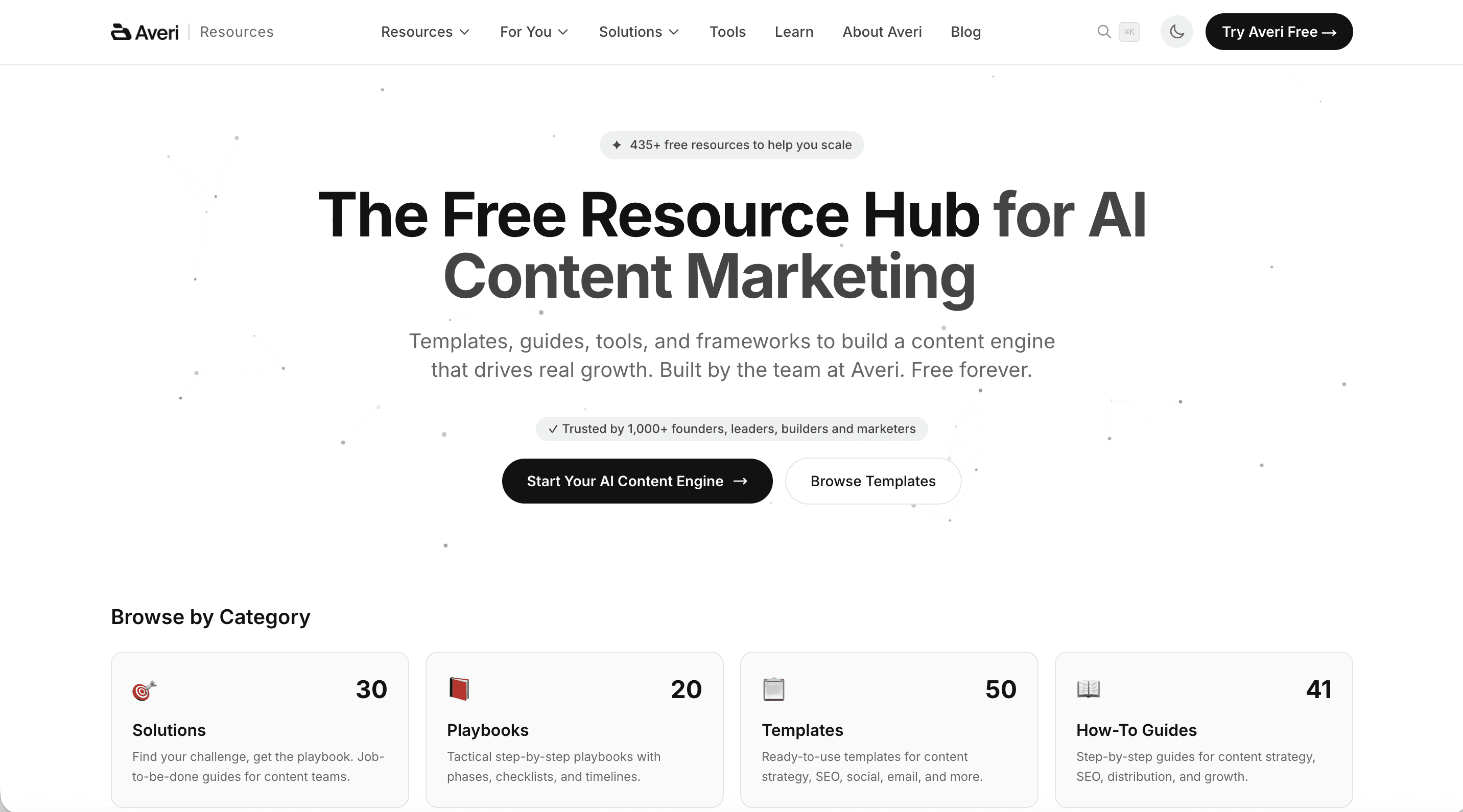
Averi's free resource hub bridges this gap with 431+ free templates, calculators, benchmarks, and interactive tools specifically designed for startup marketing teams running lean. These aren't generic downloads. They're structured workflows that connect the outputs of the six tools above into an actionable SEO strategy.
The SEO workflow stack (all free):
Your keyword research goes into the Keyword Research Template and gets prioritized using the Content Pillar Planning Template. Each target keyword gets turned into a structured brief using the SEO Content Brief Template. Before publishing, every piece gets checked against the On-Page SEO Checklist. Post-publish performance gets tracked in the SEO Reporting Template and the Content Performance Report Template.
The content planning stack (all free):
Your competitor analysis goes into the Competitor Content Analysis Template. Content gaps get mapped using the Content Strategy Template. Your publishing cadence gets structured in the Editorial Calendar Template. And your quarterly priorities get documented in the Quarterly Content Plan Template.
The GEO-ready stack (all free):
As AI search grows, you also need the GEO Optimization Checklist, the llms.txt Template, and the Schema Markup Template to ensure your content is optimized for citation by AI systems—not just ranking on Google.
Interactive tools:
Run quick calculations with the Headline Analyzer for title optimization, the Readability Checker for content quality, the Meta Description Generator for on-page optimization, and the Content Brief Generator for scaling your content workflow.
Benchmarking data:
Check your metrics against reality with the SEO Ranking Timeline benchmarks, Website Traffic Benchmarks for Startups, and Content Marketing Budget Benchmarks.
This is the connective tissue that turns seven disconnected free tools into a coherent SEO operation. No credit card required.
When Does It Actually Make Sense to Pay for Semrush?
Free tools have limits. They're designed to get you started, not to scale indefinitely. Here are the signals that it's time to upgrade:
You've published 30+ pages of content and need to track keyword rankings at scale. GSC shows you queries you already rank for, but it doesn't let you proactively track target keywords or compare your positions against competitors. When you have a meaningful content library, rank tracking at scale becomes genuinely valuable.
You need competitive intelligence beyond surface-level data. When you're past the "what do my competitors write about" stage and into "what specific keywords are they gaining or losing this month," you need a paid tool's depth.
Your site has grown past 500 pages. Screaming Frog's free crawl limit becomes a constraint. You need ongoing automated auditing that catches issues before they impact rankings.
You're investing in link building. Backlink analysis is one area where free tools are genuinely inadequate. Ubersuggest's free backlink data is limited, and understanding your link profile relative to competitors requires Semrush or Ahrefs-level data.
Your SEO is generating meaningful revenue and the ROI math works. If organic traffic drives $5,000+/month in pipeline, spending $140/month on tools that improve that traffic by even 10% is an obvious investment. Use our Revenue Impact Calculator to model this for your specific numbers.
Until you hit these signals, the seven free tools above will serve you well, and the money you save can go toward creating the content that actually earns rankings.
Related Resources
If You're Building Your SEO Foundation
SEO for Startups: How to Rank Higher Without a Big Budget in 2026
AI-Powered SEO for B2B SaaS: Getting to Page 1 Without an Agency
If You're Ready to Build a Content Engine
How to Build an AI Content Engine That Grows Your Startup in 2026
Content Marketing for PLG: The SEO Strategy That Converts Self-Serve Signups
If You Want to Add GEO to Your Stack
The Complete Guide to GEO: Getting Your Brand Cited by AI Search
Your First 90 Days of GEO: The Realistic Implementation Timeline for Startups
Free Tools, Templates & Benchmarks
FAQs
Can I really do effective SEO with only free tools?
Yes—with caveats. Free tools cover approximately 80% of what a pre-Series A startup needs for SEO: keyword research, technical audits, on-page optimization, content planning, and basic performance tracking. The 20% gap is primarily in competitive intelligence depth, historical data, automated rank tracking, and backlink analysis. For startups with fewer than 50 published pages and under 10,000 monthly organic sessions, free tools are more than sufficient.
Is Google Search Console really better than Semrush for my own site's data?
For your own site's data, yes. GSC provides actual impression counts, click counts, and average positions directly from Google's index. Every other tool—including Semrush—estimates these numbers using their own crawlers and algorithms. Estimates are useful for competitive analysis (where GSC can't help), but for understanding your own performance, GSC is the gold standard.
What about Ahrefs—should I consider it instead of Semrush?
Ahrefs and Semrush are both excellent enterprise SEO tools, and the same logic applies to both: don't pay until you need the depth. Ahrefs' Webmaster Tools (free for verified site owners) is actually another solid free option for backlink analysis that's worth adding to your stack. If and when you do upgrade, the choice between Ahrefs and Semrush depends on your needs—Ahrefs has a stronger backlink index, while Semrush offers a broader marketing toolkit.
How long should I use free tools before upgrading?
There's no universal timeline, but most startups should use free tools for 6-12 months while building their content foundation. The trigger for upgrading should be based on the signals above (30+ pages, revenue from organic, need for competitive depth)—not a calendar date. Some fast-moving startups outgrow free tools in 3 months. Others are well-served by them for 18+ months.
Do free SEO tools work for GEO (Generative Engine Optimization)?
Partially. GSC is starting to show some AI-related traffic data, and free technical tools (Screaming Frog, Yoast) help ensure your site is crawlable by AI bots. But dedicated GEO monitoring—tracking citations across ChatGPT, Perplexity, and Claude—currently requires either manual auditing or specialized tools. Start with manual sampling (query AI platforms with your target topics weekly) and use the free GEO Optimization Checklist to ensure your content is citation-ready.
What's the best free tool for a non-technical founder who knows nothing about SEO?
Start with Google Search Console and nothing else. Spend two weeks just reading the data: what queries bring people to your site, which pages get the most impressions, what your average CTR looks like. Then add the SEO Fundamentals course from Averi's learning hub for context. Build from there. The biggest mistake non-technical founders make is trying to use all the tools at once—start simple, learn the basics, then expand your stack.
Can Averi replace Semrush for my startup's SEO needs?
Different tools for different problems. Averi is an AI-powered content engine that takes you from strategy through creation, publishing, and analytics—it's the workflow that turns SEO insights into actual published, optimized content. Semrush is a data and analysis platform that tells you what to optimize. The free tools in this article give you the analysis layer. Averi gives you the execution layer. Eventually, you might use all three—but at the startup stage, free analysis tools plus an execution system that ships content is a powerful combination.