AI Content Workflow Automation: How the 6-Phase Engine Works

Zach Chmael

Head of Marketing

5 minutes

In This Article

The exact 6-phase workflow behind Averi's content engine: Brand Core → Strategy → Creation → Scoring → Publishing → Analytics. Phase-by-phase breakdown.

Updated

Trusted by 1,000+ teams

★★★★★ 4.9/5

Startups use Averi to build
content engines that rank.

TL;DR

⚙️ 6 phases: Brand Core (one-time, 10 min) → Strategy Map (automated, you approve topics) → Content Queue (AI drafts, you edit 30–45 min) → Content Scoring (55% SEO + 45% GEO, automated) → CMS Publishing (direct to WordPress/Webflow/Framer) → Analytics (GSC + GA4 integrated, weekly review)

👤 2 human checkpoints: Topic approval (5–10 min/week) and draft editing (30–45 min/post). Everything else is automated.

⏱️ Total founder time: 2 hours/week for 2 published, scored, optimized posts. 8 posts/month.

🔄 Feedback loop: Analytics → Strategy. Top-performing topics signal "publish more." Declining posts get flagged for refresh. The system improves from its own data.

📈 Output over time: 8 posts month 1 → 24 by month 3 → 48 by month 6 → 80+ by month 10. The compound curve is real. The early months are flat by design.

Start free with Averi. Brand Core in 10 minutes. First published post by day 3.

Zach Chmael

CMO, Averi

"We built Averi around the exact workflow we've used to scale our web traffic over 6000% in the last 6 months."

Your content should be working harder.

Averi's content engine builds Google entity authority, drives AI citations, and scales your visibility so you can get more customers.

AI Content Workflow Automation: How the 6-Phase Engine Works

Most AI content tools handle one phase.

A keyword tool does research.

A writing tool generates drafts.

An optimizer scores content.

A CMS publishes it.

You're the human glue connecting four tools that don't talk to each other.

A content engine is different. It connects every phase into a single workflow where the output of each step feeds directly into the next.

No copy-paste. No tab-switching. No manual formatting.

Strategy informs creation. Creation feeds scoring. Scoring triggers publishing. Publishing generates analytics. Analytics inform strategy. The loop closes.

This is how Averi's 6-phase content engine works.

Phase by phase, with the exact inputs, outputs, and the 2 hours of weekly founder time that keeps it running.

See what your Content ROI could be when running the 6-Phase Architecture

The 6-Phase Architecture


Each phase produces an output that the next phase consumes.

The Brand Core is the foundation. Analytics is the feedback loop.

Everything in between is automated with human checkpoints at two specific moments: topic approval and draft editing.

Phase 0: Brand Core (One-Time Setup, 10 Minutes)

What it is: The strategic foundation that every subsequent phase draws from. Your ICP, positioning, product capabilities, competitive differentiators, and brand voice.

What you input:

  • Who your customer is (title, company size, industry, pain points)

  • What your product does (capabilities, key features, pricing)

  • How you're different (vs. competitors, unique value proposition)

  • Your brand voice preferences

What it produces: A persistent context layer that informs every topic recommendation, every draft, and every optimization decision. The Brand Core is why the AI doesn't generate generic content. It generates content about your product, for your audience, in your voice.

Time investment: 10 minutes during initial onboarding. Update quarterly or when positioning changes.

Why this matters: AI writing tools without brand context produce generic output. You then spend 60+ minutes per post adding context that should have been there from the start. The Brand Core eliminates that rework by front-loading the context once.
Phase 1: Strategy Map (Automated → You Approve)

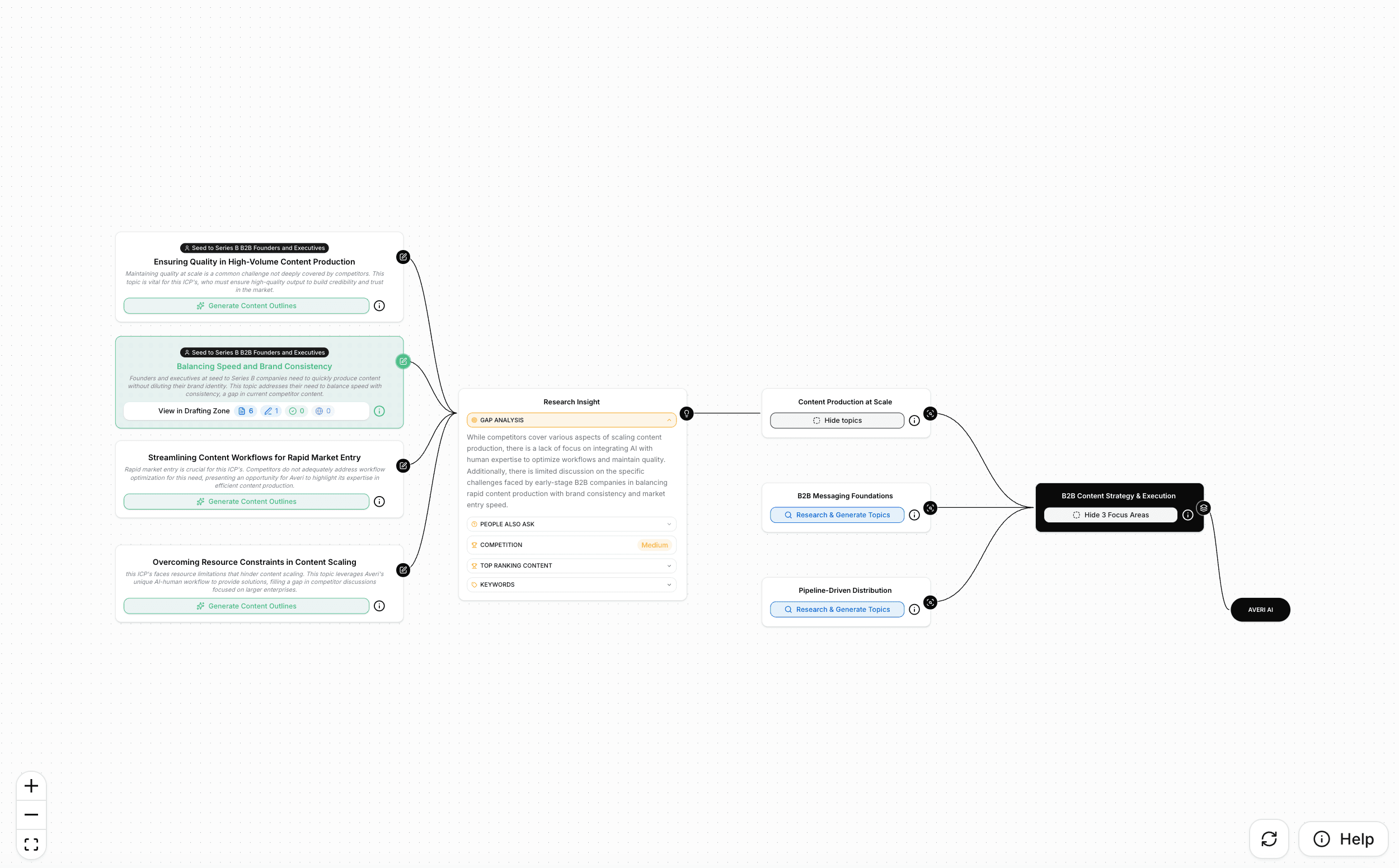
What it is: Automated topic research that generates keyword-targeted content recommendations based on your Brand Core, search opportunity data, and gaps in your existing content library.

What happens:

  • The system analyzes your Brand Core against keyword opportunity data

  • Identifies topics where your ICP is searching and competition is winnable

  • Maps topics to content clusters for topical authority building

  • Ranks recommendations by opportunity (search volume × achievable ranking potential)

  • Presents 10–20 topic recommendations with target keywords, estimated search volume, and content angles

Your checkpoint (5–10 minutes/week): Review the recommendations. Approve 2–4 topics for production this week. Reject any that don't align with your current priorities.

What you skip: Manual keyword research sessions (30–60 minutes saved). Spreadsheet-based topic planning. Gut-feel content decisions.

The output: Approved topics with target keywords flow directly into Phase 2.
Phase 2: Content Queue (Automated → You Edit)

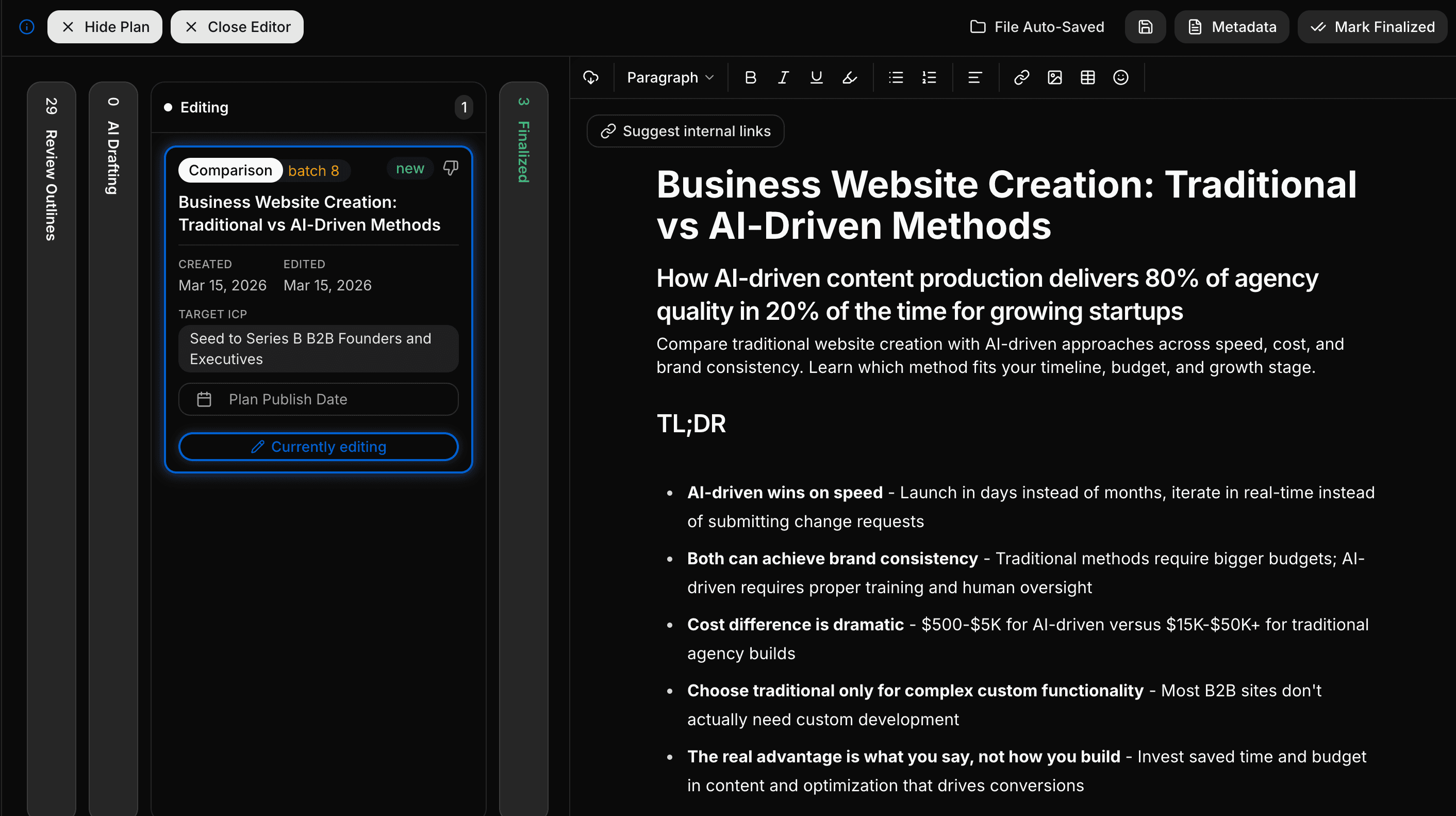
What it is: AI-assisted content creation that produces keyword-targeted first drafts structured for both SEO and GEO.

What happens for each approved topic:

  • Generates a 2,500+ word draft targeting the approved keyword

  • Structures with question-format H2 headings

  • Opens every section with a 40–60 word answer capsule

  • Sources and hyperlinks 15–20 statistics from authoritative sources

  • Maintains 120–180 word section structure for AI extractability

  • Generates a 5–7 question FAQ section with self-contained answers

  • Creates meta title (under 60 characters) and meta description (under 155 characters)

  • Suggests internal links to existing content in your library

Your checkpoint (30–45 minutes per post): Edit the draft. This is the most important human touchpoint. The AI handles the labor-intensive parts: research, structure, statistics, formatting. You add the value: your expertise, your voice, your first-person experience, and the specific perspective that makes this content uniquely yours.

What you skip: Starting from a blank page (2+ hours saved). Manual research and stat-sourcing (30–60 minutes saved). Structural formatting (15–20 minutes saved).

The output: An edited, founder-voiced draft moves to Phase 3 for scoring.

Phase 3: Content Scoring (Automated)

What it is: A dual scoring system that evaluates every piece against both SEO and GEO benchmarks before publishing.

The scoring breakdown:

SEO Score (55% of total):

  • Keyword placement (title, H1, first 100 words, headers, URL)

  • Meta title optimization (specific, under 60 chars, data hook)

  • Meta description optimization (payoff-first, under 155 chars, information gap)

  • Internal linking (5+ contextual links to existing content)

  • External linking (5+ authoritative sources)

  • Header structure (H1 → H2 → H3 logical hierarchy)

  • Readability and word count

GEO Score (45% of total):

  • Answer capsule quality (40–60 word self-contained openers per section)

  • Factual density (hyperlinked statistics per 150–200 words)

  • FAQ self-containment (each answer independently citable)

  • Extractable block count (passages that work without surrounding context)

  • Non-promotional tone (informational vs. salesy language)

  • Citation readiness (structured for AI passage extraction)

What happens:

  • Pieces scoring above threshold: cleared for publishing

  • Pieces scoring below threshold: flagged with specific elements that need improvement ("FAQ answer #3 is only 22 words — expand to 40–60 for citation readiness" or "Section 4 has no statistics — add at least 1 hyperlinked data point")

Your action (if flagged): Address the specific issues. Usually takes 5–10 minutes. The system tells you exactly what to fix, not just that something is wrong.

What you skip: Manually checking 15+ SEO elements per post. Running content through a separate optimization tool. Guessing whether your FAQ answers are "good enough" for AI citation. The scoring replaces the manual audit that most teams skip because it's tedious.

The output: A scored, optimized piece clears for Phase 4.

Phase 4: CMS Publishing (Automated)

What it is: Direct publishing from Averi to your CMS (WordPress, Webflow, or Framer) with all fields populated.

What happens:

  • Content formats for your CMS's rich text field (headers, bold, links, images, lists preserved)

  • Meta title and description populate in your CMS's SEO fields

  • URL slug generates from the title (cleaned for SEO)

  • Featured image assigns

  • Author and date fields populate

  • The CMS item publishes or saves as draft (based on your preference setting)

Publishing modes:

  • Auto-publish: Content clears scoring → publishes immediately

  • Draft: Content saves as a CMS draft → you do a 2-minute visual check → publish manually

  • Scheduled: Content queues for a specific date/time via the Calendar View

What you skip: Copy-pasting from Google Docs into your CMS (15–20 minutes per post). Manually formatting headers, links, and images. Re-entering meta tags. Fixing broken formatting from paste operations.

The output: A live blog post on your website, fully formatted, with schema markup ready to generate.
Phase 5: Analytics Integration (Automated + Weekly Review)

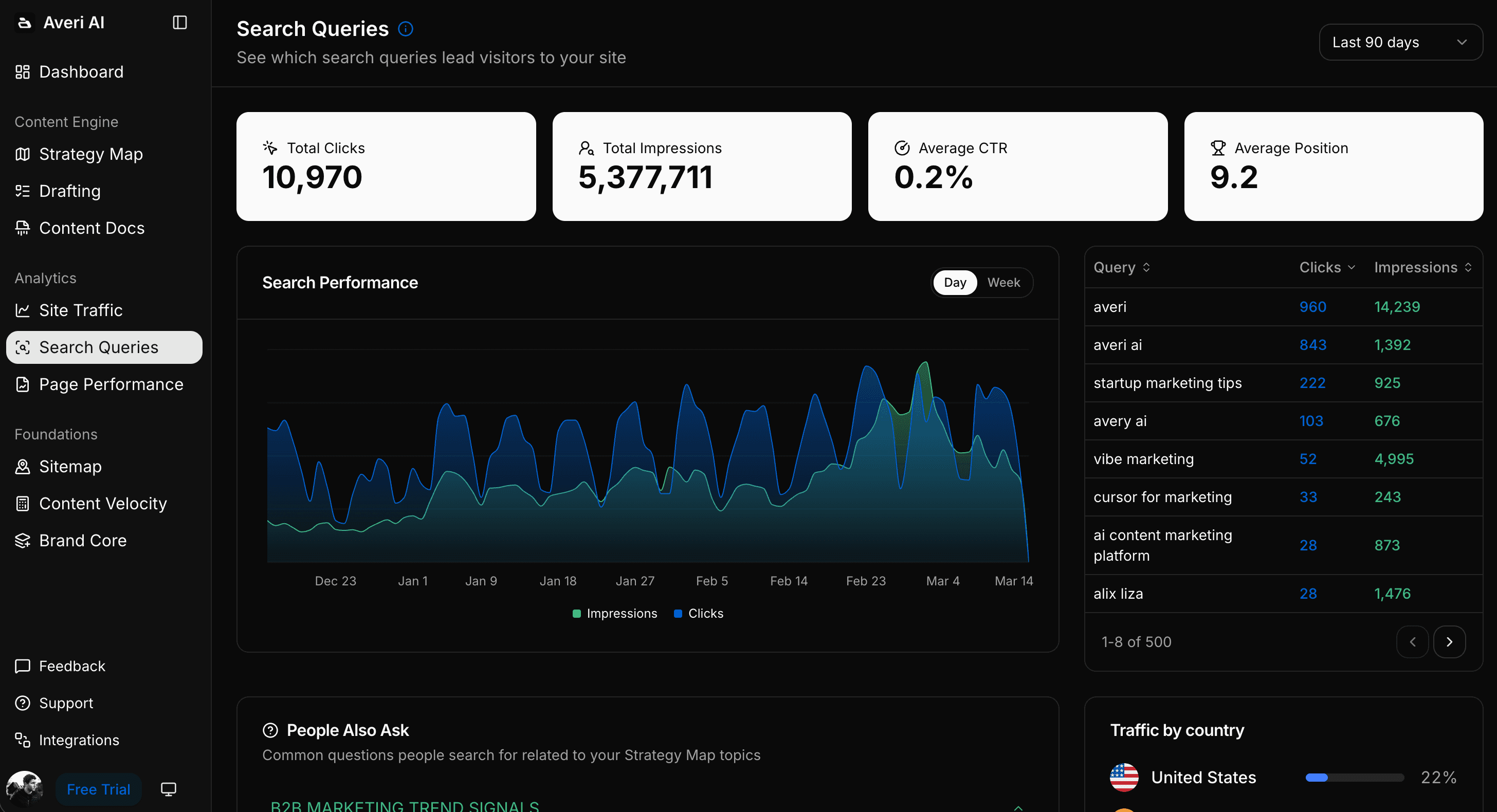
What it is: Performance tracking that connects Google Analytics and Google Search Console data to your content library, surfacing which content works and what needs attention.

What it tracks:

  • Google Search Console data: Impressions, clicks, CTR, and average position for each post's target keywords

  • Google Analytics data: Sessions, engagement rate, and conversions from organic traffic by page

  • Content performance trends: Which posts are gaining traction? Which are declining?

  • Refresh signals: Pages approaching the 90-day citation freshness window that need updated statistics and content

  • Topic cluster performance: Which clusters drive the strongest combined results?

What it surfaces:

  • Posts with growing impressions but low CTR → meta title/description needs improvement

  • Posts with declining traffic → content refresh needed (outdated stats, missing sections)

  • Posts with high engagement but zero conversions → CTA needs strengthening

  • Top-performing topics → signals to create more content in that cluster

Your weekly review (10 minutes): Check the dashboard. Note which posts are climbing and which need attention. Use the insights to inform next week's Phase 1 topic approvals.

The feedback loop: Analytics informs strategy. Posts that perform well in a topic cluster signal "publish more in this cluster." Posts with declining traffic get flagged for refresh, re-entering the Content Queue for updates. The system learns from its own output.

The Weekly Rhythm: 2 Hours Total

Day

Activity

Phase

Time

Monday

Approve 2 topics from Strategy Map

Phase 1

10 min

Monday

Edit first draft

Phase 2

40 min

Monday

Review score, fix any flags

Phase 3

5 min

Monday

Publish (or schedule)

Phase 4

2 min

Wednesday

Edit second draft

Phase 2

40 min

Wednesday

Review score + publish

Phase 3–4

7 min

Friday

Review analytics dashboard

Phase 5

10 min

Friday

Approve next week's topics

Phase 1

5 min

Total


~2 hrs

Two posts per week. Eight posts per month.

Every post SEO + GEO scored. Every post published directly to your CMS.

Every post tracked for performance.

All on 2 hours of founder time.

See how much you could save by using Averi

What the Engine Produces Over Time

Month 1: 8 published posts. Content indexed. First impressions in GSC.

Month 3: 24 posts. Topic clusters forming. Impressions growing. First page-1 rankings for long-tail keywords.

Month 6: 48 posts. Multiple complete topic clusters. Organic traffic measurable. First AI citations appearing. Organic traffic value: $1,000–$3,000/month equivalent.

Month 10: 80+ posts. 6,000% organic traffic growth trajectory. Content compounding across Google, ChatGPT, Perplexity, and AI Overviews. The engine runs.

This isn't aspirational. It's the timeline we ran ourselves, using the same system available at $99/month. The early months were flat. The compounding hit mid-timeline. The engine requires patience and consistency, not talent or budget.

Start a free 14-day trial. No credit card. The Brand Core takes 10 minutes. Your first Strategy Map generates immediately. First scored, published post by day 3.

Related Resources

FAQs

What is an AI content workflow engine?

An AI content workflow engine connects every phase of content production — strategy, creation, optimization, publishing, and analytics — into a single automated system. Unlike standalone AI writing tools that only generate drafts, an engine manages the full lifecycle: recommending topics from keyword data, producing structured drafts, scoring for SEO + GEO readiness, publishing directly to your CMS, and tracking performance post-publish. The output of each phase feeds the next without manual transfers between tools.

How much time does the 6-phase engine require?

Two hours per week for 2 published posts (8 per month). The time breaks into two human checkpoints: topic approval from the Strategy Map (5–10 minutes/week) and draft editing in the Content Queue (30–45 minutes per post). Scoring, publishing, and analytics are automated. Without the engine, the same output (2 optimized posts/week) requires 8–10 hours weekly across 4–5 disconnected tools.

What does the content scoring system evaluate?

Dual scoring at 55% SEO + 45% GEO. SEO factors: keyword placement, meta optimization, internal/external links, header structure, readability, word count. GEO factors: answer capsule quality (40–60 word self-contained openers), factual density (statistics per 150–200 words), FAQ self-containment, extractable blocks, non-promotional tone, citation readiness. Pieces below threshold get specific improvement flags — the system tells you exactly what to fix, not a vague low score.

Which CMS platforms does the engine publish to?

WordPress, Webflow, and Framer via direct API integration. All other CMS options via custom webhook. Content formats for each CMS's rich text field with headers, links, images, and meta tags preserved. No copy-paste formatting. Webflow integration details and Framer integration details are covered in dedicated setup guides.

How does the analytics feedback loop work?

Averi integrates with Google Analytics 4 and Google Search Console to track each post's performance: impressions, clicks, positions, engagement, and conversions. The system surfaces patterns: growing topics (signal to expand that cluster), declining posts (flagged for content refresh), high-impression/low-CTR pages (meta rewrite candidates). These insights feed back into the Strategy Map, informing which topics to prioritize next week. The loop means the content strategy improves from its own data over time.

What's the difference between this and just using ChatGPT?

ChatGPT generates text. It doesn't research keywords, recommend topics based on search data, score content for SEO + GEO, publish to your CMS, or track post-publish performance. Using ChatGPT for content marketing means you still need 3–4 other tools and the manual work of connecting them. The 6-phase engine replaces the full workflow: ChatGPT's writing capability is one ingredient. The engine is the complete recipe.


Continue Reading

The latest handpicked blog articles

Experience The AI Content Engine

Already have an account?

Join 30,000+ Founders, Marketers & Builders

Don't Feed the Algorithm

“Top 3 tech + AI newsletters in the country. Always sharp, always actionable.”

"Genuinely my favorite newsletter in tech. No fluff, no cheesy ads, just great content."

“Clear, practical, and on-point. Helps me keep up without drowning in noise.”

User-Generated Content & Authenticity in the Age of AI

Zach Chmael

Head of Marketing

5 minutes

In This Article

The exact 6-phase workflow behind Averi's content engine: Brand Core → Strategy → Creation → Scoring → Publishing → Analytics. Phase-by-phase breakdown.

Don’t Feed the Algorithm

The algorithm never sleeps, but you don’t have to feed it — Join our weekly newsletter for real insights on AI, human creativity & marketing execution.

TL;DR

⚙️ 6 phases: Brand Core (one-time, 10 min) → Strategy Map (automated, you approve topics) → Content Queue (AI drafts, you edit 30–45 min) → Content Scoring (55% SEO + 45% GEO, automated) → CMS Publishing (direct to WordPress/Webflow/Framer) → Analytics (GSC + GA4 integrated, weekly review)

👤 2 human checkpoints: Topic approval (5–10 min/week) and draft editing (30–45 min/post). Everything else is automated.

⏱️ Total founder time: 2 hours/week for 2 published, scored, optimized posts. 8 posts/month.

🔄 Feedback loop: Analytics → Strategy. Top-performing topics signal "publish more." Declining posts get flagged for refresh. The system improves from its own data.

📈 Output over time: 8 posts month 1 → 24 by month 3 → 48 by month 6 → 80+ by month 10. The compound curve is real. The early months are flat by design.

Start free with Averi. Brand Core in 10 minutes. First published post by day 3.

"We built Averi around the exact workflow we've used to scale our web traffic over 6000% in the last 6 months."

founder-image
founder-image
Your content should be working harder.

Averi's content engine builds Google entity authority, drives AI citations, and scales your visibility so you can get more customers.

AI Content Workflow Automation: How the 6-Phase Engine Works

Most AI content tools handle one phase.

A keyword tool does research.

A writing tool generates drafts.

An optimizer scores content.

A CMS publishes it.

You're the human glue connecting four tools that don't talk to each other.

A content engine is different. It connects every phase into a single workflow where the output of each step feeds directly into the next.

No copy-paste. No tab-switching. No manual formatting.

Strategy informs creation. Creation feeds scoring. Scoring triggers publishing. Publishing generates analytics. Analytics inform strategy. The loop closes.

This is how Averi's 6-phase content engine works.

Phase by phase, with the exact inputs, outputs, and the 2 hours of weekly founder time that keeps it running.

See what your Content ROI could be when running the 6-Phase Architecture

The 6-Phase Architecture


Each phase produces an output that the next phase consumes.

The Brand Core is the foundation. Analytics is the feedback loop.

Everything in between is automated with human checkpoints at two specific moments: topic approval and draft editing.

Phase 0: Brand Core (One-Time Setup, 10 Minutes)

What it is: The strategic foundation that every subsequent phase draws from. Your ICP, positioning, product capabilities, competitive differentiators, and brand voice.

What you input:

  • Who your customer is (title, company size, industry, pain points)

  • What your product does (capabilities, key features, pricing)

  • How you're different (vs. competitors, unique value proposition)

  • Your brand voice preferences

What it produces: A persistent context layer that informs every topic recommendation, every draft, and every optimization decision. The Brand Core is why the AI doesn't generate generic content. It generates content about your product, for your audience, in your voice.

Time investment: 10 minutes during initial onboarding. Update quarterly or when positioning changes.

Why this matters: AI writing tools without brand context produce generic output. You then spend 60+ minutes per post adding context that should have been there from the start. The Brand Core eliminates that rework by front-loading the context once.

Phase 1: Strategy Map (Automated → You Approve)

What it is: Automated topic research that generates keyword-targeted content recommendations based on your Brand Core, search opportunity data, and gaps in your existing content library.

What happens:

  • The system analyzes your Brand Core against keyword opportunity data

  • Identifies topics where your ICP is searching and competition is winnable

  • Maps topics to content clusters for topical authority building

  • Ranks recommendations by opportunity (search volume × achievable ranking potential)

  • Presents 10–20 topic recommendations with target keywords, estimated search volume, and content angles

Your checkpoint (5–10 minutes/week): Review the recommendations. Approve 2–4 topics for production this week. Reject any that don't align with your current priorities.

What you skip: Manual keyword research sessions (30–60 minutes saved). Spreadsheet-based topic planning. Gut-feel content decisions.

The output: Approved topics with target keywords flow directly into Phase 2.

Phase 2: Content Queue (Automated → You Edit)

What it is: AI-assisted content creation that produces keyword-targeted first drafts structured for both SEO and GEO.

What happens for each approved topic:

  • Generates a 2,500+ word draft targeting the approved keyword

  • Structures with question-format H2 headings

  • Opens every section with a 40–60 word answer capsule

  • Sources and hyperlinks 15–20 statistics from authoritative sources

  • Maintains 120–180 word section structure for AI extractability

  • Generates a 5–7 question FAQ section with self-contained answers

  • Creates meta title (under 60 characters) and meta description (under 155 characters)

  • Suggests internal links to existing content in your library

Your checkpoint (30–45 minutes per post): Edit the draft. This is the most important human touchpoint. The AI handles the labor-intensive parts: research, structure, statistics, formatting. You add the value: your expertise, your voice, your first-person experience, and the specific perspective that makes this content uniquely yours.

What you skip: Starting from a blank page (2+ hours saved). Manual research and stat-sourcing (30–60 minutes saved). Structural formatting (15–20 minutes saved).

The output: An edited, founder-voiced draft moves to Phase 3 for scoring.

Phase 3: Content Scoring (Automated)

What it is: A dual scoring system that evaluates every piece against both SEO and GEO benchmarks before publishing.

The scoring breakdown:

SEO Score (55% of total):

  • Keyword placement (title, H1, first 100 words, headers, URL)

  • Meta title optimization (specific, under 60 chars, data hook)

  • Meta description optimization (payoff-first, under 155 chars, information gap)

  • Internal linking (5+ contextual links to existing content)

  • External linking (5+ authoritative sources)

  • Header structure (H1 → H2 → H3 logical hierarchy)

  • Readability and word count

GEO Score (45% of total):

  • Answer capsule quality (40–60 word self-contained openers per section)

  • Factual density (hyperlinked statistics per 150–200 words)

  • FAQ self-containment (each answer independently citable)

  • Extractable block count (passages that work without surrounding context)

  • Non-promotional tone (informational vs. salesy language)

  • Citation readiness (structured for AI passage extraction)

What happens:

  • Pieces scoring above threshold: cleared for publishing

  • Pieces scoring below threshold: flagged with specific elements that need improvement ("FAQ answer #3 is only 22 words — expand to 40–60 for citation readiness" or "Section 4 has no statistics — add at least 1 hyperlinked data point")

Your action (if flagged): Address the specific issues. Usually takes 5–10 minutes. The system tells you exactly what to fix, not just that something is wrong.

What you skip: Manually checking 15+ SEO elements per post. Running content through a separate optimization tool. Guessing whether your FAQ answers are "good enough" for AI citation. The scoring replaces the manual audit that most teams skip because it's tedious.

The output: A scored, optimized piece clears for Phase 4.

Phase 4: CMS Publishing (Automated)

What it is: Direct publishing from Averi to your CMS (WordPress, Webflow, or Framer) with all fields populated.

What happens:

  • Content formats for your CMS's rich text field (headers, bold, links, images, lists preserved)

  • Meta title and description populate in your CMS's SEO fields

  • URL slug generates from the title (cleaned for SEO)

  • Featured image assigns

  • Author and date fields populate

  • The CMS item publishes or saves as draft (based on your preference setting)

Publishing modes:

  • Auto-publish: Content clears scoring → publishes immediately

  • Draft: Content saves as a CMS draft → you do a 2-minute visual check → publish manually

  • Scheduled: Content queues for a specific date/time via the Calendar View

What you skip: Copy-pasting from Google Docs into your CMS (15–20 minutes per post). Manually formatting headers, links, and images. Re-entering meta tags. Fixing broken formatting from paste operations.

The output: A live blog post on your website, fully formatted, with schema markup ready to generate.

Phase 5: Analytics Integration (Automated + Weekly Review)

What it is: Performance tracking that connects Google Analytics and Google Search Console data to your content library, surfacing which content works and what needs attention.

What it tracks:

  • Google Search Console data: Impressions, clicks, CTR, and average position for each post's target keywords

  • Google Analytics data: Sessions, engagement rate, and conversions from organic traffic by page

  • Content performance trends: Which posts are gaining traction? Which are declining?

  • Refresh signals: Pages approaching the 90-day citation freshness window that need updated statistics and content

  • Topic cluster performance: Which clusters drive the strongest combined results?

What it surfaces:

  • Posts with growing impressions but low CTR → meta title/description needs improvement

  • Posts with declining traffic → content refresh needed (outdated stats, missing sections)

  • Posts with high engagement but zero conversions → CTA needs strengthening

  • Top-performing topics → signals to create more content in that cluster

Your weekly review (10 minutes): Check the dashboard. Note which posts are climbing and which need attention. Use the insights to inform next week's Phase 1 topic approvals.

The feedback loop: Analytics informs strategy. Posts that perform well in a topic cluster signal "publish more in this cluster." Posts with declining traffic get flagged for refresh, re-entering the Content Queue for updates. The system learns from its own output.

The Weekly Rhythm: 2 Hours Total

Day

Activity

Phase

Time

Monday

Approve 2 topics from Strategy Map

Phase 1

10 min

Monday

Edit first draft

Phase 2

40 min

Monday

Review score, fix any flags

Phase 3

5 min

Monday

Publish (or schedule)

Phase 4

2 min

Wednesday

Edit second draft

Phase 2

40 min

Wednesday

Review score + publish

Phase 3–4

7 min

Friday

Review analytics dashboard

Phase 5

10 min

Friday

Approve next week's topics

Phase 1

5 min

Total


~2 hrs

Two posts per week. Eight posts per month.

Every post SEO + GEO scored. Every post published directly to your CMS.

Every post tracked for performance.

All on 2 hours of founder time.

See how much you could save by using Averi

What the Engine Produces Over Time

Month 1: 8 published posts. Content indexed. First impressions in GSC.

Month 3: 24 posts. Topic clusters forming. Impressions growing. First page-1 rankings for long-tail keywords.

Month 6: 48 posts. Multiple complete topic clusters. Organic traffic measurable. First AI citations appearing. Organic traffic value: $1,000–$3,000/month equivalent.

Month 10: 80+ posts. 6,000% organic traffic growth trajectory. Content compounding across Google, ChatGPT, Perplexity, and AI Overviews. The engine runs.

This isn't aspirational. It's the timeline we ran ourselves, using the same system available at $99/month. The early months were flat. The compounding hit mid-timeline. The engine requires patience and consistency, not talent or budget.

Start a free 14-day trial. No credit card. The Brand Core takes 10 minutes. Your first Strategy Map generates immediately. First scored, published post by day 3.

Related Resources

Continue Reading

The latest handpicked blog articles

Join 30,000+ Founders, Marketers & Builders

Don't Feed the Algorithm

“Top 3 tech + AI newsletters in the country. Always sharp, always actionable.”

"Genuinely my favorite newsletter in tech. No fluff, no cheesy ads, just great content."

“Clear, practical, and on-point. Helps me keep up without drowning in noise.”

User-Generated Content & Authenticity in the Age of AI

Zach Chmael

Head of Marketing

5 minutes

In This Article

The exact 6-phase workflow behind Averi's content engine: Brand Core → Strategy → Creation → Scoring → Publishing → Analytics. Phase-by-phase breakdown.

Don’t Feed the Algorithm

The algorithm never sleeps, but you don’t have to feed it — Join our weekly newsletter for real insights on AI, human creativity & marketing execution.

Trusted by 1,000+ teams

★★★★★ 4.9/5

Startups use Averi to build
content engines that rank.

AI Content Workflow Automation: How the 6-Phase Engine Works

Most AI content tools handle one phase.

A keyword tool does research.

A writing tool generates drafts.

An optimizer scores content.

A CMS publishes it.

You're the human glue connecting four tools that don't talk to each other.

A content engine is different. It connects every phase into a single workflow where the output of each step feeds directly into the next.

No copy-paste. No tab-switching. No manual formatting.

Strategy informs creation. Creation feeds scoring. Scoring triggers publishing. Publishing generates analytics. Analytics inform strategy. The loop closes.

This is how Averi's 6-phase content engine works.

Phase by phase, with the exact inputs, outputs, and the 2 hours of weekly founder time that keeps it running.

See what your Content ROI could be when running the 6-Phase Architecture

The 6-Phase Architecture


Each phase produces an output that the next phase consumes.

The Brand Core is the foundation. Analytics is the feedback loop.

Everything in between is automated with human checkpoints at two specific moments: topic approval and draft editing.

Phase 0: Brand Core (One-Time Setup, 10 Minutes)

What it is: The strategic foundation that every subsequent phase draws from. Your ICP, positioning, product capabilities, competitive differentiators, and brand voice.

What you input:

  • Who your customer is (title, company size, industry, pain points)

  • What your product does (capabilities, key features, pricing)

  • How you're different (vs. competitors, unique value proposition)

  • Your brand voice preferences

What it produces: A persistent context layer that informs every topic recommendation, every draft, and every optimization decision. The Brand Core is why the AI doesn't generate generic content. It generates content about your product, for your audience, in your voice.

Time investment: 10 minutes during initial onboarding. Update quarterly or when positioning changes.

Why this matters: AI writing tools without brand context produce generic output. You then spend 60+ minutes per post adding context that should have been there from the start. The Brand Core eliminates that rework by front-loading the context once.

Phase 1: Strategy Map (Automated → You Approve)

What it is: Automated topic research that generates keyword-targeted content recommendations based on your Brand Core, search opportunity data, and gaps in your existing content library.

What happens:

  • The system analyzes your Brand Core against keyword opportunity data

  • Identifies topics where your ICP is searching and competition is winnable

  • Maps topics to content clusters for topical authority building

  • Ranks recommendations by opportunity (search volume × achievable ranking potential)

  • Presents 10–20 topic recommendations with target keywords, estimated search volume, and content angles

Your checkpoint (5–10 minutes/week): Review the recommendations. Approve 2–4 topics for production this week. Reject any that don't align with your current priorities.

What you skip: Manual keyword research sessions (30–60 minutes saved). Spreadsheet-based topic planning. Gut-feel content decisions.

The output: Approved topics with target keywords flow directly into Phase 2.

Phase 2: Content Queue (Automated → You Edit)

What it is: AI-assisted content creation that produces keyword-targeted first drafts structured for both SEO and GEO.

What happens for each approved topic:

  • Generates a 2,500+ word draft targeting the approved keyword

  • Structures with question-format H2 headings

  • Opens every section with a 40–60 word answer capsule

  • Sources and hyperlinks 15–20 statistics from authoritative sources

  • Maintains 120–180 word section structure for AI extractability

  • Generates a 5–7 question FAQ section with self-contained answers

  • Creates meta title (under 60 characters) and meta description (under 155 characters)

  • Suggests internal links to existing content in your library

Your checkpoint (30–45 minutes per post): Edit the draft. This is the most important human touchpoint. The AI handles the labor-intensive parts: research, structure, statistics, formatting. You add the value: your expertise, your voice, your first-person experience, and the specific perspective that makes this content uniquely yours.

What you skip: Starting from a blank page (2+ hours saved). Manual research and stat-sourcing (30–60 minutes saved). Structural formatting (15–20 minutes saved).

The output: An edited, founder-voiced draft moves to Phase 3 for scoring.

Phase 3: Content Scoring (Automated)

What it is: A dual scoring system that evaluates every piece against both SEO and GEO benchmarks before publishing.

The scoring breakdown:

SEO Score (55% of total):

  • Keyword placement (title, H1, first 100 words, headers, URL)

  • Meta title optimization (specific, under 60 chars, data hook)

  • Meta description optimization (payoff-first, under 155 chars, information gap)

  • Internal linking (5+ contextual links to existing content)

  • External linking (5+ authoritative sources)

  • Header structure (H1 → H2 → H3 logical hierarchy)

  • Readability and word count

GEO Score (45% of total):

  • Answer capsule quality (40–60 word self-contained openers per section)

  • Factual density (hyperlinked statistics per 150–200 words)

  • FAQ self-containment (each answer independently citable)

  • Extractable block count (passages that work without surrounding context)

  • Non-promotional tone (informational vs. salesy language)

  • Citation readiness (structured for AI passage extraction)

What happens:

  • Pieces scoring above threshold: cleared for publishing

  • Pieces scoring below threshold: flagged with specific elements that need improvement ("FAQ answer #3 is only 22 words — expand to 40–60 for citation readiness" or "Section 4 has no statistics — add at least 1 hyperlinked data point")

Your action (if flagged): Address the specific issues. Usually takes 5–10 minutes. The system tells you exactly what to fix, not just that something is wrong.

What you skip: Manually checking 15+ SEO elements per post. Running content through a separate optimization tool. Guessing whether your FAQ answers are "good enough" for AI citation. The scoring replaces the manual audit that most teams skip because it's tedious.

The output: A scored, optimized piece clears for Phase 4.

Phase 4: CMS Publishing (Automated)

What it is: Direct publishing from Averi to your CMS (WordPress, Webflow, or Framer) with all fields populated.

What happens:

  • Content formats for your CMS's rich text field (headers, bold, links, images, lists preserved)

  • Meta title and description populate in your CMS's SEO fields

  • URL slug generates from the title (cleaned for SEO)

  • Featured image assigns

  • Author and date fields populate

  • The CMS item publishes or saves as draft (based on your preference setting)

Publishing modes:

  • Auto-publish: Content clears scoring → publishes immediately

  • Draft: Content saves as a CMS draft → you do a 2-minute visual check → publish manually

  • Scheduled: Content queues for a specific date/time via the Calendar View

What you skip: Copy-pasting from Google Docs into your CMS (15–20 minutes per post). Manually formatting headers, links, and images. Re-entering meta tags. Fixing broken formatting from paste operations.

The output: A live blog post on your website, fully formatted, with schema markup ready to generate.

Phase 5: Analytics Integration (Automated + Weekly Review)

What it is: Performance tracking that connects Google Analytics and Google Search Console data to your content library, surfacing which content works and what needs attention.

What it tracks:

  • Google Search Console data: Impressions, clicks, CTR, and average position for each post's target keywords

  • Google Analytics data: Sessions, engagement rate, and conversions from organic traffic by page

  • Content performance trends: Which posts are gaining traction? Which are declining?

  • Refresh signals: Pages approaching the 90-day citation freshness window that need updated statistics and content

  • Topic cluster performance: Which clusters drive the strongest combined results?

What it surfaces:

  • Posts with growing impressions but low CTR → meta title/description needs improvement

  • Posts with declining traffic → content refresh needed (outdated stats, missing sections)

  • Posts with high engagement but zero conversions → CTA needs strengthening

  • Top-performing topics → signals to create more content in that cluster

Your weekly review (10 minutes): Check the dashboard. Note which posts are climbing and which need attention. Use the insights to inform next week's Phase 1 topic approvals.

The feedback loop: Analytics informs strategy. Posts that perform well in a topic cluster signal "publish more in this cluster." Posts with declining traffic get flagged for refresh, re-entering the Content Queue for updates. The system learns from its own output.

The Weekly Rhythm: 2 Hours Total

Day

Activity

Phase

Time

Monday

Approve 2 topics from Strategy Map

Phase 1

10 min

Monday

Edit first draft

Phase 2

40 min

Monday

Review score, fix any flags

Phase 3

5 min

Monday

Publish (or schedule)

Phase 4

2 min

Wednesday

Edit second draft

Phase 2

40 min

Wednesday

Review score + publish

Phase 3–4

7 min

Friday

Review analytics dashboard

Phase 5

10 min

Friday

Approve next week's topics

Phase 1

5 min

Total


~2 hrs

Two posts per week. Eight posts per month.

Every post SEO + GEO scored. Every post published directly to your CMS.

Every post tracked for performance.

All on 2 hours of founder time.

See how much you could save by using Averi

What the Engine Produces Over Time

Month 1: 8 published posts. Content indexed. First impressions in GSC.

Month 3: 24 posts. Topic clusters forming. Impressions growing. First page-1 rankings for long-tail keywords.

Month 6: 48 posts. Multiple complete topic clusters. Organic traffic measurable. First AI citations appearing. Organic traffic value: $1,000–$3,000/month equivalent.

Month 10: 80+ posts. 6,000% organic traffic growth trajectory. Content compounding across Google, ChatGPT, Perplexity, and AI Overviews. The engine runs.

This isn't aspirational. It's the timeline we ran ourselves, using the same system available at $99/month. The early months were flat. The compounding hit mid-timeline. The engine requires patience and consistency, not talent or budget.

Start a free 14-day trial. No credit card. The Brand Core takes 10 minutes. Your first Strategy Map generates immediately. First scored, published post by day 3.

Related Resources

"We built Averi around the exact workflow we've used to scale our web traffic over 6000% in the last 6 months."

founder-image
founder-image
Your content should be working harder.

Averi's content engine builds Google entity authority, drives AI citations, and scales your visibility so you can get more customers.

FAQs

ChatGPT generates text. It doesn't research keywords, recommend topics based on search data, score content for SEO + GEO, publish to your CMS, or track post-publish performance. Using ChatGPT for content marketing means you still need 3–4 other tools and the manual work of connecting them. The 6-phase engine replaces the full workflow: ChatGPT's writing capability is one ingredient. The engine is the complete recipe.

What's the difference between this and just using ChatGPT?

Averi integrates with Google Analytics 4 and Google Search Console to track each post's performance: impressions, clicks, positions, engagement, and conversions. The system surfaces patterns: growing topics (signal to expand that cluster), declining posts (flagged for content refresh), high-impression/low-CTR pages (meta rewrite candidates). These insights feed back into the Strategy Map, informing which topics to prioritize next week. The loop means the content strategy improves from its own data over time.

How does the analytics feedback loop work?

WordPress, Webflow, and Framer via direct API integration. All other CMS options via custom webhook. Content formats for each CMS's rich text field with headers, links, images, and meta tags preserved. No copy-paste formatting. Webflow integration details and Framer integration details are covered in dedicated setup guides.

Which CMS platforms does the engine publish to?

Dual scoring at 55% SEO + 45% GEO. SEO factors: keyword placement, meta optimization, internal/external links, header structure, readability, word count. GEO factors: answer capsule quality (40–60 word self-contained openers), factual density (statistics per 150–200 words), FAQ self-containment, extractable blocks, non-promotional tone, citation readiness. Pieces below threshold get specific improvement flags — the system tells you exactly what to fix, not a vague low score.

What does the content scoring system evaluate?

Two hours per week for 2 published posts (8 per month). The time breaks into two human checkpoints: topic approval from the Strategy Map (5–10 minutes/week) and draft editing in the Content Queue (30–45 minutes per post). Scoring, publishing, and analytics are automated. Without the engine, the same output (2 optimized posts/week) requires 8–10 hours weekly across 4–5 disconnected tools.

How much time does the 6-phase engine require?

An AI content workflow engine connects every phase of content production — strategy, creation, optimization, publishing, and analytics — into a single automated system. Unlike standalone AI writing tools that only generate drafts, an engine manages the full lifecycle: recommending topics from keyword data, producing structured drafts, scoring for SEO + GEO readiness, publishing directly to your CMS, and tracking performance post-publish. The output of each phase feeds the next without manual transfers between tools.

What is an AI content workflow engine?

FAQs

How long does it take to see SEO results for B2B SaaS?

Expect 7 months to break-even on average, with meaningful traffic improvements typically appearing within 3-6 months. Link building results appear within 1-6 months. The key is consistency—companies that stop and start lose ground to those who execute continuously.

Is AI-generated content actually good for SEO?

62% of marketers report higher SERP rankings for AI-generated content—but only when properly edited and enhanced with human expertise. Pure AI content without human refinement often lacks the originality and depth that both readers and algorithms prefer.

Is AI-generated content actually good for SEO?

62% of marketers report higher SERP rankings for AI-generated content—but only when properly edited and enhanced with human expertise. Pure AI content without human refinement often lacks the originality and depth that both readers and algorithms prefer.

Is AI-generated content actually good for SEO?

62% of marketers report higher SERP rankings for AI-generated content—but only when properly edited and enhanced with human expertise. Pure AI content without human refinement often lacks the originality and depth that both readers and algorithms prefer.

Is AI-generated content actually good for SEO?

62% of marketers report higher SERP rankings for AI-generated content—but only when properly edited and enhanced with human expertise. Pure AI content without human refinement often lacks the originality and depth that both readers and algorithms prefer.

Is AI-generated content actually good for SEO?

62% of marketers report higher SERP rankings for AI-generated content—but only when properly edited and enhanced with human expertise. Pure AI content without human refinement often lacks the originality and depth that both readers and algorithms prefer.

Is AI-generated content actually good for SEO?

62% of marketers report higher SERP rankings for AI-generated content—but only when properly edited and enhanced with human expertise. Pure AI content without human refinement often lacks the originality and depth that both readers and algorithms prefer.

Is AI-generated content actually good for SEO?

62% of marketers report higher SERP rankings for AI-generated content—but only when properly edited and enhanced with human expertise. Pure AI content without human refinement often lacks the originality and depth that both readers and algorithms prefer.

TL;DR

⚙️ 6 phases: Brand Core (one-time, 10 min) → Strategy Map (automated, you approve topics) → Content Queue (AI drafts, you edit 30–45 min) → Content Scoring (55% SEO + 45% GEO, automated) → CMS Publishing (direct to WordPress/Webflow/Framer) → Analytics (GSC + GA4 integrated, weekly review)

👤 2 human checkpoints: Topic approval (5–10 min/week) and draft editing (30–45 min/post). Everything else is automated.

⏱️ Total founder time: 2 hours/week for 2 published, scored, optimized posts. 8 posts/month.

🔄 Feedback loop: Analytics → Strategy. Top-performing topics signal "publish more." Declining posts get flagged for refresh. The system improves from its own data.

📈 Output over time: 8 posts month 1 → 24 by month 3 → 48 by month 6 → 80+ by month 10. The compound curve is real. The early months are flat by design.

Start free with Averi. Brand Core in 10 minutes. First published post by day 3.

Continue Reading

The latest handpicked blog articles

Join 30,000+ Founders, Marketers & Builders

Don't Feed the Algorithm

“Top 3 tech + AI newsletters in the country. Always sharp, always actionable.”

"Genuinely my favorite newsletter in tech. No fluff, no cheesy ads, just great content."

“Clear, practical, and on-point. Helps me keep up without drowning in noise.”

How strong is your content engine? Find out in 30 seconds.

Maybe later