Seed-Stage Content Marketing: Zero to Engine in 90 Days
Zach Chmael
Head of Marketing
8 minutes

In This Article
This is the playbook for content marketing when you're pre-Series A, pre-marketing hire, and pre-"we have a content strategy." It's the system we built at Averi before we had any of those things either.
Updated
Trusted by 1,000+ teams
Startups use Averi to build
content engines that rank.
TL;DR
🌱 Content marketing at seed stage isn't a luxury. 29% of startups fail due to poor marketing. The compounding curve rewards starting early, not starting big.
💰 Real budget tiers: $0/mo (founder time only, slow compounding), $1K/mo (AI content engine + hosting, sweet spot), $3K/mo (engine + link building + tools), $5K/mo (engine + fractional strategist + distribution)
📝 First 10 posts: 3 BOFU comparison pieces (highest conversion), 3 problem-aware educational posts (build authority), 4 thought leadership pieces (brand + backlinks). Organized into 2–3 topic clusters.
⏱️ Founder time: ~2 hours/week. Review topics, edit AI-assisted drafts, publish. The AI handles research, structure, optimization. You add voice and judgment.
📊 Measure leading indicators first: indexed pages, impression growth, position trajectory. Lagging indicators come at months 5–12: organic clicks, conversions, cost per organic lead.
📈 90-day plan: 20–24 published posts across 2–3 topic clusters. Email capture running. Search Console data accumulating. Content engine operating on 2 hrs/week.
🔧 Start free with Averi. 14-day trial, no credit card. Content strategy generates in one afternoon. First post published by midweek.

Zach Chmael
CMO, Averi
"We built Averi around the exact workflow we've used to scale our web traffic over 6000% in the last 6 months."
Your content should be working harder.
Averi's content engine builds Google entity authority, drives AI citations, and scales your visibility so you can get more customers.
The Seed-Stage Content Marketing Playbook: From Zero to Content Engine
Every piece of content marketing advice for startups is written for the wrong startup.
It's written for the Series A company with a $25K/month marketing budget, a full-time content hire, and enough runway to wait 12 months for SEO to compound.
It assumes you have a marketing team. It assumes you have a content strategy. It assumes you have time.
At seed stage, you have none of those things.
You have a product that works (or almost works), a founding team of 2–5 people, $500K–$3M in funding, and a to-do list that makes content marketing feel like a luxury you can't justify.
It's not a luxury.
Poor marketing is the second most common reason startups fail, at 29%. Startups with active blogs generate 67% more leads than those without.
SEO delivers 748% ROI for B2B SaaS companies over a three-year horizon.
The math favors content marketing at every stage. The execution is where seed-stage founders stall.
This is the playbook for content marketing when you're pre-Series A, pre-marketing hire, and pre-"we have a content strategy."
It's the system we built at Averi before we had any of those things either.
(Not sure content marketing is right for your startup right now? Run through the 7-question decision framework first.)
Why Content Marketing Matters at Seed Stage (Not Just for Series A)
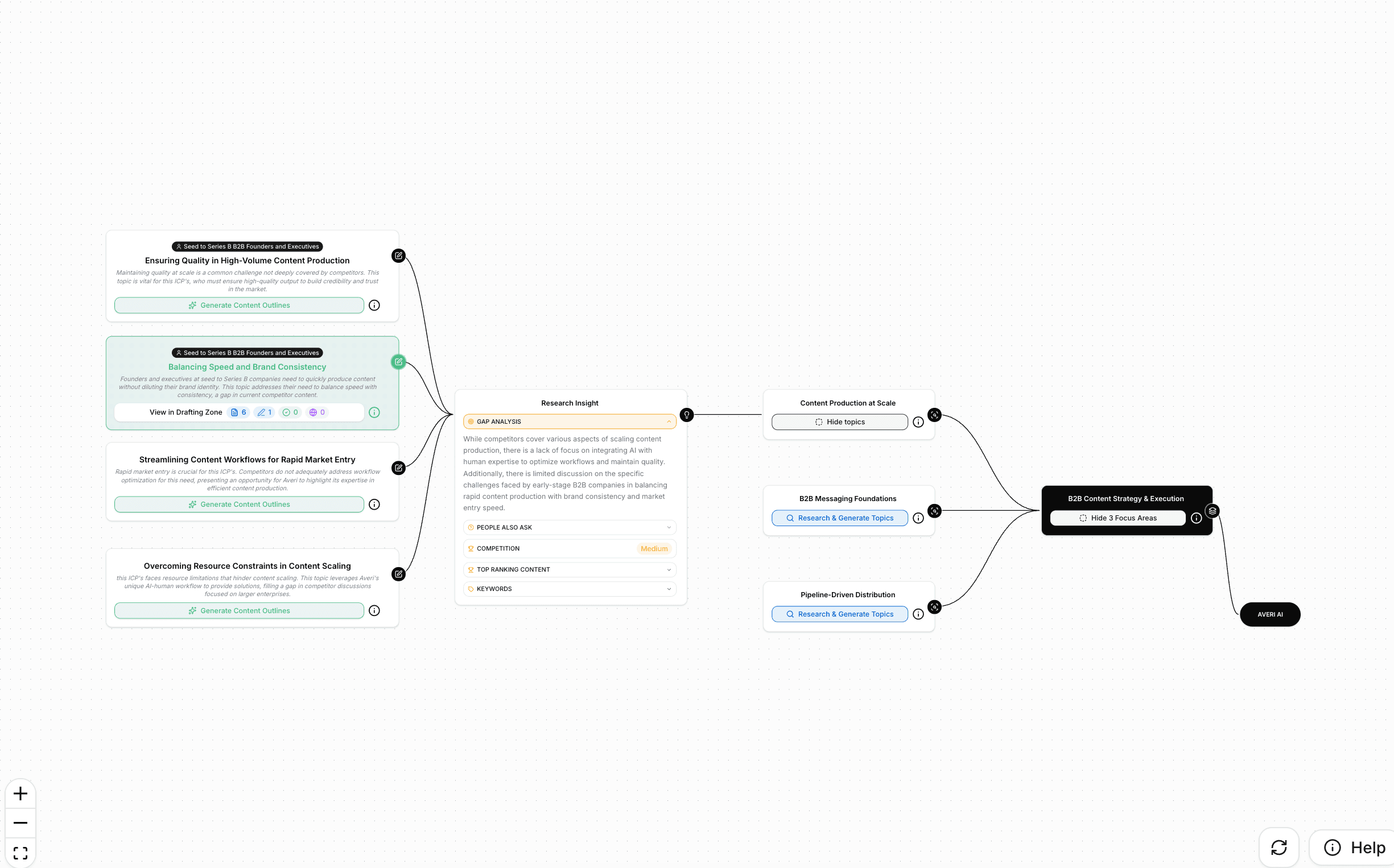
The conventional wisdom says wait. Build the product first. Hire a marketing person. Start content marketing when you have budget and bandwidth.
That advice costs you 6–12 months of compounding.
Content Marketing Compounds. Paid Ads Don't.
Content marketing costs 62% less than traditional marketing while generating 3x the leads. But the real advantage isn't cost. It's the curve shape.
Paid ads produce traffic the day you turn them on. They stop producing traffic the day you turn them off.
The ROI is linear: $1 in, some fraction of a dollar out, every month, forever.
Content marketing produces almost nothing for the first 3–4 months. Then the curve bends.
The posts you published in month 1 start ranking.
The authority your domain built over months 1–3 helps month-4 content rank faster.
By month 8–10, the system produces more traffic than you could buy with ads at the same budget.
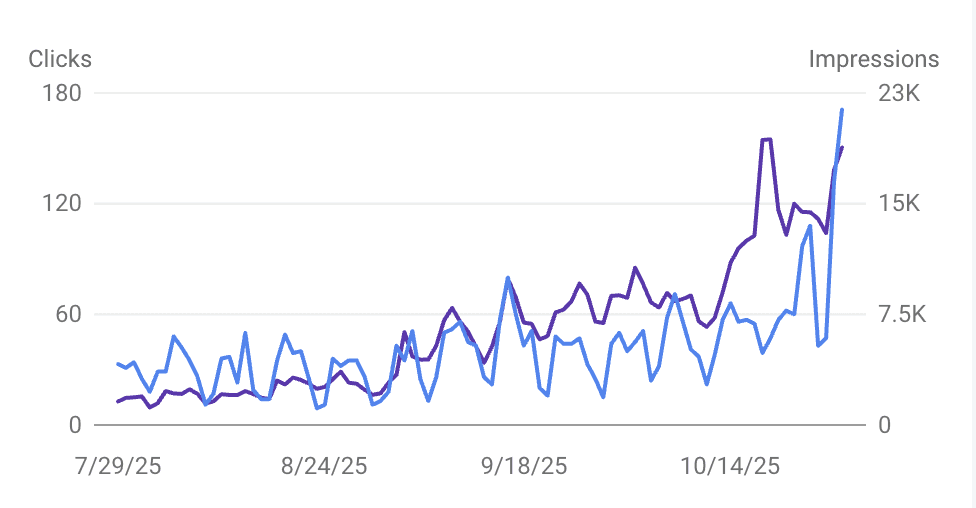
Averi grew organic traffic 6,000% in 10 months.
The first 4 months were flat.
The compounding happened because we started early, not because we started big.
Seed Stage Is the Cheapest Time to Build a Content Library
Domain authority takes time to build. Topic authority takes multiple pieces to establish. Backlinks accumulate slowly.
All of these are inputs that take months regardless of budget.
Starting at seed means those months are running in the background while you're doing everything else.
By the time you hit Series A, you'll either have:
6–12 months of content compounding, rankings building, and organic traffic growing, or
Nothing, and you'll spend Series A dollars building what you could have built with seed-stage time
Content marketing is the only channel that simultaneously validates your messaging (what resonates?), builds an organic acquisition channel (what keywords convert?), and creates investor-ready proof of traction (growing traffic, growing leads).
The Informational Footprint Argument
Every startup builds a product. Not every startup builds an informational footprint, the totality of your presence across all discovery surfaces.
At seed stage, your informational footprint is close to zero.
Potential customers searching for the problem you solve don't find you.
AI platforms building recommendations for your category don't cite you.
Investors researching your space don't see your name in the results.
Content marketing is what builds that footprint.
Organic search drives 53% of all website traffic. AI-cited content converts visitors at rates dramatically higher than traditional organic.
The footprint you build at seed stage is the foundation everything else compounds on.

The Seed-Stage Content Marketing Framework
Seed-stage content marketing operates under three constraints that change everything about how you execute:
Constraint 1: No dedicated marketing person. Content is produced by founders, or it's produced by AI tools that founders review. There is no one whose full-time job is content.
Constraint 2: Minimal budget. Seed startups should allocate 10–20% of funding to marketing, but that includes everything: website, branding, events, and content. The actual content-specific budget is typically $0–$5K/month.
Constraint 3: No existing authority. New domain. No backlinks. No ranked content. No brand awareness. You're starting from zero on every signal search engines and AI platforms use to evaluate credibility.
These constraints don't make content marketing impossible. They make it different.
The framework has to account for all three.
Goals at Seed Stage
Forget "drive 100K monthly visitors." That's a Series B goal.
Seed-stage content marketing has three realistic goals:
1. Build indexed content that starts accumulating authority. Every piece you publish adds to your domain's topical footprint. Google needs content to understand what your site is about. The goal is 15–25 pieces in the first 90 days, covering your core topic clusters.
2. Validate messaging through search data. Which topics drive impressions? Which drive clicks? Which drive trial signups? Search Console data is the fastest feedback loop for understanding what language your market responds to.
3. Create an asset that appreciates over time. Unlike ads, events, or outbound sales, content marketing builds an asset. Each piece is a permanent addition to your information layer. The content you publish at seed stage is the content that ranks, earns citations, and drives traffic for years.
Realistic Timelines
Month 1–2: Publish 8–12 articles. Mostly informational content targeting long-tail keywords your ICP searches. Google indexes and begins crawling. No meaningful traffic yet.
Month 3–4: Early impressions showing in Search Console. Positions 15–50 on target keywords. A trickle of organic visitors. The curve is still flat.
Month 5–6: Some posts climbing to positions 5–15. First page-1 rankings for long-tail terms. Organic traffic starting to register in analytics. 100–500 visits/month from search.
Month 7–9: Compounding visible. Topic clusters building mutual authority. Multiple page-1 rankings. Organic traffic: 500–2,000 visits/month. First organic-source trial signups.
Month 10–12: The content engine is running. Organic traffic grows even during weeks you don't publish. Compound blog posts generate 38% of all blog traffic from just 10% of total posts. Your earliest hits are now producing consistent, growing traffic.
These timelines assume consistent weekly publishing.
Publish less frequently and the timelines stretch. Publish more and they compress.
But the shape is the same for everyone: flat start, accelerating middle, compounding finish.

How Much Should a Seed-Stage Startup Spend on Content Marketing?
Real numbers. No percentages-of-revenue abstractions. For the full breakdown with tool stacks, ROI math, and upgrade paths, see the complete budget guide.
The $0/Month Plan
You have no marketing budget. Everything comes from founder time and free tools. For the complete $0 playbook with tool-by-tool guides and an 8-week launch plan, see how to run a content engine for $0.
What you get:
ChatGPT or Claude for drafting (free tiers or $20/month if you count it)
Google Search Console + Google Analytics (free)
Your existing website/blog as the publishing platform
Your own expertise as the research source
What you produce: 2–3 blog posts per month written by the founder. Basic keyword targeting using free tools (Google Keyword Planner, AnswerThePublic). No CMS integration. No SEO optimization beyond basics. No AI citation optimization.
Time cost: 8–12 hours/month for content production. Plus 2–3 hours/month for keyword research and analytics.
Realistic outcome at 6 months: 15–18 published posts. Some indexing. Limited rankings. The content exists but it's not optimized for competitive queries and the production quality is inconsistent. Better than nothing, but barely compounding.
Best for: Pre-funding founders validating whether content resonates with their audience before investing money.
The $1K/Month Plan
You've allocated a small content budget. Enough for tools, not enough for people.
What you get:
AI content engine like Averi ($99/month) for strategy, drafting, optimization, and publishing
Blog hosting on Webflow, Framer, or WordPress ($15–$39/month)
Google Search Console + Google Analytics (free)
Remaining budget for one-off needs (design, guest posts, etc.)
What you produce: 4–6 blog posts per month. Keyword-targeted, SEO + GEO optimized, published directly to your CMS. Content strategy generated during onboarding. Topics come from data, not guesses.
Time cost: ~2 hours/week. Reviewing topics, editing AI-assisted drafts, approving publications.
Realistic outcome at 6 months: 24–36 published posts across 3–4 topic clusters. Multiple page-1 rankings. Organic traffic growing. AI citation opportunities building. A real content engine.
Best for: Most seed-stage startups. This is the sweet spot where cost, time, and output intersect.
The $3K/Month Plan
You're investing in content as a primary acquisition channel.
What you get:
Everything in the $1K plan
Higher publishing velocity (6–10 posts/month)
Budget for link-building outreach or guest posting ($1K–$1.5K/month)
Tools for competitive analysis (Ahrefs or SEMrush at $99–$199/month)
Optional: freelance editor for voice refinement ($500–$1K/month)
What you produce: 6–10 SEO + GEO optimized posts per month. Active link-building program. Competitive gap analysis informing topic selection. Professional editing layer.
Realistic outcome at 6 months: 36–60 published posts. Strong topic cluster coverage. Accelerated domain authority from link building. Organic traffic: 2,000–8,000 visits/month. Meaningful conversion pipeline from content.
Best for: Startups where content marketing is the primary go-to-market channel and founder time is the most constrained resource.
The $5K/Month Plan
You're treating content marketing as your growth engine before you have a marketing hire.
What you get:
Everything in the $3K plan
Fractional content strategist or marketing advisor ($1.5K–$2K/month)
Dedicated design resource for content assets ($500–$1K/month)
Distribution budget: newsletter sponsorships, paid amplification of top-performing posts
What you produce: 8–12 posts/month with professional strategy oversight. Multi-format content (written + visual). Distribution beyond organic search. Brand-building alongside acquisition.
Realistic outcome at 6 months: 48–72 published posts. Multiple ranking topic clusters. Organic + distributed traffic: 5,000–15,000 visits/month. Content pipeline that impresses Series A investors.
Best for: Well-funded seed startups ($2M+) where content marketing is meant to be the centerpiece of the investor narrative for Series A.
The jump from $0 to $1K is the most impactful.
Going from no system to a system produces 10x the output with 5x less founder time.
Every dollar above $1K adds velocity but the foundational shift happens at the first thousand.
What to Create First: The Minimum Viable Content Strategy
You don't need 50 articles. You need the right 10.
The First 10 Posts (In Order)
Posts 1–3: Bottom-of-funnel comparison and alternative content.
"[Your category] for [your ICP]" — e.g., "AI content tools for B2B SaaS startups" "[Competitor A] vs. [Competitor B] vs. [Your product]" "Best [category] tools in 2026"
These target people who are already looking for a solution. The traffic is lower but the conversion intent is the highest of any content you'll create. Publish these first because they start generating qualified leads earliest.
Posts 4–6: Problem-aware educational content.
"How to [solve the problem your product solves] in 2026" "[ICP]'s guide to [the broader category your product sits in]" "Why [the old way of doing X] doesn't work anymore"
These target people who know they have a problem but haven't started evaluating solutions. The traffic is higher and the conversion path is longer, but these pieces build the topical authority that helps your BOFU content rank.
Posts 7–10: Thought leadership and first-person founder perspective.
"How we [achieved X result] at [your company]" "The data behind [controversial claim about your industry]" "[Number] mistakes [your ICP] makes with [category]" "What nobody tells you about [industry challenge]"
These build brand. They earn backlinks. They get shared on LinkedIn. They position the founder as a credible voice in the category. They also target keywords, but their primary job is authority and differentiation.
The Topic Cluster Foundation
Those 10 posts should form 2–3 topic clusters, not 10 disconnected topics. A topic cluster is a group of related posts that link to each other and collectively build authority on a subject.
Example for an AI-powered HR tool:
Cluster 1: "AI in HR"
Pillar: "The Complete Guide to AI in HR for Startups"
Supporting: "Best AI HR Tools in 2026"
Supporting: "[Competitor] vs. [You] for AI-Powered Hiring"
Cluster 2: "Startup Hiring"
Pillar: "How to Build a Hiring Process Without an HR Team"
Supporting: "Startup Hiring Mistakes That Cost You Your Best Candidates"
Supporting: "Why Your Job Descriptions Aren't Working (And How to Fix Them)"
Each cluster should target 3–5 keywords. Every post in the cluster links to the others. Google sees interconnected authority. Rankings improve across the whole cluster, not just individual posts.
The Founder-Led Content System (2 Hours/Week With AI)
At seed stage, the founder is the content team. The system needs to fit inside a schedule that already includes product development, fundraising, customer calls, and hiring.
For the full operating manual, see the founder-led content system guide.
The Weekly Rhythm
Monday (30 minutes): Review and approve topics. Your content engine generates topic recommendations based on keyword data, competitor gaps, and your existing content library. Review 3–5 recommendations. Approve 1–2 for the week. Add any angles or specific points you want covered.
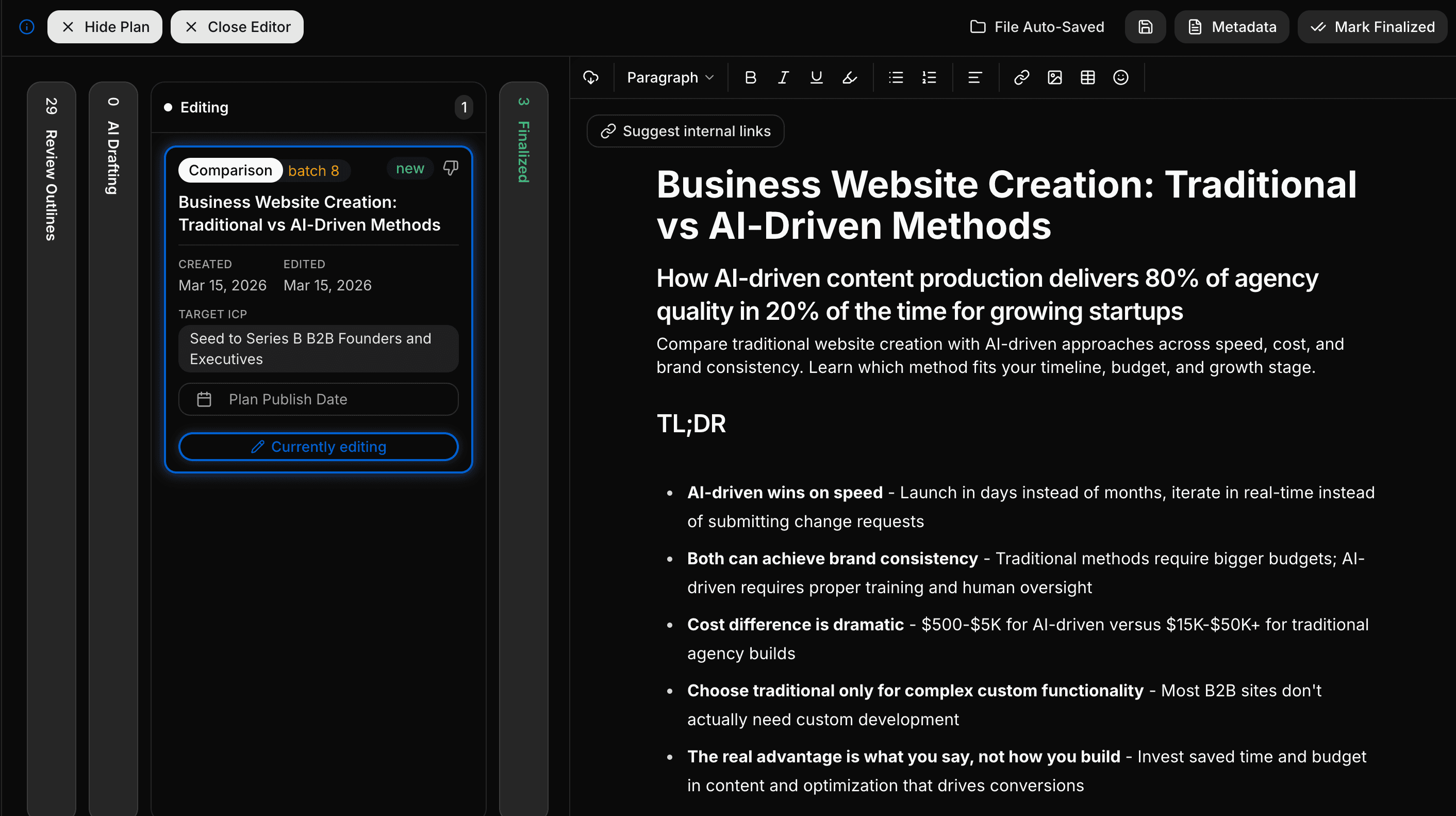
Tuesday–Wednesday (30–45 minutes): Review and edit the draft. AI-assisted drafting produces a research-backed first draft with sourced statistics, internal links, FAQ sections, and meta optimization. Your job is to add voice, perspective, and the founder-specific insights that make the piece sound like you, not like a robot.
This is the step that separates good content from generic content. The AI handles the research, structure, and optimization. You add the opinion, the experience, and the judgment.
Thursday (5 minutes): Publish. One click to your CMS. Direct publishing to WordPress, Webflow, or Framer.
Friday (10 minutes): Check performance. Glance at Search Console. Which posts are gaining impressions? Which are climbing in position? Note any trends for next week's topic selection.
Total: ~2 hours/week. Some weeks more, some weeks less. The system runs whether you have a busy week or a light one because the content engine keeps generating regardless. You're the bottleneck only at the approval and editing stage.
What the Founder Actually Writes
Nothing from scratch. The founder edits, not writes.
The AI draft arrives with the research done, the statistics sourced, the structure optimized. The founder's job is to add:
Opinions the AI can't have. "We tried X and it didn't work because..." That's founder voice. The AI can't manufacture experience.
Customer stories. "We talked to 30 founders last month and heard the same pain point..." Real interactions that prove market understanding.
Contrarian takes. "Everyone says X. The data shows Y." The founder is the one with the conviction to disagree with conventional wisdom.
The editing step takes 30–45 minutes because the structural work is done. You're adding the human layer that makes content trustworthy, not building the content from zero.
How to Measure Content Marketing ROI at Seed Stage
You won't have 10,000 monthly visitors in month 2. So how do you know it's working?
For the complete leading indicators framework with dashboard templates and attribution methodology, see the seed-stage ROI measurement guide.
Leading Indicators (Months 1–4)
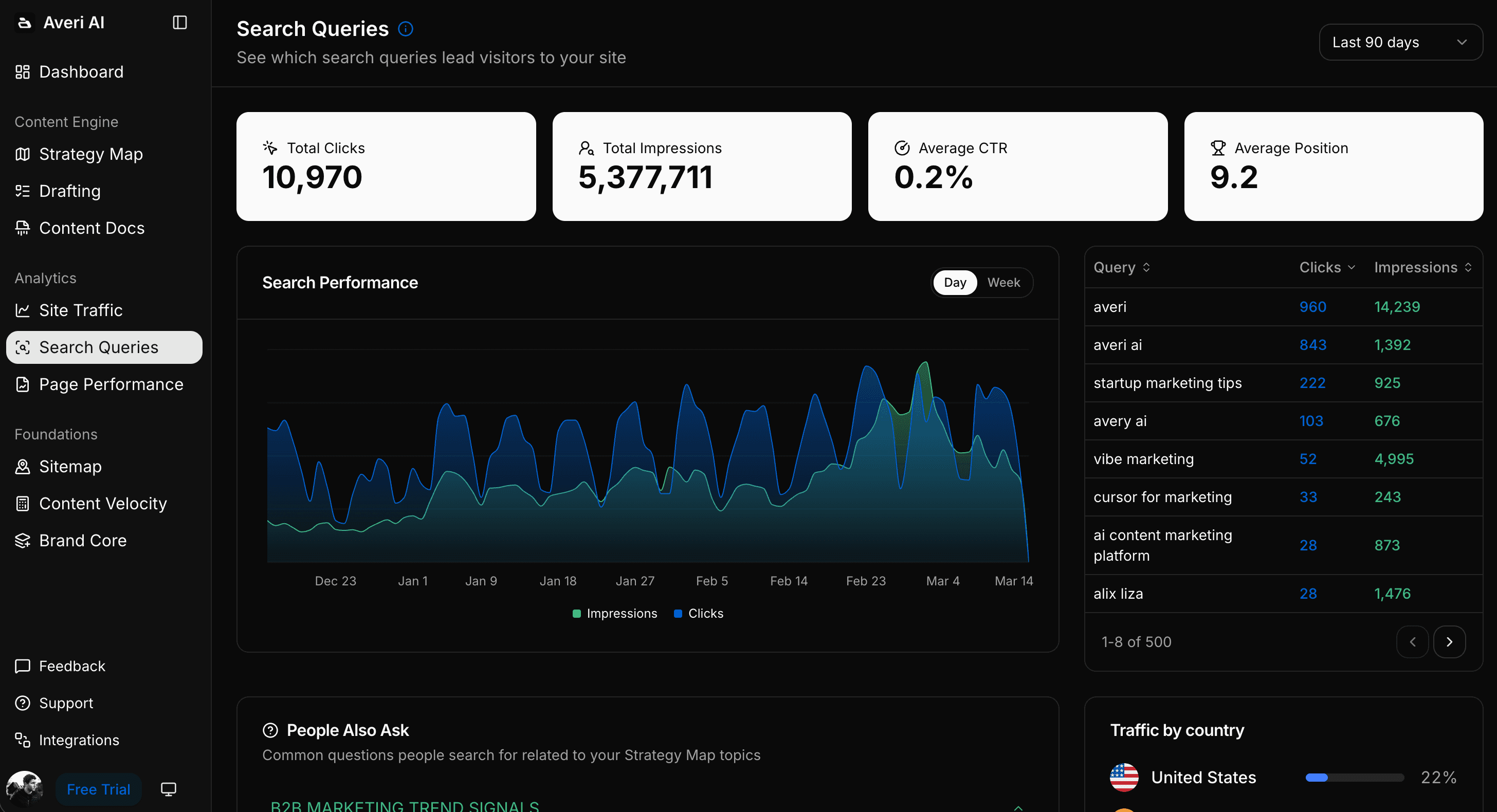
Indexed pages. Is Google finding and indexing your content? Check the Coverage report in Search Console. If your pages are indexed, the system is working. Rankings come next.
Impression growth. Impressions mean Google is showing your content in search results, even if nobody clicks yet. Growing impressions = growing relevance. The average top-10 page is over 2 years old. You're building toward that position, not starting there.
Position trajectory. Are your posts moving from position 50 → 30 → 15? That directional movement matters more than the absolute position in the early months. A post at position 20 in month 2 that's at position 8 by month 5 is on track.
Keyword coverage. How many unique keywords does your site appear for? More keywords = broader footprint. This number should grow every month as you publish.
Lagging Indicators (Months 5–12)
Organic clicks. Actual traffic from search. This is the first direct ROI metric. Track it weekly.
Organic-source conversions. How many trial signups, demo requests, or email subscribers came from organic search? Set up goal tracking in GA4.
Cost per organic lead. Total content spend divided by organic-source leads. Compare this to your paid channel CAC. Organic SEO generates leads at $31 per lead versus $181 for PPC. Your number will start higher and decrease as content compounds.
Revenue attribution. For startups with longer sales cycles, track which customers first discovered you through organic search. Even one enterprise deal sourced from a blog post can justify a year of content investment.
The Dashboard
Keep it simple. A Google Sheet with five rows, updated weekly:
Total indexed pages
Total impressions (Search Console)
Total organic clicks (Search Console)
Organic-source signups/leads (GA4)
Content spend this month
That's it.
If rows 2–4 trend up month over month, the system is working.
If they're flat after 4 months, something needs adjusting, the keyword targets, the content quality, or the publishing frequency.
Content Marketing vs. Paid Ads at Seed Stage
Both work. They work differently. Here's the math at seed-stage budgets.
For month-by-month scenario modeling at $3K and $5K, see the full data-driven comparison.
The $3K/Month Scenario: Content vs. Ads
$3K/month on paid ads (Google Ads, LinkedIn):
Month 1: ~$3K spent. 30–100 leads depending on CPC and conversion rate. Immediate results.
Month 6: ~$18K spent. 180–600 total leads. Stop spending, leads stop.
Month 12: ~$36K spent. 360–1,200 total leads. Same CAC as month 1. No compounding.
$3K/month on content marketing (AI content engine + link building):
Month 1: ~$3K spent. 0 leads from content. Posts indexing.
Month 6: ~$18K spent. 20–80 leads. Organic traffic growing. Early compounding.
Month 12: ~$36K spent. 150–500 leads. Traffic growing without proportional spend increase. CAC decreasing monthly.
At month 12, the paid ads path has generated more total leads. But the content path has a declining CAC and an accelerating traffic curve.
By month 18, the content path typically overtakes the ads path in total lead generation, and the gap widens every month after that.
Content marketing generates $3 for every $1 invested.
Paid ads generate returns only while you're paying.
The question isn't which performs better. It's which timeline your runway supports.
When to Use Both
Most seed-stage startups should do both if budget allows: content marketing as the compounding investment, paid ads as the immediate pipeline.
A common split: 60% content / 40% paid at $3K–$5K/month.
The content builds the long-term engine.
The paid ads generate leads while you wait for content to compound. Over time, shift budget from paid to content as organic traffic grows.
When AI Replaces a Marketing Hire (And When It Doesn't)
The first marketing hire at a seed-stage startup costs $111K–$180K/year fully loaded. At seed stage, that's 10–20% of your total funding going to one person.
What AI Content Engines Handle Today
Content strategy generation from your brand, audience, and competitor data
Keyword research and topic recommendation
AI-assisted first drafts with sourced statistics
SEO + GEO optimization (meta tags, internal links, FAQ sections, schema markup)
CMS publishing to WordPress, Webflow, Framer
Performance tracking and analytics
This covers roughly 80% of what a content marketing hire does in their first 6 months.
The AI handles the repeatable, research-heavy, optimization-intensive work. Averi does this for $99/month instead of $9K+/month.
What Still Needs a Human
Brand voice and editorial judgment (the founder, for now)
Relationship-based marketing (partnerships, guest posts, co-marketing)
Event marketing and in-person presence
Strategic decisions about positioning and messaging pivots
Customer story development and case study creation
These are judgment-heavy, relationship-heavy activities that AI can support but not own. At seed stage, the founder handles these alongside product and fundraising. At Series A, these are the reasons you hire a marketer.
The Decision Point
Hire a marketing person when:
Content marketing is producing measurable pipeline and you need someone to scale it
You've exhausted what the founder + AI system can produce
Your go-to-market requires channels AI can't execute (events, partnerships, outbound)
You're spending 5+ hours/week on marketing and it's pulling from product time
Don't hire a marketing person when:
You haven't validated that content drives leads for your business
You're hoping a marketer will "figure out the strategy" (AI generates strategy faster)
Your only content need is blog production (AI handles this at 10% the cost)
The 90-Day Content Launch Plan
Week-by-week execution for a seed-stage startup going from zero to running content engine. For the detailed version with daily checklists, time estimates, and a 90-day scorecard, see the week-by-week 90-day playbook.
Weeks 1–2: Foundation
Set up your blog (WordPress, Webflow, or Framer)
Connect Google Search Console and Google Analytics 4
Start Averi's free trial or set up your chosen content tools
Complete content strategy setup: brand voice, ICP, competitor analysis
Identify your first 2–3 topic clusters and 10 target keywords
Draft and publish your first 2 posts (BOFU comparison content)
Weeks 3–4: First Cluster
Publish posts 3–6: mix of BOFU and problem-aware educational content
Set up internal linking between all published posts
Build your Flodesk/beehiiv/email capture forms and embed on every blog page
Create a simple 3-email welcome sequence for blog subscribers
Start tracking impressions and indexed pages in Search Console
Weeks 5–8: Build Velocity
Publish 2 posts/week (8 total in this period)
Complete your first topic cluster (4–6 posts, fully interlinked)
Begin your second topic cluster
Publish 1 thought leadership / first-person founder piece
Share every published post on LinkedIn and in relevant communities
Weeks 9–12: Optimize and Compound
Publish 2 posts/week (8 more, total library now 20–24 posts)
Review Search Console: which keywords are gaining impressions?
Refresh your 2 earliest posts based on early performance data
Complete your second topic cluster
Begin your third cluster
First organic-source subscribers should appear in your email list
End of 90 Days: What You Should Have
20–24 published, SEO + GEO optimized blog posts
2–3 complete topic clusters with full internal linking
Google indexing your content and showing early impressions
Email capture system converting blog visitors to subscribers
Search Console data showing keyword position trajectory
A content engine that runs on 2 hours/week of founder time
This is the foundation. Everything from month 4 onward is compounding on what you built in the first 90 days.
Graduating From Seed to Series A: Scaling Your Content Engine
The content engine you build at seed stage is the same engine you scale at Series A. You don't tear it down and rebuild. You add fuel.
What Changes at Series A
Publishing velocity increases. From 2 posts/week to 4–6. More topic clusters. Deeper coverage. More competitive keywords.
A marketing hire joins. Their job isn't to start content marketing. It's to scale what's already working. They inherit a content library, a keyword strategy, performance data, and a production system. They're running, not crawling.
Budget shifts from founder time to team time. The founder moves from editing every draft to reviewing strategy and setting editorial direction. The marketing hire and the AI engine handle execution.
Competitive keywords become targetable. With 6–12 months of content, domain authority, and backlinks, you can target the higher-volume, higher-competition keywords that were out of reach at seed stage.
Investor narrative includes content traction. "We grew organic traffic X% over Y months" is a data point in your Series A deck. It proves you can build a scalable acquisition channel, not just buy leads.
What Doesn't Change
The content engine workflow is the same.
Strategy → queue → execution → publishing → analytics → optimization.
The loop runs regardless of whether you're publishing 2 posts/week or 10.
The compounding math is the same.
More content + more time = more authority = more traffic = more leads.
The curve doesn't reset. It accelerates.
The tools are the same. The Averi Solo plan at $99/month that powers your seed-stage content engine scales to the Team plan at $199/month when you add your marketing hire.
Same workflow, more seats, higher velocity.
Related Resources
Seed-Stage Content Marketing Cluster
Content Marketing Budget for Seed-Stage Startups: $0, $1K, $3K, and $5K/Month
Content Marketing vs. Paid Ads for Startups: A Data-Driven Comparison
Should Your Startup Invest in Content Marketing Now? A Decision Framework
Additional Resources
FAQs
When should a seed-stage startup start content marketing?
As early as possible after your website exists and your product positioning is clear enough to describe to a stranger. Content marketing compounds, which means the biggest advantage comes from time in market, not budget size. Startups with active blogs generate 67% more leads. Every month you delay is a month of compounding you lose. You don't need a finalized product or a marketing hire. You need a content engine and 2 hours/week of founder time. Start publishing and iterate. Waiting for "the right time" means starting later with no more information than you have now.
How much should a seed-stage startup spend on content marketing?
The sweet spot for most seed-stage startups is $1,000/month: an AI content engine ($99), blog hosting ($15–$39), and remaining budget for occasional needs. This produces 4–6 SEO/GEO-optimized posts per month on about 2 hours/week of founder time. Seed startups should allocate 10–20% of funding to marketing overall. If your total marketing budget is $3K–$5K/month, content should be 40–60% of that. The jump from $0 to $1K is the most impactful dollar-for-dollar investment because it replaces 8–12 hours of manual founder work with a system.
Can a founder do content marketing without a marketing hire?
Yes. That's the entire premise of seed-stage content marketing. The founder provides the expertise, opinions, and market understanding. An AI content engine handles keyword research, competitive analysis, drafting, SEO/GEO optimization, and CMS publishing. The founder reviews topics (30 min/week), edits AI-assisted drafts adding voice and perspective (30–45 min), and approves publishing (5 min). Total: 2 hours/week. This system produces more consistent output than most early marketing hires because the AI doesn't have ramp-up time, context switching, or sick days.
What should a seed-stage startup write about first?
Start with 3 bottom-of-funnel comparison posts (your category + competitors), then 3 problem-aware educational posts (how to solve the problem your product addresses), then 4 thought leadership pieces (first-person founder perspective, data-driven takes). Organize these into 2–3 topic clusters. Compound blog posts generate 38% of all traffic from just 10% of total posts. Your first few BOFU posts will likely become your highest-converting pages because they target people already evaluating solutions.
How long before seed-stage content marketing produces results?
Expect indexed content and early impressions in months 1–2, first page-1 rankings for long-tail keywords in months 3–5, meaningful organic traffic (500–2,000 visits/month) in months 5–7, and a compounding content engine in months 8–12. SEO delivers 748% ROI for B2B SaaS with a 7–9 month break-even period. The first 3–4 months feel like nothing is happening. That's normal. The content is indexing, building authority, and climbing positions. The compounding becomes visible around month 5–6.
Should a seed-stage startup do content marketing or paid ads?
Both if budget allows, with a 60/40 split favoring content. Paid ads generate immediate leads while content compounds. At $3K/month over 12 months, paid ads produce 360–1,200 leads at constant CAC. Content produces fewer leads initially but reaches a declining CAC and accelerating volume by month 8–12. Organic SEO generates leads at $31 per lead versus $181 for PPC. If you can only choose one, choose based on runway: content if you have 12+ months to let it compound, paid ads if you need leads this month.
How does Averi help seed-stage startups with content marketing?
Averi is the AI content engine built for this exact use case: seed-to-Series-A startups doing content marketing without a marketing team. It generates content strategy during a 10-minute onboarding, produces keyword-backed topic recommendations weekly, creates AI-assisted drafts with sourced statistics and SEO + GEO optimization, publishes directly to WordPress/Webflow/Framer, and tracks performance through Google Analytics and Search Console integration. The founder reviews and edits. Averi handles everything else. $99/month Solo plan. 14-day free trial. No credit card.