Claude AI Referrals Grew 94% in 30 Days. Gemini Dropped 27%.
6 minutes

TL;DR
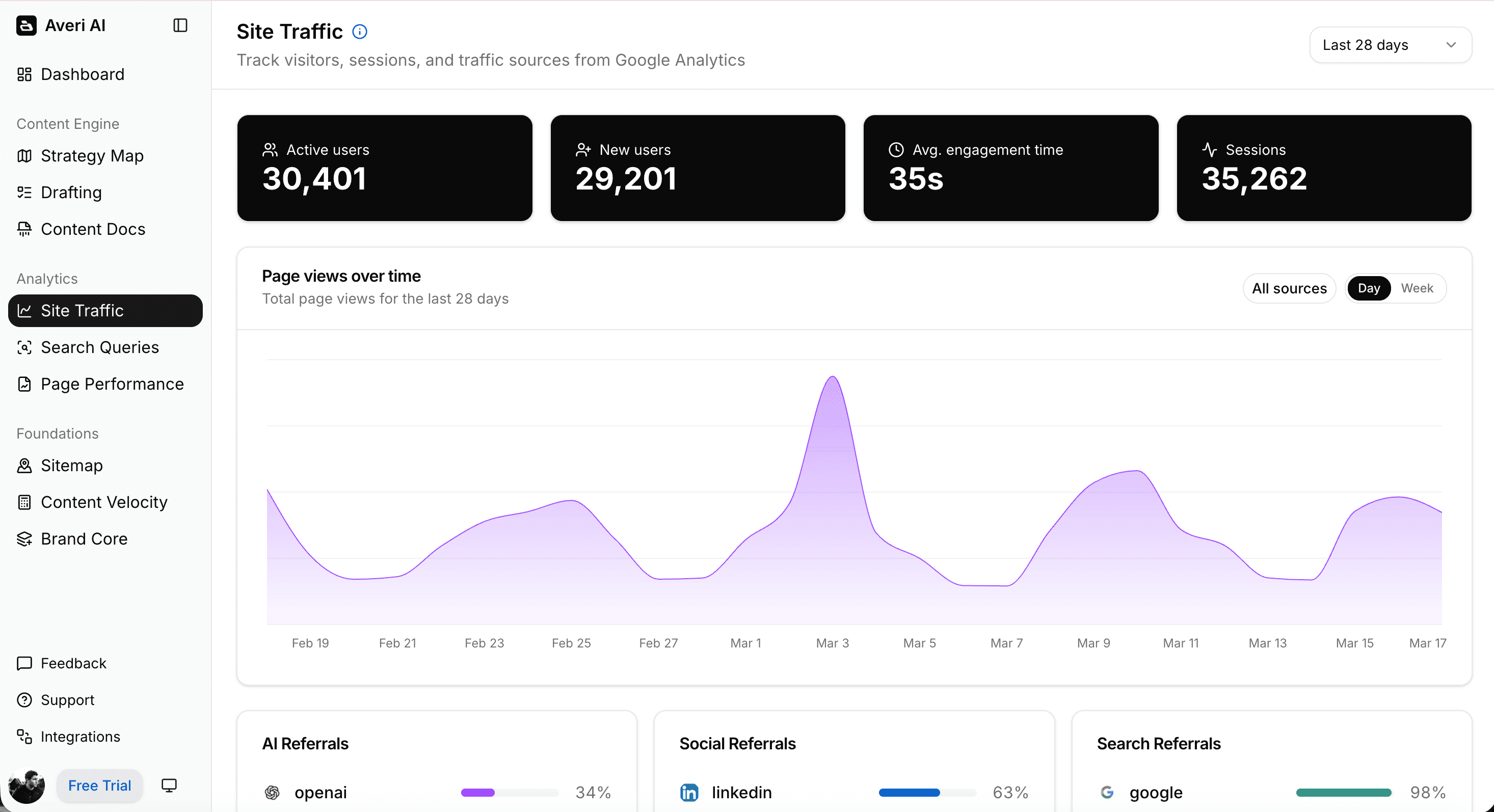
📈 Claude AI referrals grew 94% MoM in our analytics. From 90 visitors in April to 175 in May.
📉 Gemini fell 27% and Perplexity fell 44% in the same window. ChatGPT held steady at -6%.
🔄 Claude's share of our AI referrals doubled — 12% in April, 25% in May. It's now our #2 source after ChatGPT.
🌐 External data confirms this is industry-wide, not noise. Goodie's Wave 2 report shows Claude jumped from 11.8% to 18.5% of B2B AI referrals across a 41-brand panel between October 2025 and April 2026.
⚠️ Engine-specific optimization is dead. Whatever you optimized for Gemini six months ago no longer applies. The new game is engine-agnostic citation worthiness.
Zach Chmael
CMO, Averi
"We built Averi around the exact workflow we've used to scale our web traffic over 6000% in the last 6 months."
Your content should be working harder.
Averi's content engine builds Google entity authority, drives AI citations, and scales your visibility so you can get more customers.
Claude AI Referrals Grew 94% in 30 Days. Gemini Dropped 27%.
Last month I published a piece arguing that Gemini sent us better-engaged traffic than Google Search. 30 days of data later, Gemini's referral volume to our site dropped 27%, Claude nearly doubled, and Perplexity fell 44%. The argument was right. The protagonist was wrong.
This is what happens when you measure AI search performance on a quarterly cadence: the picture you describe in January is already obsolete by April. The picture in April is already obsolete by July. The AI referral mix is reorganizing faster than the reports tracking it.
Here is what our Fathom Analytics data shows for April vs May 2026:
AI Source | April | May | Delta | Share shift |
|---|---|---|---|---|
ChatGPT | 259 | 243 | -6% | 34% → 35% |
Claude | 90 | 175 | +94% | 12% → 25% |
Gemini | 232 | 169 | -27% | 31% → 24% |
Perplexity | 131 | 74 | -44% | 17% → 11% |
NotebookLM | 36 | 26 | -28% | 5% → 4% |
Copilot + other | 5 | 14 | +180% | 1% → 2% |
Total | 753 | 701 | -7% | — |
The volume number is roughly flat. The composition is unrecognizable. In a single month, Claude jumped Gemini and Perplexity to become our #2 AI referrer, a position it didn't even contend for in our March or February data.
The Reshuffle
Eight months ago, ChatGPT held 89% of B2B AI referrals across the brands Goodie tracks. Today it holds 63%. Claude went from 1.4% to 18.5%. Perplexity peaked at 12.07% in April 2025 and has since dropped to 7.07%, a decline of more than 40% per Statcounter data.
The shift we measured in our own May data is not an outlier. It is what the macro reports describe, captured one quarter ahead of when the macro reports will publish it.
Our 94% Claude growth in 30 days is consistent with Apptopia's finding that Claude jumped from under 2% to 10% of US mobile chatbot DAU share between December and March — a 167% step-function increase Apptopia called "not a trend line."
Anthropic's traffic story over the prior 18 months is roughly a 10x. Claude's web traffic grew from 16 million visits in January 2025 to over 290 million by February 2026. The company closed a $30 billion Series G at a $380 billion valuation in February. Web search inside Claude.ai shipped to all users in early 2025 and drove a 90x spike in internet-based research tasks — meaning Claude now functions as a search interface, not just a chat product.
For brands cited by Claude, that means meaningful inbound referral traffic for the first time. Our data shows the inflection landing in May, on a 30-day lag from the broader market growth.
Why this happened in this specific month
Three things hit our analytics window simultaneously and explain the May reshuffle better than any single cause.
One: Claude's product readiness caught up to its user growth
Claude.ai's web search became reliable enough through Q1 2026 that users started defaulting to it for research queries that previously went to ChatGPT or Perplexity. The 167% growth in Claude's US mobile DAU share between December 2025 and March 2026 is the precondition. Our May data is the downstream consequence — those users started clicking through to source pages, and we were a beneficiary.
Two: Google I/O 2026 was on May 19
Exactly in the middle of our measurement window. Google announced what it called the biggest Search upgrade in 25 years, including expanded AI Overviews, deeper Gemini-Search integration, and conversational AI Mode rolled out more broadly.
The mechanical effect: Gemini queries that previously sent users to source sites (showing as gemini.google.com referrals in analytics) increasingly get absorbed inside Google AI Mode and AI Overviews instead. The Gemini brand still wins the query. The referral attribution moves to "google.com" or disappears into "direct" entirely.
Three: Perplexity lost its moat
Perplexity's original differentiation was precise question-answering with cited sources. That feature is now replicated across ChatGPT, Claude, and Gemini — and the comparable feature inside the larger products is good enough that the smaller standalone product can no longer charge a premium of attention. Sherwood News described Perplexity as "the only non-Chinese AI to see stagnant growth at the start of 2026". US website traffic to perplexity.ai added fewer than 4 million visitors from February 2025 to February 2026. A 44% drop in our specific data tracks with the broader stagnation.
These three causes are simultaneous but not coordinated. They're independent forces compounding in the same window. That's what makes month-over-month AI referral measurement so volatile — the underlying drivers don't move together, but the outputs do.
Why "engine optimization" is now dead
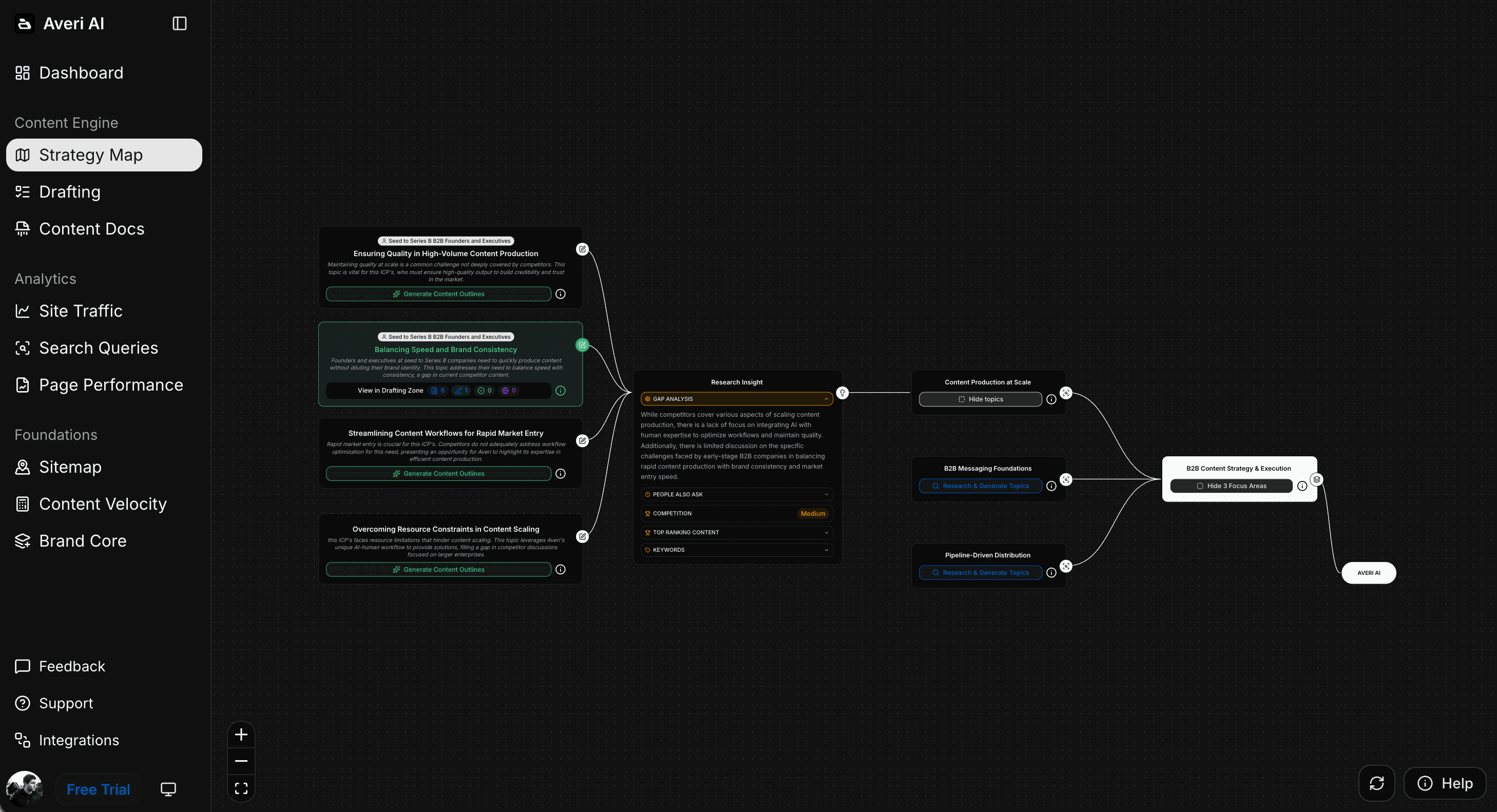
If you spent Q4 2025 or Q1 2026 building an AI search strategy specifically tuned for Gemini citation patterns, your strategy is now partially obsolete. The same is true if you built around ChatGPT specifically, or around Perplexity. Whatever engine-specific tactics you optimized for last quarter no longer describes where your readers actually come from.
The hard truth is that the engine mix will keep moving. Goodie's analysts forecast that mid-2026 is when Claude either consolidates its share or keeps taking it from ChatGPT. Gemini's growth has slowed dramatically since Google I/O as more queries shift inside AI Overviews rather than producing external clicks. Grok has crossed 3% share in some panels. DeepSeek has crossed 4% in others. The engines that matter in Q3 2026 may not all be the engines that mattered in Q1.
The strategic answer is to stop optimizing for engines and start optimizing for citation worthiness.
The signals that make content citable by Claude are the same signals that make it citable by ChatGPT, Gemini, and the engines that haven't launched yet — clear structure, fact density, named sources, original analysis, first-person experience markers, schema markup, defensible point of view. Our GEO playbook covers the mechanics. The version that pays off is the one that treats engine-specific tuning as a footnote and citation worthiness as the bet.
The engagement quality piece nobody is talking about
There's a second-order effect inside our data that matters more than the engine rotation itself.
Our April AI referral pool delivered 1.81 pages per session. May delivered 1.57.
That looks like an engagement decline. It isn't.
The pages those visitors landed on actually showed longer average dwell times in May than April. What changed was the composition of the visitor pool. Claude visitors bounce harder than Gemini visitors — 79% vs 67% in our data. As Claude grew its share of the pool, the weighted bounce rate went up. That's a portfolio rebalancing effect, not a content quality issue.
This matters because most marketers will look at "AI referral engagement dropping" and conclude their content is failing. It probably isn't. What's failing is the assumption that all AI referrals behave the same way. They don't. Different engines send different user populations with different click-through and engagement patterns. Treating AI referrals as a single channel hides the dynamic underneath.
The correct response is to start tracking AI referrals as a sub-segmented channel — at minimum, ChatGPT separately from Claude separately from Gemini separately from Perplexity. The full metrics framework lives here. If you can only track one number, track the count of pages on your site catching citation-shaped traffic (high bounce + long dwell + single-page sessions). That metric is engine-agnostic and survives the rotation we just lived through.
What we're doing differently in June
Three operational changes hit our marketing calendar this month based on this data.
First, we stopped engine-specific tuning. The pages we publish in June use the same structural patterns we've been refining since January, with no Claude-specific or Gemini-specific adjustments. The signals overlap enough that engine-tuning adds operational complexity without measurable return. [Our citation-worthy content framework is the same regardless of which engine sends the click.
Second, we built segmented AI referral tracking into our weekly review. Each engine gets its own conversion rate, engagement metric, and trend line. When the next engine rotation happens — and it will — we'll catch it inside 14 days instead of 30.
Third, we re-baselined our citation prompts across all four major engines. The same prompt we ran in February against ChatGPT and Gemini now runs against Claude and Perplexity too. The output is meaningfully different across engines. A prompt where Averi appears as the second-cited source in Claude may produce no citation in Gemini. That gap is information — it tells us which engine has indexed which of our pages and how.
Three predictions for Q3
Based on what we just measured and what the broader macro data shows, here are three falsifiable bets about the next 90 days.
One: Claude's share will keep climbing, but the slope flattens. Our 94% MoM growth is not sustainable. Realistic Q3 trajectory: Claude reaches 30-35% of our AI referrals by September, then stabilizes. The current momentum is concentrated in product launches catching up to user demand. Once that catches up, growth follows broader AI search market growth rather than outpacing it.
Two: Gemini's standalone referrals will keep shrinking as Google consolidates more queries inside AI Overviews and AI Mode. The brand still wins the query — Google's AI is still answering more questions than ever — but the attribution shifts to Google Search rather than Gemini specifically. If you measure your "Gemini" channel and see it declining through Q3, you're probably not losing relevance to Gemini. You're losing the ability to measure your relevance to Gemini.
Three: ChatGPT will hold around 60-65% of B2B AI referrals through the rest of 2026. It cannot grow much higher because the market is now diversified, but it cannot drop below 50% because OpenAI's product moat is real and its enterprise penetration is structural. Anyone forecasting ChatGPT below 50% or above 75% by year-end is reading the data wrong. The Goodie panel data supports the 60-65% band.
How to run this analysis on your own data
You can replicate what we did in roughly 90 minutes. Three steps.
Pull your last 60 days of analytics from whatever measurement tool you use — GA4, Fathom, Plausible, Matomo. Filter referrers to the AI domain list: chatgpt.com, claude.ai, gemini.google.com, perplexity.ai, copilot.microsoft.com, notebooklm.google.com, chat.deepseek.com, grok.com, meta.ai. Compare visitor count, pages per session, and bounce rate engine by engine, month over month.
The shape of your data will match ours directionally — Claude growing, Gemini and Perplexity contracting, ChatGPT holding — but the volume and ratios will be specific to your audience. B2B SaaS with technical buyers (our profile) sees more Claude growth than B2C consumer brands, where ChatGPT dominance is stickier.
The diagnostic is less about absolute numbers and more about the trajectory. Whichever engines are growing share inside your data are the ones you should write your citation strategy around. Whichever engines are shrinking are the ones you should stop tuning for.
The most defensible takeaway from this 30-day window: if you measured your AI search performance in April, the answer was different than if you measured it in May. If you measure it again in July, the answer will be different still. The engines are not the strategy. The citation worthiness underneath the engines is the strategy.
Run the analysis on your own data. The shape will match ours. The implications will be specific to your audience. The action items, if you take them seriously, will compound for the next 24 months.
Start a 14-day trial of Averi and we'll pull your AI citation baseline across all four major engines on day one — same methodology we used on our own data, applied to yours.
FAQs
Why did Claude grow so fast in your data?
Anthropic's web search inside Claude.ai matured through Q1 2026 to handle research queries reliably. Claude's US mobile DAU share grew 167% MoM December to March per Apptopia. Anthropic's $30 billion Series G in February 2026 expanded product investment. Our 94% MoM is the downstream lag.
Is the Gemini decline permanent?
Not necessarily, but the measurement gets harder. As Google integrates Gemini more deeply into Search, queries that previously showed as gemini.google.com referrals will increasingly attribute to google.com or show as direct traffic. Gemini's brand-as-engine still wins queries. The attribution layer is what's changing, not the underlying citation rate.
Should I stop optimizing for Perplexity?
Not entirely, but don't over-index. Perplexity peaked at 12% of AI referrals in April 2025 and now sits below 8% per Similarweb. It's a small channel with engaged users — worth maintaining presence, not worth building a strategy around. Our Perplexity-specific guide still applies with smaller TAM.
How often should I run this analysis?
Monthly at minimum. The AI search mix shifted dramatically in a single 30-day window in our data. Quarterly cadence is too slow to catch rotations like this until they're already over. Set up a recurring 90-minute review on the first Monday of each month and you'll catch shifts before they become structural.
Does this mean ChatGPT is in trouble?
No. ChatGPT lost 26 share points across 8 months but still holds 63% of B2B AI referrals in the Goodie panel. OpenAI's lead is structural — enterprise penetration, brand recognition, and product breadth that no competitor has matched. Expect ChatGPT to stabilize between 55-65% of referrals long-term, not collapse.
What's the single best signal that my citation strategy is working?
Citation-shaped traffic count, not attributed referrals. Filter your analytics to pages with ≥80% bounce + ≥120 seconds average dwell + ≥20 visitors. Count the pages. If the count grows month over month, your citation footprint is expanding regardless of which engine is currently sending the clicks. That's the metric that survives engine rotation.
Will the next 30 days look similar?
Probably not. The 94% Claude jump is unlikely to repeat at that magnitude — the product readiness inflection was a one-time event. Expect Claude growth to slow to 20-40% MoM through Q3, with Gemini stabilizing and ChatGPT flat. The reshuffle dynamic continues, but the slopes flatten.
Additional Resources
GEO & AI Search Optimization
The GEO Playbook 2026: Getting Cited by LLMs (Not Just Ranked by Google)
The Complete Guide to GEO: Getting Your Brand Cited by AI Search
Beyond Google: How to Get Your Startup Cited by ChatGPT, Perplexity, and AI Search
Platform-Specific GEO: How to Optimize for ChatGPT vs Perplexity vs Google AI Mode
How to Get Your SaaS Recommended by Perplexity: A Technical Deep Dive
Citation Strategy & Measurement
How to Track AI Citations and Measure GEO Success: The 2026 Metrics Guide
ChatGPT vs Perplexity vs Google AI Mode: The B2B SaaS Citation Benchmarks Report (2026)
Building Your Data Source Status: How to Become the Brand That LLMs Quote by Default
Building Citation-Worthy Content: Making Your Brand a Data Source for LLMs
Schema Markup for AI Citations: The Technical Implementation Guide
Content Engine & AI Marketing Strategy
How to Build an AI Content Engine That Grows Your Startup in 2026
SEO vs LLM Optimization: What Marketers Need to Know in 2026
LLM Optimization: Supercharging AI Visibility in the Post-Search Era
The Future of B2B SaaS Marketing: GEO, AI Search, and LLM Optimization
Founder & Startup Marketing
Early-Stage Startups: Should You Prioritize SEO vs GEO vs Paid?
2026 is the Year You Probably Should Become a Content Engineer
12 SEO & GEO Search Trends That Defined 2025 (And the Playbook for What Comes Next)