

AI Marketing Agents vs Content Engine: What Ships?

Zach Chmael

Head of Marketing

In This Article

AI marketing agents automate tasks. A content engine runs the system. Seed-stage founders need the engine, not the autonomous captain.

Updated

Trusted by 1,000+ teams

★★★★★ 4.9/5

Startups use Averi to build
content engines that rank.

TL;DR

  • 🤖 Every major vendor pivoted to agents in 2026. Jasper, AirOps Quill, Copy.ai, NoimosAI, Salesforce Agentforce all selling "autonomous marketing agents" as the next operating model

  • 🏗️ An agent is a task automator. An engine is a system runner. Different categories. Different operational implications. Different fits at different stages

  • 🚨 At seed stage, "autonomous" = "unsupervised" = brand-risky. 65% of consumers can already identify AI-generated content. Unsupervised agent output amplifies that detection problem rather than solving it

  • 🎯 What seed-stage founders need: A workflow that ships content with humans in the loop at five specific checkpoints. Not a captain that runs unsupervised between them

  • 💸 The hidden cost of agent stacks: 100+ agents need an orchestration layer. The agent operator is the content engineer hire by another name. Same $200K loaded cost trap

  • 🟢 When agents make sense: Series B+ with dedicated content teams, narrow automation tasks (monitoring, refresh, alerting), enterprise plug-ins to existing stacks. Not at sub-Series-A as a primary content production model

  • 🔄 The engine alternative: Five human-in-the-loop checkpoints (strategy review, brief approval, draft editorial pass, score validation, publish sign-off). System runs between them. Founder spends 5–10 hours weekly on the editorial layer, not on orchestrating agents

Zach Chmael

CMO, Averi

"We built Averi around the exact workflow we've used to scale our web traffic over 6000% in the last 6 months."

Your content should be working harder.

Averi's content engine builds Google entity authority, drives AI citations, and scales your visibility so you can get more customers.

AI Marketing Agents vs. a Content Engine: What Actually Ships a Startup's Content

The pitch from every major AI marketing vendor in 2026 is the same.

Jasper now sells "100+ specialized AI agents" as an "agent workspace."

AirOps launched Quill on May 13 as "an AI agent lead that acts as an extension of the marketing team."

Copy.ai positions itself as an "AI marketing OS."

NoimosAI markets itself as a "unified squad of autonomous agents."

The autonomous AI agent market is projected to hit $11.78B by end of 2026, per Statista.

The narrative is unanimous: deploy agents, let them run, watch your marketing happen without you.

For seed-stage founders, the narrative is wrong on a specific axis.

An agent automates a task. An engine runs a system.

Those are different things, and the difference determines whether content actually ships at sub-$10M ARR. A founder running marketing five hours per week doesn't need an autonomous captain making unsupervised decisions across 100+ agents — they need a packaged workflow where humans stay in the editorial loop at the five checkpoints that matter and the system handles everything else.

This piece is the counter-position to the agentic-marketing vendor narrative, with the operational case for why a content engine outperforms an agent stack at the stage most B2B SaaS startups are actually at.

The Vendor Narrative In 2026

The unanimous push toward agentic marketing across the AI tooling category is worth taking seriously before counter-positioning against it. Three reference points define the current state.

Jasper's "agent workspace" pivot

Jasper repositioned in early 2026 from "AI writing assistant" to "agent workspace built for modern marketing teams."

The current pitch: 100+ specialized AI agents and connected content pipelines that "transform strategy into execution." Each agent handles a narrow task — competitive analysis, social adaptation, email drafting, press release generation, brand voice calibration. The orchestration layer connects them.

Jasper's claim is that this configuration reduces operational complexity while strengthening brand control.

For an enterprise marketing team with established processes, the claim is plausible.

For a 1–5 person seed-stage team, "100+ agents" is the operational complexity, not the solution to it.

AirOps Quill (launched May 13, 2026)

AirOps Quill is the most explicit agent positioning in the category. Marketed as "an AI agent lead that acts as an extension of the marketing team," Quill monitors content performance, refreshes existing pieces, drafts new pieces, and optimizes for AI search visibility. Early customers including Parallel and Asana report citation increases up to 165% and share-of-voice lifts of 42%.

The customer roster is worth reading carefully. Asana is post-Series-D with a dedicated content team. Parallel is well-funded with a sophisticated marketing operation. These are companies where Quill plugs into existing infrastructure and existing humans operating it. The "agent" framing obscures that Quill, operationally, is a set of refresh and monitoring functions wrapped in a brand-friendly name. The functions are real and useful. The "AI agent lead" positioning is the part that misleads seed-stage buyers about what they're getting.

Copy.ai, NoimosAI, and Salesforce Agentforce

Copy.ai's recent positioning frames the product as an "AI Marketing OS" running autonomous workflows across email, social, ads, and content. NoimosAI markets a "unified squad of autonomous agents" covering growth strategy, SEO/GEO, and social media. Salesforce Agentforce positions agents as autonomous workers plugging into existing CRM data.

Across all three: the pitch is autonomy.

The unstated requirement: an operator who understands the underlying systems well enough to direct the autonomy, troubleshoot when agents make bad calls, and override outputs that don't pass brand or editorial scrutiny. That operator is a content engineer, marketing manager, or growth ops lead — a $130K-to-$200K hire on top of the agent platform's licensing cost.

The $11.78B projection

Statista projects the autonomous AI agent market reaches $11.78B by end of 2026, with 23.3% of marketing organizations having moved to true agent-driven workflows. The category growth is real. The question is whether seed-stage B2B SaaS founders are the right buyers at this stage of the category's maturity, or whether the early-adopter cohort is enterprise teams with the infrastructure to absorb agent complexity.
What An Agent Is vs. What An Engine Is

The distinction sits at the center of the counter-position and deserves operational precision.

An agent automates a task

An AI agent, in 2026 product terminology, is a goal-oriented software component that perceives context, reasons through a problem, and takes actions to achieve a specific outcome.

The defining characteristic: it operates without constant human prompting between steps. A "social adaptation agent" takes a blog post and ships variants across LinkedIn, Instagram, and X without human intervention at each step. A "competitive analysis agent" monitors competitor content and surfaces signals without being asked.

Agents are units of automation.

Useful in isolation, useful in chains, but each agent is calibrated to one task. The orchestration of multiple agents — the part that makes "agentic marketing" work — is a separate layer that requires its own setup, governance, and operational maintenance.

An engine runs a system

A content engine is not a chain of agents.

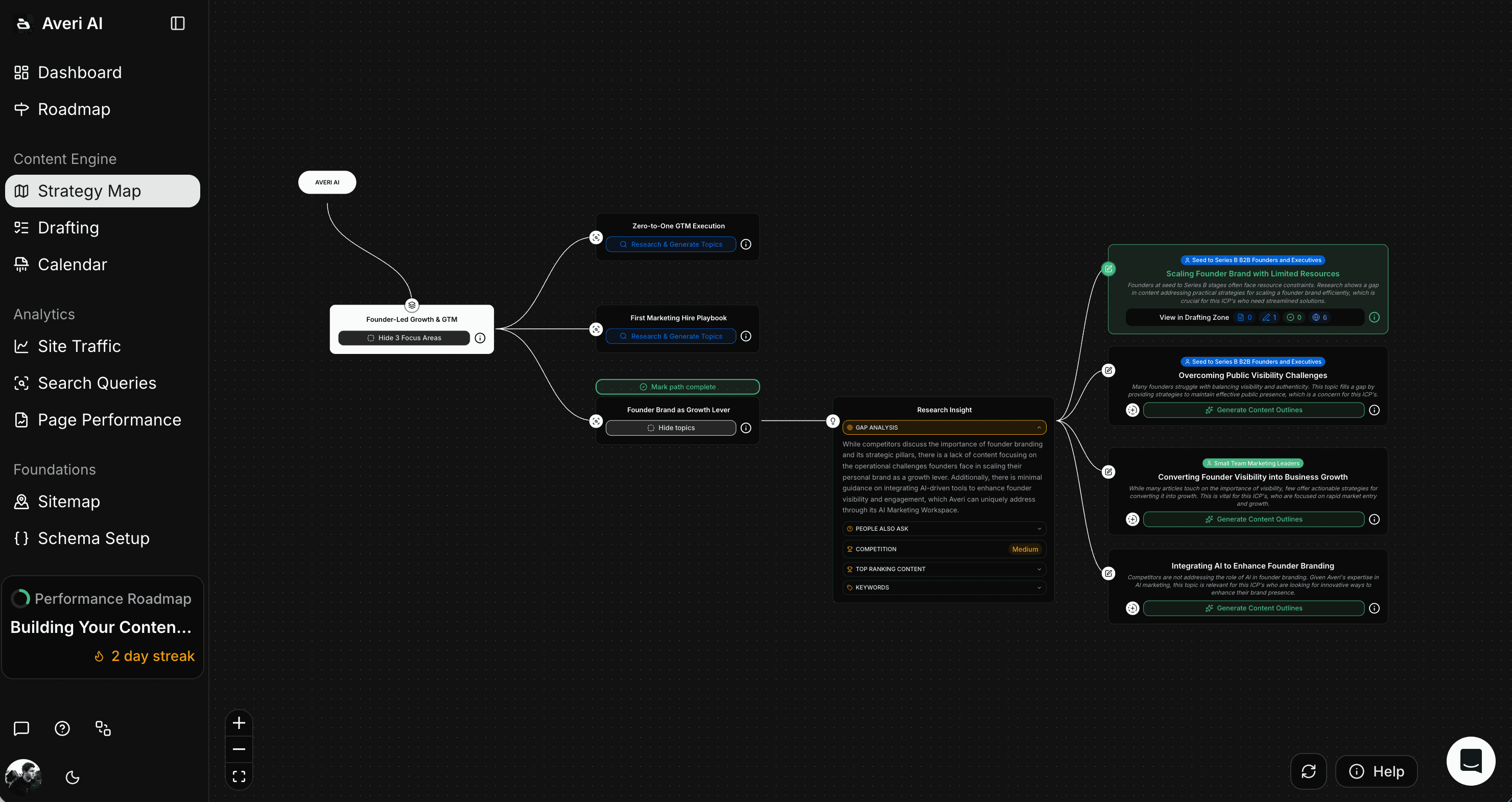
It's a packaged workflow that runs the six functions of content production — Brand Core, Strategy Map, Content Queue, AI Drafting, SEO + GEO Scoring, CMS Publishing with Analytics — as a connected loop.

The defining characteristic: humans stay in the loop at specific checkpoints, and the engine handles everything between them.

Where an agent is goal-oriented (you give it an outcome, it figures out how), an engine is workflow-oriented (you give it editorial direction at five checkpoints, it executes the workflow between them).

The engine is opinionated about the steps and the sequence. The agent is opinionated about the goal but flexible on the steps.

Why the distinction matters at seed stage

At Series B and beyond, "give it a goal, let it figure out how" is a feature. The infrastructure exists to catch mistakes, the team exists to override outputs, the budget exists to absorb the orchestration overhead. At seed stage, "give it a goal, let it figure out how" is a bug. There's no infrastructure to catch the mistake. There's no team to override the output. The founder doesn't have time to figure out why the agent published a piece that's off-brand at 3am.

The seed-stage operational reality is "I need content to ship in my voice, on the schedule that compounds, with five hours weekly of my time on editorial." That's a workflow problem, not a goal-orientation problem. A packaged workflow solves it directly. A fleet of agents solves it indirectly, with a hidden orchestration layer the founder doesn't have time to manage.

See what your Content ROI could be with an engine

The Autonomy Paradox

The most underexamined part of the agentic marketing narrative is the assumption that more autonomy is always better.

For seed-stage founders, the assumption is exactly backwards.

Autonomous equals unsupervised, which equals brand-risky

Autonomy in agentic marketing means the agent acts between human checkpoints. The longer the gap between human review and agent action, the more autonomous the agent. The vendor pitch treats this as a feature. The operational reality is that brand risk compounds in those gaps.

An autonomous social agent that publishes 30 posts before the founder reviews any of them is the configuration most likely to produce the one off-brand post that ends up screenshotted.

An autonomous content refresh agent that updates 50 pages without review is the configuration most likely to introduce factual errors that propagate before anyone catches them.

Autonomy buys speed at the cost of supervision, and at seed stage, supervision is the moat — your brand isn't large enough yet to survive bad outputs.

The 65% consumer detection problem

HubSpot's 2026 State of Marketing data reports 65% of consumers can identify and ignore AI-generated content. 56% of marketers separately confirm the internet is flooded with AI content. Buyers are calibrated to detect AI signals at higher rates than any prior period in digital marketing history.

Autonomous agent content production, by definition, removes the human-in-the-loop step where AI-tell signals get cleaned up. The five tells of AI content — false breadth, list-of-three syndrome, hedge-everywhere phrasing, sourceless stats, "in conclusion" patterns — are exactly the patterns that emerge when agents publish without editorial review. The 65% consumer detection rate is calibrated against exactly the output autonomous agents produce.

When autonomous makes sense (and when it doesn't)

Three scenarios where autonomous agents are the right configuration:

  • Narrow operational tasks like monitoring for content decay, alerting on competitor moves, or refreshing stale stats with verified replacements. These are bounded tasks with clear success criteria

  • Series B+ teams with dedicated review infrastructure where outputs flow through established quality gates before reaching customers

  • Internal-facing workflows where outputs go to a marketing or sales team for processing rather than directly to buyers

Three scenarios where autonomous agents are wrong:

  • Customer-facing content production at seed stage without an editorial reviewer in the loop

  • Brand voice calibration where the agent is making aesthetic judgments without human reference

  • Strategic positioning content where the agent is making decisions about what the company believes

Most seed-stage content production sits in the second list. The vendor narrative treats it as if it sits in the first.

What Seed-Stage Founders Actually Need

The operational requirement at seed stage is calibrated against a different problem than enterprise marketing teams face.

A workflow that ships, not a captain that operates

A seed-stage founder running marketing five hours weekly has one thing they need from their AI tooling: a workflow that takes them from "blank Monday" to "piece published by Friday" without consuming the rest of their week. The variables are review time, ship cadence, and editorial quality. The constants are founder bandwidth and brand consistency.

A content engine packages those variables.

The founder spends review time at five specific checkpoints (more on those below), the engine handles everything between them, ship cadence is determined by review bandwidth rather than agent throughput, and editorial quality is preserved because humans touch every piece before it goes live.

An agent stack inverts this.

The founder configures 100+ agents, calibrates handoffs between them, monitors for drift, and intervenes when outputs aren't right. The promise is "less human time per piece." The operational reality at seed stage is "more human time, distributed across orchestration tasks the founder didn't sign up for."

The five human-in-the-loop checkpoints that matter

A content engine that ships at seed stage routes founder editorial attention to these five moments and ignores the rest:

  1. Strategy review (quarterly, ~60 min). Approve the 90-day Strategy Map. Adjust ICP priorities, topic clusters, and content cadence based on what's working

  2. Brief approval (weekly, ~15 min). Review the next 3–5 pieces in the queue. Approve angles, adjust framing, kill any briefs that don't fit current priorities

  3. Draft editorial pass (per piece, ~30 min). Add first-person experience markers, contrarian POV, expert insights, sourced specifics that only the founder can contribute

  4. Score validation (per piece, ~5 min). Confirm SEO + GEO scores meet threshold. Apply recommendations or override with justification

  5. Publish sign-off (per piece, ~5 min). Final read, schema verification, scheduled publish

Five checkpoints, roughly 8–12 hours weekly of editorial time at a 4-pieces-per-month cadence.

The engine handles the work between checkpoints. That's the operational shape a seed-stage founder actually needs.

Why opinionated workflows beat configurable agents

The vendor pitch for agentic marketing emphasizes configurability. Mix and match agents. Build custom workflows. Adapt to your team's specific needs. The pitch sounds compelling and is mostly wrong for seed stage.

Configurability is a feature for teams that have known requirements and the time to express them through configuration. Seed-stage teams don't have known requirements yet — they're discovering what works. An opinionated workflow that ships content while you discover what works outperforms a configurable agent stack that requires you to know what works before configuration can produce output.

The reason we built Averi as an opinionated content engine, not a configurable agent platform is that opinionated workflows ship at seed stage and configurable platforms ship at enterprise stage. Different problems. Different solutions.

The Hidden Cost of Agent Stacks

The agentic marketing pitch undersells one specific operational cost.

100+ agents need an orchestration layer

Jasper's "100+ specialized AI agents" need someone to direct them. AirOps Quill needs someone to set up the playbooks it runs. Copy.ai's autonomous workflows need someone to configure the triggers and check the outputs. The orchestration layer is the unstated cost of agentic marketing.

At enterprise scale, the orchestration layer is staffed by a content engineer, marketing operations specialist, or growth ops lead. At seed stage, the orchestration layer either becomes the founder's job (consuming the time savings the agents promised) or doesn't get staffed at all, in which case the agents drift and produce off-brand outputs.

The agent operator role (a.k.a. the content engineer)

This is the same trap we covered in the AI Content Engineer pillar from a different angle. Hiring a content engineer to run a content production system costs ~$200K loaded in Year 1. Hiring an agent operator to run an agent stack costs the same, with the same operational disadvantages: six months of ramp before the operator is productive, salary that consumes 6 months of seed-stage runway equivalent, and the discovery that most of the operator's first-year work reconstructs what software would have done in 60 minutes.

The agentic marketing pitch hides this cost. The vendor implies the agents replace the need for an operator. In practice, the agents create the need for the operator at exactly the stage where the operator can't be afforded.

Why this is the same trap as the $200K hire

The $200K marketing hire trap is well-documented: seed-stage teams hire a senior marketer who spends the first six months building infrastructure rather than producing growth. The agentic marketing trap is the same pattern with a different label. Instead of hiring the senior marketer to build infrastructure, the team buys agents and hires an operator to orchestrate them. Same six months of ramp, same loaded cost, same opportunity cost on growth output.

A packaged content engine sidesteps both traps. The engine ships the infrastructure on day one. The founder runs editorial. There's no operator role to staff because the engine doesn't need orchestration — it's already opinionated about its own workflow.

See how much you could save with a Content Engine

When Agents Actually Make Sense

The counter-position isn't anti-agent. It's anti-agent-at-the-wrong-stage. Three scenarios where agentic marketing is the right call:

Series B+ with dedicated marketing teams

At post-Series-B, marketing teams have specialization, infrastructure, and budget. Agents plug into existing systems run by humans who know what good output looks like. Outputs flow through quality gates before reaching customers. The orchestration overhead is absorbed by the marketing operations function that already exists. At this stage, an agent stack is a productivity multiplier rather than a complexity tax.

Enterprise plug-ins to existing CRM and MAP stacks

Salesforce Agentforce, Adobe agents, and HubSpot's AI agents are designed to plug into existing CRM and marketing automation infrastructure at enterprise stage. The agents extend the platform rather than replacing the underlying workflow. For enterprise teams already running Salesforce or HubSpot at scale, layering agents on top makes sense. For seed-stage teams not yet on those platforms, it doesn't.

Narrow automation tasks (monitoring, refresh, alerting)

The use cases where agents actually outperform engines are narrow and bounded: monitoring for content decay, alerting on ranking changes, refreshing stale statistics, scanning competitor content. These are tasks with clear success criteria and low downside risk. A "content decay monitoring agent" running autonomously is fine — the worst case is a false positive alert. A "blog post drafting agent" running autonomously is brand risk because the worst case is bad content reaching customers.

The seed-stage configuration that works: a content engine running the workflow, plus 1–2 narrow agents handling specific monitoring or refresh tasks. Not a fleet of 100 agents orchestrated by a hire that doesn't exist yet.

The Engine Alternative: What Human-in-the-Loop Means Operationally

The honest pitch for the content engine alternative is specific about what humans do and what the engine does.

Five checkpoints where humans stay in the loop

The five checkpoints from the earlier section, expanded to show what the human actually contributes at each:

  1. Strategy review. The founder's POV on which ICP segments to prioritize, which conventional wisdom to push against, which topics matter for the next 90 days. The engine generates options; the founder makes the strategic call

  2. Brief approval. The founder's editorial direction on framing, angles, and which queue items match current priorities. The engine produces briefs; the founder makes the editorial call

  3. Draft editorial pass. The founder's lived experience, contrarian POV, expert insights, sourced specifics, first-person markers. The engine produces structure and synthesis; the founder produces the parts that don't compress into software

  4. Score validation. The founder's judgment on whether score recommendations should be applied or overridden. The engine produces scoring; the founder produces the override authority

  5. Publish sign-off. The founder's final read, schema spot-check, publish timing decision. The engine handles execution; the founder retains authority

What the engine does between checkpoints

The substrate work that doesn't require editorial judgment: maintaining Brand Core across pieces, drafting new pieces with Brand Core loaded, applying SEO + GEO structural patterns, generating schema markup, formatting for CMS publish, ingesting analytics data, refreshing the queue based on performance signals.

This is the work that takes a human content engineer six months to build.

The engine ships it on day one.

The 5-to-10 hour weekly editorial review pattern

The total founder time required at the five checkpoints, calibrated against a 4-pieces-per-month cadence (typical seed-stage output): 8–12 hours weekly.

Most of that time is in checkpoint 3 (draft editorial pass), which is where the founder's POV gets injected. The other four checkpoints together take 1–2 hours weekly.

This is the pattern our founder's guide to content marketing in 5 hours a week documents in detail. The five-hour version is achievable at 2–3 pieces per month with tight editorial discipline. The 8–12 hour version is the more typical operational reality at 4 pieces per month with thorough editorial passes.

Honest Comparison: Agent Stack vs Content Engine

Dimension

AI Agent Stack

Content Engine

Core unit

Goal-oriented agents

Opinionated workflow

Configuration model

Mix-and-match agents

Packaged 6-function loop

Operational mode

Autonomous between human checkpoints (variable)

Human-in-loop at 5 specific checkpoints

Hidden cost

Agent operator hire ($130K–$200K loaded)

None (engine includes orchestration)

Time to first ship

4–8 weeks (setup, calibration, orchestration)

<5 days (onboarding to publish)

Brand-risk profile

High at seed stage (unsupervised gaps)

Low (human review at every publish)

Best fit stage

Series B+ with dedicated team

Pre-seed to early Series A

Failure mode

Off-brand outputs at scale

Bumping against tier limits (manageable)

Founder time required

Variable (depends on agent count + drift)

5–12 hours weekly (predictable)

Pricing

$200–$2,000+/mo platform + operator salary

$99–$399/mo, no operator required

What you're buying

Future infrastructure that scales

Current workflow that ships

The dimensions favor agents at enterprise stage and the engine at seed stage. The dimensions don't change. The stage does.

Skip the agent stack. Run the engine

Averi ships your first piece in <5 days with humans in the loop at the five checkpoints that matter. No 100-agent orchestration. No operator hire required. $99/month for the Solo plan. 14-day free trial.

Start free →


FAQs

What's the difference between an AI marketing agent and a content engine?

An AI marketing agent is a goal-oriented automation that performs a single task or chain of tasks autonomously between human checkpoints. A content engine is a packaged workflow that runs six functions (Brand Core, Strategy Map, Content Queue, AI Drafting, SEO + GEO Scoring, CMS Publishing) as a connected loop with humans in the loop at five specific checkpoints. Agents are units of autonomy; engines are units of opinionated workflow. Different categories for different stages.

Should seed-stage startups use AI marketing agents?

Generally no, not as a primary content production system. Autonomous agent output without editorial review amplifies the AI-tell signals that 65% of consumers now identify and ignore. Narrow agents for bounded tasks (content decay monitoring, alerting, stat refresh) can be useful layered on top of a content engine. Full agent stacks for content production are better fits for Series B+ with dedicated marketing teams.

Is Quill from AirOps an agent or a content engine?

Quill is marketed as an agent but operationally is a set of functions (monitoring, refresh, drafting, optimization) wrapped in an agent-branded interface. The functions are real and useful at enterprise stage where humans operate the infrastructure around them. The "AI agent lead" framing obscures that Quill is part of a content engineering platform that still requires a content engineer or marketing operations specialist to direct effectively.

What about Jasper's 100+ agents?

Jasper's agent workspace works well for enterprise marketing teams with established editorial processes and budget for an agent operator. For seed-stage teams of 1–5 people, 100+ agents creates orchestration complexity the team doesn't have time to manage. The "lower operational complexity" pitch inverts at smaller team sizes because the operator role doesn't yet exist to absorb the orchestration burden.

Does Averi use AI agents internally?

Averi uses narrow agents for specific bounded tasks (citation tracking, content decay monitoring, competitor change alerts) layered inside a packaged content engine workflow. The substrate is the workflow, not the agents. Our public position on this is documented here: we chose to build an engine where humans stay in the loop rather than an agent stack where they don't, because that's the configuration that ships at seed stage.

Will agentic marketing eventually replace content engines?

For enterprise marketing teams with dedicated agent operators and established quality gates, agentic marketing will likely become the dominant operating model through 2027–2028. For seed-to-early-Series-A startups, the operational shape of "founder runs editorial, engine runs substrate, ship continuously" doesn't change because the constraint is founder time, not agent capability. Agents and engines will likely coexist with different stage fits, similar to how enterprise CRM and self-serve CRM coexist today.

What's the cheapest way to test the engine vs agent approach?

Run a 60-day side-by-side. Sign up for a content engine (Averi Solo at $99/month, 14-day free trial), and trial Jasper or AirOps' free tier. Ship 4 pieces through each over 60 days. Measure time-to-first-piece, founder hours spent, editorial review burden, and content quality (against the five-tell audit). Most seed-stage teams find the engine wins on every dimension except theoretical scalability beyond 25+ pieces monthly, which is a problem for month 18, not month 1.


Related Resources

Counter-Position References

Content Engine Operations

Brand And Editorial Layer

Buy-vs-Hire Economics

Continue Reading

The latest handpicked blog articles

Experience The AI Content Engine

Already have an account?

Join 30,000+ Founders, Marketers & Builders

Don't Feed the Algorithm

“Top 3 tech + AI newsletters in the country. Always sharp, always actionable.”

"Genuinely my favorite newsletter in tech. No fluff, no cheesy ads, just great content."

“Clear, practical, and on-point. Helps me keep up without drowning in noise.”

User-Generated Content & Authenticity in the Age of AI

Zach Chmael

Head of Marketing

In This Article

AI marketing agents automate tasks. A content engine runs the system. Seed-stage founders need the engine, not the autonomous captain.

Don’t Feed the Algorithm

The algorithm never sleeps, but you don’t have to feed it — Join our weekly newsletter for real insights on AI, human creativity & marketing execution.

TL;DR

  • 🤖 Every major vendor pivoted to agents in 2026. Jasper, AirOps Quill, Copy.ai, NoimosAI, Salesforce Agentforce all selling "autonomous marketing agents" as the next operating model

  • 🏗️ An agent is a task automator. An engine is a system runner. Different categories. Different operational implications. Different fits at different stages

  • 🚨 At seed stage, "autonomous" = "unsupervised" = brand-risky. 65% of consumers can already identify AI-generated content. Unsupervised agent output amplifies that detection problem rather than solving it

  • 🎯 What seed-stage founders need: A workflow that ships content with humans in the loop at five specific checkpoints. Not a captain that runs unsupervised between them

  • 💸 The hidden cost of agent stacks: 100+ agents need an orchestration layer. The agent operator is the content engineer hire by another name. Same $200K loaded cost trap

  • 🟢 When agents make sense: Series B+ with dedicated content teams, narrow automation tasks (monitoring, refresh, alerting), enterprise plug-ins to existing stacks. Not at sub-Series-A as a primary content production model

  • 🔄 The engine alternative: Five human-in-the-loop checkpoints (strategy review, brief approval, draft editorial pass, score validation, publish sign-off). System runs between them. Founder spends 5–10 hours weekly on the editorial layer, not on orchestrating agents

"We built Averi around the exact workflow we've used to scale our web traffic over 6000% in the last 6 months."

founder-image
founder-image
Your content should be working harder.

Averi's content engine builds Google entity authority, drives AI citations, and scales your visibility so you can get more customers.

AI Marketing Agents vs. a Content Engine: What Actually Ships a Startup's Content

The pitch from every major AI marketing vendor in 2026 is the same.

Jasper now sells "100+ specialized AI agents" as an "agent workspace."

AirOps launched Quill on May 13 as "an AI agent lead that acts as an extension of the marketing team."

Copy.ai positions itself as an "AI marketing OS."

NoimosAI markets itself as a "unified squad of autonomous agents."

The autonomous AI agent market is projected to hit $11.78B by end of 2026, per Statista.

The narrative is unanimous: deploy agents, let them run, watch your marketing happen without you.

For seed-stage founders, the narrative is wrong on a specific axis.

An agent automates a task. An engine runs a system.

Those are different things, and the difference determines whether content actually ships at sub-$10M ARR. A founder running marketing five hours per week doesn't need an autonomous captain making unsupervised decisions across 100+ agents — they need a packaged workflow where humans stay in the editorial loop at the five checkpoints that matter and the system handles everything else.

This piece is the counter-position to the agentic-marketing vendor narrative, with the operational case for why a content engine outperforms an agent stack at the stage most B2B SaaS startups are actually at.

The Vendor Narrative In 2026

The unanimous push toward agentic marketing across the AI tooling category is worth taking seriously before counter-positioning against it. Three reference points define the current state.

Jasper's "agent workspace" pivot

Jasper repositioned in early 2026 from "AI writing assistant" to "agent workspace built for modern marketing teams."

The current pitch: 100+ specialized AI agents and connected content pipelines that "transform strategy into execution." Each agent handles a narrow task — competitive analysis, social adaptation, email drafting, press release generation, brand voice calibration. The orchestration layer connects them.

Jasper's claim is that this configuration reduces operational complexity while strengthening brand control.

For an enterprise marketing team with established processes, the claim is plausible.

For a 1–5 person seed-stage team, "100+ agents" is the operational complexity, not the solution to it.

AirOps Quill (launched May 13, 2026)

AirOps Quill is the most explicit agent positioning in the category. Marketed as "an AI agent lead that acts as an extension of the marketing team," Quill monitors content performance, refreshes existing pieces, drafts new pieces, and optimizes for AI search visibility. Early customers including Parallel and Asana report citation increases up to 165% and share-of-voice lifts of 42%.

The customer roster is worth reading carefully. Asana is post-Series-D with a dedicated content team. Parallel is well-funded with a sophisticated marketing operation. These are companies where Quill plugs into existing infrastructure and existing humans operating it. The "agent" framing obscures that Quill, operationally, is a set of refresh and monitoring functions wrapped in a brand-friendly name. The functions are real and useful. The "AI agent lead" positioning is the part that misleads seed-stage buyers about what they're getting.

Copy.ai, NoimosAI, and Salesforce Agentforce

Copy.ai's recent positioning frames the product as an "AI Marketing OS" running autonomous workflows across email, social, ads, and content. NoimosAI markets a "unified squad of autonomous agents" covering growth strategy, SEO/GEO, and social media. Salesforce Agentforce positions agents as autonomous workers plugging into existing CRM data.

Across all three: the pitch is autonomy.

The unstated requirement: an operator who understands the underlying systems well enough to direct the autonomy, troubleshoot when agents make bad calls, and override outputs that don't pass brand or editorial scrutiny. That operator is a content engineer, marketing manager, or growth ops lead — a $130K-to-$200K hire on top of the agent platform's licensing cost.

The $11.78B projection

Statista projects the autonomous AI agent market reaches $11.78B by end of 2026, with 23.3% of marketing organizations having moved to true agent-driven workflows. The category growth is real. The question is whether seed-stage B2B SaaS founders are the right buyers at this stage of the category's maturity, or whether the early-adopter cohort is enterprise teams with the infrastructure to absorb agent complexity.

What An Agent Is vs. What An Engine Is

The distinction sits at the center of the counter-position and deserves operational precision.

An agent automates a task

An AI agent, in 2026 product terminology, is a goal-oriented software component that perceives context, reasons through a problem, and takes actions to achieve a specific outcome.

The defining characteristic: it operates without constant human prompting between steps. A "social adaptation agent" takes a blog post and ships variants across LinkedIn, Instagram, and X without human intervention at each step. A "competitive analysis agent" monitors competitor content and surfaces signals without being asked.

Agents are units of automation.

Useful in isolation, useful in chains, but each agent is calibrated to one task. The orchestration of multiple agents — the part that makes "agentic marketing" work — is a separate layer that requires its own setup, governance, and operational maintenance.

An engine runs a system

A content engine is not a chain of agents.

It's a packaged workflow that runs the six functions of content production — Brand Core, Strategy Map, Content Queue, AI Drafting, SEO + GEO Scoring, CMS Publishing with Analytics — as a connected loop.

The defining characteristic: humans stay in the loop at specific checkpoints, and the engine handles everything between them.

Where an agent is goal-oriented (you give it an outcome, it figures out how), an engine is workflow-oriented (you give it editorial direction at five checkpoints, it executes the workflow between them).

The engine is opinionated about the steps and the sequence. The agent is opinionated about the goal but flexible on the steps.

Why the distinction matters at seed stage

At Series B and beyond, "give it a goal, let it figure out how" is a feature. The infrastructure exists to catch mistakes, the team exists to override outputs, the budget exists to absorb the orchestration overhead. At seed stage, "give it a goal, let it figure out how" is a bug. There's no infrastructure to catch the mistake. There's no team to override the output. The founder doesn't have time to figure out why the agent published a piece that's off-brand at 3am.

The seed-stage operational reality is "I need content to ship in my voice, on the schedule that compounds, with five hours weekly of my time on editorial." That's a workflow problem, not a goal-orientation problem. A packaged workflow solves it directly. A fleet of agents solves it indirectly, with a hidden orchestration layer the founder doesn't have time to manage.

See what your Content ROI could be with an engine

The Autonomy Paradox

The most underexamined part of the agentic marketing narrative is the assumption that more autonomy is always better.

For seed-stage founders, the assumption is exactly backwards.

Autonomous equals unsupervised, which equals brand-risky

Autonomy in agentic marketing means the agent acts between human checkpoints. The longer the gap between human review and agent action, the more autonomous the agent. The vendor pitch treats this as a feature. The operational reality is that brand risk compounds in those gaps.

An autonomous social agent that publishes 30 posts before the founder reviews any of them is the configuration most likely to produce the one off-brand post that ends up screenshotted.

An autonomous content refresh agent that updates 50 pages without review is the configuration most likely to introduce factual errors that propagate before anyone catches them.

Autonomy buys speed at the cost of supervision, and at seed stage, supervision is the moat — your brand isn't large enough yet to survive bad outputs.

The 65% consumer detection problem

HubSpot's 2026 State of Marketing data reports 65% of consumers can identify and ignore AI-generated content. 56% of marketers separately confirm the internet is flooded with AI content. Buyers are calibrated to detect AI signals at higher rates than any prior period in digital marketing history.

Autonomous agent content production, by definition, removes the human-in-the-loop step where AI-tell signals get cleaned up. The five tells of AI content — false breadth, list-of-three syndrome, hedge-everywhere phrasing, sourceless stats, "in conclusion" patterns — are exactly the patterns that emerge when agents publish without editorial review. The 65% consumer detection rate is calibrated against exactly the output autonomous agents produce.

When autonomous makes sense (and when it doesn't)

Three scenarios where autonomous agents are the right configuration:

  • Narrow operational tasks like monitoring for content decay, alerting on competitor moves, or refreshing stale stats with verified replacements. These are bounded tasks with clear success criteria

  • Series B+ teams with dedicated review infrastructure where outputs flow through established quality gates before reaching customers

  • Internal-facing workflows where outputs go to a marketing or sales team for processing rather than directly to buyers

Three scenarios where autonomous agents are wrong:

  • Customer-facing content production at seed stage without an editorial reviewer in the loop

  • Brand voice calibration where the agent is making aesthetic judgments without human reference

  • Strategic positioning content where the agent is making decisions about what the company believes

Most seed-stage content production sits in the second list. The vendor narrative treats it as if it sits in the first.

What Seed-Stage Founders Actually Need

The operational requirement at seed stage is calibrated against a different problem than enterprise marketing teams face.

A workflow that ships, not a captain that operates

A seed-stage founder running marketing five hours weekly has one thing they need from their AI tooling: a workflow that takes them from "blank Monday" to "piece published by Friday" without consuming the rest of their week. The variables are review time, ship cadence, and editorial quality. The constants are founder bandwidth and brand consistency.

A content engine packages those variables.

The founder spends review time at five specific checkpoints (more on those below), the engine handles everything between them, ship cadence is determined by review bandwidth rather than agent throughput, and editorial quality is preserved because humans touch every piece before it goes live.

An agent stack inverts this.

The founder configures 100+ agents, calibrates handoffs between them, monitors for drift, and intervenes when outputs aren't right. The promise is "less human time per piece." The operational reality at seed stage is "more human time, distributed across orchestration tasks the founder didn't sign up for."

The five human-in-the-loop checkpoints that matter

A content engine that ships at seed stage routes founder editorial attention to these five moments and ignores the rest:

  1. Strategy review (quarterly, ~60 min). Approve the 90-day Strategy Map. Adjust ICP priorities, topic clusters, and content cadence based on what's working

  2. Brief approval (weekly, ~15 min). Review the next 3–5 pieces in the queue. Approve angles, adjust framing, kill any briefs that don't fit current priorities

  3. Draft editorial pass (per piece, ~30 min). Add first-person experience markers, contrarian POV, expert insights, sourced specifics that only the founder can contribute

  4. Score validation (per piece, ~5 min). Confirm SEO + GEO scores meet threshold. Apply recommendations or override with justification

  5. Publish sign-off (per piece, ~5 min). Final read, schema verification, scheduled publish

Five checkpoints, roughly 8–12 hours weekly of editorial time at a 4-pieces-per-month cadence.

The engine handles the work between checkpoints. That's the operational shape a seed-stage founder actually needs.

Why opinionated workflows beat configurable agents

The vendor pitch for agentic marketing emphasizes configurability. Mix and match agents. Build custom workflows. Adapt to your team's specific needs. The pitch sounds compelling and is mostly wrong for seed stage.

Configurability is a feature for teams that have known requirements and the time to express them through configuration. Seed-stage teams don't have known requirements yet — they're discovering what works. An opinionated workflow that ships content while you discover what works outperforms a configurable agent stack that requires you to know what works before configuration can produce output.

The reason we built Averi as an opinionated content engine, not a configurable agent platform is that opinionated workflows ship at seed stage and configurable platforms ship at enterprise stage. Different problems. Different solutions.

The Hidden Cost of Agent Stacks

The agentic marketing pitch undersells one specific operational cost.

100+ agents need an orchestration layer

Jasper's "100+ specialized AI agents" need someone to direct them. AirOps Quill needs someone to set up the playbooks it runs. Copy.ai's autonomous workflows need someone to configure the triggers and check the outputs. The orchestration layer is the unstated cost of agentic marketing.

At enterprise scale, the orchestration layer is staffed by a content engineer, marketing operations specialist, or growth ops lead. At seed stage, the orchestration layer either becomes the founder's job (consuming the time savings the agents promised) or doesn't get staffed at all, in which case the agents drift and produce off-brand outputs.

The agent operator role (a.k.a. the content engineer)

This is the same trap we covered in the AI Content Engineer pillar from a different angle. Hiring a content engineer to run a content production system costs ~$200K loaded in Year 1. Hiring an agent operator to run an agent stack costs the same, with the same operational disadvantages: six months of ramp before the operator is productive, salary that consumes 6 months of seed-stage runway equivalent, and the discovery that most of the operator's first-year work reconstructs what software would have done in 60 minutes.

The agentic marketing pitch hides this cost. The vendor implies the agents replace the need for an operator. In practice, the agents create the need for the operator at exactly the stage where the operator can't be afforded.

Why this is the same trap as the $200K hire

The $200K marketing hire trap is well-documented: seed-stage teams hire a senior marketer who spends the first six months building infrastructure rather than producing growth. The agentic marketing trap is the same pattern with a different label. Instead of hiring the senior marketer to build infrastructure, the team buys agents and hires an operator to orchestrate them. Same six months of ramp, same loaded cost, same opportunity cost on growth output.

A packaged content engine sidesteps both traps. The engine ships the infrastructure on day one. The founder runs editorial. There's no operator role to staff because the engine doesn't need orchestration — it's already opinionated about its own workflow.

See how much you could save with a Content Engine

When Agents Actually Make Sense

The counter-position isn't anti-agent. It's anti-agent-at-the-wrong-stage. Three scenarios where agentic marketing is the right call:

Series B+ with dedicated marketing teams

At post-Series-B, marketing teams have specialization, infrastructure, and budget. Agents plug into existing systems run by humans who know what good output looks like. Outputs flow through quality gates before reaching customers. The orchestration overhead is absorbed by the marketing operations function that already exists. At this stage, an agent stack is a productivity multiplier rather than a complexity tax.

Enterprise plug-ins to existing CRM and MAP stacks

Salesforce Agentforce, Adobe agents, and HubSpot's AI agents are designed to plug into existing CRM and marketing automation infrastructure at enterprise stage. The agents extend the platform rather than replacing the underlying workflow. For enterprise teams already running Salesforce or HubSpot at scale, layering agents on top makes sense. For seed-stage teams not yet on those platforms, it doesn't.

Narrow automation tasks (monitoring, refresh, alerting)

The use cases where agents actually outperform engines are narrow and bounded: monitoring for content decay, alerting on ranking changes, refreshing stale statistics, scanning competitor content. These are tasks with clear success criteria and low downside risk. A "content decay monitoring agent" running autonomously is fine — the worst case is a false positive alert. A "blog post drafting agent" running autonomously is brand risk because the worst case is bad content reaching customers.

The seed-stage configuration that works: a content engine running the workflow, plus 1–2 narrow agents handling specific monitoring or refresh tasks. Not a fleet of 100 agents orchestrated by a hire that doesn't exist yet.

The Engine Alternative: What Human-in-the-Loop Means Operationally

The honest pitch for the content engine alternative is specific about what humans do and what the engine does.

Five checkpoints where humans stay in the loop

The five checkpoints from the earlier section, expanded to show what the human actually contributes at each:

  1. Strategy review. The founder's POV on which ICP segments to prioritize, which conventional wisdom to push against, which topics matter for the next 90 days. The engine generates options; the founder makes the strategic call

  2. Brief approval. The founder's editorial direction on framing, angles, and which queue items match current priorities. The engine produces briefs; the founder makes the editorial call

  3. Draft editorial pass. The founder's lived experience, contrarian POV, expert insights, sourced specifics, first-person markers. The engine produces structure and synthesis; the founder produces the parts that don't compress into software

  4. Score validation. The founder's judgment on whether score recommendations should be applied or overridden. The engine produces scoring; the founder produces the override authority

  5. Publish sign-off. The founder's final read, schema spot-check, publish timing decision. The engine handles execution; the founder retains authority

What the engine does between checkpoints

The substrate work that doesn't require editorial judgment: maintaining Brand Core across pieces, drafting new pieces with Brand Core loaded, applying SEO + GEO structural patterns, generating schema markup, formatting for CMS publish, ingesting analytics data, refreshing the queue based on performance signals.

This is the work that takes a human content engineer six months to build.

The engine ships it on day one.

The 5-to-10 hour weekly editorial review pattern

The total founder time required at the five checkpoints, calibrated against a 4-pieces-per-month cadence (typical seed-stage output): 8–12 hours weekly.

Most of that time is in checkpoint 3 (draft editorial pass), which is where the founder's POV gets injected. The other four checkpoints together take 1–2 hours weekly.

This is the pattern our founder's guide to content marketing in 5 hours a week documents in detail. The five-hour version is achievable at 2–3 pieces per month with tight editorial discipline. The 8–12 hour version is the more typical operational reality at 4 pieces per month with thorough editorial passes.

Honest Comparison: Agent Stack vs Content Engine

Dimension

AI Agent Stack

Content Engine

Core unit

Goal-oriented agents

Opinionated workflow

Configuration model

Mix-and-match agents

Packaged 6-function loop

Operational mode

Autonomous between human checkpoints (variable)

Human-in-loop at 5 specific checkpoints

Hidden cost

Agent operator hire ($130K–$200K loaded)

None (engine includes orchestration)

Time to first ship

4–8 weeks (setup, calibration, orchestration)

<5 days (onboarding to publish)

Brand-risk profile

High at seed stage (unsupervised gaps)

Low (human review at every publish)

Best fit stage

Series B+ with dedicated team

Pre-seed to early Series A

Failure mode

Off-brand outputs at scale

Bumping against tier limits (manageable)

Founder time required

Variable (depends on agent count + drift)

5–12 hours weekly (predictable)

Pricing

$200–$2,000+/mo platform + operator salary

$99–$399/mo, no operator required

What you're buying

Future infrastructure that scales

Current workflow that ships

The dimensions favor agents at enterprise stage and the engine at seed stage. The dimensions don't change. The stage does.

Skip the agent stack. Run the engine

Averi ships your first piece in <5 days with humans in the loop at the five checkpoints that matter. No 100-agent orchestration. No operator hire required. $99/month for the Solo plan. 14-day free trial.

Start free →


FAQs

What's the difference between an AI marketing agent and a content engine?

An AI marketing agent is a goal-oriented automation that performs a single task or chain of tasks autonomously between human checkpoints. A content engine is a packaged workflow that runs six functions (Brand Core, Strategy Map, Content Queue, AI Drafting, SEO + GEO Scoring, CMS Publishing) as a connected loop with humans in the loop at five specific checkpoints. Agents are units of autonomy; engines are units of opinionated workflow. Different categories for different stages.

Should seed-stage startups use AI marketing agents?

Generally no, not as a primary content production system. Autonomous agent output without editorial review amplifies the AI-tell signals that 65% of consumers now identify and ignore. Narrow agents for bounded tasks (content decay monitoring, alerting, stat refresh) can be useful layered on top of a content engine. Full agent stacks for content production are better fits for Series B+ with dedicated marketing teams.

Is Quill from AirOps an agent or a content engine?

Quill is marketed as an agent but operationally is a set of functions (monitoring, refresh, drafting, optimization) wrapped in an agent-branded interface. The functions are real and useful at enterprise stage where humans operate the infrastructure around them. The "AI agent lead" framing obscures that Quill is part of a content engineering platform that still requires a content engineer or marketing operations specialist to direct effectively.

What about Jasper's 100+ agents?

Jasper's agent workspace works well for enterprise marketing teams with established editorial processes and budget for an agent operator. For seed-stage teams of 1–5 people, 100+ agents creates orchestration complexity the team doesn't have time to manage. The "lower operational complexity" pitch inverts at smaller team sizes because the operator role doesn't yet exist to absorb the orchestration burden.

Does Averi use AI agents internally?

Averi uses narrow agents for specific bounded tasks (citation tracking, content decay monitoring, competitor change alerts) layered inside a packaged content engine workflow. The substrate is the workflow, not the agents. Our public position on this is documented here: we chose to build an engine where humans stay in the loop rather than an agent stack where they don't, because that's the configuration that ships at seed stage.

Will agentic marketing eventually replace content engines?

For enterprise marketing teams with dedicated agent operators and established quality gates, agentic marketing will likely become the dominant operating model through 2027–2028. For seed-to-early-Series-A startups, the operational shape of "founder runs editorial, engine runs substrate, ship continuously" doesn't change because the constraint is founder time, not agent capability. Agents and engines will likely coexist with different stage fits, similar to how enterprise CRM and self-serve CRM coexist today.

What's the cheapest way to test the engine vs agent approach?

Run a 60-day side-by-side. Sign up for a content engine (Averi Solo at $99/month, 14-day free trial), and trial Jasper or AirOps' free tier. Ship 4 pieces through each over 60 days. Measure time-to-first-piece, founder hours spent, editorial review burden, and content quality (against the five-tell audit). Most seed-stage teams find the engine wins on every dimension except theoretical scalability beyond 25+ pieces monthly, which is a problem for month 18, not month 1.


Related Resources

Counter-Position References

Content Engine Operations

Brand And Editorial Layer

Buy-vs-Hire Economics

Continue Reading

The latest handpicked blog articles

Join 30,000+ Founders, Marketers & Builders

Don't Feed the Algorithm

“Top 3 tech + AI newsletters in the country. Always sharp, always actionable.”

"Genuinely my favorite newsletter in tech. No fluff, no cheesy ads, just great content."

“Clear, practical, and on-point. Helps me keep up without drowning in noise.”

User-Generated Content & Authenticity in the Age of AI

Zach Chmael

Head of Marketing

In This Article

AI marketing agents automate tasks. A content engine runs the system. Seed-stage founders need the engine, not the autonomous captain.

Don’t Feed the Algorithm

The algorithm never sleeps, but you don’t have to feed it — Join our weekly newsletter for real insights on AI, human creativity & marketing execution.

Trusted by 1,000+ teams

★★★★★ 4.9/5

Startups use Averi to build
content engines that rank.

AI Marketing Agents vs. a Content Engine: What Actually Ships a Startup's Content

The pitch from every major AI marketing vendor in 2026 is the same.

Jasper now sells "100+ specialized AI agents" as an "agent workspace."

AirOps launched Quill on May 13 as "an AI agent lead that acts as an extension of the marketing team."

Copy.ai positions itself as an "AI marketing OS."

NoimosAI markets itself as a "unified squad of autonomous agents."

The autonomous AI agent market is projected to hit $11.78B by end of 2026, per Statista.

The narrative is unanimous: deploy agents, let them run, watch your marketing happen without you.

For seed-stage founders, the narrative is wrong on a specific axis.

An agent automates a task. An engine runs a system.

Those are different things, and the difference determines whether content actually ships at sub-$10M ARR. A founder running marketing five hours per week doesn't need an autonomous captain making unsupervised decisions across 100+ agents — they need a packaged workflow where humans stay in the editorial loop at the five checkpoints that matter and the system handles everything else.

This piece is the counter-position to the agentic-marketing vendor narrative, with the operational case for why a content engine outperforms an agent stack at the stage most B2B SaaS startups are actually at.

The Vendor Narrative In 2026

The unanimous push toward agentic marketing across the AI tooling category is worth taking seriously before counter-positioning against it. Three reference points define the current state.

Jasper's "agent workspace" pivot

Jasper repositioned in early 2026 from "AI writing assistant" to "agent workspace built for modern marketing teams."

The current pitch: 100+ specialized AI agents and connected content pipelines that "transform strategy into execution." Each agent handles a narrow task — competitive analysis, social adaptation, email drafting, press release generation, brand voice calibration. The orchestration layer connects them.

Jasper's claim is that this configuration reduces operational complexity while strengthening brand control.

For an enterprise marketing team with established processes, the claim is plausible.

For a 1–5 person seed-stage team, "100+ agents" is the operational complexity, not the solution to it.

AirOps Quill (launched May 13, 2026)

AirOps Quill is the most explicit agent positioning in the category. Marketed as "an AI agent lead that acts as an extension of the marketing team," Quill monitors content performance, refreshes existing pieces, drafts new pieces, and optimizes for AI search visibility. Early customers including Parallel and Asana report citation increases up to 165% and share-of-voice lifts of 42%.

The customer roster is worth reading carefully. Asana is post-Series-D with a dedicated content team. Parallel is well-funded with a sophisticated marketing operation. These are companies where Quill plugs into existing infrastructure and existing humans operating it. The "agent" framing obscures that Quill, operationally, is a set of refresh and monitoring functions wrapped in a brand-friendly name. The functions are real and useful. The "AI agent lead" positioning is the part that misleads seed-stage buyers about what they're getting.

Copy.ai, NoimosAI, and Salesforce Agentforce

Copy.ai's recent positioning frames the product as an "AI Marketing OS" running autonomous workflows across email, social, ads, and content. NoimosAI markets a "unified squad of autonomous agents" covering growth strategy, SEO/GEO, and social media. Salesforce Agentforce positions agents as autonomous workers plugging into existing CRM data.

Across all three: the pitch is autonomy.

The unstated requirement: an operator who understands the underlying systems well enough to direct the autonomy, troubleshoot when agents make bad calls, and override outputs that don't pass brand or editorial scrutiny. That operator is a content engineer, marketing manager, or growth ops lead — a $130K-to-$200K hire on top of the agent platform's licensing cost.

The $11.78B projection

Statista projects the autonomous AI agent market reaches $11.78B by end of 2026, with 23.3% of marketing organizations having moved to true agent-driven workflows. The category growth is real. The question is whether seed-stage B2B SaaS founders are the right buyers at this stage of the category's maturity, or whether the early-adopter cohort is enterprise teams with the infrastructure to absorb agent complexity.

What An Agent Is vs. What An Engine Is

The distinction sits at the center of the counter-position and deserves operational precision.

An agent automates a task

An AI agent, in 2026 product terminology, is a goal-oriented software component that perceives context, reasons through a problem, and takes actions to achieve a specific outcome.

The defining characteristic: it operates without constant human prompting between steps. A "social adaptation agent" takes a blog post and ships variants across LinkedIn, Instagram, and X without human intervention at each step. A "competitive analysis agent" monitors competitor content and surfaces signals without being asked.

Agents are units of automation.

Useful in isolation, useful in chains, but each agent is calibrated to one task. The orchestration of multiple agents — the part that makes "agentic marketing" work — is a separate layer that requires its own setup, governance, and operational maintenance.

An engine runs a system

A content engine is not a chain of agents.

It's a packaged workflow that runs the six functions of content production — Brand Core, Strategy Map, Content Queue, AI Drafting, SEO + GEO Scoring, CMS Publishing with Analytics — as a connected loop.

The defining characteristic: humans stay in the loop at specific checkpoints, and the engine handles everything between them.

Where an agent is goal-oriented (you give it an outcome, it figures out how), an engine is workflow-oriented (you give it editorial direction at five checkpoints, it executes the workflow between them).

The engine is opinionated about the steps and the sequence. The agent is opinionated about the goal but flexible on the steps.

Why the distinction matters at seed stage

At Series B and beyond, "give it a goal, let it figure out how" is a feature. The infrastructure exists to catch mistakes, the team exists to override outputs, the budget exists to absorb the orchestration overhead. At seed stage, "give it a goal, let it figure out how" is a bug. There's no infrastructure to catch the mistake. There's no team to override the output. The founder doesn't have time to figure out why the agent published a piece that's off-brand at 3am.

The seed-stage operational reality is "I need content to ship in my voice, on the schedule that compounds, with five hours weekly of my time on editorial." That's a workflow problem, not a goal-orientation problem. A packaged workflow solves it directly. A fleet of agents solves it indirectly, with a hidden orchestration layer the founder doesn't have time to manage.

See what your Content ROI could be with an engine

The Autonomy Paradox

The most underexamined part of the agentic marketing narrative is the assumption that more autonomy is always better.

For seed-stage founders, the assumption is exactly backwards.

Autonomous equals unsupervised, which equals brand-risky

Autonomy in agentic marketing means the agent acts between human checkpoints. The longer the gap between human review and agent action, the more autonomous the agent. The vendor pitch treats this as a feature. The operational reality is that brand risk compounds in those gaps.

An autonomous social agent that publishes 30 posts before the founder reviews any of them is the configuration most likely to produce the one off-brand post that ends up screenshotted.

An autonomous content refresh agent that updates 50 pages without review is the configuration most likely to introduce factual errors that propagate before anyone catches them.

Autonomy buys speed at the cost of supervision, and at seed stage, supervision is the moat — your brand isn't large enough yet to survive bad outputs.

The 65% consumer detection problem

HubSpot's 2026 State of Marketing data reports 65% of consumers can identify and ignore AI-generated content. 56% of marketers separately confirm the internet is flooded with AI content. Buyers are calibrated to detect AI signals at higher rates than any prior period in digital marketing history.

Autonomous agent content production, by definition, removes the human-in-the-loop step where AI-tell signals get cleaned up. The five tells of AI content — false breadth, list-of-three syndrome, hedge-everywhere phrasing, sourceless stats, "in conclusion" patterns — are exactly the patterns that emerge when agents publish without editorial review. The 65% consumer detection rate is calibrated against exactly the output autonomous agents produce.

When autonomous makes sense (and when it doesn't)

Three scenarios where autonomous agents are the right configuration:

  • Narrow operational tasks like monitoring for content decay, alerting on competitor moves, or refreshing stale stats with verified replacements. These are bounded tasks with clear success criteria

  • Series B+ teams with dedicated review infrastructure where outputs flow through established quality gates before reaching customers

  • Internal-facing workflows where outputs go to a marketing or sales team for processing rather than directly to buyers

Three scenarios where autonomous agents are wrong:

  • Customer-facing content production at seed stage without an editorial reviewer in the loop

  • Brand voice calibration where the agent is making aesthetic judgments without human reference

  • Strategic positioning content where the agent is making decisions about what the company believes

Most seed-stage content production sits in the second list. The vendor narrative treats it as if it sits in the first.

What Seed-Stage Founders Actually Need

The operational requirement at seed stage is calibrated against a different problem than enterprise marketing teams face.

A workflow that ships, not a captain that operates

A seed-stage founder running marketing five hours weekly has one thing they need from their AI tooling: a workflow that takes them from "blank Monday" to "piece published by Friday" without consuming the rest of their week. The variables are review time, ship cadence, and editorial quality. The constants are founder bandwidth and brand consistency.

A content engine packages those variables.

The founder spends review time at five specific checkpoints (more on those below), the engine handles everything between them, ship cadence is determined by review bandwidth rather than agent throughput, and editorial quality is preserved because humans touch every piece before it goes live.

An agent stack inverts this.

The founder configures 100+ agents, calibrates handoffs between them, monitors for drift, and intervenes when outputs aren't right. The promise is "less human time per piece." The operational reality at seed stage is "more human time, distributed across orchestration tasks the founder didn't sign up for."

The five human-in-the-loop checkpoints that matter

A content engine that ships at seed stage routes founder editorial attention to these five moments and ignores the rest:

  1. Strategy review (quarterly, ~60 min). Approve the 90-day Strategy Map. Adjust ICP priorities, topic clusters, and content cadence based on what's working

  2. Brief approval (weekly, ~15 min). Review the next 3–5 pieces in the queue. Approve angles, adjust framing, kill any briefs that don't fit current priorities

  3. Draft editorial pass (per piece, ~30 min). Add first-person experience markers, contrarian POV, expert insights, sourced specifics that only the founder can contribute

  4. Score validation (per piece, ~5 min). Confirm SEO + GEO scores meet threshold. Apply recommendations or override with justification

  5. Publish sign-off (per piece, ~5 min). Final read, schema verification, scheduled publish

Five checkpoints, roughly 8–12 hours weekly of editorial time at a 4-pieces-per-month cadence.

The engine handles the work between checkpoints. That's the operational shape a seed-stage founder actually needs.

Why opinionated workflows beat configurable agents

The vendor pitch for agentic marketing emphasizes configurability. Mix and match agents. Build custom workflows. Adapt to your team's specific needs. The pitch sounds compelling and is mostly wrong for seed stage.

Configurability is a feature for teams that have known requirements and the time to express them through configuration. Seed-stage teams don't have known requirements yet — they're discovering what works. An opinionated workflow that ships content while you discover what works outperforms a configurable agent stack that requires you to know what works before configuration can produce output.

The reason we built Averi as an opinionated content engine, not a configurable agent platform is that opinionated workflows ship at seed stage and configurable platforms ship at enterprise stage. Different problems. Different solutions.

The Hidden Cost of Agent Stacks

The agentic marketing pitch undersells one specific operational cost.

100+ agents need an orchestration layer

Jasper's "100+ specialized AI agents" need someone to direct them. AirOps Quill needs someone to set up the playbooks it runs. Copy.ai's autonomous workflows need someone to configure the triggers and check the outputs. The orchestration layer is the unstated cost of agentic marketing.

At enterprise scale, the orchestration layer is staffed by a content engineer, marketing operations specialist, or growth ops lead. At seed stage, the orchestration layer either becomes the founder's job (consuming the time savings the agents promised) or doesn't get staffed at all, in which case the agents drift and produce off-brand outputs.

The agent operator role (a.k.a. the content engineer)

This is the same trap we covered in the AI Content Engineer pillar from a different angle. Hiring a content engineer to run a content production system costs ~$200K loaded in Year 1. Hiring an agent operator to run an agent stack costs the same, with the same operational disadvantages: six months of ramp before the operator is productive, salary that consumes 6 months of seed-stage runway equivalent, and the discovery that most of the operator's first-year work reconstructs what software would have done in 60 minutes.

The agentic marketing pitch hides this cost. The vendor implies the agents replace the need for an operator. In practice, the agents create the need for the operator at exactly the stage where the operator can't be afforded.

Why this is the same trap as the $200K hire

The $200K marketing hire trap is well-documented: seed-stage teams hire a senior marketer who spends the first six months building infrastructure rather than producing growth. The agentic marketing trap is the same pattern with a different label. Instead of hiring the senior marketer to build infrastructure, the team buys agents and hires an operator to orchestrate them. Same six months of ramp, same loaded cost, same opportunity cost on growth output.

A packaged content engine sidesteps both traps. The engine ships the infrastructure on day one. The founder runs editorial. There's no operator role to staff because the engine doesn't need orchestration — it's already opinionated about its own workflow.

See how much you could save with a Content Engine

When Agents Actually Make Sense

The counter-position isn't anti-agent. It's anti-agent-at-the-wrong-stage. Three scenarios where agentic marketing is the right call:

Series B+ with dedicated marketing teams

At post-Series-B, marketing teams have specialization, infrastructure, and budget. Agents plug into existing systems run by humans who know what good output looks like. Outputs flow through quality gates before reaching customers. The orchestration overhead is absorbed by the marketing operations function that already exists. At this stage, an agent stack is a productivity multiplier rather than a complexity tax.

Enterprise plug-ins to existing CRM and MAP stacks

Salesforce Agentforce, Adobe agents, and HubSpot's AI agents are designed to plug into existing CRM and marketing automation infrastructure at enterprise stage. The agents extend the platform rather than replacing the underlying workflow. For enterprise teams already running Salesforce or HubSpot at scale, layering agents on top makes sense. For seed-stage teams not yet on those platforms, it doesn't.

Narrow automation tasks (monitoring, refresh, alerting)

The use cases where agents actually outperform engines are narrow and bounded: monitoring for content decay, alerting on ranking changes, refreshing stale statistics, scanning competitor content. These are tasks with clear success criteria and low downside risk. A "content decay monitoring agent" running autonomously is fine — the worst case is a false positive alert. A "blog post drafting agent" running autonomously is brand risk because the worst case is bad content reaching customers.

The seed-stage configuration that works: a content engine running the workflow, plus 1–2 narrow agents handling specific monitoring or refresh tasks. Not a fleet of 100 agents orchestrated by a hire that doesn't exist yet.

The Engine Alternative: What Human-in-the-Loop Means Operationally

The honest pitch for the content engine alternative is specific about what humans do and what the engine does.

Five checkpoints where humans stay in the loop

The five checkpoints from the earlier section, expanded to show what the human actually contributes at each:

  1. Strategy review. The founder's POV on which ICP segments to prioritize, which conventional wisdom to push against, which topics matter for the next 90 days. The engine generates options; the founder makes the strategic call

  2. Brief approval. The founder's editorial direction on framing, angles, and which queue items match current priorities. The engine produces briefs; the founder makes the editorial call

  3. Draft editorial pass. The founder's lived experience, contrarian POV, expert insights, sourced specifics, first-person markers. The engine produces structure and synthesis; the founder produces the parts that don't compress into software

  4. Score validation. The founder's judgment on whether score recommendations should be applied or overridden. The engine produces scoring; the founder produces the override authority

  5. Publish sign-off. The founder's final read, schema spot-check, publish timing decision. The engine handles execution; the founder retains authority

What the engine does between checkpoints

The substrate work that doesn't require editorial judgment: maintaining Brand Core across pieces, drafting new pieces with Brand Core loaded, applying SEO + GEO structural patterns, generating schema markup, formatting for CMS publish, ingesting analytics data, refreshing the queue based on performance signals.

This is the work that takes a human content engineer six months to build.

The engine ships it on day one.

The 5-to-10 hour weekly editorial review pattern

The total founder time required at the five checkpoints, calibrated against a 4-pieces-per-month cadence (typical seed-stage output): 8–12 hours weekly.

Most of that time is in checkpoint 3 (draft editorial pass), which is where the founder's POV gets injected. The other four checkpoints together take 1–2 hours weekly.

This is the pattern our founder's guide to content marketing in 5 hours a week documents in detail. The five-hour version is achievable at 2–3 pieces per month with tight editorial discipline. The 8–12 hour version is the more typical operational reality at 4 pieces per month with thorough editorial passes.

Honest Comparison: Agent Stack vs Content Engine

Dimension

AI Agent Stack

Content Engine

Core unit

Goal-oriented agents

Opinionated workflow

Configuration model

Mix-and-match agents

Packaged 6-function loop

Operational mode

Autonomous between human checkpoints (variable)

Human-in-loop at 5 specific checkpoints

Hidden cost

Agent operator hire ($130K–$200K loaded)

None (engine includes orchestration)

Time to first ship

4–8 weeks (setup, calibration, orchestration)

<5 days (onboarding to publish)

Brand-risk profile

High at seed stage (unsupervised gaps)

Low (human review at every publish)

Best fit stage

Series B+ with dedicated team

Pre-seed to early Series A

Failure mode

Off-brand outputs at scale

Bumping against tier limits (manageable)

Founder time required

Variable (depends on agent count + drift)

5–12 hours weekly (predictable)

Pricing

$200–$2,000+/mo platform + operator salary

$99–$399/mo, no operator required

What you're buying

Future infrastructure that scales

Current workflow that ships

The dimensions favor agents at enterprise stage and the engine at seed stage. The dimensions don't change. The stage does.

Skip the agent stack. Run the engine

Averi ships your first piece in <5 days with humans in the loop at the five checkpoints that matter. No 100-agent orchestration. No operator hire required. $99/month for the Solo plan. 14-day free trial.

Start free →


FAQs

What's the difference between an AI marketing agent and a content engine?

An AI marketing agent is a goal-oriented automation that performs a single task or chain of tasks autonomously between human checkpoints. A content engine is a packaged workflow that runs six functions (Brand Core, Strategy Map, Content Queue, AI Drafting, SEO + GEO Scoring, CMS Publishing) as a connected loop with humans in the loop at five specific checkpoints. Agents are units of autonomy; engines are units of opinionated workflow. Different categories for different stages.

Should seed-stage startups use AI marketing agents?

Generally no, not as a primary content production system. Autonomous agent output without editorial review amplifies the AI-tell signals that 65% of consumers now identify and ignore. Narrow agents for bounded tasks (content decay monitoring, alerting, stat refresh) can be useful layered on top of a content engine. Full agent stacks for content production are better fits for Series B+ with dedicated marketing teams.

Is Quill from AirOps an agent or a content engine?

Quill is marketed as an agent but operationally is a set of functions (monitoring, refresh, drafting, optimization) wrapped in an agent-branded interface. The functions are real and useful at enterprise stage where humans operate the infrastructure around them. The "AI agent lead" framing obscures that Quill is part of a content engineering platform that still requires a content engineer or marketing operations specialist to direct effectively.

What about Jasper's 100+ agents?

Jasper's agent workspace works well for enterprise marketing teams with established editorial processes and budget for an agent operator. For seed-stage teams of 1–5 people, 100+ agents creates orchestration complexity the team doesn't have time to manage. The "lower operational complexity" pitch inverts at smaller team sizes because the operator role doesn't yet exist to absorb the orchestration burden.

Does Averi use AI agents internally?

Averi uses narrow agents for specific bounded tasks (citation tracking, content decay monitoring, competitor change alerts) layered inside a packaged content engine workflow. The substrate is the workflow, not the agents. Our public position on this is documented here: we chose to build an engine where humans stay in the loop rather than an agent stack where they don't, because that's the configuration that ships at seed stage.

Will agentic marketing eventually replace content engines?

For enterprise marketing teams with dedicated agent operators and established quality gates, agentic marketing will likely become the dominant operating model through 2027–2028. For seed-to-early-Series-A startups, the operational shape of "founder runs editorial, engine runs substrate, ship continuously" doesn't change because the constraint is founder time, not agent capability. Agents and engines will likely coexist with different stage fits, similar to how enterprise CRM and self-serve CRM coexist today.

What's the cheapest way to test the engine vs agent approach?

Run a 60-day side-by-side. Sign up for a content engine (Averi Solo at $99/month, 14-day free trial), and trial Jasper or AirOps' free tier. Ship 4 pieces through each over 60 days. Measure time-to-first-piece, founder hours spent, editorial review burden, and content quality (against the five-tell audit). Most seed-stage teams find the engine wins on every dimension except theoretical scalability beyond 25+ pieces monthly, which is a problem for month 18, not month 1.


Related Resources

Counter-Position References

Content Engine Operations

Brand And Editorial Layer

Buy-vs-Hire Economics

"We built Averi around the exact workflow we've used to scale our web traffic over 6000% in the last 6 months."

founder-image
founder-image
Your content should be working harder.

Averi's content engine builds Google entity authority, drives AI citations, and scales your visibility so you can get more customers.

FAQs

How long does it take to see SEO results for B2B SaaS?

Expect 7 months to break-even on average, with meaningful traffic improvements typically appearing within 3-6 months. Link building results appear within 1-6 months. The key is consistency—companies that stop and start lose ground to those who execute continuously.

Is AI-generated content actually good for SEO?

62% of marketers report higher SERP rankings for AI-generated content—but only when properly edited and enhanced with human expertise. Pure AI content without human refinement often lacks the originality and depth that both readers and algorithms prefer.

Is AI-generated content actually good for SEO?

62% of marketers report higher SERP rankings for AI-generated content—but only when properly edited and enhanced with human expertise. Pure AI content without human refinement often lacks the originality and depth that both readers and algorithms prefer.

Is AI-generated content actually good for SEO?

62% of marketers report higher SERP rankings for AI-generated content—but only when properly edited and enhanced with human expertise. Pure AI content without human refinement often lacks the originality and depth that both readers and algorithms prefer.

Is AI-generated content actually good for SEO?

62% of marketers report higher SERP rankings for AI-generated content—but only when properly edited and enhanced with human expertise. Pure AI content without human refinement often lacks the originality and depth that both readers and algorithms prefer.

Is AI-generated content actually good for SEO?

62% of marketers report higher SERP rankings for AI-generated content—but only when properly edited and enhanced with human expertise. Pure AI content without human refinement often lacks the originality and depth that both readers and algorithms prefer.

Is AI-generated content actually good for SEO?

62% of marketers report higher SERP rankings for AI-generated content—but only when properly edited and enhanced with human expertise. Pure AI content without human refinement often lacks the originality and depth that both readers and algorithms prefer.

Is AI-generated content actually good for SEO?

62% of marketers report higher SERP rankings for AI-generated content—but only when properly edited and enhanced with human expertise. Pure AI content without human refinement often lacks the originality and depth that both readers and algorithms prefer.

TL;DR

  • 🤖 Every major vendor pivoted to agents in 2026. Jasper, AirOps Quill, Copy.ai, NoimosAI, Salesforce Agentforce all selling "autonomous marketing agents" as the next operating model

  • 🏗️ An agent is a task automator. An engine is a system runner. Different categories. Different operational implications. Different fits at different stages

  • 🚨 At seed stage, "autonomous" = "unsupervised" = brand-risky. 65% of consumers can already identify AI-generated content. Unsupervised agent output amplifies that detection problem rather than solving it

  • 🎯 What seed-stage founders need: A workflow that ships content with humans in the loop at five specific checkpoints. Not a captain that runs unsupervised between them

  • 💸 The hidden cost of agent stacks: 100+ agents need an orchestration layer. The agent operator is the content engineer hire by another name. Same $200K loaded cost trap

  • 🟢 When agents make sense: Series B+ with dedicated content teams, narrow automation tasks (monitoring, refresh, alerting), enterprise plug-ins to existing stacks. Not at sub-Series-A as a primary content production model

  • 🔄 The engine alternative: Five human-in-the-loop checkpoints (strategy review, brief approval, draft editorial pass, score validation, publish sign-off). System runs between them. Founder spends 5–10 hours weekly on the editorial layer, not on orchestrating agents

Continue Reading

The latest handpicked blog articles

Join 30,000+ Founders, Marketers & Builders

Don't Feed the Algorithm

“Top 3 tech + AI newsletters in the country. Always sharp, always actionable.”

"Genuinely my favorite newsletter in tech. No fluff, no cheesy ads, just great content."

“Clear, practical, and on-point. Helps me keep up without drowning in noise.”

Maybe later