The AI Content Engineer: How $99/Month Replaces a $200K Hire

7 minutes

TL;DR
🎯 The role split into two paths. Human content engineers cost ~$200K loaded Year 1 and take 6 months to ramp. AI content engineers cost $99–399/month and ship the same build state on day one
💰 The math: 168x cost differential. $1,188/year (Averi Solo) vs. ~$201,000 (fully loaded mid-level content engineer hire). See the full breakdown
🔧 Six functions define the role. Brand Core, Strategy Map, Content Queue, AI Drafting, SEO + GEO Scoring, CMS Publishing, Analytics Feedback. An AI content engineer runs all six. Read the full function breakdown
📊 The 6,000% proof point. Averi ran our own content operation against the framework: 0 to 1.68M+ monthly Google impressions, 6,000% organic growth, one-person marketing team, no paid acquisition, no agency
🤝 The hiring decision is timing, not legitimacy. A human content engineer is the right hire at Series B+ with 15+ person teams. Before that, the AI content engineer is the structurally correct choice
🚫 Most founders get this wrong by hiring too early. The triggers for the hire are operational, not financial — when production capacity, multi-brand needs, or 25%+ pipeline contribution emerge

Zach Chmael
CMO, Averi
"We built Averi around the exact workflow we've used to scale our web traffic over 6000% in the last 6 months."
Your content should be working harder.
Averi's content engine builds Google entity authority, drives AI citations, and scales your visibility so you can get more customers.
The AI Content Engineer: How $99/Month Replaces a $200K Hire
The content engineer role didn't just emerge. It split. There are now two ways to put one inside your company.
The first is the version Jasper, AirOps, and every recruiting agency is selling: a $161,000 base salary hire, fully loaded to roughly $200,000 in Year 1, who spends the first six months building the infrastructure your content production will run on.
The second is a $99/month subscription that ships the same six-month build state on day one, then runs the same six functions continuously for less than 1% of the loaded annual cost.
We've called this The AI Content Engineer.
It is not a tool that helps a content engineer do their job. It is the role itself, instantiated as software. The same logic that turned bookkeeper into QuickBooks and media planner into Google Ads Manager has now caught up with content production.
The math is straightforward, the operational fit at seed stage is unambiguous, and the rest of this piece is the full case for why the right answer for the next two years of B2B SaaS startup content is software, not a hire.
See what your Content ROI could be with a Content Engineer
The Category Just Split In Two
Two months ago the conversation was about whether content engineers should exist at all.
Ahrefs' Ryan Law published a critique arguing the role was vendor-created job security. Jasper's April 29 piece by Loreal Lynch responded by declaring it the most in-demand role in marketing. AirOps published "10x Content Engineer One Year Later" with $1M in pipeline attributed to their certification cohort.
What none of those pieces named clearly: the role had already split.
By the time the discourse caught up to whether content engineers were real, the work itself had started showing up in two different formats. The human content engineer at Vanta, Wiz, or Carta — a real role, real salary, real impact at enterprise scale. The AI content engineer at hundreds of seed-stage and Series A startups — same six functions, packaged as software, deployed in 60 minutes instead of six months.
This is not a tool-versus-role distinction.
Both versions perform the same work. Both produce the same outputs.
The difference is the substrate: one runs on a human, the other runs on software with the human in the editorial loop for the parts only humans can contribute.
The choice between them is a timing and stage decision, not a quality or legitimacy decision. What is an AI content engineer covers the formal definition; this piece covers the operational and economic case for which version to choose at which stage.
What An AI Content Engineer Does: The Six Functions
The six functions a content engineer is responsible for are documented across the role's job descriptions on AirOps, Jasper, Wiz, Vanta, and a dozen other companies hiring for the position. The functions are consistent. What changes is who runs them.
Function 1: Brand Core
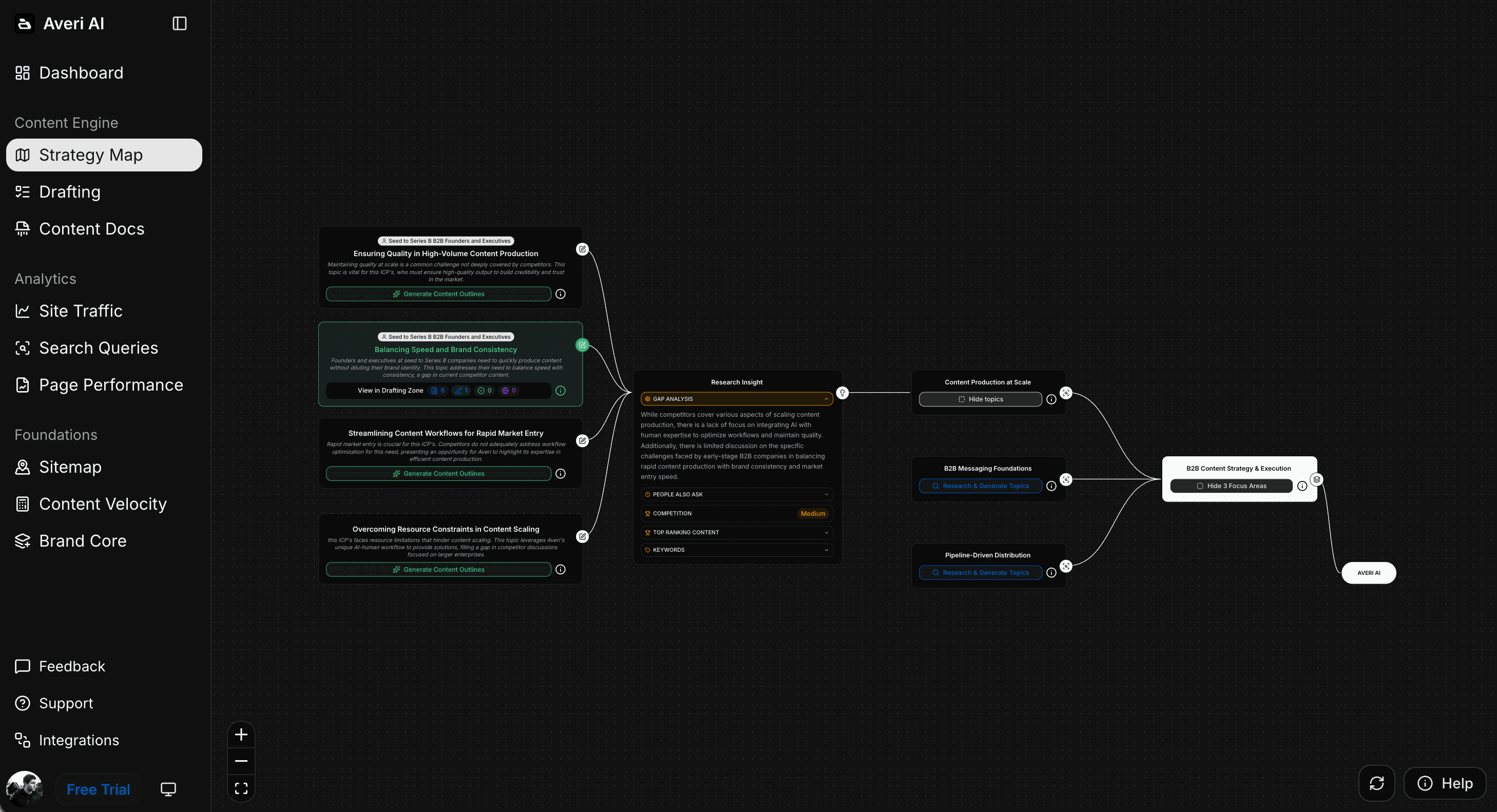
Document brand voice, tone rules, ICP segments, competitor positioning, banned terms, preferred messaging anchors, case study sources. This is the input layer every other function consumes. A human content engineer builds it from interviews and documentation review over 6–8 weeks. An AI content engineer generates it from website analysis, public positioning, and ICP signals in 30–60 minutes of onboarding.
Function 2: Strategy Map
Map content opportunities against business goals, ICP segments, funnel stages, and AI citation patterns. Identify the topic clusters that will compound. A human content engineer runs this through Ahrefs, Semrush, and competitive gap analysis over 4–6 weeks. An AI content engineer generates the strategy map from the Brand Core in the same first hour.
Function 3: Content Queue
Translate the strategy map into a working pipeline of specific pieces, briefed and ready to draft. A human content engineer manages this in Notion or Airtable, refreshed weekly. An AI content engineer keeps the queue continuously refreshed from analytics signals and editorial calendar pacing.
Function 4: AI Drafting With Brand Voice Loaded
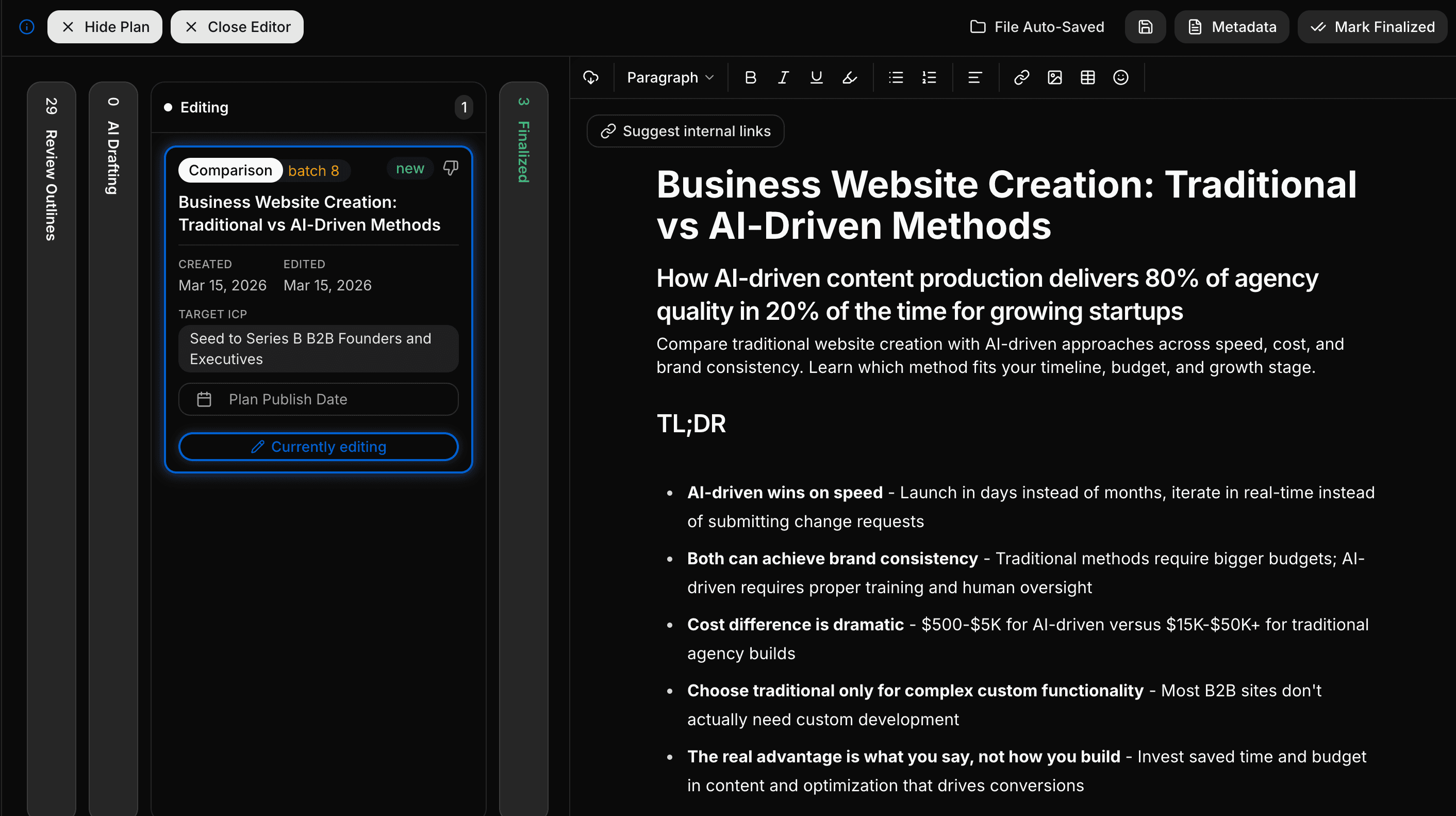
Generate first drafts that read in your voice from the first sentence. A human content engineer wires this in Jasper, Claude, or custom AI pipelines, with brand kits and tone calibration that take weeks to dial in. An AI content engineer drafts with the Brand Core loaded from session one, so the first draft already sounds like the brand.
Function 5: SEO + GEO Scoring
Score every draft against both traditional SEO (keywords, structure, internal linking, schema) and generative engine optimization (direct-answer formatting, fact density, citation worthiness, first-person experience markers). A human content engineer stitches Surfer SEO, ContentKing, and manual GEO heuristics. An AI content engineer scores dual-layer at draft time, with recommendations against the latest May 15 Google AI optimization guide.
Function 6: CMS Publishing And Analytics Feedback
Ship pieces directly to your CMS with schema, image specs, and meta correctly applied. Pull performance data back into the queue to direct future content creation. A human content engineer wires this in Zapier and Make automations that take weeks to debug. An AI content engineer does it natively.
The full six-function breakdown lives in its own piece. The key observation is that these are systems, not crafts. They benefit from being run by something built to run systems.
The craft layer — POV, experience, contrarian opinion, lived expertise — stays human.
Everything else is software.
The Math: $1,188 Vs $200,000 In Year One
The case becomes obvious when you look at the numbers next to each other.
Component | Human Content Engineer (Year 1) | AI Content Engineer (Year 1) |
|---|---|---|
Base compensation | $161,000 (mid-level, US-remote) | $0 |
Benefits (health, retirement, PTO) | +$24,000 (~15% of base) | $0 |
Payroll taxes (FICA, FUTA, SUTA) | +$13,000 (~8% of base) | $0 |
Equipment, training, AI tool stack | +$3,000 | $0 |
Software subscription | N/A | $1,188 (Solo $99/mo) |
Ramp time before first piece ships | 4–6 weeks | <5 days |
Production capacity at month 6 | Equivalent of 1 senior content marketer | Continuous output, throttled only by review time |
Fully loaded Year 1 cost | ~$201,000 | $1,188 (Solo) — $4,788 (Agency) |
The 168x cost ratio holds at the Solo tier.
At the Agency tier ($399/month for unlimited seats), it's still a 42x cost differential.
For a seed-stage startup with $18 months of average runway, the human hire consumes the equivalent of 6 months of operational runway. The AI version consumes the equivalent of one founder lunch per month.
The cleaner framing is in unit economics, not just absolute dollars.
A human content engineer earns $805 per working day fully loaded.
The AI content engineer at Solo tier costs $3.25 per day.
For a seed-stage team, the question isn't whether the human is worth more than the software — they may very well be at the right stage — it's whether they're worth 248x more on the day you're making the decision.
At seed and early Series A, almost never.
Why The Role Exists As Software First
The pattern here is older than AI. Every operational role that gets defined by a set of repeatable systems eventually gets instantiated as software before it gets instantiated as a job title in every company.
Bookkeeping became QuickBooks before most small businesses hired bookkeepers.
Media planning became Google Ads Manager before most small companies hired media planners.
Customer support routing became Zendesk before most companies hired support ops leads.
Each of these followed the same pattern: a role emerged at the enterprise stage, the work was decomposed into systems, the systems became software, and the role only became a hiring decision again when scale or complexity exceeded what the software handled.
Content engineering is on the same trajectory.
The role was first articulated in 2024 at companies like Webflow, Vanta, and Klaviyo — all post-Series-B with established content teams. By early 2026, the six functions had been documented well enough that the software version became possible. By mid-2026, the AI content engineer is what most companies should be running as their first content infrastructure investment, before they consider whether to hire the human version on top.
The human content engineer doesn't disappear.
They sit on top of the software, doing the work that doesn't compress into a system: editorial judgment on what the company actually believes, opinion on what conventional wisdom is wrong, decisions about which experiments to run, relationships with the experts being interviewed.
The split is the same one that runs in every other software-replaced role: the system runs the system, the human runs the strategy.
Where most founders get confused is treating the AI version as a substitute for the human version. It isn't.
It's the foundation the eventual human version will sit on. Hiring a human content engineer to build the foundation is like hiring a contractor to install QuickBooks — possible, but the wrong shape of investment.
When To Choose Each: The Decision Framework
The honest version of the comparison is that both options work at the right stage. The trick is matching the option to your company at this date.
Dimension | AI Content Engineer Fits | Human Content Engineer Fits |
|---|---|---|
Team size | 1–14 people | 15+ with dedicated content team |
Content production volume | 4–24 pieces per month | 25+ pieces monthly across formats |
ARR | $0–$10M (pre-seed to Series A) | $10M+ (Series B and beyond) |
Content budget | $99–$5,000 monthly | $200,000+ annually |
CMS stack | Webflow, Framer, WordPress | Contentful, Sanity, ContentStack |
Editorial review bandwidth | 5–20 hours per week (founder or marketer) | 40+ hours weekly (dedicated team) |
Time to first published piece | <5 days | 4–8 weeks |
Decision speed required | Same-day | Multi-quarter |
The full decision framework piece walks through the dimensions in detail and provides the operational triggers for when to upgrade from one to the other.
The framework also corrects a common misread.
Series A is not the trigger for hiring a human content engineer. ARR is necessary but not sufficient.
The actual triggers are operational: production capacity exceeding the AI version's ceiling, multi-brand or multi-region needs emerging, content driving 25%+ of pipeline (so further investment has clear ROI), and editorial review time exceeding 20 hours weekly.
When three or more triggers fire simultaneously, the hire becomes the right move. Most teams that try to hire on Series A funding alone end up with a $200K hire whose first six months reconstruct what the AI version would have shipped on day one.
What Most Founders Get Wrong About This Decision
Four beliefs hold founders back from making the structurally correct choice. Each one survives because it sounds reasonable.
Belief 1: "I need someone to do the work."
What you need is the work done. Those are different problems. A human content engineer does the work by building systems that do the work. An AI content engineer is the systems that do the work, available on day one. The founder confusion is hiring the builder when what they need is the built.
Belief 2: "AI can't write in our voice."
This was true in 2023. It is not true in 2026 when the AI is loaded with a Brand Core that captures voice, positioning, ICPs, banned terms, and preferred rhythms. We covered the operational difference between generic AI output and brand-loaded AI output in the AI content crisis piece. Voice is solved at the input layer, not the output layer. The teams complaining about AI voice quality are running AI tools without Brand Core context.
Belief 3: "I'll buy a humanizer tool after the AI drafts."
Humanizer tools fix surface vocabulary patterns. They do not fix the four other tells that mark AI content as AI content: false breadth, list-of-three syndrome, sourceless stats, "in conclusion" transitions. The fix is upstream — load the Brand Core before drafting, add first-person experience markers in editing — not downstream. A $20/month humanizer subscription on top of a poorly-contextualized AI tool produces worse output than $99/month with Brand Core loaded.
Belief 4: "Once we hit Series A we should hire."
Series A funding is permission to hire, not a signal that you need to. The triggers for hiring a content engineer are about content operations exceeding the AI version's ceiling, not about whether the bank account can fund the salary. The $200K marketing hire that never delivered piece covers the failure pattern… Series A startups that hired prematurely, then spent the next 6–9 months realizing the hire was reconstructing what software could have shipped immediately.
The Operational Setup: How To Start In 60 Minutes
The Day 1 sequence with an AI content engineer, walked through end-to-end.
Minutes 0–10: Brand Core onboarding. Paste your website URL and select your category. The system analyzes positioning, voice samples, ICP signals, and competitor set. You confirm or correct what gets pulled. Brand Core lives as a stored context layer the AI loads for every draft.
Minutes 10–25: Strategy Map generation. Connect Google Search Console and Google Analytics (or skip if you're pre-traffic). The system generates a 90-day content strategy mapped to your ICP, funnel stages, and topic clusters with AI Overview citation potential. Review and edit.
Minutes 25–45: First content queue review. The system produces a content queue from the Strategy Map. You see the first 12 piece briefs with target keywords, primary angles, internal link plans, and SEO + GEO score forecasts. Reorder by priority. Adjust briefs as needed.
Minutes 45–60: First draft generated. Select piece one from the queue. The AI drafts with Brand Core loaded — voice, banned terms, first-person experience markers, fact density requirements built in. Review the draft for the parts only you can add: contrarian POV, specific tests you ran, numbers you measured. Score before publish.
Day 1 outcome. Brand Core operational. Strategy Map live. Content queue running. First piece in editorial review. By end of day two or three, the first piece is published — same week, not same quarter.
Compare to the human content engineer's first 60 minutes: a coffee. Their Brand Core won't exist for 4–8 weeks. The strategy map will follow another 4–6. The first published piece typically lands in week 12–16.
The AI version is the same six-month build state, available in the time it takes to onboard the human hire to your Slack workspace.
The full version of this operational sequence is documented in the AI content engine build guide and the Averi workflow walkthrough.
When To Eventually Upgrade To A Human Content Engineer
The role is real. The hire is right at the right stage. Three triggers tell you when the AI version is no longer enough.
Trigger 1: Production capacity ceiling. When you're publishing 25+ pieces monthly across multiple formats (long-form, video transcripts, gated assets, sales enablement, partner content) and the AI version is bumping against tier limits or editorial review time, the human content engineer becomes the right investment. Not because the AI ran out of capability — it didn't — but because the volume justifies dedicated human hands managing the pipeline.
Trigger 2: Multi-brand or multi-region complexity. Operating two or more brands, three or more languages, or a complex segmented voice strategy across product lines creates governance work that benefits from a dedicated owner. At that complexity level, the human content engineer becomes the conductor of multiple AI content engine instances.
Trigger 3: 25%+ of pipeline from content. When content is the largest single growth channel and contributes more than 25% of pipeline, further investment has predictable ROI. The math finally works on a $200K hire because they're building on top of an established channel, not trying to discover whether one exists.
When all three trigger simultaneously, run the hire. The role is real, the people who do it well are valuable, and your AI content engineer becomes the substrate they build on rather than a substitute for them. The full upgrade decision framework is here.
Most seed-stage and Series A teams will not hit all three triggers for 18–36 months after they start using an AI content engineer.
By then, they have data showing exactly what the hire should do and the platform they can do it in… which makes the eventual hire dramatically more likely to succeed.
The Comparison Most Founders Eventually Run
Question | If you hire a human content engineer | If you use an AI content engineer |
|---|---|---|
Cost in Year 1 | ~$201,000 fully loaded | $1,188 (Solo) – $4,788 (Agency) |
Time to first published piece | 4–16 weeks | <5 days |
What gets built in first six months | Brand Core, Strategy, Queue, Workflow, Scoring, Publishing, Analytics — manually | Same six functions, packaged, day-one operational |
What you give up | Six months of runway equivalent | Configurability for unique enterprise edge cases |
When the investment pays back | Month 7–9 if hire works out | Same week — first piece shipped |
What you do with the savings | N/A | Editorial review time, distribution, founder content, paid acquisition tests |
Failure mode | $200K reconstructing what software does | Bumping against tier limits at scale (good problem) |
Reversibility | Severance, transition, knowledge loss | Cancel subscription |
The asymmetry isn't subtle. For a seed-stage team, the AI version is the structurally correct choice on every axis except enterprise CMS integration depth and ultra-custom workflow flexibility — neither of which a seed-stage team needs yet.
Meet your AI content engineer in 10 minutes
Averi onboards you through Brand Core, Strategy Map, and your first published piece in less time than it takes to write a job description for the human version.
$99/month for the Solo plan. 14-day free trial. No credit card.
FAQs
What is an AI content engineer?
An AI content engineer is a software platform that performs the same six functions a human content engineer would: Brand Core, Strategy Map, Content Queue, AI Drafting, SEO + GEO Scoring, and CMS Publishing with Analytics Feedback. It is not a tool that helps a content engineer do their job. It is the role itself, instantiated as software, designed to ship the six-month build state on day one and run continuously from there. Full definition lives here.
How much does an AI content engineer cost compared to hiring one?
A fully loaded human content engineer hire in the US runs approximately $201,000 in Year 1 — $161,000 base salary plus ~25% benefits, taxes, equipment, and tool stack. The AI content engineer equivalent (Averi Solo) costs $1,188 annually. That's a 168x cost differential. Even at the Agency tier ($399/month), the differential is 42x. For seed-stage teams with ~18 months of average runway, the human hire consumes the equivalent of 6 months of operational runway.
What does an AI content engineer actually do?
It runs six functions continuously: builds and maintains a Brand Core that captures voice and positioning, generates a 90-day Strategy Map mapped to your ICP and topic clusters, manages a continuously refreshed Content Queue, drafts pieces with brand voice loaded from session one, scores every draft against both SEO and GEO criteria, and publishes directly to your CMS with schema applied. The six-function breakdown covers each in detail.
Can an AI content engineer really write in my brand voice?
Yes, when it's loaded with a Brand Core that captures voice rules, ICP segments, banned terms, preferred sentence rhythms, and case study sources before any draft generation. The teams complaining about AI voice quality are running AI tools without stored brand context — which is the same as asking a contractor to do work without a brief. With Brand Core loaded, the first draft already reads in your voice, and the editor's job becomes adding lived experience and POV, not rewriting baseline structure.
When should I switch from an AI content engineer to a human content engineer?
Switch when three triggers fire simultaneously: production volume exceeds 25 pieces monthly across multiple formats, multi-brand or multi-region complexity emerges, and content contributes 25%+ of pipeline. ARR is necessary but not sufficient — Series A funding without operational triggers usually produces a $200K hire whose first six months reconstruct what software shipped on day one. Full upgrade triggers documented here.
Does an AI content engineer replace human marketers entirely?
No, and it shouldn't. The AI content engineer runs the systems — Brand Core maintenance, queue management, drafting, scoring, publishing. The human layer above it adds the parts that don't compress into systems: editorial judgment, contrarian POV, lived experience, expert interviews, opinion. Most seed-stage teams run the AI content engine with 5–15 hours of weekly human editorial review. The split is the system runs the system; the human runs the strategy.
Is Averi the AI content engineer or a tool a content engineer would use?
Averi is the AI content engineer. The distinction matters: a tool a content engineer would use (Jasper, Copy.ai, Surfer SEO, Writesonic) requires someone in the role to make it work. Averi is the role itself, packaged as software, designed to run the six functions on day one without requiring a separate content engineer hire to operate it. The founder or marketer using Averi is the editorial reviewer, not the engineer.
Related Resources
The AI Content Engineer
AI Content Engineer vs Human Content Engineer: When Each Wins
The Rise of the Content Engineer: Marketing's Most In-Demand Role
2026 Is The Year You Probably Should Become A Content Engineer
Buy-vs-Hire Economics
Build a Killer Startup Marketing Team Without Full-Time Hires
Copy.ai vs Jasper vs Averi: Which AI Content Platform Is Right For You
Operational Setup
The AI Content Crisis: Why Your Brand Voice Sounds Like Everyone Else's
How to Create Thought Leadership Content That Doesn't Sound AI-Generated
Category Definitions
The role is real. The hire decision is timing, not legitimacy. Use the next two years to build the operation an eventual human content engineer can grow.