First-Party Data for Startups: Building Your Audience Before the Cookies Fully Crumble

Zach Chmael
Head of Marketing
6 minutes

In This Article
This is the first-party data advantage for startups. And the window to build it is closing faster than most founders realize — not because of any single policy change, but because every month you wait is a month of compounding audience growth surrendered to competitors who started earlier.
Updated
Trusted by 1,000+ teams
Startups use Averi to build
content engines that rank.
TL;DR:
🍪 Google delayed cookie deprecation again. But the startups that already built their email lists aren't complaining — they're closing deals while competitors scramble for rented audiences
📊 70% of B2B marketers plan to increase first-party data usage in 2026. Activating first-party data reduces customer acquisition costs by up to 50% and drives 10-15% revenue lift
📧 Owned media is now the third-highest investment priority for content marketers (32%), behind AI tools and events — because owned audiences don't disappear when an algorithm changes
🏗️ For startups, first-party data isn't a compliance project. It's a growth moat: every email subscriber, content downloader, and product trial user is an asset your competitors can't access or replicate
⚡ The playbook: use your content engine to build an audience, capture data through value exchange, and create a feedback loop where content drives subscribers, subscribers signal what to create next, and the cycle compounds

Zach Chmael
CMO, Averi
"We built Averi around the exact workflow we've used to scale our web traffic over 6000% in the last 6 months."
Your content should be working harder.
Averi's content engine builds Google entity authority, drives AI citations, and scales your visibility so you can get more customers.
First-Party Data for Startups: Building Your Audience Before the Cookies Fully Crumble
Google Delayed Cookie Deprecation. Again. Who Cares?
Certainly not the startups who've been building their email lists for the past three years.
The cookie saga has become background noise — Google announces another delay, the ad industry exhales, and everyone goes back to pretending that third-party targeting will work forever. But the underlying trajectory hasn't changed. Browsers are restricting tracking. Privacy regulations are expanding. Users are opting out. The rented audience model is structurally decaying, regardless of what Google does with its timeline.
Meanwhile, a quiet divergence is happening in B2B.
One group of startups is still dependent on third-party data — buying intent signals, renting audiences from platforms, and hoping the targeting holds up through another algorithm change. The other group built their own audience. They own the email list. They control the distribution channel. They know exactly who's reading their content, what they care about, and when they're ready to buy — because those people opted in voluntarily.
That second group isn't worried about cookies. They're worried about what to write next for the 4,000 subscribers who actually want to hear from them.
This is the first-party data advantage for startups. And the window to build it is closing faster than most founders realize — not because of any single policy change, but because every month you wait is a month of compounding audience growth surrendered to competitors who started earlier.

What Is First-Party Data and Why Does It Matter More for Startups?
First-party data is information you collect directly from your audience through your own channels — your website, your email list, your product, your content downloads. It's data people gave you voluntarily because you offered something valuable in exchange.
This is categorically different from third-party data (information collected by external platforms about people who've never interacted with you) and second-party data (someone else's first-party data that you've purchased).
For enterprise companies with massive ad budgets, the shift to first-party data is a compliance and efficiency project. For startups, it's something more fundamental: a growth moat.
Here's why the distinction matters more at the startup stage:
You Can't Outspend the Competition on Rented Audiences
Third-party targeting — buying intent data, running retargeting pixels, purchasing lookalike audiences — works when you have budget. A Series C company can spend $50K/month on paid acquisition and absorb the increasing CPMs and declining targeting accuracy as a cost of doing business. A seed-stage startup spending $2K/month on ads is competing for the same audiences at a structural disadvantage. You're renting access to an audience someone else controls.
First-party data inverts this dynamic.
Your email list doesn't cost more when a competitor enters the market. Your content library doesn't get bid up in an auction. Your subscriber base isn't subject to an algorithm change that decimates your reach overnight. These are owned assets with compounding value that your competitors cannot access, replicate, or outbid.
First-Party Data Is the Highest-Quality Signal You'll Ever Get
Third-party intent data tells you that "someone at Company X visited a page about CRM software."
Your first-party data tells you that "Sarah, VP of Marketing at Company X, read your three-part guide on content marketing for PLG, downloaded your content strategy template, and subscribed to your newsletter last Tuesday."
One of these signals lets you send a generic outbound email. The other lets you send a perfectly timed, contextually relevant message that references exactly what she's been researching. The conversion rate difference isn't marginal — Forrester research shows businesses using first-party data strategies experience a 2x increase in conversion rates and a 30% reduction in customer acquisition costs.
Your Audience Data Teaches You About Your Market
For pre-PMF and early-stage startups, first-party data isn't just a marketing asset. It's market intelligence. Which content topics drive the most downloads? Which email subjects get the highest open rates? Which product pages do trial users visit before converting? What questions do subscribers reply with?
This behavioral data — collected from people who voluntarily engaged with your brand — is more reliable than survey responses, more actionable than investor hypotheses, and more honest than customer interviews. It tells you what people actually do, not what they say they do.

The Four Layers of First-Party Data for Startups
Not all first-party data is created equal. For startups building their audience, there's a natural hierarchy — from broadest reach to deepest signal.
Layer 1: Content Consumption Data
What it is: Anonymous behavioral data from your website visitors — pages viewed, time on page, scroll depth, content type preferences, search queries that brought them to you.
How to capture it: Google Analytics, Google Search Console, and platform-native analytics. This is the data you get automatically when someone visits your site.
Why it matters: It's the broadest layer of first-party data, and it tells you what your market cares about before anyone raises their hand. If 500 people per month read your article on "content marketing for startups" and 50 people per month read your article on "enterprise marketing automation," the market is speaking. Your content queue should listen.
Startup action: Set up GA4 and Search Console from day one. Use the Search Queries data to identify what your audience is actually searching for — not what you think they're searching for. Feed these signals into your content strategy.
Layer 2: Email Subscriber Data
What it is: Contact information and engagement data from people who've opted into your email list — newsletter subscribers, content downloaders, webinar registrants.
How to capture it: Lead magnets, newsletter sign-up forms, content gates (used sparingly and strategically), product waitlists, and free tool access.
Why it matters: This is the transition from anonymous to known. An email subscriber has made a conscious decision to hear from you. The data they generate — opens, clicks, replies, forwards — tells you exactly what resonates and what doesn't. And unlike social media followers, your email list is an owned channel: no algorithm sits between you and your subscriber.
Startup action: Build your email list from day one. The newsletter is the simplest vehicle — valuable content delivered consistently earns subscribers who stick. Free tools, templates, and calculators (the resources you're probably already creating) are lead magnets that capture emails in exchange for genuine value. Don't gate everything — gate the pieces that deserve it.
Layer 3: Product Usage Data
What it is: Behavioral data from people who've used your product — trial signups, feature usage, onboarding completion, in-app behavior.
Why it matters: This is the highest-intent first-party data you'll collect. Someone who signed up for a free trial and used three features in their first session is categorically different from someone who read a blog post. Product usage data tells you who's ready to buy, who needs nurturing, and what your product-market fit actually looks like.
Startup action: If you have a PLG motion, instrument your product analytics from day one. Track which features trial users engage with, where they drop off, and what they do right before converting. This data isn't just for marketing — it's for product, sales, and fundraising.
Layer 4: Zero-Party Data
What it is: Information your audience voluntarily shares beyond what's required — survey responses, preference selections, quiz results, feedback, feature requests.
Why it matters: Zero-party data is the gold standard because the user is explicitly telling you what they want. When a subscriber replies to your newsletter saying "I'm struggling with content distribution" or fills out a quiz that reveals they're a seed-stage founder with no marketing team — that's more valuable than any intent signal you could purchase.
Startup action: Build zero-party data collection into your content touchpoints. End newsletter editions with a question. Include quizzes and self-assessment tools in your resource library. Survey your audience quarterly (keep it short — 3 questions max). Every response makes your content engine smarter about what to create next.
The Content Engine ↔ First-Party Data Feedback Loop
Here's the mechanism that most first-party data guides miss: your content engine and your first-party data strategy aren't separate workstreams. They're a feedback loop.
Content drives first-party data collection. Every blog post that ranks on Google or gets cited by AI search brings visitors to your site. A percentage of those visitors subscribe to your newsletter, download a template, sign up for a free trial, or engage with a tool. Your content is your primary first-party data collection engine.
First-party data improves your content. Which topics drive the most email signups? Which articles produce the most trial conversions? What search queries bring visitors who actually subscribe? This data flows back into your content intelligence layer, shaping which topics the queue recommends next. You're not guessing what your audience wants — they're telling you through their behavior.
The loop compounds. More content → more visitors → more subscribers → more data → better content → more visitors. Each cycle strengthens the others. By month 12, the startup running this loop has an owned audience of thousands, a deep behavioral dataset, and a content engine that knows exactly what to create because the audience data told it. The startup that skipped first-party data has traffic from rented channels that vanishes when the budget does.
This is why CMI's 2026 report shows owned media as the third-highest investment priority for content marketers: because owned audiences compound, and rented audiences don't.
The Startup First-Party Data Playbook
You don't need a CDP, a data engineering team, or a $100K martech stack.
Here's what to do in the first 90 days:
Days 1-7: Foundation
Set up analytics. GA4 + Google Search Console on your website. This is non-negotiable. Every day without analytics is a day of visitor data lost forever.
Create an email capture. Newsletter sign-up on your blog, embedded in your homepage, and on every resource page. Don't overcomplicate it — name + email + clear value proposition ("Get weekly insights on [topic your ICP cares about]").
Launch a newsletter. Even before you have subscribers. Consistent publishing builds the archive that attracts future subscribers. Biweekly is fine. Weekly is better. The content can be repurposed from your blog articles — you're not creating net-new work.
Days 8-30: Content Engine Activation
Start your content engine. Publish consistently — 2-3 articles per week using your content engine workflow. Every article is a potential first-party data collection point: it brings visitors, some of whom subscribe.
Create 2-3 lead magnets. A content strategy template, a calculator, a checklist, a framework document. Something genuinely useful that your ICP would exchange their email for. Gate them behind a simple form. Place them contextually within blog posts that address the same topic.
Add email capture to every blog post. Not intrusive pop-ups — contextual CTAs within the content. "Want the full template? Subscribe to get it delivered to your inbox." The conversion rates on contextual, value-aligned CTAs outperform generic "subscribe to our newsletter" boxes by 3-5x.
Days 31-60: Data Activation
Segment your list. By signup source (which article or lead magnet they came through), by engagement (opens, clicks), and by behavior (did they also start a trial?). Even basic segmentation — "high-engagement subscribers" vs. "dormant" — enables personalized content that dramatically outperforms batch-and-blast.
Connect analytics to content decisions. Which blog posts drive the most email signups? Those topics should get more investment — more articles in that cluster, deeper coverage, supporting content. Which posts get traffic but no conversions? They need better CTAs or aligned lead magnets. This is the closed-loop feedback that makes your content engine smarter.
Start a simple nurture sequence. When someone subscribes, send a 3-email welcome sequence: (1) deliver the promised value, (2) share your 3 best-performing articles, (3) soft introduction to your product. This converts passive subscribers into active readers — and some into trial users.
Days 61-90: Compounding
Review your data landscape. How many subscribers? What's the growth rate? Which sources drive the highest-quality subscribers (the ones who open, click, and convert)? What does your search query data tell you about emerging audience interests?
Survey your list. Ask 3 questions: What's your biggest challenge with [your domain]? What topic should we cover next? How did you find us? The responses are zero-party data gold — they tell you exactly what to create, and the answer source data informs your acquisition strategy.
Map your first-party data to your content strategy. By day 90, your content engine should be informed by three signals: keyword data (what people search for), competitive intelligence (what competitors aren't covering), and first-party audience data (what your subscribers actually engage with). The third signal is the one your competitors don't have — because they don't have your audience.
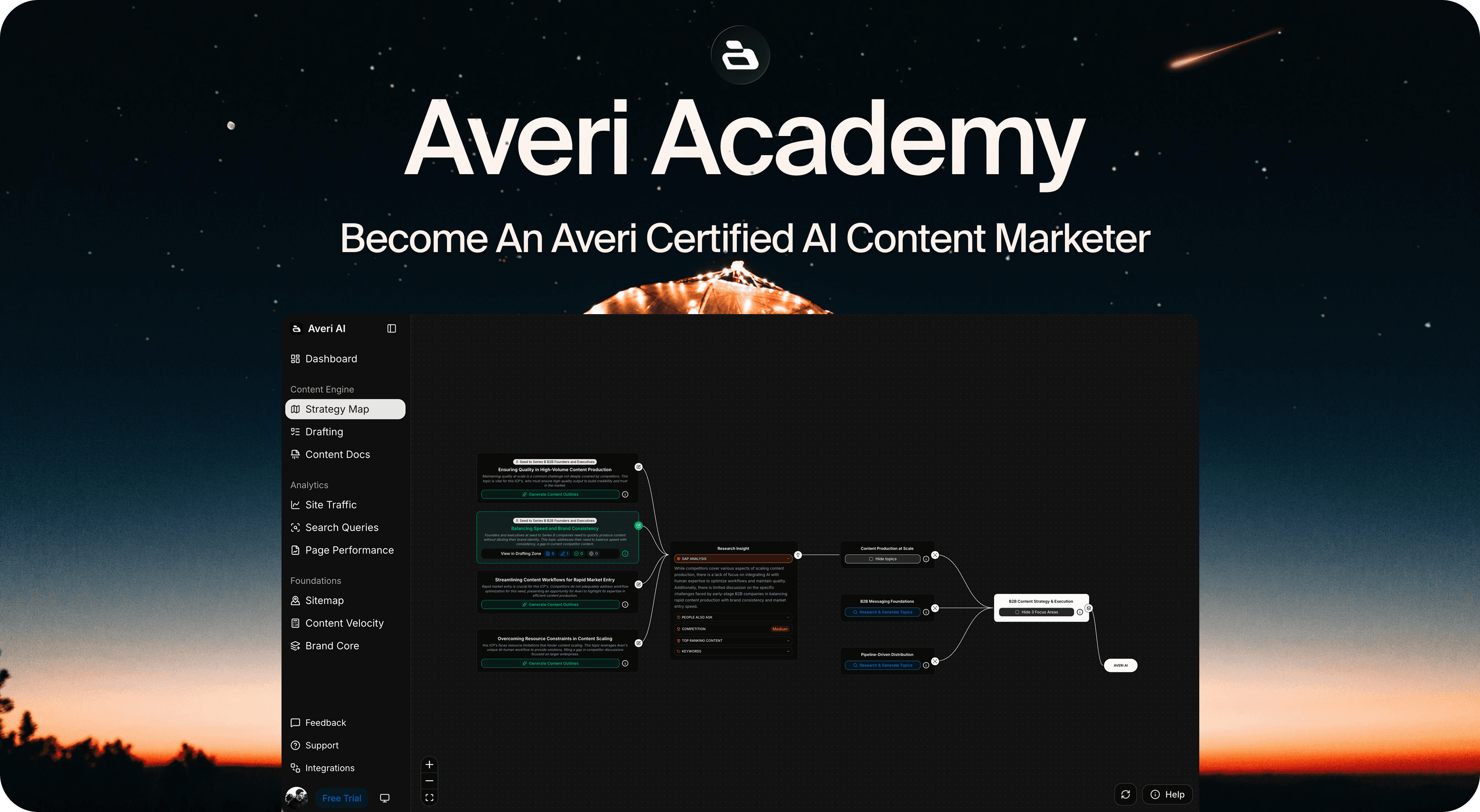
How Averi Powers the Content-to-Audience Loop
Averi doesn't just help you publish content. It helps you build the content engine that builds your audience — which feeds data back into the engine that makes your content better.
Content Queue generates the topic recommendations that keep your publishing cadence consistent — which keeps your audience growing. No publishing gaps mean no audience growth stalls.
Analytics track which content drives traffic, which search queries bring visitors, and how your content performs across both Google and AI search platforms. This data tells you which topics your audience actually cares about — the first-party intelligence that shapes what you create next.
SEO + GEO optimization ensures every piece is discoverable across both traditional and AI-powered search — maximizing the audience reach of every article and expanding the top of your first-party data funnel.
CMS publishing eliminates the friction between "content created" and "content published" — so your audience-building machine never stalls because someone didn't have time to format a blog post.
Library compounds the intelligence from every published piece, making future content more aligned to what your audience has already shown interest in. The engine learns from your audience's behavior — not from generic benchmarks.
The content builds the audience. The audience informs the content. The engine connects both. That's the loop that rented data can never replicate.
Start building your content engine →
Related Resources
FAQs
What is first-party data?
First-party data is information collected directly from your audience through your own channels — website visits, email subscriptions, product usage, content downloads, and survey responses. Unlike third-party data (collected by external platforms), first-party data is opted-in, more accurate, and fully owned by your business. It's the foundation of owned audience strategy.
Why does first-party data matter more for startups than enterprise?
Enterprise companies can absorb the rising costs and declining accuracy of third-party targeting. Startups can't. First-party data gives startups an owned asset that compounds over time without competing in paid audience auctions. Your email list doesn't cost more when a competitor enters the market. Your subscriber data doesn't degrade when an ad platform changes its algorithm.
How does content marketing connect to first-party data?
Content is the primary collection mechanism for first-party data. Every blog post that ranks brings visitors. Some visitors subscribe. Subscribers generate engagement data. That data informs what to create next. This content-to-audience feedback loop is why content engines and first-party data strategies are inseparable — each one powers the other.
What's the difference between first-party and zero-party data?
First-party data is behavioral — observed from how people interact with your channels (page views, email clicks, product usage). Zero-party data is declarative — explicitly shared by the user (survey responses, quiz results, stated preferences, feature requests). Both are owned. Zero-party data is typically more accurate because users are directly telling you what they want.
How quickly can a startup build a meaningful first-party data asset?
With consistent publishing and audience capture, most startups see meaningful traction within 90 days — a few hundred to a thousand email subscribers, enough engagement data to identify top-performing content types, and sufficient search query data to inform content strategy. By month 6-12, the audience and data become a genuine competitive moat.
Do I need a CDP or expensive tools to build first-party data?
No. Startups need three things: analytics (GA4 + Search Console, free), email platform (beehiiv, ConvertKit, or Mailchimp — free or low-cost at startup scale), and a content engine to maintain publishing consistency. The infrastructure scales with you. Start simple, add sophistication as your audience grows.
What's the relationship between first-party data and GEO?
Content optimized for GEO (AI search citations) expands your reach beyond Google — getting cited by ChatGPT, Perplexity, and AI Overviews. This expanded discovery brings new visitors to your site, which expands your first-party data collection. GEO optimization and first-party data strategy are complementary: GEO maximizes the top of the funnel, first-party capture converts visitors into owned audience.