How a 1-Person Marketing Team Published 100 Blog Posts in 30 Days

Zach Chmael
Head of Marketing
7 minutes

In This Article
100 blog posts in 30 days. Not thin, keyword-stuffed filler. Real articles — researched, optimized, internally linked, and structured for both Google and AI search engines.
Updated
Trusted by 1,000+ teams
Startups use Averi to build
content engines that rank.
TL;DR
📊 The numbers are real. I'm the CMO and co-founder of Averi. I run all marketing. No content team. No agency. No freelancers. In a single 30-day window, I published 100 blog posts — each SEO and GEO-optimized, internally linked, and structured for AI search citation. This is the story of how and exactly what happened after.
⚡ The system, not the hustle. I didn't work 16-hour days. I averaged 5-6 hours per day on content — roughly 150-180 total hours across the month. That's ~1.5-1.8 hours per published piece including strategy, review, editing, and publishing. The AI handled research, first drafts, optimization, and formatting. I added perspective, approved, and published.
📈 The results. Organic impressions grew from ~50K/month to over 1.68 million. Traffic increased 6,000%+. We started appearing in ChatGPT and Perplexity responses. Pages began ranking within weeks instead of months. The content library hit a compounding tipping point where every new piece accelerated the performance of every previous piece.
🔧 I built Averi to do this. The content engine I used to publish 100 posts in 30 days is the same platform that's now available to every startup at $99/month. The workflow that produced these results isn't a secret — it's the product.

Zach Chmael
CMO, Averi
"We built Averi around the exact workflow we've used to scale our web traffic over 6000% in the last 6 months."
Your content should be working harder.
Averi's content engine builds Google entity authority, drives AI citations, and scales your visibility so you can get more customers.
How a 1-Person Marketing Team Published 100 Blog Posts in 30 Days (And How That System Became Averi)
The Starting Point: One Person, Zero Content, and a Ticking Clock
Six months before this 30-day push, Averi had almost no organic presence.
A handful of pages. Minimal search visibility. No content strategy. No topical authority.
We were a startup building an AI platform — and we hadn't done our own marketing yet.
The irony wasn't lost on me.
We were building a tool to help startups create content, and our own site was a ghost town. I was the only person doing marketing. No content team. No freelancers. No agency. Just me, a thesis about how content should work, and a clock ticking toward the next fundraise.
So I set a goal that most people thought was unreasonable: 100 blog posts in 30 days. Not thin, keyword-stuffed filler. Real articles — researched, optimized, internally linked, and structured for both Google and AI search engines.
Here's the part nobody expected… the system I built to pull this off didn't just save our marketing. It became the product.
The manual workflow I cobbled together to publish 100 posts as a solo operator is now the same content engine that thousands of startups use every day inside Averi.
This is the story of how I built that system, what happened when I ran it, and how we turned a scrappy marketing sprint into the product we sell today.

Week 0: Building the System From Scratch (2 Days)
Before I wrote a single word, I spent two days building the system — by hand — that would make everything else possible. I didn't have a polished product to lean on. I had a collection of tools, documents, and processes that I wired together into something that worked.
Brand context document. First, I built what I called a "brand bible" — a single document capturing our positioning, voice, ICPs, competitive landscape, messaging hierarchy, and product differentiators. I scraped our own website, studied our competitors' content, and distilled everything into a persistent context file that I could feed to AI at the start of every drafting session.
The insight: most AI content fails because the AI starts from zero context every time. If I could eliminate that cold start problem, the output quality would jump dramatically.
This document eventually became what we now call Brand Core inside Averi.
Topic architecture. I mapped out a visual content structure — pillars, clusters, and supporting topics organized around our core themes… AI content marketing, SEO/GEO for startups, content strategy, marketing tools, and startup growth. Not a spreadsheet of random blog ideas. An interconnected architecture where every piece would strengthen every other piece through topical authority signals and internal linking.
I built this in a combination of spreadsheets and Notion databases, manually mapping which topics supported which pillars and tracking which clusters needed more depth. It was clunky, but it worked.
This architecture became what we now call the Strategy Map.
Content type mapping. I mapped the 100 posts across intentional content types… long-form editorial pieces, tactical how-to guides, educational explainers, definition pages, competitive comparisons, strategic breakdowns, and actionable plays. Each type served a different search intent and a different stage of the buyer journey. This wasn't 100 versions of the same blog post — it was a comprehensive content ecosystem designed from the top down.
The scoring criteria. I created a manual checklist for every piece before it could publish… keyword targeting, internal link count, FAQ section present, statistics with attribution, meta description written, question-based H2s, answer blocks formatted for AI extraction. I couldn't score content automatically yet — but I knew exactly what "good" looked like, and I checked every piece against the same standard.
That checklist became the foundation for our Content Scoring system.
Total time on strategy: approximately 12 hours across two days. Every minute invested here saved 10+ minutes during production.
Weeks 1-4: The Production Rhythm
Here's the daily workflow that produced roughly 3-4 published posts per day, every day, for 30 days straight.
Morning (2 hours): Research and Draft Generation
Each morning started with the same process. I'd review my topic architecture, identify the 3-4 topics that were next in the cluster sequence, and pull together the research — keyword data from Ahrefs, competitor content analysis, relevant statistics, and source material.
Then I'd load my brand context document into Claude and generate drafts — feeding it the topic brief, the keyword targets, the content type requirements, and the structural standards from my checklist. The brand context file was the difference between getting generic AI output and getting something that actually sounded like us. Without it, every draft read like it could have been written by any SaaS company. With it, the drafts arrived with our positioning, our perspective, and our language already embedded.
By the time I poured my second coffee, I had 3-4 complete first drafts ready for editing.
The process of loading context, generating research-backed drafts, and organizing them into a queue — that entire morning workflow is what we eventually built into the Content Queue and drafting system inside Averi.
Midday (2.5 hours): Editing and the Human Layer
This was the critical step — and the one that separates content that ranks from content that gets ignored.
I reviewed each draft against three criteria:
Accuracy: Are the statistics real? Do the claims hold up? Are the sources credible?
Voice: Does this sound like Averi, not like generic AI? Does it have an opinion? Does it challenge something?
Perspective: Is there a founder insight, a contrarian take, or a specific example that only I could add?
For each post, I'd spend 20-40 minutes editing. Some posts needed minimal work — the AI nailed the angle, the research was solid, the structure was clean. Others needed heavier lifting — I'd rewrite the intro, add a personal anecdote, sharpen a weak section, or inject a perspective the AI couldn't have generated.
I'd manually check internal link density against my published inventory, verify that FAQ sections were present and substantive, and confirm that statistics had proper attribution.
All of this was manual. All of it was tedious. And all of it was non-negotiable.
This editing workflow — the human review layer with real-time quality checks — became the Editing Canvas and Content Scoring system in the product.
Afternoon (1 hour): Publishing and Distribution
Final review. Format for the CMS. Publish. Then manually update my tracking spreadsheet: title, URL, target keyword, publish date, cluster assignment, internal links added.
Each published piece went into my growing content library — a reference document that I'd feed back to the AI during the next morning's drafting sessions. Tomorrow's drafts would be slightly smarter because they could reference today's content, suggest connections to it, and build on the topical authority it established.
That manually maintained content library — the one I updated every afternoon — became the Library feature inside Averi, where every published piece automatically feeds back into the system's context for future drafts.
Some days I'd batch-publish — doing all editing in the morning and publishing 4-5 pieces in a single afternoon session. The rhythm varied, but the system stayed consistent.
The Weekly Numbers
Week 1: 22 posts published. Heavy process refinement. Learning the optimal editing rhythm. Lots of copy-paste between tools.
Week 2: 26 posts. Drafts started arriving closer to publication-ready as the brand context document matured and the Library grew.
Week 3: 28 posts. Internal linking became easier — I had enough published content to connect everything meaningfully. The clusters were filling in.
Week 4: 24 posts. Focused more on pillar-depth pieces that required heavier editorial input. The quality ceiling rose as the system matured.
30-day total: 100 posts.
Average time per post: approximately 1.5-1.8 hours (including research, drafting, editing, publishing, and tracking).
Total hours invested: roughly 150-180 hours across the month.

What 100 Posts in 30 Days Actually Looked Like
This wasn't 100 copies of the same generic AI blog post. Here's what the content library looked like at the end of the month:
Editorial blog posts covering AI marketing trends, startup growth strategies, content engineering, and contrarian takes on industry conventional wisdom. These were the thought leadership pieces — longer, more opinionated, designed to build brand authority.
Tactical how-to guides walking readers through specific workflows: how to build a content engine, how to optimize for GEO, how to do content marketing in 5 hours a week. High search intent, high conversion potential.
Definition pages establishing entity authority for key terms: topical authority, GEO, E-E-A-T, content velocity, pillar pages. Short, definitive, structured for featured snippets and AI citation.
Competitive comparisons positioning Averi against ChatGPT, Jasper, Copy.ai, and other alternatives. Bottom-of-funnel content designed to capture decision-stage traffic.
Strategic breakdowns and plays providing actionable frameworks for specific marketing challenges. Mid-funnel content that demonstrates expertise.
Every piece linked to multiple other pieces. The internal linking web grew exponentially as the library expanded — by week 4, I was manually adding 15-20+ contextual internal links per post because the Library had enough content to support it.
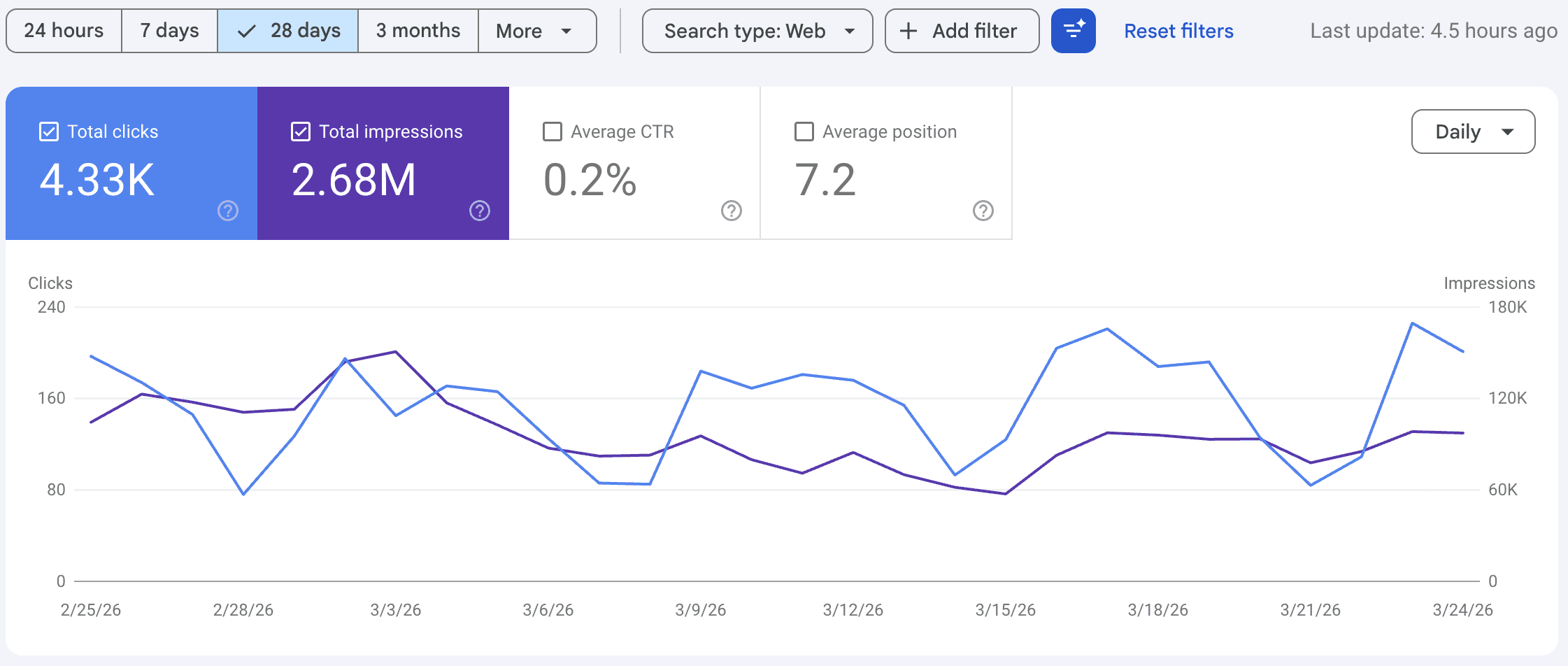
The Results: What Happened After
The publishing sprint ended. The compounding started.
Organic Impressions: 50K → 1.68 Million Monthly
The growth wasn't linear.
Months 1-3 were quiet — Google was crawling and indexing, but rankings hadn't materialized yet. Month 4, the first long-tail keywords started climbing. By month 6, the topical authority signals from 100 interconnected pieces hit a tipping point. Impressions accelerated. By month 9, we hit 1.68 million monthly organic impressions.
That's a 6,000%+ increase driven entirely by content — no paid ads, no viral stunts, no backlink campaigns.
Just systematic, pillar-based content production that built compound authority across our target topics.
AI Search Citations Started Appearing
By month 3, Averi started showing up in ChatGPT and Perplexity responses for queries like "AI content engine for startups," "GEO optimization tools," and "content marketing platforms for lean teams."
I hadn't done any specific GEO outreach — the citation-ready structure I'd baked into every draft (answer blocks, FAQ sections, statistics with attribution) was enough for AI systems to start referencing our content as authoritative sources.
Ranking Velocity Accelerated
Early posts took 8-12 weeks to rank for their target keywords.
By month 6, new posts were ranking within 2-3 weeks.
By month 9, some posts ranked within days of publication.
The domain authority had accumulated enough compound support that Google trusted new content from our domain faster.
This is the flywheel effect that makes a content engine fundamentally different from one-off content production. Each piece doesn't just generate its own traffic — it makes every future piece perform better.
How the System Became the Product
Here's the part that changed everything for Averi as a company.
During that 30-day sprint, I wasn't just publishing content. I was stress-testing a workflow. And every pain point I hit became a product feature.
The cold start problem — loading brand context into AI every session, re-explaining who we are, losing fidelity with every new conversation. That friction became Brand Core: persistent brand intelligence that loads once and applies to every piece forever.
The topic sprawl problem — managing a spreadsheet of 200+ topic ideas organized by cluster, content type, and priority without losing the strategic thread. That mess became the Strategy Map: a visual content architecture that shows how every piece connects.
The "what should I write next" problem — deciding each morning which topics to prioritize based on keyword opportunity, cluster gaps, and competitive movements. That decision fatigue became the Content Queue: AI-recommended topics surfaced daily, organized by impact.
The quality control problem — manually checking every piece against a 15-item checklist before publishing, catching missing FAQ sections, insufficient internal links, and unattributed statistics. That checklist became Content Scoring: automated quality evaluation across SEO and GEO dimensions in real-time as you edit.
The copy-paste publishing problem — formatting content for Framer, wrestling with CMS formatting, losing time on the last mile. That frustration became native CMS publishing: one click from draft to live on Webflow, Framer, or WordPress.
The context decay problem — maintaining a manually updated content library so that tomorrow's AI drafts could reference today's published work. That spreadsheet became the Library: automatic context accumulation where every published piece makes the next one smarter.
The measurement gap — tracking which pieces drove traffic, which keywords were climbing, and which AI platforms were citing our content, all across disconnected tools. That fragmentation became Analytics: Google Search Console integration, AI referral tracking, and performance-based recommendations in one dashboard.
Every feature in Averi today exists because I needed it during that sprint and it didn't exist yet.
The product isn't a theoretical vision of what content marketing should be.
It's a direct translation of the system that one person used to publish 100 posts in 30 days and grow organic traffic 6,000%.
What I'd Do Differently
Transparency matters, so here's what I'd change if I did this again.
Start with fewer, deeper pillar pieces. Some of the early posts were solid but not exceptional. If I'd spent the first week producing 5 genuinely definitive pieces instead of 22 good ones, those pillars would have ranked faster and supported the subsequent content more effectively.
Build the internal linking architecture more deliberately from day one. Early posts had fewer connections because the Library was still small. Retroactively adding internal links accelerated their performance — but building the cluster foundation first would have been more efficient.
Invest in distribution sooner. I was so focused on production that I under-invested in distribution during the sprint. LinkedIn promotion and newsletter distribution of key pieces would have shortened the time to traction.
Build the product while running the sprint. This is the one I wish I'd seen earlier. The system I was building by hand — the brand context documents, the topic maps, the scoring checklists, the Library updates — was the product. If I'd started translating those manual workflows into software from week 1, we would have launched the product months earlier.
Why This Matters for Your Startup
I'm not sharing this because I think every startup should publish 100 posts in 30 days.
That was a sprint specific to our situation — we needed to build a content library fast to prove our thesis.
The point is what the underlying system makes possible — and the fact that you don't have to build that system yourself anymore. I already did that part.
47% of startup founders do all their own marketing. 56% have one hour or less per day for it.
The conventional wisdom says that's not enough to build a real content program. And with disconnected tools, manual processes, and AI that forgets you between sessions — it's not.
But with a content engine that maintains your brand context, generates strategic recommendations, produces optimized drafts in your voice, scores content across multiple dimensions, publishes natively to your CMS, and compounds intelligence with every piece — the math changes completely.
You don't need 100 posts in 30 days.
You need 2-3 per week, published consistently, within a strategic architecture that compounds.
That's roughly 5 hours a week. That's $99/month.
And the compounding curve I described above — the one that took our impressions from 50K to 1.68 million — starts the same way regardless of velocity. It just starts.
The system I built by hand during those 30 days?
It's the same system you get access to on day one — except it's a product now, not a collection of spreadsheets and context documents held together with duct tape and stubbornness.
The workflow is the product. I know, because I lived in the workflow before it was one.
FAQs
Were These Posts Actually Good, or Just High-Volume AI Output?
They were editorially reviewed, brand-voiced, and structurally optimized. Every post went through human review focused on accuracy, voice, and perspective. AI handled the 80% (research, structure, optimization). I added the 20% (voice, opinion, founder expertise). The 6,000% traffic growth confirms Google rewarded the content, not penalized it.
How Long Were the Posts on Average?
The average was approximately 2,200 words. Editorial blog posts ran 2,500-3,500 words. How-to guides averaged 2,000-2,800 words. Definition pages were shorter at 800-1,200 words. Depth was calibrated to keyword competitiveness and content type — not arbitrary.
Didn't Google Penalize Publishing That Much AI-Assisted Content?
No. Google penalizes low-quality content regardless of origin — not AI-assisted content specifically. Our posts had named authorship, original perspectives, sourced statistics, comprehensive internal linking, and E-E-A-T signals throughout. The results speak for themselves.
Can a Non-Technical Founder Replicate This?
Yes — and at a more sustainable pace. The 100-post sprint required building the system from scratch while also running it. You don't have to do that part. The system is now a product. Most founders using Averi publish 2-3 posts per week in about 5 hours total. The same compounding curve applies — it just reaches the tipping point in month 4-6 instead of month 2-3. The engine is identical. The velocity is your choice.
What Were You Using Before It Became a Product?
A combination of ChatGPT for drafting (with my brand context document loaded each session), Ahrefs for keyword research, Google Sheets for topic tracking and content scoring checklists, Notion for the Strategy Map architecture, manual copy-paste for CMS publishing, and another spreadsheet for the Library of published content. It worked — but it was roughly 15 tools and manual processes duct-taped together. Every feature in Averi exists because I needed a better version of one of those duct-tape solutions.
What Does the Content Library Look Like Now?
As of March 2026, averi.ai has 1,000+ pages in the main sitemap — 361 blog posts, 345 guides, 112 learn articles, 33 definitions, 31 comparisons, 28 how-tos, 20 plays, and 15 breakdowns — plus 431+ free resources across tools, templates, guides, and industry content. All produced by a lean team using the same content engine that started as my manual workflow.
Related Resources
FAQs
Were These Posts Actually Good, or Just High-Volume AI Output?
They were editorially reviewed, brand-voiced, and structurally optimized. Every post went through human review focused on accuracy, voice, and perspective. AI handled the 80% (research, structure, optimization). I added the 20% (voice, opinion, founder expertise). The 6,000% traffic growth confirms Google rewarded the content, not penalized it.
How Long Were the Posts on Average?
The average was approximately 2,200 words. Editorial blog posts ran 2,500-3,500 words. How-to guides averaged 2,000-2,800 words. Definition pages were shorter at 800-1,200 words. Depth was calibrated to keyword competitiveness and content type — not arbitrary.
Didn't Google Penalize Publishing That Much AI-Assisted Content?
No. Google penalizes low-quality content regardless of origin — not AI-assisted content specifically. Our posts had named authorship, original perspectives, sourced statistics, comprehensive internal linking, and E-E-A-T signals throughout. The results speak for themselves.
Can a Non-Technical Founder Replicate This?
Yes — and at a more sustainable pace. The 100-post sprint required building the system from scratch while also running it. You don't have to do that part. The system is now a product. Most founders using Averi publish 2-3 posts per week in about 5 hours total. The same compounding curve applies — it just reaches the tipping point in month 4-6 instead of month 2-3. The engine is identical. The velocity is your choice.
What Were You Using Before It Became a Product?
A combination of Claude for drafting (with my brand context document loaded each session), Ahrefs for keyword research, Google Sheets for topic tracking and content scoring checklists, Notion for the Strategy Map architecture, manual copy-paste for CMS publishing, and another spreadsheet for the Library of published content. It worked — but it was roughly 15 tools and manual processes duct-taped together. Every feature in Averi exists because I needed a better version of one of those duct-tape solutions.
What Does the Content Library Look Like Now?
As of March 2026, averi.ai has 2,000+ pages in the main sitemap — 410 blog posts, 345 guides, 112 learn articles, 33 definitions, 31 comparisons, 28 how-tos, 20 plays, and 15 breakdowns — plus 431+ free resources across tools, templates, guides, and industry content on a subdomain. All produced by a lean team using the same content engine that started as my manual workflow.