The Definitive Guide to GEO: Get Cited by AI in 2026
Academic research + platform tactics + technical implementation + measurement + case study in ONE guide. The most complete GEO resource on the internet.

Averi Academy

In This Article
Academic research + platform tactics + technical implementation + measurement + case study in ONE guide. The most complete GEO resource on the internet.
Updated
Trusted by 1,000+ teams
Startups use Averi to build
content engines that rank.
TL;DR
🔬 GEO is the practice of optimizing content for citation by AI systems (ChatGPT, Perplexity, Google AI Overviews). Princeton research shows GEO techniques boost AI visibility by up to 40%.
📊 GEO ≠ SEO. Brand mentions correlate 0.664 with AI citation vs. 0.218 for backlinks. Promotional tone has -26.19% citation correlation. Different optimization problem, different signals.
🤖 Platform breakdown: ChatGPT drives 87.4% of AI referral traffic. Google AI Overviews reach 1.5B users. Each platform has distinct citation preferences covered in this guide.
✍️ The content framework: 40–60 word answer capsules, 1 statistic per 150–200 words, FAQ sections with 5–7 self-contained answers, non-promotional tone, front-loaded insights
🔧 Technical essentials: allow all AI crawlers in robots.txt, implement Organization + Article + FAQ schema, optimize for FCP under 1 second, add llms.txt
📋 50-point GEO audit checklist included: content structure, factual density, technical implementation, brand authority signals, content quality
📈 AI visitors convert 4.4x higher than traditional organic. The traffic share is small but growing fast and converting at dramatically higher rates.
⚡ Start free with Averi. Built-in GEO scoring, answer capsule structure, FAQ generation, and schema optimization in every piece. 14-day trial, no credit card.
"We built Averi around the exact workflow we've used to scale our web traffic over 6000% in the last 6 months."

Your content should be working harder.
Averi's content engine builds Google entity authority, drives AI citations, and scales your visibility so you can get more customers.
The Definitive Guide to GEO: Get Cited by AI in 2026
Search has split in two. The old search sends you a list of links. The new search gives you an answer.
In the old model, ranking meant visibility. If your page appeared on page 1, people saw it.
In the new model, ranking is necessary but not sufficient. Your page can rank #1 and still be invisible if the AI-generated answer above it cites your competitor instead of you.
AI Overviews now appear in roughly 50% of all search results.
ChatGPT has 883 million monthly users.
93% of Google AI Mode sessions end without a click to an external website.
The discovery layer, the mechanism through which people find information, has changed. The optimization required to show up in that layer has changed too.
That optimization is Generative Engine Optimization. GEO.
This guide is the most complete single resource on GEO available.
It covers the academic research, the platform-by-platform citation mechanics, the content framework, the technical implementation, the measurement system, and the real-world case study.
Everything you need to go from "what is GEO?" to executing it for your own content.

What Is Generative Engine Optimization (GEO)?
Generative Engine Optimization is the practice of optimizing digital content to increase its visibility in responses generated by AI systems, including ChatGPT, Perplexity, Google AI Overviews, Google AI Mode, Claude, and Gemini.
Unlike traditional SEO, which optimizes for ranking position in a list of links, GEO optimizes for citation within an AI-generated answer. The goal isn't to be on the page. The goal is to be in the answer.
The Academic Foundation
The term was formalized in November 2023 by researchers from Princeton University, Georgia Tech, IIT Delhi, and the Allen Institute for AI. The study, presented at ACM SIGKDD 2024 in Barcelona, introduced GEO-bench (a benchmark of 10,000 queries) and tested nine optimization strategies.
The key finding: GEO techniques can boost visibility in generative engine responses by up to 40%. The most effective strategies, ranked by impact:
Adding statistics: +40% visibility improvement
Citing authoritative sources: +40%
Adding quotations from experts: +28%
Optimizing text fluency: +15–30%
Keyword stuffing: -10% (performed worse than the baseline)
Two findings from this research changed how we think about content optimization.
First, factual density (statistics and citations) is the single strongest lever for AI visibility.
Second, the tactics that work for traditional SEO (keyword density, exact-match optimization) can actively hurt AI visibility when applied to generative engines. GEO is not rebranded SEO. It's a different optimization problem with different mechanics.
The Cambridge Dictionary Entry
GEO's entry into the Cambridge Dictionary in 2025 confirmed that the term has crossed from academic jargon to standard marketing vocabulary.
The definition: "the process of improving online content so that it is more likely to be used in answers produced by artificial intelligence tools."
The Market Size
The GEO market is valued at $848 million in 2025 and projected to reach $33.7 billion by 2034 at a 50.5% CAGR. 54% of US marketers plan to implement GEO within 3–6 months.
This isn't an emerging practice. It's an emerging industry.

GEO vs. SEO vs. AEO: Addressing the "It's Just Rebranded SEO" Criticism
The most common pushback: "GEO is just SEO with a new name." The data says otherwise.
What's Actually Different
Dimension | Traditional SEO | GEO |
|---|---|---|
Goal | Rank in a list of links | Get cited in an AI-generated answer |
Mechanism | Match keyword intent, earn backlinks, optimize technical signals | Provide extractable, authoritative, statistically dense content that AI systems select as a source |
Success metric | Position, clicks, traffic | Citation frequency, citation position, brand mention in AI answers |
Content format | Optimized for human scanners (headers, bullets, bold) | Optimized for machine extraction (40–60 word answer blocks, structured FAQ, high entity density) |
Freshness weight | Moderate (query-dependent) | High (content under 3 months old is 3x more likely to be cited) |
Key ranking factor | Backlinks (0.218 correlation with citation) | Brand mentions (0.664 correlation with citation) |
What fails | Thin content, poor technical SEO | Promotional tone (-26.19% citation correlation), vague language, keyword stuffing (-10%) |
The backlink vs. brand-mention comparison is especially telling.
Brand mentions correlate 0.664 with AI citation probability versus just 0.218 for backlinks, according to Ahrefs' analysis of 76 million AI Overviews.
The foundational authority signal for traditional SEO (backlinks) matters three times less than brand visibility for GEO. That alone proves these are different optimization problems.
Where They Overlap
GEO isn't a replacement for SEO. It's an additional layer. The overlap is real:
Both require quality content on a fast, accessible website
Both benefit from topical authority and thorough coverage
Both reward E-E-A-T signals (Experience, Expertise, Authoritativeness, Trust)
Pages that rank well on Google are more likely to be cited by AI (but not guaranteed)
The relationship is: SEO is the foundation. GEO is the superstructure.
You need SEO to get your content indexed and ranked. You need GEO to get it cited in the AI answers that increasingly replace the click.
How to Allocate Resources Between SEO and GEO
For most startups in 2026, the allocation should shift over time:
Months 1–6 (New content operation): 70% SEO / 30% GEO. Focus on building the content library that Google indexes and ranks. Apply GEO structural elements (answer capsules, FAQ sections, statistics density) to every piece, but prioritize keyword targeting and topical authority building. You need ranked content before you can get cited content.
Months 7–12 (Established content operation): 55% SEO / 45% GEO. You have ranked content. Now optimize for citation. Refresh existing posts with better answer blocks. Build off-site brand authority. Start monthly citation audits. This is where the Averi content scoring system applies the 55/45 split automatically.
Month 13+ (Mature content operation): 50% SEO / 50% GEO, potentially shifting further toward GEO as AI platforms capture more search share. Gartner projects search engine volume dropping 25% by 2026. As that shift accelerates, GEO becomes proportionally more important for maintaining total visibility.
The split isn't about doing different activities for SEO versus GEO. Most of the work (content creation, keyword research, link building) serves both.
The split is about where you invest the incremental effort: optimizing meta titles and internal links (SEO emphasis) versus optimizing answer blocks, schema, and brand authority (GEO emphasis).
Where AEO Fits
Answer Engine Optimization (AEO) is the broader category. GEO sits within it.
AEO covers optimization for any answer-based search experience, including Google's Featured Snippets, People Also Ask boxes, and voice search. GEO is specifically about AI-generated responses that synthesize multiple sources.
In practice, the tactics overlap substantially. This guide uses "GEO" because it's the more specific and increasingly standard term.

How AI Engines Select Sources: Platform by Platform
Each AI platform has distinct citation behaviors. Optimizing for all of them requires understanding how each selects sources.
ChatGPT
ChatGPT accounts for 77% of all AI-driven website visits and 87.4% of all AI referral traffic. It's the dominant AI discovery platform.
How it works: ChatGPT uses Retrieval-Augmented Generation (RAG) via Bing integration. When a user asks a question that benefits from current information, ChatGPT's "query fan-out" system generates multiple sub-queries, retrieves results from Bing, evaluates the retrieved pages, and synthesizes an answer citing the most relevant sources.
What it favors:
Sites with 350K+ referring domains are 5x more likely to be cited than sites with 200
Articles over 2,900 words are 59% more likely to be chosen than those under 800
Pages with FCP under 0.4 seconds are 3x more likely to be cited than slower pages
Content with definite language, high entity density, and a mix of facts and opinions
Pages structured into 120–180 word sections earn 70% more citations than pages with very short sections
ChatGPT only cites 15% of pages it retrieves. 85% are retrieved but not cited.
Citation consolidation trend: Reddit citations surged 87% in mid-2025, now representing 10%+ of all ChatGPT citations. Wikipedia holds ~13% citation share. ChatGPT increasingly favors "answer hub" domains over individual brand websites, making both direct citation and indirect visibility (being mentioned within Reddit threads and comparison articles) important strategies.
Google AI Overviews
AI Overviews reach 1.5 billion monthly users and appear in roughly 50% of searches as of late 2025. They're the AI feature with the broadest reach.
How it works: AI Overviews synthesize information from multiple sources indexed by Google, then display the answer at the top of the search results page with citation links. 59.6% of AI Overview citations come from URLs not ranking in the top 20 organic results. Google's AI is reaching deeper into its index than traditional organic rankings suggest.
What it favors:
Content with clear, authoritative answers to the specific query
Sites with strong E-E-A-T signals
Content matching the informational intent of the query (AI Overviews trigger on 39.4% of informational queries)
Brands cited in AI Overviews earn 35% higher organic CTR and 91% higher paid CTR
Google AI Mode
Google's newer AI Mode is more conversational and citation-heavy than AI Overviews.
What it favors:
Domain traffic is the #1 predictor of AI Mode citations (SHAP value of 0.63)
Wikipedia, Reddit, and YouTube are the top-cited domains
AI Mode is highly volatile: 60%+ of domains and 80% of URLs disappear between runs even for identical queries
Perplexity
Perplexity functions as a pure "answer engine" with explicit citation formatting.
Every claim in a Perplexity response is footnoted with a numbered source. This makes Perplexity the most transparent AI platform for citation tracking.
How it works: Perplexity conducts real-time web searches for every query, retrieves multiple sources, synthesizes an answer, and attributes each claim to a specific URL. Unlike ChatGPT (which sometimes generates from parametric memory without citation), Perplexity almost always cites.
What it favors:
Perplexity has the fastest index refresh cycle among AI platforms, making it the most sensitive to content freshness
Sources with clear, concise, factually dense answers
Approximately 50% of Perplexity's citations come from 2025 content alone
Well-structured content with extractable passages
Perplexity rewards depth: detailed guides and data-rich posts get cited more than thin overview content
For startups: Perplexity's freshness sensitivity is an advantage. A new, well-structured post on a timely topic can earn Perplexity citations within days of publishing. This makes Perplexity the easiest AI platform for new domains to break into.
Claude
Anthropic's Claude uses a different approach than ChatGPT. Claude tends to be more cautious about attributing sources, which means the content it does cite has passed a higher credibility bar.
What it favors:
Content with nuanced, balanced perspectives (Claude's training emphasizes avoiding overconfident or misleading claims)
Well-structured, long-form content with clear section organization
Sources with strong institutional authority signals
Content that addresses multiple perspectives on a topic rather than single-viewpoint advocacy
For startups: Claude currently drives less referral traffic than ChatGPT, but its growing user base (particularly in professional and enterprise contexts) makes it increasingly relevant. The content characteristics Claude favors (balanced, nuanced, well-structured) are broadly good practices for all AI platforms.
The Cross-Platform Pattern
Despite platform differences, common patterns emerge:
Factual density wins. Statistics, specific claims, and authoritative citations increase citation probability across all platforms.
Structure matters. Question-answer formatting, clear headers, and 40–60 word extractable blocks are preferred by every AI system.
Freshness is weighted. AI-cited content is 25.7% fresher than organic Google results.
Brand authority transfers. Strong brand mentions across independent sources (Reddit, YouTube, review sites) correlate with higher citation probability.
Promotional tone kills citations. Promotional copy has a -26.19% correlation with citation.
The GEO Content Framework
Knowing what AI platforms want is step one. Structuring your content to deliver it is step two. This is the content framework we use at Averi and teach to our users.
The Answer Capsule
Every section of GEO-optimized content should open with an "answer capsule": a 40–60 word direct answer to the question implied by the section heading. This is the text AI systems extract and cite.
Why 40–60 words? Shorter answers lack the context AI needs to cite with confidence. Longer answers exceed what AI systems extract as a single passage. The 40–60 word range matches the extraction patterns observed across ChatGPT, Perplexity, and Google's AI features.
Example — Before GEO optimization: "There are many factors that go into deciding whether your startup should invest in content marketing. Some of these include your budget, your team size, your industry, and your competitive landscape. Let's explore each of these in detail."
Example — After GEO optimization: "Seed-stage startups should invest in content marketing when they have 12+ months of runway, clear product positioning, and an ICP that researches online before buying. The minimum viable investment is $99/month for an AI content engine plus 2 hours of weekly founder time. ROI typically breaks even at months 7–9."
The first version is 43 words of throat-clearing.
The second is 50 words of extractable, citable information with specific numbers, a clear recommendation, and a defined timeline.
AI systems will cite the second. They'll skip the first.
Factual Density: A Statistic Every 150–200 Words
The Princeton study found that adding statistics improves AI visibility by 41%. In practice, this means maintaining factual density throughout the piece, not just in a "data" section.
The benchmark: one hyperlinked statistic from an authoritative source every 150–200 words.
That's roughly one per major paragraph. This density signals to AI systems that the content is research-backed, not opinion-only.
Sources that strengthen citation likelihood:
Academic journals and conference proceedings (highest authority)
Industry research firms (Gartner, Forrester, McKinsey, Ahrefs, SEMrush)
Government and institutional data
Primary research (your own data, surveys, experiments)
Sources that weaken citation likelihood:
Self-referential statistics without external validation
Outdated data (older than 18 months for fast-moving topics)
Unlinked claims without attribution
Every statistic should be hyperlinked to its source. AI systems evaluate not just the presence of data but whether the data is attributable. A claim without a source is a claim without citation power.
The 40–60 Word Extractable Block
Beyond the opening answer capsule, each substantive section should contain at least one extractable block: a self-contained statement that makes sense without surrounding context.
Test: Could this paragraph be pulled out of the article and still make complete sense? If yes, it's extractable. If it depends on the paragraph above it for context, AI systems will pass over it.
44.2% of all LLM citations come from the first 30% of text. Front-load your most citable content. Don't save the best insight for the conclusion. The AI that's evaluating your page may never read that far.
FAQ Sections: The Citation Engine
FAQ sections structured as question-answer pairs are the single most reliable format for earning AI citations.
Each question is a heading. Each answer opens with a 40–60 word self-contained response. The remaining text expands with context and examples.
Content with FAQ schema sees higher citation rates.
The structured format maps directly to how AI systems process queries: question in → passage retrieved → answer extracted. FAQ sections hand the AI a pre-formatted answer.
Build 5–7 FAQ items per long-form piece. Each answer should be independently citable. Together, the FAQ section creates 5–7 citation opportunities from a single page.
Technical GEO Implementation
Content optimization is one half. Technical infrastructure is the other. AI crawlers need to access, understand, and trust your site.
Robots.txt for AI Crawlers
AI platforms use dedicated crawlers to index content. Blocking them blocks citation. Here are the major AI crawlers and their user-agents:
Critical decision: Some publishers block AI crawlers to prevent content scraping. For startups pursuing GEO, blocking these crawlers is counterproductive. You need AI systems to read your content in order to cite it. If you block GPTBot, ChatGPT can't cite you.
Check your current robots.txt. If any of these crawlers are blocked (Disallow: /), remove the block. Then verify by searching Google Search Console's robots.txt tester.
JSON-LD Schema Templates
Structured data helps AI systems understand what your content is, who wrote it, and what entity it represents. Three essential schema types for GEO:
Organization Schema:
Article Schema:
FAQPage Schema:
The schema doesn't guarantee citations, but it removes a barrier that prevents them.
Page Speed for AI Citation
AI platforms factor page speed into source selection. Pages with First Contentful Paint under 0.4 seconds are 3x more likely to be cited by ChatGPT than pages loading above 1.13 seconds.
Optimize for Core Web Vitals: LCP under 2.5 seconds, FID under 100ms, CLS under 0.1.
The llms.txt File
A newer standard (proposed 2024) for communicating directly with AI systems. Place a Markdown file at yourdomain.com/llms.txt containing your site name, description, and links to your most important pages with brief descriptions.
Think of it as a robots.txt for AI comprehension rather than crawling. It's not widely adopted yet, but early adopters report improved citation accuracy.

Brand Authority Building for AI
Technical optimization and content structure get your pages considered. Brand authority is what gets them selected.
Why Brand Mentions Beat Backlinks for GEO
Traditional SEO's authority signal is backlinks. GEO's authority signal is brand mentions across independent sources. Brand mentions correlate 0.664 with AI citation probability versus 0.218 for backlinks.
AI systems evaluate whether an entity (your brand) is recognized and discussed across the web.
A brand mentioned on Reddit, YouTube, LinkedIn, industry publications, and review platforms has a stronger entity signal than a brand with many backlinks but limited mention diversity.
This means GEO strategy extends beyond your own website. Building citation probability requires building your brand's presence across the platforms AI systems trust.
Reddit: The #1 Cited Domain
Reddit is the most-cited domain in AI search overall with approximately 5,588 citations across tracked prompts. Domains with millions of brand mentions on Reddit have roughly 4x higher chances of being cited.
Why Reddit?
AI systems value Reddit because of its community moderation, authentic voice, and discussion format. A Reddit thread comparing CRM tools reads as real user experience, not marketing copy. AI systems can identify the promotional intent of a brand's website. They have a harder time identifying it on Reddit, which makes Reddit mentions carry higher trust signals.
For startups, the Reddit playbook:
Find your subreddits. Identify 5–10 subreddits where your ICP discusses the problems you solve. For a B2B SaaS startup, these might include r/startups, r/SaaS, r/Entrepreneur, r/smallbusiness, and niche-specific subreddits related to your vertical.
Build credibility before mentioning your product. Reddit users and moderators flag and downvote transparent self-promotion. Spend 4–6 weeks answering questions, sharing insights, and building post history before any brand mention. Your comment history IS your credibility on the platform.
Answer questions where your product is the honest answer. When someone asks "What tools do you use for [thing your product does]?" respond with your actual experience: "I built [product] because I was frustrated with X and Y. Here's what it does differently." Self-disclosure plus specificity reads as authentic, not spammy.
Create original content that earns upvotes. Share frameworks, data, or counterintuitive insights that get upvoted because they're useful, not because they mention your brand. High-upvote posts get cited by AI systems more frequently than low-engagement posts.
Monitor competitor mentions. Set up alerts for competitor brand names on Reddit. When users ask about alternatives or express frustration, provide helpful context (not aggressive competitor-bashing).
The detailed Reddit strategy for AI citations covers specific case studies and implementation timelines.
YouTube: The #2 Cited Domain
YouTube is the second most-cited domain across AI platforms.
Video transcripts are searchable by AI, and YouTube's massive domain authority gives cited videos significant weight in AI response generation.
For startups with limited video budgets, the approach is straightforward: record short (5–10 minute) videos answering the same questions your blog content addresses. You don't need production quality. You need a founder speaking with expertise about a topic their audience cares about.
Optimize titles and descriptions with target keywords. AI systems read video metadata the same way they read page titles. "How to Build a Content Engine for Your Startup in 2026" as a YouTube title creates the same keyword signal as a blog post title.
Transcripts are the citation surface. YouTube automatically generates transcripts. AI systems can index and cite from these transcripts. A 10-minute video generates roughly 1,500–2,000 words of transcript, which is equivalent to a substantial blog post for citation purposes.
Repurpose blog content as video. Your top-performing blog posts are pre-validated topics. Record yourself talking through the key frameworks and insights from those posts. The blog drives Google traffic. The video drives YouTube/AI citations. Same content, two citation surfaces.
LinkedIn: Most-Cited for Professional Queries
LinkedIn is the most-cited domain for professional queries across AI Overviews, AI Mode, ChatGPT, Copilot, and Perplexity.
For B2B startups, this makes LinkedIn a critical GEO channel.
The mechanism: AI systems index public LinkedIn posts and articles. When a user asks a professional question ("What's the best approach to startup content marketing?"), AI platforms draw from LinkedIn content where professionals have shared expertise on that exact topic.
Founder-led LinkedIn content is the highest-value play. Posts from founders that reference their company, share frameworks, and include data earn both personal brand authority and company brand mentions. Employee content generates 8x more engagement than brand content. The AI citation effect compounds that: the engagement creates visibility, the visibility creates mentions, and the mentions create entity signals AI platforms use for citations.
LinkedIn articles (long-form) vs. posts (short-form). Both get indexed. Articles have higher citation surface area because they contain more extractable content. Posts have higher engagement. A mix of both, with the articles covering your target GEO topics and the posts driving engagement and brand mentions, is the optimal approach.
Review Platforms (G2, Capterra, Trustpilot)
Domains with profiles on platforms like Trustpilot, G2, Capterra, and Yelp have 3x higher chances of being cited by ChatGPT compared to sites without such presence.
Why?
Review platforms create independent brand mentions that AI systems trust as third-party validation. A brand with 50 G2 reviews has stronger entity signals than one with zero reviews, regardless of website content quality.
The action items are simple:
Claim profiles on G2, Capterra, Trustpilot, and Product Hunt
Ask early customers to leave reviews (even 5–10 reviews establish presence)
Complete every profile field (description, features, pricing, screenshots)
Respond to reviews (signals active brand management)
This takes 2–3 hours of one-time setup and 15 minutes/month of maintenance. The citation probability improvement is disproportionate to the effort.
Wikipedia and Directory Listings
Getting listed on Wikipedia is difficult for early-stage companies (notability requirements are high).
But related directories are more accessible: Crunchbase, AngelList, LinkedIn Company Pages, industry-specific databases, and professional association listings all contribute to the entity recognition signals AI systems use.
The goal isn't a Wikipedia page. It's ensuring your brand exists as a recognized entity across enough independent sources that AI systems can confidently identify and cite you.

The GEO Measurement Framework
You can't improve what you can't measure. GEO measurement is still maturing, but a functional framework exists.
The Core KPIs
Citation frequency: How often your pages appear as cited sources in AI-generated answers. Measured manually (running queries in ChatGPT, Perplexity, AI Overviews) or through tools like Profound, Otterly, or SE Ranking's AI visibility tracking.
Citation position: Where in the AI answer your content is cited. First citation = highest value (it shapes the answer). Fifth citation = lower value (supporting reference).
AI referral traffic: Visits to your site from AI platforms. In GA4, create custom channel groups for AI traffic sources (chatgpt.com, perplexity.ai, etc.).
Brand mention frequency: How often your brand appears in AI answers, even without a direct citation link. Track manually or through brand monitoring tools.
Organic traffic value from AI: The equivalent paid search cost of traffic AI platforms send you. Calculate by multiplying AI referral visits by average CPC for those keywords.
The Manual Tracking Method
For startups without enterprise measurement tools, a manual citation audit works:
Select 20 target queries your ICP searches. Mix informational, commercial, and navigational intent.
Run each query in ChatGPT, Perplexity, and Google (to check AI Overviews). Once per month.
Record: Did your site appear? Was it cited with a link? Was your brand mentioned without a link? Which competitor appeared instead?
Track monthly in a spreadsheet with columns: Query, Platform, Cited (Y/N), Mention (Y/N), Competitor Cited, Date.
Twenty queries × three platforms = 60 checks per month.
Takes about 45 minutes.
After 3 months, patterns emerge: which queries cite you consistently, which you're losing, which competitors dominate.
The AI Citation Scorecard
Score each piece of content on citation readiness before publishing:
Factor | Score 0 | Score 1 | Score 2 |
|---|---|---|---|
Answer capsule (40–60 words opening each section) | None | Some sections | Every section |
Statistics density (1 per 150–200 words) | Below 1 per 300 | 1 per 200–300 | 1 per 150–200 |
FAQ section | None | 3–4 questions | 5–7 questions |
Schema markup (Organization + Article + FAQ) | None | Partial | Complete |
Source citations (hyperlinked) | Under 5 | 5–15 | 15+ |
Content freshness | Older than 6 months | 3–6 months | Under 3 months |
Extractable blocks | None | 1–3 | 5+ |
Non-promotional tone | Promotional | Mixed | Informational/authoritative |
Score 12–16: High citation readiness. Publish.
Score 8–11: Moderate. Strengthen weak areas before publishing.
Score 0–7: Low. Needs significant revision.
This is the manual version of what Averi's content scoring system automates.
The scoring system evaluates every piece for both SEO (55%) and GEO (45%) factors before publishing, catching citation readiness gaps before they become missed opportunities.
The 50-Point GEO Audit Checklist
Use this to audit any existing page or validate a new one before publishing.
Content Structure (10 points)
☐ Title contains target keyword and is under 60 characters
☐ Every H2 is formatted as a question or clear topic statement
☐ Every section opens with a 40–60 word answer capsule
☐ Content includes at least one extractable block per 300 words
☐ FAQ section with 5–7 questions and self-contained answers
☐ Content length exceeds 2,000 words for pillar topics
☐ Paragraphs are 3–5 sentences (not walls of text)
☐ Internal links to 5+ related pages on your site
☐ External links to 5+ authoritative sources
☐ TL;DR or summary section with key takeaways
Factual Density (10 points)
☐ At least 1 hyperlinked statistic per 200 words
☐ All statistics cite specific sources with dates
☐ No statistics older than 18 months (for competitive topics)
☐ Data includes year of publication
☐ Sources include at least 3 different authority types (academic, industry, government)
☐ Claims are specific, not vague ("41% improvement" not "significant improvement")
☐ Numerical data formatted for extraction (numbers, not words)
☐ Comparison data presented in tables where applicable
☐ Primary/original data included where possible
☐ Every claim links to its source URL
Technical GEO (10 points)
☐ Organization JSON-LD schema present
☐ Article JSON-LD schema with author and dates
☐ FAQPage schema for FAQ section
☐ Robots.txt allows GPTBot, ChatGPT-User, PerplexityBot, ClaudeBot
☐ Page loads with FCP under 1 second
☐ Core Web Vitals pass (LCP, FID, CLS)
☐ Mobile-responsive design
☐ HTTPS active
☐ Author page exists with bio, credentials, and linked schema
☐ dateModified reflects the actual last update
Brand Authority Signals (10 points)
☐ Brand mentioned on Reddit in relevant subreddits
☐ YouTube video exists for key topics
☐ LinkedIn content from founder/team references the brand
☐ G2, Capterra, or Trustpilot profile exists and is populated
☐ Wikipedia mention or relevant database listing
☐ Guest posts or citations on industry publications
☐ Crunchbase and LinkedIn company profiles complete
☐ Brand appears in at least one "best of" or comparison article
☐ Social proof (customer quotes, logos, case study data) on the page
☐ sameAs links in Organization schema point to all brand profiles
Content Quality (10 points)
☐ Non-promotional tone throughout (informational, not salesy)
☐ Definite language (specific claims, not hedging)
☐ High entity density (people, companies, products named specifically)
☐ Clear formatting (headers, tables, lists where appropriate)
☐ No thin sections (every section adds substantive information)
☐ Content addresses search intent completely (doesn't leave questions unanswered)
☐ Unique perspective or data (not a rewrite of competitor content)
☐ Updated within the last 3 months
☐ Author expertise evident (first-person experience, specific examples)
☐ Meta description sells the click (under 155 characters, creates information gap)
Scoring: Each checked item = 1 point. Total possible = 50.
40–50: Strong GEO readiness. Publish and monitor.
30–39: Good foundation. Address the gaps before publishing.
20–29: Needs work. Focus on the weakest category first.
Under 20: Not citation-ready. Major revision needed.
Case Study: Averi's Own GEO Results
We don't just write about GEO. We run it.
Here's what the data looks like — including the parts that didn't work as expected.
The Starting Point
When we launched the Averi blog in mid-2025, our informational footprint in AI search was zero.
No citations. No mentions. No brand recognition by AI systems.
We were a new domain with no authority, competing in a category (AI content marketing) where established players had years of content, thousands of backlinks, and strong entity recognition.
Our domain rating was under 10. Our referring domain count was in single digits. By every traditional SEO metric, we shouldn't have been able to compete.
What We Did
We applied every principle in this guide to our own content, using the content engine we sell:
Content structure. Every piece published through Averi includes answer capsules (40–60 word section openers), extractable blocks, and FAQ sections with self-contained answers. This structure wasn't optional. It was enforced by our content scoring system, which evaluates every piece for GEO readiness before publishing.
Factual density. 15–20 hyperlinked statistics per piece from authoritative sources. We set the internal standard at one statistic per 150–200 words and built the workflow to source and hyperlink them automatically.
Publishing velocity. 100+ blog posts in 10 months. Publishing weekly drives 3.5x more conversions than monthly. We published multiple times per week, building topic clusters rapidly.
Topic clusters. We didn't publish randomly. Posts were organized into interconnected clusters: content marketing for startups, GEO and AI citations, SEO for B2B SaaS, founder-led marketing, marketing budgets, and content tools. Each cluster had a pillar page and 4–8 supporting articles linked bidirectionally.
Technical implementation. Full schema (Organization with @id and knowsAbout, Article with author on every post, FAQPage on every FAQ section). All AI crawlers allowed. Page speed optimized.
Brand authority building. Active presence on Reddit (r/startups, r/SaaS, r/marketing), founder-led LinkedIn content twice per week, G2 profile, Crunchbase listing, and guest appearances on industry podcasts.
Content scoring. Our dual scoring system evaluates every piece at 55% SEO and 45% GEO. Pieces that don't meet the threshold get flagged for improvement before publishing. This prevented us from publishing content that looked good but wasn't structured for citation.
Quarterly refreshes. Our top-performing posts get refreshed quarterly with updated statistics, new internal links, and structural improvements. Content under 3 months old is 3x more likely to be cited by AI. The refresh cycle keeps our best content in the citation eligibility window.
The Results
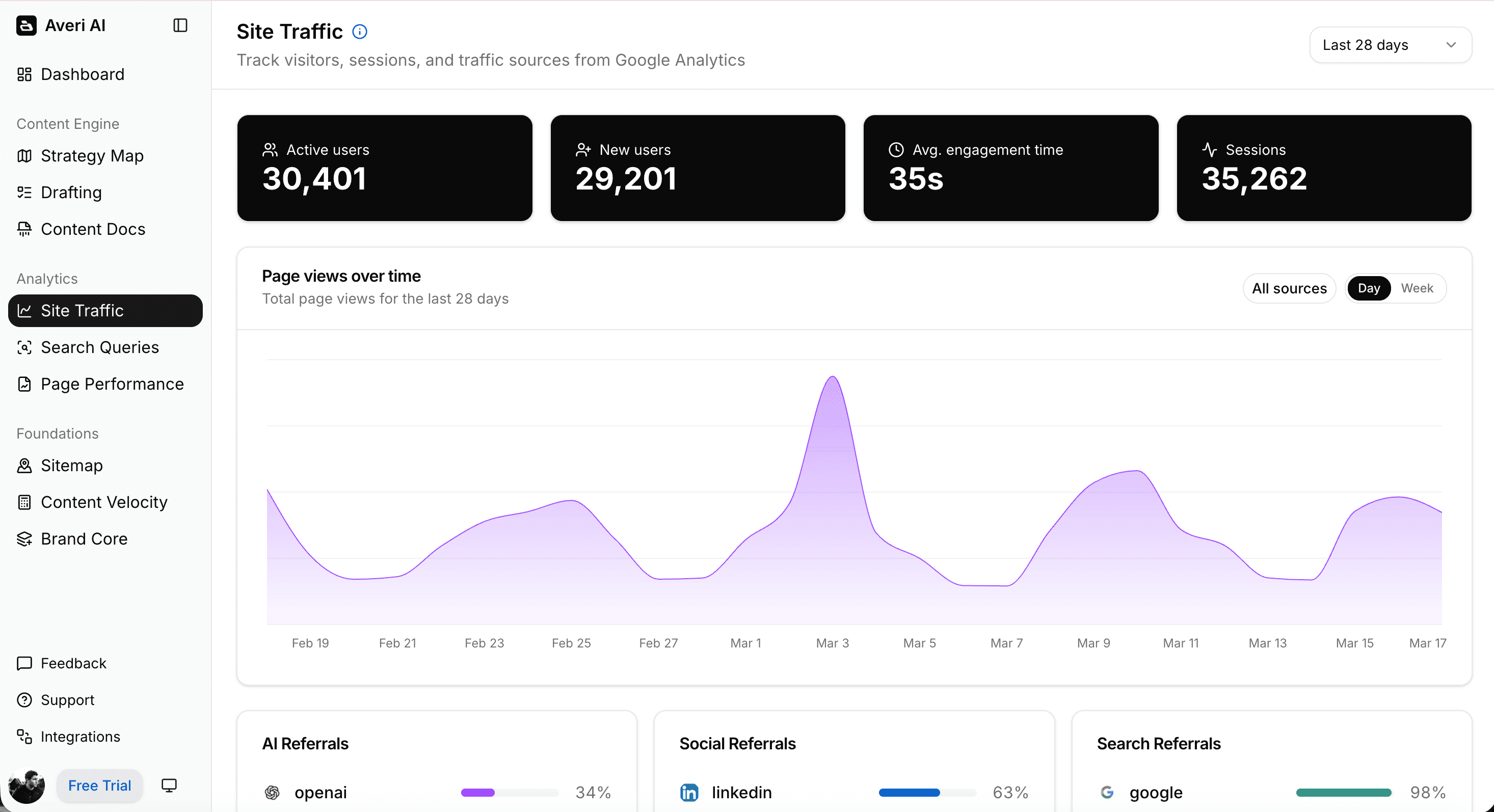
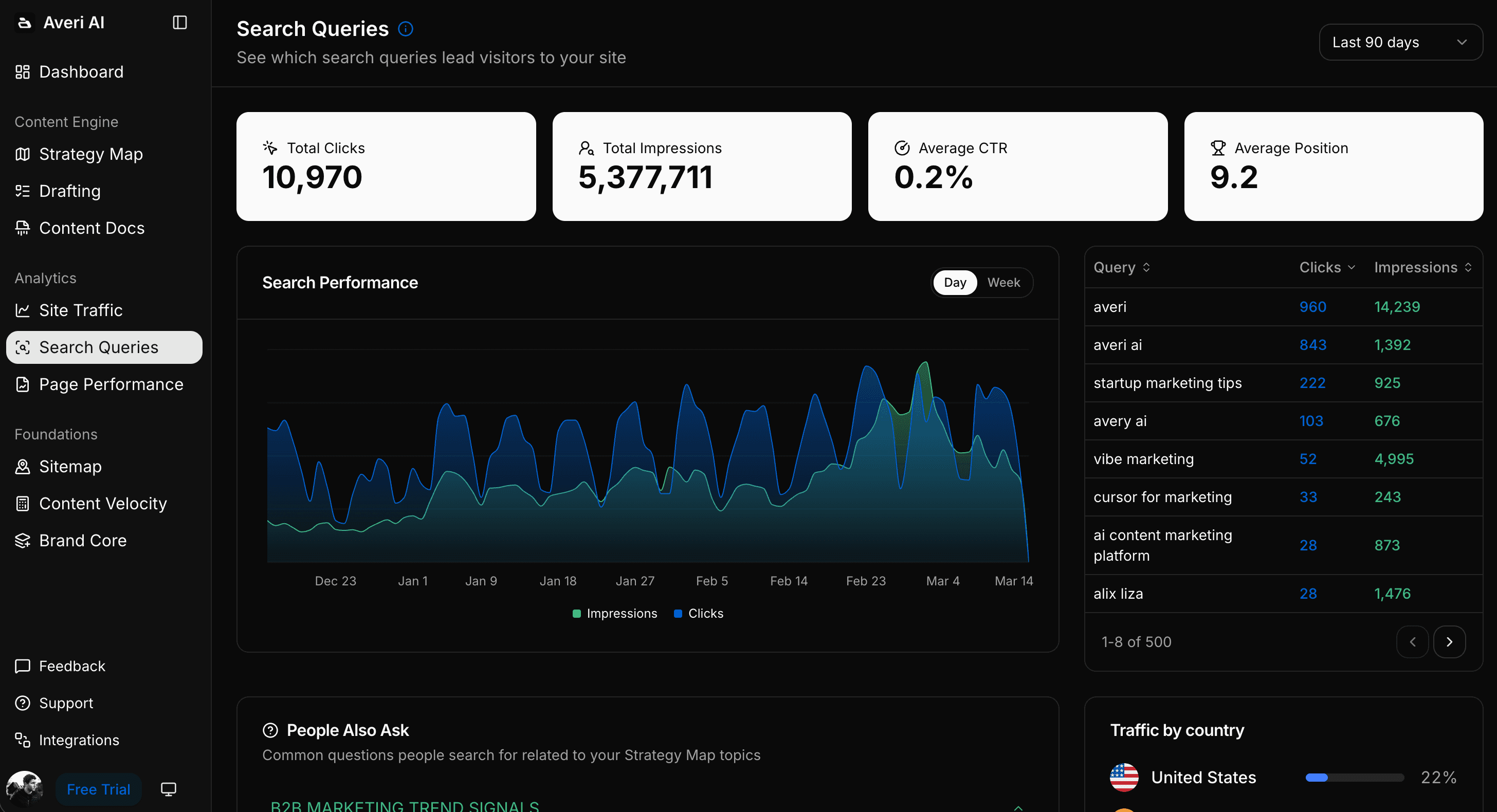
Organic traffic: 6,000% growth in 10 months. From near-zero to 2.91 million monthly organic impressions.
AI citations: Our content appears in ChatGPT and Perplexity responses for queries including "AI content engine for startups," "content marketing for seed stage," "GEO optimization for startups," and dozens of related terms. We track 50 target queries monthly across three AI platforms.
Citation growth pattern: Months 1–3, virtually zero AI citations. Month 4–5, first Perplexity citations (Perplexity's fast refresh cycle picked us up first). Month 6–7, ChatGPT citations began appearing for long-tail queries. Month 8+, citations expanding to more competitive queries as domain authority and brand mentions accumulated.
Content library compounding. 100+ posts organized in topic clusters. Each new post in a cluster strengthens the existing posts' rankings and citation probability because the internal links pass authority and the topical coverage signals expertise.
Branded search growth. Branded search impressions for "averi ai" grew alongside content-driven non-branded impressions. The content built awareness that converted into branded search, which strengthened domain signals that helped non-branded content rank higher. A virtuous cycle.
What Didn't Work (And What We Changed)
Early FAQ sections were too short. Our first 10 posts had FAQ sections with 3 questions and brief answers. After studying citation patterns, we expanded to 7 questions with 40–60 word self-contained openers. Citation rates on updated posts improved noticeably within the next quarterly tracking cycle.
We under-invested in Reddit early on. We started Reddit activity in month 4. In retrospect, starting day 1 would have built entity signals faster. Reddit brand mentions take time to accumulate, and we left 3 months of potential mentions on the table.
Some topic clusters outperformed others dramatically. Our "content marketing for startups" cluster generated 5x more citations than our "marketing tools" cluster. The lesson: clusters targeting underserved topics (where few competitors had structured, citation-optimized content) produced faster GEO results than clusters in saturated categories.
The Honest Caveat
Our results reflect 10 months of consistent publishing with a purpose-built content engine.
The principles in this guide are exactly what we used. The timeline is real.
The early months were flat. The compounding became visible around month 5.
Your results will vary based on niche competitiveness, publishing velocity, domain age, and implementation quality.
We had the advantage of using our own tool, which automates much of the structural optimization.
A startup doing this manually will take longer per piece but can achieve the same structural quality with the frameworks in this guide.

Common GEO Mistakes (And How to Avoid Them)
Mistake 1: Treating GEO as Separate From Content Marketing
GEO isn't a separate initiative. It's a structural layer applied to the content you're already producing. Companies that create a "GEO project" alongside their regular content marketing end up with two parallel workflows producing different content in different formats. The result: double the work, half the coverage.
The fix: integrate GEO principles into your standard editorial workflow. Every blog post follows the answer capsule structure. Every piece includes FAQ sections. Every article hits the factual density benchmark. GEO becomes how you write, not what you write.
Mistake 2: Optimizing for AI Instead of Humans
AI systems cite content that's useful to humans. If your content reads like it was written for a robot (keyword-stuffed, mechanically structured, void of personality), both humans and AI will pass on it. The Princeton study found that keyword stuffing performed 10% worse than baseline. Promotional copy correlates negatively with citations.
The fix: write for humans first. Add GEO structural elements (answer capsules, FAQ sections, statistics) as a layer on top of content that's already clear, useful, and well-written. The structure makes human-quality content more citable. It doesn't substitute for it.
Mistake 3: Ignoring Off-Site Entity Building
The most common GEO mistake is optimizing only on-site content while ignoring the brand authority signals that AI systems weight most heavily. Brand mentions correlate 0.664 with citation probability. You can perfect every on-site element and still miss citations because your brand isn't mentioned anywhere else.
The fix: allocate 20–30% of your GEO effort to off-site activities. Reddit participation. LinkedIn thought leadership. Review platform profiles. Guest posts on industry publications. Each mention on an independent source strengthens the entity signal that makes your on-site content citable.
Mistake 4: Expecting Immediate Results
GEO takes months to produce measurable citations, especially for new domains. AI systems need to crawl your content, evaluate it against alternatives, and build confidence in your entity before citing you. The timeline mirrors SEO: 3–6 months for initial citations, 6–12 months for consistent presence.
The fix: measure leading indicators (indexed pages, impression growth, keyword position trajectory) in months 1–4. Measure citation frequency starting month 4. Set expectations with stakeholders that GEO is a compounding investment, not a campaign with a launch date and immediate results.
Mistake 5: Blocking AI Crawlers
Some companies block AI crawlers in robots.txt over content scraping concerns. For publishers with thousands of articles generating subscription revenue, this makes sense. For startups trying to build visibility, blocking AI crawlers is blocking citations.
The fix: allow all major AI crawlers (GPTBot, ChatGPT-User, PerplexityBot, ClaudeBot, Google-Extended). The benefit of being cited vastly outweighs the risk of content being used in training. If AI systems can't access your content, they can't recommend your brand.
Mistake 6: Publishing Thin Content at High Volume
Articles over 2,900 words are 59% more likely to be cited than those under 800 words. AI systems favor depth over breadth. Publishing 20 thin posts per month produces fewer citations than publishing 8 substantive posts with high factual density, thorough coverage, and clear structure.
The fix: prioritize depth. Pages structured into 120–180 word sections earn 70% more citations. Long-form, well-structured content with a statistic every 150–200 words outperforms thin content at any volume.

GEO ROI: What It Costs, What the Return Is, How to Budget
What GEO Costs
GEO isn't a separate budget item. It's a layer applied to content you're already producing (or should be producing).
The marginal cost of making content GEO-ready is primarily structural: answer capsules, FAQ sections, schema markup, and citation optimization.
If you're already doing content marketing: The GEO layer adds 15–30 minutes per piece for structural optimization and schema implementation. Most of this is handled automatically if you use a content engine with built-in GEO scoring.
If you're starting from scratch: Content marketing + GEO together at the seed-stage budget tiers:
$0/month: founder time + free tools + GEO structural best practices (the framework in this guide)
$1K/month: AI content engine with built-in GEO optimization ($99) + hosting + analytics
$3K/month: Engine + link building + brand authority building (Reddit, review profiles, guest posts)
What the Return Looks Like
AI-driven visitors convert on average 4.4x higher than standard organic visitors.
AI search traffic converts at 14.2% compared to Google's 2.8%.
The traffic volume from AI platforms is currently small (1–3% of total for most sites), but the conversion quality is dramatically higher.
The ROI calculation:
100 monthly AI referral visitors × 14.2% conversion rate = 14 conversions
100 monthly organic Google visitors × 2.8% conversion rate = 3 conversions
Same traffic volume, 4.7x more conversions from AI
Scenario: A B2B SaaS startup at $99/month product price.
At month 6 of GEO implementation with steady content publishing: assume 200 AI referral visitors/month (conservative) at 14.2% conversion = 28 trial signups. If 25% convert to paid at $99/month = 7 new customers/month × $1,188 annual value = $8,316 in first-year revenue from AI traffic alone.
At month 12 with growing citations and content compounding: assume 500 AI referral visitors/month at 14.2% conversion = 71 trial signups. 25% paid conversion = 18 new customers/month × $1,188 = $21,384 in first-year revenue.
Against a content investment of $1K/month ($12K/year), the month-12 AI traffic alone produces a 78% return, and that's before counting the Google organic traffic the same content generates.
The combined SEO + GEO return on the same content investment is where the ROI becomes dramatic.
As AI platforms capture more search volume, the traffic share grows.
Gartner projects that search volume via traditional engines will drop 25% by 2026.
The startups building GEO infrastructure now are building the acquisition channels that replace what Google organic used to provide.
How to Budget
For seed-to-Series-A startups, GEO shouldn't be a separate line item. It should be built into your content marketing workflow:
Use a content engine that scores for both SEO and GEO ($99/month handles both)
Implement schema markup once (1–2 hours, then maintained automatically)
Structure all new content with answer capsules and FAQ sections (built into your editorial workflow)
Run monthly citation audits (45 minutes/month)
Build brand authority across platforms as part of your broader marketing (ongoing)
Total incremental cost for GEO on top of content marketing: effectively $0 if you use a system that builds GEO into the content production workflow. The optimization is structural, not budgetary.
FAQs
What is Generative Engine Optimization (GEO)?
Generative Engine Optimization is the practice of optimizing digital content to increase its visibility in responses generated by AI systems like ChatGPT, Perplexity, Google AI Overviews, and Claude. Unlike traditional SEO, which optimizes for ranking in a list of links, GEO optimizes for citation within an AI-generated answer. The term was formalized in a 2023 Princeton University study (presented at ACM KDD 2024) that demonstrated GEO techniques can boost AI visibility by up to 40%. The most effective strategies include adding statistics (+40%), citing authoritative sources (+40%), and including expert quotations (+28%).
Is GEO the same as SEO?
No. GEO and SEO share foundations (quality content, topical authority, E-E-A-T) but optimize for different outcomes using different signals. SEO optimizes for ranking position. GEO optimizes for citation in AI answers. The authority signals differ: backlinks correlate 0.218 with AI citation probability while brand mentions correlate 0.664. Content format differs: GEO requires extractable 40–60 word answer blocks that SEO doesn't need. SEO is the foundation. GEO is the additional layer required for AI-era visibility.
How do I get my content cited by ChatGPT?
Structure content with question-format headings and 40–60 word answer capsules that open each section. Maintain factual density of one hyperlinked statistic per 150–200 words. Include a 5–7 question FAQ section. Allow GPTBot in your robots.txt. Implement Article and Organization schema. ChatGPT favors articles over 2,900 words, pages with FCP under 0.4 seconds, and content structured in 120–180 word sections. Build brand mentions across Reddit, LinkedIn, and review platforms to strengthen entity signals.
How do I measure GEO success?
Track five KPIs: citation frequency (how often you appear in AI answers), citation position (where in the answer), AI referral traffic (visits from AI platforms in GA4), brand mention frequency (appearances without direct links), and organic traffic value from AI. Run a monthly citation audit: 20 target queries across ChatGPT, Perplexity, and Google (checking AI Overviews). Record citations and brand mentions in a spreadsheet. Patterns emerge after 3 months. For automated tracking, tools like Profound, SE Ranking, and Otterly monitor AI citations at scale.
How much does GEO cost?
GEO is a structural optimization layer, not a separate budget. If you're already producing content, the marginal cost is 15–30 minutes per piece for answer capsule structure, FAQ optimization, and schema implementation. Using a content engine with built-in GEO scoring ($99/month) automates most of this. Schema markup is a one-time setup (1–2 hours). Monthly citation audits take 45 minutes. Brand authority building (Reddit, LinkedIn, review platforms) is ongoing but doesn't require dedicated budget. The total incremental cost for GEO is effectively $0 beyond what you'd spend on content marketing anyway.
What technical setup does GEO require?
Three essentials. First, allow all AI crawlers in robots.txt (GPTBot, ChatGPT-User, PerplexityBot, ClaudeBot, Google-Extended). Second, implement JSON-LD schema: Organization (with sameAs and knowsAbout), Article (with author and dates), and FAQPage (for FAQ sections). Sites with complete Tier 1 schema see ~40% more AI Overview appearances. Third, optimize page speed for FCP under 0.4 seconds (3x citation improvement). Optional: add an llms.txt file as a communication layer for AI systems.
How important is brand authority for GEO?
Critical. Brand mentions correlate 0.664 with AI citation probability, making it the strongest predictor of citation. Build presence across the platforms AI systems monitor: Reddit (most-cited domain overall), YouTube (#2 cited), LinkedIn (most-cited for professional queries), and review platforms like G2 and Trustpilot (3x higher citation chances). This means GEO strategy extends beyond your own website to building a recognized, discussed brand entity across independent sources.