84K Impressions, 99 Clicks. You're Reading the Wrong Number.
6 minutes

TL;DR
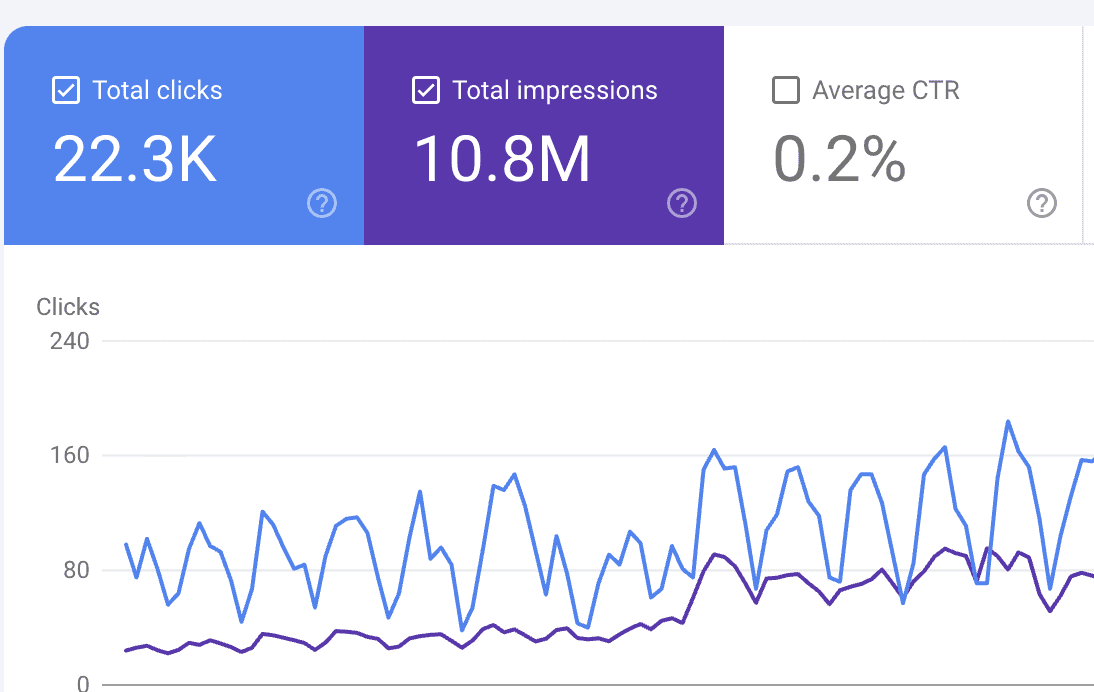
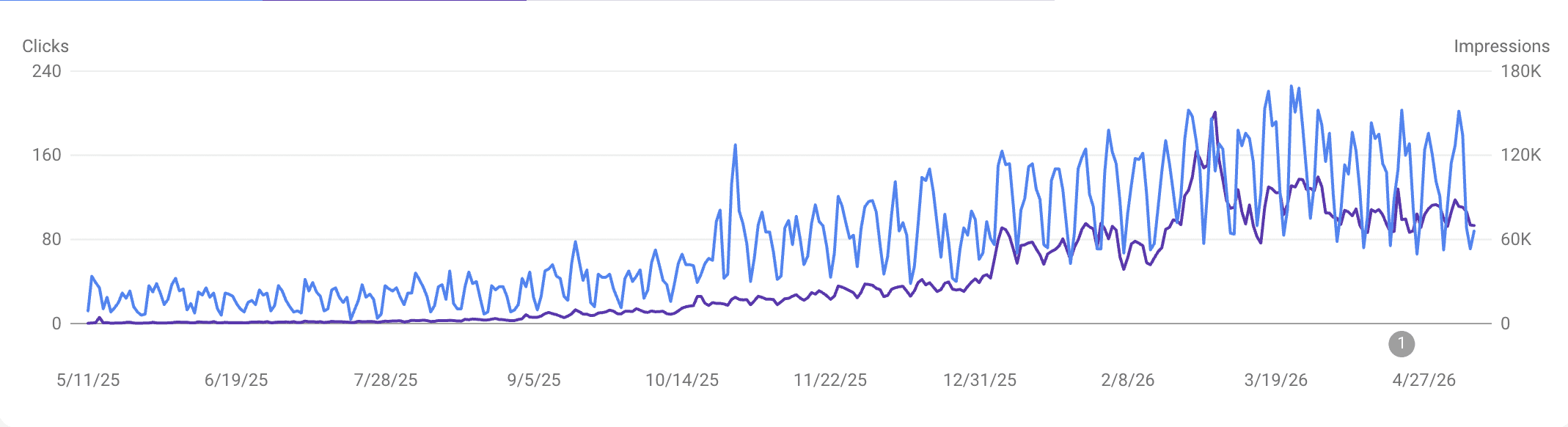
📊 84,587 impressions. 99 clicks. That's one of our own ranking pages in April 2026, and the click-through rate is 0.12%. Across our top four pages by impressions, the combined ratio is 252,983 / 267 — about 0.1% CTR.
🔍 Google confirmed AI Overview appearances count as Search Console impressions. A link in an AI Overview is logged as a regular impression at the AI Overview's position. Your impression number now includes AI citation surface.
🧭 The thesis: impressions are no longer a click proxy. They're a citation proxy. In 2022, you served impressions to earn clicks. In 2026, you serve impressions to earn citations — and the user often gets the answer without ever clicking.
🎯 The action: reprioritize your library by impressions, not CTR. Your top-20 pages by impressions are your citation portfolio. Those get schema work, internal linking work, and refresh cadence first.
🔧 What to do with high-impression pages: Article + FAQPage schema, internal links pointing in, fact refresh every 90 days, AI citation tracking via manual prompts across ChatGPT, Perplexity, Claude, and Gemini.
🚫 What NOT to do: chase CTR back to 2022 benchmarks. That scoreboard is broken. The founders measuring against it in 2026 will measure themselves into the wrong decisions.
Zach Chmael
CMO, Averi
"We built Averi around the exact workflow we've used to scale our web traffic over 6000% in the last 6 months."
Your content should be working harder.
Averi's content engine builds Google entity authority, drives AI citations, and scales your visibility so you can get more customers.
84K Impressions, 99 Clicks. You're Reading the Wrong Number.
The Number That Made Us Stop Optimizing for CTR
84,587 impressions. 99 clicks. A 0.12% click-through rate on one of our highest-ranking pages.
Across our top four pages by impressions in April 2026, the math compounds: 252,983 combined impressions, 267 combined clicks, 0.1% combined CTR.
That's our actual Search Console data, not a hypothetical.
Page | Impressions | Clicks | CTR | Avg. Position |
|---|---|---|---|---|
SaaS marketing metrics post | 84,587 | 99 | 0.1% | 6.3 |
AI marketing tools post | 57,082 | 66 | 0.1% | 7.1 |
Tech industry trends post | 57,700 | 54 | 0.1% | 5.8 |
Freelance marketing post | 53,614 | 48 | 0.1% | 6.5 |
Combined: 252,983 impressions. 267 clicks. 0.1% CTR across the board.
Every instinct most founders have when they see a number like that is wrong.
The instinct is "fix the CTR." Rewrite the meta titles. Add power words. Run the AI snippet through a CTR optimizer. Get the click-through back to 2–4% where it "should" be.
That instinct is reading the wrong number.
The CTR isn't broken. The scoreboard is.
The page is doing exactly what a citation-era page is supposed to do — earning impression surface at scale while the click rate stays low because users are getting their answers without clicking through.
The work isn't to chase the click back.
The work is to recognize that the impression count is now the metric that matters, and to reorganize the content library around that.
This piece is the reframe that took us from panicking about our CTR data to using our impression data as the primary signal for what gets attention next.
Impressions Used to Be a Click Proxy. Now They're a Citation Proxy.
In 2022, impressions were how you earned clicks. A page served impressions to a user; the user clicked through; the click was the conversion.
Impressions on their own were vanity — meaningful only because they led to clicks.
In 2026, the mechanic inverted.
Google Search Console treats AI Overview link appearances as standard impressions — counted when the link is scrolled or expanded into view, with the AI Overview itself occupying a single position in search results that all included links share.
Google's own representatives have confirmed this: sites appearing in AI features like AI Overviews and AI Mode are included in the overall search traffic in Search Console.
The translation: every time your URL appears as a citation source inside an AI Overview, your impression count goes up. The user reads the AI's synthesized answer — which often includes your data, your phrasing, or your specific recommendation — and frequently doesn't click through, because the answer was already delivered.
That's not a failure of the page. That's the page working as designed in the citation era.
The CTR collapse is real.
Seer Interactive research in late 2025 found organic CTR for queries with AI Overviews dropped from 1.76% to 0.61% — a 61% decline — while impression counts maintained or grew.
The decline isn't a quality problem. It's a structural change in what an impression now represents. The impression earned the citation. The citation delivered the answer. The click didn't need to happen for the value to be created.
Founders staring at their Search Console seeing impressions climbing and clicks flat are watching the new metric work correctly. They just learned to measure it on the old scoreboard.
Why Your Impression Count Is Your Most Underrated Metric
Three reasons impressions became the top-of-funnel signal in 2026, replacing CTR in the metric hierarchy:
Impressions register every time AI cites you, whether or not the user clicks. When ChatGPT or Perplexity quotes your page in a synthesized answer, the user sees your domain in the citation list. For partially visible or hidden citations, an impression is only recorded after a user has shown a level of interest by choosing to expand the content, which means logged impressions in the AI era often correlate with active user attention rather than passive scroll. The brand exposure is happening. The trust signal is compounding. The click is no longer required for the value to register.
Impressions correlate with brand exposure that compounds even without conversion. A founder who sees "Averi" cited in an AI Overview alongside three competitors gets the brand impression even without clicking through. Over weeks of similar exposure across different queries, the buyer arrives at the comparison conversation already knowing the name. That's the work impressions do that clicks never did at this scale — they buy mindshare in the answer surface itself.
High-impression pages signal what Google trusts you for, and that trust transfers to AI citation systems. AI engines trained on web corpora weight pages with strong organic ranking signals more heavily in their citation behavior. When AI Overviews appear for your keyword, those appearances are added to your total Search Console impression count without distinguishing them from typical organic impressions, so a page's impression number is now a composite signal — Google rank authority plus AI citation surface, in one merged metric.
This is the most important section of the piece.
If the reframe lands here, everything that follows is execution detail.
Impressions stopped being a vanity metric and became the primary measurement of citation footprint. The teams that recognize this reorganize their content work around it. The teams that don't keep optimizing for a click rate that no longer represents the value being created.
The Prioritization Framework: How to Read Your GSC Data Through the New Lens
Three steps to apply the reframe to your existing content library this week:
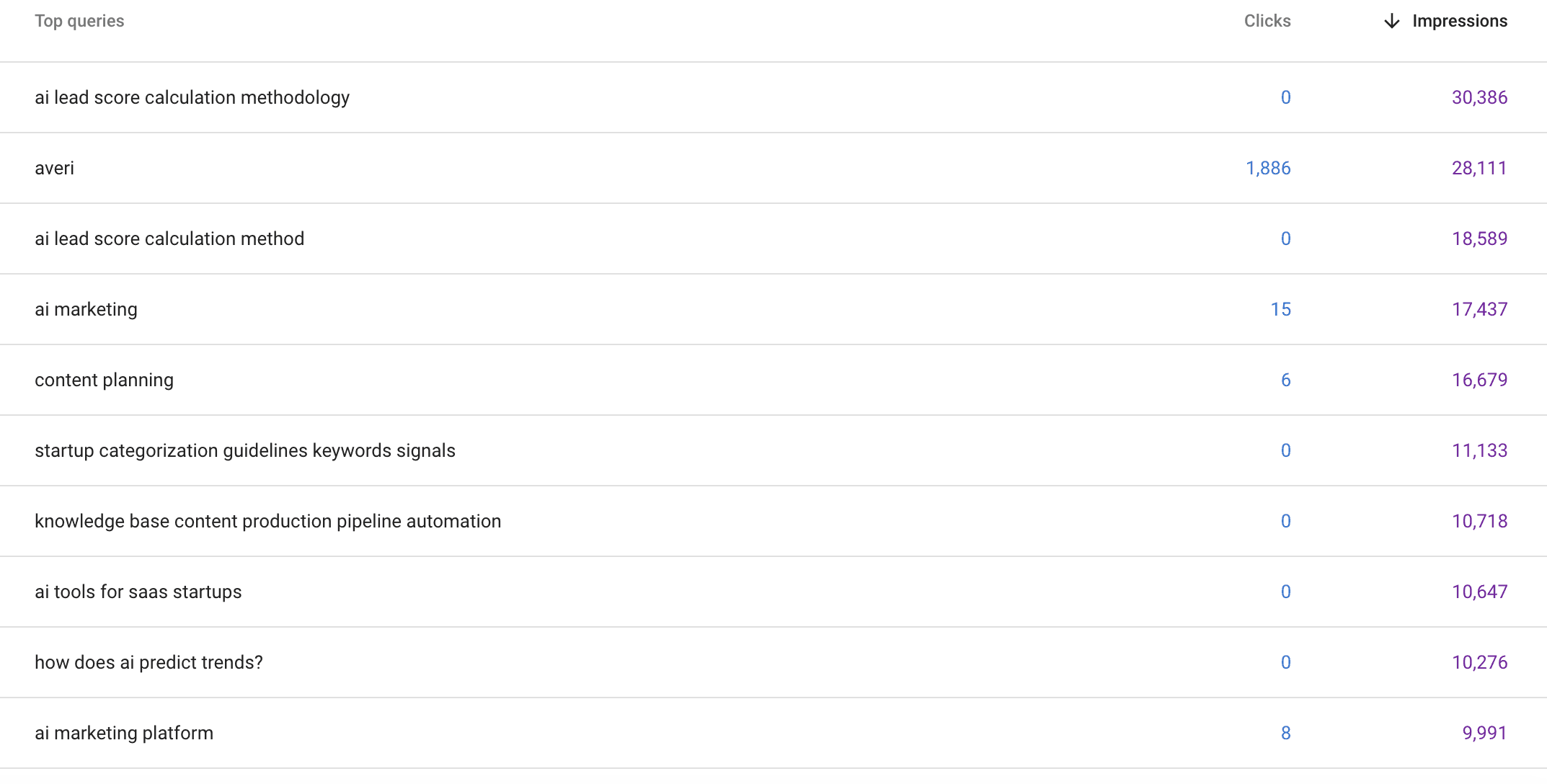
1. Sort by impressions, descending. Not clicks. Not CTR. Impressions. Open Google Search Console, go to the Performance report, and sort the Pages tab by impression count from highest to lowest. Your top 20 pages by impressions are your citation portfolio. Treat them that way.
2. Treat those pages as citation assets, not click failures. Pages with high impressions and low CTR are not broken. They're earning the citation impressions that the AI era pays in. Stop trying to "fix" them through meta rewrites as the primary intervention. Start treating them as your most valuable owned assets — the pages that earn schema work, internal linking work, and refresh cadence first.
3. Use CTR as a secondary signal — but only for the positions-6-to-10 opportunity. Recent click-through research shows positions 6–10 are seeing roughly 30% more clicks as users scroll past AI Overviews looking for alternative sources. Meta rewrites still matter, but for a specific population of pages — the ones ranking 6–10 on queries where AI Overviews appear and users are actively clicking past them. That's a real CTR opportunity. Just not the highest-leverage one.
The hierarchy reorders. Most content marketing playbooks from 2022 led with CTR optimization. The citation-era playbook leads with impression-portfolio prioritization, then schema work, then internal linking, then refresh cadence, then — eventually — meta optimization for the specific page populations where clicks still matter.
If your library is 50 pages and your top 10 by impressions are different from your top 10 by clicks, the citation-era work happens on the impression list.
The click-era work happens on the click list. Both lists matter. The order of attention matters more.
What to Actually Do With Your High-Impression Pages
For each of your top 20 pages by impressions, the tactical playbook:
Add or upgrade schema markup. Article schema at minimum, FAQPage schema if the page includes Q&A, ItemList schema if it's a listicle. Pages with proper layered schema see roughly 36% higher AI citation rates than pages with single-schema implementations. The schema upgrade is a one-time 30-minute investment per page that compounds permanently.
Audit internal links pointing IN to the page. Citation-asset pages should have at least 5–10 internal links from other pages on your site, with descriptive anchor text that signals what the page is about. Internal link velocity is one of the strongest signals to both Google's ranking systems and AI citation systems that a page is authoritative on its topic.
Refresh facts and stats every 90 days. AI citation systems weight recently-updated sources more heavily. A page that was authoritative in February but hasn't been touched since loses citation share to a competitor's page that got refreshed last week. The refresh doesn't require a full rewrite — updating 3–5 stats, adding a recent data point, and bumping the "Last Updated" date is enough to signal active maintenance.
Add or refine the meta description. Meta descriptions still matter — both for the clicks that do happen (positions 6–10 traffic, branded searches) and for the snippets AI engines sometimes pull when generating answers. The meta is no longer the primary lever, but it's a secondary lever worth pulling on citation-asset pages.
Track citation appearances manually. Until automated AI citation tracking tooling matures, run fixed prompts across ChatGPT, Perplexity, Claude, and Gemini once a month. Ask the buyer-question prompts your high-impression pages are designed to answer. Track which queries surface your domain in the citation list. The manual tracking is 30 minutes per month and gives you the only direct read on citation performance until the tooling market matures.
The total time investment per citation-asset page: roughly 30 minutes for the schema-plus-internal-linking work, plus 15 minutes per 90-day refresh, plus 5 minutes per month of citation tracking.
For 20 pages, that's about 30 hours of work spread across the year — meaningful but doable for a solo founder running content in 5 hours a week.
The Math, Recalculated
The existing scoreboard ran the math like this: 252,983 impressions × target 2% CTR = 5,059 clicks.
Compared to the 267 actual clicks, that's a "missing" 4,792 clicks. Frame it that way and the page is leaking 95%+ of its potential value.
The citation-era math runs differently.
252,983 impressions represent the citation surface area — the number of times those four pages appeared in front of users in 30 days, including every AI Overview citation that was logged when a user expanded or scrolled into view.
The 267 clicks are the residual click conversion, not the primary measurement.
The value being created is in the impression number itself. Brand exposure. Citation footprint. Trust signal accumulation. Authority compounding across both Google's ranking systems and AI citation systems that consume Google's signal.
I don't have hard data yet on impression-to-citation conversion rates — the tooling that measures this directly doesn't exist outside enterprise platforms, and the metrics that do exist are early.
But the hypothesis is straightforward and testable: if your top 20 pages by impressions are accumulating 252K monthly impressions, and even 1–2% of those impressions represent AI Overview citation appearances, you're looking at 2,500–5,000 monthly AI citation impressions. That's brand exposure at scale, with the user actively engaged with the content (scrolling, expanding, reading) at the moment of impression — not passive scroll.
Run the manual citation tracking for 90 days and you'll start to see the pattern.
The page generating 84K monthly impressions is probably surfacing in AI Overview citations on dozens of queries. The page that's nowhere on the impression chart isn't. The signal is in the impression number even before the tooling catches up to measure it directly.
The math hasn't gone away. It just changed denominator.
How We're Tracking This Going Forward
Running in public on this one — same energy as the AI search referrals data piece we shipped last week, but the metric being tracked shifts from referral attribution to impression-as-citation-signal.
The dashboard we're watching weekly:
Impression growth on top-20 citation-asset pages. Are the pages we identified as citation assets continuing to accumulate impression surface, or are they declining? If they're growing, the prioritization is working. If they're declining, something structural shifted in how those pages are being surfaced (algorithm update, AI Overview pattern change, content getting stale).
AI citation appearances via manual prompts. Once a month, fixed prompt set across ChatGPT, Perplexity, Claude, and Gemini. Track which of our pages get surfaced. This is the closest signal we have to "is the impression growth actually translating into AI citation surface."
Click-through where it happens. Not as the primary metric, but as the secondary signal. Pages in positions 6–10 with rising clicks are telling us users are scrolling past AI Overviews to find alternative sources. Pages with high impressions and stable low clicks are doing the citation work. Both are useful signals; neither is the headline number.
The thing we're explicitly not tracking as the primary metric: site-wide CTR averages compared to industry benchmarks. That comparison made sense in 2022. In 2026, site-wide CTR is a composite of click-era metrics and citation-era metrics mashed together, and the average obscures more than it reveals.
Better to look at the per-page pattern and ask the diagnostic question: is this page in the citation portfolio or the click portfolio? Different pages, different work, different success metric.
The New Content Engine Prioritization
The bigger frame: this work is part of running a content engine rather than a content pipeline. A pipeline runs content in, runs content out, optimizes for the conversion at the end. An engine compounds — the work today produces returns for years, the prioritization compounds the highest-yield work, and the team running it gets to do more with less because the system gets smarter as it runs.
Founders running content as engines in 2026 will reorganize their attention around impressions-as-citation-signal.
The work compounds because each citation-asset page strengthens the next one — schema lifts AI citation rates, internal linking transfers trust signal between pages, refresh cadence keeps the corpus current, and the impression surface keeps growing.
Founders running content as pipelines will keep optimizing for CTR benchmarks from 2022 and watching their best pages "underperform" by a metric that no longer measures the value being created.
They'll rewrite meta titles instead of adding schema. They'll chase the click rate instead of compounding the citation surface. They'll measure the wrong scoreboard.
The Monday-morning action is straightforward. Open Search Console. Sort by impressions descending. Your top 20 pages — regardless of CTR — are your citation portfolio.
Those are the pages that get the schema work, the internal linking, the refresh cadence first. The CTR conversation is a secondary one. The founders who get that hierarchy right in 2026 will compound past the ones who don't.
Score Both Sides of the Scoreboard
Most content tools still optimize for clicks. Averi's content scoring system measures both axes — SEO at 55% weight, GEO at 45% — because the citation-era pillar needs both ranking signals and extraction structure to compound. The roadmap is bringing more of the impression-as-citation analytics view directly into the workflow over the next 12–18 months, so the prioritization the brief above describes happens by default rather than manually.
Today, the scoring system is the foundation; the analytics layer is being built alongside it.
Start your 14-day free trial →
FAQs
What do impressions in Google Search Console actually mean in 2026?
Impressions in 2026 measure total visibility surface — every appearance of your URL on a Google search results page, including when your link appears as a citation source within an AI Overview. Google's documentation confirms that AI Overview link appearances are counted under standard impression rules when the link is scrolled or expanded into view. The impression number is now a composite metric: traditional organic ranking visibility plus AI citation surface, merged into one count.
Should I still optimize for CTR if my impressions are climbing?
Yes, but only on specific pages — not as your primary content strategy. The pages where CTR optimization still pays off are typically ranking in positions 6–10 on queries where AI Overviews appear and users scroll past them looking for alternative sources. For your top citation-asset pages (high impressions, low CTR), the higher-leverage work is schema markup, internal linking, and refresh cadence — the work that compounds citation surface area rather than chasing the click rate back to 2022 benchmarks.
How do I know if AI search engines are citing my content?
Run a manual citation tracking pass once a month. Pick 10 buyer-question prompts your content is designed to answer, run them across ChatGPT, Perplexity, Claude, and Gemini, and track which prompts surface your domain in the citation list. The process takes 30 minutes monthly and is the cleanest direct signal of AI citation performance until automated tooling matures. Indirect signals: impression growth on pages where AI Overviews appear, and referral traffic from chatgpt.com / perplexity.ai / claude.ai / gemini.google.com.
What's the difference between an impression and a citation in 2026?
An impression is the appearance of your URL on a search results page, including inside AI Overviews. A citation is the active reference to your content as a source within an AI-generated answer — whether that's a Google AI Overview, a ChatGPT response, or a Perplexity answer. All citations create impressions when surfaced to users, but not all impressions are citations. The relationship: rising impressions on citation-eligible pages is the leading indicator that citations are accumulating, even when you can't measure citations directly.
How should I prioritize my content library if I can't see citation data directly?
Use impressions as the proxy. Open Search Console, sort your pages by impression count descending, and treat the top 20 as your citation portfolio. Those pages get schema work, internal linking, and refresh cadence first — the work that compounds citation surface area. Until direct AI citation tracking tooling becomes accessible at startup price points, impression rank is the cleanest available proxy for citation potential.
What does high impressions, low clicks indicate about my content quality?
In 2026, the pattern usually indicates the content is doing the citation work successfully — earning impression surface through AI Overview citations and high-position rankings, while users get their answers without needing to click through. It's not a quality problem. It's a structural change in what an impression now represents. Industry research shows organic CTR for AI Overview queries dropped from 1.76% to 0.61% — a 61% decline — while impression counts held steady or grew. The pattern is now the norm for top-of-funnel content, not a sign of underperformance.
How does schema markup affect AI citation rates?
Pages with proper layered schema markup (Article + FAQPage at minimum, with ItemList added for listicles and Product schema for comparison pages) see roughly 36% higher AI citation rates than pages with single or no schema. The mechanic: structured data signals to AI engines what content type they're parsing, which buyer-question types it answers, and what factual claims it makes. Schema is the technical foundation of citation-worthy content — and it's the highest-leverage 30-minute investment most B2B SaaS startups aren't making on their existing high-impression pages.
Related Resources
AI Citation & GEO Foundations
The GEO Playbook 2026: Getting Cited by LLMs (Not Just Ranked by Google)
Google AI Overviews Optimization: How to Get Featured in 2026
Beyond Google: How to Get Your Startup Cited by ChatGPT, Perplexity, and AI Search
Building Citation-Worthy Content: Making Your Brand a Data Source for LLMs