The Long-Tail Defense Playbook: Specific Queries Are the Last Click-Through Real Estate Left

5 minutes

TL;DR
📉 AI Overviews trigger on 30–40% of queries and cut CTR ~30%. Head-term SEO is a melting asset. Position 1 CTR fell from 28% to 19% YoY once AIO went mainstream.
🎯 Long-tail queries (4+ words, specific intent) trigger AI Overviews far less often and account for roughly 70% of total search volume in aggregate. They're the last click-bearing real estate.
💰 Long-tail converts 2–6x better than head terms because the searcher already knows what they want. Combined with intact CTR, the ROI gap is bigger than the volume gap.
🧭 The framework: low-AIO-risk × high-buyer-intent quadrant first, ICP-language phrasing always, comparison and "for X" modifiers as the cheat code.
⚙️ Averi's content queue auto-surfaces long-tail variants from your GSC data, scores them on AIO risk and intent, and queues the pieces in the right order. The structural sprint, on rails.

Zach Chmael
CMO, Averi
"We built Averi around the exact workflow we've used to scale our web traffic over 6000% in the last 6 months."
Your content should be working harder.
Averi's content engine builds Google entity authority, drives AI citations, and scales your visibility so you can get more customers.
The Long-Tail Defense Playbook: Specific Queries Are the Last Click-Through Real Estate Left
Why Are Long-Tail Keywords Still Driving Clicks When Head Terms Aren't?
Long-tail keywords still drive clicks because AI Overviews struggle with specificity.
AI Overviews now appear on 30–60% of US searches depending on query type, and they trigger most often on broad informational queries with one obvious answer.
"What is content marketing" gets an AI Overview. "Content marketing tools for solo founders under $100" rarely does.
The mechanic is straightforward: AI Overviews summarize when the query has a single canonical answer Google can confidently synthesize. Long-tail queries carry too much specific intent (audience, budget, use case, comparison context) for a synthesized one-paragraph answer to satisfy the searcher. So Google still sends those searchers to a page.
That preserved click-through is concentrated exactly where seed-stage startups should compete anyway.
Specific queries match specific buyer states.
A founder Googling content marketing strategy for B2B SaaS startups is closer to converting than a marketer Googling "content marketing."
The long-tail isn't a fallback. It's the primary surface.
How Much CTR Did Head-Term SEO Actually Lose to AI Overviews?
The damage to head-term SEO is bigger than most teams realize. 60% of Google searches now generate zero clicks, and on informational queries with AI Overviews the number runs higher. Position 1 CTR dropped 32% year-over-year once AIO went mainstream, falling from 28% to 19%. Position 2 fell 39%.
The shift is not uniform across the SERP.
Positions 6–10 are seeing 30% more clicks as users scroll past AI Overviews looking for alternative sources. The middle of the SERP gained share precisely because the top of the SERP got eaten.
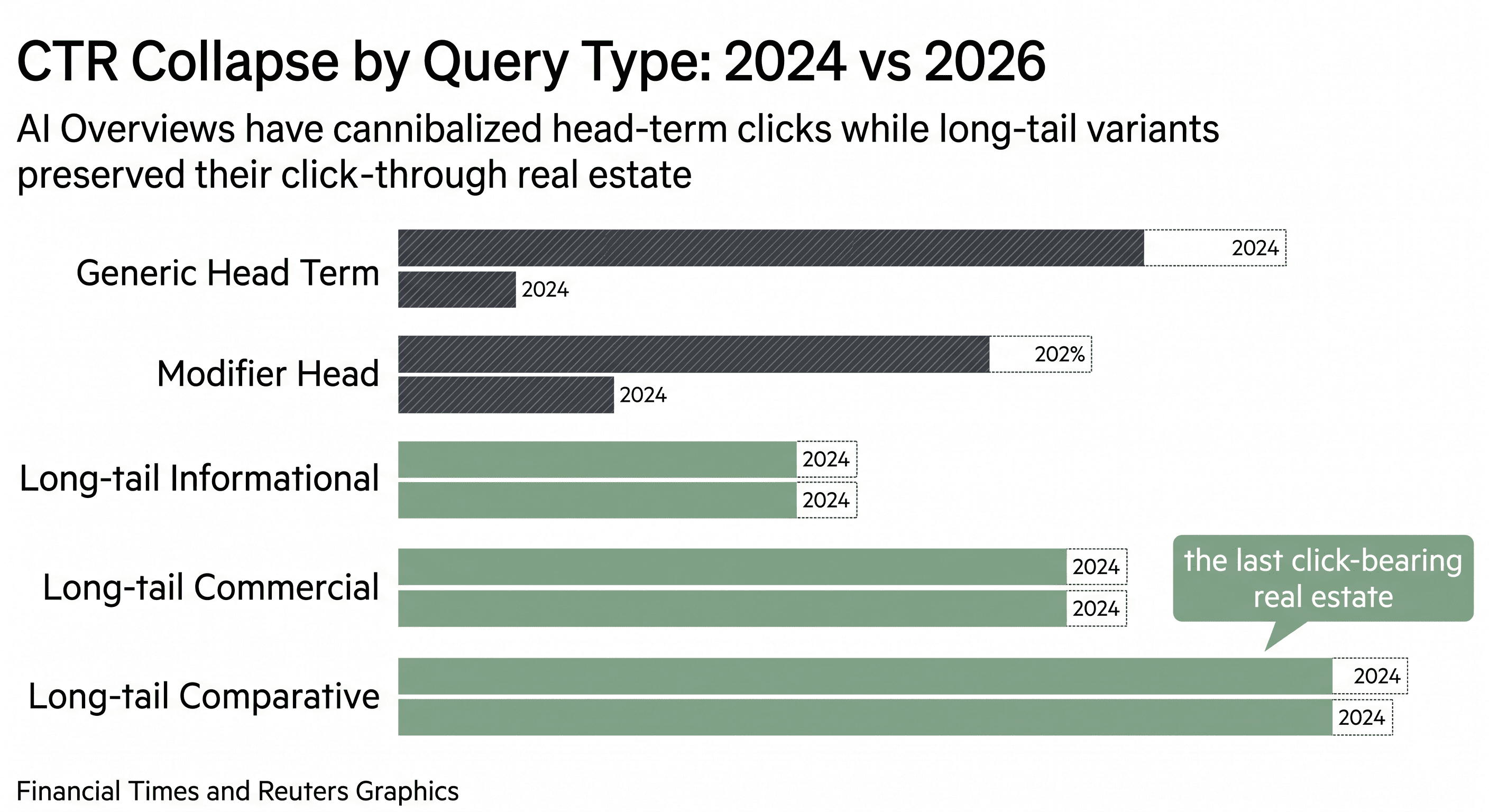
Translated into action: optimizing a piece to rank #1 for a head term in 2026 might earn fewer clicks than optimizing the same piece to rank #6 for a long-tail variant. The traffic math now rewards specificity over volume. Most startup blogs are still optimizing for head terms because that's what Ahrefs scores highest. The Ahrefs score doesn't price in the AIO penalty yet.
Which Query Types Still Trigger Real Click-Through?
Five query types preserve click-through even in the AIO era.
The pattern is consistent: the more specific the intent, the lower the AIO risk and the higher the click-bearing CTR.
Query Type | Example | AI Overview Likelihood | Avg CTR | Conversion Intent |
|---|---|---|---|---|
Generic head term | "content marketing" | Very High | <5% | Low |
Modifier head | "content marketing strategy" | High | ~8% | Medium |
Long-tail informational | "content marketing strategy for B2B SaaS startups" | Medium | ~15% | High |
Long-tail commercial | "content marketing tools for solo founders under $100" | Low | ~25% | Very High |
Long-tail comparative | "Averi vs Jasper for startup content marketing" | Very Low | ~35% | Very High (BOFU) |
The bottom three rows are where the click-bearing real estate lives.
Comparative queries especially almost never trigger an AIO because Google's confidence in synthesizing a head-to-head comparison is low. Founder-Googling-Averi-vs-Jasper still gets a SERP, and the brand that ranks gets the click.
Most seed-stage blogs underweight rows 4 and 5 because the keyword volumes look small. The math changes when you multiply preserved CTR against conversion intent.
How Do You Find Long-Tail Keywords AI Overviews Don't Cannibalize?
The discovery method that works is question-based, audience-modified, and grounded in your own GSC data instead of generic keyword tools.
Start with your existing GSC data. Open Google Search Console, go to Performance, filter Queries by 4+ words. Sort by impressions descending. The queries already bringing impressions to your domain are validated demand. Your only job is to write content that converts those impressions into clicks.
Layer audience modifiers. Take a head term in your space and add modifiers that match your ICP. "SEO" becomes "SEO for [seed-stage startups / solo founders / pre-revenue companies / two-person marketing teams]." Each modifier creates a long-tail variant with lower AIO risk because the specific audience phrasing is harder to summarize generically.
Mine Reddit and customer support tickets. Reddit is the most-cited source in AI Overviews, so the threads where your buyers ask specific questions are also where Google sees long-tail demand surface. Pull recurring question patterns. They become your H2s.
Use comparison and "vs" patterns. Comparative long-tail rarely triggers AIO and converts at BOFU rates. If your category has 3 named competitors, you have 6 comparison pieces of citation real estate available.
What's the Right Long-Tail Keyword Density Per Cluster?
The density that works is roughly 8–12 long-tail variants per cluster, weighted toward the AIO-resistant types.
Most pillar clusters fail because they target one head term and stop. The cluster that captures the click-bearing surface has long-tail variants threaded through the supporting pieces.
A working density looks like this:
1 pillar piece anchored around the cluster's defining buyer question (medium-tail, ~3 words)
2–3 supporting pieces targeting long-tail informational queries (4–6 words, high specificity)
2–3 supporting pieces targeting long-tail commercial queries (with audience or budget modifiers)
2–3 supporting pieces targeting long-tail comparative queries (vs competitors, vs alternatives, decision frameworks)
Each piece carries its own AI extraction surface, so 8–12 variants give you 8–12 separate citation opportunities and 8–12 separate click-bearing SERP entries. The cluster's combined click yield comfortably outperforms a single head-term piece even when each individual variant has lower volume.
The math compounds because long-tail clusters also feed AI citation. Specific buyer-question phrasing is exactly what LLMs extract as direct answer blocks.
How Should Seed-Stage Startups Prioritize Long-Tail Targets?
The prioritization framework is a 2x2: AI Overview risk on one axis, buyer intent on the other. Target the low-risk, high-intent quadrant first. That's the click-bearing, conversion-bearing real estate.
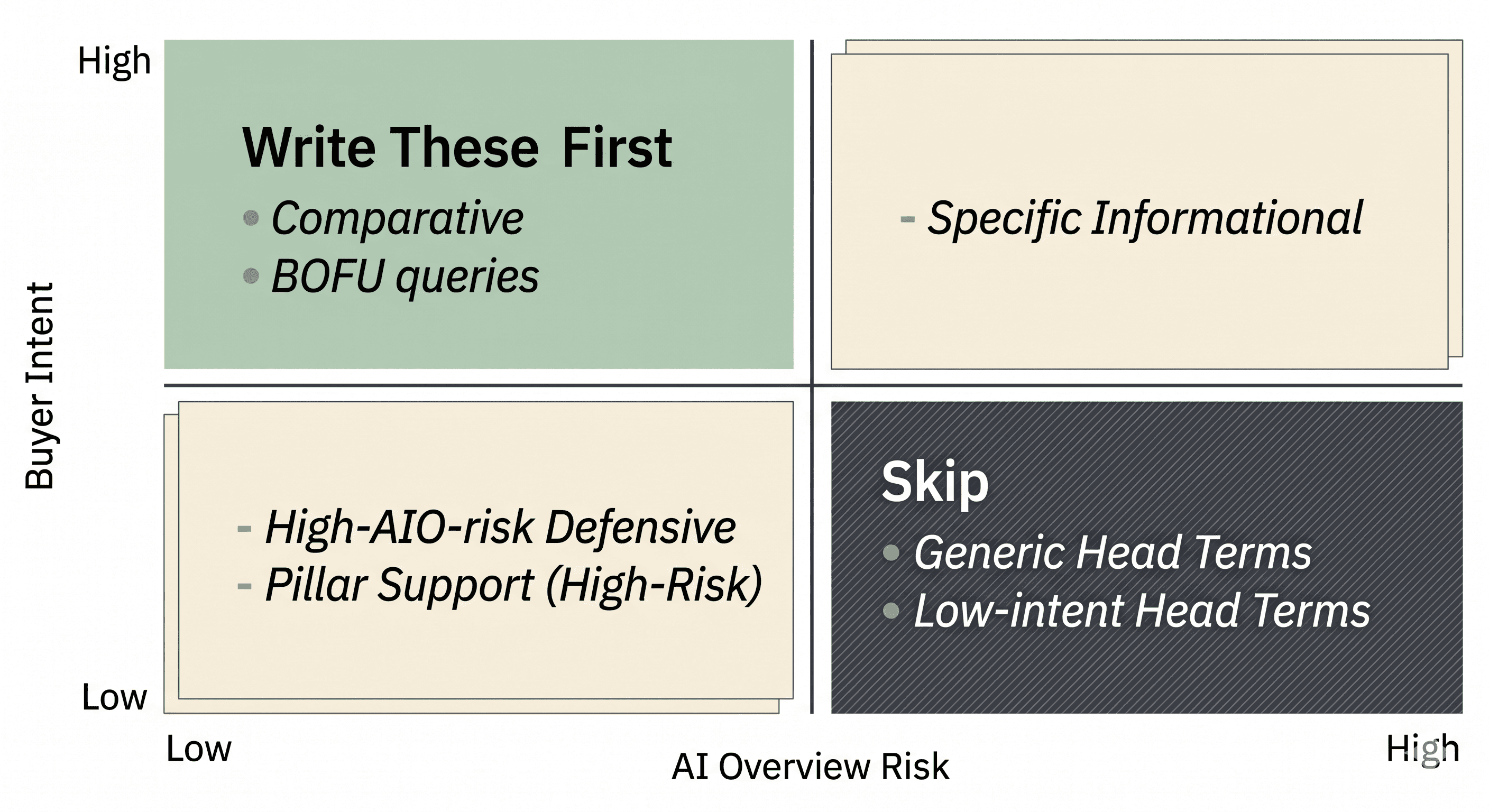
Quadrant 1: Low AIO Risk × High Intent (Write These First) Comparative queries, "for [specific audience]" queries, "[product] vs [product]" queries, "best [tool] for [use case] under $[budget]" queries. These convert at BOFU rates and almost never get AI-summarized. Start the cluster here.
Quadrant 2: Low AIO Risk × Medium Intent Specific informational queries with audience modifiers ("how to do X as a Y"). High click yield, medium conversion. Use as supporting cluster pieces feeding the pillar.
Quadrant 3: High AIO Risk × High Intent "What is [category]" queries that might still convert. Often AIO-cannibalized, but worth defensive ranking if the cluster's pillar lives here. Don't overweight this quadrant.
Quadrant 4: High AIO Risk × Low Intent Generic head terms with no buyer specificity. The "content marketing" type. Skip these entirely unless you have unique data and an existing authority signal.
Most seed-stage blogs spend most of their time in Quadrant 4 because that's where the volume looks biggest. The volume is illusory. AIO has eaten it.
How Does Averi's Content Queue Handle Long-Tail Discovery?
Averi's content queue automates the long-tail discovery flow that founders otherwise run manually.
The mechanic: pull your GSC data, score every query against the 2x2 prioritization framework, surface the high-yield variants in execution order.
In practice, the queue does four things:
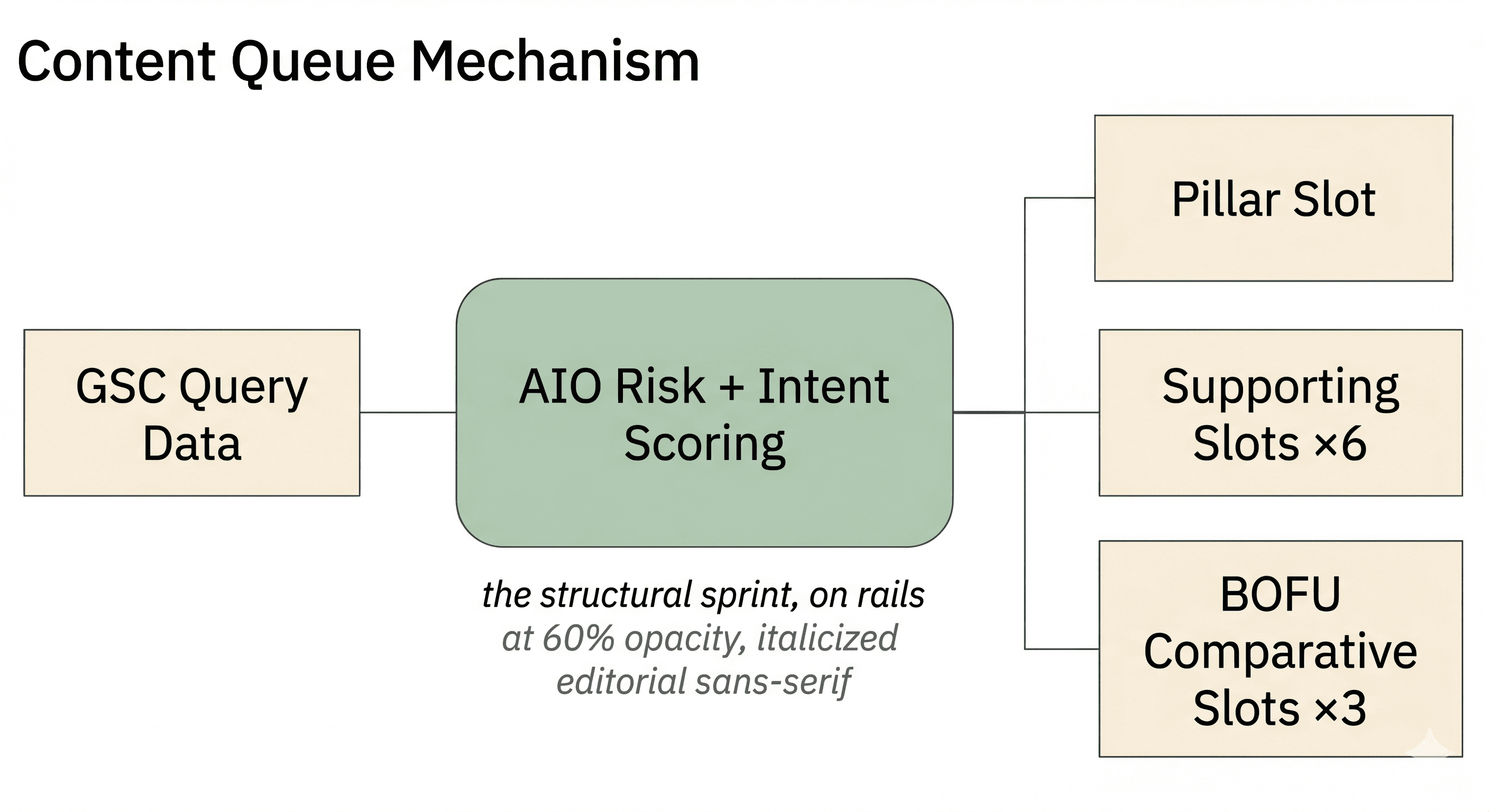
Pulls validated long-tail demand. GSC integration surfaces every 4+ word query already bringing impressions to your domain, sorted by buyer-intent signal rather than raw volume.
Scores AIO risk per query. The queue runs each candidate query through an AIO presence check (does this query trigger an AI Overview today?) so you see the click-bearing real estate flagged separately from the head-term graveyard.
Maps queries to cluster slots. A buyer-question query becomes a supporting piece slot in the right cluster. A comparative query becomes a BOFU piece slot. The 1+6+5 12-piece sprint structure gets populated automatically.
Queues the pieces in execution order. Quadrant 1 first, Quadrant 2 second, defensive Quadrant 3 only when the pillar requires it. Solo founders running the queue average 5 hours a week of content time instead of the 15+ hours the manual flow demands.
The queue is the long-tail defense playbook on rails.
How Do You Track Whether Your Long-Tail Strategy Is Working?
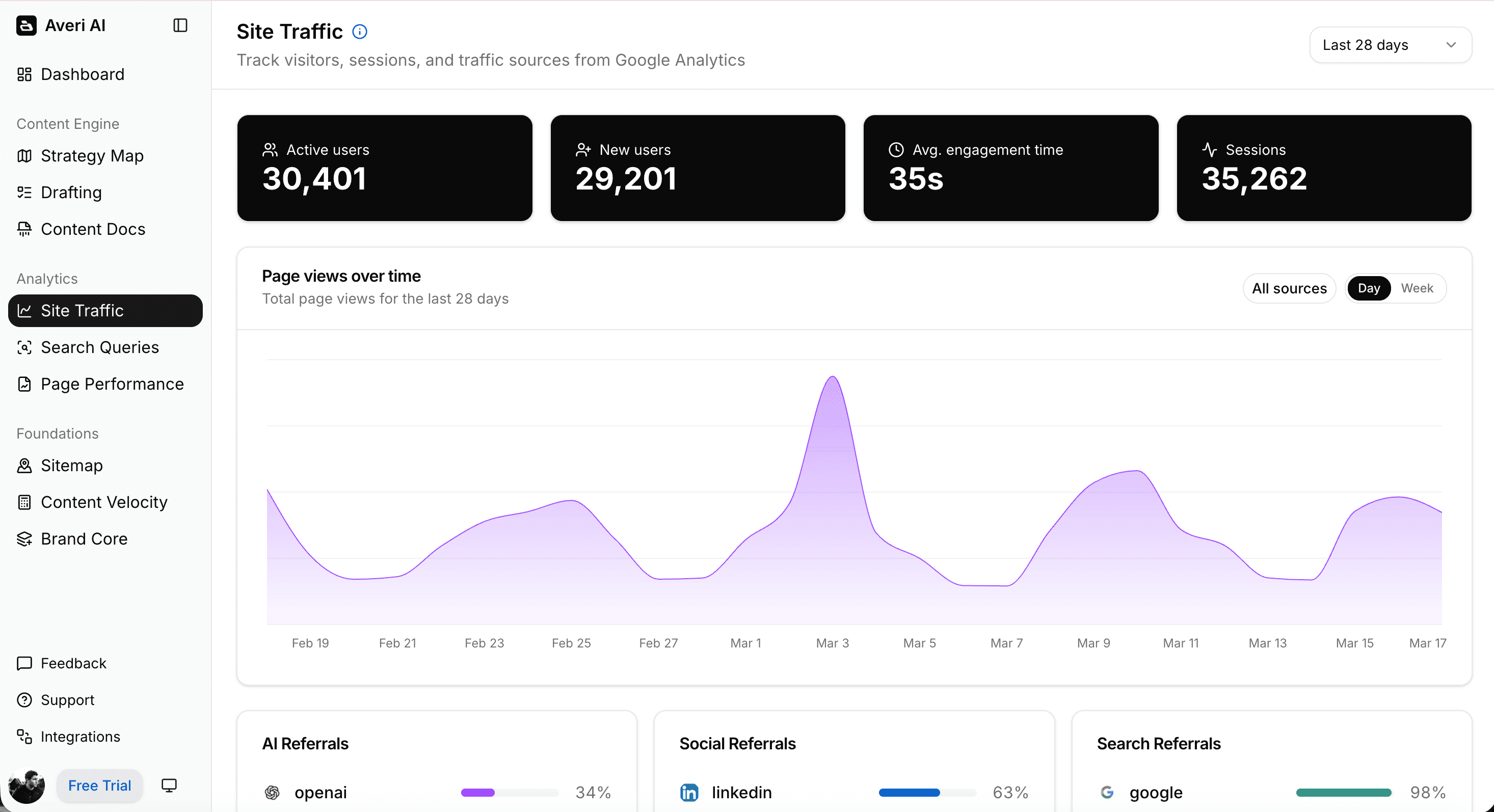
Track four signals weekly. Traffic alone isn't the signal anymore. Click yield per piece and conversion-per-cluster are.
Click yield by query specificity. Group your GSC queries into the 5 query types from the table above. Track CTR for each group monthly. Healthy long-tail clusters show CTR climbing in groups 3–5 even as group 1 CTR collapses. The shift is the leading indicator.
Cluster-level conversion rate. UTM-tag every CTA on cluster pages. Conversion rate from long-tail-targeted pieces should run 2–3x higher than from head-term pieces. If it doesn't, the piece is either ranking for the wrong long-tail variant or the CTA is mismatched to intent.
AIO encroachment rate. Spot-check your top 20 ranking queries monthly. How many now trigger an AI Overview that didn't last quarter? AIO encroachment compounds. Pieces ranking for soon-to-be-AIO queries should get rewritten toward more specific long-tail variants before the click yield collapses.
AI citation rate alongside SEO rank. Long-tail pieces get cited by ChatGPT, Perplexity, and Claude at higher rates than head-term pieces because the specific phrasing matches buyer-question prompts. Track citations alongside ranks to see the dual-channel return.
The four signals together tell you whether the long-tail clusters are compounding or eroding.
What Happens When AI Engines Catch Up to Long-Tail?
AI engines will close some of the long-tail click gap over the next 12–24 months.
The defense isn't permanent. But the structural advantage is durable enough to compound while it lasts.
The likely progression: AI Overviews will get more confident on commercial long-tail (rows 3–4 in the table) before they get confident on comparative long-tail (row 5). Comparative queries depend on neutral synthesis of competing brands, which AI engines have strong incentives to leave to ranked SERPs because they don't want to make competitive judgments on behalf of users.
That gives a clear sequence.
Build comparative and "vs" content first because it has the longest defensible runway.
Build commercial long-tail second because it captures click-bearing real estate today even if AIO eventually expands into it.
Build informational long-tail third as the supporting cluster layer that compounds AI citation regardless of click yield.
By the time AI Overviews close the long-tail click gap, the clusters built on this sequence will have generated 18–24 months of compounding sign-ups, AI citations, and entity authority signals. The defense is temporal. The accumulated authority is durable.
Ready to Run the Long-Tail Defense Playbook?
Pull your GSC data into Averi's content queue. The Solo plan ($99/month) auto-surfaces your validated long-tail demand, scores each query against AI Overview risk and buyer intent, and queues the pieces in execution order. The same workflow we used to compound our cluster traffic without paid spend.
Start your 14-day free trial →
FAQs
What are long-tail keywords and why do they matter for AI Overviews?
Long-tail keywords are search queries with 4+ words and high specificity (audience, budget, use case, or comparison context). They matter because AI Overviews trigger on 30–60% of US queries but disproportionately on broad head terms. Specific long-tail queries preserve click-through because Google can't synthesize a single confident answer for them, so the user still needs to click a result.
How much traffic do long-tail keywords actually represent?
Long-tail keywords account for roughly 70% of total search volume in aggregate, though each individual variant is low-volume. The aggregate matters more in 2026 because head-term volume is increasingly zero-click, while long-tail volume converts at 2–6x higher rates than head terms thanks to specific buyer intent. The traffic-to-revenue math now favors long-tail clusters over head-term pillars.
Are AI Overviews going to eventually take over long-tail queries too?
Probably yes, but not at uniform pace. Commercial long-tail will likely get summarized first as AI engines build confidence. Comparative long-tail ("Product A vs Product B for [use case]") has a longer defensible runway because AI engines have incentives to leave competitive judgments to ranked SERPs. Building comparative content first gives you 18–24 months of compounding click-bearing traffic.
How do I find long-tail keywords my competitors haven't already targeted?
Start with Google Search Console queries already bringing impressions to your domain, filtered to 4+ words. Layer audience modifiers (your specific ICP language) onto the head terms in your space. Mine Reddit threads and customer support tickets for recurring question patterns. Use "vs" and "for [audience]" patterns aggressively. Generic keyword tools like Ahrefs miss most of this because their volume thresholds filter out the highest-intent variants.
What's the right number of long-tail variants per content cluster?
The density that works is 8–12 long-tail variants per cluster: 1 pillar (medium-tail), 2–3 informational long-tail supporting pieces, 2–3 commercial long-tail supporting pieces, and 2–3 comparative long-tail BOFU pieces. The cluster's combined click yield outperforms a single head-term pillar even when each individual variant has lower keyword volume because click-through stays intact across the long-tail surface.
How does Averi's content queue help with long-tail discovery?
Averi's content queue pulls validated long-tail demand from your GSC data, scores each candidate query against AI Overview risk and buyer intent (the 2x2 prioritization framework), maps the highest-yield queries to specific cluster slots, and orders the pieces for execution. Solo founders running the queue average 5 hours a week of content work instead of the 15+ hours the manual discovery and prioritization flow demands.
Should I stop targeting head terms entirely?
No, but reweight. Head terms still earn entity authority signals and feed cluster topical authority even when they don't earn clicks. Keep one head-term-anchored pillar piece per cluster as the authority backbone. Then weight 80%+ of net-new content production toward Quadrant 1 and Quadrant 2 long-tail variants. The pillar holds the cluster together. The long-tail variants do the click-and-convert work.
Related Resources
Long-Tail & Click Defense
AI Overviews & GEO
Google AI Overviews Optimization: How to Get Featured in 2026
The GEO Playbook 2026: Getting Cited by LLMs (Not Just Ranked by Google)
Beyond Google: How to Get Your Startup Cited by ChatGPT, Perplexity, and AI Search
The Future of B2B SaaS Marketing: GEO, AI Search, and LLM Optimization