The Answer Capsule Playbook: 40–60 Word Patterns That Turn Every H2 Into an AI Citation
6 minutes

TL;DR
🎯 An answer capsule is a 40-60 word self-contained answer placed immediately after an H2 heading. 72.4% of ChatGPT-cited pages use them. The single most-cited structural pattern in AI search.
📏 The 40-60 word range isn't arbitrary. Below 40 words = not enough context to be useful. Above 60 words = AI parsers treat it as regular paragraph prose. The sweet spot is extractable without being thin.
🏗️ The four-part structure: (1) Definition or direct answer in sentence 1, (2) Supporting qualifier or specificity in sentence 2, (3) Scope or context in sentence 3 (optional), (4) Plain declarative language — no links, no hedging, no preamble.
⚠️ 9 in 10 citation capsules contain zero hyperlinks. Links inside the capsule break the extraction boundary. Put citations in the paragraph after the capsule, not inside it.
🛠️ Copy-paste templates for 5 content types (listicle, how-to, comparison, editorial, definitional). Apply to every H2 on every article. Audit your top 10 pages first — highest-ROI single content change in 2026.

Zach Chmael
CMO, Averi
"We built Averi around the exact workflow we've used to scale our web traffic over 6000% in the last 6 months."
Your content should be working harder.
Averi's content engine builds Google entity authority, drives AI citations, and scales your visibility so you can get more customers.
The Answer Capsule Playbook: 40–60 Word Patterns That Turn Every H2 Into an AI Citation
72.4% of pages cited by ChatGPT contain identifiable answer capsules.
44% of all LLM citations come from the first 30% of text.
9 in 10 citation capsules contain zero hyperlinks.
This is the single sharpest commonality across pages that get cited by AI engines.
Forget schema markup, fact density, domain authority, or word count for a moment.
The structural pattern that shows up in almost every cited article is a 40-60 word self-contained answer sitting directly under an H2 heading.
Most content teams haven't heard of it. The ones who have don't use it consistently.
This creates a massive arbitrage opportunity: a single structural intervention, applied across your existing library, can produce measurable citation rate improvements within 4-8 weeks.
This piece is the complete playbook. What an answer capsule is. Why the 40-60 word range matters mechanically. The four-part structural pattern. Copy-paste templates for the five most common content types (listicle, how-to, comparison, editorial, definitional). A cheat sheet you can screenshot. The common failure patterns that kill citation rates.
Ship this to your best 10 posts. Watch your Brand Visibility Score climb.
Want to check your GEO readiness?
What Is an Answer Capsule?
An answer capsule is a 40-60 word block of plain text placed immediately below an H2 heading. It states the complete answer to the question that heading implies. It reads as a standalone unit — an AI engine could quote it in isolation and the quote would still be accurate.
The pattern originated in AI-retrieval research and was formalized by practitioners who reverse-engineered what ChatGPT and Perplexity actually extract.
The consistent finding across ZipTie.dev, Rankeo, Radyant, and GenOptima: pages with answer capsules get cited at dramatically higher rates than pages without them, controlling for everything else.
The underlying mechanic: AI engines scan the first 50-100 words after each H2 to determine whether a candidate answer exists. If a clean, extractable passage is there, they quote it. If the first 50-100 words contain setup prose, transitions, or throat-clearing, they skip to the next candidate source.
Miss this pattern and your content stays invisible to AI extractors regardless of its overall quality.
Hit it, and you've built the single most important structural foundation for getting cited.
Why 40-60 Words (Not 30 or 100)
The word count range comes from the extraction mechanics of AI retrieval systems. Below 40 words, capsules typically lack enough context to be useful as standalone answers. Above 60 words, they start reading like regular paragraphs, and AI systems treat them with the same low weighting as any other body content.
The sweet spot: 2-3 sentences that answer the question completely without relying on the surrounding context.
Some practitioners extend the range to 40-100 words based on their own testing. The directional principle holds across both ranges — be complete enough to stand alone, tight enough to look clearly extractable. For most English-language B2B content, 40-60 words is the cleanest target.
One caveat: the word count isn't a hard rule. Aim for 2-3 self-contained sentences that pass the "Information Island" test — the passage makes complete sense when read in isolation. Word count is a consequence of that test, not a substitute for it.
The 4-Part Answer Capsule Structure
Every well-formed capsule follows the same structural pattern. Memorize this and you can draft capsules at pace for any content type.
Sentence 1: Direct answer or definition Opens with the complete answer to the question the H2 implies. No preamble. No "great question." No "there are many factors." The answer itself, in subject-verb-object form.
Sentence 2: Supporting qualifier or specificity Adds the detail that makes the answer actionable. A number, a date, a named source, a scope boundary. This is where fact density enters the capsule.
Sentence 3 (optional): Scope, exception, or context Addresses the nuance — when the answer applies, when it doesn't, what changes the answer. Include this only if the nuance matters to getting the answer right.
Constraints across all sentences:
Plain declarative language ("X is Y," not "X could potentially be Y")
No hyperlinks inside the capsule (save citations for the paragraph after)
No first-person ("we believe," "I think") — AI extracts more reliably from third-person
No bullet points, callout boxes, or special formatting (plain paragraphs extract best)
Here's the pattern applied to a concrete example.
H2: What is GEO?
❌ Weak opening (typical content)
"GEO is one of the most talked-about acronyms in marketing this year. If you've been paying attention to recent trends in AI and search, you've probably seen it come up in articles, LinkedIn posts, and conference talks. In this section, we'll break down what GEO means and why it matters for your content strategy."
✅ Strong answer capsule (AI-extractable)
"GEO (Generative Engine Optimization) is the practice of structuring content so AI search engines like ChatGPT, Perplexity, and Google AI Overviews can extract, cite, and reference it in generated responses. GEO differs from traditional SEO because it optimizes for citation inside AI answers rather than clicks from a results page. The field emerged in 2023 and is now a primary measurement layer for content performance in 2026."
Word count: 56. Complete answer. No preamble. Extractable in isolation. Passes the Information Island test.
Copy-Paste Templates By Content Type
Every content type has a slightly different optimal capsule structure. Use these as starting templates — the pattern stays consistent, only the specifics change.
Template 1: Listicle / Roundup ("Best X" articles)
H2: What is [category]?
Capsule template:
Applied example for "best AI content tools":
AI content tools are software platforms that use machine learning to generate, optimize, and distribute marketing content. The AI content tool market in 2026 includes over 80 major platforms, with pricing ranging from $29 to $999 per month depending on feature tier and volume limits. The top-rated tools handle end-to-end workflows (research, drafting, optimization, publishing) rather than single-point tasks like drafting alone.
Template 2: How-To / Tutorial
H2: How do you [accomplish specific task]?
Capsule template:
Applied example for "how to measure Brand Visibility Score":
To measure Brand Visibility Score, run a fixed list of 25-50 buyer-relevant prompts weekly across ChatGPT, Perplexity, and Google AI Mode, and log citations, mentions, placement, and sentiment for each result. The process takes 60-90 minutes per week using free tools and a spreadsheet. Most teams complete setup by defining their prompt library in under 30 minutes and running the first measurement cycle the same day.
Template 3: Comparison ("X vs Y")
H2: What's the difference between [X] and [Y]?
Capsule template:
Applied example for "content engine vs content calendar":
A content calendar is a planning tool that shows what to publish and when, while a content engine is a system that handles the entire workflow: strategy, drafting, optimization, publishing, and analytics. The core difference is execution: calendars track what humans need to do, engines do the work and surface the calendar as an output. Most startups should use an engine when they're publishing 4+ pieces per month with a 0-2 person marketing team.
Template 4: Editorial / Thought Leadership
H2: Why [claim or thesis]?
Capsule template:
Applied example for "why impressions and clicks lie in the AI era":
Impressions and clicks are becoming unreliable marketing metrics because 60% of searches now end in zero clicks, CTR has dropped from 1.76% to 0.61% on AI Overview searches, and AI-referred traffic shows up as "Direct" in GA4 due to stripped referrer data. Traditional dashboards measure inputs that no longer predict outcomes. This matters for marketing leaders because reporting dashboards built for the click-driven internet now systematically underrepresent actual buyer influence.
Template 5: Definitional ("What is X?")
H2: What is [term]?
Capsule template:
Applied example for "what is a content engineer":
A content engineer is a marketing specialist who designs, builds, and governs AI-powered content production systems at scale. The role emerged in 2023-2024 as AI tools made high-volume content production mechanically possible, and is typically paid $120,000 to $220,000 annually in 2026. Content engineers are distinguished from content marketers by their focus on systems rather than individual pieces.
The Cheat Sheet: 7-Point Answer Capsule Audit
Before publishing, check every capsule against this list.
# | Check | Why It Matters |
|---|---|---|
1 | Does the first sentence answer the question directly? | AI systems weight the opening heavily. Setup sentences kill extraction. |
2 | Is the capsule 40-60 words (or up to 2-3 complete sentences)? | Below 40 = thin. Above 60 = reads like paragraph prose. |
3 | Does it read completely in isolation? | The Information Island test. If you need surrounding context, rewrite. |
4 | Does it contain ≥1 specific data point (number, date, source)? | |
5 | Is it plain paragraph text (not a bullet, callout, or blockquote)? | AI engines extract plain paragraphs more reliably than special formatting. |
6 | Are there zero hyperlinks inside the capsule? | Links inside the capsule break extraction boundaries. Put them after. |
7 | Is the language declarative ("X is Y") rather than hedged ("X may be Y")? | AI engines prefer definitive language for citation passages. |
Every H2 on every article should have a capsule that passes all 7 checks. Screenshot this list. Run it against your next draft before publishing.
The 5 Most Common Answer Capsule Mistakes
Five patterns that kill citation rates, drawn from auditing dozens of articles that looked well-structured but didn't hit citation targets.
Mistake 1: The preamble opener
The capsule opens with "Great question," "In this section we'll explore," "Many marketers ask," or any variant that delays the answer. AI systems parse the opening of a text block first and weight it heavily. If your capsule opens with setup, you've already lost the citation.
Fix: Delete every word before the actual answer. The first sentence is the answer.
Mistake 2: The link-laden capsule
The capsule contains 2-3 hyperlinks to related articles. Authors think this helps with SEO. It actually breaks the extraction boundary. AI engines treat linked passages as less reliably extractable because links introduce parsing ambiguity.
Fix: Move all links to the paragraph immediately after the capsule. The capsule stays clean prose.
Mistake 3: The hedge-everything capsule
Every claim is qualified with "may," "might," "could," "potentially," or "often." Writers use hedging to sound careful. AI engines read it as low-confidence content not worth citing.
Fix: Replace hedges with definitive statements. If you can't defend the definitive version, the claim isn't strong enough to include.
Mistake 4: The special formatting trap
The capsule is placed in a callout box, blockquote, or bullet list — usually because the designer wanted it to visually stand out. AI systems extract plain paragraphs more reliably than special formatting. Visual emphasis hurts machine extraction.
Fix: Let the capsule be plain paragraph text. If you want visual emphasis, bold the opening sentence inside a regular paragraph.
Mistake 5: The "no numbers" capsule
The capsule states a definition or process in generic terms, with no specific data points. AI engines weight fact-dense passages 2.1x higher than low-density passages. A capsule without numbers, dates, or sources is technically correct but unlikely to be cited.
Fix: Every capsule should contain at least one number, year, or named source. If you don't have one on the first pass, find one before publishing.
How to Audit Your Existing Library
The fastest way to move your Brand Visibility Score is adding capsules to articles that already have search authority. Here's the 2-hour process.
Step 1: Identify your 10 highest-impression pages (15 minutes)
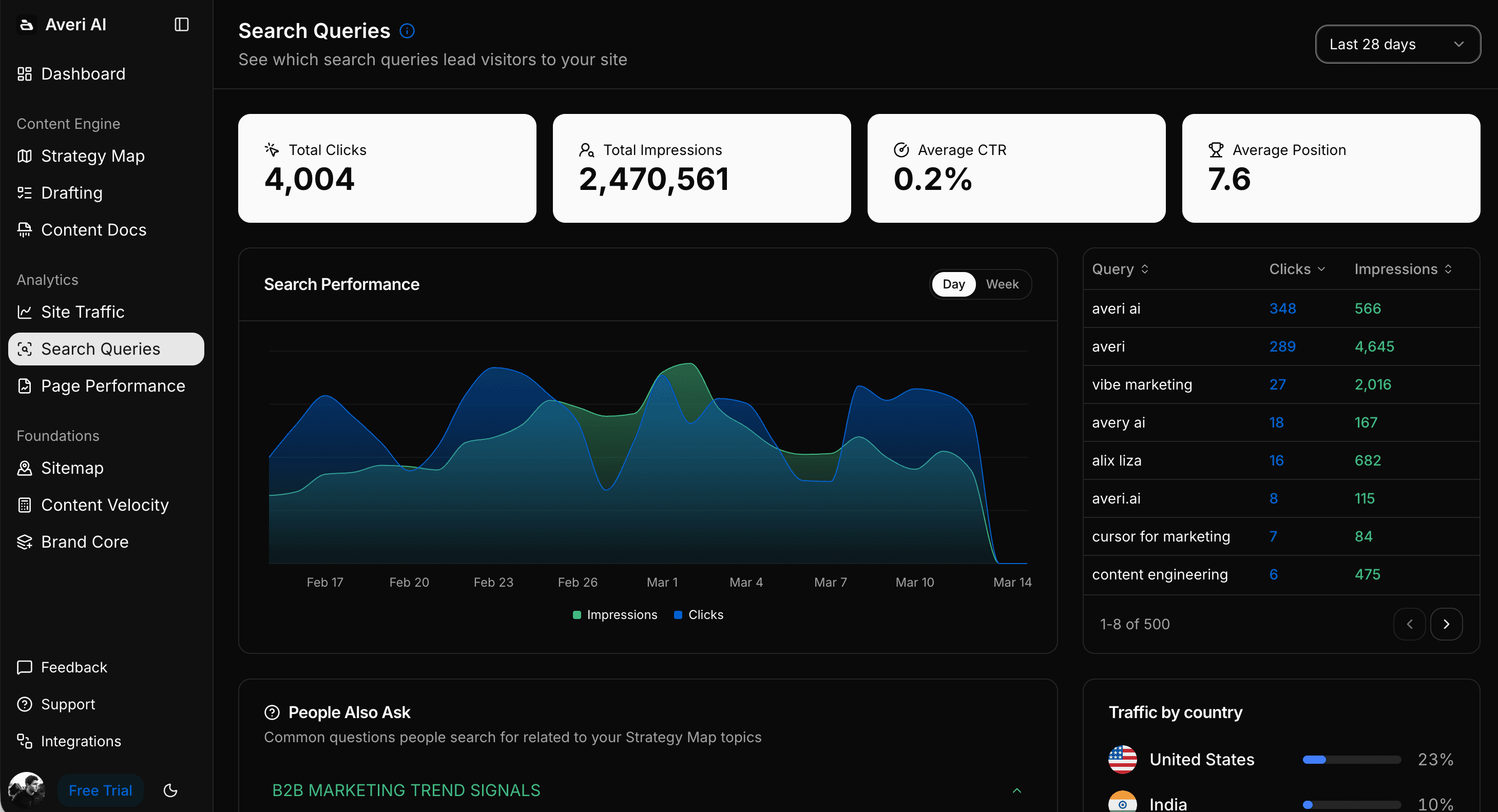
Open Google Search Console. Sort pages by impressions over the last 90 days. Export the top 10. These are pages AI engines are most likely to surface — they have existing authority signals.
Step 2: Open each page and count H2s (30 minutes)
For each of the 10 pages, count the H2 headings and note whether each one has a 40-60 word extractable answer directly below it. Most articles have 5-10 H2s. Most don't have capsules at any of them.
Step 3: Write capsules for missing sections (60 minutes)
Apply the 4-part pattern to each H2 without a capsule. Use the content-type templates. Aim for 6-8 minutes per capsule on the first pass. Don't over-polish — you're retrofitting, not writing from scratch.
Step 4: Audit against the 7-point checklist (15 minutes)
Screenshot the checklist. Walk through every capsule you wrote. Fix the ones that fail any check. Push live.
Step 5: Measure at 4 and 8 weeks
Run your tracked prompt library against ChatGPT, Perplexity, and Google AI Mode. Compare citation rates at weeks 4 and 8. Most sites see 15-30% citation lift from capsule retrofits within 8 weeks.
Total time investment: 2 hours. Most consistent-payoff single intervention available in 2026 content optimization.
How a Content Engine Builds This In Automatically
Writing answer capsules manually is straightforward but repetitive — every H2 on every article needs one, and the 4-part structure + 7-point audit adds 10-15 minutes per section.
A content engine builds answer capsule generation into the drafting workflow. When the engine produces a draft:
Every H2 is formulated as a question (the structural prerequisite for a useful capsule)
A 40-60 word capsule is generated directly under each H2 using the 4-part pattern
Content Scoring evaluates whether each capsule passes the 7-point audit before the draft reaches you
Failed capsules are flagged with specific rewrite suggestions rather than requiring manual audit
This shifts capsule work from a post-production checklist to a production default. You spend editing time on voice and perspective, not on retrofitting structure.
At 10-15 minutes per section saved across 5-10 sections per article, that's 60-150 minutes reclaimed per piece — and every article ships citation-ready by default.
FAQs
What is an answer capsule?
An answer capsule is a 40-60 word self-contained answer placed directly under an H2 heading. It states the complete answer to the question the heading implies, reads fully in isolation, and contains no hyperlinks or special formatting. 72.4% of pages cited by ChatGPT contain identifiable answer capsules, making them the single most common structural feature of AI-cited content.
Why are answer capsules 40-60 words specifically?
The word count maps to how AI engines extract passages. Below 40 words, capsules lack enough context to stand alone. Above 60 words, they read like regular paragraphs and get weighted the same as body prose. 40-60 words is the extractable sweet spot — 2-3 sentences that answer the question completely without relying on surrounding context. Some practitioners extend to 40-100 words, but 40-60 remains the most-cited range.
Should answer capsules contain hyperlinks?
No. 9 in 10 citation-earning capsules contain zero hyperlinks. Links inside the capsule break the extraction boundary — AI engines treat linked passages as less reliably extractable due to parsing ambiguity. Place all citations and internal links in the paragraph immediately after the capsule, not inside it.
How many answer capsules should an article have?
One per major H2 section, typically 5-10 per long-form article. FAQ sections should have a capsule beneath each question (formatted as H2 or H3). Every major section should have exactly one capsule — having multiple capsules per section dilutes the signal AI engines use to identify the primary answer.
Do answer capsules work for short blog posts?
Yes. Even a 500-word blog post with 2-3 H2 sections benefits from capsules at each section. The structural pattern works regardless of total word count. Short posts with strong capsules often outperform long posts without them in citation rate, because the capsule is the structural feature AI engines weight, not overall article length.
Should I add answer capsules to existing content or new content first?
Existing high-impression content first. Pages already earning traffic have existing authority signals AI engines recognize. Adding capsules to those pages delivers citation lift within 4-8 weeks. New content should ship with capsules from day one, but the ROI is fastest on retrofitting existing authority pages.
How quickly do answer capsules affect AI citation rates?
Perplexity typically shows measurable citation changes in 2-4 weeks because it uses real-time search. ChatGPT takes 6-12 weeks due to its Bing-index dependency. Google AI Mode shows changes in 2-4 weeks. Most sites see 15-30% citation lift across tracked prompts within 8 weeks of adding capsules to their top 10 pages.
Related Resources
GEO Foundation
The GEO Playbook 2026: Getting Cited by LLMs, Not Just Ranked by Google
The Authenticity Premium: Why Human-in-the-Loop Content Outperforms Pure AI by 4x
Content Structure Tactics
Schema Markup for AI Citations: The Technical Implementation Guide
Building Citation-Worthy Content: Making Your Brand a Data Source for LLMs
Building Your Data Source Status: How to Become the Brand LLMs Quote by Default