Why Jasper Wants You to Hire a Content Engineer. Why AirOps Wants You to Build One. Why You Should Do Neither for the Next Six Months.

6 minutes

TL;DR
💼 The role is real. Content Marketing Manager job listings dropped 73% since 2023; technical hybrid roles are growing 300%+ annually
💰 The cost isn't payable at seed stage. $161K base salary, ~$200K fully loaded Year 1 — equal to roughly 6 months of average seed runway
🎯 Both vendors have skin in this game. Jasper sells the tools a content engineer would use. AirOps coined "10x Content Engineer" and runs the certification cohort that trains them
🚫 The bottleneck at seed stage isn't headcount. It's a packaged workflow that does what a content engineer would build in their first 6 months
🛠️ For the next 6 months: do neither. Run a packaged content engine at $99–399/month and revisit the hire only after content compounds into real pipeline
📊 The cost frame: Averi Solo at $1,188/year vs. fully loaded content engineer at ~$200,000/year — same outcome window, 168x cost ratio

Zach Chmael
CMO, Averi
"We built Averi around the exact workflow we've used to scale our web traffic over 6000% in the last 6 months."
Your content should be working harder.
Averi's content engine builds Google entity authority, drives AI citations, and scales your visibility so you can get more customers.
Why Jasper Wants You to Hire a Content Engineer. Why AirOps Wants You to Build One. Why You Should Do Neither for the Next Six Months.
Two pieces landed in the same two-week window in April, both telling seed-stage startups they need a content engineer.
Jasper's April 29 piece by Loreal Lynch calls the role "the most in-demand in marketing."
AirOps' "10x Content Engineer One Year Later" reports their January 2026 cohort drove over $1M in pipeline at companies like Wiz, Vanta, Netflix, and Ramp.
Both pieces argue the same thing… you need to hire this person, or build someone into them, right now.
They're not wrong about the trend. They're wrong about your stage.
The fully loaded Year-1 cost of a content engineer runs about $200,000. The Averi Solo plan costs $1,188 a year.
That's a 168x cost differential for a workflow that, in the first six months, does most of what a content engineer would build from scratch.
This piece is the honest math on the buy-versus-hire decision, and the operational answer for the next six months.
See how much you could save with Averi
What Jasper And AirOps Both Said In April
The two pieces are worth reading next to each other, because the framing convergence is too clean to be coincidence.
Jasper's April 29 piece argues that content engineering is becoming "critical for the future of how teams build and scale brand-safe content."
Their framing extends a thesis they ran earlier in their 3 Predictions for AI in Marketing in 2026 — "every team inside an enterprise will have engineers embedded in it" because "marketing is becoming a systems-thinking discipline." The implication: hire a content engineer or fall behind.
AirOps' "10x Content Engineer One Year Later" is more direct.
They invented the "10x Content Engineer" framing in February 2025, ran their first cohort in January 2026, and now report "$1M in pipeline" attributed to companies that adopted content engineering as a strategic capability. AirOps is also actively hiring a Content Engineer themselves, positioning the role internally as "one of the most important new roles in modern marketing."
Both arguments contain truth.
The role exists. The skill set is real. The trend toward systems-over-content-pieces is correct. The piece you should read alongside both, though, is Growthwaves' "My take on the content engineer (for now)", which names the structural issue…
"AirOps became one of the most vocal evangelists of the concept. They coined the term '10x Content Engineer' and published extensively about why this was the most strategic growth hire a company could make in 2026... The companies behind [the tools] needed a way to describe the person who would get the most out of their product."
This is not a corruption claim. AirOps' tools are powerful. Their cohort is well-run. Their customers cite real outcomes. The structural issue is that both Jasper and AirOps benefit commercially from the role existing — Jasper because their stack assumes someone is engineering content workflows, AirOps because their workflow builder requires a technical operator. The role's existence is convergent with their product roadmaps. That's worth weighing against their case for it.
The Role Is Real. It's Also Not For You (Yet).
Two things can be true at the same time. The content engineer role is real and growing. And it is not the right hire for a 1-to-10-person seed-stage team.
The Averi cluster has covered the role definition in detail. What Is a Content Engineer: The 2026 Role (And Who Should Hire One) walks through the skill stack… content strategy + low-code workflow construction + AI orchestration + technical SEO + measurement. Content Engineer vs. Content Marketer covers the transition. This piece picks up where those two left off.
When the role makes sense
A content engineer is the right hire when:
Your team is 15+ people with a defined editorial strategy and dedicated content operations
Your content production is 50+ pieces per month across multiple formats and channels
Your content stack includes enterprise CMS (Contentful, Sanity, ContentStack) requiring technical configuration
Your annual content budget exceeds $500K — at that scale, a $200K loaded salary is a routine ops line item
You have multiple brands, regions, or languages to govern
Your time-to-ROI tolerance is 6–12 months for the new hire to ramp into infrastructure work
Wiz, Vanta, Netflix, and Ramp — the customers AirOps cites — fit this profile. So do Webflow, Klaviyo, Carta, and Chime. These are post-Series-B companies with established content teams. The hire works at that stage because the foundation exists for the engineer to build on.
When it doesn't
For a seed-to-early-Series-A B2B SaaS startup, the math doesn't pencil:
Your team is 1–10 people, the founder still touches content, and headcount is rationed by ARR
Your content production target is 4–12 pieces per month, mostly long-form, with the founder as primary editorial voice
Your CMS is Framer, Webflow, or WordPress — no enterprise schema or multi-tenant requirements
Your content budget is $3K–$10K monthly — a $200K loaded hire would consume 70% of annual marketing spend
You're at the figure-out-what-works stage, not the scale-what-works stage
At this stage, hiring a content engineer to build the system means hiring before you know what the system needs to do. Most seed-stage content failures are not infrastructure failures. They're product-market-fit-for-content failures. The infrastructure has to come after the working topic and voice, not before.
The Money Math (Honest Numbers)
The numbers from public job listings as of Q2 2026:
Cost component | Year 1 | Source |
|---|---|---|
Base salary (mid-level content engineer, US-remote) | $161,000 | Semrush + LinkedIn salary data referenced in Averi's content engineer breakdown |
Benefits (health, retirement, PTO) | +$24,000 | ~15% of base |
Payroll taxes (FICA, FUTA, SUTA, workers' comp) | +$13,000 | ~8% of base |
Equipment, software stack, training | +$3,000 | Laptop, AI tools, content stack tooling |
Year 1 fully loaded | ~$201,000 |
Now Averi:
Plan | Annual cost |
|---|---|
Solo ($99/month) | $1,188 |
Team ($199/month) | $2,388 |
Agency ($399/month) | $4,788 |
Pricing detail |
The ratio: a fully loaded content engineer hire costs 168x the Averi Solo plan and 42x the Agency plan.
The framing question is not "do you need a content engine?" — both you and the content engineer are building one.
The framing question is whether you build it for $1,188 or $201,000 in the first year.
For an 18-month-runway seed startup, the content engineer hire consumes the equivalent of roughly 6 months of operational runway when fully loaded — and most seed startups shouldn't be making 6-month-runway-equivalent bets on a single hire until they know exactly what that hire is going to build.
Not sure which makes sense for you? Check your Marketing Maturity
What A Content Engineer Builds In Their First Six Months
This is the part both Jasper and AirOps gloss over. A content engineer doesn't show up on day one running a 50-piece-per-month operation. They spend the first six months building infrastructure. Specifically:
Month 1–2: Brand context layer. Document brand voice, tone rules, positioning, ICP segments, competitor map, banned terms, preferred messaging anchors. This is what Averi calls Brand Core. A content engineer builds it manually from interviews and documentation review.
Month 2–3: Strategy and queue. Run keyword research, AI-citation pattern analysis, competitor gap analysis, ICP intent mapping. Generate a 90-day content queue. A content engineer builds this in Notion or Airtable, often combined with Ahrefs and Semrush exports.
Month 3–4: Workflow stack. Stand up the AI drafting pipeline, configure scoring (SEO + GEO), build CMS publishing connections, set up analytics flow. A content engineer wires this in AirOps, Jasper, or custom Make/Zapier pipelines depending on stack preference.
Month 4–5: First content shipped. Pieces enter the pipeline. Most teams report 2–4 weeks of iteration before the first piece feels production-ready. Editing cycles compress over time as the system learns.
Month 6: Analytics feedback loop active. Performance data starts feeding back into the queue. The "engine" is operational.
That's six months. Roughly $100,000 in loaded compensation. And every dependency the engineer needs (Jasper subscription, AirOps workflow stack, Ahrefs, Semrush, analytics tooling, CMS integrations) is layered on top — easily another $20,000–$50,000 in tool spend for a year.
What A Packaged Content Engine Already Includes
The Averi parallel for each of those six months:
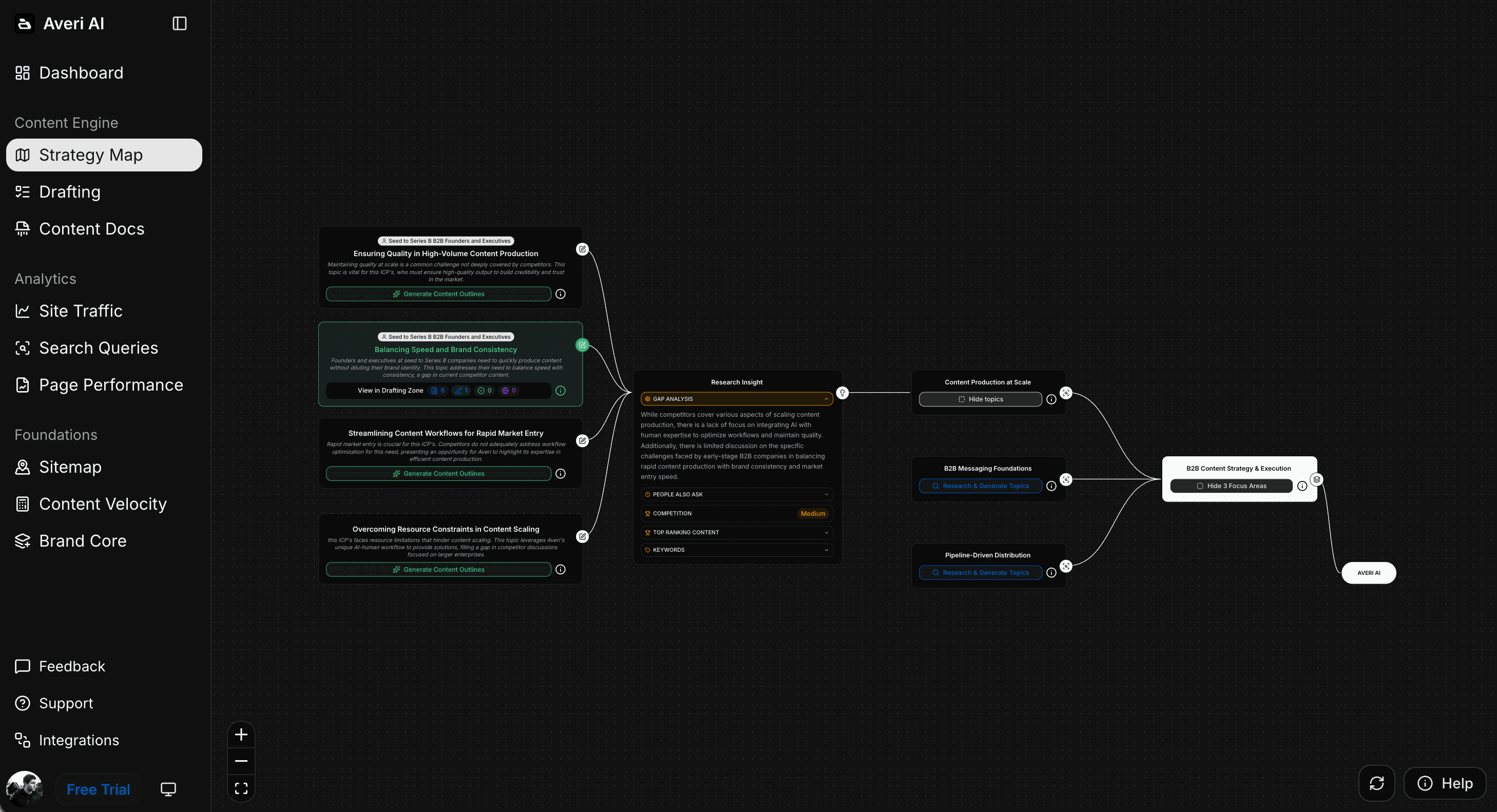
Day 1: Brand Core generated. Onboarding flow analyzes your website, ICP signals, and competitor set. Brand voice rules and segment context loaded into the AI. 30–60 minutes elapsed.
Day 1: Content queue generated. Strategy Map produces a 90-day content queue from the Brand Core, keyword research integration, and ICP intent mapping. Same session.
Day 1: First draft generated. AI drafts the first piece with Brand Core loaded. Scoring runs at draft time. CMS publishing integration ready for Webflow, Framer, or WordPress.
Week 1: First piece published. Editorial review, scoring optimization, publish. Most teams ship their first piece within 5 days of signing up.
Month 1: Three to four pieces published. Standard seed-stage cadence. Engine is operational, learning from each piece.
Month 6: 18–24 pieces in the library. Analytics feeding back into the queue. The "engine" is operational — same outcome state as the content engineer hire, six months earlier, at less than 1% of the cost.
This is the structural argument.
A content engineer's first six months of work is the system Averi shipped to you on day one.
You are not skipping the work. You are buying the work that's already been done.
After month six, if the company is scaling and content needs are growing past what a packaged engine handles, then revisit the hire with actual data… what is the engine producing, what are the gaps, what would a content engineer add that the engine can't?
See what your Content ROI could be
What To Do For The Next Six Months Instead
Five operational moves, in order:
1. Stand up a packaged content engine. Averi Solo at $99/month for solo founders, Team at $199 if you have 2–3 marketers, Agency at $399 for 4–10 person teams. 14-day free trial. Time-to-first-published-post should be inside 5 days.
2. Reserve 5–10 hours weekly for editorial review. This is the founder or fractional marketer hour. The engine handles drafts and scoring. The human adds first-person experience markers, contrarian POV, sourced specifics. Editorial review at this stage is the highest-impact time the founder spends on marketing.
3. Track three metrics, not twenty. Pieces published per month (target 4–8). Average SEO + GEO score per piece (target 80+). Branded search lift over 90 days (the leading indicator of content compounding). Skip Page360-style dashboards until you have something to measure.
4. Build the editorial relationship first, the infrastructure second. The first 18–24 published pieces tell you what your audience reads, what voice resonates, what topics convert. That data is what makes the eventual content engineer hire (if you make it) productive. Hire before you have that data and you're paying a $200K consultant to figure out what the engine would have told you for $1,188.
5. Revisit the hire at month 6. If content is driving meaningful pipeline (defined: contributing 15%+ of pipeline by month 6), if production volume is bumping against the packaged engine's ceiling, and if you've raised a Series A or are close, then run the hire process. Otherwise: stay on the engine for another 6 months and revisit again.
The honest version is that most seed-stage teams will not need a content engineer at month 6, month 12, or month 18. They'll need a content engine and a 5-hour-per-week editorial habit. By the time they need a content engineer, they'll also have the revenue to pay one — and the data to direct them.
When To Actually Hire A Content Engineer
The hiring trigger should be defined ahead of time, so you don't make the buy-versus-hire decision on emotion or vendor pressure.
Concrete triggers:
Trigger | Signal |
|---|---|
Production exceeds packaged engine ceiling | Publishing 25+ pieces monthly, hitting tier limits, requiring custom workflows |
Multi-brand or multi-region needs emerge | Operating 2+ brands or 3+ language markets simultaneously |
Pipeline contribution exceeds 25% | Content is the largest single growth channel; further investment has clear ROI |
ARR clears $5M (post-Series A) | Headcount is no longer the binding constraint; specialization makes sense |
Engineering or product needs to be in the loop | Programmatic SEO at scale, internal tools integration, multi-CMS governance |
Editorial review time exceeds 20 hours weekly | Founder bandwidth is constraining content cadence |
When three or more of these trigger simultaneously, run the hire. The role is real and the people who do it well are valuable. The question is never "should this role exist" — it's "should this hire exist at this company on this date."
Skip the $200K hire. Build the engine in 30 minutes instead
Averi sets up your Brand Core, generates your 90-day content queue, and ships your first scored draft on day one. $99–399/month. 14-day free trial. No content engineer required.
FAQs
Should I hire a content engineer for my seed-stage startup?
For most seed-stage B2B SaaS startups, no — not for the next six months at minimum. The role's fully loaded Year-1 cost runs roughly $201,000, which is equivalent to about 6 months of average seed-stage runway. A packaged content engine at $99–399 per month delivers the same six-month build state as a content engineer would, at less than 1% of the cost. Revisit the hire after you have 18–24 pieces published and pipeline data showing where the gaps are.
What does a content engineer actually do?
A content engineer designs, builds, and governs AI-powered content systems end-to-end. Their first six months typically involve building a brand context layer, generating a content strategy and queue, configuring the AI drafting pipeline, setting up scoring and publishing workflows, and standing up the analytics feedback loop. After month six, they operate the system they built, scale it, and customize it as the business evolves. The full role definition lives in our 2026 content engineer breakdown.
Why do Jasper and AirOps push the content engineer role?
Both companies have commercial alignment with the role existing. Jasper's stack assumes someone is engineering content workflows across their Grid, Pipelines, and IQ products. AirOps' workflow builder requires a technical operator who can configure no-code automations. AirOps explicitly coined the "10x Content Engineer" framing and runs the certification cohort that trains the role. The role is real, but the vendor case for it is convergent with their product roadmap.
How much does Averi cost compared to a content engineer hire?
Averi Solo is $99/month ($1,188/year). A fully loaded mid-level content engineer hire in the US runs approximately $201,000 in Year 1. That's a 168x cost ratio. For most seed-to-Series-A startups, the packaged engine produces the same six-month build state as the hire — same brand context layer, same content queue, same scoring system, same CMS publishing, same analytics loop — at less than 1% of the cost.
When should I switch from a packaged engine to hiring a content engineer?
Run the hire when three or more of these are true: production exceeds 25 pieces monthly, multi-brand or multi-region needs emerge, content drives 25%+ of pipeline, ARR clears $5M post-Series-A, engineering or product needs to be in the loop, or founder editorial review exceeds 20 hours weekly. Most seed-stage startups won't trigger three until 12–18 months after launch — sometimes longer.
What if I want the content engineer role but can't afford it?
Two operational alternatives. First, run a packaged content engine and develop your fractional marketer or marketing-aware founder into the content engineer role over 12–18 months. The skills are learnable, especially with the packaged engine handling the heaviest infrastructure work. Second, hire a fractional content marketer at 10–15 hours weekly layered on top of the packaged engine. Total monthly cost: $1,500–$3,500 vs. $16,000+ for a full-time hire.
Does this mean the content engineer role is fake?
No. The role is real, the skills are valuable, and at the right company stage the hire is correct. The critique here is timing-specific: at seed and early Series A, the role doesn't fit the company yet. By Series B or later, with an established content team and infrastructure, the hire is often the right move. The framing question is always stage, not role legitimacy.
Related Resources
Content Engineering
What Is a Content Engineer: The 2026 Role (And Who Should Hire One)
Content Engineer vs. Content Marketer: Why the Job Title Shift Matters for Your Startup
The Rise of the Content Engineer: Marketing's Most In-Demand Role
2026 Is the Year You Probably Should Become a Content Engineer
Buy-vs-Hire Economics
The $200K Marketing Hire That Never Delivered: Why Full-Time Is the New Risk
Build a Killer Startup Marketing Team Without Full-Time Hires
Full-Funnel Content Team on a Budget: A Framework for Combining AI + Flexible Talent
Seed-Stage Operations
The role exists. The hire decision is about stage, not legitimacy. If you're past Series B with a defined content operation, hire one. If you're at seed or early Series A, run an engine for six months first.