
TL;DR
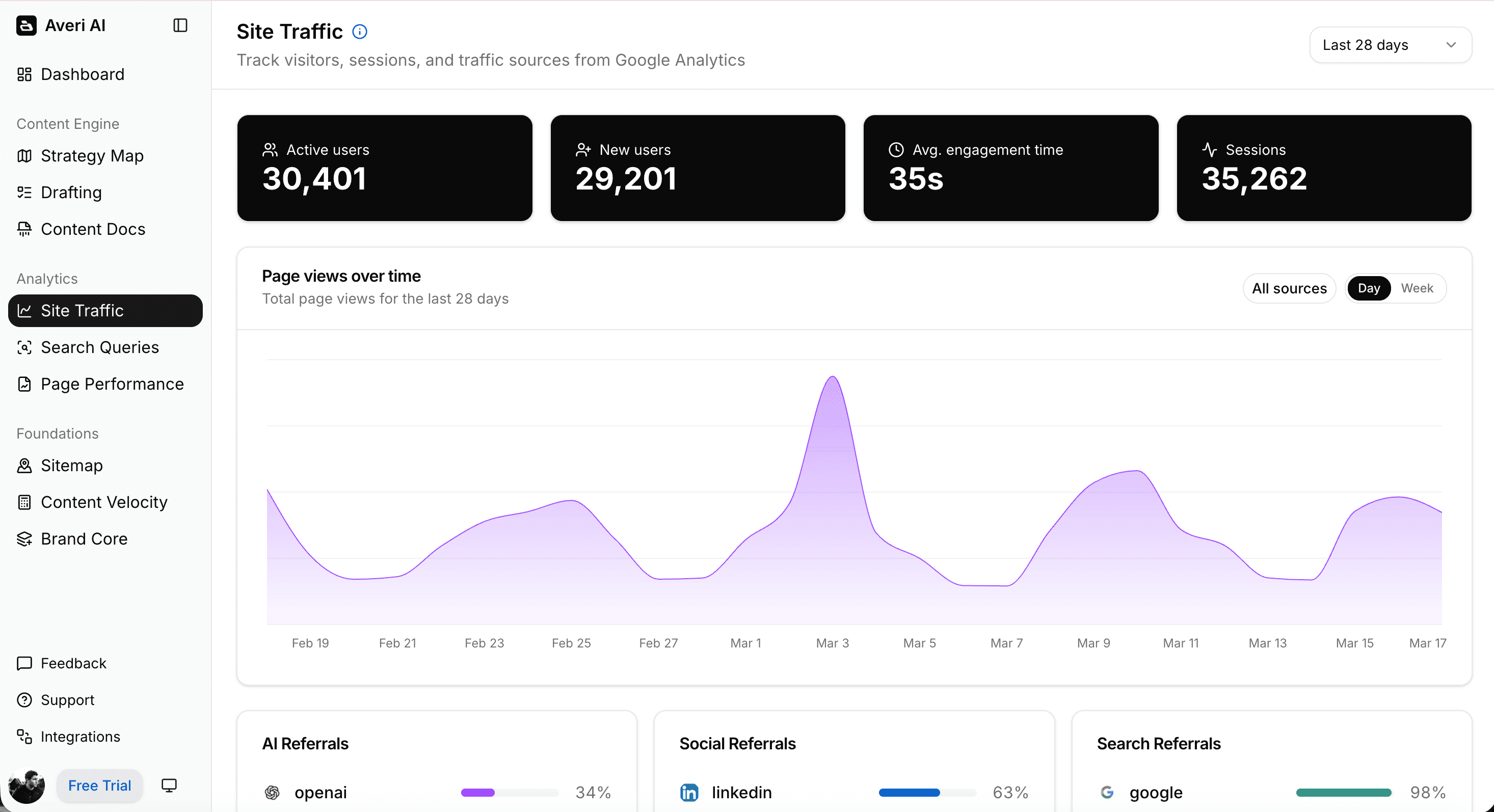
📊 18,270 visitors across our site in 16 days. AI sources delivered just 392 of them, or 2.1% of the total.
🔻 Gemini traffic bounced at 64.7%. Google Search bounced at 83.2% on the same site, same window.
📈 ChatGPT pages per session: 1.69. Google pages per session: 1.35. A 25% read-depth gap.
🥇 The single best-engaged source on our entire dashboard was Gemini — Google's own AI cannibalizing Google's own search results on quality.
⚠️ AI traffic is 2% of volume. By engagement, it's worth far more than that 2% suggests — and the bounce rate metric most teams optimize for is increasingly the wrong one.

Zach Chmael
CMO, Averi
"We built Averi around the exact workflow we've used to scale our web traffic over 6000% in the last 6 months."
Your content should be working harder.
Averi's content engine builds Google entity authority, drives AI citations, and scales your visibility so you can get more customers.
Google's AI Sent Us 30% Better Traffic Than Google's Search
Gemini sent us 1.76 pages per visit. Google Search sent 1.35.
Google's own AI engine is outperforming Google's own search results on the metric that actually matters… what the visitor does after they land.
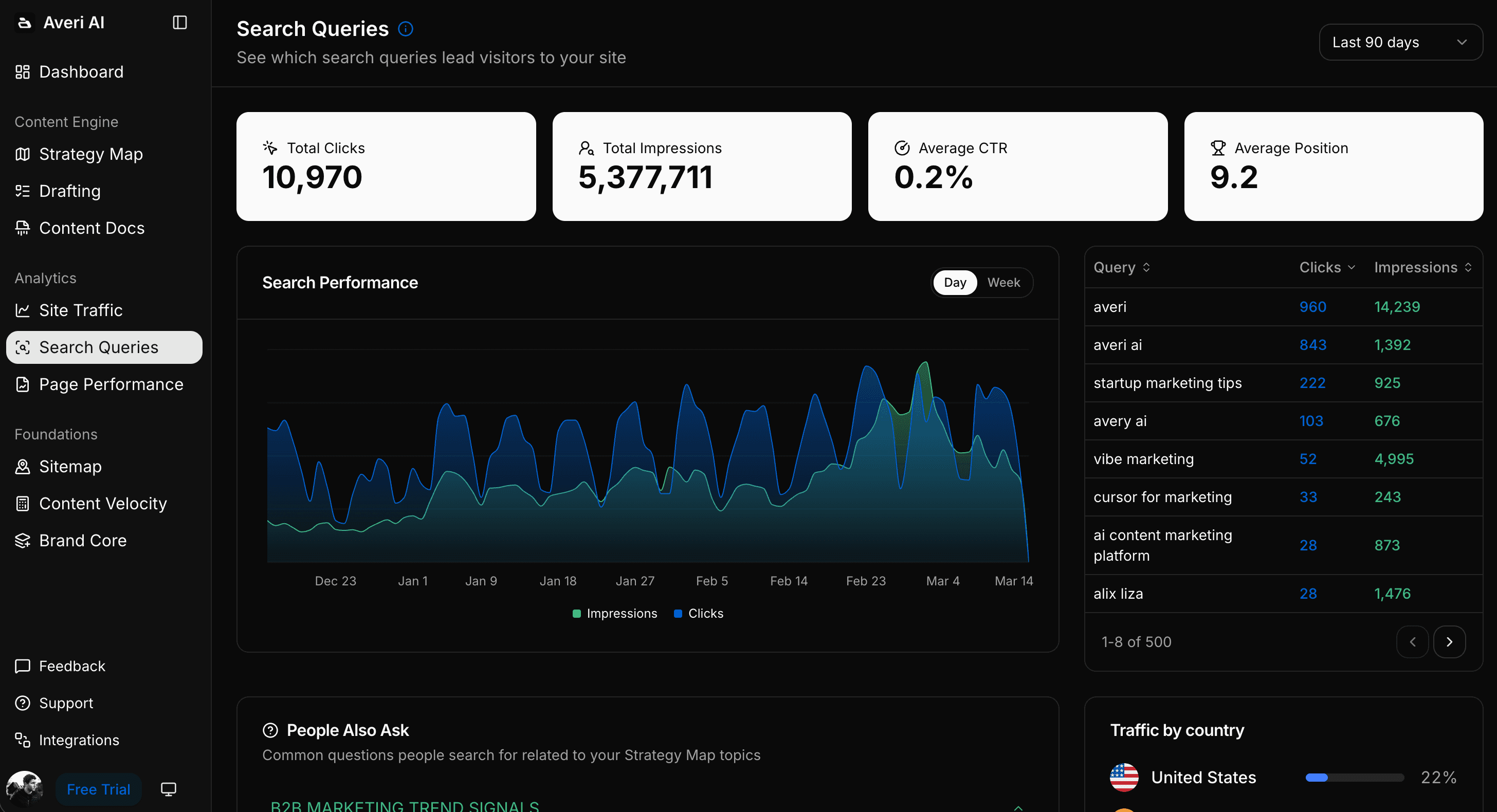
I pulled our Fathom Analytics export covering May 1 to May 16, 2026. Sixteen days. 18,270 visitors. The number that stopped me wasn't the headline traffic count. It was the gap between how AI-referred visitors behave on our site and how Google-referred visitors behave on the same pages.
The volume story is the one every marketing blog is telling: AI referrals are small. Conductor's 2026 benchmarks put AI referrals at roughly 1.08% of website traffic versus 25% for organic search. Our numbers match — 392 AI-referred visitors, or about 2.1% of total traffic. That part is unremarkable.
The engagement story is the one nobody is telling clearly. So here it is.
The actual numbers
Here is what 16 days of our data look like, with no smoothing or selection:
Source | Visitors | Pageviews | Pages/session | Bounce |
|---|---|---|---|---|
Google Search | 7,296 | 9,868 | 1.35 | 83.2% |
ChatGPT | 135 | 228 | 1.69 | 65.2% |
Gemini | 102 | 180 | 1.76 | 64.7% |
Claude | 84 | 123 | 1.46 | 76.2% |
Perplexity | 46 | 70 | 1.52 | 69.6% |
NotebookLM | 17 | 25 | 1.47 | 70.6% |
AI combined | 392 | 637 | 1.63 | 68.4% |
The weighted bounce rate across AI sources runs roughly 15 percentage points lower than Google's.
The pages-per-session number runs 20% higher.
Gemini specifically pushes that gap to 30%.
This is one site, one window, one data set. But the directional finding lines up with what bigger studies are now reporting.
Seer Interactive's B2B SaaS analysis found ChatGPT visitors viewed 2.3 pages per session against 1.2 for organic — almost double.
BrightEdge and Fuel Online benchmarks put AI-referred engagement time at 8 to 10 minutes against 2 to 3 minutes for traditional Google clicks.
Microsoft Clarity tracked Copilot referrals converting at 17x the rate of direct traffic across 1,277 publisher domains.
Our numbers aren't an outlier. They're a small version of a structural pattern.
The Gemini paradox
The most surprising finding sits inside Google. Google Search sends us roughly 70 times more visitors than Gemini.
Per visit, Gemini sends better ones.
That's not how either product is marketed. Google Search is the workhorse. Gemini is the experimental layer on top.
But the visitor who lands on our site after Gemini synthesized our content into an answer arrives with different intent than the visitor who saw us as result #4 on a SERP and clicked through. The first person already saw a summary, decided we were credible, and chose to read more. The second person is comparison-shopping ten blue links. The mechanics of why this happens differently across platforms are worth understanding.
This effect is now showing up in cross-site data.
Statcounter's March 2026 report put Gemini at 8.65% of global AI chatbot referrals, up from 2.31% a year ago — the second-largest AI referral source after ChatGPT. SE Ranking found Gemini referral traffic grew 115% between November 2025 and January 2026 alone. The traffic is small but accelerating, and the per-visit value is high.
What this means in practice: Google is competing with itself. Every Gemini answer that satisfies a user inside the chat interface is one less click to a search result. Every Gemini citation that does send a click is a higher-quality visitor than the search results would have produced.
Why this is happening (the boring part you need to understand)
This is not magic and it isn't temporary. It's a structural property of how AI search works.
Traditional organic search has always carried a heavy load of low-intent visitors — people scanning ten results, opening three tabs, bouncing in eight seconds when the page doesn't match the query. Pew Research tracked 68,000 actual searches and found users clicked a result only 8% of the time when an AI Overview appeared, against 15% without one.
The clicks that survive AI Overview filtering are the ones with genuine intent behind them. Everything else got answered in the summary.
AI referrals operate on the same selection pressure, only stronger. By the time someone clicks a citation in a ChatGPT or Claude response, they have already read a synthesized answer that includes you, evaluated whether to dig deeper, and decided you were worth their next action. The pre-click work is already done. They're not browsing. They're checking.
This is what behavioral analysts call "pre-qualified intent": the visitor arrived already informed about their problem and further along in the buying decision.
It produces the conversion premium that Ahrefs measured at 23x (0.5% of visitors driving 12.1% of signups), the 4.4x figure BrightEdge and Fuel Online keep citing, and the 11.4% vs 5.3% e-commerce gap Similarweb reported across aggregate sites.
The boring mechanical version: AI does the comparison shopping for the user. By the time the click happens, the comparison is already over.
Bounce rate is the wrong metric now
Here is the part of our data that will make most marketing dashboards spiral.
We have pages on our site running 100% bounce rates with 10-plus minute average read times.
Our GEO playbook page clocked 703 seconds of read time at near-100% bounce.
Our UGC authenticity post hit 597 seconds at 100% bounce.
By traditional reporting, those pages are "failing." By any honest read of what's actually happening on them, they are doing exactly what content is supposed to do.
A bounced session is just a one-page session. In the AI-citation era, that is increasingly the shape of a successful visit.
Someone arrives with a specific question that the AI has already framed, reads your answer in depth, gets what they came for, and leaves. They are not browsing your site map. They are not converting on the second click because there is no second click in the user's mental model of this interaction.
The single page was the answer.
If your dashboard treats bounce rate as a quality signal, you are mismeasuring the highest-value traffic you have. The metric that actually tracks engagement on AI-referred sessions is read time.
We've started weighting page health by avg_time_on_page × (1 — bounce_rate) for traditional Google traffic and avg_time_on_page alone for AI traffic. The two visitor types are doing different things on our site. They need different scorecards. How to track AI citations and measure GEO success covers the measurement framework in depth.
What this means for your content strategy
Three falsifiable predictions, in order of how much I'd bet on them:
One: brands that optimize for citation-worthy depth will outperform brands that optimize for click-through-rate within the next 24 months.
The CTR-on-SERP fight is being lost to zero-click answers. Seer Interactive found organic CTR on AI Overview queries dropped from 1.76% to 0.61% — a 61% collapse. Optimizing harder for the click that AI Overviews are eating is a losing trade. Optimizing for the citation that AI Overviews are giving is a winning one. Our GEO playbook covers the mechanics.
Two: pages-per-session and engagement time will replace bounce rate as the credible site-health metric inside 36 months.
GA4 has already half-deprecated bounce rate by defining a bounce as a session without an engagement event within 10 seconds. The next move is the metric disappearing from default dashboards entirely. Teams that build their reporting around engagement events now will not need to retool when that happens.
Three: AI referral traffic will compound for citation-leader brands and decline for everyone else.
AirOps research found 85% of brand mentions in AI search come from third-party pages, not the brand's own domain. The brands cited frequently across third-party sources are the ones AI models trust as defaults. Citation begets citation. Building data-source status is now its own discipline.
The teams that earn it in 2026 will widen the gap through 2028.
See what your Content ROI could be this year
What we did to earn the citations we have
This is the part where you're supposed to be skeptical, so I'll show our work.
In the last six months we shifted our editorial framework to optimize for AI citation rather than traditional SEO ranking. Three structural changes mattered most.
First, we restructured every long-form piece around direct-answer H2s phrased as buyer questions. AI models extract well-formed Q&A patterns more readily than narrative prose. Our FAQ optimization guide documents the pattern.
Second, we added structured data (Article, FAQPage, ItemList) to every editorial and case study. The schema implementation guide covers what we deployed.
Third, we front-loaded fact density… hyperlinked stats, named sources, specific numbers in the first 30% of every piece. AirOps found 44.2% of all LLM citations come from the first 30% of text. The pattern shows up in how to build a brand in the age of LLM search too.
We tracked this in our own citation benchmarks report and watched our citation rate inside ChatGPT, Perplexity, and Gemini move from background noise to a consistent presence across our category prompts.
The same pattern shows up in how to get cited by ChatGPT, Perplexity, and AI search and the complete guide to GEO.
Our site has grown to over 2.9M monthly organic impressions on $0 paid acquisition, with a one-person marketing team running on Averi itself.
The 30% engagement gap from Gemini is one of the visible outputs of that work.
When AI traffic matters and when volume still wins
A decision framework, because nobody needs another think-piece without one:
If your business model is... | The metric that matters most is... | Where to focus content |
|---|---|---|
B2B SaaS, $2K–$30K ACV, considered purchase | AI referral conversion rate | Citation-worthy depth, third-party mentions, structured comparison content |
E-commerce, low AOV, impulse buys | Volume + traditional CRO | Google rankings still win; treat AI as upside |
Marketplace / community, network effects | Sign-up rate from any source | Both — AI for credibility, Google for top-of-funnel |
Consulting, high-touch services | Engagement time on credibility pages | AI citations + long-form pillar content |
Hardware / physical products | Volume + comparison-shopping intent | Maintain Google; build review-site presence for AI |
The pattern: the more your buyer needs to be convinced before they click, the more AI traffic outperforms Google traffic per visit. T
he more your buyer is impulse-driven, the less the engagement premium matters and the more volume still wins.
Most B2B SaaS startups should be prioritizing AI search visibility over additional Google rankings at this point.
The bigger shift
The single most important thing in our data is not the 30% engagement gap. It's that the gap is widening month over month.
In January, the engagement delta between AI and Google traffic on our site was roughly 11%.
By April it was 18%.
The May number is 20% on combined AI and 30% on Gemini specifically.
Gemini referrals grew 115% industry-wide between November and January. ChatGPT outbound referrals grew 206% in 2025 according to Semrush. The trajectory of AI-referred traffic is one of compounding quality, not just compounding volume. Our breakdown of LLM optimization vs traditional SEO covers what's diverging.
If you measure your marketing on session counts, you will miss this story for another year. By the time the volume catches up, the brands that were optimizing for citation depth in 2026 will have a moat that's expensive to cross. Only 14% of marketers are currently tracking AI search performance even though 43% claim they're optimizing for it.
That gap is the opportunity.
The boring framing: if you can't measure it, you can't compound it. The marketers building real citation engines right now are doing it inside reporting frameworks that surface the engagement premium. Everyone else is reading their dashboard upside down.
What to do tomorrow morning
If you have 15 minutes: open GA4, build a custom channel group that captures the five major AI domains, and look at your last 90 days. You'll see the gap.
If you have 90 days: stop optimizing for the click-through rate that AI Overviews are eating. Start optimizing for the citation that AI Overviews are giving. Our complete GEO playbook is the starting point. Pair it with the AI citation metrics guide for the measurement side.
If you want to see what AI search currently surfaces about your category — and what it misses — Averi tracks your AI referral traffic to your website by model. 14 days, no card required.
The number that matters isn't the visitors you're getting. It's the visitors AI is sending to your competitors instead.
Start Tracking Your AI Traffic
FAQs
How do I tell if AI referral traffic is converting better for my site?
Set up a GA4 custom channel group for chatgpt.com, perplexity.ai, gemini.google.com, claude.ai, and copilot.microsoft.com. Compare conversion rate, pages per session, and engagement time against non-branded organic over 90 days. The full metrics framework is here.
Is bounce rate still a useful metric in 2026?
For Google traffic on transactional pages, yes — high bounce on a checkout page still signals a CRO problem. For AI-referred traffic and informational content, bounce rate is misleading at best. The right replacement is engagement time on page. A 100% bounce with 10 minutes of read time is a successful visit, not a failure.
Which AI engine sends the highest-quality referral traffic?
On our data, Gemini delivers the best pages-per-session (1.76) and lowest bounce (64.7%), followed by ChatGPT. On broader Conductor and Similarweb data, Perplexity converts highest per visitor while ChatGPT sends the most volume at 87.4% of all AI referrals. Priority depends on whether you optimize for volume, conversion, or depth.
Why does AI traffic convert better than Google traffic?
Pre-qualified intent. By the time someone clicks an AI citation, they have read a synthesized answer that includes you, evaluated the alternatives the AI surfaced, and decided you were worth digging into. Google traffic arrives mid-comparison. The AI does the filtering before the click, so the click that arrives is closer to a decision.
How small does AI traffic need to be before I stop ignoring it?
On our site it's 2.1% of total. Ahrefs found 0.5% AI-referred traffic drove 12.1% of total signups — a 23x multiplier. Conversion-weighted value of AI traffic is typically 5–10x its volume share. If AI is over 1% of your site, measure it. Over 5%, it's likely your highest-ROI channel.
Do I need to choose between SEO and GEO?
No, but you need to prioritize. Pages built for AI citation also perform in traditional search — the underlying signals overlap. Our SEO-vs-GEO breakdown covers the allocation question. The mistake is treating them as separate workstreams instead of complementary outputs from one content engine.
How long does it take to see AI referral traffic grow?
For B2B SaaS sites starting from zero, expect 60–90 days from publishing citation-optimized content to first measurable AI referrals. The compounding curve starts steeper than SEO because LLMs incorporate new content faster than Google re-ranks it. We saw our first ChatGPT referrals within three weeks of restructuring our editorial framework.
Additional Resources
GEO & AI Search Optimization
The GEO Playbook 2026: Getting Cited by LLMs (Not Just Ranked by Google)
The Complete Guide to GEO: Getting Your Brand Cited by AI Search
Beyond Google: How to Get Your Startup Cited by ChatGPT, Perplexity, and AI Search
Platform-Specific GEO: How to Optimize for ChatGPT vs Perplexity vs Google AI Mode
How to Get Your SaaS Recommended by Perplexity: A Technical Deep Dive
Content Engine & Citation Strategy
How to Build an AI Content Engine That Grows Your Startup in 2026
Building Your Data Source Status: How to Become the Brand That LLMs Quote by Default
Building Citation-Worthy Content: Making Your Brand a Data Source for LLMs
Schema Markup for AI Citations: The Technical Implementation Guide
Measurement & Analytics
How to Track AI Citations and Measure GEO Success: The 2026 Metrics Guide
ChatGPT vs Perplexity vs Google AI Mode: The B2B SaaS Citation Benchmarks Report (2026)
SEO, LLM Optimization & Trends
SEO vs LLM Optimization: What Marketers Need to Know in 2026
LLM Optimization: Supercharging AI Visibility in the Post-Search Era
The Future of B2B SaaS Marketing: GEO, AI Search, and LLM Optimization
12 SEO & GEO Search Trends That Defined 2025 (And the Playbook for What Comes Next)
Founder & Startup Marketing
Technical Founders: How to Build Marketing Momentum Without a Marketing Co-Founder
Early-Stage Startups: Should You Prioritize SEO vs GEO vs Paid?
2026 is the Year You Probably Should Become a Content Engineer