HubSpot's 2026 State of Marketing in 90 Seconds: 7 Takeaways for Seed-Stage Founders
6 minutes

TL;DR
📊 HubSpot's 2026 State of Marketing dropped this week. 50+ stats, most of which don't matter for a 1–10 person team.
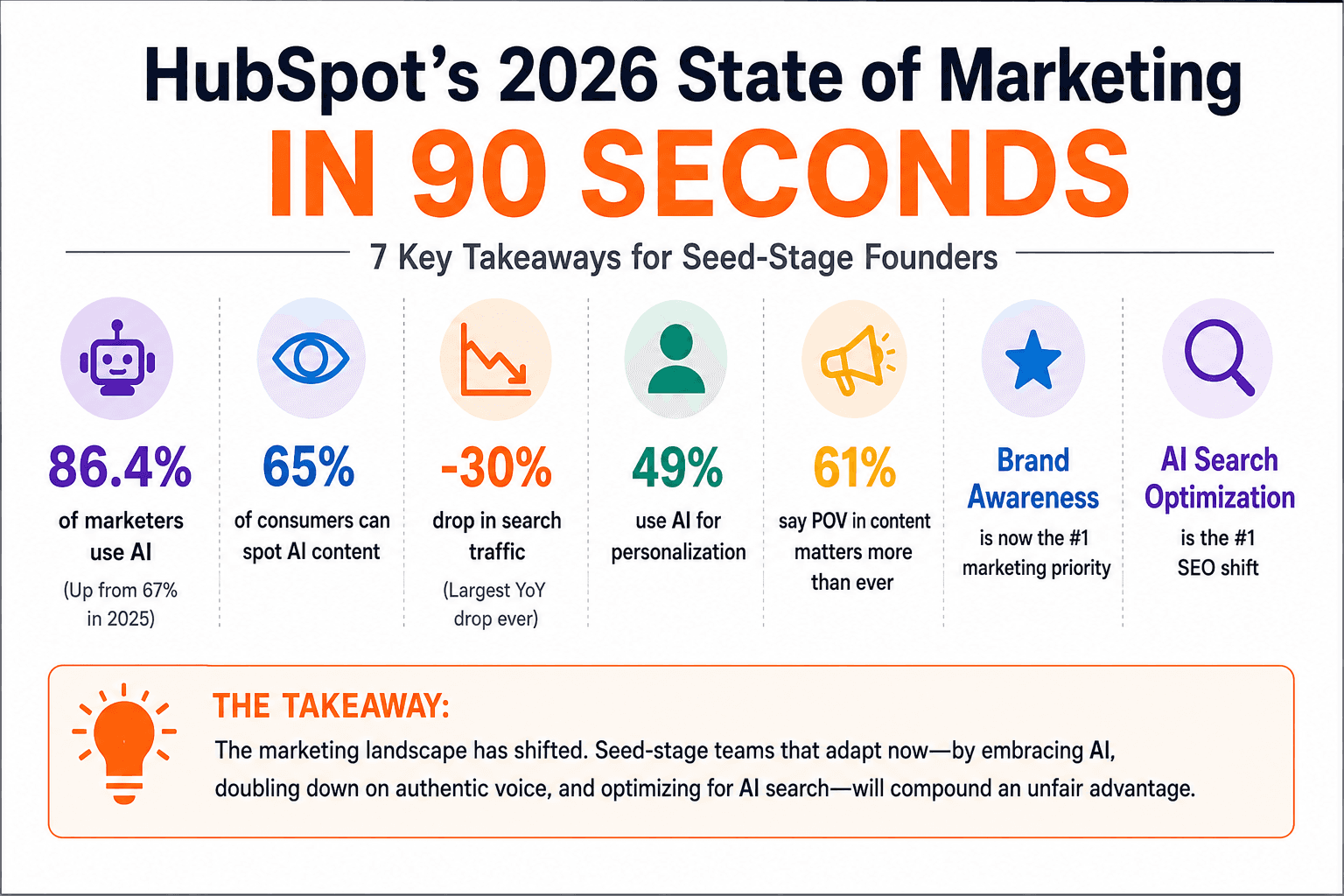
🎯 Seven takeaways do matter. 86.4% AI adoption, 65% consumer AI detection, 30% search traffic decline, 49% AI personalization, 61% POV-matters-more, brand awareness now #1 priority, and AI search optimization as the #1 SEO shift.
⚠️ The report is written for enterprise marketing teams. The seed-stage reading is different from the enterprise reading on every one of these stats. The angle below is the seed-stage translation.
📈 Proof point: Averi hit 10M+ Google impressions on a one-person marketing team running the seed-stage version of every takeaway below. The stats become actionable when you're operating against your real constraints.
⏱️ Action items at the bottom. What to change this week, before competitors finish reading the report.

Zach Chmael
CMO, Averi
"We built Averi around the exact workflow we've used to scale our web traffic over 6000% in the last 6 months."
Your content should be working harder.
Averi's content engine builds Google entity authority, drives AI citations, and scales your visibility so you can get more customers.
HubSpot's 2026 State of Marketing in 90 Seconds: 7 Takeaways for Seed-Stage Founders
Why This Take Looks Different From Every Other HubSpot Recap
Most takeaway pieces on this report will regurgitate 50 stats with a sentence of context each. That's noise.
HubSpot's report is written for marketing teams with $1M+ budgets and 50+ people. The seed-stage founder reading it without translation walks away anxious and confused about which signals to act on.
The 7 takeaways below are the ones that actually shift what a 1–10 person team should do in the next 14 days.
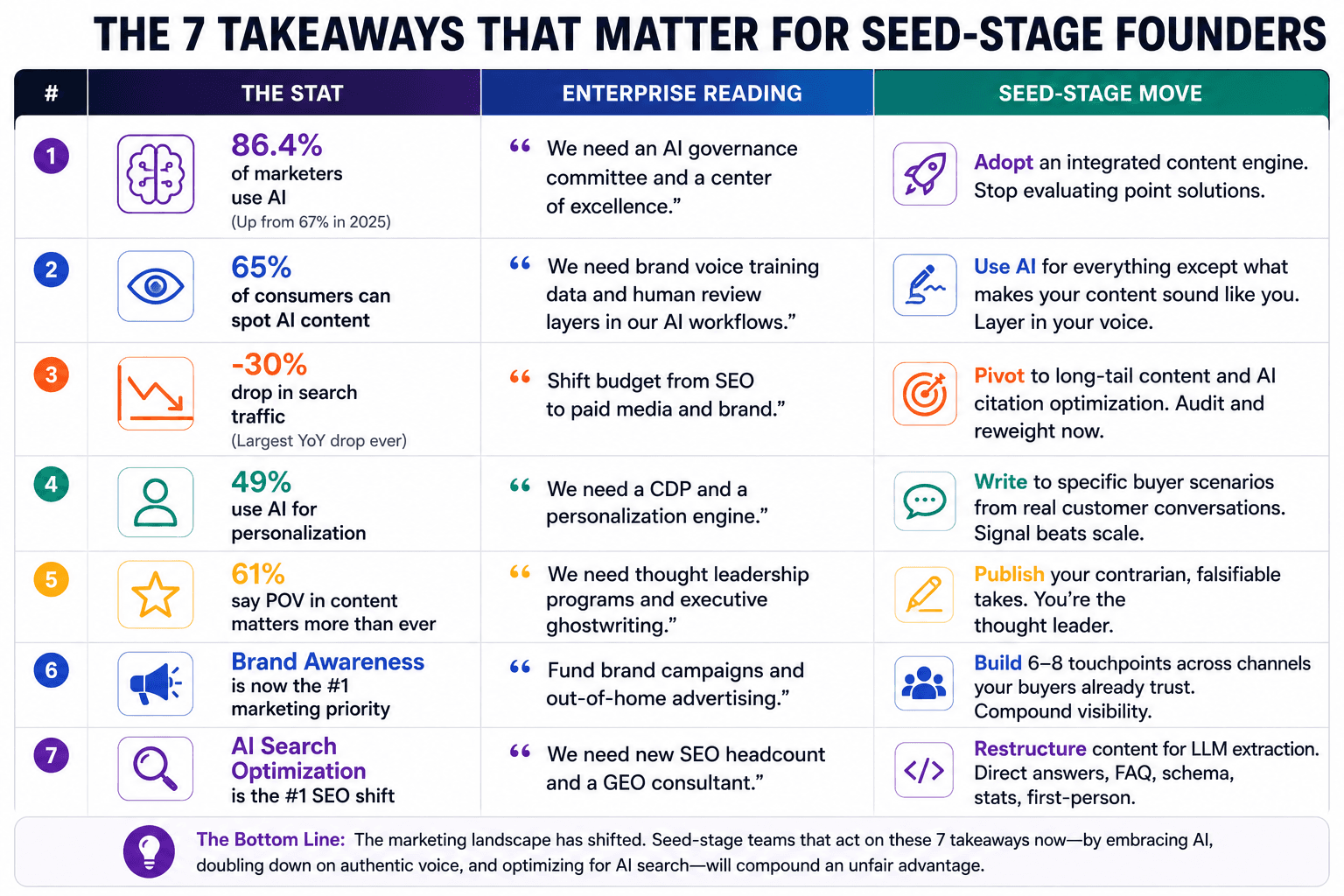
Each section has the stat, the enterprise reading (so you can compare to what your VP friends at bigger companies are doing), and the seed-stage move that compounds.
Let's go.
Takeaway 1: 86.4% AI Adoption Means You're Not Early Anymore
HubSpot reports 86.4% of marketing teams now use AI in some part of their workflow. That number was 41% in the 2024 report and 67% in 2025. The S-curve has bent.
Enterprise reading: "We need an AI governance committee and a center of excellence."
Seed-stage reading: If you're still drafting blog posts in Google Docs from a blank page in 2026, you're not "skeptical of AI." You're behind. The competitive edge AI offered in 2024 has fully commodified. The remaining edge is in how well you've integrated AI into a coherent workflow — strategy, drafting, optimization, publishing, analytics — rather than which AI tool you're using for which one-off task.
The seed-stage move: stop evaluating AI tools as individual point solutions. Adopt an integrated content engine that handles the full workflow in one place. The 14% who haven't adopted yet aren't the contrarian play. They're the laggards.
Takeaway 2: 65% of Consumers Can Spot AI Content
HubSpot's consumer research found 65% of buyers can identify AI-generated content within seconds of reading. This is the most underweighted stat in the report, and it carries the biggest seed-stage implication.
Enterprise reading: "We need brand voice training data and human review layers in our AI workflows."
Seed-stage reading: Your founder voice is your unfair advantage and you're about to give it up. The temptation when AI drafting gets faster is to publish more AI-default content. The market is moving the other way. Buyers are getting better at detecting AI signals, and once they detect them, trust and conversion drop sharply.
The seed-stage move: use AI for everything except the parts that make your content sound like you. First-person experience markers, specific anecdotes from your actual work, your strong opinions, your domain idioms — none of these should ever come from an AI draft. They get layered in by you. The 65% detection rate is a tax on lazy AI use, not on AI use itself.
Takeaway 3: Search Traffic Is Down 30% (And It's Not Coming Back)
The 30% search traffic decline HubSpot reports across surveyed sites is the largest year-over-year drop ever recorded in their survey.
The driver is well-understood: Google AI Overviews now appear on 30–60% of US searches, and head-term queries that used to drive volume now resolve without a click.
Enterprise reading: "We need to shift budget from SEO to paid media and brand."
Seed-stage reading: Don't follow enterprises into paid media. You can't outspend them. Pivot SEO investment toward AI citation optimization and long-tail click defense instead. The 30% lost traffic isn't recoverable. The 70% remaining is concentrated in long-tail queries that convert at 2–6x head-term rates and rarely trigger AI Overviews.
The seed-stage move: audit your top 20 ranking pages this week. Tag each one by whether the keyword now triggers an AI Overview. Reweight new content production toward 4+ word, specific-intent queries. The traffic math has changed; your content strategy needs to match.
Takeaway 4: 49% Are Using AI for Personalization (Most Doing It Wrong)
49% of teams now use AI for personalization at scale, per HubSpot. Sounds impressive. The footnotes are less impressive… most are running first-name token replacement and calling it personalization.
Enterprise reading: "We need a CDP integration and a personalization engine layered on top of our martech stack."
Seed-stage reading: Real personalization at seed-stage looks different from enterprise. You don't have a customer data platform. You have a Notion doc with your last 50 customer conversations. That doc is actually a better personalization input than most enterprise CDPs because the signal density is higher.
The seed-stage move: write content that names specific buyer scenarios from your actual customer conversations.
"If you're a solo founder running content in 5 hours a week,"
"if you raised seed in the last 90 days and your runway calculus just changed,"
"if you've shipped 6 blog posts and none of them rank."
These hyper-specific framings outperform algorithmic personalization for SMB and seed-stage audiences. The founder who knows their buyer wins on personalization regardless of which CDP enterprise teams are buying.
Takeaway 5: 61% Say POV Matters More Than Ever
61% of marketers in the report say strong perspective and opinion in content is more important than it was a year ago. This is the takeaway with the longest compounding upside for seed-stage teams.
Enterprise reading: "We need thought leadership programs and executive ghostwriting."
Seed-stage reading: You are the thought leader. The enterprise thought leadership programs are expensive simulations of what seed-stage founders get for free if they're willing to publish their actual opinions. The 61% stat is the market telling you that contrarian, specific, falsifiable perspectives win against neutral category overviews.
The seed-stage move: every content piece you ship this quarter should carry one falsifiable claim or contrarian position. Not "content marketing is important" but "head-term SEO is dead and long-tail is the only click-bearing real estate left." Not "AI adoption matters" but "if you're still drafting in Google Docs from blank in 2026, you're behind." Specificity and opinion are the moat. Neutral content gets summarized by AI Overviews and forgotten. Opinionated content gets cited, shared, and remembered.
Takeaway 6: Brand Awareness Just Became the #1 Marketing Priority
For the first time in HubSpot's report history, brand awareness ranked above lead generation as the #1 marketing priority among surveyed teams.
The cited drivers: AI commoditizing performance marketing, intent capture moving up-funnel, and longer enterprise sales cycles requiring brand familiarity before MQL conversion.
Enterprise reading: "We need to fund brand campaigns and out-of-home advertising."
Seed-stage reading: Brand for seed-stage doesn't mean billboards. It means showing up consistently in the channels your buyers already trust — Reddit comments under threads they search, LinkedIn posts in their feed, founder-led podcasts in their queue, editorial content that gets cited by AI engines when they ask for recommendations. The brand awareness compounds because each touchpoint costs almost nothing once the system is running.
The seed-stage move: stop optimizing every piece of content for direct conversion. Build a touchpoint frequency that gets your buyer seeing your name 6–8 times before the first sales conversation. Compound visibility beats single-touch conversion at the seed stage where brand recognition is the constraint.
Takeaway 7: AI Search Optimization Is the #1 SEO Shift
HubSpot reports AI Overviews and AI search optimization as the most significant SEO change since mobile-first indexing in 2018. This isn't surprising. The implication for seed-stage teams is.
Enterprise reading: "We need new SEO team headcount and a GEO consultant."
Seed-stage reading: You don't need new headcount. You need to restructure the content you're already producing. The pivot is from optimizing for keyword rank to optimizing for extraction by LLMs. The mechanics: direct-answer H2s, 40–60 word self-contained FAQ blocks, schema markup, original statistics, first-person experience markers. None of these require additional staff. They require a different content production discipline.
The seed-stage move: pick one in-flight piece and rewrite it to AI citation standards this week. Direct-answer subheadings, FAQ block with proper schema, fact density of one statistic per 100 words minimum, no fluff paragraphs. Then measure citation rate across ChatGPT, Perplexity, Claude, and Gemini in 30 days. The single-piece test reveals whether your content production system needs upgrading. For most teams, the answer is yes.
What This Looks Like When It Works
The seven takeaways above aren't theoretical. They're the same operating principles we ran while building Averi's content engine to 10M+ Google impressions on a one-person marketing team.
The growth math: 6,000%+ traffic growth in 10 months, 2.9M+ monthly organic impressions, 25K+ monthly site visitors, on a budget that wouldn't cover a single enterprise SEO consultant's monthly retainer.
What we actually did, mapped to the takeaways:
Takeaway | What we did | Outcome |
|---|---|---|
1. 86.4% AI adoption | One workspace replaces 5 tools | |
2. 65% consumer detection | Founder voice layered on AI drafts | Editorial quality at AI speed |
3. 30% search decline | Long-tail clusters, AI citation focus | Traffic up while category traffic declined |
4. 49% AI personalization | Wrote to specific founder scenarios | Higher conversion than tokenized personalization |
5. 61% POV matters | Falsifiable claims in every editorial | "Content engine" category claimed |
6. Brand #1 priority | LinkedIn + Reddit + editorial compounding | Recognition before conversation |
7. AI search SEO shift | Multimodal citation framework | Cited by ChatGPT, Perplexity, Claude, Gemini |
The proof isn't that we read HubSpot's report and reacted.
The proof is that we operationalized these patterns before the report confirmed them.
The report is now the rear-view validation. The window is open for seed-stage teams to do the same in the next 14 days, before larger publishers index the takeaways and the competitive edge dilutes.
See what your Content ROI could be this year
What to Change This Week
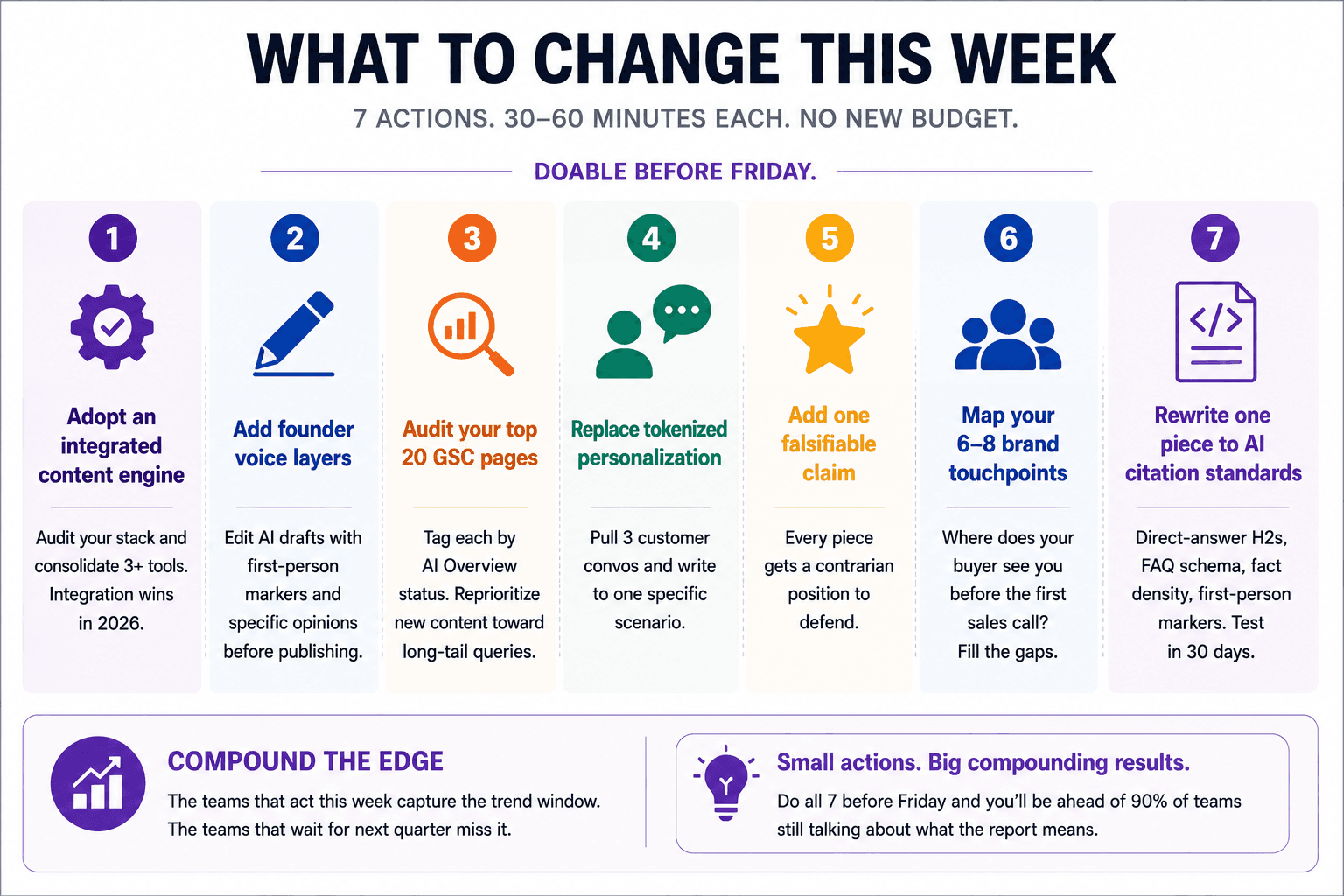
The 7 takeaways translate into 7 actions. Each is a 30–60 minute task. None require new headcount or new budget. All are doable before Friday.
Adopt an integrated content engine (or audit your current stack for the 3+ tools you can consolidate). The patchwork loses to integration in 2026.
Add founder voice layers to every AI draft. Pick one piece in your queue this week and edit it for first-person experience markers and specific opinions before publishing.
Audit your top 20 GSC pages. Tag each by AI Overview status. Reprioritize new content toward long-tail queries.
Replace tokenized personalization with scenario-specific framing. Pull 3 customer conversations from this month and write a piece directly to one of their named situations.
Add one falsifiable claim to every piece in your editorial queue. No more neutral category overviews. Pick a position and defend it.
Map your 6–8 brand touchpoints. Where does your buyer see you between the first awareness moment and the first sales call? Fill the gaps.
Rewrite one in-flight piece to AI citation standards. Direct-answer H2s, FAQ schema, fact density, first-person markers. Test citation rate in 30 days.
That's the playbook. The teams that act this week capture the trend window. The teams that read the report and put it in a folder labeled "to discuss at next quarterly planning" miss it entirely.
Run the Seed-Stage Version of the 2026 Playbook
The seven actions above are doable this week. If you want the integrated workflow that handles them in one workspace — strategy mapping, content queue, AI drafting with founder-voice layers, multimodal optimization, schema-ready publishing, and AI citation analytics — that's Averi.
Start your 14-day free trial →
FAQs
Where can I read HubSpot's 2026 State of Marketing report directly?
HubSpot publishes the full report on their website (hubspot.com), typically gated behind an email form. The full report runs 60–80 pages with 50+ data points. For seed-stage teams, the 7 takeaways above are the actionable subset. If you have time for the full report, read it after you've completed this week's 7 actions, not before.
Is HubSpot's 86.4% AI adoption stat overstated?
The number is from a self-reported survey of marketing teams, so adoption likely skews higher than ground truth. But even adjusted down to 70–75%, the implication is the same: AI adoption is mainstream, not contrarian, and the late-majority window has closed. The competitive edge is in workflow integration, not in whether you've adopted AI at all.
How does seed-stage AI adoption look different from enterprise AI adoption?
Enterprises adopt AI through procurement-led tool selection, governance committees, and multi-tool stacks with redundancy. Seed-stage teams adopt through single integrated workflows that handle strategy through analytics in one place. The enterprise pattern produces tool sprawl. The seed-stage pattern produces shipping velocity. Different constraints, different optimal architectures.
What's the right response to the 30% search traffic decline if I'm already at low traffic?
Don't panic-pivot to paid media. Restructure your content production toward AI citation and long-tail click defense. The 30% decline is concentrated in head-term informational queries. Long-tail commercial and comparative queries are still click-bearing and convert at higher rates. Your low traffic base might actually be an advantage — less legacy head-term content to rewrite.
How do I add POV to my content without sounding aggressive or controversial?
POV doesn't require controversy. It requires specificity. Replace "X is important" with "X works because Y, and most teams get Y wrong by doing Z." The specificity of the supporting claim is what reads as perspective. The opposite of POV isn't politeness; it's vagueness. Founders avoid POV not because they fear controversy but because they fear being specific enough to be wrong.
Should seed-stage startups still focus on lead generation if brand is now the #1 priority?
Yes, but the leads come from sustained brand visibility, not direct-response campaigns. The 2026 funnel for seed-stage looks like: brand touchpoints across 6–8 surfaces → buyer awareness builds over 30–90 days → buyer self-identifies and converts. Direct lead-gen campaigns at low brand awareness convert poorly because there's no recognition foundation. Brand-first compounds; lead-gen-first burns budget.
Is Averi's "content engine" approach the same as HubSpot's recommended approach?
The vocabulary overlaps; the architecture differs. HubSpot's report recommends enterprise stack integration (CRM + marketing automation + content tools + analytics + ABM platforms). Averi's content engine collapses the marketing-content slice of that stack into one workspace for seed-to-Series-A teams that can't justify enterprise sprawl. Different category fit, same underlying logic that integration beats patchwork.
Related Resources
State of Marketing & 2026 Trends
AI Search & GEO
The GEO Playbook 2026: Getting Cited by LLMs (Not Just Ranked by Google)
Google AI Overviews Optimization: How to Get Featured in 2026
Beyond Google: How to Get Your Startup Cited by ChatGPT, Perplexity, and AI Search
Building Citation-Worthy Content: Making Your Brand a Data Source for LLMs