

TL;DR
📅 HubSpot AEO launched April 14, 2026 at the Spring Spotlight event — the standalone product is $50/mo, no HubSpot account required; the Marketing Hub Pro–integrated version is $890/mo + $3,000 onboarding
📉 HubSpot's own customers saw organic traffic drop 27% YoY, while AEO beta users grew AI referral traffic 20% — the launch is a defensive move, not just a feature
🎯 HubSpot AEO is a brand visibility dashboard, not a content production system — it surfaces gaps and recommendations, then expects you to act on them in another tool (or upgrade)
💸 For a seed-to-Series-A founder, the real cost of "HubSpot AEO" is rarely $50/mo — it's $50/mo + your existing content stack, OR the full $890/mo Marketing Hub bundle
📊 AI search visitors convert at 4.4x the rate of traditional organic — making AEO real, but making the production layer that captures that traffic the actual battleground
🔧 A content engine built for AEO from day one combines the monitoring layer with drafting, scoring, publishing, and analytics — at lower total cost
✅ HubSpot AEO is the right call when you already run on HubSpot, have a content team, and need a CRM-aware monitoring layer; it's the wrong call for everyone else

Zach Chmael
CMO, Averi
"We built Averi around the exact workflow we've used to scale our web traffic over 6000% in the last 6 months."
Your content should be working harder.
Averi's content engine builds Google entity authority, drives AI citations, and scales your visibility so you can get more customers.
HubSpot Just Built AEO. Here's Why Most Startups Still Shouldn't Buy HubSpot.
On April 14, 2026, HubSpot launched AEO — a dedicated tool that tracks how brands appear in ChatGPT, Gemini, and Perplexity, with recommendations to improve.
It's the loudest possible signal that AI search optimization is no longer a niche concern.
When the company that built the modern inbound playbook ships an AEO product (with 248,000+ customers across 135+ countries), the category is officially mainstream.
The pricing surprised some people: HubSpot AEO is $50/month standalone, no HubSpot subscription required.
That's cheap.
That's also the entire problem for most seed-to-Series-A founders — because a $50/mo monitoring dashboard isn't a content engine.
With 60% of searches now ending without a click and AI Overviews appearing on 50%+ of US searches, monitoring tells you what's broken; it doesn't fix it.
And the version that does both costs $890/mo plus a $3,000 onboarding fee.
This piece is the honest breakdown of when HubSpot AEO is right, when it's wrong, and why a content engine built around AEO from day one beats bolting AEO onto a CRM.
Want to see your startup's Marketing Maturity?
What HubSpot AEO actually is (the honest breakdown)
HubSpot AEO ships in two configurations, and the difference matters more than the marketing materials suggest.
The standalone product ($50/mo, no HubSpot account required):
A visibility score showing how often your brand appears across ChatGPT, Gemini, and Perplexity
Prompt tracking: pick the prompts you want to monitor, see exactly what each engine returns
Citation analysis: which domains and content types are driving AI mentions for you and your competitors
Competitor share-of-voice tracking with sentiment scoring
Prioritized recommendations on what to fix
That's a real, useful brand monitoring tool. If your job is to track your AI visibility week over week, $50/mo is fair pricing.
The Marketing Hub Pro–integrated version ($890/mo + $3,000 onboarding):
Everything above
CRM-powered prompt suggestions: HubSpot generates the prompts to track based on what it knows about your buyers from your CRM data, not generic category suggestions
One-click execution: when AEO surfaces a content gap, you can create the content, publish a social post, or update a page without leaving HubSpot
The execution layer is the actual new thing.
HubSpot acquired XFunnel (an AEO platform) earlier this year and bolted that capability onto Marketing Hub. For an existing HubSpot Marketing Hub Pro customer with a content team, this is a real upgrade. You see a gap, you fix it inside the same tool, you measure the impact in the same dashboard.
For a startup founder who isn't on HubSpot?
It's a $890/mo upgrade to access an execution layer most startups don't need bolted to a CRM they aren't using.
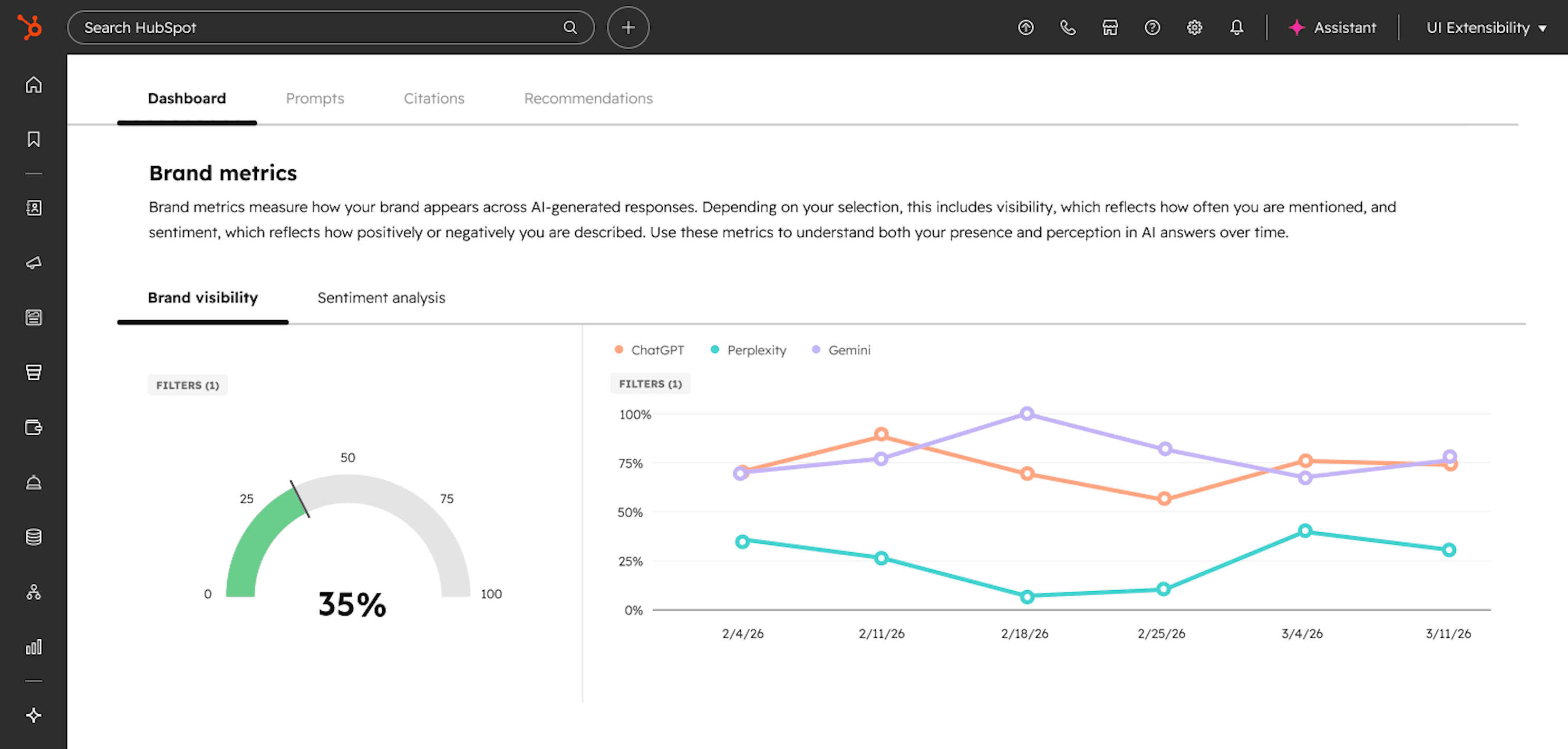
Why HubSpot launched this now
HubSpot's framing is honest about the pressure they're under.
From their own announcement: organic traffic for HubSpot customers is down 27% year-over-year. AI-referred sessions are up 527% YoY, and 42% of CRM software buyers now use AI search as part of their evaluation process. ChatGPT now serves 883 million monthly users processing 2 billion daily queries, and the average prompt length is 23 words versus 3.37 for traditional Google search.
HubSpot needed an AEO product because their entire customer base was watching Google search collapse in real time.
The question wasn't whether to ship AEO; it was how fast they could acquire one.
They acquired XFunnel and shipped in roughly six months, fast for a company HubSpot's size. Over 850 customers participated in the beta program, including Sandler, Mercantile Bank, and Middleby Corporation.
Two things to take from this:
The category is real. When HubSpot enters a market, it's a lagging indicator. The buyers were already there.
HubSpot is solving for HubSpot's existing customers first. The product was designed for the 248,000+ companies already running on Marketing Hub. The standalone $50/mo version is the consolation prize for everyone else — and consolation prizes have limits.
For more on the category context, our GEO Playbook 2026 covers the citation mechanics, and our piece on what AEO and GEO actually mean breaks down the terminology.
What HubSpot AEO does well
Credit where it's due. HubSpot built three things into this product that work well:
1. The CRM-powered prompt suggestions are unique. Most AEO tools (including most monitoring-only tools) make you guess which prompts to track. HubSpot uses CRM data — actual buyer firmographics, deal history, product interactions — to generate prompts your real buyers might use. For a HubSpot-native company, that's a meaningful edge.
2. The citation analysis is clean. Showing which domains AI is pulling from for your category, broken down by content type, makes the "what should we publish next" question much more answerable. This is the layer most monitoring tools handle poorly.
3. The one-click execution inside Marketing Hub is a real workflow win. Seeing a gap and acting on it in the same tool — rather than copying recommendations into a separate CMS — saves real time. For a 10-person marketing team running on HubSpot, this matters.
The product isn't bad. It's well-designed for the buyer it was designed for: existing HubSpot Marketing Hub Pro customers with a content team and a CRM full of customer data.
The question is whether that's the buyer you are.
The math for a seed-to-Series-A founder
Here's where the announcement-day excitement runs into the actual budget.
You're a founder with 5–15 employees and one marketing person (often you).
You've heard about AEO.
You read the HubSpot launch and thought: "$50/mo for AI visibility tracking? Sold."
Then you start adding up what you actually need to act on the recommendations the $50/mo dashboard surfaces:
You need | Standalone HubSpot AEO ($50/mo) | HubSpot Marketing Hub Pro ($890/mo) | Averi Solo ($99/mo) |
|---|---|---|---|
AI visibility tracking | ✅ | ✅ | ✅ (via Content Scoring) |
Citation analysis | ✅ | ✅ | ✅ |
Competitor monitoring | ✅ | ✅ | ✅ |
CRM-powered prompt suggestions | ❌ | ✅ | N/A (engine uses brand + ICP data) |
Content drafting | ❌ | ✅ (with Content Hub) | ✅ |
Content scoring (SEO + GEO) | ❌ | Partial | ✅ (composite 0–100 score) |
Direct CMS publishing | ❌ | ✅ | ✅ (Webflow, Framer, WordPress) |
Strategy generation | ❌ | ❌ | ✅ (Strategy Map) |
Onboarding fee | $0 | $3,000 one-time | $0 |
Annual contract required | No | Yes | No (monthly billing) |
Free trial | 28 days | None | 14 days |
A few things jump out:
The HubSpot AEO standalone tool is real but partial. You're paying $50/mo for diagnostics. You still need to write the content, publish it, and refresh it elsewhere — which usually means another $200–$500/mo in writing tools, CMS, and analytics.
The Marketing Hub Pro version is the integrated answer, but the actual first-year cost is $890 × 12 + $3,000 = $13,680. That's before contact overage fees.
A startup-built content engine like Averi includes the AEO layer (Content Scoring is composite SEO + GEO at 55/45) plus drafting, publishing, and analytics for $99/mo. Total Year 1: $1,188.
For founders evaluating this honestly, the question isn't "is $50/mo a good price for AEO monitoring." It's "what's the total cost of actually executing on the data, and which tool was built for my company stage."
For more on the broader founder budget framing, see our 2026 marketing budget reality check, which lays out where every dollar should go in an AI-first marketing budget.
Calculate what your Content ROI could be this year
Where HubSpot is the right answer
I'm going to stop short of the "HubSpot is wrong for everyone" pitch you'd expect here, because it's not true. HubSpot AEO (in the Marketing Hub bundle specifically) is the right call when several things are true at once:
You already run on HubSpot Marketing Hub Pro or Enterprise
You have at least 2 dedicated marketing/content people
Your company is large enough that the CRM-powered prompts actually beat generic ones (typically 50+ employees, $5M+ ARR)
Sales and marketing alignment is your primary bottleneck and the integrated workflow saves real meeting time
The $13,680 first-year cost is a rounding error in your marketing budget
If most of those describe you, HubSpot AEO is probably worth the upgrade. The CRM-aware execution layer is the sharpest version of "AEO inside your existing workflow" that anyone has shipped, and the integration discount versus building a comparable stack from parts is real.
For founders not in that situation, the same money buys a different system entirely.
Where a content engine wins
For seed-to-Series-A B2B SaaS founders (Averi's actual ICP), the math runs the other direction.
A startup founder typically has:
One marketing person (often the founder themselves)
No CRM full of historical buyer data to make CRM-aware prompts useful yet
A 5–15 person team where every dollar of marketing spend has to convert
A content backlog that's actively bleeding pipeline because nothing's publishing fast enough
The bottleneck isn't "we don't know what AI thinks of us."
The bottleneck is "we can't ship enough good content to be what AI thinks of."
A monitoring dashboard tells you the score. A content engine plays the game.
With 99.9% of informational keywords now triggering an AI Overview and 44.2% of AI citations coming from the first 30% of a page's text, the production layer is where the citation either happens or doesn't.
This is what Averi does differently.
The platform is designed for the founder who is the marketing team:
Strategy Map generates your ICPs, competitor analysis, and content goals from a website scrape — no CRM data required
Content Queue auto-surfaces topics weekly using the same buyer-question framework HubSpot AEO uses for monitoring, but feeds it directly into a queue with target keywords and outlines pre-attached
Content Scoring evaluates every draft on a composite 0–100 score (55% SEO + 45% GEO) before publish — this is the AEO layer, baked into the workflow
CMS publishing ships directly to Webflow, Framer, or WordPress with autopublish on calendar
Analytics dashboard tracks both Google Search Console performance and AI citation patterns
The whole stack is $99/mo, no onboarding fee, no annual contract, 14-day free trial. We built it after spending two years running this exact workflow manually and watching our own organic traffic grow over 6,000% — now 2.9M+ monthly organic impressions on a one-person marketing team.
For more on how the engine works end-to-end, see our content engine workflow guide. For the broader argument on why startups need a different stack than enterprises, our piece on the HubSpot SEO collapse covers why the inbound playbook itself is the constraint.
See how much you could save this year with Averi as your content engine
What to do this week
If you're a founder evaluating this decision in May or June, here's the framework I'd use:
1. Try HubSpot AEO standalone first. It's $50/mo with a 28-day free trial. Run it on your brand and your top 3 competitors. The visibility data alone is useful — even if you don't keep paying, the snapshot tells you where you stand right now.
2. Audit your real bottleneck. After two weeks of HubSpot AEO data, ask yourself: "Is my problem that I don't know what's broken, or that I can't ship the content to fix it?" If it's the second one (which it almost always is for startups), monitoring is the wrong investment.
3. Calculate your full execution cost. HubSpot AEO + Frase + Webflow + a content writer is the same cost as a content engine that does all four jobs. Add it up honestly before committing to either path.
4. Match the tool to the team you actually have. HubSpot AEO is designed for marketing teams. If you have one, use it. If you ARE the team, you need the engine that produces the content, not the dashboard that grades it after the fact.
5. Don't buy on category validation. HubSpot launching AEO doesn't mean you should buy HubSpot AEO. It means you should buy AEO. Those are different decisions.
If you want to test the alternative — a content engine built around AEO from day one, designed for founders running marketing solo — start a free 14-day Averi trial. No credit card. Full access to Strategy Map, Content Queue, scoring, and publishing.
FAQs
What is HubSpot AEO and how much does it cost?
HubSpot AEO is a tool launched on April 14, 2026 that tracks how a brand appears in AI answer engines like ChatGPT, Gemini, and Perplexity. It's available standalone for $50/month with no HubSpot subscription required, or integrated into Marketing Hub Pro ($890/mo + $3,000 onboarding) and Enterprise ($3,600/mo) for execution capabilities.
Is HubSpot AEO worth it for a startup?
It depends on whether you need monitoring or production. The $50/mo standalone tool is fairly priced for AI visibility tracking but doesn't write, publish, or refresh content. For most seed-to-Series-A startups, the bottleneck is content production capacity, not visibility data — which means a content engine that includes AEO scoring beats a standalone AEO dashboard at the same price point.
What does HubSpot AEO do that other AEO tools don't?
The standalone HubSpot AEO is a competent brand monitoring tool with prompt tracking and citation analysis — features other tools also have. The unique advantage is in the Marketing Hub Pro–integrated version, which uses CRM data to generate prompt suggestions based on actual buyer profiles and lets users act on recommendations inside HubSpot without switching tools.
How is Averi different from HubSpot AEO?
HubSpot AEO is a monitoring layer that tells you how AI sees your brand. Averi is a content engine that includes AEO/GEO scoring as part of a full production workflow — strategy, content queue, drafting, scoring, publishing, and analytics in one platform at $99/mo. Averi is built for founder-led marketing teams; HubSpot AEO is built for existing HubSpot customers with a marketing team.
Why did HubSpot launch AEO in April 2026?
HubSpot's own customers saw organic traffic drop 27% year-over-year in 2025, and AI-referred sessions grew 527% in the same period. The launch is a defensive move to keep customers on the platform as buyer behavior shifts from Google search to AI answer engines. HubSpot acquired AEO platform XFunnel earlier in 2026 to accelerate the build.
Can I use HubSpot AEO without buying HubSpot Marketing Hub?
Yes. The standalone HubSpot AEO product is available for $50/month with no HubSpot subscription required, including a 28-day free trial. The standalone version includes visibility tracking, prompt monitoring, citation analysis, and competitor share-of-voice. The CRM-powered prompts and one-click execution features require Marketing Hub Pro or Enterprise.
What's the total first-year cost of HubSpot AEO inside Marketing Hub Pro?
The first-year cost of HubSpot Marketing Hub Pro (which includes AEO integration) is approximately $13,680 — that's $890/month for 12 months plus the mandatory $3,000 one-time onboarding fee. Contact overage fees apply if you exceed the 2,000 marketing contact limit. Annual commitment is required for the published price.
Related Resources
HubSpot & Competitive Context
AEO & GEO Fundamentals
Content Engine Workflow
Startup Marketing Execution
Marketing at 12 Months Runway: The Survival Playbook for Series A Pressure
Seed Stage Marketing Budget: Where to Spend Your First $5K/Month
Test the alternative. Averi runs the AEO scoring inside the same workflow that drafts, scores, and publishes the content. $99/mo, no annual contract, no onboarding fee. Start your free 14-day trial →