We Got 95,431 AI Citations as Google Traffic Fell 31%
6 minutes

TL;DR
📊 95,431 AI citations on Bing and Copilot in 89 days (Feb 27 – May 26, 2026)
📈 14x growth — from ~272 citations/day in the first two weeks to ~3,796/day in the last two
🔻 Google impressions down 31% over the same window, with 74% of measured queries returning zero clicks
🔁 9:1 ratio — AI cited us roughly 9 times for every 1 traditional Bing impression
🎯 2.2% overlap between what AI cites us for and what we actually rank for
🧭 Distinct cited pages per day climbed from 64 to 196 as the quarter progressed

Zach Chmael
CMO, Averi
"We built Averi around the exact workflow we've used to scale our web traffic over 6000% in the last 6 months."
Your content should be working harder.
Averi's content engine builds Google entity authority, drives AI citations, and scales your visibility so you can get more customers.
We Got 95,431 AI Citations as Google Traffic Fell 31%
From February 27 to May 26, AI engines cited Averi 95,431 times.
Over the same 89 days, traditional Bing search showed us in 10,378 impressions. Our Google impressions fell 31%.
Three datasets, one site, one quarter, and the engine that grew is the one that powers ChatGPT, Microsoft Copilot, and a growing share of how B2B buyers evaluate software.
I pulled the numbers off my own webmaster tools this week, expecting to see a worse story than I'd been telling my team. What I found was the opposite.
This piece is the data: the methodology, the trajectory, what AI cites us for, and what it means for any B2B startup still treating Google rankings as the scoreboard. If you've been refreshing Google Search Console waiting for traffic to come back, this is the page that's going to change what you watch.
What we actually measured
The data comes from three exports, all pulled May 28, 2026, all covering Averi's owned domain:
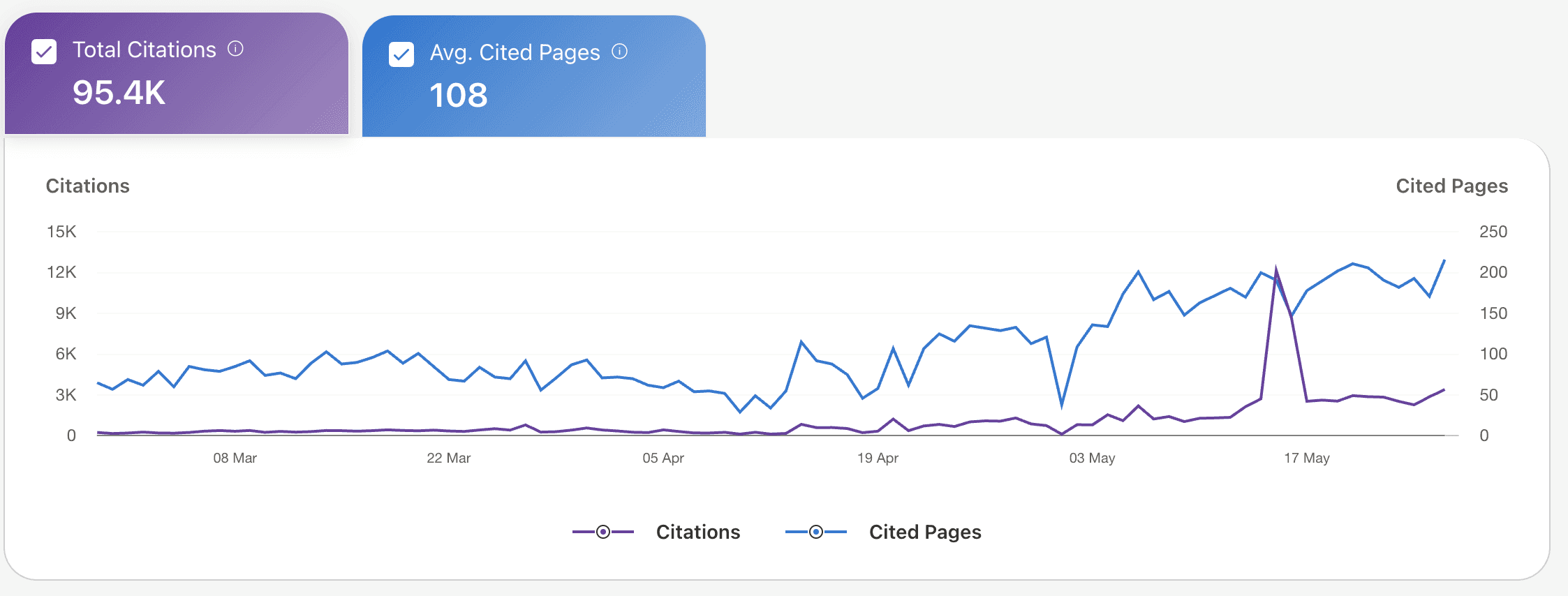
Bing Webmaster Tools — AI Performance Overview. Daily citation counts from Microsoft Copilot and Bing AI-enabled surfaces, plus the number of distinct cited pages per day. 89 days of data, totalling 95,431 citations across ~108 cited pages/day on average.
Bing Webmaster Tools — AI Search Queries Report. The "grounding queries," meaning the specific user intents that pulled Averi into a Copilot answer. 1,115 distinct queries accounting for 57,210 cited mentions in the export.
Bing Webmaster Tools — Keyword Report. The traditional, non-AI Bing search report: queries, impressions, clicks, CTR, average position. 2,271 keywords, 10,378 impressions, 607 clicks.
Cross-referenced against Google Search Console for the same window (Feb 27 – May 26, "Last 3 months" view).
A few caveats up front.
AI citation data here is Bing/Copilot-specific. ChatGPT's own visibility tracking isn't exposed at this granularity, and Google's AI Overview citation data is similarly opaque.
But Bing's index is what Microsoft Copilot uses, and Microsoft's investment in OpenAI means Bing is also a substrate for ChatGPT Search. So Bing AI citations are the closest first-party proxy a B2B startup has for "the AI engines are referencing my content."
It's not perfect. It's the best operator data publicly available.
What does an AI search citation actually mean?
An AI search citation is a count of how many times your domain is used as a grounding source inside an AI-generated answer.
When a user asks Microsoft Copilot or Bing's AI surface a question, the model retrieves context from indexed pages, synthesizes a response, and (in most cases) links back to the sources it used. Each retrieval where your domain is selected counts as one citation. It's a measure of influence, not traffic.
That distinction matters.
We had 95,431 citations on Bing/Copilot. We had 607 traditional Bing clicks over the same window. The traffic number is tiny. The influence number is enormous. In an answer-engine world, those are two different KPIs, and most marketers are still only watching one.
Gartner predicted in February 2024 that traditional search engine volume would drop 25% by 2026 as generative AI solutions became "substitute answer engines." That deadline arrived this quarter. Our numbers, paired with HubSpot's recent disclosure that its own customers' organic traffic fell 27% year over year, suggest the prediction was directionally right and the timing was close.
The 14x trajectory
The most telling number isn't the total. It's the slope.
Here's the weekly citation trend:
Week of | AI citations | Distinct cited pages/day |
|---|---|---|
Feb 23 | 612 | 64 |
Mar 9 | 2,295 | 85 |
Mar 23 | 3,046 | 73 |
Apr 6 | 1,485 | 49 |
Apr 20 | 5,959 | 112 |
May 4 | 9,836 | 166 |
May 11 | 30,890 | 177 |
May 18 | 18,656 | 196 |
We went from ~272 citations/day in the first two weeks to ~3,796/day in the last two.
That's a 14x trajectory over 12 weeks.
Distinct cited pages per day climbed from 64 to 196, which means more of our library is getting pulled into AI answers, not just one viral page.
The mid-May spike (30,890 in one week) is real but volatile, and I wouldn't anchor any claim on a single peak.
The cleaner story is the trend: every two-week block since mid-April has set a new high for both total citations and unique cited pages.
We've documented the playbook that produced this growth, but the short version is that we've been writing for citation density rather than keyword density for the last 18 months.
Averi grew from a standing start to 2.9M+ monthly Google impressions on $0 paid spend with one marketer (me). The Bing/Copilot citation data is the second-order effect of that same approach showing up in answer engines.
The 9:1 ratio: AI cited us more than search even showed us
This is the stat I keep coming back to.
Over 89 days, AI engines cited Averi 95,431 times. Over the same 89 days, traditional Bing search showed our domain in only 10,378 impressions. That's a ratio of roughly nine AI citations for every one traditional impression.
Read it again. The AI surface saw us nine times more than the search surface did.
If you're a B2B SaaS founder running a content program in 2026 and you're only measuring rankings, you're watching the wrong scoreboard.
Your search impression count is increasingly a fraction of your true AI-search visibility. Bing is the substrate for Microsoft Copilot and ChatGPT Search. Google's AI Overviews now appear on 48% of queries, with 44.2% of AI citations coming from the first 30% of a page's text. The discovery surface has split in two, and one half doesn't appear in any traditional report.
What AI actually cites us for
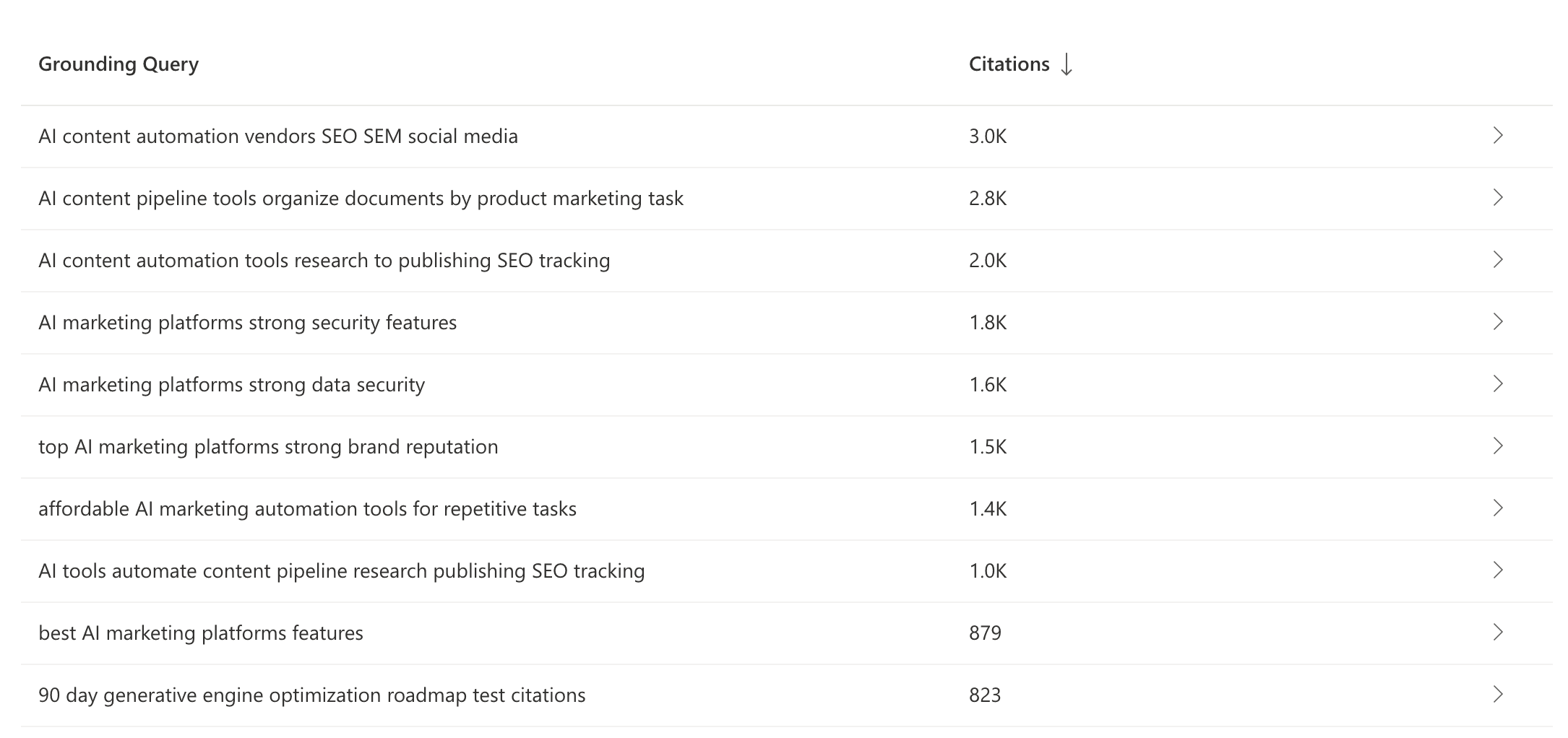
This is where it gets practical. The grounding queries (the actual user intents that pulled Averi into Copilot answers) broke down like this by citation volume:
Theme | Share of citations | Example query |
|---|---|---|
Content creation | 39% | "AI content pipeline tools organize documents by product marketing task" |
Comparison / vendor evaluation | 30% | "best AI marketing platforms features" |
Automation / workflow | 29% | "affordable AI marketing automation tools for repetitive tasks" |
SEO / SEM / GEO | 21% | "90 day generative engine optimization roadmap test citations" |
Security / data security | 10% | "AI marketing platforms strong data security" |
Analytics / reporting | 9% | "tracking brand voice consistency via AI tools" |
Social media | 7% | "AI tools for facebook page management" |
Pricing / affordability | 6% | "affordable AI marketing automation tools repetitive tasks" |
(Themes overlap. A query like "best AI marketing platforms strong data security" counts in both comparison and security.)
Two findings deserve their own moment.
AI grounds us heavily in bottom-funnel evaluation queries.
"Best AI marketing platforms features," "top AI marketing platforms 2026," "AI marketing platforms best integrations."
These are buyers asking AI to evaluate the category, and we're being pulled in as the grounding source. That's high-intent citation.
When Copilot synthesizes an answer to "what's the best AI marketing platform for a 2-person startup team" and Averi is one of the sources cited, the buyer's mental shortlist has been formed before they ever land on our site. That's how citation precedes consideration in an answer-engine world.
AI is citing us roughly 6,000 times for security and data-security queries, which is not a topic we lead with. That's either a near-term opportunity (build content that converts existing AI demand) or a quiet credibility risk (cited for something we haven't proven). Either way it's information we couldn't have gotten from any traditional report.
The 2.2% overlap problem
Here's the finding that should make every content marketer reading this stop scrolling.
Only 24 of the 1,115 grounding queries that pulled Averi into AI answers also appear in our traditional Bing keyword list. A 2.2% overlap.
What AI cites us for and what we rank for in traditional search are almost completely different query sets. Traditional Bing surfaces us mostly for our brand name, a handful of category terms ("content engine," "ai marketing platform"), and a long tail of random fragments… tool names, template queries, even one query that's an exam question about agentic AI.
AI grounding queries are different. They're long, conversational, decomposed. They're machine-phrased. 63% of our AI grounding queries are six words or longer, vs 37% of traditional keywords. They're what query fan-out looks like in the wild, which is the way AI engines break a user's question into many retrieval sub-queries.
The lesson: optimizing for keyword rankings does not, on this evidence, produce AI citations. They're different disciplines, and a strategy built only for the first will leave most of the second on the table.
(We'll publish the deep dive on what to do about this in a separate piece. The short version - write for decomposed buyer intent, not for keyword strings. Topical depth beats keyword targeting, every time.)
Why this is the leading indicator of the discovery shift
The macro frame is starting to click into place. Gartner's 25%-by-2026 forecast called for a quarter of traditional search volume to migrate to answer engines. HubSpot's customers, a representative cross-section of B2B SaaS, are reporting organic traffic down 27% year over year. The same shift is showing up in our own data. The decline is real, and the channel absorbing it is the one that pulls from Bing.
What's underrated is that this shift was visible in our own analytics before it was visible in our revenue.
Bing impressions and AI citation counts are leading indicators. By the time it shows up in branded search demand or pipeline, you're 6 to 12 months behind the marketers who started writing for AI grounding queries earlier.
That's the case for treating answer engine optimization as a discrete content discipline now, not in 2027.
What to do about it if you're running B2B content right now
Five actionable takeaways from this data, for any startup running a content program:
1. Install Bing Webmaster Tools today. It's free. Verify your domain. Wait two weeks for citation data to accumulate. You now have a free dashboard for AI-search visibility. Most B2B marketers don't have one. This is the lowest-cost step in answer engine measurement.
2. Stop watching average position as your primary health metric. In an answer-engine world it measures phantom queries and AI-Overview-eaten clicks as much as real demand. Watch non-branded clicks, CTR on real pages, and AI citation volume.
3. Audit your grounding queries quarterly. Look at what AI cites you for. If you're being cited for a theme your content doesn't actually back up (the way Averi is being cited for security), you have either a strategic opportunity to lean in or a credibility liability to address.
4. Write for decomposed buyer intent, not for keywords. Long, conversational, evaluation-stage queries are how AI engines retrieve. Single-keyword targeting was optimal for 2014 Google. It's not optimal for 2026 Copilot.
5. Lead with proof, front-load with stats, structure for citation. 44.2% of AI citations come from the first 30% of a page. FAQ sections get cited at 3x the rate of standard prose. If you're not building those into every long-form piece, you're losing citations you'd otherwise win.
We built Averi to do all of this in one workflow: brand context, content queue, AI drafting structured for citation, SEO and GEO scoring before publish, multi-CMS publishing.
The reason we publish data like this is the reason we lean on the engine: we ran the playbook on ourselves and the numbers are what came out.
What to do next
Pull your own Bing Webmaster Tools AI Performance report this week. Compare it to your Google Search Console for the same window. If the gap looks anything like ours, you have a measurement problem, not a traffic problem. Then run a piece of your content through the Averi content engine and see what your AI citation score looks like. 14-day free trial.
FAQs
What is an AI search citation?
An AI search citation is a single retrieval where your domain is used as a grounding source in an AI-generated answer from a tool like Microsoft Copilot, ChatGPT, or Perplexity. It measures influence in AI responses, not traffic to your site. Bing Webmaster Tools now reports these for any verified domain.
How is an AI search citation different from a traditional search ranking?
AI citation measures whether an answer engine uses your content to construct an answer. Search ranking measures your position in a list of links. In our 89-day data, only 2.2% of queries that earned us AI citations also appeared in our traditional keyword report. They're different surfaces serving different intents, and they don't move together.
What's a good baseline for AI citation volume on a B2B SaaS site?
Hard to benchmark publicly because most companies aren't reporting their numbers yet. Our baseline: ~272 citations/day in February 2026, growing to ~3,796/day by late May, on a B2B SaaS site at roughly Series A scale. Treat your own first-week number as the baseline and measure the trajectory from there.
Does Google Search Console show AI citations the way Bing does?
Not at this granularity, no. Google reports impressions that include AI Overview appearances but doesn't expose a dedicated citation count or grounding query report. Bing Webmaster Tools is the most developed first-party AI search reporting available to operators in 2026. That's why it's worth checking weekly.
What kind of content gets cited most by AI?
In our data, content built for decomposed buyer intent earned the highest citation volume: long-form guides, FAQ-rich how-tos, definitional pieces, and evaluation-stage comparisons. Promotional or thin content earned almost none. Front-loading specific stats and structuring for self-contained extraction (40-60 word answer blocks) is the strongest single signal.
How long does it take to start seeing AI citations after publishing?
For an indexed page on a domain with existing authority, citations can register within days. For a new domain or a content cluster on a fresh topic, expect a multi-week ramp. Our cited-pages count climbed from 64 to 196 per day over 89 days, which suggests compounding rather than overnight gains.
Is the discovery shift to AI search overhyped?
Not on this data. Gartner forecast a 25% drop in traditional search volume by 2026 and HubSpot's customers are reporting 27% YoY organic declines. Our own Google impressions fell 31% while AI citations grew 14x. The shift is real, it's measurable in first-party reports, and most B2B marketers are still only watching the side that's shrinking.
Related Resources
Get started with AI search citations
The Complete Guide to GEO: Getting Your Brand Cited by AI Search
Your First 90 Days of GEO: The Realistic Implementation Timeline for Startups
How to Track AI Citations and Measure GEO Success: The 2026 Metrics Guide
Deeper on what AI engines actually retrieve
Platform-Specific GEO: How to Optimize for ChatGPT vs. Perplexity vs. Google AI Mode
ChatGPT vs. Perplexity vs. Google AI Mode: The B2B SaaS Citation Benchmarks Report (2026)
Build citation-ready content
Building Citation-Worthy Content: Making Your Brand a Data Source for LLMs
Schema Markup for AI Citations: The Technical Implementation Guide
Content Formats That Win With LLMs: Snippets, Q&A, Tables, Structured Outputs