Introducing the Strategy Map: The System Behind 1.68 Million Monthly Impressions

7 minutes
TL;DR
🗺️ New feature: the Strategy Map — a visual, AI-powered system that organizes your entire content strategy from pillars to published articles in one interface.
📈 Built from our own playbook — the exact workflow that took Averi from 0 to 1.68M monthly organic impressions and 6,000% visitor growth in 10 months.
🏗️ Layered content architecture — Content Pillars → Focus Areas → Research Overview → Topics → Sub-Topics → Content Outlines. Every click takes you deeper.
🔍 Backed by real data — each layer is powered by keyword research, competitive intelligence, and trending content analysis so you're never guessing what to write.
🤖 Built for Google and AI search — the pillar-based structure builds the topical authority that both traditional SEO and AI platforms like ChatGPT and Perplexity reward with higher rankings and citations.
🚀 Live now — your pillars are already mapped. Log in to Averi, start with the one that matters most, and build from there.

Zach Chmael
CMO, Averi
"We built Averi around the exact workflow we've used to scale our web traffic over 6000% in the last 6 months."
Your content should be working harder.
Averi's content engine builds Google entity authority, drives AI citations, and scales your visibility so you can get more customers.
Introducing the Strategy Map: The System Behind 1.68 Million Monthly Impressions
Ten months ago, Averi's organic presence was essentially zero.
No rankings. No traffic to speak of. The kind of starting point every startup knows intimately — where the product is strong but the content engine doesn't exist yet.
Today, we're at 1.68 million monthly organic impressions.
Site visitors are up over 6,000%.
Not from paid spend binges or viral moments — from a systematic content engine that compounds on itself month after month.
People keep asking how we did it. So instead of just telling you, we turned the exact workflow behind those numbers into a product feature.
Introducing the Strategy Map — a visual, AI-powered system inside Averi that takes the content engine playbook we used to drive our own growth and puts it in your hands. The same pillar-based architecture. The same layered approach to building topical authority. The same systematic connection between strategy and execution that turned a blank slate into nearly two million monthly impressions.
This isn't a framework we theorized about.
It's the operational system we built, ran, measured, and refined over 10 months of aggressive growth — now productized and available to every Averi user starting today.
Here's why we built it, how it works, and why I believe it changes the game for startups competing in an era where topical authority is now the strongest on-page ranking factor — surpassing even domain traffic.
Why Does Content Strategy Keep Failing at Startups?
Content strategy fails at startups not because of a lack of ideas, but because there's no connective tissue between strategy and execution. The strategy exists in one place, the calendar in another, the keywords in a spreadsheet somewhere, and the actual writing happens in yet another tool entirely. The result is chaos disguised as productivity.
The numbers tell the story.
Only 43% of B2B marketers have a documented content strategy guiding their efforts, despite the fact that 91% of global brands use content marketing in some form. That's an extraordinary disconnect. Nearly everyone is doing content marketing. Fewer than half have a plan for it. And 54% of marketers cite a lack of resources as their biggest content challenge — which often isn't about budget at all, but about the absence of a system that makes limited resources go further.
We lived this ourselves.
Before we built the Strategy Map workflow as an internal process, our content operation looked like every other startup's: reactive, scattered, and over-reliant on whoever happened to have the best instinct on any given Tuesday. Smart people doing smart work with no scaffolding underneath it.
So we built the scaffolding. And the results weren't incremental — they were f*cking exponential.
What Is the Strategy Map and How Does It Work?
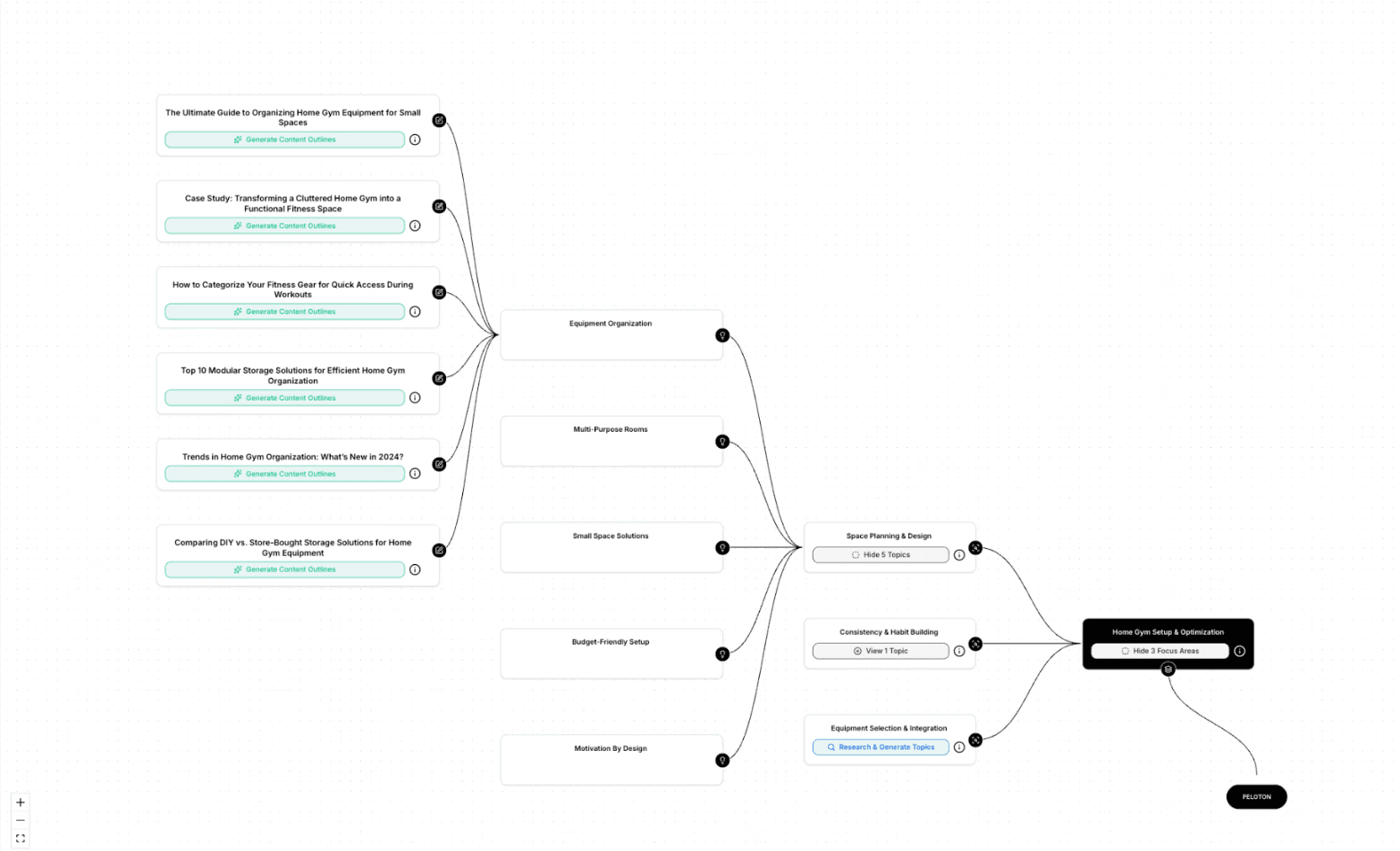
The Strategy Map is a visual, interactive system that organizes your entire content strategy into a layered hierarchy — from the broadest strategic themes down to individual articles ready to be drafted.
It replaces the scattered collection of spreadsheets, docs, and half-abandoned editorial calendars that most teams rely on with a single, living system where strategy and execution are the same workflow.
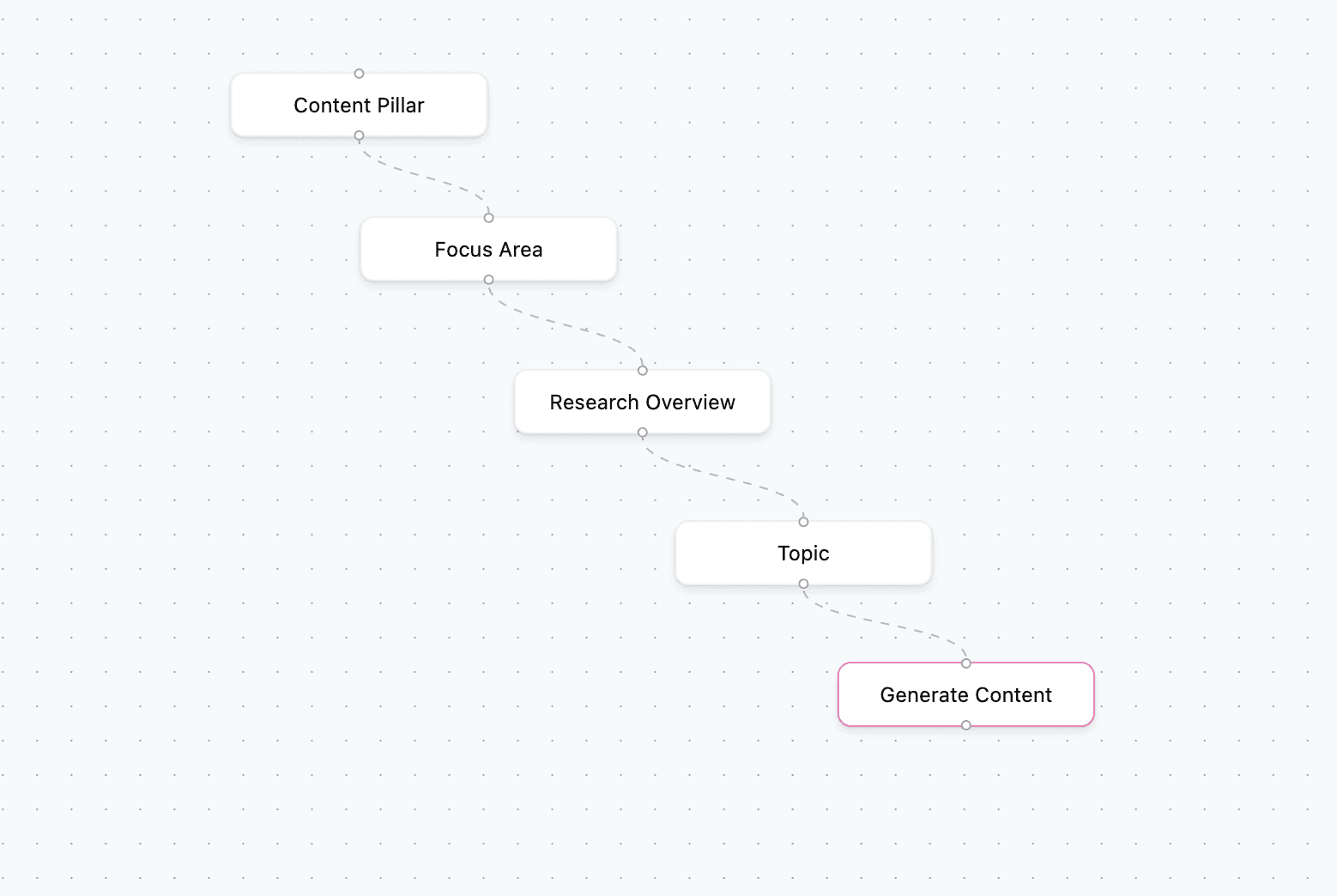
When you log into Averi, your content pillars are already mapped based on your business, audience, and goals. These are the 5–7 major thematic territories your brand needs to own — the big buckets that define what you're known for and what you want to rank and get cited for. From there, you build outward:
Content Pillars → The core themes mapped to your ICP's pain points and your strategic objectives.
Focus Areas → The specific angles within each pillar. Each one represents a content cluster — a group of related pieces that build deep coverage around a theme.
Research Overview → A data layer showing trending keywords, top-performing content, and what's ranking in each space — so every content decision is backed by competitive intelligence, not gut feeling.
Topics → Thematic groupings within each focus area that organize your content ideas around shared themes.
Sub-Topics → The actual articles. Each one has a distinct keyword target, search intent, and angle — making it the direct input for generating a content outline and starting a draft.
Every click takes you deeper. Every layer gets more specific. And when you're ready, you generate your content outline and start writing — all without leaving the platform.
Why Does Topical Authority Matter More Than Ever?
Topical authority — the depth and breadth of your content coverage around a specific subject — has become the defining factor in how search engines evaluate and rank websites. It matters more than ever because both Google and AI search platforms now reward comprehensive expertise over isolated keyword targeting.
A study of over 253,800 search results found that page-level topical authority is the single largest on-page ranking factor for Google rankings — more influential than even the domain traffic of the site hosting the content. This finding fundamentally changes how startups should think about content. You don't need to be the biggest. You need to be the deepest.
And that's just the traditional search side. The rise of AI-powered search is making topical authority even more critical.
AI Overviews now appear in over 25% of Google searches, and platforms like ChatGPT process upwards of 2.5 billion prompts daily. These systems don't just surface individual pages — they synthesize information from multiple sources to construct answers. The brands with the most comprehensive, well-structured content clusters become the go-to citation across entire topic spaces.
Content updated within the past three months averages 6 citations from ChatGPT compared to 3.6 for outdated pages. Pages with well-organized headings are 2.8x more likely to earn citations in AI search results. This isn't speculation — it's the new physics of discoverability. And the Strategy Map is built to help you win on both fronts.
How Did This Workflow Drive 1.68 Million Impressions?
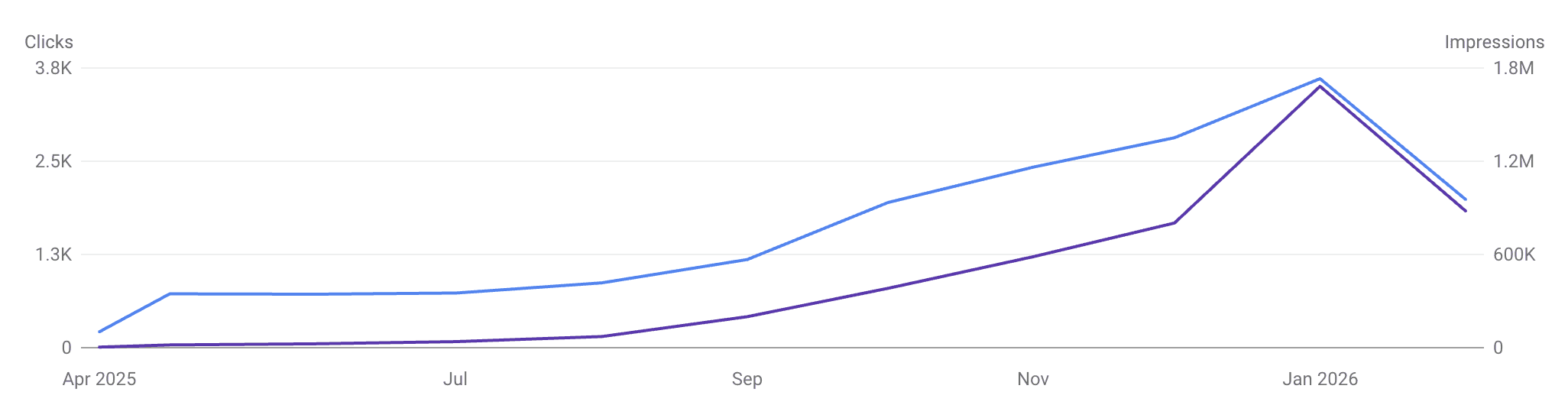
The workflow behind the Strategy Map generated 1.68 million monthly organic impressions in 10 months by replacing reactive content production with systematic topical authority building — covering each strategic theme in depth rather than publishing scattered pieces across unrelated subjects.
Here's what we learned: most companies don't fail at content because they lack talent or ideas. They fail because there's no system connecting what they know about their audience to what they actually publish. The content gap isn't creative — it's structural.
When we implemented the pillar-based approach internally, something shifted.
Instead of asking "what should we write about this week?" we were asking "which layer of our authority map needs building out next?"
The content wasn't random anymore. Each piece reinforced the pieces around it. Internal links formed naturally because the content architecture demanded it. Clusters deepened. Rankings compounded.
This is consistent with what the data shows across the industry. Nearly half of SEO professionals plan to increase investment in authority signals heading into 2026, with 33% specifically focused on improving topical authority and site structure. Strong internal linking, content clusters, and consistent publishing within a niche are now among the strongest signals Google uses to evaluate rankings.
The companies that build these systems win. Everyone else publishes into the void.
The Strategy Map isn't a feature we designed in a product meeting. It's the operational system we built out of necessity, validated with our own traffic, and then turned into software so every Averi user can run the same playbook.
What Does This Mean for AI Search Visibility?
AI search is no longer a future consideration — it's a current distribution channel that rewards the same structural depth the Strategy Map is designed to build. Brands that build comprehensive, well-organized content ecosystems get cited more often, more accurately, and more prominently across AI platforms.
The numbers here are staggering.
AI search visitors convert at 14.2% compared to traditional organic's 2.8% — making AI-referred traffic roughly five times more valuable per session. AI platforms generated 1.13 billion referral visits in June 2025 alone, a 357% increase year-over-year. And Gartner projects that by 2028, 50% of all online searches will involve an AI assistant.
But here's the part most people miss: you can't optimize for AI search without first building the topical depth that makes your content worth citing. Domains with strong brand signals and comprehensive topic coverage get up to 10x more AI visibility than those without. Pages using structured headings, FAQ sections, and question-based formatting see dramatically higher citation rates across ChatGPT, Perplexity, and Google AI Overviews.
The Strategy Map structures your content this way by default.
Every layer of the hierarchy — from pillars to sub-topics — is designed to create the interconnected, authoritative content ecosystem that AI systems need in order to trust and cite your brand.
You're not just writing articles. You're building citation architecture.
How Is This Different From a Content Calendar?
A content calendar tells you when to publish. The Strategy Map tells you what to publish, why it matters, and how each piece connects to a larger strategic objective — then helps you actually create it.
The difference is the difference between a schedule and a system.
Most content tools solve for one part of the workflow: research, or writing, or scheduling, or SEO optimization. But 66.5% of content marketers struggle with knowing where to allocate resources, and the top frustration in 2025 was getting content to rank at 77.6%. These aren't separate problems. They're symptoms of a fragmented workflow where strategy, research, and execution happen in different places with no thread connecting them.
The Strategy Map solves this by making the entire workflow visual and sequential.
You can see your content engine — all of it — in one view. You can see where you have depth and where you have gaps. You can see which clusters are built out and which need attention. And when you're ready to create, the transition from "this is the article I should write" to "here's my outline and draft" happens in the same interface.
Like many challenges in marketing — the answer is more obvious than we tend to make it. Stop treating content as a series of disconnected tasks. Start treating it as an interconnected system where every piece makes the pieces around it stronger.
That's what the Strategy Map does.
What Happens After You Generate Your Content?
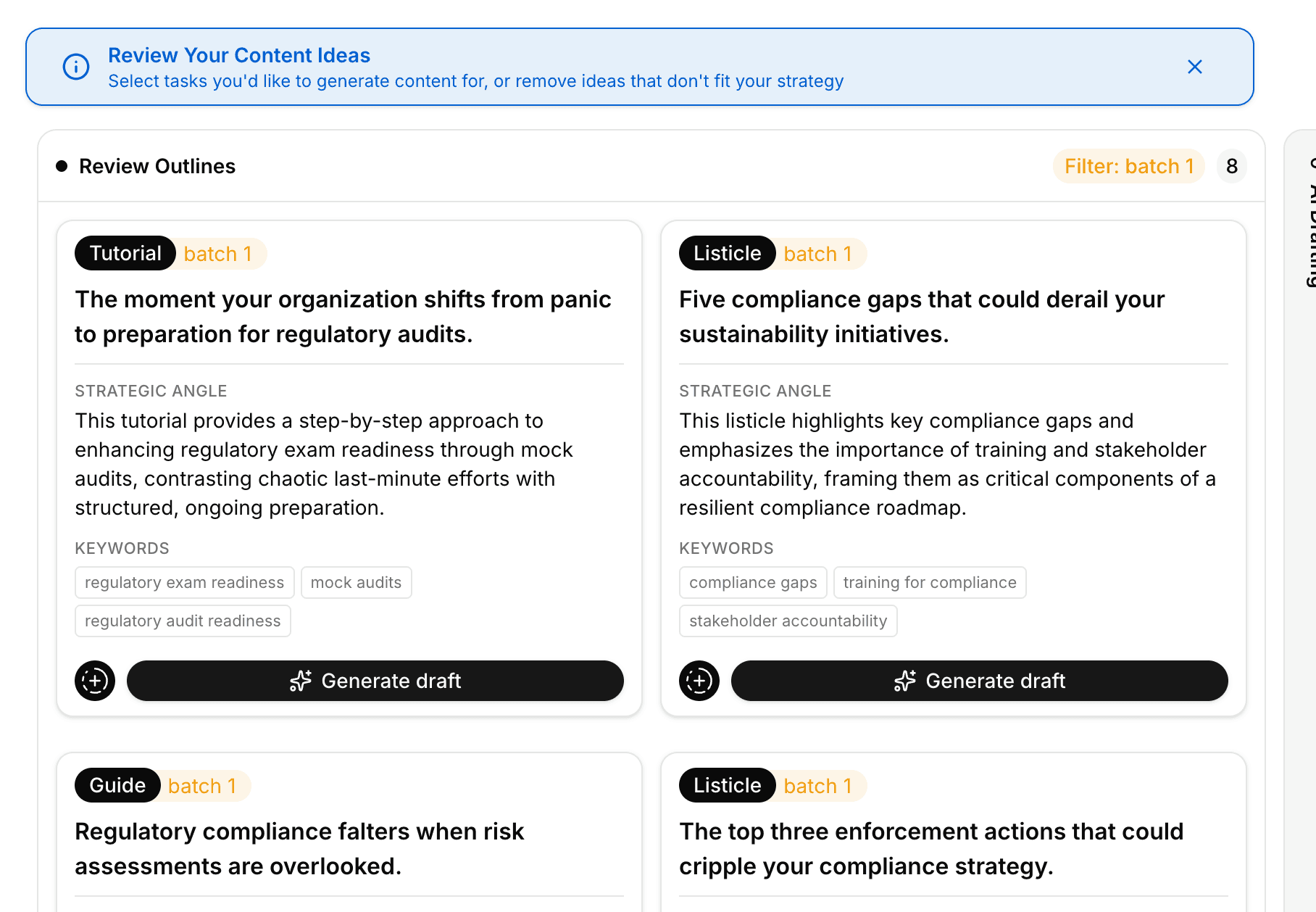
Once you generate a content outline from a sub-topic, Averi produces a structured brief with content type, target audience, strategic angle, and keyword targets already mapped. From there, you generate your draft — which is built around SEO and GEO best practices from the start — and move into the editor to make it yours.
The editor gives you full control: edit copy, adjust formatting, rearrange sections, add links, insert images, embed tables. You can add your own guidance or context before Averi generates the draft, or refine it after. When it's ready, you mark it complete and move it to your published queue.
This is where the Strategy Map's real value compounds.
Because each piece of content is connected to a larger strategic structure, your published content automatically builds the topical authority and internal linking architecture that Google's 2026 algorithm updates increasingly reward.
You're not just creating content — you're constructing an asset that gets more powerful with every piece you add.
Original content delivered the strongest SEO impact in 2025 according to 66% of respondents, and the hybrid model of AI assistance with human oversight is now the majority approach. The Strategy Map embodies this — AI handles the research, structure, and initial drafting; you bring the perspective, judgment, and brand voice that makes content resonate.
The Bigger Picture
I've always believed that in a world awash with artificial intelligence, it is the unique ability of the human mind to be outlandish, authentically creative, and deeply original that becomes invaluable.
Taste — not via pattern recognition or algorithmic machine learning, but developed by decades of experience — is the real difference maker.
The Strategy Map doesn't replace that. It amplifies it.
It handles the structural work that slows creative people down: the research, the keyword mapping, the competitive analysis, the content architecture, the outline generation.
It gives you the scaffolding so you can focus on what actually makes content resonate — your perspective, your voice, the insight that only comes from being in the trenches with your audience every day.
We built this because we needed it. We validated it with our own growth. And now it's yours.
Your Strategy Map is live inside Averi.
FAQs
What is the Averi Strategy Map?
The Strategy Map is Averi's visual, AI-powered content strategy system that organizes your entire content engine into a layered hierarchy. It maps your content pillars — the core themes your brand needs to own — and lets you expand through focus areas, research overviews, topics, and sub-topics until you're generating outlines and drafting content. It's designed to replace fragmented content workflows with a single system that connects strategy directly to execution.
How does the Strategy Map build topical authority?
The Strategy Map builds topical authority by organizing your content into interconnected clusters around strategic themes. Instead of publishing isolated articles, each piece reinforces the others within its cluster — creating the depth of coverage that search engines use to evaluate expertise. This pillar-based approach is why analysis of 250,000+ search results found topical authority to be the strongest on-page ranking factor, surpassing domain traffic.
Does the Strategy Map help with AI search optimization?
Yes. The Strategy Map's layered content structure is designed for both traditional SEO and AI search visibility. AI platforms like ChatGPT and Perplexity prioritize content from brands with comprehensive topic coverage and well-structured information architecture. Pages with organized headings and FAQ sections see significantly higher citation rates across AI platforms, and the Strategy Map structures your content this way by default.
Is my Strategy Map pre-built when I log in?
Your content pillars are pre-populated based on your business, audience, and goals from onboarding. From there, you build outward at your own pace — clicking into any pillar to generate focus areas, then expanding into research overviews, topics, and sub-topics. You don't need to build the entire map at once. Start with the pillar that matters most and expand from there.
How is this different from other content planning tools?
Most content tools solve for one slice of the workflow — either research, writing, scheduling, or SEO optimization. The Strategy Map connects the entire pipeline from strategic planning through to published content in a single interface. It's also backed by real-time keyword research and competitive intelligence at every layer, so content decisions are driven by data rather than intuition. The workflow was validated internally before being productized — it's the same system behind Averi's own growth from 0 to 1.68M monthly impressions.
What content formats does the Strategy Map support?
Content outlines generated from the Strategy Map span multiple formats including blog posts, guides, tutorials, comparison pieces, listicles, and POV articles. Each outline includes content type, target audience, strategic angle, and keyword targets. The format follows the search intent of each sub-topic, so the system recommends the right format for the right context automatically.
Related Resources
Content Engine & Workflow
Content Strategy & Topical Authority
Content Clustering & Pillar Pages: Building Authority in AI and SaaS Niches
Content Velocity for Startups: How Much Content to Publish (And How Fast)
AI Search & GEO Optimization
ChatGPT vs. Perplexity vs. Google AI Mode: The B2B SaaS Citation Benchmarks Report
LLM Optimization: Supercharging AI Visibility in the Post-Search Era