86% of Top-Ranking Content Is Human-Written. Here's What That Means.

5 minutes

TL;DR
🔥 The paradox is real: 85% of marketers use AI, but 57% of consumers trust human content more—emotional resonance has become the scarcest resource.
📖 Stories dominate: People are 22x more likely to remember stories than facts, and 70% of purchasing decisions are driven by emotion, not logic.
🤝 Hybrid wins: AI content with human oversight performs 4.1x better than fully automated output—73% of marketers now use this approach.
⚡ Reclaim your time: AI saves marketers 15+ hours per week on automatable tasks—use it for the deep creative work AI can't touch.
🎯 The strategic move: Let AI handle research, drafts, and optimization. Humans provide strategy, emotional intelligence, and the irreplaceable creative spark.

Zach Chmael
CMO, Averi
"We built Averi around the exact workflow we've used to scale our web traffic over 6000% in the last 6 months."
Your content should be working harder.
Averi's content engine builds Google entity authority, drives AI citations, and scales your visibility so you can get more customers.
The Future of Storytelling: How AI Can Help Human Marketers Create Meaningful Connections
There's a moment in every great campfire story, right before the resolution, when the flames flicker and shadows dance across faces… where time seems to suspend itself.
Our ancestors knew this feeling intimately. Before the written word, before the printing press, before the algorithm, humans gathered in circles to share tales that would bind communities together and transmit wisdom across generations.
Now here we are, in an era where a machine can generate a thousand blog posts before your morning coffee cools, and we're left wondering… have we lost the fire?
The tech evangelists will tell you AI is the future of content. The doom-prophets will tell you it's the death of creativity.
Both, I'd argue, are missing the point entirely.
The future of storytelling isn't about choosing between silicon and soul, it's about understanding what each does best and orchestrating them in symphony.
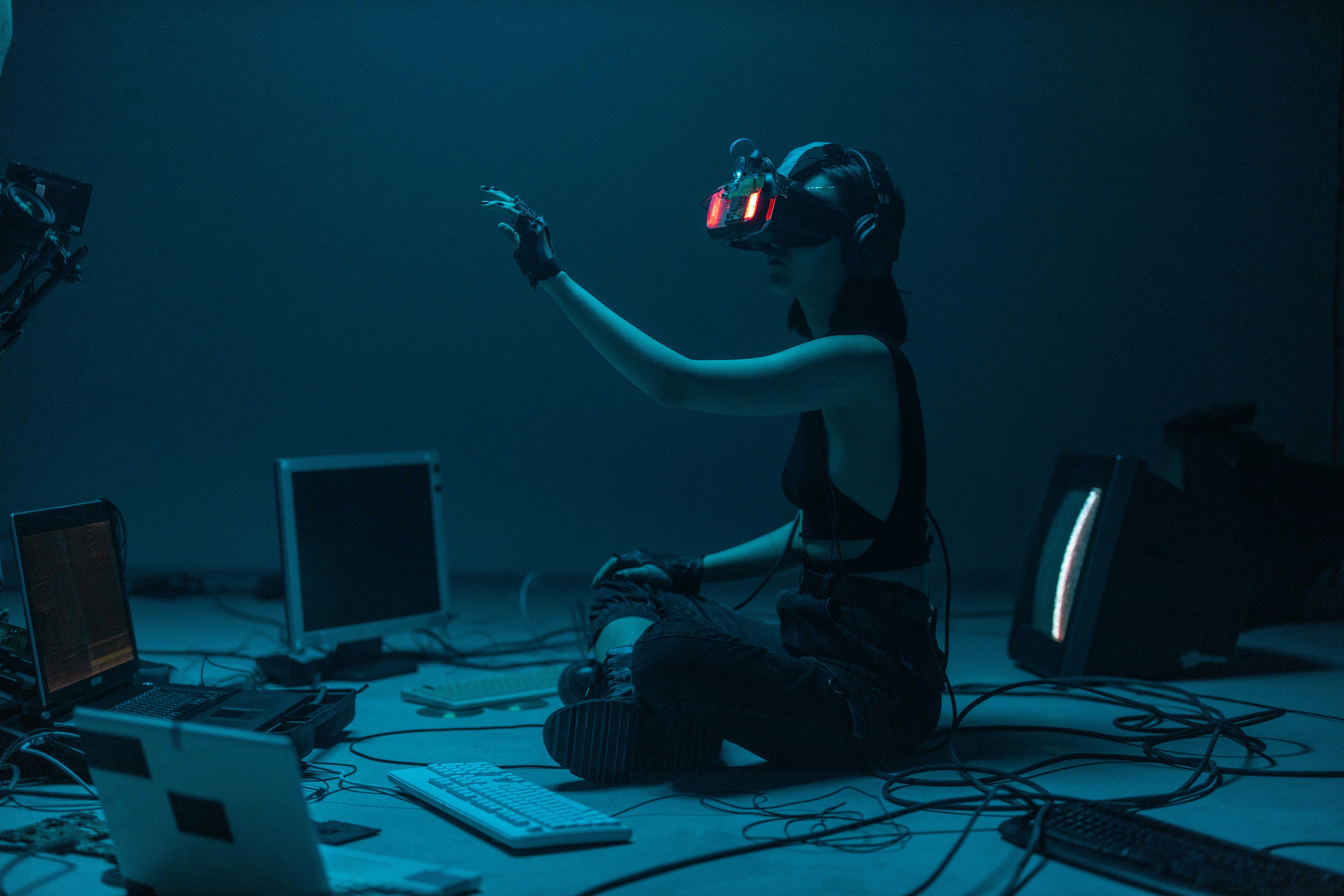
The Stark Reality Of AI Content
Let me be direct with you: 85% of marketers are now using AI writing tools to enhance their marketing.
The generative AI content creation market was valued at $14.8 billion in 2024 and is projected to reach $80 billion by 2030. These aren't fringe experiments, this is the new f*cking terrain.
But here's where it gets interesting.
Amid all this automation, something curious has emerged: 57% of consumers trust human-generated content more than AI-generated content, regardless of how familiar they are with AI technology. And when people discover that content was created by an algorithm rather than a human? 62% are less likely to engage with or trust it.
This isn't technophobia, it's something far more primal. Researchers call it the "AI-authorship effect." I call it the human gut recognizing when something lacks the fire.
Only 15% of consumers believe brands actually understand how to form emotional connections. In a marketplace drowning in algorithmically optimized content, emotional resonance has become the scarcest resource of all.
Why Stories Still Win (And Always Will)
Here's a statistic that should make every marketer pause: people are 22 times more likely to remember facts when they're delivered in a story rather than as bare data. Twenty-two times. Not twice as likely. Not marginally more engaged. Twenty-two times more likely to carry your message with them after they've scrolled past a thousand other posts.
Stories aren't just nice to have—they're how our brains are wired to process the world. Personal stories and gossip make up roughly 65% of all human conversations, according to research from the University of Liverpool. We evolved telling tales around fires because stories helped us survive—they encoded danger signals, social norms, and tribal identity in packages that could survive the journey from one generation to the next.
This isn't changing because we invented better content management systems.
The numbers bear this out in every metric that matters. Storytelling can improve conversion rates by approximately 30%. Brands that tell compelling stories see a 20% increase in customer loyalty. And perhaps most striking: 64% of consumers believe stories help brands form stronger connections with customers.
But here's the part the AI optimists tend to gloss over: 92% of people want brands to create story-like ads. They don't want to be sold to—they want to be moved. They want to feel that ancient pull toward the fire.

The Emotion Economy
We live in what I've come to call the Emotion Economy. It's not a metaphor.
70% of purchasing decisions are driven by emotional factors, with only 30% driven by rational thinking. Read that again. Seven times out of ten, the heart wins over the head. And yet how much of our marketing stack is optimized for emotional resonance versus click-through rates?
Customers with emotional connections to brands are twice as likely to spend more with their favorites. 82% of emotionally engaged consumers remain loyal, compared to just 38% of those who lack that connection. The difference between mediocre marketing and marketing that actually moves markets isn't cleverer targeting—it's the ability to make someone feel something real.
Here's what makes this even more urgent: 98% of consumers agree that authentic images and videos are pivotal in establishing trust. In an age when AI can generate photorealistic imagery on demand, authenticity has become the ultimate luxury good.
The irony isn't lost on me. We've built machines that can produce infinite content, and in doing so, we've made finite human creativity more valuable than ever. Welcome to the paradox of abundance.
The Human-AI Alliance (Not Replacement)
So where does AI fit into all of this? Not where most people think.
The data is crystal clear on one point: AI content that includes human strategic oversight performs 4.1x better than fully automated output. Not marginally better. Four times better. This isn't a debate about whether humans or machines are superior—it's proof that the combination unlocks something neither can achieve alone.
73% of marketers now use a hybrid approach, with human editors refining AI drafts. Only 7% publish AI-generated content without any editing—56% significantly revise it, and 38% make minor tweaks before publishing. The smartest teams aren't choosing between human and machine. They're building workflows that let AI handle the heavy lifting while humans add the soul.
Consider what this actually looks like in practice: AI can increase marketing productivity by 5-15% of total marketing spending. 86% of marketers report that using AI for creative tasks saves at least one hour per day. That's time reclaimed—not for scrolling Twitter, but for the deep thinking that produces genuinely original ideas.
The strategic question isn't "How do we automate storytelling?" It's "How do we use automation to create more space for the irreplaceable human elements of great marketing?"

What AI Does Brilliantly (And What It Can't)
Let's be honest about what AI excels at:
Research and synthesis. 47% of marketers use AI for research, and for good reason. AI can surface patterns across thousands of data points, identify trending topics, and compile competitive intelligence at speeds no human team can match.
Scale and consistency. 55% of marketers cite scaling content output as a top benefit of AI. When you need to maintain presence across dozens of channels in multiple markets, AI provides the throughput to stay visible.
Optimization and iteration. A/B testing headlines, adjusting for SEO, reformatting for different platforms—these are tasks that benefit enormously from AI's tirelessness.
But here's what AI fundamentally cannot do:
Feel something genuine. Emotionally triggering ads can persuade 70% of viewers to buy a product. AI can analyze which emotional triggers have worked historically, but it cannot feel surprise, loss, joy, or transformation. It can only simulate patterns of what those feelings have produced before.
Take creative risks. AI predicts based on patterns. True innovation means breaking patterns—making the unexpected move, challenging orthodoxy, saying something that has never been said in quite that way before. This remains irreducibly human.
Build genuine relationships. Two-thirds of emotionally connected shoppers trust their chosen brand to do the right thing. Trust isn't an algorithm. It's built through consistency, vulnerability, and the sense that there's a real person behind the message who gives a damn.
The New Creative Playbook
So how do we actually work in this new reality?
Here's what I've learned:
Use AI to eliminate the blank page, not the creative process. The hardest part of any creative work is starting. Let AI generate first drafts, outlines, and rough concepts. Then bring your taste, your weird intuitions, your hard-won expertise to transform that raw material into something that could only come from you.
Protect time for deep thinking. Marketing leaders spend more than 15 hours per week on tasks they believe could be automated. Reclaim those hours not for more execution, but for the strategic and creative work that AI cannot replicate. If you're using AI to do more of the same faster, you're missing the point.
Invest in your distinctive voice. In a world awash with AI-generated content, content that sparks emotion is twice as likely to be shared compared to purely factual content. Your voice—quirky, authoritative, irreverent, whatever it is—becomes your competitive moat.
Build hybrid workflows, not either/or systems. The winning model isn't human versus machine. It's AI handling research, first drafts, and optimization while humans provide strategy, emotional intelligence, and creative direction. 68% of businesses report a direct increase in content marketing ROI with this approach.

The Storytelling Advantage in the AI Age
Here's what I believe, after a decade in this industry and two years of watching AI reshape it in real time:
The brands that will win the next decade aren't the ones that generate the most content. They're the ones that generate the right content.
That tell stories people actually want to hear. Stories that make you feel something. Stories that stick in memory long after the scroll has ended.
66% of people say their favorite brand stories are about ordinary people—not celebrities, not perfect products, but real humans navigating real challenges.
This is precisely what AI struggles most to create: the texture of authentic experience, the vulnerability of genuine struggle, the satisfaction of hard-won triumph.
We stand at the valley's edge, looking into an unknown future. And I rest easy knowing that those who choose to continue honing true craft, pushing creative boundaries, and thinking far outside the box will win the day.
We have become prompters, but now we must become something the world has never seen before: creative professionals armed with AI, but driven by the same ancient and hallowed traits of taste, invention, and imagination that our forefathers used to crawl out of the primordial soup and set the stage for us.
The fire hasn't gone out. We just need to remember how to tend it.
Averi is the AI content engine for startups—combining AI-powered workflows with persistent brand context to help resource-constrained teams rank on Google, get cited by AI systems, and turn content into customers.
Start building your content strategy today →
FAQs
Will AI replace human marketers and storytellers?
No. The data consistently shows that AI-generated content without human oversight performs significantly worse in engagement, trust, and conversion metrics. AI content with human strategic oversight performs 4.1x better than fully automated output. AI is a powerful tool for augmentation, not replacement—the most successful teams are building hybrid workflows that leverage both.
Why do consumers prefer human-created content?
It comes down to emotional authenticity. 98% of consumers say authentic content is pivotal for establishing trust, and human-created content carries subtle signals of genuine experience, vulnerability, and intentionality that AI cannot replicate. Researchers call this the "AI-authorship effect"—when consumers know content is machine-generated, they perceive it as less natural and less useful.
How should marketers integrate AI into their storytelling workflow?
The winning formula is using AI for scale and efficiency while preserving human creativity for emotional resonance. Specifically: use AI for research, first drafts, SEO optimization, and content iteration. Apply human judgment for strategic direction, emotional tone, brand voice, and creative risk-taking. 73% of successful marketers use this hybrid approach, with human editors refining AI drafts before publication.
What makes storytelling so effective in marketing?
Human brains are literally wired for narrative. People are 22 times more likely to remember facts delivered in story form, and personal stories make up 65% of all human conversation. Stories trigger oxytocin production, creating emotional connection and trust. This translates directly to business results: 30% higher conversion rates and 20% increase in customer loyalty for brands that tell compelling stories.
Can AI create emotionally resonant content?
AI can analyze patterns of what has worked emotionally in the past and mimic those structures, but it cannot feel genuine emotions or take truly creative risks. Only 15% of consumers believe brands understand how to form emotional connections—and that percentage drops further when content is identified as AI-generated. The most effective approach is using AI to handle scale and logistics while humans inject the authentic emotional elements that create lasting connection.
What's the ROI of prioritizing storytelling over pure content volume?
68% of businesses report increased content marketing ROI when using AI strategically with human oversight. Brands that use storytelling effectively see conversion rates increase by 30% and customer loyalty improve by 20%. The key insight: it's not about producing more content—it's about producing content that actually moves people.
Related Resources
Explore more perspectives on the intersection of AI, creativity, and marketing:
The Rise of the Creative Operator: Why Tomorrow's Marketers Look Like Today's Filmmakers
Balancing Creativity and AI: Human Oversight in AI-Generated Content
The New Creative Currency: Why Taste Outranks Talent in the AI Era
Craft in the Age of Automation: Why Handmade Thinking Matters More Than Ever
Beyond Jasper: Crafting Unique AI-Generated Content with Emotional Intelligence
The Psychology of Branding: How Customers Build Emotional Connections
We Asked 100 Marketers What AI Can't Replace—Here's What They Said
The New Renaissance: What Happens When Creative Tools Become Infinitely Powerful
Data-Driven Storytelling: Using AI Insights to Shape Your Content Calendar
Storytelling for Startups: Sharing Behind-the-Scenes Moments
The Great AI Split: Why Averi Is Choosing Humans Over Agents