

In This Article
AI-first content workflows combine unified platforms, GEO, and automation to triple output, cut production time, and keep brand control.
Updated:
Trusted by 1,000+ teams
Startups use Averi to build
content engines that rank.
By 2026, content marketing is powered by AI-driven platforms that combine planning, creation, and performance tracking into a single system. These tools reduce production time by 60–80% and triple or quintuple output while maintaining quality. The shift to AI-first workflows prioritizes strategies like Generative Engine Optimization (GEO) to secure mentions in AI-generated answers from tools like ChatGPT and Perplexity. Content updated quarterly and structured with headings or FAQs sees 2.8x more AI citations.
Key takeaways:
AI in Daily Use: 88% of marketers rely on AI tools every day.
New SEO Focus: GEO replaces traditional keyword optimization for AI visibility.
Efficiency Gains: Teams save time by automating tasks like research, SEO tagging, and drafting.
Unified Platforms: Tools like Averi AI streamline strategy, creation, and publishing.
AI-Human Balance: AI handles repetitive tasks, while humans refine brand voice and strategy.
This transformation is reshaping how teams produce content, optimize for AI visibility, and maintain brand alignment.
Creating an AI-Driven Content Marketing Workflow
Major Trends in Content Workflows for 2026
Content production in 2026 is undergoing a transformation driven by three major shifts. First, fragmented tools are being replaced by unified platforms that handle everything from strategy and creation to publishing and tracking - all in one place. Platforms like Averi's "Synapse" are leading the charge, using advanced reasoning to delegate routine tasks like social media captions and competitor analysis to AI. Meanwhile, more complex decisions are flagged for human oversight. These systems develop a persistent brand memory, learning from edits and performance data to ensure future content aligns more closely with your brand's voice.
The second shift is the rise of Generative Engine Optimization (GEO). This approach moves away from traditional keyword rankings, focusing instead on earning citations in AI-generated responses from tools like ChatGPT, Perplexity, and Gemini. With AI-generated answers influencing billions of searches every week, GEO has become essential for maintaining visibility. In fact, the AI marketing industry reached a valuation of $47.32 billion in 2025 [1]. Tools like Writesonic's Professional tier now offer GEO tracking, making it easier to adapt content strategies for this new landscape.
The following sections explore how these trends are reshaping content workflows.
AI Agents and Automated Workflow Management
Content teams have evolved into architects, focusing on managing metadata and prompt libraries rather than static assets. AI agents now assemble pre-approved content blocks - text, visuals, and disclaimers - into tailored outputs based on real-time audience signals. These agents also act as compliance monitors, scanning for unapproved claims and halting data collection when Global Privacy Control (GPC) signals are detected.
To make the most of these systems, train your AI with 10–20 examples of high-performing, brand-specific content to avoid generic results. Maintain a centralized "Never Use" list of banned jargon and phrases to ensure consistency. When choosing tools, prioritize those with strong API compatibility - 80% of marketers view deep integrations as critical to avoiding data silos.
Generative Engine Optimization (GEO) and AI Search Visibility
GEO is redefining how content achieves visibility on AI platforms. Instead of focusing solely on keywords, the goal is to structure content to directly answer AI-generated queries. This involves adding features like TL;DR summaries, FAQ sections with concise answers, and clear subheadings. Writesonic’s GEO tracking capabilities allow teams to monitor how often their content is cited by AI systems like ChatGPT, Gemini, and Perplexity [1]. The aim isn’t just to rank - it’s to become the trusted source of information that AI platforms rely on in your field.
Personalization and Real-Time Content Adjustments
By 2026, AI systems are using ambient intelligence to monitor live interactions and adapt content in real time [5]. Organizations that adopt hyper-personalized workflows report 42% higher user adoption rates [4]. For example, UCSF Health piloted simulation-based training for AI agents, achieving 88% task coverage [5].
"The experience becomes what we call 'invisible service' - where problems are addressed before customers articulate them." - Silvio Savarese, EVP and Chief Scientist, Salesforce AI Research [5]
Before deploying personalized AI agents, it’s essential to test them in controlled environments. This ensures they can handle unpredictable scenarios without disrupting workflows or compromising brand consistency [5].
These advancements are setting the stage for a reimagined approach to content workflows, which will be explored in the next sections.
The 6 Phases of a Modern Content Workflow
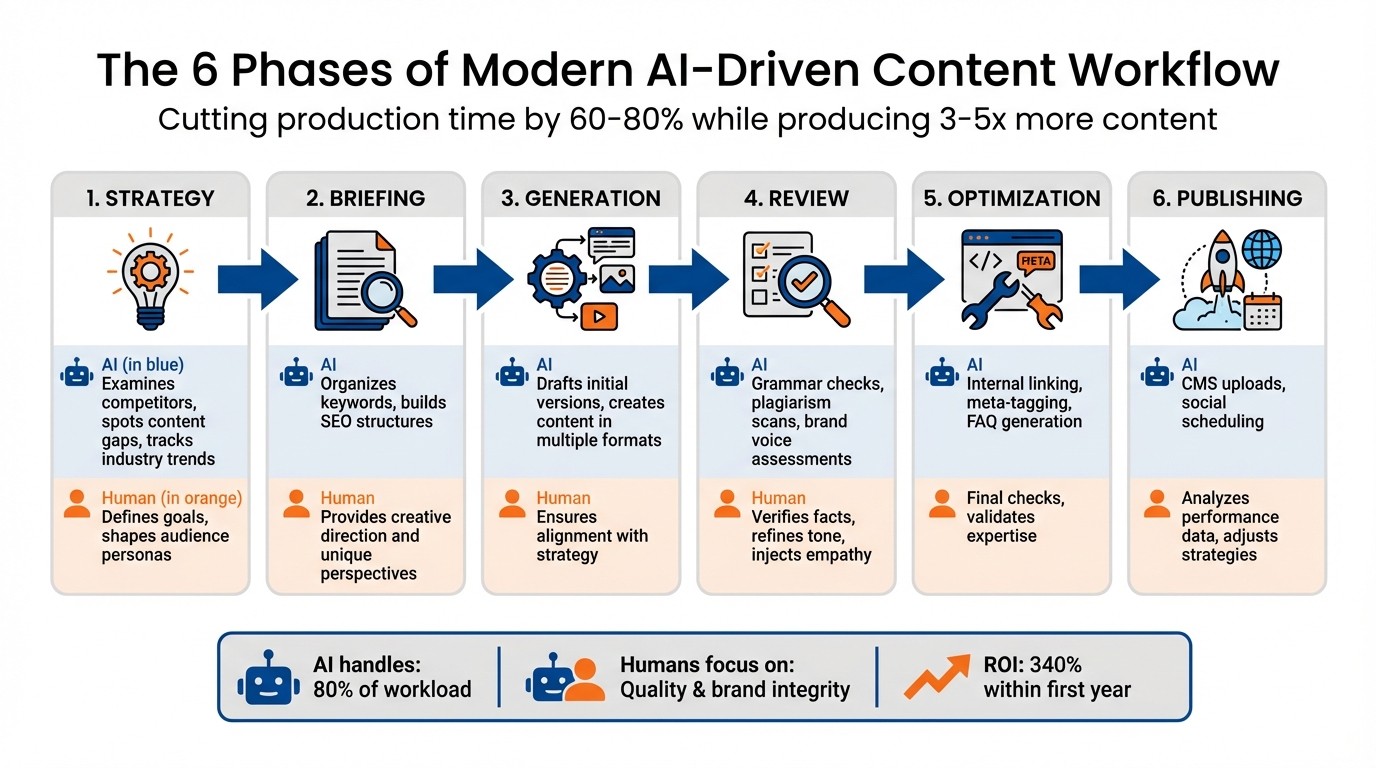
The 6 Phases of Modern AI-Driven Content Workflow in 2026
By 2026, content workflows have evolved into six tightly connected phases, blending AI efficiency with human oversight. This approach can cut production time by 60–80%, enabling teams to produce three to five times more content while maintaining high standards [2].
The journey begins with Strategy, where AI examines competitors, spots content gaps, and tracks industry trends. Meanwhile, humans define the goals and shape audience personas. In the Briefing phase, AI organizes keywords and builds SEO structures, while creative direction and unique perspectives come from the team. During Generation, AI drafts the initial versions and creates content in multiple formats, overseen by humans to ensure alignment with the strategy.
Next comes Review, where AI performs tasks like grammar checks, plagiarism scans, and brand voice assessments. Humans step in to verify facts, refine tone, and inject empathy into the content. In the Optimization stage, AI manages technical tasks such as internal linking, meta-tagging, and generating FAQs, while humans conduct final checks and validate expertise. Finally, the Publishing phase sees AI handle CMS uploads and social scheduling, with humans analyzing performance data and adjusting strategies as needed.
Tools like SEObot streamline the SEO process, from research to CMS publishing, and approval workflows use scoring systems - covering brand voice and factual accuracy - to either trigger automatic publication or flag content for human review. This integrated system has been shown to deliver a 340% ROI within the first year [1][2][3].
Platforms like Make.com (starting at $9/month) seamlessly connect these phases, offering substantial cost savings for operations with high content demands [3]. Under this model, AI takes on 80% of the workload, while humans focus on ensuring quality and maintaining brand integrity [2].
Best Tools for Content Workflow Automation in 2026
As content marketing evolves, the tools driving automation in 2026 fall into three main categories: all-in-one workflow platforms that manage everything from planning to analytics, specialized AI writing tools designed for content creation and collaboration, and scalable operations platforms tailored for teams with mature content strategies. The choice of platform now hinges on the level of automation a team needs. Below, we break down the leading options to help you find the best fit for your team.
Averi AI: All-in-One Content Workflow Platform
Averi AI embodies the growing preference for comprehensive, end-to-end solutions. Designed as an AI Content Engine, it’s a go-to for startups and smaller teams aiming to produce consistent content without adding headcount. Averi covers every stage of the content workflow - from strategy and creation to publishing and performance tracking - all within a single platform. The Plus Plan is priced at $100/month.
Averi simplifies the process by automatically analyzing your website to capture your brand's voice, researching competitors, identifying gaps, and generating content ideas. These ideas are categorized into formats like listicles, how-to guides, and comparisons, which you can approve and publish directly. The AI takes care of research, drafting, SEO optimization, and even publishing on platforms like Webflow, Framer, or WordPress. Published content is stored in a Library, making future pieces even more tailored to your brand.
The platform’s self-sustaining engine operates on a weekly cycle, providing market analysis, topic generation, and performance-based recommendations for your review. With SOC 2 Type II compliance and enterprise-grade data safeguards, Averi ensures your proprietary content remains secure and isn’t used to train other models.
Jasper and AirOps: Focused AI Writing Solutions
For teams prioritizing brand voice and collaboration, Jasper is a strong contender. It’s designed for mid-to-large marketing teams (5+ members) and focuses on content creation, requiring integration with other tools for strategy, publishing, and analytics [1]. Jasper excels in generating content while maintaining robust security with SOC 2 compliance. However, it lacks features like automated publishing, strategic insights, and in-depth performance tracking, making it more of a specialized tool than a complete solution.
AirOps, on the other hand, is tailored for teams with established content workflows looking to scale operations [1]. It specializes in optimizing and managing high-volume content production. Like Jasper, AirOps focuses on content generation but doesn’t provide end-to-end capabilities like strategy development or advanced analytics.
When choosing between these tools, consider your team’s biggest challenge: saving founder time (Averi), maintaining brand voice (Jasper), or scaling proven processes (AirOps) [6].
Tool Comparison Table
Feature | Averi AI | Jasper | AirOps |
|---|---|---|---|
Workflow Scope | Strategy through Analytics | Generation and Collaboration | Operations at Scale |
Best For | Startups and lean teams | Mid-to-large marketing teams | Teams scaling proven strategies |
Primary Target | Seed to Series A startups | 5+ member marketing teams | Established content ops |
Starting Price | $100/month | Custom pricing | Custom pricing |
Direct CMS Publishing | Yes (Webflow, Framer, WordPress) | No | Limited |
Automated Strategy | Yes | No | No |
Performance Analytics | Yes, with recommendations | Limited | Limited |
Brand Voice Training | Automatic from website scrape | Manual setup required | Manual setup required |
How to Implement AI Content Workflows by Team Size
When it comes to implementing AI content systems, the size of your team plays a critical role in shaping the strategy. Trying to apply enterprise-level workflows to a startup can lead to unnecessary complexity, while small-scale systems won’t meet the needs of larger organizations. Tailoring your approach to your team’s size is essential for success.
For Startups and SMBs
For smaller teams, a phased approach over about eight weeks works best to integrate AI into content workflows effectively [2]. Here’s a breakdown:
Weeks 1–2: Lay the groundwork. Select a comprehensive content platform, define your brand voice, and link your CMS to streamline processes.
Weeks 3–4: Test the waters with a pilot project. Start with a single content type, such as blog posts, to refine the workflow without overwhelming your team.
Weeks 5–8: Scale up. Expand to other content formats and automate distribution across your marketing channels.
Automation can dramatically improve efficiency, cutting publishing time by up to 60% and production time by up to 80%, while delivering quick returns [2][3]. For instance, a five-person team could save around $4,461 per month, achieving an eight-day payback period - an impressive 8x return [3]. To maximize savings, platforms that eliminate manual transitions are key. For example, Make.com, priced at $9/month, offers a 93% cost reduction over Zapier for high-volume tasks [3]. Alternatively, an all-in-one platform can eliminate the need for connectors entirely, simplifying operations even further.
For Enterprises
Larger organizations face different challenges. Instead of focusing solely on speed, enterprises require systems with robust contextual memory and strict compliance measures. Persistent memory platforms like Jasper IQ or Averi Library are invaluable here, as they store brand guidelines, audience insights, and approved messaging in centralized hubs. This ensures every piece of content aligns with the brand’s identity. The importance of this cannot be overstated, especially when only 20% of marketers using AI report strong results - often due to tools that fail to retain brand context [6]. Additionally, 42% of marketers worry about losing originality when AI tools don’t reflect their established voice [6].
Enterprises also need tools that meet high compliance standards, such as SOC 2 Type II certification, alongside features like strict data retention policies and audit trails. These are particularly important for regulated industries. Platforms like Writer, which starts at $180 per user per month, are leading options in this space [6]. Workflow systems for enterprises should also include approval layers, role-based access, and seamless integration with CRM, CMS, and advertising tools. While startups prioritize speed, enterprises must balance governance with efficiency to avoid bottlenecks.
Training AI on Your Brand Data
The effectiveness of AI-generated content hinges on how well the platform understands your brand. The best tools automatically gather data from your website to learn your product positioning, tone, and messaging. Each new piece of content then feeds back into a centralized hub, sharpening future outputs. This compounding effect gives platforms with persistent memory a clear advantage over session-based tools, which reset with every new project [1][6]. For businesses of any size, investing in tools that adapt and learn over time is a cornerstone of modern content workflows.
Conclusion: What's Next for Content Workflows
AI is reshaping the way content teams function. Tasks that once required multiple tools, endless coordination, and manual transitions are now streamlined into self-sufficient systems that manage everything from strategy to publishing. This evolution isn’t just about working faster - it’s about creating workflows that grow smarter over time, improving with each piece of content you produce.
The results speak for themselves. Teams using integrated AI workflows are producing 3 to 5 times more content while maintaining high standards, and they’re reducing production timelines by 60% to 80% [2]. However, the real game-changer lies in platforms that maintain brand consistency across all content. This ability, highlighted throughout this discussion, sets solutions like Averi apart from session-based AI tools.
The future of content workflows won’t focus on simply doing more with less - it will center on systems that continuously refine themselves. Each piece of published content feeds into your Library, where performance analytics drive smarter topic recommendations, enhance brand alignment, and strengthen search rankings. These systems allow the content engine to operate seamlessly while you concentrate on your core business.
With these advancements, content teams must now choose tools that align with their scale and objectives. Startups and small businesses should opt for platforms that cover the entire workflow - from strategy to analytics [1]. On the other hand, enterprises should prioritize systems with built-in brand memory and compliance to ensure every piece of content aligns with brand guidelines without bogging down approval processes.
Content marketing has become an essential part of business infrastructure - a unified workspace where every tool and process works together to drive growth. Teams that embrace this approach, using tools designed to amplify results, will achieve greater visibility without needing to expand their teams.
FAQs
What is GEO and how do I measure it?
Generative Engine Optimization (GEO) is all about tailoring content to shine in AI-driven search engines and generative models like ChatGPT and Gemini. Unlike traditional SEO, which focuses on ranking in search engine results, GEO aims to boost a brand's presence in AI-generated answers.
To gauge the effectiveness of GEO efforts, you can monitor specific metrics such as AI search visibility, the relevance of AI-generated responses, and how these efforts influence brand discoverability. Some key indicators to watch include shifts in organic traffic, rankings within AI-generated snippets, and engagement levels on AI-powered or social platforms. These metrics provide a clear picture of how well your content performs in this evolving digital landscape.
How do I keep AI content on-brand and factual?
To keep AI-generated content aligned with your brand and factually accurate, blend the strengths of AI with human expertise. AI can handle tasks like drafting and gathering research, but it's essential for humans to step in to fine-tune the tone, ensure accuracy, and uphold quality standards. Introduce structured review processes, approval checkpoints, and clear guidelines for AI usage, including tone, style, and factual boundaries. Using modular content assets and centralized tools can further ensure consistency and precision, striking a balance between the speed of AI and the need for brand integrity.
Which workflow phase should I automate first?
The ideal starting point for automation is content creation, particularly the drafting process. By automating this phase, production time can be reduced by 60–80%, while still maintaining a high standard of quality. Tools like GPT-4 or Claude can generate initial drafts and briefs, significantly simplifying workflows. This approach frees up teams to concentrate on refining strategy, perfecting tone, and polishing final edits, ultimately achieving greater efficiency.
Related Blog Posts

Zach Chmael
CMO, Averi
"We built Averi around the exact workflow we've used to scale our web traffic over 6000% in the last 6 months."
Your content should be working harder.
Averi's content engine builds Google entity authority, drives AI citations, and scales your visibility so you can get more customers.