

In This Article
AI-driven marketing automation for startups: scale with personalized campaigns, real-time optimization, tool comparisons, setup steps, and privacy best practices.
Updated:
Trusted by 1,000+ teams
Startups use Averi to build
content engines that rank.
Startups in 2026 must embrace AI-driven marketing automation to stay competitive. Lean teams can now achieve efficiency, scalability, and personalization once reserved for larger organizations. AI tools manage tasks like real-time campaign adjustments, lead qualification, and content creation - boosting productivity and revenue growth.
Key insights:
AI adoption among SMBs grew from 39% in 2024 to 55% in 2025, with continued growth in 2026.
92% of marketers reported AI's impact on their roles by 2025.
Modern automation platforms integrate strategy, content, and analytics into unified systems, reducing costs and complexity.
Getting started:
Define bottlenecks and goals.
Start small with low-risk tasks.
Track performance and refine workflows.
AI-powered platforms are transforming how startups operate, enabling them to compete effectively with fewer resources.
How to Build & Sell AI Automations: Ultimate Beginner’s Guide
What AI Marketing Automation Does for Startups in 2026
AI platforms have stepped into roles previously handled by multiple specialists, autonomously tweaking strategies based on real-time data [1]. The results are undeniable: 81% of sales teams using AI tools report higher productivity, and 83% have experienced revenue growth [1].
The leap from 2024's automation tools to 2026's AI agents lies in their flexibility. Traditional workflows follow rigid sequences - like sending a follow-up email three days after capturing a lead. AI agents, however, assess CRM signals, historical trends, and current context to decide the most effective action right now [1]. This ability to adapt ensures campaigns remain dynamic and responsive [1]. For startups, particularly those juggling rapid growth and limited resources, these AI-driven advancements tackle the dual challenges of scaling operations and delivering personalized experiences.
Real-Time Campaign Adjustments
AI agents analyze and tweak campaigns while they're still running, eliminating the delays of manual optimization. They refine messaging, adjust timing, and retarget audiences based on immediate feedback [1]. For startups, this means no more waiting weeks to see results or make changes. Instead, teams can dedicate their energy to broader strategy while the AI handles the day-to-day adjustments.
Personalization Based on User Behavior
Building on real-time updates, AI takes personalization to a new level by evaluating user interactions - what they click, how long they engage, and which pages they revisit. These insights enable the system to craft highly tailored messages [3]. By pulling data from CRM systems, website activity, and email engagement, AI determines the next best action for each individual contact [1]. However, this level of personalization hinges on clean, consistent data. To avoid the chaos of mismatched systems, startups should invest in native CRM integrations to ensure their AI tools access accurate, unified data [3].
Streamlining Content Creation and Execution
AI platforms like HubSpot with Breeze AI and Jasper have transformed how startups approach content creation. These tools can draft campaign copy, run A/B tests, and even automate prospecting - all within a single ecosystem [1][3]. Jasper, for example, integrates seamlessly with CMS platforms, simplifying the process from brainstorming ideas to publishing content [1]. With these integrated systems, startups can move from strategic planning to market execution in just days, not months [2]. This streamlined process allows teams to focus on crucial tasks like refining content or qualifying leads, proving ROI faster than ever before.
3 Types of Marketing Automation Platforms
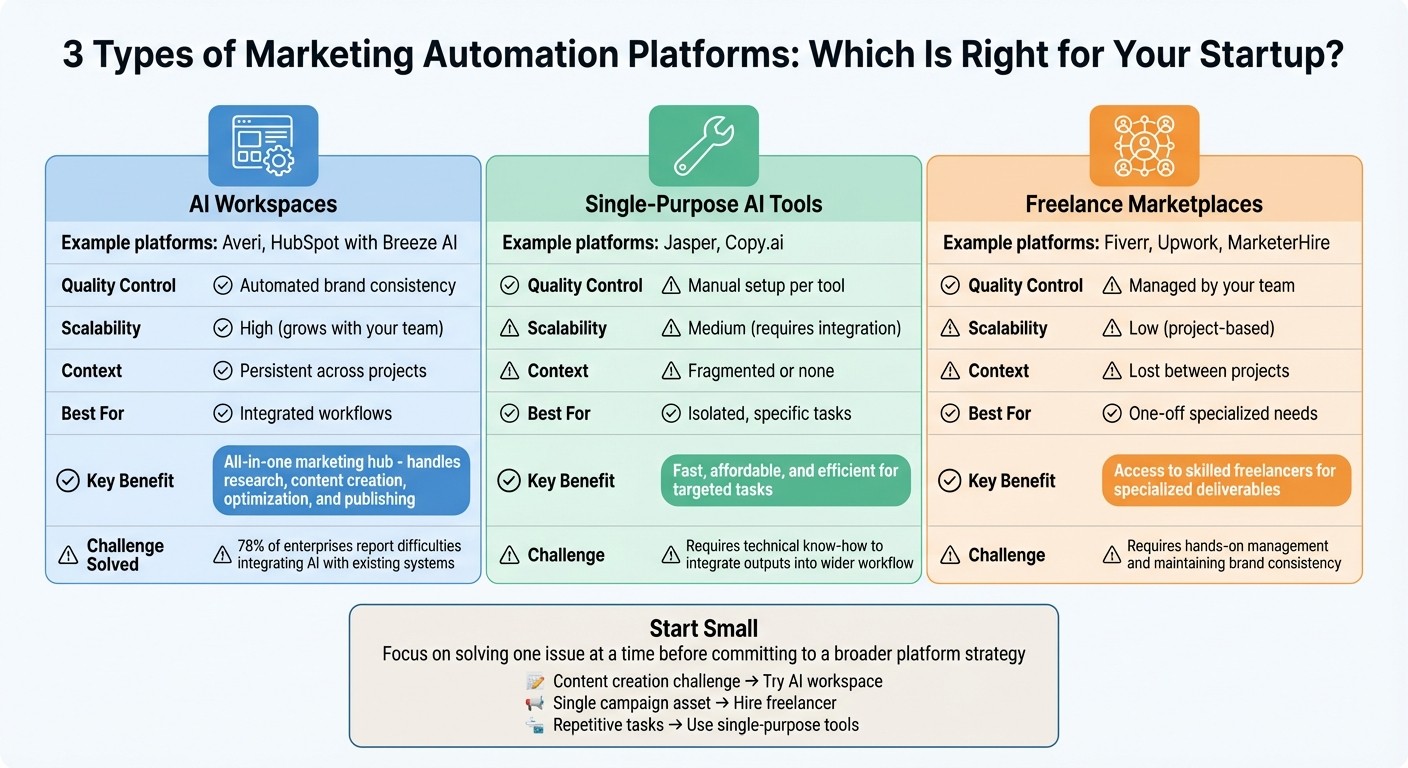
Marketing Automation Platform Comparison for Startups 2026
By 2026, startups will have three main categories of AI marketing platforms for startups to choose from: AI workspaces that handle everything from strategy to publishing, freelance marketplaces for on-demand expertise, and single-purpose AI tools designed for specific tasks. Each option offers distinct workflows, advantages, and ideal scenarios, allowing startups to align their choice with their specific needs. Let’s break them down.
AI Workspaces with Built-In Execution
Think of platforms like Averi as all-in-one marketing hubs. These systems manage the entire process - research, content creation, optimization, and publishing - without requiring external integrations. Your role? Approve ideas and edits while the platform takes care of execution. This setup addresses a common hurdle: 78% of enterprises report difficulties in integrating AI with existing systems [1]. By embedding integration directly into the platform, AI workspaces ensure consistent branding and strategy across all projects. For startups looking for steady, high-quality output without juggling freelancers or disconnected tools, this is a strong choice.
Freelance Marketplaces
Platforms like Fiverr, Upwork, and MarketerHire connect startups with skilled freelancers for project-based work. Whether you need a product launch video or a technical whitepaper, you can post a project, review proposals, and hire the right expert. However, this model requires hands-on management - you’re responsible for ensuring quality, maintaining brand consistency, and overseeing project handoffs. Since freelancers work on a project-by-project basis, maintaining context across campaigns can be challenging. This option shines when you need specialized deliverables and have the bandwidth to manage the process.
Single-Purpose AI Tools
Tools such as Jasper and Copy.ai focus on specific tasks like drafting blog posts, writing ad copy, or automating email sequences. They’re fast, affordable, and efficient, but they operate independently, meaning you’ll need to integrate their outputs into your wider workflow manually. Whether it’s connecting these tools to your CMS, CRM, or ad platforms, you’ll need some technical know-how to make it all work. These tools are ideal for solving targeted issues - like drafting social media posts - when you have the resources to tie everything together.
Here’s a quick comparison to help you decide:
Feature | AI Workspaces | Single-Purpose AI Tools | Freelance Marketplaces |
|---|---|---|---|
Quality Control | Automated brand consistency | Manual setup per tool | Managed by your team |
Scalability | High (grows with your team) | Medium (requires integration) | Low (project-based) |
Context | Persistent across projects | Fragmented or none | Lost between projects |
Best For | Integrated workflows | Isolated, specific tasks | One-off specialized needs |
The key is to start small. If your main challenge is content creation, try an AI workspace. Need help with a single campaign asset? A freelancer might be the way to go. For repetitive tasks, single-purpose tools can save the day. Focus on solving one issue at a time before committing to a broader platform strategy [2].
How to Set Up Marketing Automation: A Step-by-Step Guide
To make the most of AI-driven tools and automation, it’s essential to approach the process methodically. Marketing automation is most effective when used to address specific challenges, and it’s worth noting that 88% of marketers already incorporate AI into their daily workflows [2]. The key to success? Start small, solve one problem at a time, and gradually scale up. Here’s how to get started.
Step 1: Build Your Marketing Strategy
Before diving into automation, take a step back and assess your current processes. Identify the bottlenecks - are you struggling to keep up with content demands, personalize email campaigns, or follow up with leads in a timely manner? Once you’ve pinpointed the issues, define your ideal customer profiles (ICPs) and establish clear goals.
Platforms like Averi can simplify this initial phase by analyzing your website, evaluating competitors, and generating a detailed content marketing plan. The system handles the heavy lifting, leaving you to review and refine its recommendations.
To ensure smooth implementation, appoint an "AI Champion" within your team. This person will take the lead in testing the tool, troubleshooting issues, and encouraging team adoption [2]. Their role is critical in turning initial doubts into enthusiasm and progress.
Step 2: Set Up Workflows and Integrate Your Tools
Next, map out how tasks move through your team - from ideation to execution to publishing. For example, if you’re automating email sequences, connect your CRM (like HubSpot) with your email platform (such as ActiveCampaign) and set triggers for specific actions, like downloading a whitepaper or recovering an abandoned cart. For content automation, link your CMS (e.g., Webflow, WordPress, or Framer) to streamline publishing.
Start small by automating a low-risk task, such as generating email subject lines, to build confidence and familiarity with the system [2]. Dedicate 2–4 weeks to cleaning up your data - removing duplicates and standardizing identifiers - so your AI tools can operate effectively [5]. Once workflows are in place, shift your focus to tracking results and refining your approach.
Step 3: Track Performance and Optimize
Analytics are your best friend when it comes to evaluating what’s working. Focus on metrics that directly impact revenue, such as lead-to-customer conversion rates and the lifetime value to customer acquisition cost (LTV:CAC) ratio. A good target is a 3:1 ratio, meaning the lifetime value of a customer is three times the acquisition cost [6][7]. Avoid getting distracted by vanity metrics like page views or social media likes, as they rarely translate into meaningful growth [7].
Tools like Dreamdata or HockeyStack can help you link your automation efforts to revenue, making it clear which campaigns are driving results and which aren’t [3]. Many platforms, such as Averi, also provide actionable insights. For instance, they might suggest ways to improve a piece of content ranking at #8 to push it to the first page or recommend low-competition, high-relevance keywords to target.
Adopt a continuous improvement mindset by running experiment loops. Identify a bottleneck, hypothesize a solution, test it, and review the results weekly [8]. Each cycle helps the system learn and become more efficient, ensuring your marketing automation efforts deliver maximum impact.
Common Problems Startups Face with Marketing Automation
Startups often face recurring challenges when implementing marketing automation. Fortunately, most of these issues have practical solutions if you know where to focus. Below, we break down some common hurdles and how to address them effectively.
Keeping Your Brand Voice Consistent
One of the biggest pitfalls with automation is losing control of your brand's voice. Without proper oversight, AI-generated content can stray off-brand - something that happens frequently, as only 27% of organizations actively review AI content [2]. Over time, this can lead to what’s known as "technical drift", where outdated references and inconsistencies creep into your messaging [5].
The fix? Combine human oversight with centralized brand guidelines. Tools like Averi can store your brand standards in a persistent memory system, but human review is still essential. Create a simple approval process to catch tone mismatches, outdated product details, or overly generic language.
Additionally, conduct quarterly workflow audits to refresh your AI's context. This ensures the system stays aligned with your current messaging, product updates, and positioning rather than clinging to outdated information.
Meeting Data Privacy Requirements
Data privacy remains a significant obstacle, with 40.44% of marketers citing it as a barrier to adopting AI [2]. Mishandling customer data not only risks regulatory penalties but also undermines customer trust.
To stay compliant, verify that your chosen platform meets key certifications like SOC 2, GDPR, and CCPA compliance [1]. It's also critical to ask vendors for their "model-training disclosures" to confirm whether your proprietary customer data is being used to train public AI models [1].
Before diving into automation, dedicate 2–4 weeks to cleaning up your database. Remove duplicate entries and incomplete records to avoid amplifying existing errors. Additionally, set up a bidirectional sync with minimal latency (under 15 minutes) and implement frequency caps across communication channels to prevent overwhelming your audience [5].
Preventing Tool Overload
Startups often fall into the trap of accumulating too many disconnected tools. This creates inefficiencies, as 78% of enterprises report struggles with AI integration, and 28.61% identify integration friction as a major issue [2].
The best approach is to tackle one problem at a time. Start by identifying a specific pain point - like bottlenecks in content creation or delays in email follow-ups - and choose a tool that addresses it while integrating smoothly with your existing platforms. Before investing in new software, check if your current tools (e.g., HubSpot, Mailchimp) already have built-in AI features [2].
To avoid "zap sprawl", document all workflows in an automation registry. Assign a team member to review these workflows monthly and eliminate redundancies. Whenever possible, opt for consolidated platforms like Averi’s unified workspace instead of juggling multiple specialized subscriptions. This simplifies processes and reduces unnecessary complexity.
What's Next for Startup Marketing Automation
Marketing automation is entering a transformative phase, driven by autonomous AI agents capable of reasoning, adapting, and acting in real time. By 2026, one in five marketers plans to deploy these AI agents to handle entire workflows from start to finish [1]. Unlike traditional tools that rely on predefined triggers, these agents analyze context, learn from past actions, and adjust strategies dynamically.
This evolution demands a fresh approach to content optimization. Traditional SEO alone won't cut it anymore. With 73% of B2B buyers now turning to AI tools like ChatGPT and Perplexity during their research [4], Generative Engine Optimization (GEO) has become critical. To optimize for AI, startups should focus on creating concise, extractable answer blocks (40–60 words), keeping content updated with fresh timestamps, and tailoring strategies to specific platform preferences. For example, ChatGPT favors detailed, encyclopedic information, while Perplexity emphasizes real-time, community-validated insights [4].
What Startups Should Do in 2026
To keep pace with these advancements, startups must rethink their marketing strategies to fully harness AI's potential. Start by consolidating tools with all-in-one platforms to avoid integration headaches. These unified systems streamline processes by combining research, content creation, and publishing into a single workflow, making growth more efficient. As Zach Chmael, CMO at Averi, explains:
"We built Averi around the exact workflow we've used to scale our web traffic over 6,000% in the last 6 months. It's intuitive, efficient, and customizable" [9].
Another priority is building an AI content creation framework that requires minimal human oversight. Many founders aim for what’s being called "The 60-Minute Marketing Week", where AI takes over the heavy lifting, and marketers spend just 1–2 hours weekly on approvals and fine-tuning [9]. This ensures high-quality, consistent branding without turning content creation into an all-consuming task.
Finally, adopt strong, AI-compatible data practices. Standardize customer activity across all platforms using tools like Segment to avoid fragmented automation [3]. Consider a "two-lane" strategy: a Fast Lane for high-priority leads and a Nurture Lane for long-term prospects. This approach keeps workflows efficient and prevents the buildup of "automation debt" as your startup scales.
FAQs
How can startups protect customer data while using AI marketing automation tools?
Startups can protect customer information while utilizing AI-driven marketing automation by focusing on a secure data infrastructure. Select platforms that centralize consent management, encrypt data during transfer and storage, and support detailed retention policies. These measures provide control over data access and ensure the ability to delete information when it's no longer required. Building a solid data infrastructure not only supports compliance but also streamlines operations.
Furthermore, prioritize tools offering advanced privacy features, such as role-based access controls, private cloud options, and IP-specific usage agreements. It's crucial to work with vendors who are transparent about how they manage prompts, training data, and generated outputs. By negotiating clear terms around data ownership, restricting third-party sharing, and conducting regular log audits, startups can adhere to U.S. privacy regulations like the CCPA while efficiently scaling their marketing initiatives.
What’s the difference between AI workspaces and freelance marketplaces?
AI workspaces, like Averi, bring together AI-driven tools and human collaboration into a single platform. These systems are built to simplify workflows, automate repetitive tasks, and help teams execute marketing campaigns with speed and precision. With features like built-in quality controls and seamless integrations, they’re ideal for teams aiming to enhance efficiency without sacrificing accuracy.
On the other hand, freelance marketplaces such as Fiverr, Upwork, or MarketerHire connect businesses with specialized, on-demand talent for individual projects. These platforms offer flexibility and access to experts across various fields, but managing the process often falls on the business, requiring more hands-on involvement and oversight.
The core difference comes down to their focus: AI workspaces excel at automation and scalability, making them perfect for streamlined operations, while freelance marketplaces prioritize personalized, human-driven solutions tailored to specific project needs.
How can startups ensure their AI-generated content stays consistent with their brand?
Startups can uphold their brand identity by turning their AI tools into brand-aware collaborators rather than generic content generators. This begins with crafting a comprehensive, adaptable brand guide that outlines tone, style, messaging, and visual elements. AI platforms like Averi can then be trained on these materials to produce content that reflects the company’s distinct voice and personality.
To maintain uniformity, startups can leverage AI-driven asset management tools to organize and retrieve approved logos, color palettes, and templates during the content creation process. Adding a layer of human oversight - where brand experts or editors review AI-generated drafts - adds an essential safeguard against misalignment. This blend of automation and human expertise ensures precision without sacrificing authenticity.
Regular audits of AI-created content across channels such as social media, email campaigns, and advertisements are crucial for maintaining consistency. By treating AI as a collaborative partner and fine-tuning its prompts over time, startups can scale their content creation efforts while preserving the trust and recognition their brand has built.
Related Blog Posts

Zach Chmael
CMO, Averi
"We built Averi around the exact workflow we've used to scale our web traffic over 6000% in the last 6 months."
Your content should be working harder.
Averi's content engine builds Google entity authority, drives AI citations, and scales your visibility so you can get more customers.