

In This Article
Turn one long-form asset into 10+ platform-ready pieces with AI, saving time and preserving brand voice.
Updated:
Trusted by 1,000+ teams
Startups use Averi to build
content engines that rank.
AI tools can turn a single blog post or webinar into 10–15 tailored assets for platforms like LinkedIn, Twitter, and email. This approach saves up to 80% of content creation time and increases reach by 300%. Companies using this method, like Averi, have seen web traffic grow by 6,000% in six months. AI breaks down content into key insights, quotes, and data, transforming them into carousels, threads, videos, and more - all while maintaining brand voice. This strategy helps small teams maximize output without extra resources, ensuring consistent presence across multiple platforms.
Key points:
Time-saving: Cuts creation time by 60–80%.
Cost-effective: Reuses existing content at 20% of the cost.
Increased reach: Amplifies content exposure by 300%.
Formats: Includes carousels, threads, infographics, videos, and emails.
AI-driven content repurposing is a game-changer for teams aiming to do more with less.
How To Repurpose Content with AI [Real Examples] : Copy My Workflow
How AI Automates Content Repurposing
AI takes the concept of content repurposing to a whole new level by automating the process. It breaks down your content into its essential components - referred to as "atoms" - and reassembles them into formats tailored for specific platforms. For instance, when given a 2,000-word article, an AI tool can identify 5–7 key insights, 2–4 quotable phrases, 1–2 impactful data points, and any step-by-step instructions that can be extracted from the text [2]. These "atoms" are then reorganized into platform-friendly formats: FAQs transform into Twitter threads, data-driven paragraphs become LinkedIn carousels, and concise insights turn into scripts for short videos [3]. This process ensures that the content is not only repurposed but also optimized for the intended platform.
Analyzing Source Content for Repurposing Opportunities
AI begins by thoroughly analyzing the source material - whether it’s a blog, video, or webinar transcript - to identify content elements worth repurposing and their best-fit platforms. For text-based content, AI uses tools like topic modeling (such as LDA algorithms) to group related themes, sentiment analysis to gauge emotional tone, and keyword extraction to uncover SEO opportunities aligned with buyer intent [9][10]. For video content, AI transcribes the audio, identifies key visuals, and flags attention-grabbing moments - like a compelling statistic that could become an infographic or a workflow that lends itself to a LinkedIn carousel [9]. What’s remarkable is that this process, which might take hours manually, is completed by AI in mere minutes. The system prioritizes content that aligns with platform-specific formats, such as LinkedIn’s professional storytelling style, ensuring the output is ready for immediate adaptation [8][9].
Generating Format-Specific Content Ideas
After breaking down content into its core elements, AI maps these pieces to templates tailored for different platforms. For example, a blog stat like "80% of businesses lack frameworks" could be turned into an infographic for top-of-funnel awareness. Similarly, a detailed workflow might become an 8–12 slide LinkedIn carousel, while SMART goal examples could be repurposed into a middle-of-funnel email campaign [8][9]. Using targeted prompts, AI generates specific content ideas - such as "create a carousel" or "design an email campaign." The benefit is clear: businesses can ideate 5–10 times faster, transforming one piece of content into ten different formats. This streamlined approach reduces the time needed for content creation from days to hours, all while using templates and checklists to maintain consistency [8][9][10].
Maintaining Consistent Brand Voice
One common concern among marketers is that AI might produce content that sounds mechanical or off-brand. To address this, AI tools incorporate brand guidelines through fine-tuned models or custom prompts. These prompts define tone - such as professional for LinkedIn or casual for TikTok - along with specific style and voice parameters like "empowering" or "data-driven" [8][9]. During the content creation process, AI ensures outputs align with these rules by using quality control checklists. For example, a blog can be repurposed into LinkedIn carousels (featuring visual storytelling and brand colors), emails (with tailored CTAs), and videos (scripted with the brand’s signature phrasing), all while maintaining an "educational yet motivational" tone. By leveraging tools like content frameworks and living documents in platforms such as Notion, brands have achieved full alignment across channels, resulting in a 30% boost in engagement for social and video content [8][9].
This process allows AI to handle the repetitive work of reformatting while marketers focus on strategy and final touches. The result? Teams save up to 60 hours a month when managing a 20-piece content operation [7]. AI not only speeds up content creation but also ensures a cohesive and engaging brand presence across all platforms.
3-Step Process: Turning One Piece Into Ten
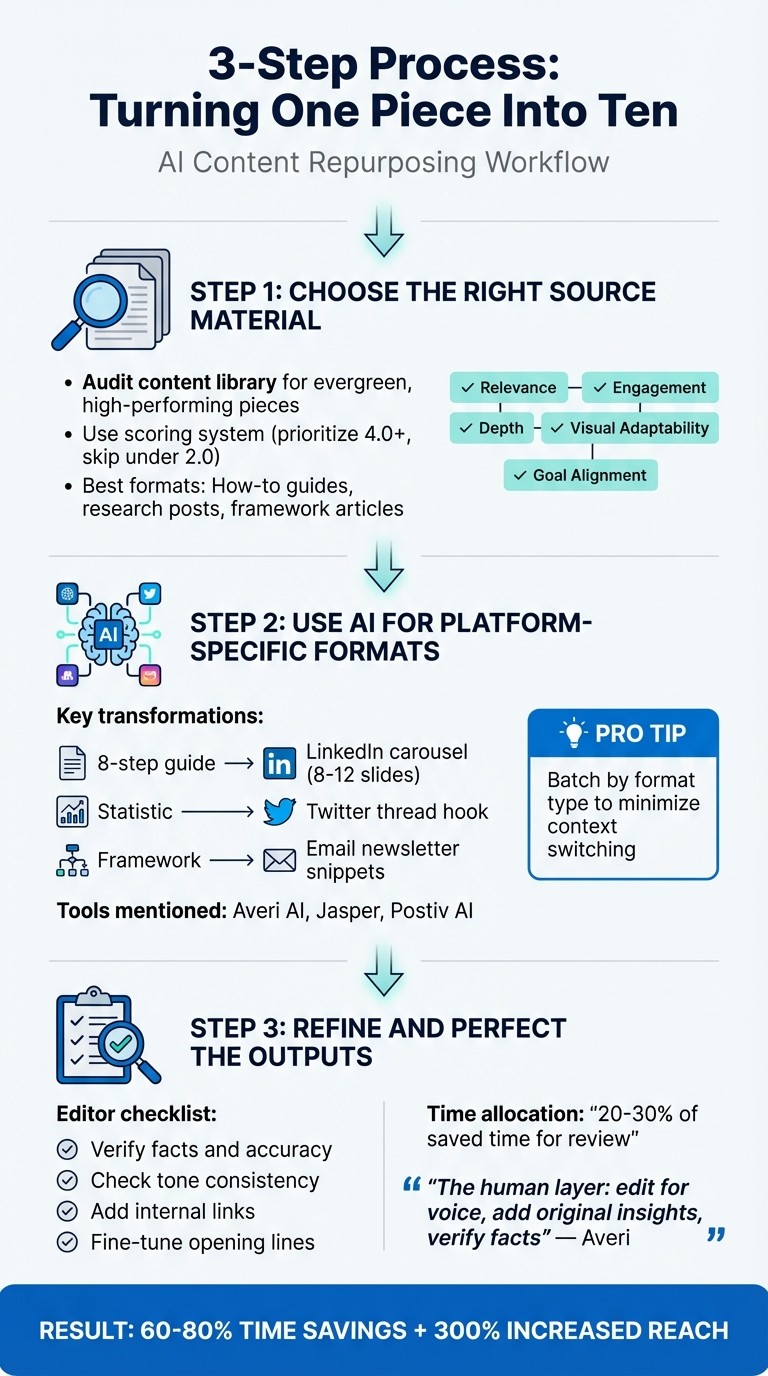
3-Step AI Content Repurposing Process: From One Piece to Ten Formats
Transforming a single piece of content into multiple assets is easier with a clear plan. This three-step approach helps you go from identifying the right material to publishing polished, platform-ready pieces across various channels.
Step 1: Choose the Right Source Material
Start by auditing your content library to find pieces that are evergreen, high-performing, and rich in insights. Use a scoring system that considers factors like long-term relevance, past engagement, depth, visual adaptability, and alignment with your goals. Prioritize content scoring 4.0 or higher, while anything under 2.0 can be set aside.
Certain formats work especially well for repurposing. For example:
How-to guides can be broken into step-by-step carousels.
Research-heavy posts can transform into infographics or quote cards.
Framework articles can inspire Twitter threads or LinkedIn carousels.
When creating new pillar content, structure it with clear sections, actionable frameworks, and quotable phrases. This makes future repurposing much smoother. Once you’ve identified your high-value pieces, let AI tools handle the heavy lifting.
Step 2: Use AI for Platform-Specific Formats
AI tools excel at reformatting content to fit different platforms. They take your core piece and adapt it to suit the unique style of each channel. For instance:
An 8-step guide could become a LinkedIn carousel, with one slide per step.
A compelling statistic might serve as the hook for a Twitter thread.
Detailed frameworks could be distilled into snippets for email newsletters.
Tools like Averi AI can follow your brand guidelines and use tailored templates for each platform. Instead of vague prompts like "Turn this into a Twitter thread", you can be specific:
"Create a 6-tweet thread in a conversational tone for B2B SaaS marketers, highlighting three key benefits from our blog, using our brand hashtags, and ending with a CTA to download our free resource."
To stay efficient, batch your work by format type. For example, first generate all text-based derivatives, then focus on visuals. This minimizes context switching and helps maintain momentum.
Step 3: Refine and Perfect the Outputs
Even with AI doing most of the work, a thorough review is essential to ensure quality. Editors should:
Verify facts and ensure accuracy.
Check for tone consistency and alignment with strategic goals.
Add internal links to boost topical authority.
Fine-tune opening lines, especially for social posts, to grab attention before the "see more" cut-off.
"The human layer: edit for voice, add original insights, verify facts, add internal links, and do a final quality read."
Averi
Use collaborative tools like Google Docs or Notion for feedback, and rely on standardized checklists for each format to make the review process smoother. For critical content like thought leadership pieces, consider multi-level reviews. For simpler social posts, a single editor’s input may suffice. Plan to dedicate 20–30% of your saved time to this final step. This balance ensures your audience gets content that’s both efficient and high-quality.
10 Formats You Can Create From One Piece of Content
Repurposing a single piece of content across multiple formats allows you to maximize its reach and engagement across different platforms. Below are ten effective ways to adapt your core content, each tailored to fit its platform and audience.
LinkedIn Carousel Posts transform your main ideas into 8–12 visually appealing slides. Each slide highlights one key point using bold, mobile-friendly text. These carousels yield an impressive 6.60% engagement rate, nearly doubling the 3.5% seen with standard video reposts [3]. They're perfect for showcasing step-by-step guides, comparison charts, or ranked lists. AI tools can extract the most impactful points from your content and structure them for optimal performance on LinkedIn.
Twitter/X Threads break your content into 8–15 connected tweets that dive into complex topics. The opening tweet serves as a hook, using a bold claim, surprising statistic, or intriguing question to grab attention. The following tweets build on this, delivering insights that establish authority and encourage profile visits [4][6]. AI can pinpoint the most engaging parts of your content and craft threads with a compelling opening.
Infographics simplify data-heavy sections into visually engaging summaries. These work exceptionally well on Pinterest or as embedded assets in blogs, providing long-term visibility [4][5]. AI tools can identify key statistics, comparisons, or timelines from your content and organize them for easy handoff to a designer.
Short-Form Video Scripts are designed for platforms like TikTok, Instagram Reels, and YouTube Shorts. These 60–90 second scripts typically follow a structure: a 3-second hook, 10 seconds of context, 45 seconds of core content, and a call-to-action [4][6]. AI can distill one key insight into a script tailored for high visual impact. With short-form video projected to deliver the highest ROI in 2026 [3], this format is critical for engaging audiences who prefer quick, visual content.
Email Campaigns adapt long-form content into newsletters or drip sequences. AI can craft a concise 300-word summary with actionable takeaways or outline a 5-day email series, each focusing on a different section of your content [1][2]. Given that email marketing generates an average $42 return for every $1 spent [3][4], this format turns your content into a direct revenue generator.
Beyond these primary formats, there are additional ways to extend the value of your content:
Quote Graphics: Create 3–5 branded visuals featuring shareable quotes or insights.
LinkedIn Long-form Articles: Condense your blogs into 600–1,200-word native posts.
FAQ Snippets: Develop Q&A pairs for SEO and sales enablement.
Podcast Talking Points: Outline conversational topics for audio content.
Checklists/Lead Magnets: Turn how-to guides into actionable 1–2 page PDFs [4][5][6].
These ten formats ensure your content reaches a broader audience while delivering more value.
"We're not creating 10x more, they're extracting 10x more value from what they already have." - Zach Chmael, CMO, Averi [4]
Comparing AI Tools for Content Repurposing
When deciding on a content repurposing tool, you'll encounter three main categories: AI-driven platforms that manage strategy and publishing (like Averi AI), broader marketing platforms designed to maintain a unified brand voice (such as Jasper), and specialized tools created for specific platforms (like Postiv AI). These tools differ in their strategic approach, ability to maintain brand consistency, and platform focus.
Features and Capabilities
Averi AI operates as a comprehensive content engine. It takes a single piece of cornerstone content - like a blog post, video, or podcast - and transforms it into 10–15 platform-specific adaptations, such as LinkedIn articles, Twitter threads, newsletters, and infographics [4]. The platform emphasizes building Google entity authority and integrates AI citations from tools like ChatGPT and Perplexity [4]. Additionally, its Repurposing Tracker allows seamless integration with platforms like Webflow, Framer, and WordPress [4].
Jasper, on the other hand, focuses on being a marketing assistant. It uses templates and its "Brand Voice" feature to ensure consistency across various formats, including ads, emails, and blog posts. While it supports collaboration for larger marketing teams, it lacks built-in tools for visual design, requiring users to rely on separate software for creating carousels or infographics [11]. Interestingly, a survey found that 71% of marketers believe generative AI has significantly reduced busy work in their workflows [12].
Postiv AI is tailored specifically for LinkedIn content. It offers an end-to-end workflow, handling everything from content ingestion to carousel design, scheduling, and analytics - all within the same platform [11]. Its standout "knowledge ingestion" feature allows the AI to learn from your specific blog posts or case studies, ensuring the output reflects your expertise rather than generic summaries [11].
These differences in functionality also explain the pricing structures and overall costs tied to each tool.
Pricing and Total Cost of Ownership
Tool | Starting Price | Trial/Free Tier | Best For |
|---|---|---|---|
Averi AI | Currently in Free Beta | Free Beta access | Startups needing an end-to-end content strategy |
Jasper | $39 per seat/month | No free tier | Marketing teams requiring brand-consistent copy |
Postiv AI | $99 per seat/month | $1 seven-day trial | LinkedIn-focused growth and carousel creation |
While monthly fees are a key factor, they only tell part of the story. For example, Jasper requires additional tools for visual design and scheduling, which can add $50–$150 per month to your budget [11]. Postiv AI, in contrast, includes design and scheduling features but is limited to LinkedIn, which may hinder efforts to expand across platforms [11]. Meanwhile, Averi AI handles the entire workflow - from strategy to publishing - without the need for extra tools, though it's currently in beta [4].
These pricing models highlight how each tool is designed to extend your content's reach while balancing resources.
Best Use Cases for Each Tool
Depending on your goals and budget, each tool shines in different scenarios:
Postiv AI is ideal if LinkedIn is your primary growth channel and you want an all-in-one solution for writing, carousel design, and scheduling [11].
Jasper works best for larger marketing teams that need to maintain a consistent brand voice across multiple formats like ad copy, emails, and blog posts. Its collaborative features and extensive templates make it a strong choice for teams with five or more members [11].
Averi AI is perfect for startups or lean teams looking to maximize the value of long-form content across multiple platforms while building SEO authority. Its ability to repurpose cornerstone content without requiring a dedicated content marketer makes it especially appealing, as reflected in its 4.9/5 rating from over 1,000 teams [4].
Each tool offers a unique approach to streamlining content repurposing, allowing teams to create high-quality, impactful content that aligns with their specific goals and resources.
Conclusion
AI-driven content repurposing enables lean teams to transform a single high-quality piece into 10–15 customized assets, saving time and expanding reach significantly [3][4]. Tasks that once demanded 3–4 hours per asset can now be completed in just 45 minutes with the help of AI [7].
But it's not just about working faster - it's about working smarter. Strategic repurposing boosts ROI by an average of 32% compared to sticking with one format, while also creating the kind of cross-platform consistency that AI tools like ChatGPT and Perplexity value when determining citation authority [3]. With 94% of marketers already repurposing content [4], the real edge lies in automating the repetitive tasks without losing the brand's unique voice.
The question isn't whether to repurpose - it's how to do it effectively. Averi's CMO, Zach Chmael, proved this by achieving a staggering 6,000% increase in web traffic in just six months [3].
To start, focus on your best-performing evergreen content. Follow a simple three-step approach: pick high-value material, use AI to create tailored versions, and fine-tune them to align with your brand. Group your repurposing efforts into batches to avoid distractions, and then spread out the distribution over 2–4 weeks to maximize each piece's impact [3][4].
FAQs
What’s the best type of content to repurpose first?
The best starting point for repurposing content is long-form, in-depth pieces such as blog posts, guides, or articles packed with data. These types of content often have lasting relevance, detailed insights, and visual opportunities, making them perfect for transforming into formats like social media posts, email campaigns, infographics, or quick videos. By extracting key points and statistics, you can extend their reach and create engaging material for various platforms.
How do I ensure AI-generated repurposed content stays on-brand?
To ensure AI-generated content aligns with your brand, establish a Brand Voice System with clear, practical rules. Begin by identifying your Brand Core - the essence of your brand - and turning it into detailed Voice Guidelines that outline precise instructions for AI. Continuously evaluate and adjust AI-generated outputs to maintain consistency with your brand's tone and avoid bland or mismatched messaging. This approach guarantees cohesive, high-quality content across different platforms and formats.
How do I measure whether repurposing is actually working?
To gauge how well your content repurposing efforts are working, keep an eye on key metrics like engagement, reach, and ROI. Leverage analytics tools to track performance and compare results between the original content and its repurposed versions. Pay attention to KPIs such as engagement rates, click-through rates, conversions, and reach across various platforms. By analyzing these metrics over time, you can fine-tune your approach and better measure the impact of your strategy.
Related Blog Posts

Zach Chmael
CMO, Averi
"We built Averi around the exact workflow we've used to scale our web traffic over 6000% in the last 6 months."
Your content should be working harder.
Averi's content engine builds Google entity authority, drives AI citations, and scales your visibility so you can get more customers.