

In This Article
Systemize onboarding, health scores, reporting, and 90-day renewals to reduce churn and boost agency profits.
Updated:
Trusted by 1,000+ teams
Startups use Averi to build
content engines that rank.
Most agency churn comes from a few fixable issues, not bad work. In this piece, I show that retention improves when I treat it like a clear system: track the right numbers, score account health, set tight onboarding and reporting habits, and run renewals before contracts get close to the end.
Here’s the short version:
New clients cost 5–7x more than keeping current ones.
A 5% lift in retention can grow profit by 25–95%.
Many churn cases tie back to poor communication, late deliverables, and unclear ROI.
Agencies with weekly updates, monthly reviews, and quarterly sessions report far better retention than teams that only check in once a month.
A simple health score, 90-day renewal plan, and clear owner for every risk can stop a lot of preventable churn.
I’d boil the full article down to this: if I want retention to scale, I can’t leave it to memory, hustle, or one strong account lead. I need one shared system for onboarding, client communication, account risk, renewals, upsells, and churn review.
That’s what this article lays out in plain terms.
The Client Retention Playbook for Digital Marketing Agencies: How to Reduce Churn
Define the retention metrics and data your agency needs
Start with the metrics and data sources that drive action. If the data doesn't help your team spot risk, assign ownership, and move fast, it's just noise.
Track the numbers that should trigger action
Every agency should keep a close eye on six core metrics: Client Retention Rate (CRR), Churn Rate, Net Revenue Retention (NRR), Expansion Revenue, Contract End Dates, and Client Health Score.
CRR and Churn Rate tell you how stable your client base is. They move in opposite directions, so together they give you a plain read on whether you're holding ground or leaking accounts. NRR is different. It shows growth inside the accounts you already have because it includes upsells and downgrades, not just whether a client stayed. Healthy agencies often aim for 110–130% NRR and depend heavily on renewals and expansions[1].
Contract timing matters just as much as revenue. If you can't see which agreements end in the next 90 days, your renewal process will drift into last-minute scrambling. That's when teams start reacting instead of leading.
Client Health Score turns account risk into something your team can act on. It gives each account a simple status, so account managers can tell at a glance which clients need attention now, not next month.
Bring health data from your CRM, billing platform, and project tools into one dashboard. When those signals sit in one place, patterns show up fast: delivery issues, weak communication, payment friction, and missing ROI. That's usually where churn starts.
Review retention in a way agency leaders can act on
Metrics only matter if the review process leads to action. A steady cadence works best: monthly reviews for individual client health, and quarterly reviews for GRR, NRR, and client count.
Monthly reviews should end with three clear outputs:
Accounts slipping from Green to Yellow
Contracts expiring within 90 days
Accounts showing 1–2 week payment delays
Each item needs an owner and a deadline. Otherwise, the meeting turns into a dashboard tour and nothing changes.
Use these monthly and quarterly reviews to update health scores and trigger outreach while there's still time to fix the account.
Build a client health score and churn risk workflow
Raw metrics are useful, but they don't help much if account owners still have to piece the story together on their own. A health score fixes that. It turns scattered signals into a clear account view, so teams can spot trouble early instead of reacting when churn is already in motion.
Choose the right health signals for agency accounts
For agency accounts, the best signals are the ones that show drift early: slow replies, missed meetings, lower scope usage, and payment delays of 30+ days. Those usually show up before budget cuts or stakeholder turnover.
A simple model works well here. Weight the signals across four categories, with relationship signals carrying the most weight at 40% total. That bucket includes meeting attendance, decision-maker engagement, stakeholder engagement, and strategic alignment. Delivery and engagement signals make up 30%, split between response time (15%) and scope usage (15%). KPI performance adds 20%, and financial signals such as invoice payment timing make up the last 10% [1].
That weighting reflects how agency churn often starts. Performance matters, of course. But in many accounts, the first warning sign isn't a bad dashboard. It's a client who stops replying, skips meetings, or goes quiet.
A client that stops asking questions or pushing back is often a higher churn risk than a vocal one.
Set thresholds, alerts, and escalation rules
Score each account from 1–5 across five categories. If the total score drops below 18, trigger a proactive conversation. Yellow scores should prompt an account director review. Red scores should move straight to leadership, along with a recovery plan. And if any single category lands at 3 or below, treat the account as Red right away.
The table below gives the team a shared way to judge account health:
Health Signal | Green (Healthy) | Yellow (At-Risk) | Red (Critical) |
|---|---|---|---|
Meeting Attendance | 90%+ over last 90 days | 70–89% | Under 70% or recent no-shows |
Email Response Time | Within 1 business day | 2–3 business days | Over 3 days or "going dark" |
KPI Performance | Meeting/exceeding targets | Slightly under target | Significantly under target |
NPS / Satisfaction | Score of 9–10 | Score of 7–8 | Score under 7 |
Scope Changes | Expanding or steady | Reducing slightly | Cutting scope or budget |
Stakeholder Status | Stable champion in place | Champion role changing | Champion left or unclear |
To make this usable day to day, automate CRM alerts so the account owner gets a Slack or Teams notification when a contract enters each renewal window. That small step keeps renewal risk from sneaking up on the team.
Use AI to summarize account risk and recommend next steps
Once an account is flagged, speed matters. The account owner shouldn't have to dig through 90 days of notes, email threads, and KPI reports just to figure out what changed.
Use AI to turn the last 90 days of analytics, email sentiment, and meeting notes into a short risk summary. Then have it draft QBR talking points the team can use for check-ins, escalation notes, and renewal conversations. The point isn't to replace judgment. It's to cut the prep work and make the next move obvious.
Strategic re-engagement still needs a person in the room. But the summary, the pattern spotting, and the first draft of next steps can all happen before the next client meeting.
Build retention into onboarding, delivery, and renewals
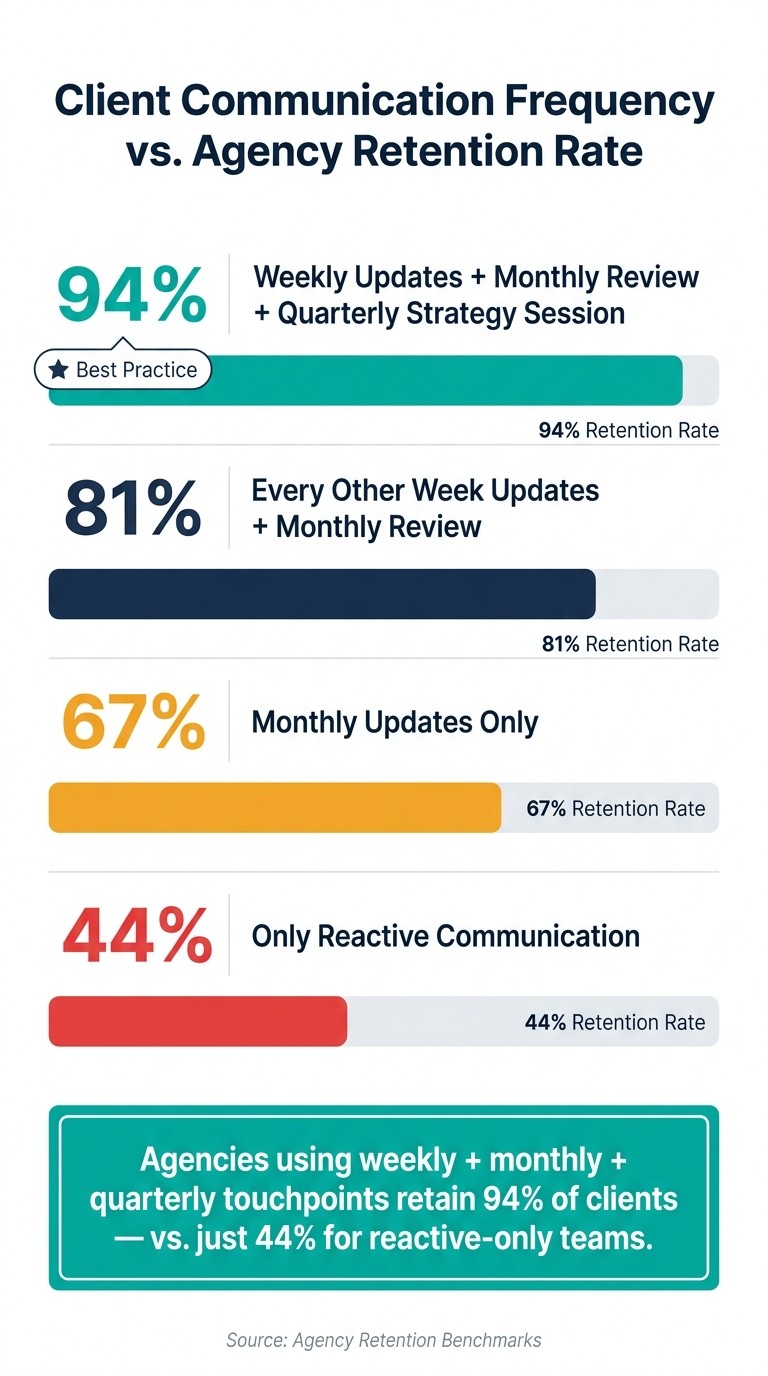
Client Communication Frequency vs. Agency Retention Rate
Once risk is out in the open, retention needs to live inside the day-to-day client experience. Onboarding, reporting, and renewals are where the client-health system from the last section starts doing actual work.
Standardize onboarding and expectation setting
The first 60–90 days shape the whole relationship. If an agency rushes onboarding, the damage often shows up by month four. The usual reason is simple: no one defined what success would look like.
A strong kickoff should lock in business outcomes, not just marketing KPIs. Write down the client’s top business goals, the target timeline, and the metrics that will define success. Then get client sign-off so everyone is working from the same playbook.
As soon as the contract is signed, onboarding should start automatically. That includes tasks, recurring meetings, and a welcome kit with key contacts, shared expectations, and a 90-day roadmap. E-signature tools can trigger these workflows right away, which cuts down on dropped handoffs. The onboarding doc should also spell out a 2-hour business-hours response SLA. And it helps to land an early win in the first 30 days, like a technical fix or a landing page update, so the account builds trust fast.
Run weekly updates and monthly reports clients can understand
Once onboarding is set, the next job is simple: keep clients informed on a steady cadence. Cadence has a direct tie to retention. Agencies using weekly updates, monthly reviews, and quarterly strategy sessions post a 94% retention rate, compared with 67% for agencies that rely on monthly updates alone [2].
Communication Frequency | Retention Rate |
|---|---|
Weekly updates + monthly review + quarterly strategy session | 94% [2] |
Every other week updates + monthly review | 81% [2] |
Monthly updates only | 67% [2] |
Only reactive communication | 44% [2] |
Weekly updates should be easy to scan: what shipped, what changed, and what’s next. Monthly reports need to go a step further and connect agency work to business results like leads, revenue, and pipeline. That’s the part clients care about most. AI can draft monthly client summaries from dashboard data, which cuts a lot of the manual lift without leaving clients in the dark.
Create QBR, upsell, renewal, and win-back sequences
That same cadence should feed renewal, expansion, or recovery motions before the contract starts slipping.
Run renewals on a 90-day clock: assess satisfaction at 90 days, present options at 60, and close by 30 [2][1]. Agencies that run structured QBRs see gross retention rates 10–15 percentage points higher than those that don’t [3].
A QBR should feel like a strategy session, not a status meeting. Give it 60–90 minutes and use a simple agenda: 15 minutes for performance review, 15 minutes for ROI and business impact, 15 minutes for competitive pressure, 15 minutes for the next 90-day roadmap, and 20 minutes for feedback and action items [2]. It also helps to bring in more than one stakeholder, such as the CEO or CFO, so the account isn’t tied to a single contact.
For upsells, watch these five CRM signals [1]:
Metric milestones above target by 20%+
Competitive threats
Seasonality 90 days ahead
Organizational changes, such as new executive hires
The renewal window itself
When one of those triggers fires, the CRM should send an alert and prompt a tailored expansion offer.
For clients showing exit risk, use a 3-email win-back sequence: an immediate candid check-in, a concrete improvement plan on day 7, and by day 21, three paths forward - reset the engagement, adjust scope, or agree on an orderly transition [1].
Turn retention into a playbook your team can repeat and improve
Retention only grows when the team runs one documented system. If the process lives in one person's head, it breaks the moment that person gets busy, leaves, or misses a handoff. Put the system on paper so any account manager can run it, week after week, without guesswork.
Document owners, SLAs, and templates in one place
Take the workflows above and turn them into one shared operating system the team can follow every week. Keep retention runbooks in one place, not scattered across docs, Slack threads, and someone's memory. Each playbook should map to a client lifecycle phase: onboarding, health checks, risk recovery, renewals, and expansion.
For each playbook, spell out the owner, the due dates, and the SLA. That way, when an account manager leaves, the next person can step in, see the full account history, and catch renewal triggers before they slip.
Capacity matters too. Cap account loads at 7–8 complex accounts or 12–15 low-touch accounts per AM. When AMs are overloaded, they skip steps. And skipped steps are where churn starts.
AI can also take some of the manual grind out of retention work:
Execution Task | Human-Only | Human-plus-AI |
|---|---|---|
QBR Preparation | 4–6 hours of manual data pulls and slide building [1] | AI drafts an 8-slide deck from 90 days of data in about 10 minutes; a human refines the strategy [1] |
Upsell Detection | Relies on AM intuition or accidental discovery | AI scans daily for metric milestones, org changes, and competitive moves [1] |
Once the playbook is live, the next step is simple: use churn patterns to make it tighter.
Use client feedback and churn analysis to improve the playbook
A playbook isn't something you write once and leave alone. It gets better when churn data keeps shaping it. If NPS or CSAT drops, run a structured follow-up and tag the root cause in your CRM. Then feed those root causes back into your health score and risk rules.
Do the same for churned accounts. Run a short exit interview, write down what you learn, and store it in the same system. That matters because churn reports, by themselves, don't fix anything. The change happens when the team uses that data to adjust the playbook.
One example makes the point. A 12-person digital marketing agency found gross retention was 78%, not 85% to 90%, which meant $340,000 in lost annual revenue. After tightening its retention playbook, it reached 86% by Q4 2025 [3].
Review the playbook every quarter. Update templates, thresholds, and SLAs based on what churn data is telling you in plain English, not what the team assumes is happening.
FAQs
How do I start a client health score from scratch?
Create a simple client scorecard and update it on a set cadence. Focus on five areas: engagement, results, relationship quality, strategic alignment, and financial health.
Rate each area on a 1–5 scale, then total the scores for each client. Set a threshold like 18/25 to flag accounts that may need a proactive conversation.
That way, you’re not waiting for a contract surprise or a tense email to tell you something’s off. You’re spotting drift early, while there’s still time to fix it.
Review the score monthly or quarterly so you can catch at-risk clients before small issues turn into bigger ones.
What tools do I need to automate retention workflows?
You need tools for client health monitoring, communication, reporting, and automation. In most agencies, the core stack includes:
CRM systems
Reporting dashboards
Client portals
Workflow automation platforms
Communication tools
Client health scoring systems
Used together, these tools give your team a clear view of each account. They help agencies track client health, automate routine touchpoints, and catch churn risk early enough to step in before a client walks.
How often should my agency review churn risk and renewals?
Review churn risk and renewal status at least monthly and quarterly. That cadence gives your team two things at once: an early-warning system and a steady rhythm for client check-ins.
Monthly client health scores can flag problems before they snowball - declining engagement, slower response times, or other signs that a relationship is starting to drift. When you spot those signals early, your team has a better shot at stepping in before the account slips into danger.
Quarterly reviews, including structured QBRs, give the relationship more depth. They create space to talk about goals, performance, and what the client wants next - not just what happened last week. That kind of review can strengthen the partnership and support renewals.
Some agencies also rely on real-time monitoring for a closer read on account health, but monthly reviews remain a common standard.
Related Blog Posts

Zach Chmael
CMO, Averi
"We built Averi around the exact workflow we've used to scale our web traffic over 6000% in the last 6 months."
Your content should be working harder.
Averi's content engine builds Google entity authority, drives AI citations, and scales your visibility so you can get more customers.