

In This Article
SEO gives creators control over traffic and builds sustainable organic growth beyond platform algorithms.
Updated:
Trusted by 1,000+ teams
Startups use Averi to build
content engines that rank.
SEO is a game-changer for creators and influencers looking to build a reliable, long-term traffic source. Unlike social media platforms, where algorithms can change overnight, SEO provides a steady stream of intent-driven visitors who are already searching for what you offer. This means more email signups, affiliate clicks, and sponsorship opportunities. Here’s the quick breakdown:
Why SEO Matters: It gives you control over your traffic, unaffected by platform changes.
Key Strategies:
Define your niche, audience, and their search intent.
Focus on long-tail keywords (3–5 words, low competition).
Use platform-specific SEO tactics (e.g., blog posts, YouTube videos, TikTok captions).
Organize content into clusters (pillar pages + supporting pieces).
Keep your brand voice consistent across all platforms.
Tools to Use: AI tools like Averi simplify keyword research, content drafting, and publishing.
Optimization Tips:
Refresh old content to maintain rankings.
Monitor key metrics like traffic growth, bounce rate, and click-through rate.
Use analytics to spot quick-win opportunities and refine your approach.
SEO isn’t instant - it takes 3–6 months to see results - but with a structured approach and consistent effort, it can drive 50–60% of your total traffic. Start by building topic clusters and let data guide your next steps for long-term growth.
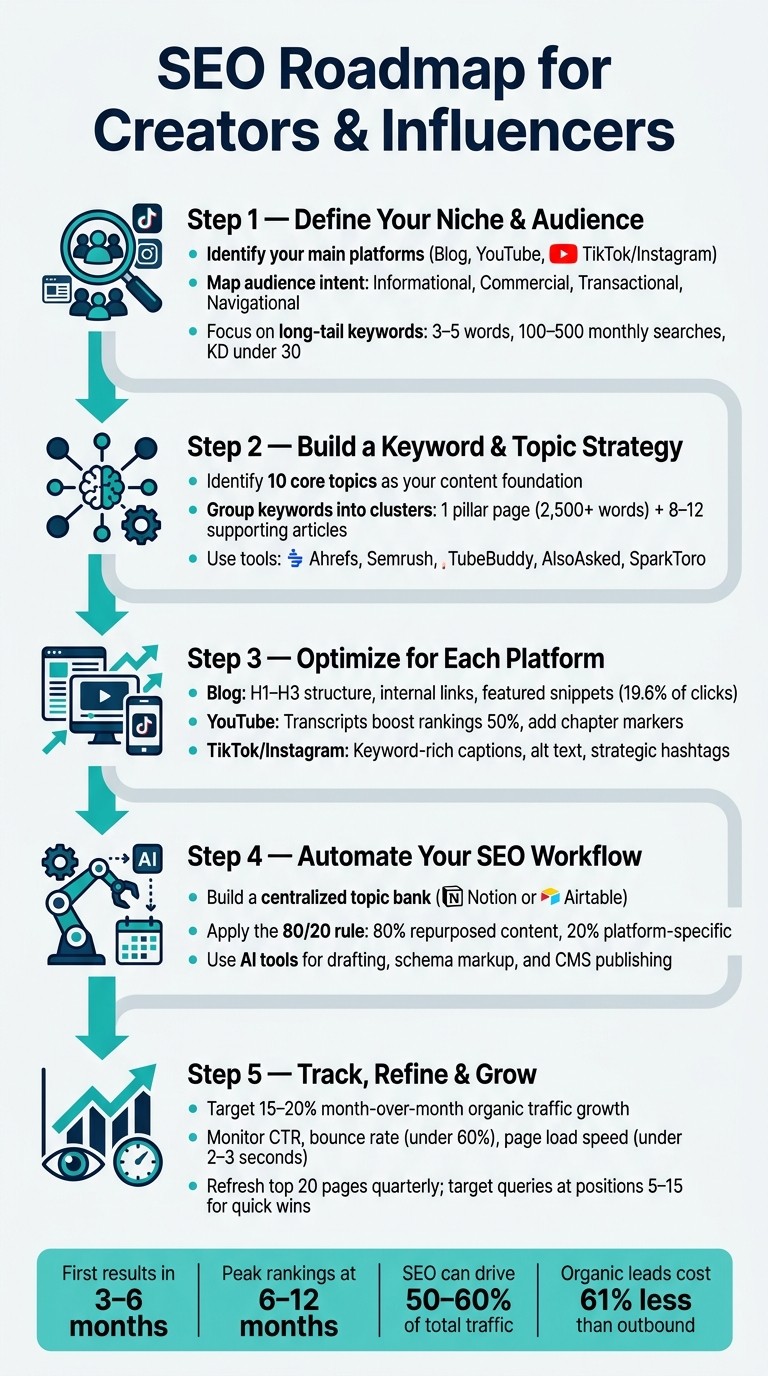
SEO Roadmap for Creators: From Niche to Long-Term Traffic Growth
The Risk of Social Media Dependency: SEO and the Influencer Marketing Space
Define Your Niche, Audience, and Search Intent
SEO plays a key role in driving long-term traffic, but it all starts with defining your niche, audience, and their intent. Before diving into keyword tools, take the time to clarify these elements. Skipping this step risks creating content that misses the mark - either attracting the wrong audience or, worse, reaching no one at all.
Identify Your Main Platforms and Content Formats
Each platform offers a different lifespan for SEO-driven content. For example, a well-optimized blog post can generate traffic for over a year, while posts on TikTok or Instagram often peak within hours. Understanding where your audience spends their time is essential for shaping your SEO strategy.
Platform | SEO Longevity | Best Content Formats |
|---|---|---|
Personal Blog | High | Comparisons, deep guides, affiliate funnels |
YouTube | High | How-tos, product reviews, tutorials |
TikTok/Instagram | Low | Discovery, trends, short-term engagement |
With 72% of creators active on at least three platforms [3], your SEO efforts must consider how each platform's algorithm surfaces content - not just Google. From there, analyze how your audience expresses their needs to refine your approach further.
Understand What Your Audience Is Searching For
One of the easiest ways to figure out what your audience wants is to look at the conversations they’re already having. Dive into comments, direct messages, and forum threads to uncover recurring phrases and questions [1][2]. These aren’t just random ideas - they’re potential search queries waiting to be optimized.
Organize these phrases by intent type to align your content format with what users are searching for:
Intent Type | User Goal | Example Query |
|---|---|---|
Informational | Seeking to learn | "How to edit YouTube videos" |
Commercial | Comparing options | "Best camera for vlogging 2026" |
Transactional | Ready to purchase | "Buy ring light for streaming" |
Navigational | Looking for a specific site | "TikTok creator fund login" |
Focus on long-tail keywords - phrases with three to five words, 100–500 monthly searches, and a Keyword Difficulty under 30. These keywords are easier to rank for and tend to attract users who are closer to making decisions [1][6].
Build a Consistent Brand Voice
A consistent brand voice not only builds trust but also aligns with search engine expectations. Google's E-E-A-T framework (Experience, Expertise, Authoritativeness, Trustworthiness) rewards creators who demonstrate clear expertise. An inconsistent tone or message can weaken these signals.
Start by identifying 10 core topics you already cover - such as "sustainable denim", "budget vlogging gear", or "home gym workouts under $200" [2]. These topics serve as the foundation of your brand. Tools like Averi can help you analyze your existing content, flag inconsistencies, and document your tone so it remains uniform across platforms and collaborators. This kind of consistency supports not just your branding but also your SEO goals, laying the groundwork for a well-targeted keyword and topic strategy.
Build a Keyword and Topic Strategy for Your Niche
Once you've defined your brand voice and understand your audience's intent, it's time to transform that understanding into a reliable keyword and topic strategy. This is where many content creators get stuck - not because they lack creativity, but because they lack a structured approach.
Find Keywords and Topics That Align With Your Niche
Start by identifying 10 key topics you frequently cover, such as “budget vlogging kit,” “home gym workouts under $200,” or “sustainable denim hauls.” These will serve as your foundation in tools like Ahrefs, Semrush, TubeBuddy, or vidIQ [2]. From here, search for keyword variations that strike a balance between moderate search volume and low competition. To capture authentic search terms, pay attention to insights from your community - comments, direct messages, and even Reddit threads are goldmines for real-world phrasing [1][2].
Organize Keywords Into Content Clusters
Group related keywords into clusters to create a cohesive content strategy. For example, develop a central pillar page (2,500+ words) supported by 8–12 shorter pieces that dive into specific subtopics [3][2]. Make sure each supporting article links back to the pillar using descriptive anchor text, ideally within the first 200 words, to effectively pass authority signals [3][4].
This cluster approach isn’t just for blogs - it works seamlessly across platforms. A blog pillar on “how to start a YouTube channel” can inspire a YouTube tutorial series, a podcast episode, and a LinkedIn post. Each piece can target a slightly different keyword variation, ensuring you’re not competing against your own content [3]. Once your clusters are in place, AI tools can help you keep your topic list fresh and aligned with audience trends.
Use AI Tools to Discover New Topics
To keep your keyword strategy dynamic, regularly refresh your topic pipeline using AI-powered tools. Platforms like Averi can automate this process by tracking industry trends, analyzing competitor content, and identifying high-potential topics that resonate with your audience [2][7].
"You don't need more time for content. You need a system that creates content without requiring your time." [2]
Other tools can fill specific needs. For instance, AlsoAsked is excellent for structuring FAQ or how-to content by mapping related question clusters. SparkToro, on the other hand, reveals what your audience is reading and sharing, helping you align content with genuine interests rather than guesswork. The ultimate goal is to establish a system where new ideas surface automatically, leaving you to focus on approving and refining instead of researching.
Optimize Content for Search on Each Platform
Once you've refined your keyword strategy, the next step is tailoring your content to match the search algorithms of different platforms. What works on YouTube might not translate to TikTok or Google, so it's crucial to understand the unique way each platform surfaces content and adjust your SEO approach accordingly.
YouTube and Podcast SEO
YouTube offers long-term visibility, as its content is indexed by Google. A well-optimized video can appear in both YouTube and Google search results. To make the most of this, include your primary keyword within the first 100 characters of your video description [2]. Adding chapter markers with keyword-focused timestamps not only improves navigation for viewers but also enhances indexing.
Transcripts are another powerful tool. Videos with transcripts see 30% more engagement and rank 50% higher than those without [6]. For podcasts, treat your show notes like a mini blog post - include a keyword-rich summary, guest names, and topic timestamps. This makes it easier for search engines to crawl and index the content effectively.
Short-Form Content SEO on TikTok and Instagram
TikTok has become a go-to search engine for Gen Z, making it essential to balance intent-driven keywords with engaging content [6]. Write captions in natural, conversational language that mirrors the questions your audience might ask, such as "how to edit Reels on iPhone." Avoid overloading captions with keywords, as TikTok's algorithm favors authenticity and specific phrasing.
On Instagram, keyword-rich captions can improve search discovery for Reels. Combine broad, high-volume hashtags with niche-specific ones to expand reach. Use alt text on images - not just for accessibility but also as a ranking signal [6]. Adding location tags can further boost visibility, especially for creators targeting local audiences or events.
Blog and Website SEO
For blogs and websites, a pillar-and-cluster content model can create a strong foundation for SEO. Use a clear heading structure (H1-H2-H3) to signal hierarchy to search engines, and keep paragraphs short - 3–4 sentences work best for mobile readability, as 68% of Google searches now come from mobile devices [6]. Internal links should use descriptive anchor text rather than generic phrases like "click here."
To target featured snippets - those prominent answer boxes at the top of Google results - provide concise, clear answers to common questions. These snippets account for an average of 19.6% of clicks [6]. Pair this strategy with fast-loading pages (aim for an LCP under 2.5 seconds) and use WebP image formats to meet Google's Core Web Vitals standards, which directly impact rankings [2][4].
By optimizing for these platform-specific nuances, you'll be ready to streamline your SEO workflow in the next phase.
Platform | SEO Longevity | Best Optimization Elements |
|---|---|---|
Personal Blog | High | Clear heading structure, internal links, schema |
YouTube | High | Transcripts, chapter markers, VideoObject schema |
TikTok/Instagram | Low | Keyword-rich captions, strategic hashtags, alt text |
Automate and Systematize Your SEO Workflow
As SEO efforts grow, automation becomes a necessity - not just for saving time but for keeping up with shifting search trends. While platform-specific SEO is key to boosting visibility, manually managing optimizations every week isn’t practical. The solution lies in building a repeatable system that delivers consistent results.
Turn Keywords Into a Weekly Content Pipeline
Start by creating a centralized topic bank. Use tools like Notion or Airtable to store your validated keywords, tagging them by content cluster, funnel stage, and format (e.g., blog post, YouTube video, TikTok script). This way, you can draw from an organized queue each week instead of starting from scratch.
To uncover topics your audience cares about, dig into YouTube comments, Instagram DMs, or Reddit threads in your niche. These platforms are goldmines for real phrases your audience uses, which often align with actual search queries [1]. Each content brief should include the target keyword, search intent, a unique angle, and any brand-specific details [10].
For repurposing, stick to the 80/20 rule: 80% of your content can be adapted for multiple platforms, while 20% should be created specifically for each platform. For example, a single long-form blog post can be transformed into a YouTube script, a LinkedIn summary, and several TikTok clips - all without reinventing the wheel [9].
Once your content pipeline is in place, focus on automating the creation and publishing processes to save time while maintaining quality.
Automate Content Creation and Publishing
AI tools can handle time-intensive tasks like research, drafting, SEO structuring, and metadata generation. For instance, Averi scrapes your website to learn your brand voice, then creates drafts optimized for both Google rankings and AI search citations (e.g., ChatGPT and Perplexity).
The key is knowing where human input is essential. The table below outlines how responsibilities can be divided between AI and human oversight [5][10]:
Workflow Stage | AI Handles | You Handle |
|---|---|---|
Keyword Research | Long-tail variations, clusters | Relevance, intent, business fit |
Briefing | SERP gap analysis | Unique angles, brand context |
Drafting | Structured first drafts | Original insights, voice calibration |
Editing | Semantic coverage, readability | Fact-checking, final quality checks |
Publishing | Schema markup, CMS uploads | Final QA, strategic distribution |
Once approved, Averi can publish directly to platforms like WordPress, Webflow, or Framer, eliminating the need for manual copy-pasting or formatting. Each published piece is also added to its content library, further refining future drafts to align with your voice [5].
Use Analytics to Keep Improving
After your system is up and running, analytics become your guide for fine-tuning performance and spotting growth opportunities. In Google Search Console, focus on queries with more than 10 impressions and an average position below 5 - these are quick wins. A small adjustment to the title or introduction can push a ranking from position 8 to page 1 [1].
For tutorial-style content, monitor metrics like scroll depth and time-on-page. If readers drop off early, it may be time to embed a video or expand a specific section for clarity [1]. Tools like Averi can surface these signals and suggest actionable tweaks, such as optimizing a ranking from position 8 to page 1.
Another overlooked metric to track is your edit ratio - the percentage of an AI-generated draft that makes it to the final version. A high edit ratio may indicate that your prompts or brand voice settings need adjustment, while a low ratio suggests your system is well-calibrated [5]. Monitoring this helps refine your workflow and ensures your AI tools stay aligned with your evolving content standards.
This streamlined approach ties directly into your broader SEO strategy, ensuring your content remains visible and effective over the long haul.
Track Results and Refine Your SEO Strategy
Monitoring SEO performance goes beyond simply watching numbers climb. Now that your workflow is automated, it’s time to focus on the metrics that truly matter - and act on them before minor issues spiral into bigger challenges.
Key Metrics to Track
Not all metrics carry the same weight. For content creators, the priorities include organic traffic growth, keyword rankings, click-through rate (CTR), and engagement signals like time on page and bounce rate.
A good benchmark is aiming for 15–20% month-over-month traffic growth from organic search. This reflects how SEO builds momentum - starting slow but gaining speed over time. With consistent effort, creators can achieve a 180–350% increase in organic traffic year-over-year [1]. However, patience is key; it typically takes 3–6 months to see meaningful results, with stronger gains often emerging between months 4 and 6 [9].
CTR often flies under the radar, but it’s critical. A high ranking is meaningless if users aren’t clicking. For example, a low CTR on a page ranked at position 3 suggests the title and meta description need a quick rewrite - not an overhaul of the entire article [9][11].
Metric | Target Benchmark | What It Tells You |
|---|---|---|
Monthly Traffic Growth | 15–20% | Reflects SEO momentum [9] |
Bounce Rate | Under 60% | Indicates content relevance [11] |
Page Load Speed | Under 2–3 seconds | Signals mobile usability and ranking health [11] |
Keyword Difficulty (KD) | Under 30 (for smaller sites) | Helps determine winnable keywords [1] |
These metrics are your roadmap for refining and expanding your content strategy.
Use Data to Update and Expand Content
Metrics don’t just show what’s working - they pinpoint areas for improvement. One of the most effective yet underused SEO tactics is refreshing existing content. Instead of constantly churning out new articles, revisit what’s already performing and optimize it.
In Google Search Console, filter for queries with over 10 impressions and an average position between 5 and 15. These are your quick-win opportunities - content that’s close to ranking on page one and only needs minor tweaks to break through [1][11]. Simple updates like rewriting the introduction, adding recent data, or improving internal links can make a big difference.
If a post experiences three straight weeks of declining impressions, act quickly. A content refresh - such as updating outdated facts, refining the meta title, or incorporating FAQ schema - can halt the slide and restore rankings [11]. To stay proactive, schedule a quarterly refresh cycle, focusing on your top 20 pages by impressions.
Beyond updating, use search query data to identify new content opportunities. If a recurring question appears in your queries but isn’t directly addressed in your content, that’s a gap worth filling. Transform these frequently asked questions into dedicated articles or FAQ sections to strengthen your authority on the topic [11].
Act on AI Recommendations to Keep Improving
While manual analysis is effective, it doesn’t scale efficiently. This is where AI tools like Averi come into play, transforming raw data into actionable insights.
Averi doesn’t just highlight performance trends - it provides specific recommendations. For instance, it can identify a post ranking at position 8 and suggest adjustments to push it onto page one. It also alerts you when competitors publish on topics you haven’t covered and flags low-competition keywords to add to your strategy.
Conclusion: Building Long-Term SEO Growth
SEO isn’t a one-and-done task - it’s a system that thrives on consistency, data-driven decisions, and ongoing adjustments. The creators who see lasting success are the ones who commit to tracking their performance, refining their approach, and staying adaptable.
The roadmap is straightforward: identify your niche, develop a keyword strategy centered on topic clusters, tailor your content for each platform, and use automation to handle repetitive tasks so you can focus on creating high-quality content. Let the data guide your choices and refine your strategy as you go.
"SEO builds a traffic channel you control, independent of platform whims." - RankPill [1]
This independence is crucial. Organic search can contribute 50–60% of total website traffic for well-established content programs [8], and inbound organic leads cost 61% less to acquire than outbound methods [8]. These numbers highlight how SEO directly supports the sustainability of your business as a creator.
However, results take time. You’ll likely see your first significant outcomes within 3–6 months, with content often hitting its peak ranking potential after 6–12 months [8][9]. Tools like Averi can help streamline this process by identifying quick-win opportunities and automating your weekly content workflow. By integrating SEO into your core strategy, you create a foundation for steady, long-term growth.
Start with one pillar topic, build a cluster of related content around it, and stay consistent with your publishing schedule. Over time, this disciplined approach will compound, driving the kind of organic growth that lasts.
FAQs
Which platform should I focus my SEO on first?
To make the most of your SEO strategy, concentrate on platforms where your audience is actively searching - primarily Google and YouTube. As the second-largest search engine, YouTube is vital for boosting both visibility and aligning with its unique algorithms. Google, on the other hand, excels in capturing long-tail keywords and addressing niche queries. While social media can enhance visibility, focusing first on Google and YouTube lays the groundwork for consistent, long-term traffic and credibility.
How do I pick long-tail keywords that match my audience’s intent?
To effectively connect with your audience, target specific, question-based keywords that align with your niche. These types of keywords often face less competition and can lead to better conversion rates. Tools like Ahrefs, Semrush, or Google’s "People Also Ask" feature are great for uncovering detailed queries your audience is searching for. Focus on low-competition keywords that are highly relevant to your content and have reasonable difficulty scores. By crafting content that directly addresses these questions, you not only meet your audience’s needs but also improve your chances of standing out in search results.
What should I do if my rankings stall after a few months?
If your rankings hit a plateau, it’s time to shift your attention to steady, long-term strategies. Make it a habit to monitor key metrics like organic traffic, keyword rankings, and user engagement on a monthly basis. To keep your content relevant, update your top-performing articles every six months with fresh statistics and new insights. Additionally, focus on building backlinks by contributing guest posts, forming collaborations, or earning citations from reputable sources. SEO is all about persistence - consistent effort is key to breaking through stagnation and ensuring continued growth.
Related Blog Posts

Zach Chmael
CMO, Averi
"We built Averi around the exact workflow we've used to scale our web traffic over 6000% in the last 6 months."
Your content should be working harder.
Averi's content engine builds Google entity authority, drives AI citations, and scales your visibility so you can get more customers.