

In This Article
Overview of collaborative, content-based, and hybrid AI recommenders, advanced techniques, and metrics to boost engagement and revenue.
Updated:
Trusted by 1,000+ teams
Startups use Averi to build
content engines that rank.
AI recommendation systems are transforming how platforms like Netflix, Amazon, and TikTok deliver personalized experiences. These systems analyze user behavior to predict preferences, driving engagement and sales. Netflix’s recommendations influence over 80% of what users watch, while Amazon attributes 35% of its revenue to its suggestion engine. Platforms use three main approaches: collaborative filtering (analyzing user interactions), content-based filtering (focusing on item attributes), and hybrid models (combining both). Hybrid systems offer the best balance, improving conversion rates by 25% and average order values by 17%. Advanced techniques like neural networks, reinforcement learning, and graph-based models further refine personalization, boosting metrics like watch time and revenue. Businesses can leverage these insights to enhance user experiences and drive growth, with measurable results through A/B testing and metrics like Precision@K and NDCG.
What Is An AI Recommendation System? | How AI Recommendation Systems Work? | Simplilearn
Core AI Algorithms Behind Content Recommendations
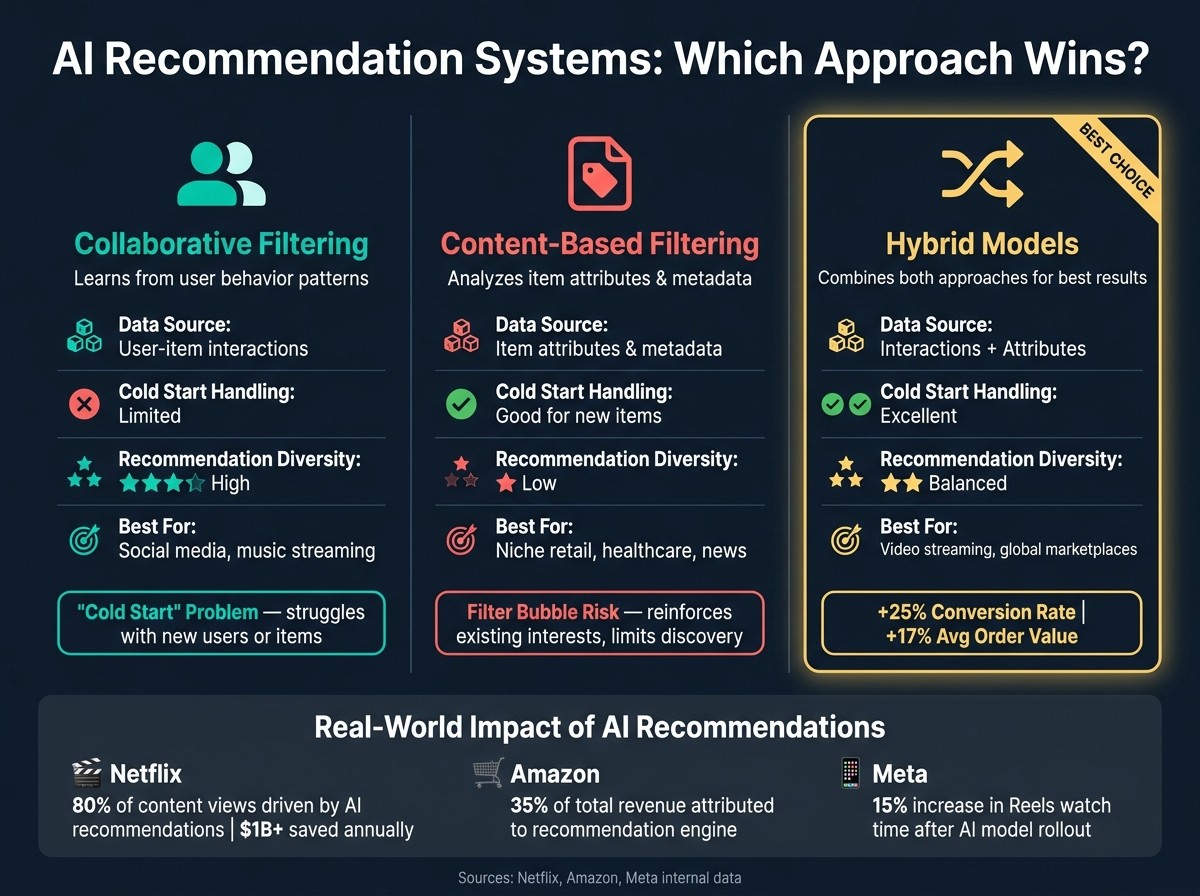
AI Recommendation Systems Compared: Collaborative vs. Content-Based vs. Hybrid
Three main approaches - collaborative filtering, content-based filtering, and hybrid models - each play a distinct role in personalizing recommendations.
How Collaborative Filtering Works
Collaborative filtering (CF) operates on a straightforward concept: users with similar behaviors are likely to enjoy similar content [11]. Instead of focusing on the characteristics of items, CF analyzes user activity. For example, if two users share similar listening habits, a music streaming platform might recommend the same new artist to both.
This method thrives on platforms with extensive user bases, such as social media, e-commerce, and music streaming services, where behavioral data is abundant. However, CF struggles with the "cold start" problem, making it difficult to recommend content for new users or items with little interaction history.
How Content-Based Filtering Works
Content-based filtering (CBF), on the other hand, evaluates the attributes of items - like genre, keywords, or topics - to tailor recommendations to a user's preferences.
"AI-based recommendations are suggestions generated by algorithms that analyze large datasets to predict what a user might be interested in." - Natasha Lockwood, Senior Integrated Marketing Manager, Tealium [4]
For instance, if you've been reading articles about electric vehicles, a CBF system will suggest more EV-related content by identifying shared characteristics among those articles. This approach works particularly well in specialized sectors like niche retail, healthcare, and news. However, its downside is a tendency to limit discovery, as it often reinforces a user's current interests without offering much variety.
To address the limitations of both CF and CBF, hybrid models combine their strengths.
Hybrid Models for Better Accuracy
Hybrid models blend collaborative and content-based filtering, creating a more robust recommendation system. By combining CF's crowd-sourced insights with CBF's detailed analysis of item attributes, hybrid systems excel at personalizing recommendations for both new and experienced users.
The results speak for themselves. Platforms using hybrid models have seen conversion rates climb by 25% and average order values grow by 17% [5]. Giants like Netflix and Amazon rely on these systems to deliver highly personalized experiences at scale [10][11].
Feature | Collaborative Filtering | Content-Based Filtering | Hybrid Models |
|---|---|---|---|
Primary Data Source | User-item interactions | Item attributes and metadata | Both interactions and attributes |
New User/Item Handling | Limited (Cold Start) | Good for new items with known features | Excellent |
Recommendation Diversity | High | Low | Balanced |
Best Fit Industries | Social media, music streaming | Niche retail, healthcare, news | Video streaming, global marketplaces |
For platforms catering to new users, starting with content-based filtering can be effective, gradually incorporating collaborative signals as more data becomes available. For large-scale enterprises, adopting a hybrid model is crucial - not just to avoid filter bubbles, but also to maintain accuracy and personalization [5][7].
Advanced AI Techniques for Personalized Content
Today's advanced AI techniques leverage hybrid models to deliver highly personalized content recommendations. By incorporating neural networks, reinforcement learning, and graph-based architectures, these systems push the boundaries of what personalization can achieve.
Neural Networks and Deep Learning
Deep learning excels at capturing evolving user behavior. It identifies keyword clusters and user intent across vast amounts of content, allowing recommendations to align closely with individual preferences [1]. Once these patterns are recognized, reinforcement learning steps in to refine personalization further, using real-time feedback to adapt and improve.
Reinforcement Learning in Recommendations
Reinforcement learning takes personalization to the next level by continuously learning from user interactions. Every click, ranking, and engagement feeds back into the system, enabling it to adjust and optimize its recommendations automatically. This feedback loop not only enhances the user experience but also drives measurable results, such as higher ROI for content marketing [12][13].
Zach Chmael, CMO of Averi, highlights this efficiency, describing how a content engine can "produce, publish, and optimize content with minimal ongoing founder involvement" [12]. Teams can use automated analytics dashboards to approve AI-generated topic suggestions based on current performance metrics, seamlessly integrating this data into future recommendations. Beyond these iterative improvements, graph-based models add another layer of sophistication by uncovering deeper connections.
Graph Neural Networks for Relationship Mapping
Graph neural networks (GNNs) bring a new dimension to personalization by mapping complex user–content relationships. Using graph embeddings, GNNs can identify connections that go beyond straightforward metadata links [8]. For instance, a user researching home insulation might unknowingly share behavioral patterns with others exploring solar panels. Even without an obvious link between these topics, GNNs detect structural similarities, surfacing relevant content that traditional systems might overlook [8].
The value of these advanced techniques is undeniable. Netflix, for example, estimates that its recommendation algorithms save the company over $1 billion annually, with roughly 80% of its content views driven by algorithmic suggestions [8]. More broadly, AI-powered personalization has been shown to boost business revenues by 5%–15% [8]. For organizations building or refining their recommendation systems, these relationship-aware and context-sensitive models consistently outperform simpler approaches, especially at scale.
Case Studies: AI Recommendation Engines in Practice
Understanding how AI recommendation systems work becomes much clearer when examining their use on platforms like YouTube, Amazon, and TikTok. Each platform applies its own unique strategy, showcasing how theoretical AI models translate into measurable success.
YouTube and Google's Recommendation Models
YouTube's recommendation system is a masterclass in leveraging advanced filtering and neural networks. It accounts for over 70% of the platform's total watch time [14]. The system operates through a multi-stage pipeline: first narrowing down millions of videos to a smaller pool of candidates, then ranking those to determine what appears on a user's homepage.
In September 2025, researchers from Stanford and Google introduced the IS-Rec (Intent-Structured Whole-Page Recommender System) on YouTube. This framework shifts focus from predicting individual clicks to understanding user intent - whether they want fresh content or something familiar. This approach led to a 0.05% increase in daily active users [14].
"Something I think people tend to overlook is the value of all this behavioral and psychological and economic understanding of the world. These understandings can actually help the system learn better, learn faster, and learn more robustly." - Yuyan Wang, Assistant Professor of Marketing, Stanford Graduate School of Business [14]
Additionally, YouTube transitioned its optimization goal from click-through rates to expected watch time back in 2012. This change significantly reduced clickbait and influenced how creators approach their content strategy [6].
E-Commerce Personalization: Amazon and Beyond
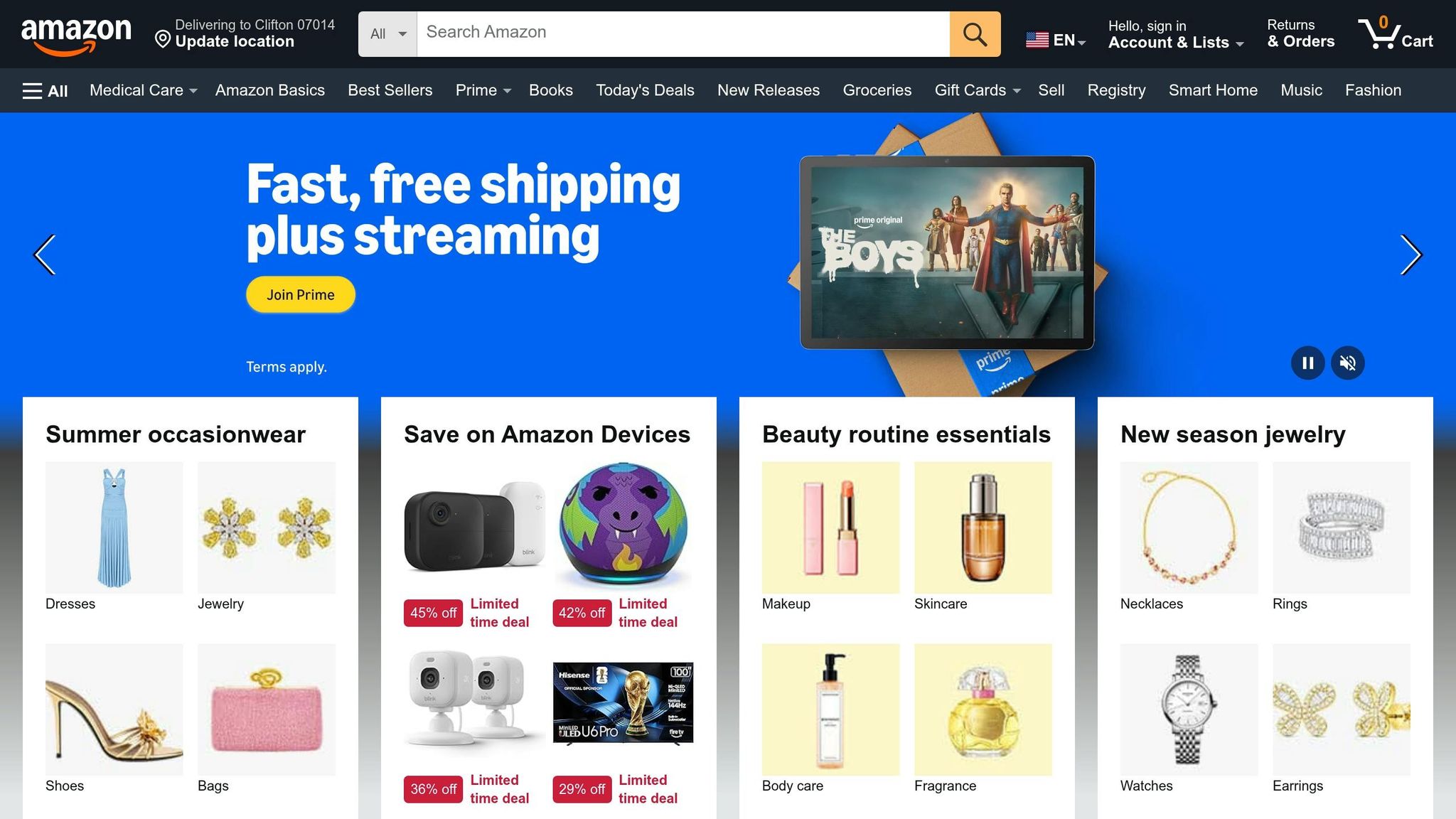
Amazon's recommendation engine takes a transactional approach, focusing on conversion-oriented signals such as purchase history, browsing patterns, and "add to cart" actions. This strategy contributes to roughly 35% of Amazon's total revenue [11][16].
Amazon pioneered item-to-item collaborative filtering, which recommends products based on what similar users purchased together. Modern e-commerce platforms have enhanced this by incorporating context-aware signals like device type and location to improve relevance [9]. Across the industry, AI-driven recommendations drive a 25% increase in conversion rates and a 17% growth in average order value (AOV) [5].
Social Media and Entertainment Platforms
Social media platforms like TikTok and Meta prioritize retention and content discovery. Metrics such as watch time, completion rates, and "Meaningful Social Interactions" are key to their recommendation strategies [15].
In June 2023, Meta introduced the Meta Interest Learner, a few-shot learning system designed to tackle the cold-start problem for new content on Facebook and Instagram. This system matches new Reels with potential audiences, even when initial engagement data is limited, resulting in a 15% increase in Reels watch time [15]. Currently, over 20% of the content in Facebook and Instagram feeds is AI-recommended [15].
Platform | Metric | AI Impact |
|---|---|---|
YouTube | Watch time | >70% of total watch time driven by recommendations [14] |
Amazon | Revenue | |
Meta (Facebook/Instagram) | Reels watch time | 15% increase after Meta Interest Learner rollout [15] |
The common thread across platforms is clear: the better a system understands why a user is engaging - not just their past clicks - the more effective it becomes. AI's ability to anticipate user intent is reshaping how content and products are delivered.
How to Measure AI Content Suggestion Systems
To validate the effectiveness of AI-driven recommendation systems, robust measurement frameworks are essential. These frameworks operate on two levels: offline evaluation, which tests algorithms against historical data before deployment, and online evaluation, which uses live A/B testing to gauge real-world impact. Both are critical because even the most promising models in controlled environments can falter when exposed to actual user interactions.
Key Metrics: Precision, Recall, and NDCG
Evaluation frameworks typically focus on a "K" parameter, which limits analysis to the top K recommendations (e.g., Top-5 or Top-10). This makes sense because users rarely explore beyond the first few suggestions [17].
Three metrics are especially important within this context:
Precision@K: Measures the percentage of recommended items that are relevant. This is particularly useful for scenarios like e-commerce, where every recommendation slot matters.
Recall@K: Evaluates the proportion of all relevant items that the system successfully surfaces. This metric is vital in fields like legal research, where missing a key match can have significant consequences [17].
NDCG (Normalized Discounted Cumulative Gain): Rewards systems for placing the most relevant items higher in the list, applying a logarithmic penalty for lower-ranked items [17][18].
"The 'discounted' part of the [NDCG] metric penalizes items of higher relevance appearing at lower ranks." - Mayukh Bhattacharyya, Data Scientist [20]
In addition to these, modern systems also monitor diversity (variety in suggestions), novelty (highlighting less obvious or "long-tail" items), and serendipity (unexpectedly delightful recommendations) [17][18]. A system that only pushes popular content risks losing user interest over time, even if its Precision@K score is strong.
Industry Benchmarks and A/B Testing
Before deploying any algorithm, companies typically split historical data chronologically - training models on older data and testing them on more recent behavior to simulate real-world conditions. Following this, A/B testing is conducted by comparing the new algorithm against a baseline with a subset of real users. Metrics like click-through rate (CTR), conversion rate, and average revenue per user (ARPU) determine whether technical improvements translate into business success [17][4].
One ongoing challenge is AI drift, where models degrade over time as user preferences evolve or content catalogs change. To address this, companies regularly re-evaluate models using fresh data, such as recent clicks or purchases, captured through event tracking [17][19].
Algorithm Trade-Offs Compared
No single metric can capture the full picture, and no algorithm excels across every dimension. Balancing trade-offs is key:
Metric | Primary Focus | Best Use Case | Key Limitation |
|---|---|---|---|
Precision@K | Correctness of selected items | E-commerce top-N product lists | Not rank-aware; ignores item order [17] |
Recall@K | Coverage of relevant items | Information retrieval, legal search | Ignores irrelevant noise in top results [17] |
NDCG | Ranking quality | Search engines; graded ratings | |
MRR | Position of first relevant result | Q&A systems; single "best answer" scenarios | |
MAP | Overall ranking precision | High-stakes retrieval tasks | Hard to communicate to non-technical teams [17] |
Relying on a combination of metrics is often the best approach. For example, pairing a ranking metric like NDCG with a behavioral metric such as diversity can help avoid the pitfall of optimizing for accuracy while unintentionally narrowing recommendations to a small pool of popular items [17][18].
Conclusion: Where AI Content Suggestions Are Headed
Key Takeaways from the Research
Hybrid models have proven to be a game-changer, outperforming single-method approaches by 15–30% across critical performance metrics [23]. Major platforms have already capitalized on these advancements [22][23]. Techniques like reinforcement learning and graph neural networks further enhance outcomes, though they demand higher computational resources and add complexity. For instance, YouTube's use of reinforcement learning boosted watch time by 6.5% [21], while TikTok's graph neural network-driven For You Page led to a 40% increase in average session time between 2019 and 2023 [24].
Effective measurement remains the cornerstone of improvement. Combining ranking metrics like NDCG with behavioral indicators such as diversity ensures a balanced approach, preventing systems from over-optimizing for accuracy at the cost of showing users a broader range of content. These findings highlight the transformative impact of AI in shaping content personalization and point to actionable strategies for businesses.
How Businesses Can Apply These Insights
By leveraging these proven techniques, businesses can significantly enhance both engagement and revenue. The AI recommendation market is expected to hit $25.1 billion by 2027, fueled by its growing adoption [3]. Companies can start by exploring open-source tools like TensorFlow Recommenders or LightFM, integrating them via APIs into their current systems, and conducting A/B tests to evaluate improvements in click-through rates (CTR) and user retention.
Incorporating ethical practices is equally important. Tools such as Fairlearn and transparent dashboards explaining "why this suggestion" can increase user trust by 15–20% [1][2]. This not only fosters long-term engagement but also ensures that AI-driven strategies align with broader business objectives. Platforms like Averi AI exemplify these principles, offering integrated solutions that combine hybrid recommendation models with brand-specific guidelines, making AI adoption more seamless and impactful.
FAQs
How do you handle the cold-start problem?
The cold-start problem in AI content suggestion systems can be tackled by designing content with AI evaluation in mind right from the beginning. This involves incorporating tools like structured data and schema markup, while also focusing on signals such as Experience, Expertise, Authority, and Trustworthiness (E-E-A-T). Furthermore, establishing a robust content engine that consistently builds topical authority and strengthens citation networks helps AI systems produce reliable recommendations, even when starting with limited data.
When should you use a hybrid recommender?
A hybrid recommender system shines when it merges AI's capability to process massive datasets with human insight for refining content suggestions and decision-making. AI excels at spotting patterns and crafting preliminary recommendations, while human input ensures these align with specific contexts, brand identity, and objectives. This method is particularly effective in platforms like Averi, where tasks are thoughtfully distributed between AI and experts, achieving a balance between speed and precision for well-informed, high-quality outcomes.
Which metrics matter most for ranking quality?
To improve how AI systems and search engines assess and rank content, several key factors come into play. These include citation frequency, which reflects how often your content is referenced, and structural patterns, ensuring the layout is logical and easy to follow. Maintaining an optimal word count tailored to the topic helps provide enough depth without overwhelming the reader.
Using question-based headings can engage users and align with AI's preference for direct answers, while hyperlinked internal links create a connected web of information within your site. Finally, incorporating an FAQ schema enhances visibility by providing structured answers that AI tools can easily interpret. Together, these strategies align content with modern best practices, boosting recognition and rankings.
Related Blog Posts

Zach Chmael
CMO, Averi
"We built Averi around the exact workflow we've used to scale our web traffic over 6000% in the last 6 months."
Your content should be working harder.
Averi's content engine builds Google entity authority, drives AI citations, and scales your visibility so you can get more customers.