

In This Article
How nonprofits can use AI for donor personalization, automation, and predictive analytics to improve fundraising and retention.
Updated:
Trusted by 1,000+ teams
Startups use Averi to build
content engines that rank.
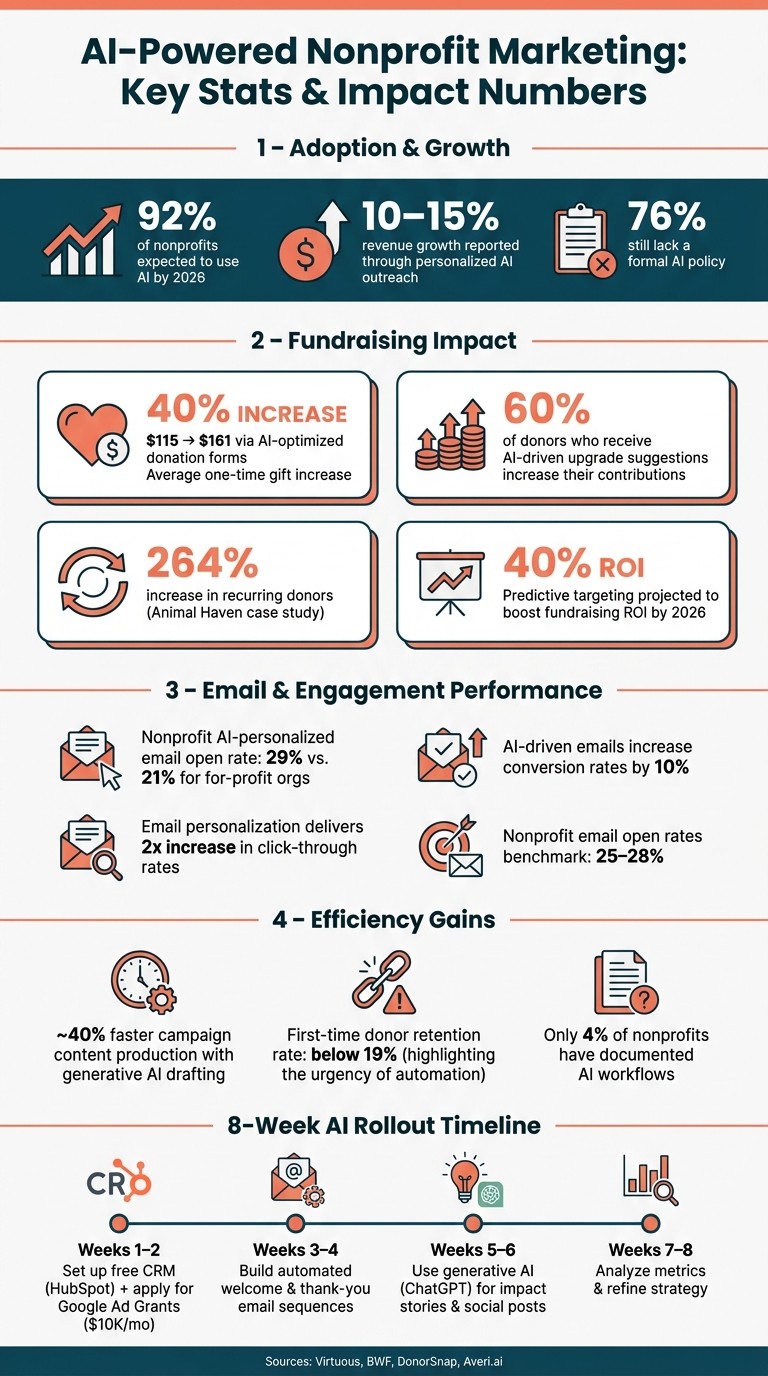
AI tools are transforming nonprofit marketing by automating repetitive tasks, improving donor engagement, and increasing fundraising efficiency. Nonprofits can use AI for personalized email campaigns, predictive donor behavior analysis, and automated workflows, enabling small teams to achieve more with limited resources. By 2026, 92% of nonprofits report using AI, with many seeing 10–15% revenue growth through personalized outreach and optimized donation forms.
Key Takeaways:
Personalization at Scale: AI-driven emails increase conversion rates by 10%, and optimized donation forms raise average gifts from $115 to $161.
Automation: Tools like Mailchimp and HubSpot streamline donor journeys, saving time and reducing manual effort.
Predictive Analytics: AI identifies at-risk donors, suggests ideal ask amounts, and forecasts giving trends for better campaign results.
Affordable Tools: Nonprofits can start with free or discounted platforms like HubSpot, Canva, and Google Ad Grants ($10,000/month in ad credits).
Start small: Clean your data, define clear goals, and integrate tools into your existing systems. Assign an "AI champion" to oversee adoption, ensuring AI enhances - not replaces - the human connection central to nonprofit missions.
AI-Powered Nonprofit Marketing: Key Stats & Impact Numbers
Nonprofits Are Finally Automating Everything
Preparing Your Nonprofit for AI Integration
Before diving into AI, it's crucial to set a solid foundation. Many nonprofits stumble by layering AI tools over disorganized data or undefined objectives, leading to underwhelming results. Start by clarifying your goals and ensuring your data is in good shape to avoid these common pitfalls.
Define Your Fundraising and Outreach Goals
Focus on one clear goal to guide your AI efforts. Examples could include reducing donor churn by 10%, boosting recurring donations, or cutting the time spent drafting appeals. A well-defined target helps you select the right AI tool - rather than trying to fit your goals into a tool's capabilities.
Turn broad objectives into measurable KPIs. For instance, "improve donor relationships" is too vague. Instead, aim for something like "save 5 hours weekly on social media tasks" or "increase email click-through rates by 15%." Here's how common nonprofit goals align with specific AI applications:
Goal | AI Application | Expected Outcome |
|---|---|---|
Fundraising | Predictive prospecting | Higher ROI on major gift outreach |
Engagement | Email personalization | 2x increase in click-through rates |
Retention | Churn propensity modeling | Increased donor lifetime value |
Operations | Task automation | Reduced staff burnout and administrative drag |
Content | Generative drafting | ~40% faster campaign production |
Organize and Clean Your Supporter Data
AI's effectiveness depends on the quality of your data. As Nathan Chappell, Chief AI Officer at Virtuous, aptly states:
"If you have a broken fundraising practice and you put AI on top of it, you will have a broken AI fundraising practice." [8]
Start by reviewing your donor and volunteer records. Standardize fields like giving history, contact information, and interests while consolidating data into a single CRM (e.g., HubSpot or Bloomerang). This ensures a reliable "single source of truth" for AI to analyze and learn from.
Data privacy is critical. Avoid inputting sensitive information, such as donor PII, board minutes, or financial records, into free or public AI platforms. Instead, opt for closed systems that don’t use your data to train public models. With only 4% of nonprofits having documented AI workflows [1], implementing clear data privacy protocols now gives you a significant edge.
Set Up Key Integrations
For seamless operations, integrate your CRM with other systems to automate data flow. Avoid manual exports by connecting tools like your website, email platform, and CRM. For instance, Zapier can link form submissions on your website to HubSpot, which can then trigger a welcome email in Mailchimp - saving your team valuable time.
Even for small nonprofits on tight budgets, a basic tech stack is affordable. Consider starting with HubSpot Free CRM, Mailchimp Free (up to 500 contacts, with a 15% nonprofit discount on paid plans), and Canva for Nonprofits (free premium access for eligible organizations) [6]. These tools integrate easily with AI marketing platforms, providing a solid infrastructure to build on before scaling up to more advanced automation.
Using AI for Personalization and Engagement
Leveraging AI alongside your existing data and integrations can transform how you connect with donors. Personalization powered by AI delivers immediate benefits: 60% of donors who receive AI-driven upgrade suggestions increase their contributions [1]. This approach not only boosts engagement but also allows you to scale personalization without needing additional staff. The next step? Segmenting your audience for more tailored outreach.
Segment Your Audience for Better Targeting
Personalization works best when you organize your supporters into meaningful segments based on behavior - such as giving frequency, recency, event attendance, or email engagement. Tools like HubSpot, Bloomerang, or Salsa Labs can help you go beyond basic demographics to uncover deeper insights.
A simple way to start is by creating four core donor segments, each with a specific communication focus:
Donor Segment | Messaging Focus | Goal |
|---|---|---|
First-Time Donors | Welcome messages; explain gift impact | Encourage a second gift within 90 days |
Monthly Donors | Appreciation and stories of deep impact | Build retention and a sense of community |
Major Donors | Leadership recognition; specific outcomes | Foster stewardship and future major gifts |
Lapsed Donors | "We’ve missed you" updates; progress stories | Re-engage and renew their support |
Once these segments are set up in your CRM, AI can analyze them to uncover actionable insights - like identifying which donors are most likely to increase their giving this quarter. With clearly defined groups, you can then create targeted, AI-assisted content.
Build AI-Assisted Content Templates
After defining your audience segments, the next step is to develop reusable content templates tailored to each group. AI tools like Averi can simplify this process. By loading your organization's brand voice and mission into the system, you can generate customized drafts for emails, social posts, and landing pages without starting from scratch.
AI serves as an excellent starting point, but your personal touch is key.
"AI is your first draft editor, not your replacement. Always add your personal touch, specific stories from your organization, and mission-specific details that only you know." - DonorSnap [4]
A practical approach is to craft one compelling impact story each month and use AI to adapt it into 4–5 formats: a donor email, an Instagram caption, a LinkedIn post, and even a talking point for your board. For example, Animal Haven used AI to identify donors likely to switch to monthly giving and personalized their outreach, resulting in a 264% increase in recurring donors [1].
Scale Personalization Across Campaigns
To manage AI-generated content at scale, adopt a structured framework like the 4D Framework - Delegation, Description, Discernment, and Diligence [1]. This system ensures consistency and accountability in your AI-driven communication strategy.
"The organizations achieving the best results from AI have established a single source of truth: one accountable expert who owns the strategy... Not a committee. Not an algorithm. One person." - Drew Hendricks, Founder & CEO, Nimbletoad [1]
This approach also aligns with donor expectations, as 92% of supporters believe nonprofits should disclose how AI is used in their communications [1]. By combining well-defined templates, audience segments, and a clear review process, nonprofits can efficiently produce personalized content for multiple donor groups each week.
Automating Donor Journeys and Campaign Workflows
Once you’ve set up audience segments and created content templates, the next step is to link them into automated workflows. This allows you to maintain donor engagement without the need for constant manual effort. By pairing automation with personalized content, you can keep your supporters connected and invested in your mission.
Map Out Key Donor Journeys
Take a close look at your post-donation strategy, especially since first-time donor retention rates often hover below 19% [1]. The 90 days following a donation are crucial, making it the perfect window for a 3–4 email series. Start with a heartfelt thank-you, follow up with an impact update, and end with a soft ask for a second gift. Beyond this welcome series, consider other flows like:
Lapsed donor re-engagement: Triggered when someone hasn’t donated in over 12 months, this flow can help reignite their interest.
Monthly donor stewardship: Designed to show recurring donors the ongoing impact of their contributions, reinforcing their commitment.
AI tools can also play a role here by tracking behavioral indicators - such as lower email open rates or decreased site visits - to identify donors at risk of disengaging before it’s too late [11].
Build Automation in Marketing Platforms
Many nonprofits already have access to platforms that make automation straightforward. For example:
Mailchimp: Offers free plans for up to 500 contacts, a 15% nonprofit discount on paid plans, and over 100 pre-built automation templates, including send-time optimization.
HubSpot: Its free CRM tier includes email sequences and basic lead scoring, while its Starter plan (after nonprofit discounts) starts at $18/month.
Salesforce Nonprofit Cloud: Uses AI to generate engagement summaries and even suggests personalized thank-you notes.
Zapier: Connects tools like donation forms, CRMs, and email platforms. For instance, when a donation is made, Zapier can automatically send a thank-you email, update the donor’s contact record, and enroll them in a nurture sequence - all hands-free. A 15% nonprofit discount is also available on one plan.
These tools ensure your content reaches the right donors at the right time, without adding extra work for your team.
Align Content with Automated Campaigns
Automation can sometimes feel impersonal, but tools like Averi help maintain a consistent and engaging tone. After setting up your donor journeys, Averi ensures all communications - from emails to social posts - reflect your organization’s voice and mission. As Averi explains:
"AI doesn't replace your voice, it amplifies it." - Averi.ai [10]
For example, one impact story can be transformed into a donor email, a social media post, and an update - all carrying the same tone and message. This ensures that even as you scale your outreach, your donors still feel a personal connection to your mission.
Using Predictive Analytics to Improve Nonprofit Marketing
With automated donor journeys in place, predictive analytics can help nonprofits anticipate donor behavior and adjust their strategies with greater precision.
Track the Right Campaign Metrics
Pay attention to metrics that matter most: fundraising signals, email performance, and retention indicators. Fundraising signals include RFM scores - Recency, Frequency, and Monetary value. Email performance metrics cover open rates, click-through rates, and bounce rates. Retention indicators, on the other hand, focus on first-to-second gift conversion rates and the length of donor lapses. For context, nonprofit email open rates generally range between 25% and 28% [1]. Falling below this range could signal the need for adjustments.
Here’s a quick guide on what to monitor at each funnel stage:
Funnel Stage | Key Metrics to Watch |
|---|---|
Awareness | Social impressions, blog traffic, new email subscribers |
Consideration | Time on page, landing page CTR, form completions |
Conversion | Total donations, campaign ROI, event registrations |
Retention | Recurring donation volume, email open rates, unsubscribe rates |
Apply Predictive Insights to Outreach
Predictive AI dives into your donor data to uncover patterns that might otherwise go unnoticed. It can pinpoint which donors are likely to upgrade their contributions, identify lapsed donors worth re-engaging, and determine the ideal ask amount for specific groups [12]. This eliminates much of the uncertainty in fundraising efforts.
"AI tools eliminate the guesswork from fundraising, enabling nonprofits to concentrate more energy on their top prospects." - BWF [12]
Focus on four key predictive models: major giving, planned giving, donor reacquisition, and renewals [12]. This is especially critical given that roughly 80% of individual donation revenue typically comes from the top 20% of donors [5]. Using data in this way ensures campaigns are continuously optimized for better results.
Refine Campaigns Based on Data
For predictive analytics to work effectively, nonprofits need to regularly review their performance, apply AI-driven insights, and refine their campaigns. Predictive targeting could increase nonprofit fundraising ROI by as much as 40% by 2026 [6]. Additionally, nonprofits leveraging AI for personalized outreach have already reported revenue growth of 10–15% [1].
One actionable strategy is to use A/B testing for subject lines and messaging, tailoring variations for different donor segments with AI-generated suggestions. Pairing this with send-time optimization tools, such as those offered by Mailchimp or HubSpot, creates a feedback loop that improves outreach efforts over time - no data analyst required.
Choosing the Right AI Tools for Your Nonprofit
With predictive analytics enhancing your campaigns, the next step is making sure you have the right tools to act on those insights. The challenge isn’t finding AI tools - they’re everywhere - but identifying ones that fit your team’s capacity, work with your systems, and stay within your budget.
Understand the Main Tool Categories
AI tools come in different shapes and sizes, and they’re designed for specific tasks. For example, content platforms like Averi and Canva AI focus on speeding up production. These tools can take a single strategy brief and turn it into emails, social posts, and blog content without needing to expand your team [1][2]. Meanwhile, email and marketing automation platforms such as Mailchimp and HubSpot are great for managing donor journeys, automating welcome sequences, and optimizing email timing [6][10].
If your nonprofit relies on CRM systems, options like Salesforce Nonprofit Cloud, Bloomerang, and DonorSearch AI add predictive capabilities to help forecast donor behavior, clean up data, and track lifecycle metrics [3][6]. Then there are specialized tools like Grantable for grant writing and Funraise for donation form optimization - perfect for tackling high-impact tasks [6].
While content platforms streamline production, CRM-integrated AI tools focus on smarter targeting. Most nonprofits benefit from using a mix of both, as they address different parts of the workflow.
Compare Costs and Features
Before jumping into new subscriptions, check whether tools you already use - like Microsoft 365, Zoom, or your donation platform - offer built-in AI features that meet your needs [13]. For those that don’t, many AI tools offer discounts for nonprofits, which can make a big difference to your budget.
Tool | Nonprofit Pricing | Free Tier |
|---|---|---|
Google Ad Grants | $10,000/mo in ad credits [6] | Yes (eligible orgs) |
HubSpot | From $18/mo with discount [6] | Yes (free CRM) |
Mailchimp | 15% off paid plans [6] | Yes (up to 500 contacts) |
50% off all plans [6] | Yes (3 social channels) | |
ChatGPT Plus | $16/mo (20% discount) [6] | Yes (limited GPT-4o) |
Canva Pro | ~$13/mo nonprofit pricing [6] | Yes (basic AI features) |
Averi | $100/mo (Plus Plan) [9] | Free marketing plan on signup |
Platforms like TechSoup and Charity Digital are excellent resources for nonprofits, offering aggregated software discounts [10]. Don’t forget to also account for human review time when budgeting. AI tools often require staff to fact-check outputs and ensure they align with your organization’s voice, so this is an important part of the total cost [2].
With a clear understanding of costs and features, you’ll be better prepared to integrate AI into your workflows responsibly.
Adopt AI Responsibly
By 2026, 92% of nonprofits are expected to use AI in some form, yet 76% still lack a formal AI policy [1][2]. This is important because 92% of donors believe organizations should disclose their use of AI and ensure human oversight [13].
A helpful way to address this is through the 4D approach:
Delegation: Define which tasks AI should handle.
Description: Create clear, detailed prompts for AI use.
Discernment: Include a human review step.
Diligence: Assign one person to be accountable for the results [1].
"The organizations achieving the best results from AI have established a single source of truth: one accountable expert who owns the strategy... Not a committee. Not an algorithm. One person." - Drew Hendricks, Founder & CEO, Nimbletoad [1]
Using tools like Averi, which prioritize enterprise-grade data practices and comply with GDPR/CCPA standards, can help maintain donor trust. These tools also ensure that your data isn’t used to train models for other customers, reinforcing transparency and security. Strong data governance is a must for nonprofits aiming to build trust with their supporters.
Conclusion: Building a Smarter Marketing Engine for Your Nonprofit
Key Takeaways
Implementing AI can lead to noticeable improvements for nonprofits. For example, nonprofits using AI for personalized content experience email open rates of around 29%, compared to 21% for for-profit organizations [6]. AI-optimized donation forms have increased average one-time gifts by 40%, jumping from $115 to $161. Additionally, predictive targeting is expected to boost fundraising ROI by as much as 40% by 2026 [6]. The real power of AI lies in the combination of cleaner data, better segmentation, automated workflows, and well-coordinated content. Together, these elements provide a solid foundation for a phased and focused strategy.
Next Steps to Get Started
Consider an 8-week timeline to introduce AI into your nonprofit's marketing efforts:
Weeks 1–2: Set up a free CRM like HubSpot and apply for Google Ad Grants, which offer $10,000 per month in free search advertising for eligible 501(c)(3) organizations.
Weeks 3–4: Develop automated email sequences to welcome and thank new donors.
Weeks 5–6: Leverage generative AI tools like ChatGPT to draft compelling impact stories and schedule social media posts.
Weeks 7–8: Analyze metrics like email open rates, donation conversion rates, and time saved. Use these insights to fine-tune your approach.
Assign an internal "AI champion" - a team member responsible for overseeing AI adoption, assessing tool performance, and keeping everyone aligned. This role can significantly enhance the likelihood of a smooth and effective rollout.
Final Thoughts
AI is a tool meant to complement - not replace - the human connection, trust, and mission that are at the heart of every nonprofit. Each new tool or process should support your goals and allow your team to focus on what truly matters. With tangible benefits and a clear roadmap, your nonprofit can confidently embrace this next step.
"AI is not a substitute for human connection, empathy, and passion. It is a powerful tool that, when used in harmony with these attributes, can propel nonprofits to create greater impact with fewer resources." - Good360 [7]
Start small, track your progress, and refine your strategy as you go.
FAQs
What donor data is needed before using AI?
Before diving into AI-powered donor outreach, it's vital to collect the right data to ensure personalized and meaningful interactions. Here's what you should focus on:
Contact details: Names, emails, and phone numbers are the foundation for tailoring communication.
Donation records: Track amounts, dates, and giving frequency to uncover patterns and trends.
Demographic insights: Information like age and location helps with targeted segmentation.
Engagement activity: Metrics such as event participation and email open rates reveal levels of interest.
Affinity indicators: Look for involvement in volunteering or advocacy to strengthen connections.
With this data in hand, AI tools can better refine donor engagement strategies and enhance fundraising outcomes.
How do we use AI without losing the human touch?
To keep the human touch while using AI, treat it as a tool that supports rather than replaces creativity. AI can take care of repetitive tasks like drafting initial content or polishing messages, allowing your team to dedicate more time to crafting meaningful stories and building emotional connections. Always review and adjust AI-generated content to match your organization's tone and style, ensuring it feels authentic and fosters real human engagement.
How can a small nonprofit start AI on a tight budget?
Small nonprofits can tap into AI without breaking the bank by using free or discounted tools tailored for their needs. Platforms like HubSpot offer free CRM plans, while services such as Mailchimp and Sender provide affordable email marketing options, often with special discounts for nonprofits. Many AI tools also feature free starter plans, making it easier to automate tasks like donor management and email campaigns. By starting small and focusing on budget-friendly tools, nonprofits can gradually adopt AI to streamline operations while keeping costs in check.
Related Blog Posts

Zach Chmael
CMO, Averi
"We built Averi around the exact workflow we've used to scale our web traffic over 6000% in the last 6 months."
Your content should be working harder.
Averi's content engine builds Google entity authority, drives AI citations, and scales your visibility so you can get more customers.