The Best Way to Manage Content Creation With a Small Team

Averi Academy
Averi Team
8 minutes

In This Article
Use AI, clear briefs, and weekly workflows to scale content output without hiring more staff.
Updated:
Trusted by 1,000+ teams
Startups use Averi to build
content engines that rank.
Creating content with a small team can feel overwhelming, but with the right approach, you can publish more without burning out.
Here’s how small teams can maximize their output:
Set clear goals and know your audience: Focus on measurable targets like increasing organic traffic or ranking specific keywords. Use tools like Averi to define your ideal customer profile and align content with their needs.
Streamline content planning: Use an AI-powered content strategy to identify topics, research keywords, and create a dynamic content queue. This saves hours of manual work and ensures you always have relevant ideas ready.
Simplify approvals and workflows: Establish a weekly schedule with clear deadlines for briefs, drafts, and reviews. Avoid bottlenecks by sticking to this rhythm.
Leverage AI for drafts and research: AI tools can generate 80% of a polished draft in minutes, leaving your team to focus on refining and editing.
Automate publishing and track performance: Integrate tools with your CMS to publish faster and use analytics to improve future content.
Key takeaway: By combining AI tools with a structured process, even a small team can produce 16+ posts a month - driving 3.5x more traffic. Focus on strategy, efficient workflows, and automation to scale your content without adding headcount.
How I Built a Complete AI Content Team (And Cut 10+ Hours Weekly)
Step 1: Build a Content Strategy That Scales
A content strategy isn’t just a content calendar. It’s the blueprint for what you create, who you’re creating it for, and why it matters. Without a clear strategy, you’re just churning out content and hoping something resonates.
Define Your Goals and Target Audience
Start with one specific and measurable goal. For example, instead of saying, “grow our blog,” opt for something like, “attract 500 new organic visitors per month” or “rank 10 keywords in the top 50 within three months” [9]. Vague goals lead to scattered efforts, while precise ones drive focused action.
Next, connect your goal to your Ideal Customer Profile (ICP) - the audience you want to reach. What questions are they asking? What challenges are they facing? Tools like Averi can simplify this process by analyzing your website to understand your product, positioning, and tone. From there, it suggests ICPs and stores this information in what Averi calls a "Brand Core" - a centralized memory that ensures every piece of content aligns with your objectives. This approach is especially valuable for lean teams with limited time [8][2].
"Scaling bad strategy just gets you bad content faster." – Averi [2]
Use AI to Generate and Organize Content Topics
Once you’ve nailed down your audience, the next hurdle is deciding what to write. This is where AI content tools can save hours. Instead of manually digging through keyword tools, AI can identify competitor gaps, search trends, and high-intent keyword clusters in about 20 minutes - cutting research time by two-thirds [4].
The result? A Topic Bank: a dynamic list of content ideas organized by funnel stage (awareness, consideration, decision). Tools like Averi keep this bank updated by tracking competitor activity, market trends, and search opportunities. It then presents pre-vetted topics for approval, so you’re never stuck wondering what to create. Many teams find that dedicating just one hour per month to keyword research is enough to keep this queue full [2].
Once your topics are set, having a clear system to approve and move them forward is critical.
Set Up a Simple Content Approval Process
Even with a queue of great ideas, content can stall if approvals become a bottleneck. For small teams, delays in reviewing and approving content often slow down publishing schedules.
The solution is a batched weekly schedule with clear roles and deadlines. For instance:
Finalize briefs on Monday.
Send drafts for review by Wednesday.
Complete QA and schedule publishing by Thursday [6].
This structured rhythm eliminates daily decision-making and keeps the process moving. Pair it with three key quality checkpoints - Brief Review (before writing starts), Draft Review (to ensure alignment with the brief), and Pre-Publish Check (for technical accuracy) - and you’ll have a streamlined workflow that scales as your output grows [3].
"Quality at scale comes from three things: exceptional briefs, strong editing, and a culture where quality standards are explicit and non-negotiable." – Averi [3]
The brief itself is the cornerstone of this process. Every piece of content should begin with a clear target keyword, search intent, audience pain point, and a unique perspective. Skipping this step often leads to AI-generated drafts that require more editing than starting from scratch [8][4].
Step 2: Produce and Collaborate on Content Efficiently
Once your strategy and approval process are in place, the next hurdle is creating content that meets both your pace and quality standards. For smaller teams, this is often where things falter - starting from scratch takes time, coordination can be clunky, and maintaining consistent quality becomes a struggle.
Let AI Take Care of Research and First Drafts
The slowest part of content production is often the research, outlining, and structuring phase. AI can drastically cut this time, reducing research from an hour to just 20 minutes and turning a detailed brief into a 2,000-word draft in roughly three minutes. This approach can boost output by five to eight times compared to traditional methods [4][8].
Averi integrates your Brand Core - your voice, tone, and audience preferences - into every draft. This means the output isn’t just generic content; it’s 80% complete in 30 to 45 minutes [2]. The drafts are already tailored to your brand, complete with SEO-optimized structures, FAQ sections, and internal linking recommendations.
"The goal isn't to replace human judgment. It's to stop paying human labor rates for tasks that don't require human judgment." – Averi [2]
However, raw AI drafts shouldn’t be published as-is. While AI excels at structure and coverage, it lacks the ability to provide unique insights, verify facts, or avoid tone-deaf language. Instead of writing everything from scratch, your role shifts to strategically editing and refining - an approach that’s far more efficient [8]. With a polished draft in hand, your focus can go toward elevating it into a finished piece.
Refine Content as a Team
Even with AI-assisted drafts, effective collaboration is crucial. Without streamlined processes, feedback loops and version control can eat into the time savings you’ve gained. A three-step editorial process helps keep revisions efficient and focused:
Substantive pass: Add original insights, examples, or data that AI can’t provide.
Voice pass: Read aloud to catch and smooth out any robotic or awkward phrasing.
SEO/Technical pass: Ensure proper placement of keywords, meta descriptions, and internal links.
Averi’s collaborative editing canvas simplifies this process by enabling teammates to leave comments, tag others, and even ask Averi to rewrite or expand sections - all in real time. This eliminates much of the coordination bottlenecks that traditionally slow teams down, cutting editorial time from 3–4 hours to just 60–90 minutes per post [1][5].
AI Tools vs. Traditional Alternatives
Choosing the right tool for your team depends on how well it integrates into your workflow and its ability to maintain quality.
Integrated AI (e.g., Averi) | Point Tools (e.g., Jasper) | Freelance Marketplaces (e.g., Fiverr) | |
|---|---|---|---|
Best for | Full workflow automation | Standalone drafting tasks | Deep subject matter expertise |
Brand consistency | Maintains Brand Core across all content | Manual prompt setup needed each time | Varies by freelancer |
Time to first draft | 30–45 minutes [2] | 20–30 minutes | 2–5 days |
Team visibility | Centralized queue and editing canvas | Scattered across tools | Relies on email or external file sharing |
Cost per piece | ~$131 [5] | Low per use, but costs add up | ~$300–$600 per piece |
This comparison highlights the trade-offs that can directly affect a small team’s ability to maintain speed and consistency. The best choice depends on your team’s workflow and how often you need to publish. By aligning the right tools with your needs, you can ensure smoother production without sacrificing quality.
Step 3: Automate Publishing and Track Performance
Once your content is polished, automating the publishing process ensures it reaches your audience quickly and efficiently. The traditional manual steps - copying content into a CMS, formatting, and adding metadata - are time-consuming and can slow down your workflow.
Publish Directly to Your CMS
Manual publishing typically takes around 30 minutes per post, but Averi cuts that down to just two minutes by directly integrating with your CMS, whether it’s WordPress, Webflow, or Framer [5]. Beyond speed, Averi handles tasks like generating meta descriptions, suggesting internal links, and creating schema markup automatically.
"A content engine is a system that produces, publishes, and optimizes content with minimal ongoing founder involvement." – Zach Chmael, CMO, Averi [5]
Once a piece is published, it becomes part of Averi's content library. This allows the AI to refine future drafts, ensuring they align more closely with your brand's voice. With publishing simplified, the next focus shifts to performance tracking and optimization.
Use Performance Data to Improve Future Content
After publishing, automated performance insights provide the foundation for your next content cycle, starting with AI-assisted content ideation. By integrating directly with Google Search Console and Analytics, Averi delivers actionable data in just 15 minutes of weekly review time [5]. Key metrics like keyword rankings, impressions, and clicks are early indicators of success, offering valuable insights before conversion data becomes available.
Instead of overwhelming dashboards, Averi highlights what matters: which post is close to breaking onto page one, which keywords have low competition but high relevance, or which topics competitors have recently covered that you haven’t yet [5]. Maintaining a structured review schedule - weekly for quick updates, monthly for deeper ranking analysis, and quarterly for strategic audits - ensures you stay on top of performance without overloading your team [2][6].
Activity | Traditional Approach | AI Content Engine |
|---|---|---|
Publishing | 30 minutes | 2 minutes |
Analytics Review | 2–3 hours | 15 minutes |
SEO Optimization | 1–2 hours | Automated |
Total Weekly Time | 15–20+ hours | ~2 hours |
Teams that publish 16 or more posts per month see 3.5x more traffic compared to those publishing fewer than four [5]. With automation, even small teams of two or three can sustain this level of output, keeping the content machine running effortlessly.
Averi vs. Alternatives: Features, Workflow, and Cost
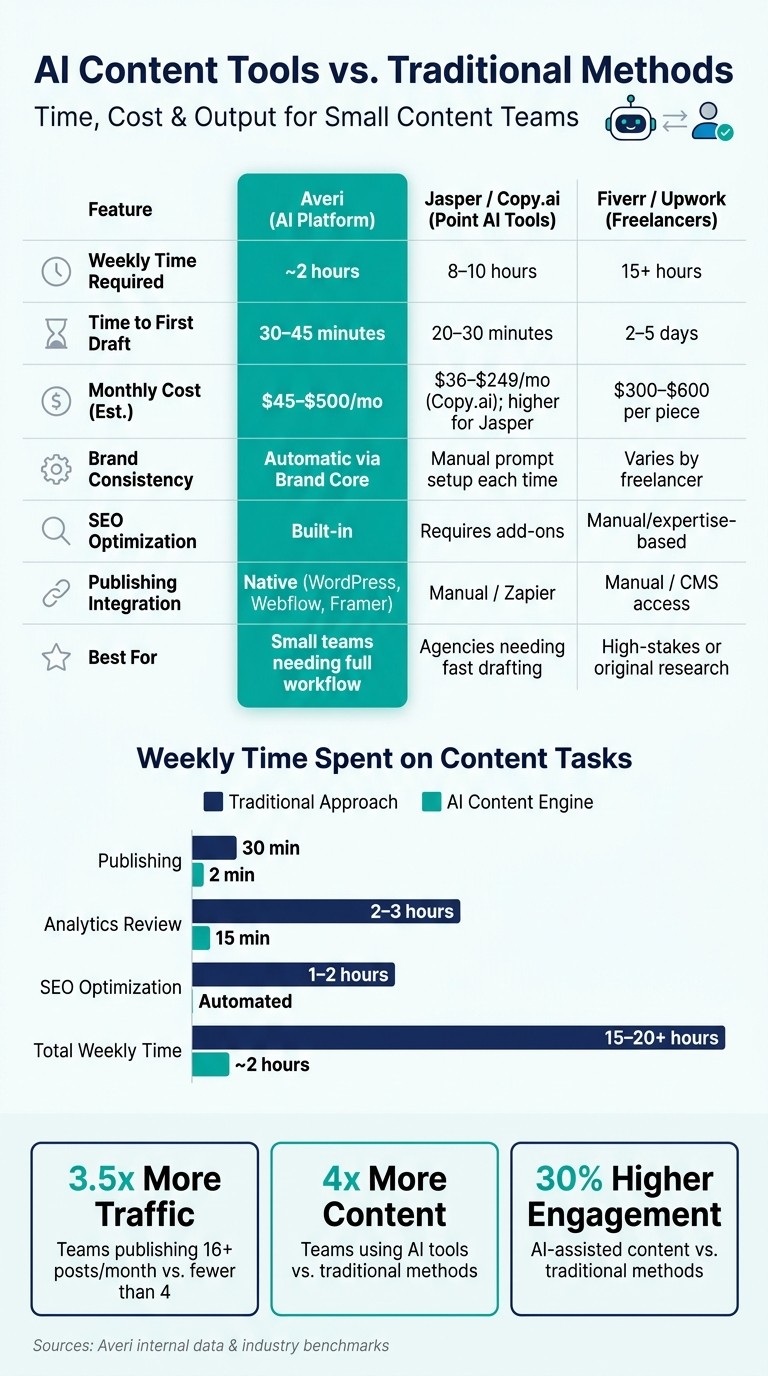
AI Content Tools vs. Traditional Methods: Time, Cost & Output Compared
When deciding between Averi's integrated AI-human workspace, platforms like Fiverr, Upwork, and MarketerHire for human-driven execution, or AI tools such as Jasper and Copy.ai for quick drafting, it's essential to understand how they compare. Averi stands out by combining strategy, drafting, SEO, and publishing into a single streamlined system. In contrast, the alternatives typically handle only specific parts of the content creation process. Here's a closer look at the features, pricing, and workflow of each option to help you determine the best fit for your team.
Comparison Table: Features, Pricing, and Fit
Feature | Averi | Jasper | Copy.ai | Fiverr/Upwork |
|---|---|---|---|---|
Primary Focus | End-to-end platform | Marketing drafting & brand voice | GTM & sales automation | Human execution & research |
Strategy Layer | Built-in strategy map & topic clusters | User-defined | User-defined | Human-led |
SEO/GEO Optimization | Built-in SEO + GEO | Requires Surfer SEO add-on | Basic keyword guidance | Manual/expertise-based |
Publishing | Native (WordPress, Webflow, Framer) | Manual / Zapier | Manual / Zapier | Manual / CMS access |
Weekly Time Required | ~2 hours | 8–10 hours | 8–10 hours | 15+ hours (coordination) |
Monthly Cost (Est.) | $45–$500/mo [5] | Higher; criticized for pricing [12] | $300–$600/piece [5] | |
Best For | Small teams needing strategy + execution | Agencies needing brand consistency | Sales teams & short-form copy | High-stakes or original research |
Jasper is particularly strong for maintaining a consistent brand voice in long-form content, earning a 4.8/5 rating on G2 from over 1,200 reviews [12]. However, it lacks built-in SEO tools and a publishing workflow. Copy.ai is a good choice for sales-heavy tasks like automated prospecting and short-form ad copy, with plans starting at $36/month [13][15]. Its free plan, though, is limited to 2,000 words per month [13]. On the other hand, Fiverr and Upwork shine for highly specialized projects requiring human expertise, such as original research or executive-level thought leadership [11].
Now, let's dive into how Averi specifically caters to small teams looking for efficiency.
Averi for Small Teams: Pros and Cons
Pros:
All-in-one workflow: Averi integrates research, drafting, SEO, and publishing into a single platform, reducing the need for multiple tools.
Cumulative brand knowledge: The "Brand Core" feature builds a strategic foundation around your ideal customer profile, positioning, and differentiators [14]. This ensures that each new draft benefits from prior work.
Higher output with fewer resources: A small team of three using Averi can produce 12–20 pieces per month, matching the output of a larger team of 6–8 people [8].
Cons:
Initial setup required: Configuring Averi's strategy takes about 45–60 minutes [8]. While it's a one-time task, it requires upfront effort.
Editorial review needed: Each piece still requires 20–30 minutes of human review to ensure accuracy and maintain the desired tone [8].
Limited CMS integrations: Currently, native publishing is only available for WordPress, Webflow, and Framer [5], which may not suit all teams.
When to Choose Averi vs. Other Options
Opt for Averi if your team is small and time-constrained but needs a repeatable, all-in-one content system. Averi, priced at $45–$500/month [5], offers a cost-effective alternative to traditional agencies that typically charge $60,000–$180,000/year [5]. If your goal is to scale from fewer than four posts per month to 16 or more without increasing headcount, Averi is designed for this exact scenario.
Consider freelancers (Fiverr/Upwork) when you need a partner who can work across various tools or handle projects requiring deep personal interviews or original reporting that AI can't replicate [14][11]. Be aware, however, that about 70% of freelance projects fail to meet their initial goals [5].
Choose Jasper or Copy.ai if you already have a content strategy and publishing workflow in place but need faster drafting capabilities.
"Jasper is the tool to choose if you need more SEO-led marketing content or comprehensive, in-depth materials... Copy.ai is ideal for Go-to-Market workflows and sales-focused content." – Machined Content Team [12]
Step 4: Grow Content Output Without Growing Your Team
Once you’ve streamlined your strategy, production, and publishing, the next step is figuring out how to increase content output without adding more people to your team. The key isn’t about working longer hours - it’s about working smarter. By letting AI handle repetitive tasks, your team can focus on strategy and delivering high-quality content.
Run Weekly Content Cycles
The best small teams approach content creation like a well-oiled machine, sticking to a consistent weekly process rather than treating it as an occasional creative sprint. This structured rhythm ensures steady output without overwhelming your team. With AI handling the heavy lifting, your team only needs to commit about 1.5 to 2 hours per week.
Day | Task | Time Required | Owner |
|---|---|---|---|
Monday | Queue Review & Approval | 15 minutes | Human |
Tue–Thu | Review & Refine Content | 45–60 minutes total | Human |
Friday | Analytics Check & Strategy Adjustment | 15–20 minutes | Human |
All week | Research, Drafting, SEO & Formatting | Automated | AI |
This predictable routine not only keeps your team on track but also allows for data-informed tweaks to the strategy.
Between July 2025 and January 2026, Averi’s team used this exact model to increase their web traffic by over 6,000%. AI handled the execution, while the team limited their involvement to just two hours per week. As Zach Chmael, Averi's CMO, explained:
"We built Averi around the exact workflow we've used to scale our web traffic over 6,000% in the last 6 months." [5]
Track the Right Metrics and Adjust
Once you’ve established a structured workflow, the next priority is to focus on metrics that matter. Instead of trying to monitor every possible data point, zero in on a few key indicators. Start with leading metrics like keyword rankings, organic traffic growth, and email subscriber numbers. These early signs of progress provide momentum even before revenue attribution becomes clear [6]. Later, incorporate lagging metrics like conversion rates and sales-qualified leads to measure the content’s impact on the bottom line [10][11].
Tracking analytics isn’t just about reporting - it’s a chance to refine your strategy. For instance, if a piece is stuck at position 8 in search rankings, it might be time for an update. Or, if a topic is drawing clicks but has low time-on-page, the content angle could need reworking. These insights feed directly into your weekly cycle, ensuring that your content remains both effective and efficient.
"Content is a 6–12 month channel. Agree on leading indicators (rankings, traffic growth, email subscribers) that you'll report monthly. These show progress before the pipeline attribution is measurable." – Averi [6]
Conclusion: Managing Content Creation With a Small Team
Handling content creation with a small team becomes more manageable when approached as a connected system rather than a collection of separate tasks. The four steps discussed - developing a scalable strategy, producing content effectively, automating publishing, and sticking to weekly cycles - work in harmony to increase both output and quality without the need for additional staff.
Teams leveraging AI tools for content marketing report publishing 4x more content per month and achieving 30% higher engagement rates compared to traditional methods [7]. Furthermore, 78% of small businesses identify limited team resources as their biggest obstacle to consistent content creation, yet automation resolves this challenge for 65% of users [16]. These statistics highlight the importance of an integrated approach, showing how the gap between small teams and larger ones is shrinking fast.
Averi provides an all-in-one solution that eliminates the inefficiency of juggling multiple tools, ensuring each content piece is better than the last [1]. With Averi, a single marketer can match the output of a 5-person team [6], dedicating just two hours a week while AI handles the heavy lifting. Over a year of consistent weekly cycles, this approach can yield 50+ high-quality content pieces. Along the way, keyword rankings improve, your content library grows, and AI recommendations become increasingly accurate with every iteration.
"The goal isn't to replace human judgment. It's to stop paying human labor rates for tasks that don't require human judgment." – Averi [2]
Choose one step from this guide, implement it for two weeks, and see what changes. Start now and watch the improvements take shape.
FAQs
How do I choose the right content goal for a small team?
To determine the best content goal for your team, start by evaluating your available resources and primary priorities. Aim for goals that are manageable and scalable, such as boosting content production or maintaining high standards with the help of AI tools. Take a close look at your current workflows to pinpoint areas where efficiency can improve, then set realistic objectives that match your team's capacity. For example, you might focus on increasing output without hiring additional staff. Always prioritize processes that improve both efficiency and quality while ensuring your team isn't overwhelmed.
What should a content brief include to avoid heavy rewrites?
A content brief works best when it provides clear and focused guidance, emphasizing a single core message while aligning with overarching goals. It should outline specific objectives, define the target audience, and include detailed instructions. By incorporating the purpose of the content, the desired tone, and key points, the brief ensures clarity and simplifies the creation process. This approach minimizes confusion, avoids misalignment, and significantly reduces the need for major revisions.
Which metrics should we track weekly to improve content faster?
To step up your content game, keep an eye on both qualitative and quantitative metrics every week. Focus on these key areas:
Content engagement: Measure views, clicks, and shares to understand how well your audience is connecting with your material.
Team processes: Evaluate communication and workflow efficiency to identify and address any bottlenecks.
Content quality: Ensure your work aligns with your brand's voice and meets established review standards.
Production progress: Track your adherence to the content calendar and monitor the volume of output.
By consistently reviewing these metrics, you can fine-tune your approach and consistently improve the impact of your content.
Related Blog Posts

Zach Chmael
CMO, Averi
"We built Averi around the exact workflow we've used to scale our web traffic over 6000% in the last 6 months."
Your content should be working harder.
Averi's content engine builds Google entity authority, drives AI citations, and scales your visibility so you can get more customers.