

In This Article
Self-improving weekly content engine using AI, data, and human editing to plan, publish, and optimize content continually.
Updated:
Trusted by 1,000+ teams
Startups use Averi to build
content engines that rank.
Most content efforts fail because they lack consistency and structure.
To create a system that works every week, you need a process that eliminates "starts and stops." Here's how you can build a system that evolves over time:
Consistency is key: Publish regularly to maintain momentum and drive traffic. Businesses posting 16+ times per month see 3.5x more traffic than those posting fewer than four.
Leverage AI: Use an AI content engine for research, first drafts, and optimization to save time and reduce costs. AI can cut article creation time from 8 hours to 2.5 hours and costs from $611 per post to $131.
Focus on performance: Track metrics like keyword rankings, impressions, and engagement weekly. Use insights to refine topics and improve existing content.
Streamline workflows:Automate repetitive tasks like keyword tracking, internal linking, and publishing to free up time for strategy and creativity.
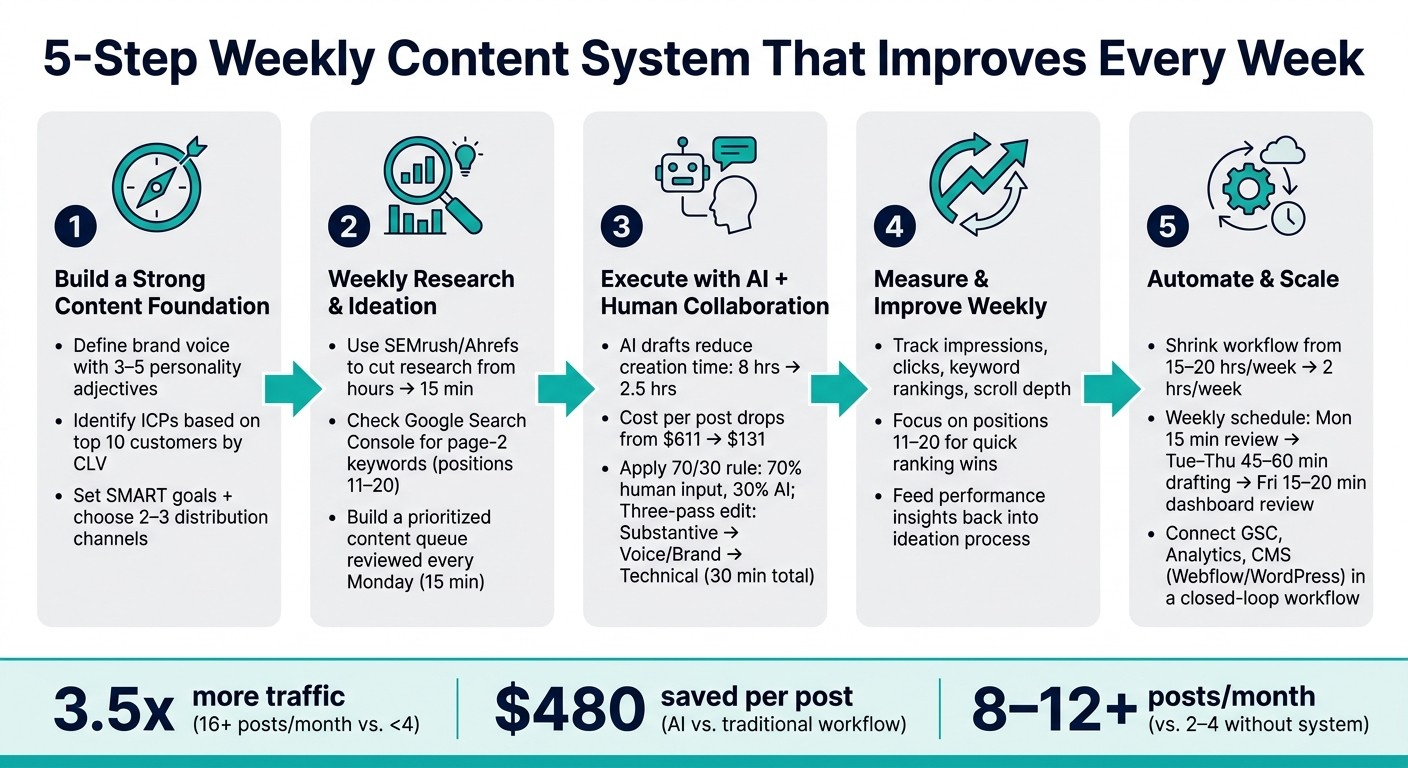
5-Step Weekly Content System: From Foundation to Scale
Claude Code + Paperclip AI Content System (Full Build)
Step 1: Build a Strong Content Foundation
Creating a solid content foundation ensures every piece you produce is purposeful, consistent, and measurable.
Audit Your Brand Voice and Positioning
Start by reviewing your top-performing content to check for consistency in how your brand is represented. Many teams find their content varies wildly - some pieces sound formal and rigid, while others are light and conversational. This inconsistency often stems from not having a clear, standardized brand voice from the beginning.
Define your voice by selecting 3–5 adjectives that encapsulate your brand's personality (e.g., "sharp, practical, no-fluff"). Additionally, create a list of phrases or tones to avoid. This clarity ensures your content remains uniform, whether it's created by a writer or generated by AI. Interestingly, only 20% of marketers using AI tools report strong outcomes, primarily because these tools struggle to maintain brand context without proper guidelines [3]. A concise one-to-two-page document outlining tone, style, and example phrases can bridge this gap effectively.
Tools like Averi AI can analyze your website to identify your product positioning and tone, while platforms like Jasper require manual input. Regardless of the method, the objective remains the same: make your brand voice explicit so it can be consistently applied across all content.
With a clear voice in place, you can now focus on tailoring content to your audience.
Define Your ICPs and Content Themes
Once your brand voice is documented, shift your focus to defining your Ideal Customer Profiles (ICPs). These profiles go beyond job titles - they should capture details like company size, commonly used tools, key challenges, and what success looks like for your target audience.
A practical way to start is by analyzing your top 10 customers based on Customer Lifetime Value (CLV) to identify shared characteristics. From there, narrow down 3–4 content themes that address their biggest pain points while aligning with your business goals. For instance, a B2B SaaS company targeting operations managers at mid-sized companies might choose themes like workflow automation, team efficiency, and software integration. These themes act as a framework for generating content ideas moving forward.
"I advise a lot of companies, and almost unanimously their ideal customer profile is far too broad." - Belal Batrawy, Founder, learntosell.io [4]
Specificity is key here. A broad ICP often results in content that fails to connect with anyone. Narrowing your focus ensures your content resonates with the audience most likely to engage and convert.
With clear ICPs and themes, the next step is setting measurable objectives and selecting the right channels for distribution.
Set Measurable Goals and Pick Distribution Channels
Establish SMART goals - Specific, Measurable, Attainable, Relevant, and Time-bound [5] - to guide your content efforts. Categorize your distribution channels into Owned (e.g., website, email), Earned (e.g., media mentions, guest posts), and Paid (e.g., social ads, PPC). For example, you might aim to boost organic blog traffic by 25% in 90 days or gain 50 new email subscribers each month through your content.
Focus on the two or three platforms where your ICP is most active and allocate your resources accordingly. Efficient distribution is just as important as content creation, so plan your time and efforts wisely.
Building this foundation sets the stage for a consistent and adaptable content strategy, ensuring your efforts remain aligned with your goals.
Step 2: Build a Weekly Research and Ideation Process
After defining your brand voice, identifying your ICPs, and setting clear goals, the next step is ensuring your content pipeline stays full. The key? Streamlining your approach to avoid wasting time on topic selection.
Track Keywords, Trends, and Competitor Content
Streamlining data collection is crucial, and automation tools like SEMrush and Ahrefs make this process much easier. These platforms can handle keyword tracking, monitor competitors, and identify trends, reducing hours of manual research to just 15 minutes of reviewing the insights they provide.
A simple but effective habit is checking Google Search Console weekly for "page 2" keywords - those ranking in positions 11–20. These terms are close to breaking into higher visibility and can often be improved with a well-timed content update or a related new post. Additionally, automated alerts for competitor activity can help you identify content gaps and create counter-angle pieces that address areas they’ve overlooked.
"One hour of good keyword research or content planning returns more value than three hours of drafting topics nobody searches for." - Averi Team [6]
These insights lay the groundwork for AI-powered topic generation in the next phase.
Use AI to Generate and Prioritize Topic Ideas
Once your research tools are in motion, AI can transform the collected data into actionable content ideas. Platforms like Averi can organize trends, competitor gaps, and keyword opportunities into a structured list, complete with suggested titles, outlines, and keywords. This eliminates the dreaded blank-page syndrome and keeps your team focused.
To prioritize effectively, apply three filters: Is there genuine search demand? Can your brand realistically compete for that keyword? And does the topic align with a specific business objective, such as driving buyer interest rather than just traffic? This validation process ensures your content ideas are purposeful and balanced across the customer journey.
With this refined list, you’re ready to build a comprehensive content queue.
Build and Review a Prioritized Content Queue
A prioritized content queue can solve one of the biggest challenges in content marketing: deciding what to write when it’s time to create. By maintaining a pre-approved list of topics, your team can work more efficiently and avoid last-minute decision-making.
AI tools can populate this queue based on your ongoing research, but a quick weekly review - about 15 minutes every Monday - ensures that the topics align with current business priorities. Each approved topic should include a detailed brief outlining target keywords, internal linking opportunities, and a proposed structure before moving into drafting.
This system has proven to save teams significant time. For example, teams using this model have reduced weekly content management efforts from 15–20 hours to just 2 hours, while increasing monthly output from 2–4 posts to 8–12 or more [1].
Step 3: Execute Content with AI and Human Collaboration
Once your content queue is full and briefs are approved, the next step is transforming those ideas into polished, ready-to-publish pieces - quickly. Here's the good news: you don't have to sacrifice quality for speed. With the right balance of AI and human input, you can have both.
Use AI for Research and First Drafts
AI shines in tasks that typically eat up the most time during content creation: research, outlining, and tackling the dreaded blank page. By feeding AI tools your brand's positioning, tone, keywords, and examples of great content, you can generate a structured, SEO-ready first draft in no time. Platforms like Averi even go a step further, crafting drafts with FAQ sections and entity definitions tailored for AI-driven search engines like ChatGPT and Perplexity.
This approach slashes article creation time from 8 hours to just 2.5 hours [7]. The financial upside is just as compelling, with costs dropping from $611 per piece to approximately $131 when AI is involved [1].
"AI isn't here to replace writers. It's here to eliminate everything that isn't writing." - Averi Team [7]
A good rule to follow is the 70/30 Rule: content that combines 70% human input with 30% AI assistance delivers 89% of the engagement seen in fully human-created content. By contrast, when AI contributes more than 50%, engagement dips and bounce rates climb [7].
Edit and Review Content as a Team
AI-generated drafts are a starting point, not a finished product. The real magic happens during the editing phase, where your team brings in original ideas, refined judgment, and your brand's unique voice. In fact, 86% of marketers edit AI-generated content before publishing to ensure it meets their standards [8].
A streamlined editing process might include a three-pass edit:
Substantive pass: Ensure the content addresses the reader's core questions.
Voice and brand pass: Add personality and refine the tone to align with your brand.
Technical pass: Optimize for LLM-driven SEO and ensure proper internal linking [2].
Tools like Averi's collaborative editing canvas make this process even smoother. Team members can highlight specific sections and instruct the AI to rewrite, expand, or adjust tone in real time. This keeps the workflow efficient, with the entire editing process taking no more than 30 minutes per piece: 5 minutes for structural review, 15 minutes for refining insights and tone, and 10 minutes for final polish [1]. Once complete, the content is ready to move into publishing.
Prepare Content for Publishing
Before hitting "publish", a few final steps are essential: adding metadata, verifying internal links, and uploading to your CMS. Modern AI tools can handle much of this automatically, generating meta descriptions, suggesting internal links, and even creating schema-friendly FAQ sections [1]. Platforms like Averi simplify things further by publishing directly to systems like Webflow, Framer, and WordPress, cutting out the copy-paste step entirely.
Each published piece also strengthens your content library. Over time, as your AI tool processes more of your brand's content, its drafts will align more closely with your voice, reducing the need for heavy edits in the future [7][1].
Phase | AI Handles | Human Handles |
|---|---|---|
Drafting | Research, SEO structure, first draft | Creative direction, unique POV |
Editing | Grammar, plagiarism checks, brand voice scan | Fact-checking, tone refinement |
Optimization & Linking | Internal links, meta tags, FAQs | Final expertise validation |
Publishing | CMS upload | Performance analysis |
Step 4: Measure and Improve Weekly Performance
Once your content is live, the real work begins: evaluating its performance and refining your strategy. Publishing is just the starting point; understanding how your content performs and applying those insights is what drives growth. Too often, content systems fail because they produce without learning from the data.
Track Key Metrics and Identify Trends
To truly understand your content's impact, focus on two key areas: upstream inputs (how well AI crawlers are finding and indexing your content) and downstream outcomes (how your content drives traffic and conversions). For early performance, monitor bot activity - such as how often AI crawlers like GPTBot index your pages - and track how frequently your content is cited by AI-powered tools like Perplexity.
When it comes to audience engagement, prioritize metrics like impressions, clicks, keyword rankings, and engagement depth (e.g., scroll depth and time spent on the page). Keep in mind that as AI-driven platforms deliver direct answers, you might see a dip in clicks and sessions, even if your content is performing well. In these cases, impressions and citation rates become better indicators of reach.
"You can't manage what you don't measure." - Hussain Chinoy, Technical Solutions Manager, Google Cloud [9]
Tools like Averi simplify this process by automating the tracking of key metrics, cutting down analytics time to just 15 minutes [1]. These insights provide the foundation for targeted improvements.
Use Data to Guide Action
Data isn’t just for observation - it’s your roadmap for improvement. Often, valuable opportunities lie in content that ranks between positions 11 and 20 in search results. These pieces have already proven relevant but may need a strategic update to break into the top 10. Averi can pinpoint these opportunities, suggesting specific updates like optimizing content ranked at #8 to push it to page 1 or identifying untapped, high-relevance keywords to incorporate.
This turns your weekly review into a proactive decision-making session. By acting on these recommendations, your content system becomes smarter and more effective with every iteration.
Record Insights and Refine Your Approach
Each week’s performance data tells a story - what resonates with your audience, which formats drive engagement, and which topics spark interest. If a particular content type consistently performs well or a topic cluster generates demo requests or sales mentions, it’s a clear signal to double down on similar content.
Keep your strategy flexible, updating content themes, target keywords, and customer profiles based on these insights. Feed these learnings back into your ideation and content planning process to sharpen future efforts. Averi’s Library feature ensures that every published piece enhances the AI’s understanding of your brand, improving the quality of future drafts.
As Zach Chmael, Head of Marketing at Averi, explains:
"We built Averi around the exact workflow we've used to scale our web traffic over 6000% in the last 6 months." [1]
This cycle - where lessons from each week fuel smarter decisions for the next - is what separates static content systems from those that continually evolve and improve.
Step 5: Automate and Scale Your Content System
Now that performance metrics are steering your strategy, it’s time to cut out the manual work that bogs down your process. Automation isn’t about sidelining human judgment - it’s about freeing up your team to focus on decisions rather than repetitive tasks.
Use AI Tools to Streamline Content Execution
In content production, the real time sink isn’t the writing itself - it’s everything else: research, formatting, SEO, internal linking, and publishing. Tools like Averi can handle these tasks, shrinking a 15–20+ hour workflow to just 2 hours per week, leaving you with only the review and approval steps [1].
Link Analytics and Publishing Platforms
Scaling your content system requires seamless data flow between your tools. By connecting platforms like Google Search Console and Google Analytics to your content engine, you create a closed-loop workflow where performance data automatically informs future topics. High-performing themes are flagged for follow-up content opportunities [1].
On the publishing side, direct integrations with CMS platforms - such as Averi’s connections to Webflow, Framer, and WordPress - remove the need for manual copy-pasting and reformatting. Meta titles, internal links, and styling are carried over automatically. Integrating with communication tools like Slack ensures draft approvals and topic reviews happen promptly, while Zapier can fill any gaps between systems.
This interconnected setup establishes a smooth, repeatable process that keeps your content system running like clockwork.
Establish a Weekly Workflow for Steady Output
Automation works best when it follows a predictable schedule. A weekly routine ensures consistent output without constant micromanagement:
Monday: Spend 15 minutes reviewing AI-generated topic suggestions.
Tuesday–Thursday: Dedicate 45–60 minutes refining AI drafts.
Friday: Use 15–20 minutes to review dashboards and approve optimizations for the next week.
With research, drafting, SEO, publishing, and analytics handled by automation, your team can maintain a high output without feeling overwhelmed.
"A solo marketer using AI well can outproduce a five-person team that doesn't." - Averi
As your content library expands, AI tools become even more effective at understanding your brand’s context, producing drafts that are faster and more accurate [1]. These automated processes not only improve efficiency but also strengthen the feedback loop that sharpens your overall strategy.
Conclusion: Build a Self-Improving Content Engine
Every part of your content system should work together to create a dynamic, self-improving engine. Publishing one-off posts is just a task, but a AI-powered content strategy - where each piece of content informs the next, performance data refines the strategy, and AI takes care of execution - becomes a true engine of growth.
The numbers speak volumes. When AI workflows are set up effectively, the average cost per blog post can drop from $611 to $131, saving $480 per post [1]. Over time, these savings stack up, creating even greater efficiencies as the system matures. This continuous feedback loop forms the backbone of a strategy that evolves and improves over time.
The key isn’t in relying on a single tool but in building a system with a strong feedback mechanism. As your content library grows, AI gains more context to refine its output. Search rankings improve, highlighting areas to focus on. Recommendations become more precise because they’re based on real performance data rather than assumptions. Week by week, the system becomes smarter and more effective.
The goal is to establish a system that publishes regularly, learns from its results, and gets better without adding to your workload. That’s the kind of content engine that delivers lasting results.
FAQs
How many posts per week should I publish to stay consistent?
When it comes to deciding how many posts to publish each week, there’s no one-size-fits-all answer. However, maintaining consistency is key, and many find that 1-3 posts per week strikes a good balance between manageable effort and effective output. To stay on track without overloading your schedule, consider leveraging AI tools or automated workflows. These can simplify content creation and help you maintain a steady rhythm without requiring excessive time.
What should humans do vs. AI in the workflow?
Humans excel at shaping strategy, defining brand voice, making creative judgments, and interpreting insights from data and audience feedback. On the other hand, AI takes on repetitive, data-intensive tasks such as generating ideas, drafting content, conducting research, applying SEO tags, and managing automation. This partnership allows AI to streamline production processes while leaving the strategic and creative reins firmly in human hands, striking a balance between speed and quality.
Which weekly metrics matter most for improving content?
To improve your content, keep an eye on key weekly metrics. Start with engagement metrics such as page views, unique visitors, and time spent on the page. These numbers help you understand what’s catching your audience’s attention.
Next, focus on conversion metrics like lead generation and sign-ups. These show how well your content drives action.
Don’t overlook social media activity either. Metrics like shares, likes, comments, and click-through rates provide valuable feedback about how your audience interacts with your content. Together, these insights help refine your strategy and boost performance over time.
Related Blog Posts

Zach Chmael
CMO, Averi
"We built Averi around the exact workflow we've used to scale our web traffic over 6000% in the last 6 months."
Your content should be working harder.
Averi's content engine builds Google entity authority, drives AI citations, and scales your visibility so you can get more customers.