Why Most AI Content Tools Don’t Rank (And How to Fix It)

Averi Academy
Averi Team
8 minutes

In This Article
AI-only content rarely ranks—speed produces generic, shallow pieces; human oversight, brand voice, and analytics are the fix.
Updated:
Trusted by 1,000+ teams
Startups use Averi to build
content engines that rank.
Most AI content tools struggle to rank because they prioritize speed over quality. Here's why they fail and how to fix it:
Generic Content: AI often produces repetitive, shallow content that lacks originality and a distinct brand voice. This results in 61% fewer backlinks compared to human-written content.
Weak SEO: AI misses search intent, leading to poor rankings for 38% of AI-generated pieces. Issues like keyword cannibalization and missing schema further hurt performance.
Surface-Level Research: Only 4% of AI content includes original data, while Google favors deeper insights and unique perspectives.
No Feedback Loop: Most tools lack analytics integration, making it hard to improve content post-publication.
Solution: Combine AI with human oversight. Edit drafts to align with search intent, inject unique data, and maintain a consistent brand voice. Platforms like Averi outperform others by offering end-to-end workflows, from strategy to analytics, ensuring AI-assisted content ranks within 4% of human-written material.
Quick Comparison: Averi vs. Jasper
Feature | Averi | |
|---|---|---|
Workflow | Strategy → Draft → Publish → Track | Prompt → Draft |
SEO Focus | Entity authority, GEO, AI citations | Keyword-based content volume |
Brand Voice | Persistent (learns from your site) | Manual (re-entered per session) |
Analytics | Integrated (rankings, performance insights) | External/manual |
Ranking Potential | Within 4% of human-written content | ~23% lower than human-written content |
Pricing | $100/month | Varies by plan |
Best For | Startups, lean teams needing a full content system | Writers focused on fast drafting |
Averi excels at creating a complete content engine, while Jasper is better for quick, standalone drafts. To rank effectively, prioritize tools and workflows that combine AI speed with human expertise.
This is the #1 AI SEO ranking factor (for 2026)
The Core Problems with AI Content Tools
AI content tools often focus on speed rather than creating meaningful, impactful material. Recognizing these limitations is key to moving away from generic, low-performing content toward material that stands out and ranks effectively.
Generic Output and Lack of Brand Voice
AI models are built to recycle existing information instead of offering fresh perspectives. As Dogukan Emre Demirel, Founder of Wyrote, explains:
"If you can generate it in 90 seconds, so can your 200 competitors targeting the same keyword. The content itself becomes a commodity." [3]
This lack of originality has real consequences. AI-generated articles earn 61% fewer editorial backlinks than those written by humans [4]. Why? Because they lack the unique insights, proprietary data, and distinctive tone that encourage other sites to link back. Without a clear brand voice or a fresh angle, this content tends to fade into the digital noise.
These issues with originality also lead to significant SEO challenges.
Weak SEO and Misaligned Search Intent
AI tools are programmed to optimize for specific keywords, but they often miss the mark when it comes to understanding the true intent behind a search. For instance, someone searching for "best project management software" is likely looking for a detailed comparison table, not a historical breakdown of software development. This disconnect results in poor performance for 38% of AI-generated content in audits [2].
Furthermore, publishing a high volume of AI-generated articles can lead to keyword cannibalization. This happens when multiple shallow pieces target the same query, diluting ranking potential. Add to this the absence of schema markup, weak E-E-A-T signals, and poor keyword distribution, and the performance gap grows significantly - from 8% for low-competition keywords to 41% for high-competition commercial queries [4].
But the problems don’t stop with search intent - AI content often lacks depth as well.
Surface-Level Research and Thin Content
AI tools rely on publicly available data, which means they produce content that’s serviceable but rarely exceptional. Zach Chmael, CMO of Averi, captures this perfectly:
"AI makes it easy to generate 1,500-word articles that cover a topic adequately but not deeply... It's the content equivalent of a mid-tier hotel room - adequate yet forgettable." [1]
The numbers back this up: only 4% of AI-generated articles cite original research or proprietary data, compared to 38% of human-written content [4]. Google's "information gain" metric favors content that brings new insights to the table. Without this depth, AI-generated material struggles to compete, with its performance gap widening over time - from 14% at 3 months to 31% after 16 months [4].
This lack of innovation and depth leaves AI content trailing behind, a problem made worse by the absence of ongoing optimization.
No Feedback Loop or Analytics Integration
Most AI tools churn out drafts without offering analytics or tracking how the content performs after publication. Without this feedback loop, it’s nearly impossible to identify issues like keyword cannibalization or to understand why competitors are outranking you. This missing piece is what separates basic AI tools from a truly performance-driven content strategy.
How to Fix Ranking Problems in AI Content
The challenges with AI-generated content aren’t insurmountable. The solution lies in rethinking how AI is used in marketing execution - not as a standalone publishing tool, but as a drafting partner that benefits from human oversight at key stages.
Use Human-AI Collaborative Workflows
When humans collaborate with AI, the results speak for themselves. Data shows that AI content refined by human intervention achieves top 10 rankings 61% of the time, compared to just 14% for untouched AI drafts [5]. The difference comes from strategic input: defining the content angle, understanding the target audience, and aligning with search intent before the AI begins drafting. Afterward, a thoughtful review and rewrite ensure the output is tailored and impactful.
"The startups winning with AI content aren't publishing more - they're publishing smarter, with human oversight at the right stages." - Zach Chmael, CMO, Averi [1]
Revising at least 30% of an AI-generated draft can make a huge difference. It eliminates formulaic phrasing, enhances originality, and, in some cases, can boost blog-to-trial conversion rates from 0.8% to 2.6% [5]. Beyond editing, embedding your brand’s identity into every draft ensures consistency across all content.
Maintain Persistent Brand Context
One common problem with AI tools is their tendency to start fresh with every prompt, which often leads to generic results. The solution? Equip your AI with a memory. Tools like Averi solve this by scraping your website during setup to learn your brand’s voice, product details, and positioning. This built-in context ensures each draft aligns with your brand identity, saving time and eliminating the need for repetitive instructions.
Automate Deep Research and SEO Structure
To rank well in the future, content must provide real value - offering insights that go beyond the top 10 search results [2]. AI tools relying solely on public data often fall short in this regard. Pair AI’s speed with thorough competitor analysis, keyword prioritization, and SERP intent matching to create content that stands out. For example, high-competition keywords (difficulty 50+) may require 6–10 hours of editorial effort, while lower-difficulty terms (0–25) can be handled with lighter reviews [4]. Matching your effort to keyword opportunity ensures quality content without overextending resources.
Connect Publishing and Analytics for Ongoing Improvement
Publishing content isn’t the end of the process - it’s just the beginning. While many AI tools stop at draft creation, long-term success requires continuous refinement. Platforms like Averi close this gap by tracking metrics like impressions, clicks, and keyword rankings. They provide actionable insights, such as identifying content stuck around position 8 that could use optimization, spotting emerging competitor topics, or highlighting low-competition keywords with strong potential. This approach transforms content from a one-time effort into a dynamic, evolving strategy.
"The sites that scaled successfully with AI treat it as a first-draft engine. The sites that got wiped out treated it as a publishing pipeline." - Dogukan Emre Demirel, Founder, Wyrote [3]
Averi vs. Jasper: Which Tool Actually Helps You Rank?
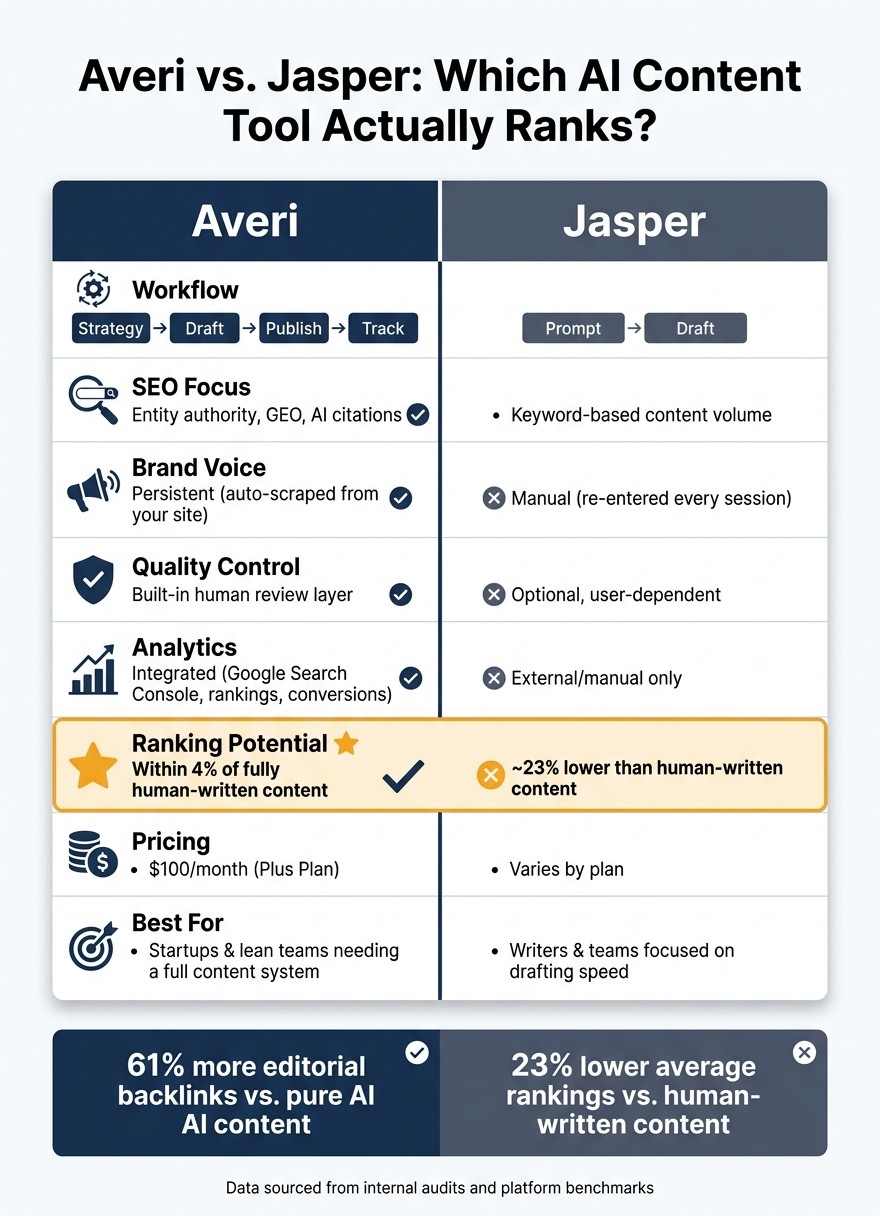
Averi vs. Jasper: AI Content Tool Comparison for SEO Rankings
Choosing the right AI tool to tackle content challenges is no small task. Averi and Jasper both leverage AI, but their approaches differ significantly. Averi operates as a comprehensive content execution hub, while Jasper focuses on rapid drafting. These distinctions are key when addressing the common pitfalls that can hold your content back from ranking effectively.
Averi vs. Jasper: A Quick Comparison
Feature | Averi | Jasper |
|---|---|---|
Primary Workflow | Strategy → Draft → Publish → Track | Prompt → Draft |
SEO Focus | Entity authority, GEO, AI citations | Keyword-based content volume |
Brand Voice | Persistent (scraped from your site, applied automatically) | Manual (re-entered per session) |
Quality Control | Built-in human review layer | Optional, user-dependent |
Analytics | Integrated (Google Search Console, rankings, conversions) | External/manual |
Ranking Potential | Within 4% of fully human-written content [4] | ~23% lower than human-written on average [4] |
Pricing | $100/mo (Plus Plan) | Varies by plan and seat count |
Best For | Startups and lean teams needing a full content system | Writers and teams focused on drafting speed |
How Each Platform's Workflow Operates
Jasper’s workflow is straightforward but requires a lot of input from the user. You provide keywords, context, and a brief, and Jasper generates a draft. While this can be helpful if you already have a solid content strategy, SEO framework, and editorial team, many teams lack these foundational elements. Without them, the content often falls short in terms of intent, depth, and brand alignment.
Averi, on the other hand, automates much of the heavy lifting. It pulls your brand’s established tone and applies it consistently to every draft. Beyond drafting, Averi builds a content strategy that actually ranks, prioritizes topics based on ranking opportunities, and structures content for both Google and AI-driven search tools like ChatGPT and Perplexity. Its workflow includes a built-in human review layer and integrates seamlessly with platforms like Webflow, Framer, and WordPress, handling everything from metadata to internal linking.
What a Week of Content Creation Looks Like
On Jasper, the process begins with your team deciding on a topic, researching keywords, and creating a brief. After prompting the AI, you’ll need to edit the output, optimize it for SEO using a third-party tool, and manually upload it to your CMS. This approach involves multiple steps and handoffs, which can lead to delays or quality issues.
With Averi, the experience is far more streamlined. The platform suggests pre-researched topics, complete with target keywords. Once you approve a topic, Averi drafts the content using your stored brand context. You can refine the draft collaboratively, and once finalized, it’s published directly to your CMS. By week’s end, Averi’s analytics highlight which pieces are performing well and suggest next steps, closing the feedback loop that many AI tools overlook.
Pros and Cons of Each Platform
Here’s a breakdown of what each tool does well - and where they fall short.
Averi | Jasper | |
|---|---|---|
✅ Pro 1 | Covers the full content lifecycle - strategy, drafting, publishing, and analytics | Quick and flexible drafting for teams that know exactly what they need |
✅ Pro 2 | Automatically applies a consistent brand voice to every draft | Offers a variety of templates for different use cases beyond SEO content |
✅ Pro 3 | Includes a feedback loop with actionable ranking insights | Easier onboarding for teams familiar with AI prompting |
❌ Con 1 | Limited flexibility for ad hoc content requests outside its workflow | Lacks integrated strategy, research, and publishing tools - requires external solutions |
❌ Con 2 | Geared toward startups and lean teams, less ideal for solo freelancers | Brand voice must be manually re-entered for each session |
❌ Con 3 | Currently supports only Webflow, Framer, and WordPress integrations | No built-in analytics or feedback loop for improving future content decisions |
The main trade-off here is clear: Jasper offers speed during the drafting phase, while Averi provides an end-to-end system designed to improve over time. Each piece of content created with Averi feeds into a smarter, more efficient process, with data-driven insights shaping future strategies. Up next, we’ll dive into how Averi builds a content engine that drives rankings consistently.
How to Set Up a Ranking Content Engine with Averi
Many teams approach content creation as a series of isolated tasks. Averi takes a different approach, offering a system where every piece of content builds on the last. This multi-phase process ensures a smooth flow from strategy to measurable improvement. Here's how you can set it up.
Phase 1: Build a Content Strategy
Start by providing your website URL. Averi will automatically extract essential details about your products, positioning, and brand voice in about 10 minutes. From there, it creates a Strategy Map - a roadmap of high-value keyword clusters and prioritized topics tailored to your target audience and competitive gaps.
One key step here is defining your Brand Core. This includes your preferred tone, vocabulary, and sentence structure. Unlike a one-time prompt, this information is stored and applied to every draft Averi generates. Before moving forward, a human review of the strategy is crucial to refine target markets, unique angles, and points of differentiation that AI alone can't determine [1].
Phase 2: Produce Content with AI and Human Input
Once your strategy is in place, it's time to create content. Averi combines AI and human collaboration to refine drafts into impactful pieces. After approving a topic from the queue, Averi generates a structured outline with H2 and H3 headings, backed by research and hyperlinked sources. It's important to review and adjust this outline before drafting begins.
The initial draft serves as a foundation - rewrite 30–50% of it to incorporate unique insights, proprietary data, or case studies that only your team can provide. This collaborative approach addresses ranking challenges: AI-assisted content that's heavily edited performs nearly as well as fully human-written content, ranking within 4% of median positions. By contrast, content created solely by AI ranks 23% lower on average [4].
Averi’s editing tools make teamwork seamless. You can leave comments, tag collaborators, and even ask Averi to rewrite specific sections directly within the platform. Before publishing, use Averi's SEO tools to check for keyword coverage, add 3–5 internal links, and apply schema markup.
Phase 3: Publish, Track, and Improve
The final phase focuses on publishing and tracking performance. Averi allows you to publish directly to platforms like WordPress, Webflow, or Framer, eliminating formatting headaches. Once live, each piece is saved to your Library, which Averi uses to suggest internal links for future posts and refine your Brand Core over time. This creates a feedback loop that strengthens your content engine.
Averi’s Analytics Dashboard tracks impressions, clicks, and keyword rankings, but its standout feature is its actionable insights. It identifies keywords ranking in positions 11–20 and suggests specific optimizations to push them to page 1. Each piece is evaluated through a Content Scoring System, which combines an SEO Score (55% weight) for technical and keyword checks and a GEO Score (45% weight) for credibility in AI-driven search tools like ChatGPT and Perplexity [6].
The Smart Content Queue uses this performance data to highlight the next high-value topics, ensuring continuous improvement.
"Averi doesn't just show you data. It tells you what to do about it... which pieces are at striking distance for page 1, which keywords are declining, and where new opportunities are emerging." - Averi AI v5 Release Notes [6]
Conclusion: How to Build Content That Actually Ranks
Content created solely by AI tends to rank 23% lower and garners 61% fewer editorial backlinks [4]. These numbers highlight the need for a smarter strategy. Interestingly, when humans step in to refine AI-generated drafts, the performance gap narrows significantly - AI-assisted content with substantial human editing performs within 4% of fully human-authored content [4]. That small margin can be the difference between landing on the first page of search results or fading into obscurity.
The key isn’t to discard AI but to use it as a drafting tool within a larger framework.
"The startups winning with AI content aren't publishing more - they're publishing smarter, with human oversight at the right stages." - Zach Chmael, CMO, Averi [1]
To succeed, your content must maintain a consistent brand voice, demonstrate strong E-E-A-T (Experience, Expertise, Authoritativeness, and Trustworthiness) signals through first-hand insights and expert attributions, and leverage performance data to refine your strategy. These are areas where AI falls short on its own - but with the right human-AI collaboration, you can bridge the gap. By refining AI drafts with human expertise, you can turn mediocre content into material that ranks.
This is where Averi steps in. Designed for startups and lean teams without dedicated content departments, Averi handles the heavy lifting - strategy, research, drafting, SEO optimization, publishing, and analytics. At just $100/month, with a 14-day free trial, Averi provides the infrastructure you need to produce content that consistently meets and exceeds ranking goals. It’s not just a tool; it’s a system that empowers you to create smarter, more impactful content.
FAQs
How can I tell if AI content matches search intent?
To ensure AI-generated content meets search intent, it’s important to address user queries head-on with originality and thoroughness. Prioritize E-E-A-T - expertise, experience, authoritativeness, and trustworthiness - to create content that resonates with both users and search engines. Avoid producing material that feels surface-level or overly generic.
Structure your content into clear, meaningful sections tailored to user needs. Additionally, involve human oversight to inject unique insights, relevant data, and editorial judgment. This approach not only enhances relevance but also adds value by aligning content with what users are genuinely searching for.
What should I change in an AI draft to make it original?
To create content that stands out and performs well in rankings, it's important to focus on delivering fresh perspectives and thorough analysis. Avoid falling into the trap of generic or repetitive writing. Instead, rely on human expertise to fine-tune the tone, sharpen ideas, and bring depth to the piece. Including original data, tailored industry examples, or exclusive research not only boosts the content's value but also aligns it with search quality standards, improving its visibility and ranking potential.
What metrics matter most after publishing AI content?
When assessing the performance of AI-generated content, it's important to monitor a few critical metrics. Start with search rankings, which reveal how well the content is performing in search results. Next, evaluate the backlink profile - a strong network of backlinks indicates credibility and authority. Finally, pay close attention to user engagement metrics, such as bounce rate and time spent on the page, as these highlight how effectively the content meets user expectations and search intent.
In addition to these, E-E-A-T signals - Experience, Expertise, Authority, and Trustworthiness - play a pivotal role in maintaining visibility and ranking consistency. Ensuring the content is original and adds genuine value is equally important. Without a solid backlink strategy, content may struggle to perform well and risks being deindexed over time.
Related Blog Posts

Zach Chmael
CMO, Averi
"We built Averi around the exact workflow we've used to scale our web traffic over 6000% in the last 6 months."
Your content should be working harder.
Averi's content engine builds Google entity authority, drives AI citations, and scales your visibility so you can get more customers.