The Best Content Marketing Workflow for Seed-Stage SaaS Startups

Averi Academy
Averi Team
8 minutes

In This Article
Lean, revenue-first content workflow for seed-stage SaaS: 2–4 monthly pieces, AI-assisted drafting, BOFU-first topics, owned-channel distribution, and ARR-linked tracking.
Updated:
Trusted by 1,000+ teams
Startups use Averi to build
content engines that rank.
Seed-stage SaaS startups often struggle to balance content marketing with limited time and resources. Here's a simple, effective workflow to help you stay visible and drive growth - without hiring a full-time marketer.
Why Content Marketing Works: It generates 3x more leads than outbound methods and costs 62% less.
The Challenge: 47% of founders handle marketing themselves, but most have less than 1 hour daily to dedicate to it.
The Solution: Build a lean content system that ties directly to revenue goals, aligns with a full-funnel marketing strategy, and uses AI to save time.
Key Takeaways:
Tie Content to Revenue: Work backward from your ARR target to calculate lead volume and focus on high-impact content.
Start Small: Publish 2–4 pieces monthly, prioritizing bottom-of-funnel topics like pricing guides and product comparisons.
Leverage AI + Human Effort: Use AI for research, drafting, and SEO tasks while humans refine tone and strategy.
Distribute Smartly: Focus on owned channels like blogs, LinkedIn, and email, then use AI content repurposing techniques to turn one asset into multiple formats.
Measure and Improve: Track metrics like lead quality and trial signups, and refine content based on performance data.
This system-first approach ensures consistent visibility while letting you focus on product and customers. Let’s dive into the details.
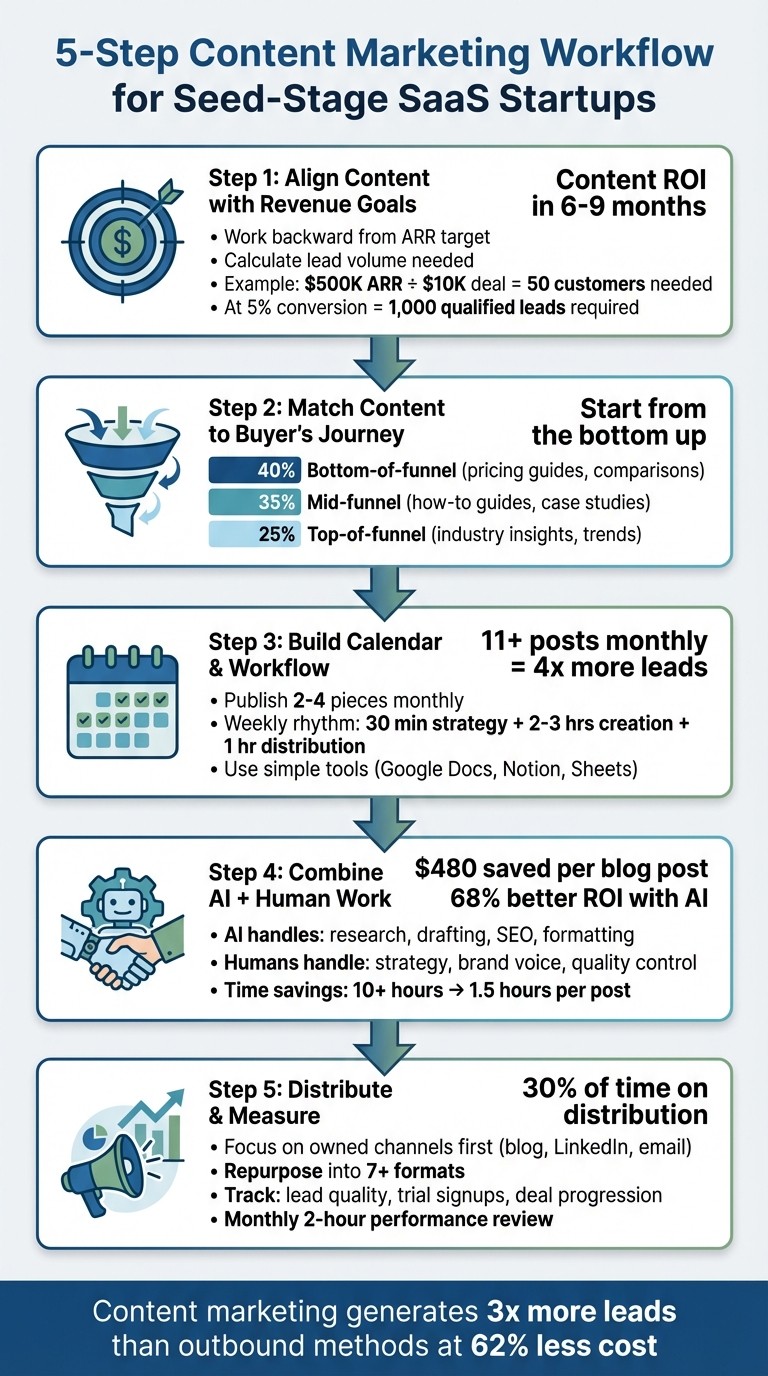
5-Step Content Marketing Workflow for Seed-Stage SaaS Startups
If I Started SaaS in 2026, Here’s My B2B Content Strategy for $1M ARR
Align Content with Revenue Goals
Content marketing for seed-stage SaaS startups isn't about publishing for the sake of it. Every piece of content must tie directly to revenue. With limited resources, creating content that doesn't contribute to growth is simply a waste of time and effort.
Start by working backward from your revenue goals. Take your Annual Recurring Revenue (ARR) target, divide it by your average deal size to figure out how many customers you need, and then calculate the lead volume required based on your conversion rates [3]. For instance, if your goal is $500,000 in ARR and your average deal size is $10,000, you’ll need 50 customers. With a 5% lead-to-customer conversion rate, you’ll require 1,000 qualified leads. This calculation helps you determine not only how much content is necessary but also the type of content that will drive those conversions.
Calculate Lead Volume from Revenue Targets
Defining your conversion stages is crucial. Clearly outline what constitutes a Marketing Qualified Lead (MQL) versus a Sales Qualified Lead (SQL). This ensures you're focusing on high-intent prospects instead of chasing generic traffic [10]. If you lack internal data, industry benchmarks can guide you. Track your funnel through these four stages: Website Visits → MQL → SQL → Closed-Won [9].
Here’s a simple table to map out conversion rates and the volume needed at each stage:
Metric | Purpose | Typical Rate |
|---|---|---|
Visit to SQL | Top/middle funnel efficiency | 2-5% |
MQL to SQL | Lead quality indicator | 15-25% |
SQL to Won | Bottom funnel conversion | 20-30% |
Source: [9]
Rather than focusing on total traffic, prioritize pipeline value per content cluster [8]. At the seed stage, metrics like cost per content-influenced lead are far more meaningful than vanity stats such as page views. Use tools like hidden fields and UTM parameters to connect your content activity to your CRM. This allows you to track which pieces directly impact your pipeline and ARR [8]. Keep in mind, content marketing often delivers measurable ROI within 6 to 9 months, thanks to its compounding benefits and the long buying cycles typical in SaaS [8].
Set a Consistent Publishing Schedule
Once you’ve calculated your lead volume, establish a schedule that ensures a steady pipeline. Consistency is more important than sheer output at this stage. Publishing 2-4 high-quality pieces per month is achievable for small teams and still builds domain authority over time [3]. While companies posting 11 or more blogs monthly generate 4x more leads than those publishing less frequently [3], this pace isn’t realistic when founders are juggling multiple responsibilities.
A manageable weekly schedule can keep things on track. Dedicate 30 minutes on Monday for strategy, spend 2-3 hours mid-week on content creation and review, and reserve an hour on Friday for distribution [3]. This rhythm ensures progress without consuming all your time. As Zach Chmael, Head of Marketing at Averi, explains:
"The goal isn't to become a full-time content marketer. The goal is to build the minimal infrastructure that produces results while you focus on product and customers." [3]
Match Content to the SaaS Buyer's Journey
SaaS buyers don’t usually make immediate purchasing decisions. Instead, they progress through three distinct stages - awareness, consideration, and decision - each requiring tailored content. In the awareness stage, they’re just beginning to identify a problem. During consideration, they’re exploring potential solutions. By the decision stage, they’re comparing specific products and looking for proof that your tool delivers results. Aligning your content with these stages allows you to answer the right questions at the right time, instead of overwhelming someone with product details before they’ve even defined their problem.
Interestingly, many seed-stage startups focus too heavily on top-of-funnel content, which rarely converts. A more effective approach is to start at the bottom of the funnel and work upward. Allocate 40% of your content to bottom-of-funnel topics like pricing guides and product comparisons, 35% to mid-funnel content such as how-to guides and case studies, and just 25% to top-of-funnel content like industry insights and trends [3]. This method prioritizes capturing demand from buyers actively searching for solutions before investing in generating new demand.
"Most startups invert this pyramid, writing top-of-funnel thought leadership. Start from the bottom. Capture existing demand before creating it." - Zach Chmael, Head of Marketing, Averi [3]
Choose Content Types for Each Stage
Different stages of the buyer’s journey call for specific content formats:
Awareness: Blog posts, industry reports, podcasts, and thought leadership pieces work best here. These formats educate on broader problems without pushing your product, attracting a wide audience with minimal investment [7]. To maintain this efficiency, teams can use an AI content engine to accelerate production without sacrificing quality.
Consideration: Shift to product workflows, educational guides, and case studies. Buyers in this stage want to see solutions in action, not just hear about them [7].
Decision: Focus on feature breakdowns, templates, tool comparisons, and ROI calculators. These high-intent resources address the specific concerns of buying committees and help shorten sales cycles [7].
Take Webflow as an example. Over two years, they published more than 300 blog posts, blending educational content for awareness with workflows and case studies for consideration and decision stages [4]. This strategy led to an impressive 900% growth in blog traffic. By balancing beginner-friendly guides with advanced tactics, they successfully catered to both new users exploring design tools and experienced designers evaluating platforms.
Create Content for Different Experience Levels
Your audience likely spans a range of experience levels. Some are entirely new to your category and need basic education, while others are seasoned users seeking advanced strategies or implementation details. To address this diversity, your content strategy tools should help you plan resources for both beginners and experienced users.
For beginners, focus on foundational guides written in simple, jargon-free language [5]. For advanced users, develop in-depth analyses, detailed product use cases, and scaling strategies [7]. The secret to striking this balance is to rely on your customers’ actual language. Conduct monthly customer interviews to understand their research process, the terms they search for, and the questions they ask before making a purchase [5]. Additionally, review sales conversations to uncover recurring topics or challenges. If your sales team frequently explains the same issue, it’s a clear signal to create content that addresses it.
Build a Content Calendar and Workflow
Once your content aligns with the buyer's journey, the next step is to establish a structured workflow. Without a clear calendar, content tends to appear sporadically, failing to meet audience expectations. The solution isn't working longer hours - it's about shifting from random tasks to a well-oiled content machine that consistently delivers.
The aim is to move beyond scattered "content activities" to a streamlined system. As Zach Chmael, Head of Marketing at Averi, puts it:
"The real bottleneck isn't talent. It's systems. A content engine approach lets seed-stage startups publish with the consistency and quality of teams 10x their size" [1].
For startups, publishing 2–4 pieces per month is manageable and effective. Even at this pace, momentum builds, and the results are clear - companies posting 11+ blog entries monthly generate 4x more leads than those publishing fewer than four [3].
Pick Planning Tools
Your content calendar needs a central hub, but it doesn’t have to cost a fortune. Start simple. Tools like Google Docs for writing, Notion or Google Sheets for scheduling, and Google Search Console for keyword tracking provide a solid, free foundation [3]. As your needs grow, consider upgrading to specialized tools: CoSchedule ($19/month) is excellent for managing calendars across blogs, social media, and email, while Loomly ($32/month) excels in social media planning with a strong visual layout [13].
The key is to centralize your planning. By eliminating scattered spreadsheets, you can view all content, campaigns, and social posts in one place [11][13]. Focus on building a reliable system first, then upgrade tools as specific challenges arise. To put costs into perspective, hiring a full-time content manager costs $120,000–$165,000 annually, including overhead [1], while AI-powered content tools range from $45–$500 per month, depending on your needs [2]. Remember, tools enhance a functioning system but can’t fix a broken one.
With planning centralized, it's time to assign responsibilities clearly to ensure smooth execution.
Assign Roles and Set Up Approvals
For solo founders, it's crucial to define roles for writing, editing, and publishing. Modern workflows can also include AI content creation strategies for research, drafting, and SEO, letting you focus on strategy and refining your brand’s voice [12]. Interestingly, 68% of businesses report better content marketing ROI after adopting AI tools [1], but only when humans remain in control of key decisions.
Set up an approval process that avoids bottlenecks. Founders can approve topics, refine AI drafts for tone, and review performance data weekly [2]. Tools like CoSchedule make this easier by integrating approval stages directly into the workflow, ensuring brand consistency before publishing [11][13]. For teams, quarterly strategy reviews can help refine KPIs and adjust content themes based on performance data [14][6].
A one-page brand guide can also be a game-changer. Include your ideal customer profile, positioning, and tone (e.g., formal or casual) [3]. This guide ensures everyone stays on the same page, reducing unnecessary revisions. A standardized content brief template - covering target keywords, search intent, competitive analysis, and tone - saves hours of back-and-forth later [3].
Plan Your Publishing Schedule
Consistency outperforms sheer volume. Websites that publish regularly see 74% more traffic than those with erratic schedules [3]. For example, B2B SaaS companies average 702% ROI from SEO within seven months - but only when content is published systematically [1][3]. A predictable schedule ensures your audience knows when to expect new content.
Adopt a weekly routine: spend 30 minutes on Monday for strategy, 2–3 hours mid-week on content creation, 1 hour Thursday for SEO polishing, and 1 hour Friday for publishing [3]. Include a 2-hour monthly audit to assess performance and close the feedback loop.
Start with Bottom-of-Funnel (BOFU) content like comparison pages and pricing guides. These provide immediate value to buyers ready to make decisions, outperforming top-of-funnel content in driving conversions [3]. Use a prioritization framework that scores topics based on Search Demand (30%), Buyer Intent (40%), and Competition (30%) to focus on high-impact content [3].
Finally, time your content releases strategically. Publish across owned channels - your website, email list, and LinkedIn - for maximum reach [11][12]. Repurpose blog posts into social updates, email sequences, or landing page sections to extend their value without extra effort [11][12]. As Gigi Kurtanidze, Co-Founder and Head of Marketing at AdMagica, explains:
"SaaS users want clarity, not theory. They need to see how a workflow changes, how a problem gets solved, and how fast they can get value" [12].
Your publishing schedule should reflect this mindset by consistently delivering practical, actionable insights your audience can rely on.
Combine AI and Human Work for Content Creation
Once you’ve set up a structured calendar and workflow, the next step is to efficiently blend AI capabilities with human expertise for content creation. Many early-stage startups face a frustrating dilemma: accept inconsistent results or settle for lower-quality content. The real solution lies in striking the right balance - leveraging AI for repetitive, time-consuming tasks while reserving human effort for high-value work like strategic decisions, brand voice, and quality assurance.
The cost savings alone make this approach hard to ignore. On average, AI-assisted content production reduces costs by $480 per blog post compared to traditional methods ($131 versus $611) [2]. Additionally, 68% of businesses report better content marketing ROI after adopting AI tools [1][3]. However, these benefits only emerge when workflows are thoughtfully designed. This approach creates a seamless system where AI drafts and automates, while humans refine and elevate the final product. As Zach Chmael, Head of Marketing at Averi, succinctly puts it:
"AI handles the work that slows you down. Humans add the judgment that makes it work" [3].
Use AI for Drafts and Research
AI tools excel at automating research, drafting, and formatting, but they need proper training to align with your business needs. Start by investing 45–60 minutes to build a "Brand Core." This foundational document should include details about your products, positioning, voice guidelines, and target audience profiles [2]. This upfront effort ensures that every draft AI generates reflects your brand identity rather than producing generic content.
Once trained, AI can handle research autonomously, pulling in real-time industry data, compiling statistics, and even providing hyperlinked sources for verification [2]. It also optimizes content for both traditional SEO and Generative Engine Optimization (GEO) by incorporating FAQ sections and clear definitions that make it easier for AI search engines like ChatGPT and Perplexity to reference your content [2]. By automating research and drafting, AI can save 4–6 hours per blog post, with topic research alone dropping from 2–3 hours to being fully automated [2].
Refine Content with Human Review
After AI has created a draft, human review is critical for refining the content to ensure it aligns with your strategy and goals. This phase is where you inject your brand’s unique perspective, verify facts, and confirm that the content meets your standards. Keep this review process focused, limiting it to 20–30 minutes per piece [2]. Use this time to add insights that only your team can provide.
Fact-checking is especially important. AI tools can sometimes present incorrect information or misattribute quotes with a high degree of confidence - a phenomenon known as "hallucinations" [15]. Always verify technical details, statistics, and industry-specific claims. Collaborative editing tools can make this process smoother by allowing you to highlight sections and request rewrites, tone adjustments, or expansions from the AI in real time [3]. This iterative process keeps the workflow efficient without requiring you to start over.
To maintain consistency, rely on your brand guide during the review phase. As Pawel Tatarek, a Freelance B2B SaaS Content Writer, explains:
"AI produces content. Humans produce content that converts" [15].
Automate Technical Tasks
Tasks like SEO optimization, internal linking, and formatting are ideal for automation. AI tools can generate meta titles, meta descriptions, and schema markup for rich snippets with minimal input [2][3]. They can also suggest and automatically insert links to related content on your site, helping to build topical authority over time [2][3].
Formatting automation further streamlines the process, applying heading hierarchies, creating TL;DR summaries, and structuring content for both human readers and AI search engines [2]. This includes crafting concise 40–60 word answer blocks that make your content easier to cite. With these tools, content creation time can drop from over 10 hours to just about 1.5 hours [2], with tasks like SEO optimization and publishing taking only minutes.
To maintain momentum, establish a weekly rhythm: spend 15 minutes reviewing your content queue, 45–60 minutes refining AI drafts, and 15–20 minutes analyzing performance metrics [2]. This system-first approach helps you publish consistently without feeling overwhelmed. In fact, 67% of businesses report improved content quality and SEO performance when they incorporate AI tools into their workflow [2]. By combining AI-driven efficiency with human expertise, you can create a streamlined content system that delivers results.
Distribute Content Across Multiple Channels
Creating excellent content is only half the battle. Without a strong distribution strategy, even the most compelling pieces can go unnoticed.
"Publishing without distribution is like opening a store in a basement. You need a repeatable system to get eyes on every piece." [3]
To make your content work for you, allocate at least 30% of your content-related time to distribution efforts. For early-stage startups, begin by focusing on channels you control before gradually expanding as your resources grow. [3]
Focus on Owned Channels First
Start with a structured, tiered approach to distribution. Begin with Tier 1 channels—platforms you own and can fully control as part of your B2B SaaS marketing strategy. These might include your blog, LinkedIn (both personal and company pages), and email newsletters. For B2B SaaS startups, LinkedIn often delivers the best return on investment. A successful post typically follows a formula: start with a compelling hook, highlight the significance of the topic, share a key insight supported by data, and end with a call-to-action linking to the full piece. [3]
Tier 2 channels involve earned distribution opportunities, such as posting in relevant subreddits, industry-specific Slack groups, Hacker News, or Quora. These are best reserved for your most impactful content. Tier 3 channels, which involve paid promotion like LinkedIn ads or newsletter sponsorships, should be used sparingly and only when your budget permits. A small investment - around $50–$100 - can help extend your reach significantly. [3]
Repurpose Content into Different Formats
Once you’ve established your primary channels, expand your reach by repurposing your content into various formats. A single blog post can be transformed into multiple platform-specific assets, maximizing its impact. For instance, AI tools can help extract key points from your work to create social media snippets, meta descriptions, and email content, ensuring your effort continues to generate value long after publication. [3]
Take Opsly as an example. In September 2025, this SaaS company specializing in remote onboarding released a "5-Step Playbook for Scaling Distributed Teams." They repurposed this single resource into seven LinkedIn posts from their founder, two YouTube explainer videos, and a one-page checklist for sales outreach. The results? Over 1,200 LinkedIn impressions, 150 checklist downloads, and three early design partners. [16]
Partner with Other Companies
Collaborations with other companies can extend your reach far beyond your own networks. Partnering with complementary businesses or industry experts allows you to tap into entirely new audiences. Tactics like guest blogging on established industry sites, co-hosting webinars, or sharing content through a partner’s channels can help you build credibility and expand your visibility. Webinars, in particular, are a powerhouse for B2B lead generation, often accounting for nearly 75% of sales leads. [17]
Direct outreach can also be incredibly effective. For example, in September 2025, Finlytics - a fintech compliance startup - published an 8-page "2024 Guide to First-Time Regulatory Audits." Instead of waiting for downloads, they sent it directly to 40 fintech founders. Within three weeks, six founders requested demos, and two converted into paying customers. By using high-value content as a lead magnet, Finlytics not only shortened their sales cycle but also built valuable industry connections. [16]
Combine these distribution strategies with consistent performance tracking to ensure your efforts lead to measurable growth.
Measure Performance and Improve Over Time
Once your content is out in the world, the next step is tracking its impact carefully. This isn't just about collecting numbers - it’s about uncovering what truly drives revenue and doubling down on those efforts.
Publishing content without measuring its performance is like steering a car with no visibility. For seed-stage SaaS startups, the focus should be on metrics that connect directly to revenue, not vanity indicators. Metrics like social media likes or page views might look good on paper, but they rarely translate to meaningful growth. Instead, prioritize lead quality over quantity by employing lead scoring based on factors like demographic fit, engagement, and conversion potential. With the average MQL-to-SQL conversion rate at just 13% [18], identifying and addressing this bottleneck can make a significant difference.
Track Key Metrics
Your metrics should align with the buyer's journey to provide actionable insights. At the awareness stage, track data such as targeted traffic, content downloads, and social shares. During the consideration phase, focus on email click-through rates, webinar attendance, and how lead scores progress. At the decision stage, key metrics include trial signups, demo requests, and trial-to-paid conversion rates. Don’t stop there - post-purchase metrics like feature adoption, upsell revenue, and churn reduction can reveal the impact of your educational content.
Integrating content performance with CRM data is essential. This connection allows you to trace how specific pieces of content influence deal progression and contribute to assisted conversions. For B2B SaaS, 63% of buyers engage with multiple pieces of content before making a decision [12]. These insights can help you refine your approach and get the most out of your content strategy.
Adjust Based on Data
Set aside two hours each month to review traffic and lead data. This time can help you spot top-performing content that might benefit from updates or expansion [3]. Look for opportunities like content currently ranking at #8 on Google - optimizing it could push it into the top spots [2].
Automated feedback loops can also streamline your adjustments. For example, if a specific topic is consistently driving trials or demos, consider creating more content around that theme. On the flip side, if a particular format underperforms repeatedly, it might be time to retire it and focus on what’s working.
Get AI-Generated Topic Recommendations
To stay ahead, consider using AI tools to automate topic discovery. Platforms like Averi AI can analyze both your performance data and market trends to suggest actionable next steps. Instead of manually sifting through dashboards, you could receive automated alerts - for instance, when a topic starts trending or when a competitor publishes on a related subject. These insights can guide you to create countercontent or refine your strategy. This approach turns analytics into a powerful strategic tool, keeping your content pipeline filled with high-potential ideas based on live market dynamics [2][3].
Conclusion
Creating a content marketing workflow for your seed-stage SaaS startup doesn’t require a big team or hefty budget. The secret lies in starting small and staying consistent. Begin with one or two owned channels, like your blog and email list. Publish one post per week and keep your focus on three key metrics: traffic, lead opt-ins, and trial signups. This steady approach helps you build momentum without straining your team.
A mix of AI and human collaboration ensures this workflow is manageable. AI can handle tasks like research, drafting, SEO optimization, and technical publishing, freeing up your team to focus on strategic decisions, refining your brand voice, and providing the kind of insights only humans can offer.
Tie your content directly to revenue by tracking how it drives demo requests, trial signups, and conversions through CRM integration. Skip vanity metrics like social shares or raw page views. Instead, use your CRM to connect specific pieces of content to deal progression and revenue impact.
Quarterly performance reviews are essential. Use the data to refine your strategy. For example, if a blog post ranks #8 on Google, optimize it to break into the top results [2]. If a particular topic consistently drives trials, double down by creating more content around it. AI tools can help you spot trending topics and competitive gaps, turning your analytics into actionable insights.
The startups that succeed with content marketing treat it as a system, not an afterthought. Build your workflow, document it with checklists and templates, and let the system run while you stay focused on your product and customers. Consistency beats sporadic, high-effort efforts every time. By following these principles, your content marketing system can evolve into a core part of your growth strategy.
FAQs
Which 2–4 topics should we publish first?
For seed-stage SaaS startups, it’s all about laying the groundwork and finding opportunities that bring results quickly. Begin by focusing on developing a content strategy - this means identifying core themes (content pillars) and setting up an editorial calendar to stay organized. Next, streamline your efforts by automating content creation workflows, which helps conserve both time and resources. Don’t overlook the power of AI tools for added efficiency, whether it’s generating ideas or optimizing content. Finally, share case studies that highlight successful content systems; these not only inspire but also provide a clear roadmap for driving early growth.
How do I connect content to ARR in my CRM?
To tie your content efforts to ARR (Annual Recurring Revenue) within your CRM, start by linking your content marketing activities to CRM data. Make sure your CRM tracks essential metrics such as lead sources, engagement levels, and conversion rates. Leverage integrations or set up workflows that allow you to directly attribute revenue to specific content campaigns. This approach not only helps measure ROI but also fine-tunes your strategies and ensures your marketing initiatives align closely with revenue objectives.
What should AI do vs. what should humans do?
AI can take charge of repetitive tasks such as research, drafting, optimization, and publishing, making content production more efficient. Meanwhile, humans should concentrate on strategic planning, exercising creative judgment, and maintaining brand consistency. This division of labor allows AI to handle execution effectively, while humans ensure the content aligns with overarching goals. For startups, this approach provides a way to scale content creation without overwhelming small teams.
Related Blog Posts

Zach Chmael
CMO, Averi
"We built Averi around the exact workflow we've used to scale our web traffic over 6000% in the last 6 months."
Your content should be working harder.
Averi's content engine builds Google entity authority, drives AI citations, and scales your visibility so you can get more customers.