The Best Way for Startups to Create SEO Content Consistently

Averi Academy
Averi Team
8 minutes

In This Article
Five-step system that uses AI plus human review to automate SEO strategy, topic research, drafting, CMS publishing, and performance tracking for startups.
Updated:
Trusted by 1,000+ teams
Startups use Averi to build
content engines that rank.
Creating SEO content at scale is a major challenge for startups. Limited time, high costs, and inconsistent results often leave founders stuck between hiring expensive agencies, managing freelancers, or relying on generic AI tools. Yet, publishing 16+ posts monthly can drive 3.5x more traffic, making content a key growth driver.
Key Takeaways:
Time Crunch: 47% of founders handle marketing themselves, but most spend under an hour daily on it.
Cost Barriers: Agencies charge $5,000–$15,000/month; full-time hires cost $97,500–$111,000/year.
The Solution: AI tools like Averi automate workflows - strategy, topic research, drafting, and publishing by building a strategic content engine - cutting costs by 62% and reducing time spent to 2 hours weekly.
This article outlines AI content creation strategies and a 5-step system to simplify the process, blending AI and human input to produce SEO-ready posts efficiently.
How I Build a Custom AI Blog Writer | Automate SEO Content with Google Sheets
Step 1: Set Up Your Content Strategy
Startups often dedicate weeks to researching keywords, analyzing competitors, and defining audience personas. AI-powered tools now streamline this process, cutting the time down to mere minutes by automating tasks that once required specialized expertise.
1.1: Automate Strategy Setup with Averi
Averi simplifies the process by scanning your website and extracting key details like your business description, product or service offerings, audience signals from existing content, and patterns in your brand voice. In just 10 minutes, it generates a 12-month editorial calendar complete with prioritized topics, refined audience personas, and targeted keyword suggestions [4][5].
Take, for instance, a fintech startup catering to small business owners. They used Averi to analyze their site and design a content plan centered on "cash flow management." Previously, their ad-hoc content strategy brought in around 500 monthly visitors. After implementing Averi’s AI-driven plan, which focused on long-tail keywords like "best cash flow tools for freelancers", they saw their organic traffic grow by 150% within three months [7][8].
Averi also ensures your content aligns with your brand voice by analyzing your site’s language and integrating semantic SEO keywords [4][6]. Spending 10–15 minutes refining the AI's customer profiles can help capture subtle audience nuances [1].
The next step involves identifying untapped opportunities through competitor analysis.
1.2: Find Content Gaps Through Competitor Analysis
Using tools like Ahrefs, Averi scans your top competitors' websites to analyze their best-performing pages. It evaluates keywords, search volume, backlinks, and engagement metrics, pinpointing areas where competitors fall short. This includes identifying underserved long-tail queries with over 1,000 monthly searches and low competition scores (below 30) [4][5][7].
For example, a lean marketing tech startup might notice competitors ranking for "SEO for startups" but neglecting niche topics like "SEO for bootstrapped SaaS." This insight could uncover 20–50 new content ideas grouped into actionable topic clusters [4][6]. Averi prioritizes these opportunities based on search intent, helping you focus on content that drives conversions rather than just boosting traffic. Startups adopting this gap-driven strategy often see their rankings improve 40% faster than those focusing solely on high search volume keywords [4][8].
Step 2: Generate Content Ideas Automatically
With your strategy mapped out, the next hurdle is ensuring a steady stream of relevant and engaging topics. Relying on manual brainstorming can eat up 2–3 hours weekly and often leads to creative slumps when other priorities arise. AI-powered tools tackle this issue head-on, continuously tracking your market and filling a content queue that’s ready for approval - building on the efficient workflow established in Step 1.
2.1: Use AI for Topic Research
Averi simplifies the research process by scanning trends, competitor activity, and high-value keywords that match your audience’s search intent. Instead of spending hours on manual keyword research, Averi identifies long-tail phrases (those with 1,000+ monthly searches) and organizes them into thematic clusters [4][7].
For instance, a project management SaaS startup might see Averi highlight topics like "best project management software for remote teams" after noticing a spike in remote work discussions across Reddit and industry-specific forums [9]. These suggestions are ranked based on factors like search volume, relevance to your target audience, and gaps in competitor content - ensuring each topic offers measurable ROI potential [4][5].
All identified topics are then neatly categorized into a structured content queue for easy review and approval.
2.2: Organize Your Content Queue
Averi takes it a step further by sorting topics according to search intent. Informational queries become how-to guides (e.g., "How to automate content creation workflows"), comparison-based keywords inspire "vs." articles, and broader themes are transformed into listicles [4][5]. This system enables teams to approve 10 or more content ideas in just 15 minutes at the start of the week.
The result is a 30-day content pipeline, prioritized by type and importance. Startups using this approach typically produce 8–12 posts per month - far surpassing the 2–4 posts created through less structured planning [2]. Each approved topic comes with a target keyword, a brief outline, and format suggestions, eliminating decision fatigue and ensuring your content production stays on track without requiring constant manual input.
Step 3: Create SEO-Optimized Content with AI and Human Review
With your content queue filled with approved topics, it’s time to bring those ideas to life. This stage combines AI-driven research and drafting with your team’s input to refine the content’s unique voice. The outcome? AI-optimized content that ranks on Google and are formatted for AI search tools like ChatGPT and Perplexity - all while reducing production time by 60–80% compared to traditional methods [7]. Once the draft is polished, it’s ready to be seamlessly published and integrated into your content library.
3.1: Let AI Handle Research and First Drafts
Averi's AGM-2 model takes on the heavy lifting, creating first drafts that are about 80% complete [4]. The AI efficiently gathers key statistics, organizes content with clear heading structures, and even incorporates meta tags, FAQs, and internal link suggestions.
For instance, when generating an article on "How to automate content workflows", Averi identifies related terms like "content automation tools" and "workflow efficiency", naturally embedding them into subheadings and the main text. It also crafts concise 40–60 word FAQ answers and summaries, cutting down manual optimization time by up to 70%. To meet Google’s E-E-A-T (Experience, Expertise, Authoritativeness, Trustworthiness) standards, the AI proposes external links to credible sources. Tasks that once took 8 hours manually can now be completed in just 2 hours using AI-powered drafting [7].
This combination of automation and personalization builds on the streamlined processes established in earlier steps.
3.2: Refine Content with Your Team
The final 20% of the process is where your team steps in to add the human touch - shaping the content with distinct insights, brand-specific language, and emotional depth. Using Averi's collaborative editing tools, you can tweak sections, adjust tone, or expand ideas without starting from scratch. This hybrid workflow slashes editing time in half while ensuring the content feels authentic and aligned with your brand.
"The draft is a starting point that your team refines with unique perspectives and brand-specific voice." – Zach Chmael, Head of Marketing, Averi
Your team reviews the structure, enhances the tone, and fine-tunes meta tags and link placements. Companies adopting this process often experience 15–20% higher conversion rates because the content connects more effectively with their audience. The collaborative platform also supports real-time comments and change tracking, allowing teams to align on the brand’s voice without the need for extra meetings. Once finalized, the content is published directly to your CMS, eliminating the hassle of manual uploads. Each published piece also enriches your content library, making future AI drafts even sharper and more efficient.
Step 4: Publish and Build Your Content Library
After refining your content with a blend of AI and human input, the next step is to seamlessly publish and organize it.
Once your content is ready, it’s time to make it live. Direct publishing to your CMS eliminates the need for manual copy-pasting, saving valuable time - up to 30–45 minutes per post. With Averi, you can connect your Webflow, Framer, or WordPress site during onboarding, allowing content to go live in just about 2 minutes. This process ensures all formatting, meta descriptions, and internal links are intact, making it a game-changer for lean teams that need to publish consistently without adding extra workload.
4.1: Publish Directly to Your CMS
Averi allows you to publish finalized content directly to your CMS while maintaining its original formatting and internal links. This eliminates technical hurdles, freeing your team to focus on strategy. AI-suggested internal links can be reviewed to ensure alignment with existing pillar pages and topic clusters [1]. Tools like Postpire handle SEO-ready formatting, including metadata, OG tags, schema markup, internal links, and hero images [12]. This means your content is optimized not only for traditional search engines but also for AI-driven tools like ChatGPT and Perplexity as soon as it’s published. By automating the transfer process, your team can dedicate more energy to creating high-quality, strategic content.
4.2: Improve Future Content with Your Library
Every piece of content is archived in a centralized library that enhances future drafts. As this library grows, Averi adapts to your brand’s voice and terminology, requiring less manual fine-tuning over time [1]. This approach transforms your library into a strategic resource, organized by topic clusters and themes rather than a random collection of articles. This structure helps build authority in specific topics over time [5]. Metadata like target keywords, search intent, performance metrics, and linking opportunities are included to enhance usability [4][5]. Additionally, older content gains authority from newer pieces through automated internal linking and shared context. This creates a compounding effect where each new post sharpens and accelerates the development of future content [1]. The automated archiving process also ensures Averi continues to refine its drafts, making each content cycle faster and more effective.
Step 5: Track Performance and Improve Over Time
Publishing content is just the starting point - tracking its performance is where the real work begins. For startups, the focus should shift from vanity metrics to actionable indicators like impressions, clicks, and keyword rankings [1]. With traffic from generative AI platforms to e-commerce sites skyrocketing by 4,700% year-over-year [3], your content needs to excel in both traditional search results and AI-generated answer formats.
5.1: Monitor Key Performance Metrics
Keep an eye on the metrics that matter most: impressions (how often your content shows up in search results), clicks (how many people visit your site), and keyword rankings (where you stand for important terms) [1]. These numbers provide insight into your content's visibility, engagement, and competitiveness.
To streamline the process, set up automated alerts for significant changes, such as a drop of more than three positions in rankings or a traffic decrease of over 20% week-over-week. This approach can cut monitoring time down to just 15–20 minutes a week, compared to spending hours manually digging through dashboards [1][13]. Regularly reviewing these trends helps you determine whether to update, reinforce, or pivot your strategy.
5.2: Get AI-Driven Recommendations
Why spend hours analyzing dashboards when AI can provide actionable insights? For instance, you might receive a notification that a post ranking at #8 could benefit from optimization or an alert about a competitor publishing similar content [1]. Tools like Averi go a step further by continuously monitoring competitor activity, identifying trending topics, and flagging content on the second page of search results that could be improved [1][11].
"The engine doesn't just measure performance - it closes the loop by suggesting what to create next based on what's working." – Zach Chmael, Head of Marketing, Averi [11]
As your content library grows, these tools learn from your successes, offering increasingly tailored recommendations aligned with your brand's strengths [1][11]. Notably, 25.6% of marketers report that AI-generated content outperforms traditional content [14]. These ongoing insights not only improve your current content but also lay the groundwork for comparing Averi's AI content engine against more traditional methods in the next section.
Averi vs. Traditional Content Creation Methods
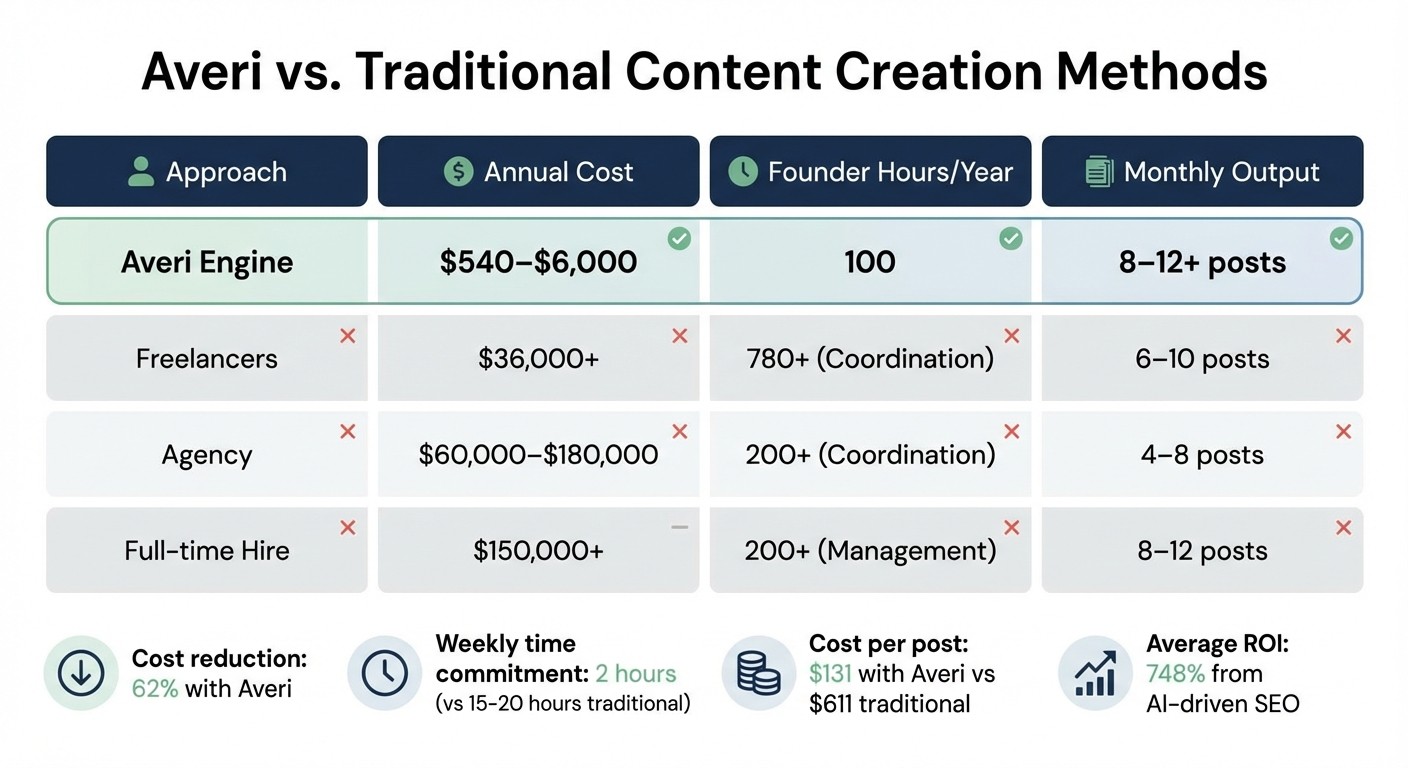
Cost and Time Comparison: Averi vs Traditional Content Creation Methods for Startups
Building on the workflows discussed earlier, let’s dive into how Averi’s AI-driven system stacks up against traditional content creation methods. Startups typically face a choice: hire in-house talent, outsource to agencies or freelancers, or adopt AI tools. Each option comes with its own challenges, especially when considering costs and scalability. Traditional methods often involve hiring additional personnel or managing complex coordination for every new piece of content. Averi, on the other hand, automates much of the process while keeping humans involved for strategic input and fine-tuning, making content creation more efficient and scalable without compromising brand consistency. Let’s break these options down in terms of cost, time, and scalability.
6.1: Compare Costs and Time Investment
The real cost of content creation goes beyond just monetary expenses - it also includes the time spent managing the process. For example, a full-time content marketing manager costs between $78,000 and $115,000 annually in base salary, with total expenses (benefits, tools, and overhead) climbing to $120,000–$165,000 per year [11]. Agencies typically charge $5,000–$15,000 or more per month for 4–8 posts, while freelancers cost $300–$600 per article, requiring over 15 hours per week for coordination and revisions [1]. For founders who can only spare an hour or less per day on marketing, this coordination becomes a major bottleneck [1].
Averi simplifies this process, cutting the cost of each post from $611 to just $131 and slashing the weekly time commitment from 15–20 hours to a manageable 2 hours [1]. This streamlined workflow includes 15 minutes to review the content queue, 45–60 minutes refining drafts, and 15–20 minutes analyzing performance metrics [1]. In contrast, traditional methods demand 10–20 hours per article for tasks like research, drafting, editing, and optimization [1].
Approach | Annual Cost | Founder Hours/Year | Monthly Output |
|---|---|---|---|
Averi Engine | $540–$6,000 | 100 | 8–12+ posts |
Freelancers | $36,000+ | 780+ (Coordination) | 6–10 posts |
Agency | $60,000–$180,000 | 200+ (Coordination) | 4–8 posts |
Full-time Hire | $150,000+ | 200+ (Management) | 8–12 posts |
Averi’s Brand Core feature further reduces overhead by retaining your brand’s context permanently, eliminating the need for repetitive briefings [3].
"You don't need more time for content. You need a system that creates content without requiring your time." – Zach Chmael, Head of Marketing, Averi [1]
While cost and time efficiency are key, Averi’s ability to scale content production sets it apart.
6.2: Scale Content Without Adding Overhead
Traditional content creation methods quickly hit scalability limits. Agencies can only handle so much output based on their team size, freelancers require more coordination as demand grows, and hiring new employees adds recruitment, onboarding, and management expenses. These factors not only increase costs but also drain resources, limiting how much content startups can produce. Averi sidesteps these issues by automating the entire workflow - from competitor analysis to publishing - allowing lean teams to scale without increasing overhead.
The system continuously tracks industry trends, identifies gaps in competitor content, and generates SEO-optimized and GEO-targeted topics, eliminating the need for manual keyword research [1]. As your content library expands, Averi’s AI adapts to your brand’s style and tone, producing increasingly refined drafts that require minimal human editing [1][3].
For instance, in August 2025, a direct-to-consumer skincare brand using similar AI workflows scaled its output from 4 to 40 articles per month. This resulted in a 284% boost in email click-through rates and enabled campaign launches 89% faster than traditional methods [3]. These results highlight the compounding benefits of AI-driven content systems. Instead of hiring 5–10 additional employees - an expense that could exceed $200,000 in salaries and overhead - startups can maintain small teams while building authority through automated topic clusters and internal linking [9][10].
Averi not only reduces costs by 62% but also generates three times the leads compared to traditional methods. B2B companies leveraging AI-driven systems report an average ROI of 748% from SEO within just nine months [3][11].
Conclusion
Producing consistent, high-quality SEO content no longer requires a large team or hours of manual effort. The five-step framework - establishing a strategy, automating idea generation, creating optimized content with a mix of AI and human input, publishing directly to your CMS, and tracking performance - offers startups a practical way to build organic visibility without overwhelming their resources.
Transitioning from sporadic content creation to a self-sustaining content engine is a game-changer for startups aiming to scale their marketing efforts. AI takes care of research, drafting, and optimization, while humans ensure strategic alignment, maintain the brand voice, and refine the final product. This hybrid approach slashes the weekly time commitment from 15–20 hours to just 2 hours and reduces costs by over 60% compared to traditional methods [1]. It’s a streamlined system that not only saves time but also delivers lasting value.
Each published piece contributes to your content library, enhances your AI's understanding of your brand, and strengthens your authority in the market. Startups using AI-driven SEO strategies report an average ROI of 748% [3][11]. By following this framework, you’re not just creating content - you’re building a self-sustaining ecosystem where every article becomes a strategic asset, compounding its impact over time.
The secret lies in shifting your mindset: content isn’t just a task, it’s a long-term investment. Tools like Averi allow you to automate the entire process - from competitor analysis to publishing - while maintaining the quality and consistency needed for organic growth. Whether you’re a seed-stage founder or leading a lean growth team, the principles remain the same: focus on building systems, not just content.
For startups ready to embrace scalable growth, Averi’s Plus Plan is available for $100/month. Sign up today and gain immediate access to a free, tailored marketing plan designed to jumpstart your journey.
FAQs
How many posts per month should a startup publish to see SEO results?
Startups aiming to see progress with SEO should focus on publishing 4–8 posts per month as a baseline. For those looking to maximize engagement and performance, many experts suggest stepping it up to 3–5 posts per week. The real secret, however, lies in consistency - regular posting helps build momentum and steadily boosts search rankings over time.
What should humans edit vs. what should AI automate in SEO content?
AI can handle time-consuming tasks such as keyword research, drafting, creating content briefs, and even publishing, making processes faster and more cost-effective. However, the human touch remains essential. By editing AI-generated drafts, humans ensure the content aligns with the brand’s voice, maintains the desired tone, and meets strategic objectives. This partnership blends AI’s speed and efficiency with human creativity and oversight, resulting in content that connects meaningfully with the intended audience.
How can I measure SEO success beyond traffic?
SEO performance isn't just about driving traffic; it's about understanding the broader impact on your business. Metrics such as conversion rates, revenue attribution, engagement time, and audience reach offer a clearer view of how your efforts translate into tangible results. These measurements help gauge the true effectiveness of your strategy, ensuring your work aligns with business goals.
Related Blog Posts

Zach Chmael
CMO, Averi
"We built Averi around the exact workflow we've used to scale our web traffic over 6000% in the last 6 months."
Your content should be working harder.
Averi's content engine builds Google entity authority, drives AI citations, and scales your visibility so you can get more customers.