

In This Article
Benchmarks for startup blogs: pageviews, CMGR targets, traffic source mixes, and tactics to scale organic and AI-driven traffic and improve conversions.
Updated:
Trusted by 1,000+ teams
Startups use Averi to build
content engines that rank.
The key to growing blog traffic as a startup is setting realistic goals based on your current stage, focusing on an AI-powered content strategy, and tracking the right metrics. Startups with active blogs generate 67% more leads, and organic search accounts for 44.6% of all B2B revenue. Here's what you need to know:
First-year traffic goals: Aim for 45,000 pageviews (around 3,764 per month) with a 6% compound monthly growth rate (CMGR).
Organic traffic benchmarks: Early blogs get 10.85% of traffic from organic search, while mature blogs see 59.22%.
Publishing frequency matters: Weekly posts drive 320% more conversions than monthly ones.
Content focus: Target low-competition, high-intent keywords and create topic clusters to build authority.
Conversion rates: Bottom-of-funnel content converts at 2–5x higher rates than general posts.
AI-driven traffic:Optimizing for AI search engines like ChatGPT can boost conversions by 4.4x.
How I'm driving traffic to my blog in 2025 (50 000+ page views per month) 👀
What Healthy Blog Traffic Looks Like for Startups
Healthy blog traffic isn’t about hitting arbitrary numbers; it’s about understanding your current stage and building from there. Traffic benchmarks vary significantly depending on a blog’s maturity. For example, smaller blogs (those with fewer than 10,000 monthly pageviews) generally see just 10.85% of their traffic from organic search, relying more heavily on direct traffic (23.42%) and referral sources (15.67%). On the other hand, established blogs average 59.22% organic traffic [5]. This gap highlights an important reality: organic traffic grows over time, but it starts small.
For early-stage startups, the key is to focus on growth speed rather than overall traffic volume. Smaller blogs should aim for a 6% compound monthly growth rate (CMGR) overall and an 8.13% CMGR specifically for organic traffic [5]. Interestingly, smaller blogs often experience the fastest organic growth - 8.13% CMGR - compared to just 1.15% for blogs with 50,000–100,000 monthly pageviews [5]. This underscores that gaining momentum early can be more impactful than starting with a large audience.
Once growth metrics are in place, it’s important to connect organic traffic to revenue.
Organic Traffic Share and Conversion Rates
The true health of blog traffic isn’t just about volume - it’s about how well that traffic converts. Organic search accounts for 44.6% of all B2B revenue [1], making it the top revenue channel for startups. However, not all content performs equally. Bottom-of-funnel (BOFU) content, such as comparison pages (e.g., "Alternative to [Competitor]"), converts at 2–5 times the rate of general educational posts [1]. This focus on high-intent content explains why startups increasingly prioritize BOFU topics over broader, less targeted educational material.
Additionally, traffic from AI-driven search engines like ChatGPT and Perplexity converts at 4.4 times the rate of traditional organic traffic [1]. This shift highlights how users are changing the way they discover and evaluate solutions. Startups that optimize for both Google and AI-powered search engines (a strategy referred to as GEO) are better positioned to capture these high-intent audiences.
While conversion rates are critical, the overall growth trajectory of your blog traffic is what drives sustained success.
How Blog Traffic Grows Over Time
Blog traffic doesn’t grow in a straight line - it follows a compounding curve. Publishing content weekly can result in 320% more conversions compared to publishing monthly [2]. This happens because consistent publishing boosts SEO rankings, expands organic reach, and builds a library of content that continues to attract visitors long after it’s posted. Each new article strengthens your authority on specific topics, making it easier for future content to rank higher and faster.
A systematic approach, such as creating topic clusters, accelerates this process. These clusters typically consist of 3–5 core topics, each supported by 10–15 related subtopics [1]. This strategy builds authority in a structured way, creating a self-reinforcing cycle: more content leads to more keywords, internal links, and opportunities for both Google and AI-driven engines to showcase your work. As a result, traffic doesn’t just grow - it gains momentum over time.
Blog Traffic Benchmarks by Startup Stage
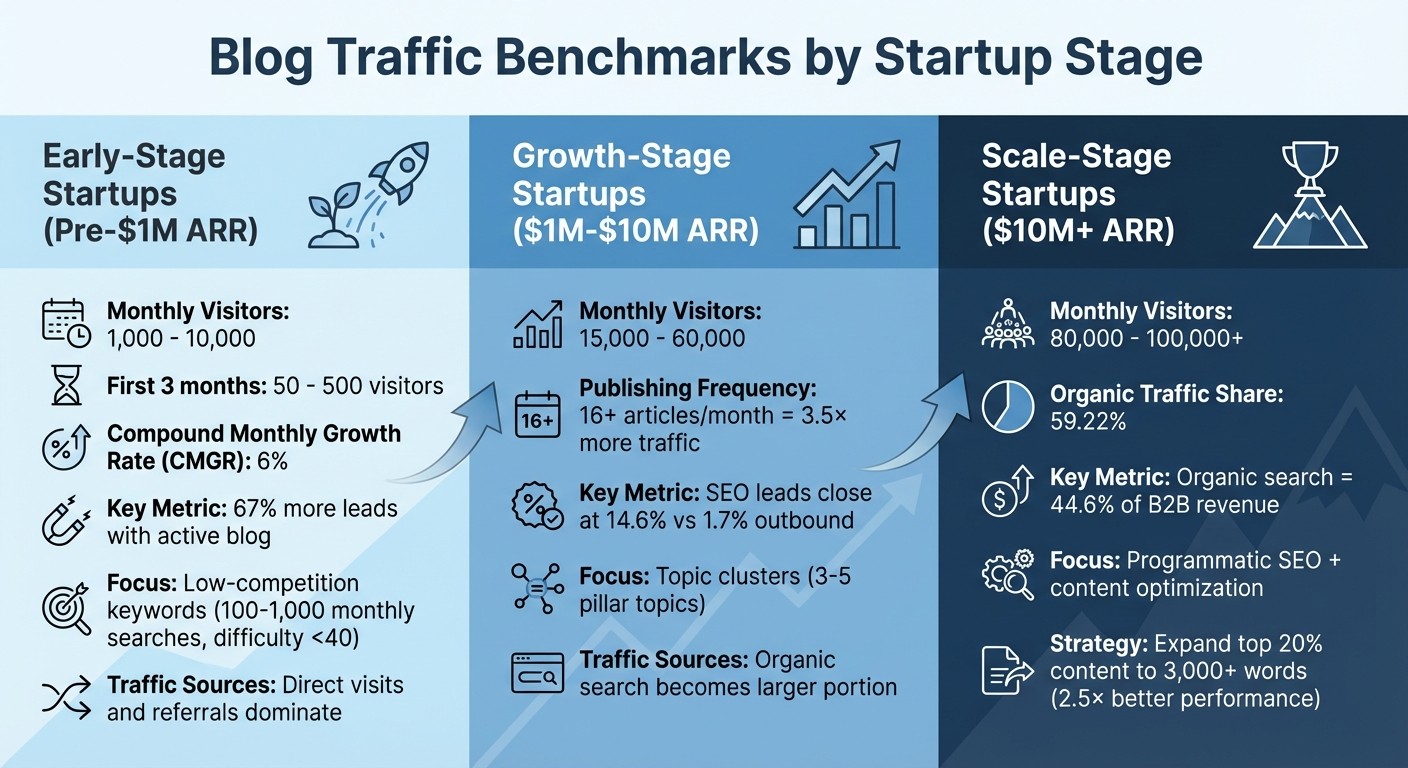
Blog Traffic Benchmarks by Startup Stage: Monthly Visitors and Growth Metrics
These benchmarks offer a clear guide to align your content strategy with your startup's growth phase. Tailor your traffic goals to match your company's current stage of development.
Early-Stage Startups (Pre-$1M ARR)
At this point, your blog is laying the groundwork for future growth. Expect to attract between 1,000 and 10,000 monthly visitors in your first year [1][7]. Early on, it’s common for new blogs to see just 50–500 visitors per month during the first three months [1].
Rather than obsessing over total traffic volume, focus on your compound monthly growth rate (CMGR). For small blogs, the median CMGR is typically around 6% [5]. Active blogs, even at this stage, can generate 67% more leads compared to those without one [1]. To gain traction, target low-competition, long-tail keywords with search volumes of 100–1,000 monthly searches and difficulty scores below 40 [1][8]. Early traffic often comes from direct visits and referrals, as organic search tends to contribute less initially. The priority here is building momentum, not competing with established players right away.
Once you’ve built a solid foundation, you can start shifting your focus toward scaling your reach.
Growth-Stage Startups ($1M–$10M ARR)
With product-market fit established, your content strategy transitions to scaling. At this stage, aim for 15,000–60,000 monthly visitors [1][7]. As your content library matures, organic search will become a larger portion of your traffic mix.
A key tactic here is creating topic clusters - interconnected groups of content centered around 3–5 pillar topics to establish authority with search engines [1]. Publishing frequently makes a significant impact; blogs posting 16+ articles per month can drive 3.5× more traffic than those publishing fewer than four [6]. Focusing on higher-intent topics is also crucial, as SEO-driven leads at this stage close at a rate of 14.6%, compared to just 1.7% for outbound marketing leads [1]. Your blog evolves into a central growth driver.
Scale-Stage Startups ($10M+ ARR)
At this advanced stage, your blog becomes a well-oiled machine for driving revenue. Monthly traffic goals surpass 80,000–100,000 visitors, with organic search dominating your traffic sources [1][7]. Established blogs often see 59.22% of their traffic coming from organic search [5].
Your content library will likely include hundreds of pieces, bolstered by programmatic SEO to target long-tail keyword variations and industry-specific topics [1]. Organic search's influence at this level is undeniable, accounting for 44.6% of all B2B revenue [1].
The focus now shifts to optimization and refreshing existing content. Regular content audits help identify the top-performing 20% of content driving 80% of results. Expanding these high-performing pieces into 3,000+ word guides can maximize their impact [1]. Long-form content like this tends to perform 2.5× better than shorter pieces across most engagement metrics [1].
Key Metrics to Track for Blog Performance
Metrics are the foundation for turning goals into measurable progress. By focusing on the right ones, you can pinpoint areas for growth. Traffic Metrics provide a snapshot of your audience size, Engagement Metrics dive into how readers interact with your content, and SEO & Conversion Metrics connect your blog activity directly to business results.
Traffic Metrics
To understand your blog's reach, track monthly unique visitors, sessions, and pageviews. For reference, the industry median is 3,930 sessions and 3,020 users monthly, while SaaS startups average 3,160 sessions and 2,740 users [10].
Pay attention to your new-to-return visitor ratio. A balance here shows you're both attracting fresh readers and retaining loyal ones. Another key metric is your traffic source distribution. Successful startup blogs often see 17% from organic search, 22% direct, 16% social media, and 14% email [6]. Over time, organic search should become your dominant source, climbing to 58% or more as your content matures [12].
With 76% of blog visits now coming from mobile devices [12], optimizing for mobile is non-negotiable. A slow or poorly designed mobile experience could drive away most of your audience before they even engage with your content.
Engagement Metrics
Raw traffic numbers are important, but how readers engage with your content tells a deeper story.
Average time on page reflects content quality. The 2026 benchmark is 3 minutes and 47 seconds[12], with interactive content often pushing this past 5 minutes[12].
Bounce rate measures visitors who leave without interacting further. The median is 60.78%, while SaaS companies average 64.46%[10]. A bounce rate above 70% could indicate a disconnect between search intent and your content [10][12]. However, in Google Analytics 4, engagement rate - sessions lasting 10+ seconds, with 2+ pageviews or a conversion event - provides a more reliable measure [13][14].
Scroll depth and pages per session reveal how deeply readers explore your content. Aim for an average of 2.2 pages per session[13], and use internal links strategically to encourage further exploration.
SEO and Conversion Metrics
Keyword rankings are a clear indicator of traffic potential. Focus on "striking distance" keywords - those ranking between positions 10 and 30 - that can be optimized to reach the first page [1]. Improving a keyword from position 15 to position 5 can lead to noticeable traffic boosts [1].
Monitor Google Search Console impressions to track how often your content appears in search results, even if users don't click. For example, Averi's AI-powered workflow significantly increased organic search impressions, showing the value of a well-optimized strategy [2].
Your blog-to-lead conversion rate matters more than raw traffic. A healthy rate is 2%–5%, with 2.4% being a solid benchmark [13][14][17]. SEO-driven leads are especially effective, closing at 14.6%, compared to just 1.7% for outbound leads [15][16].
As AI search engines like ChatGPT and Perplexity grow in influence, tracking citations in AI search results is becoming essential. AI-referred traffic converts at 4.4 times the rate of traditional organic search [1], making these citations a valuable asset for startups seeking visibility.
How to Drive Consistent Blog Traffic Growth
Generating steady blog traffic isn't just about publishing content; it’s about treating it as a long-term investment. The most successful startups approach content like infrastructure, ensuring each piece contributes to measurable growth. This involves focusing on three key areas: targeted keyword research, consistent publishing, and leveraging tools to streamline the process.
Keyword Research and SEO Optimization
Start by targeting high-intent, low-competition keywords - those with difficulty scores under 40 and monthly search volumes between 100 and 1,000 [1]. These "striking distance" keywords give you a better chance to rank quickly without competing against established players. Build topic clusters by choosing 3–5 pillar topics (2,500–4,000 words each) and supporting them with 6–12 subtopics (1,500–2,500 words each) [1]. This structure not only helps with search engine rankings but also creates natural internal linking opportunities.
To maximize visibility, aim for dual discovery - optimizing content for both traditional Google search and AI-driven platforms like ChatGPT and Perplexity [1]. Include concise, 40–60 word summaries at the start of major sections, use question-based subheaders, and add a detailed FAQ to every post. AI-driven traffic, which converts at 4.4 times the rate of traditional search traffic, can significantly boost your growth metrics [1].
Instead of chasing high search volumes, align keywords with your Ideal Customer Profiles (ICPs) and address their pain points at different awareness stages [1]. This ensures your content resonates with actual buyer needs, improving both rankings and conversions. Don’t overlook technical SEO - keep mobile load times under 3 seconds, aim for a Largest Contentful Paint (LCP) under 2.5 seconds, and strive for click-through rates above 2% [1]. Hosting your blog on a subfolder (e.g., /blog) rather than a subdomain can also help pass domain authority more effectively [1].
Content Planning and Publishing Frequency
A consistent publishing schedule is critical for sustained growth. Publishing weekly can lead to 320% to 350% more conversions compared to monthly schedules. Websites with blogs also enjoy 434% more indexed pages and 97% more inbound links [2][4]. While balancing content creation with other priorities, maintaining a steady rhythm is essential.
Interestingly, average blog post lengths have shortened over time, dropping to 1,333 words by 2025 compared to 1,427 in 2023 [3]. Instead of aiming for arbitrary word counts, focus on answering specific questions and diversifying formats. How-to guides, comparisons, case studies, and editorials can cater to different stages of the buyer journey.
Publishing original research is another powerful way to attract backlinks. Proprietary data or industry surveys can increase backlink growth by 42.2% [1]. Even simple internal performance metrics or surveys can set your content apart and naturally attract links. Organic search remains a major driver, accounting for 44.6% of B2B revenue [1].
Tools and Platforms for Blog Traffic Optimization
Executing these strategies effectively requires the right tools. Platforms like Averi can simplify the process by researching your market, generating AI-powered drafts aligned with your ICPs, and optimizing content for both SEO and GEO [1][2]. Content integrates directly with platforms like Webflow, Framer, or WordPress, and performance data is fed back into future recommendations.
"We built Averi around the exact workflow we've used to scale our web traffic over 6000% in the last 6 months." - Zach Chmael, CMO, Averi [1]
For SEO insights, tools like Ahrefs, Semrush, and Mangools provide keyword research, rank tracking, and competitor analysis [1]. Google Search Console and GA4 offer raw search data and user engagement metrics, while tools like NeuronWriter and Screaming Frog handle on-page SEO and technical site health [1].
Content marketing continues to outperform traditional advertising, generating three times more leads while costing 62% less. B2B companies report an average ROI of 717% to 748% from SEO-driven strategies [2][4]. With 95% of bloggers now using AI tools as of 2025 [3], the real edge lies in blending AI’s efficiency with human oversight - ensuring strategic alignment, refining the brand voice, and maintaining quality where it counts.
Common Mistakes in Blog Traffic Management
Even with a solid content strategy, startups can stumble when managing blog traffic, often because they treat their blog as an afterthought rather than a key driver of growth. Steering clear of these common errors is crucial to achieve the growth and conversion goals discussed earlier.
Inconsistent Publishing Schedules
Publishing sporadically sends a clear signal to search engines: your site isn’t regularly updated. This can hurt both your rankings and reader engagement. The numbers tell the story - 57% of bloggers who post daily report "strong results", compared to just 11% of those with irregular schedules [9]. Companies publishing nine or more posts per month see traffic grow by 35.8%, while those posting just one to four times experience only 16.5% growth [1].
To keep things consistent, use an editorial calendar and prepare posts in advance [9][21]. For example, between July 2025 and January 2026, Averi boosted its organic search impressions from 28,000 to an astounding 1.68 million per month - a 6,000% jump - by consistently publishing 15–20+ posts monthly through an AI-powered content system [1][2].
"Even one steady, weekly post is better than random spurts of activity followed by total silence." - Hiten Shah, CEO of Crazy Egg [9]
Consistency is critical, but it won’t matter if you’re not paying attention to how your content performs.
Ignoring Performance Data
Skipping analytics means flying blind. Without tracking performance, startups risk wasting time on content that doesn’t convert or resonate with their audience [19][20]. The real value of a blog lies in its ability to drive signups, downloads, or sales - not just in racking up pageviews.
Set measurable goals in Google Analytics to focus on high-value traffic. Identify which topics deliver results and flag underperforming ones [20]. In 2025, HubSpot’s blog team took a bold step by auditing their content, deleting 3,000 outdated posts, and later removing another 2,888 URLs. This pruning effort eliminated low-quality pages that were dragging down their search authority, leading to a significant boost in organic traffic [18].
"Your blog is a honeypot, not a megaphone. Make it a point to position your content around what your audience wants to discover, not what you want to tell them." - Amanda Sellers, Blog Growth Manager at HubSpot [18]
Analyzing performance data is essential, but so is ensuring the content itself reflects human expertise.
Using Generic AI Content Without Editing
Relying on unedited AI-generated content can damage your brand. These drafts often focus on high-volume, low-relevance keywords, which Google’s algorithms increasingly penalize [22]. HubSpot learned this lesson the hard way. Between March and December 2024, their blog’s organic search traffic plummeted by 70%–80%, dropping from 13.5 million to just 2–6 million monthly visits. The culprit? Over-reliance on generic, keyword-stuffed AI content that wasn’t aligned with their core CRM business [22].
The fix is simple: adopt a human-in-the-loop process. Use AI for research and initial drafts, but spend 30–60 minutes refining each post to align with your brand’s voice and values.
"Dedicate 2 hours to review rather than 20 hours to generate." - Zach Chmael, CMO of Averi [2]
Additionally, regularly audit and remove low-quality AI-generated posts to ensure they don’t dilute your site’s overall authority [11].
"If you have 10 hours, spend them writing one really good blog instead of two shorter, less in-depth pieces." - Bjork Ostrom, co-founder of Pinch of Yum [9]
Conclusion
Driving consistent blog traffic is about prioritizing steady, meaningful growth over chasing superficial metrics. The benchmarks shared in this guide highlight the importance of setting realistic goals and focusing on gradual, incremental progress while maintaining high-quality, relevant content throughout the journey.
Publishing weekly delivers 320% more conversions compared to monthly publishing [2], and organic search accounts for 44.6% of all B2B revenue [1]. Achieving such results requires a repeatable system that combines strategic planning, consistent execution, and ongoing performance tracking. The key lies in creating a content engine that fuels growth over time.
Platforms like Averi make this process manageable, even for founders who can’t dedicate their full attention to content marketing. Averi’s AI-powered workflow has proven its potential, driving a staggering 6,000% increase in organic search impressions [2]. This system streamlines everything from research and drafting to optimization and publishing, all while staying true to the brand’s voice and strategic goals.
"We built Averi around the exact workflow we've used to scale our web traffic over 6000% in the last 6 months. It's intuitive, efficient, and highly customizable." - Zach Chmael, CMO, Averi [2]
This example underscores how a well-designed content system can deliver real, measurable results. By revisiting the benchmarks outlined earlier, the path forward becomes clear: set benchmarks that align with your growth stage, publish consistently, analyze what works, and optimize for both traditional SEO and emerging AI-driven search tools. With the right strategy and tools in place, building predictable blog traffic becomes an achievable goal.
Related Blog Posts

Zach Chmael
CMO, Averi
"We built Averi around the exact workflow we've used to scale our web traffic over 6000% in the last 6 months."
Your content should be working harder.
Averi's content engine builds Google entity authority, drives AI citations, and scales your visibility so you can get more customers.