How to Use Marketing Analytics for Healthcare & Wellness

Averi Academy
Averi Team
8 minutes

In This Article
Centralize EHR, CRM and ad data, track patient lifetime value with multi-touch attribution, and use HIPAA-compliant tools to prove marketing ROI.
Updated:
Trusted by 1,000+ teams
Startups use Averi to build
content engines that rank.
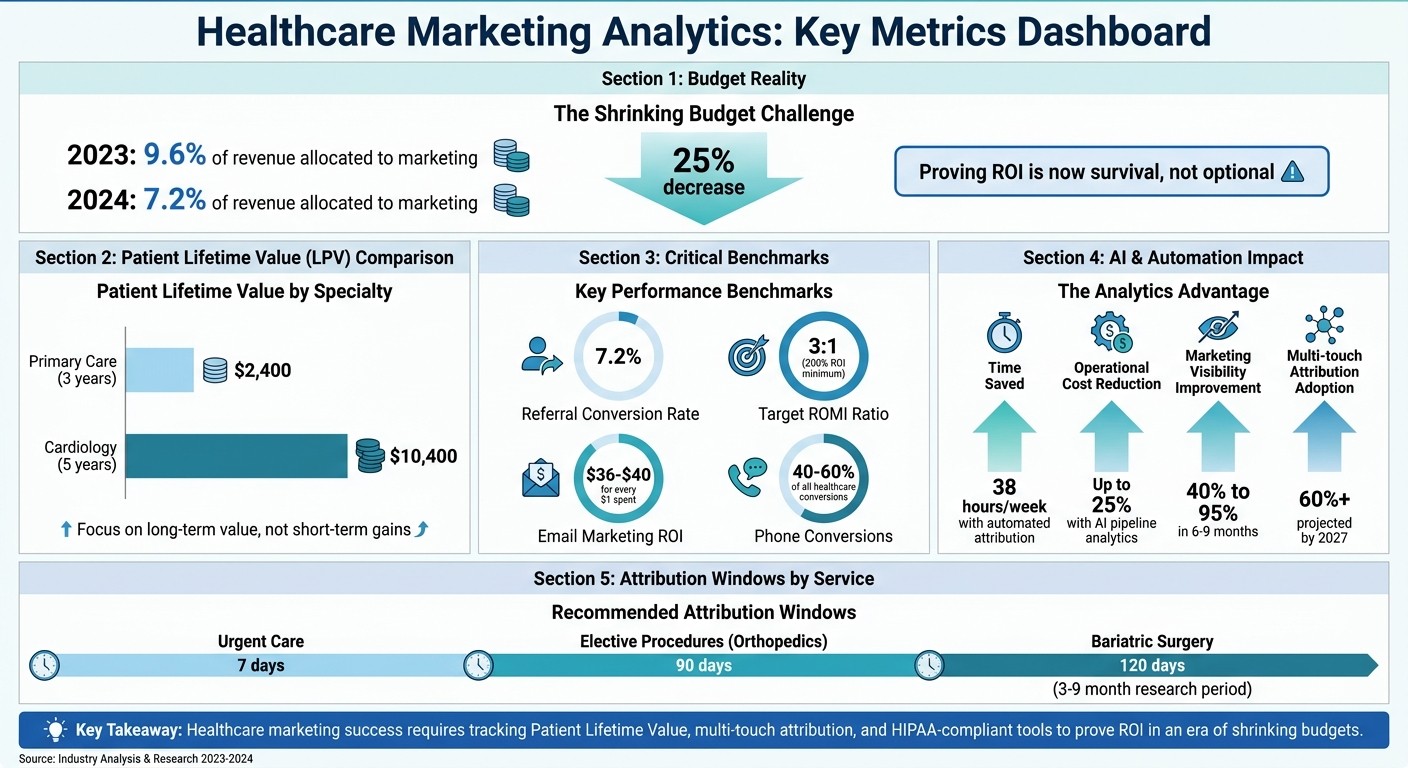
In healthcare marketing, data is your strongest ally. Patients now spend months researching providers and treatments, making it essential to track and analyze every step of their journey. With marketing budgets shrinking - from 9.6% of revenue in 2023 to 7.2% in 2024 - proving ROI is no longer optional; it's survival. Here's how healthcare organizations can use marketing analytics to drive patient acquisition, improve retention, and maximize limited resources:
Focus on Patient Lifetime Value (LPV): Measure the long-term financial impact of each patient instead of short-term gains.
Track Key Metrics: Monitor appointment show-up rates, referral conversions, and marketing-attributed revenue.
Ensure Compliance: Use HIPAA-certified tools and encrypt all patient data to avoid penalties.
Integrate Data Sources: Consolidate fragmented data from EHRs, CRMs, and campaign platforms to gain a unified view of patient behavior.
Segment Audiences: Group patients by demographics, conditions, and behavior to deliver targeted campaigns.
Leverage AI and Attribution Models: Adopt multi-touch attribution to credit all interactions in the patient journey, not just the last click.
Healthcare Marketing Analytics: Key Metrics and Benchmarks for ROI Success
Marketing Analytics in Healthcare: What You Need to Know
What Marketing Analytics Means for Healthcare
Marketing analytics in healthcare relies on machine learning and data integration to evaluate and visualize how every marketing interaction influences patient acquisition and revenue [8]. Unlike retail, where decisions are often immediate, healthcare choices can take months. For example, a patient exploring knee replacement surgery might spend weeks or even months researching providers, reading reviews, and consulting with family before scheduling an appointment.
This extended decision-making process makes analytics indispensable. By analyzing digital behaviors - like symptom-related search queries - healthcare organizations can identify high-value patients and engage them at pivotal moments [2]. The aim is to unify fragmented data from campaigns, website traffic, phone inquiries, and appointment bookings into a comprehensive view of what drives patient volume and revenue. This approach shifts marketing from being just an expense to a key growth engine by showing how investments directly support service lines like cardiology or orthopedics [4].
Once patient journeys are mapped out, the focus turns to tracking metrics that reflect long-term value.
Which Metrics to Track
Healthcare metrics differ from those in other industries, with Patient Lifetime Value (LPV) standing out as one of the most important. LPV measures the long-term financial impact of a patient-provider relationship. For instance, a three-year primary care patient might generate around $2,400, while a five-year cardiology patient could contribute as much as $10,400 [4].
In addition to LPV, healthcare teams should monitor appointment show-up rates to assess lead quality, rather than relying solely on bookings [4]. Other critical metrics include patient satisfaction scores, return visit rates, and referral conversion rates, with 7.2% being a key benchmark [4]. For evaluating campaign performance, focus on cost per new patient, marketing-attributed revenue by service line, and return on marketing investment (ROMI). A 3:1 ratio (or 200% ROI) is considered the baseline for success [4].
Compliance and Privacy Requirements
Tracking these metrics comes with strict privacy and compliance challenges. Healthcare marketing analytics operates under rigorous U.S. regulations. In 2024, the Department of Health and Human Services (HHS) expanded the definition of Protected Health Information (PHI) to include combinations of health data with device identifiers like IP addresses, cookies, and tracking pixels - even on unauthenticated webpages [5][6]. This change means that tools like Google Analytics and Meta Pixel cannot be used on pages where PHI might be present unless vendors sign a Business Associate Agreement (BAA), which most major platforms decline to do [5][10].
"All of our trackers, in one day, were rendered inoperable. We moved swiftly in response to what we were seeing in the changing regulatory environment... Without an understanding of how our media campaigns were performing, we were flying blind." – DJ Willard, Senior Director of Strategic Marketing, Priority Health [6]
Non-compliance comes with steep penalties, as recent enforcement actions have shown. To avoid these risks, healthcare organizations must encrypt all marketing emails using TLS, enforce strict access controls to protect patient-level data, and maintain detailed audit logs [2][4]. Additionally, only use analytics platforms that are SOC 2 Type II and HIPAA-certified, with encryption for data both at rest and in transit [4][8]. Written consent is also mandatory before using PHI for marketing purposes, such as featuring patient testimonials or photos on social media [7].
Step 1: Consolidate and Organize Your Data
Locate All Data Sources
The first task is to pinpoint where your data resides. In healthcare, data is typically scattered across various systems, such as clinical platforms (Electronic Health Records and Electronic Medical Records), financial tools (insurance claims and billing systems), marketing software (CRM systems, Google Ads, Meta), digital analytics (website and social media platforms), and patient feedback channels (surveys, call center logs, and review sites). Additionally, external sources like wearable devices and Health Information Exchanges are becoming increasingly relevant.
A staggering 80% of medical data remains unstructured after it’s created, and nearly half - 47% - of healthcare data is not used effectively in decision-making [12]. Begin by mapping every point of patient interaction, from their initial online search to the final appointment. This process helps identify where your data is stored and highlights any gaps in the patient journey.
Bridge the Gaps Between Disconnected Data
After identifying your data sources, the next challenge is integrating them. MultiCare Health System provides a great example: by consolidating its data with Health Catalyst, it reduced its tools by 71% and saved over $1 million [13].
Use APIs and standardized UTM parameters to connect and track data from all sources [4]. Automated attribution tools can save marketing teams up to 38 hours a week on reporting. Consistent use of UTM parameters - such as source, medium, campaign name, content, and term - combined with Dynamic Number Insertion also allows offline phone inquiries to be tied back to specific campaigns [4].
Once your data is integrated, it’s essential to ensure it remains consistent and compliant with regulations.
Ensure Data Accuracy and Compliance
Integrated data is only useful if it’s both accurate and compliant. Establish structured naming conventions for campaigns and ad sets to ensure data flows seamlessly from ad platforms to EMR systems [4]. This consistency minimizes manual clean-up and enables smooth data connections across systems.
To remain compliant, ensure your data repository adheres to HIPAA and SOC 2 Type II standards. This includes implementing role-based access controls, conducting annual risk assessments, and performing quarterly access reviews. Any third-party vendor handling Protected Health Information (PHI) must sign a Business Associate Agreement (BAA); without this, using their services is considered non-compliant [14][15]. Moreover, enforce least-privilege access policies so employees can only view the data necessary for their specific roles [15].
Step 2: Segment Your Audience and Set Campaign Goals
How to Segment Patients
Breaking your patient population into meaningful segments is a critical step. Start by focusing on clinical and health status - categorize patients based on chronic conditions, risk levels (high, low, or rising), and comorbidities [20]. A great example of this approach comes from Loma Linda University Health, which used GIS software to analyze 10,000 data points from patients admitted for 72-hour psychological holds. This analysis revealed specific communities where law enforcement needed better training to distinguish between patients requiring hospitalization and those who didn’t [19].
Demographics are another key factor. Consider age, gender, socioeconomic status, and geographic location [18][20]. In 2023, SCAN Health Plan collaborated with Included Health to launch "Affirm", a healthcare product tailored to the LGBTQ+ population, addressing previously unmet needs [21]. Similarly, Clever Care, a Medicare Advantage startup in Southern California, achieved growth within the Asian community by leveraging a grassroots approach and building a network of providers that aligned with the community’s preferences [21].
Behavioral patterns also offer valuable insights. Track how patients interact with your organization - appointment frequency, treatment adherence, and digital engagement, such as email open rates and website visits [17][20]. Tools like Google Search Console and GA4 can help you monitor branded versus non-branded search traffic. Branded searches, which involve users specifically looking for your providers or clinic names, indicate higher trust and conversion potential [3]. In fact, branded search visibility has become a strong signal for awareness, trust, and marketing performance [3].
Lastly, don’t overlook social determinants of health (SDoH) like food insecurity, housing stability, and transportation access [19][20]. High-need adults with three or more chronic diseases spend an average of $21,000 annually - nearly three times the cost for adults with multiple chronic conditions alone [19].
"We want to understand what are the issues they face, what are the barriers that they face, who are they, where are they going, what's happening to them. And we can use that information to drive strategy." – Pete Knox, Executive Vice President at Bellin Health [19]
These segmentation strategies provide the foundation for targeted analytics, driving both patient acquisition and retention. Once your segments are clearly defined, the next step is to establish specific campaign goals.
Set SMART Campaign Goals
To effectively engage each patient segment, set SMART (Specific, Measurable, Achievable, Relevant, Time-bound) goals for your campaigns. Healthcare marketing often revolves around two primary objectives: acquiring new patients and maintaining loyalty [17]. For example, rather than a vague goal like "increase awareness", aim for something precise, such as "boost appointment bookings from diabetic patients aged 55-70 by 15% within Q2 2026."
Shift your approach from frequency (how often you reach patients) to relevance (how meaningful and timely the interaction is) [11]. Track conversion metrics like completed appointment forms and call tracking, and identify where prospects drop off to refine your strategy [17].
"We help our healthcare clients grow their practices by referring to what we call the five factors of digital marketing success: high-converting websites, SEO and paid ad traffic, email marketing, reviews, and social media." – Stena Lambert, Director of Vortala Service [17]
Campaign Examples
Preventive care campaigns: These focus on low-risk or rising-risk patients by sending timely reminders for screenings and wellness visits. For instance, you might aim to increase mammogram appointments among women aged 40-50 by 20% over six months. Metrics like branded search volume and email click-through rates can measure engagement [3][17].
Treatment adherence campaigns: Target patients with chronic conditions who have irregular appointment patterns. For example, diabetic patients who missed their last two check-ups could receive personalized emails and portal alerts. A SMART goal here might be to "reduce missed appointments by 25% within 90 days", with success measured through CRM data tracking completed versus abandoned appointments [17][20].
Patient retention campaigns: These aim to keep regular patients engaged while reactivating those who’ve lapsed. Use AI-powered multi-touch attribution to identify which interactions - such as attending a webinar followed by a sales call - lead to conversions [8]. Organizations using AI for pipeline analytics have reported up to a 25% reduction in operational costs and a 20-30% improvement in marketing pipeline influence [8].
Step 3: Choose and Set Up Analytics Tools
Types of Tools You'll Need
Selecting the right tools is essential for leveraging data to improve patient acquisition and maximize campaign performance. To build an effective analytics stack, focus on four HIPAA-compliant tools: a CRM (like Salesforce Health Cloud or HubSpot with a BAA), a marketing automation platform, predictive analytics software, and advanced attribution tools.
Marketing Automation: These platforms handle email workflows, appointment reminders, and multi-channel campaigns. In healthcare, email marketing delivers impressive returns - generating $36–$40 for every $1 spent [4].
Predictive Analytics Software: These tools help identify high-value patients early, an increasingly important capability as AI adoption reaches 85% [11].
Attribution Tools: Healthcare journeys can be complex, so choose platforms that support multi-touch, time-decay, and position-based attribution models. For instance, bariatric surgery patients often research for 3–9 months before booking, requiring a longer attribution window (e.g., 120 days) to track key touchpoints accurately [4][8].
All tools must meet strict compliance standards, including HIPAA regulations, signed BAAs, SOC 2 Type II certification, and full data encryption with audit trails [11][4]. Consider platforms like Freshpaint, which filters out PHI before data reaches non-compliant third-party destinations, such as Meta Ads [16].
How to Integrate Your Tools
Integration is key to ensuring your tools work together smoothly. Options include direct API integration (using FHIR/HL7 for real-time data), batch CSV exports, or middleware solutions like Improvado or Redox for automated data transformation [22][23]. With over 90% of U.S. hospitals adopting FHIR-enabled systems, API integration is often the preferred choice for teams with technical resources [22].
To achieve closed-loop attribution, link campaign metadata to patient records in your EHR. Clinical outcomes, such as completed appointments or procedures, should then flow back into your marketing tools to refine ad targeting and spending [22][24]. This process requires mapping clinical data fields (e.g., ICD-10 codes, Medical Record Numbers) to marketing attributes (like campaign segments or hashed identifiers) [22]. Tokenization can further protect patient data by hashing identifiers before they leave your EHR environment, enabling compliant audience targeting on platforms without BAAs [22].
Automating consent management is another critical step. Use your EHR as the central source for patient preferences. For example, if a patient opts out via a marketing email, this preference should automatically sync with the EHR to prevent non-compliant retargeting [22][23]. Automated attribution systems can save marketing teams up to 38 hours per week by eliminating the need for manual data exports [4].
When properly integrated, these tools provide actionable insights without unnecessary complexity.
Plan for Growth and Team Adoption
Once your tools are integrated, ensure they can scale to meet your organization's future needs. For smaller clinics running occasional campaigns, batch exports might be enough. However, high-volume campaigns across multiple service lines may require middleware for real-time data syncing, even without a dedicated engineering team [22]. Middleware costs typically range from $1,000 to $15,000 per month, depending on data volume and the number of connectors [22][24].
To encourage stakeholder buy-in, provide live dashboards for transparency. As David Metcalf, Director at Distl, notes:
"If a client needs something urgently, we give them access to their AgencyAnalytics dashboard. And that 24/7 access has been a fundamental way for our team to save time" [17].
Protect patient confidentiality while enabling collaboration by implementing role-based permissions, ensuring staff only access data relevant to their roles [17][11]. Use Single Sign-On (SSO) to connect your CRM and EHR to a unified identity provider, simplifying permission management and maintaining audit trails [23].
Architecture | Latency | Engineering Effort | HIPAA Compliance | Best For |
|---|---|---|---|---|
Direct API | Minutes | High | Requires custom BAA logic | Large systems with development teams [22] |
Batch Export | Days | Low | Manual risk | Small clinics, one-off tasks [22] |
Middleware | Real-time | Low | Platform-enforced BAA | Marketing teams without engineers [22] |
Step 4: Personalize Content and Messaging
Create Flexible Content Templates
Transform patient data into tailored messages by developing adaptable templates for different patient groups. For instance, an annual wellness reminder template can be adjusted based on factors like age, gender, and previous interactions. If a patient has shown interest in heart health content, their message might emphasize cardiovascular screenings, while another patient could receive information about diabetes prevention.
Predictive segmentation plays a key role here, using data such as search behavior, purchase history, and forum participation to identify at-risk individuals and group them by demographics [2]. Pfizer’s "Get Old" campaign is a great example - it delivered age-specific wellness content, resulting in a 40% rise in engagement among people aged 65 and older [9]. Similarly, AstraZeneca’s "Diabetes Can Break Your Heart" campaign used patient data to craft personalized digital ads, leading to a 25% increase in click-through rates and a 15% rise in overall engagement [9].
Behavioral triggers are another powerful tool. By pinpointing critical moments - like when someone searches for a treatment or visits a medical forum - you can deliver timely and relevant content [2]. Hutchinson Regional Medical Center effectively used this approach in a predictive patient targeting campaign, doubling their initial investment within just three weeks [9].
These targeted and flexible messages set the stage for smooth, multi-channel communication.
Coordinate Across Channels
Once you’ve segmented your audience and created flexible templates, ensure your messaging is consistent across all platforms. Whether it’s email, SMS, patient portals, or social media, each channel offers unique advantages. Social media, for example, works well for visual engagement and community-building, while email excels at detailed follow-ups and education. Patient portals provide secure access to clinical resources [1][25]. To streamline this process, synchronize your CRM, EHR, and CMS systems, enabling patient data and behavioral triggers to flow seamlessly [25][9].
Englewood Health demonstrated the power of this approach with a two-way SMS campaign targeting over 7,000 women overdue for mammograms. The messages included a link for self-scheduling, resulting in approximately 20% of recipients booking appointments. Among those who responded, breast cancer was detected in 0.5% [25].
Channel | Use Case | Best Content Format |
|---|---|---|
Patient Portals | Secure access to records/care plans | FAQs, checklists, post-visit instructions |
Ongoing education and nurturing | Newsletters, onboarding series, wellness tips | |
Social Media | Community building and awareness | Patient stories, clinician spotlights, short videos |
SMS/Texting | Time-sensitive alerts | Reminders, refill alerts, quick CTAs |
Maintain a calm and supportive tone across all platforms to build trust. For example, if a patient receives an email about diabetes management and later sees a related post on your social media, the messaging should feel cohesive and reliable.
Test and Improve Your Campaigns
Continuous testing is key to refining your messages and improving engagement. Multi-touch attribution is replacing older single-touch models. AI-powered tools now map and evaluate every interaction - emails, webinars, ads, and even sales calls - assigning value to each touchpoint [8]. By 2028, this model is expected to dominate marketing strategies, with over 60% adoption projected by 2027 [8].
Testing subject lines and tone can reveal what resonates best with different segments. For example, a data-driven message may appeal to one group, while a more conversational and empathetic tone could work better for another [25]. Behavioral science techniques like digital nudging help identify which channels and messaging styles a patient responds to most effectively, automatically adjusting future reminders for appointments or refills [26]. Invoca reports that its AI platform can boost appointment bookings and leads from paid search by nearly 50% [26].
"The future isn't about who has the most data. It's about who can act on the right data at the right time." – Philip Poulidis, CEO, Odaia [26]
Organizations leveraging AI for pipeline analytics have seen operational costs drop by up to 25% through automation and improved accuracy [8]. Teams adopting advanced attribution tools report marketing visibility increasing from 40% to 95% within six to nine months [8]. This cycle of ongoing refinement ensures maximum efficiency from integrated systems.
How to build an effective health care data analytics program in hospitals
Step 5: Measure Results and Improve Campaigns
Once you've established a strong foundation with data consolidation, segmentation, tool integration, and personalized content, the next step is to evaluate your results and fine-tune your strategies for better outcomes.
Track the Right KPIs
Effective healthcare marketing requires monitoring three key layers of metrics: channel performance (e.g., cost-per-click, engagement rates), conversion metrics (such as form submissions and appointment bookings), and revenue metrics (like return on marketing investment by service line) [4]. Since healthcare often involves extended decision cycles, relying solely on last-click attribution won't cut it. Instead, adopt multi-touch attribution models, such as time-decay or position-based, to fairly credit campaigns that nurture patients over time [4][8].
When calculating ROI, focus on the lifetime patient value (LPV) rather than just the revenue from an initial visit. This approach justifies higher acquisition costs for service lines that yield greater long-term value. Tailor attribution windows to the type of service - 90 days for elective procedures like orthopedics, and 7 days for urgent care - to align with patient decision timelines [4].
Don’t overlook call tracking. With 40–60% of healthcare conversions happening over the phone rather than online, tools like dynamic number insertion can help attribute these interactions accurately [4]. In a time when healthcare marketing budgets are shrinking - from 9.6% of total revenue in 2023 to 7.2% in 2024 - proving ROI is more crucial than ever [4]. Aim for a marketing revenue ratio of 3:1 (200% ROI) as your benchmark [4].
Gather Real-Time Feedback
Real-time insights can significantly improve campaign performance. Sentiment analysis of patient calls and surveys can reveal how well your messaging resonates [4][25]. Feedback from patient advisory boards and frontline staff is invaluable for uncovering questions patients may feel too overwhelmed to ask, enabling you to adjust your content accordingly [25]. Tailor your tone and content density based on the channel - clinical language may work well in patient portals, while a conversational tone often performs better on social media and email [25].
For example, in 2024, Allergy Partners slashed their Cost Per Lead from $300 to $12 by using Freshpaint to feed real-time conversion data into Google Ads [27]. Jonathan Silver, their VP of Marketing, shared:
"Freshpaint helped us go from flying blind to optimizing everything. We finally had the data we needed to prove the value of digital advertising." [27]
This ability to optimize budgets in real time allows marketers to shift spending from underperforming channels to high-performing ones within days, rather than waiting for quarterly reviews [4]. These insights enable swift adjustments to campaigns and budgets.
Refine and Scale What Works
With real-time feedback and LPV-adjusted ROI calculations, you can identify which service lines justify higher acquisition costs and scale successful campaigns accordingly [4]. Automating attribution processes can save time, allowing your team to focus on expanding winning strategies. Set automated alerts for critical metrics, such as cost per patient acquisition, to avoid overspending [4].
AI-driven attribution is on the rise, with adoption expected to surpass 60% by 2027. Multi-touch attribution models are also predicted to replace single-touch approaches as the standard by 2028 [8]. To get a clearer picture of your true acquisition costs, track metrics like "attended appointments" and "no-shows" instead of just clicks or form fills [27].
This ongoing cycle of measurement and adjustment ensures that your marketing efforts become increasingly efficient over time, helping you stay competitive in the ever-evolving healthcare landscape.
Conclusion
Transforming marketing analytics in healthcare starts with small, strategic steps. Begin by centralizing data from a few critical sources - such as your CRM, ad platforms, and patient portal - into one unified dashboard [17]. Before investing in new tools, test and optimize the data you already have [28]. As Wolters Kluwer emphasizes:
"Analytics has a reputation for being too recondite or too expensive, but everyone can utilize the predictive and insightful power of data" [28].
This foundational step creates a solid base for accurate measurement and meaningful improvements.
Once your data is consolidated and baseline metrics are in place, focus on precise measurement. Shift your attention to metrics like Patient Lifetime Value (LPV) instead of short-term revenue from first visits. Employ multi-touch attribution to ensure every interaction in the patient journey receives proper credit [4]. Demonstrating ROI has become a necessity [4].
After establishing reliable metrics, scale what works by reallocating resources from underperforming campaigns to high-performing channels in real time, rather than waiting for quarterly reviews [17]. For example, Texas Children's Hospital reduced labor costs by 67% and cut report-building time by 69% by implementing a centralized data warehouse [29]. Similarly, Hutchinson Regional Medical Center saw a twofold return on investment within three weeks by leveraging predictive patient targeting [9]. These successes highlight the importance of ongoing refinement over guesswork.
The healthcare industry is evolving quickly. Organizations that prioritize data-driven decision-making will adapt more effectively to shifting patient expectations and technological advancements. As Health Catalyst points out:
"Health systems are successfully becoming data-driven when they make decisions from data rather than instinct alone" [29].
To get started, audit your current data flows, identify one high-value patient segment, and automate your reporting processes [8]. This structured approach not only aligns with changing patient needs but also meets the demands of an increasingly regulated environment. Continuously refine and improve your strategy to stay ahead.
FAQs
How can we track ROI without violating HIPAA?
To measure ROI in healthcare marketing while adhering to HIPAA regulations, it's essential to use analytics tools designed with data privacy and security in mind. These tools should be HIPAA-compliant, capable of securely managing Protected Health Information (PHI), and typically include Business Associate Agreements (BAAs) to ensure legal safeguards.
Prioritize gathering first-party data instead of relying on third-party tracking, as this minimizes risks and aligns with compliance requirements. Make sure all collected data is fully auditable to maintain transparency and accountability. Opt for tools that seamlessly integrate with platforms such as CRMs or patient portals, enabling you to evaluate ROI without compromising patient confidentiality.
What’s the fastest way to unify EHR, CRM, and ad data?
The quickest method to bring together EHR, CRM, and advertising data in healthcare marketing is through AI-driven platforms that feature HIPAA-compliant, no-code automation tools. Platforms like Keragon and Altair link EMRs, CRMs, and communication channels, simplifying data integration, automating lead management, and boosting efficiency. With AI, these tools offer a consolidated view of patient and operational data, cutting out the need for manual tasks.
How do we choose an attribution window for each service line?
When selecting an attribution window, it’s important to factor in the usual patient journey and the timeframe for decision-making specific to each service line. For treatments with extended sales cycles or more intricate decision processes, a longer window helps capture all relevant touchpoints. On the other hand, shorter windows are better suited for services requiring quick decisions. Analyze historical data to understand the average time between initial contact and conversion, ensuring the chosen window reflects patient behavior and accurately measures marketing effectiveness.
Related Blog Posts

Zach Chmael
CMO, Averi
"We built Averi around the exact workflow we've used to scale our web traffic over 6000% in the last 6 months."
Your content should be working harder.
Averi's content engine builds Google entity authority, drives AI citations, and scales your visibility so you can get more customers.